The purpose of this blog is the creation of an open, international, independent and free forum, where every UFO-researcher can publish the results of his/her research. The languagues, used for this blog, are Dutch, English and French.You can find the articles of a collegue by selecting his category. Each author stays resposable for the continue of his articles. As blogmaster I have the right to refuse an addition or an article, when it attacks other collegues or UFO-groupes.
Druk op onderstaande knop om te reageren in mijn forum
Zoeken in blog
Deze blog is opgedragen aan mijn overleden echtgenote Lucienne.
In 2012 verloor ze haar moedige strijd tegen kanker!
In 2011 startte ik deze blog, omdat ik niet mocht stoppen met mijn UFO-onderzoek.
BEDANKT!!!
Een interessant adres?
UFO'S of UAP'S, ASTRONOMIE, RUIMTEVAART, ARCHEOLOGIE, OUDHEIDKUNDE, SF-SNUFJES EN ANDERE ESOTERISCHE WETENSCHAPPEN - DE ALLERLAATSTE NIEUWTJES
UFO's of UAP'S in België en de rest van de wereld Ontdek de Fascinerende Wereld van UFO's en UAP's: Jouw Bron voor Onthullende Informatie!
Ben jij ook gefascineerd door het onbekende? Wil je meer weten over UFO's en UAP's, niet alleen in België, maar over de hele wereld? Dan ben je op de juiste plek!
België: Het Kloppend Hart van UFO-onderzoek
In België is BUFON (Belgisch UFO-Netwerk) dé autoriteit op het gebied van UFO-onderzoek. Voor betrouwbare en objectieve informatie over deze intrigerende fenomenen, bezoek je zeker onze Facebook-pagina en deze blog. Maar dat is nog niet alles! Ontdek ook het Belgisch UFO-meldpunt en Caelestia, twee organisaties die diepgaand onderzoek verrichten, al zijn ze soms kritisch of sceptisch.
Nederland: Een Schat aan Informatie
Voor onze Nederlandse buren is er de schitterende website www.ufowijzer.nl, beheerd door Paul Harmans. Deze site biedt een schat aan informatie en artikelen die je niet wilt missen!
Internationaal: MUFON - De Wereldwijde Autoriteit
Neem ook een kijkje bij MUFON (Mutual UFO Network Inc.), een gerenommeerde Amerikaanse UFO-vereniging met afdelingen in de VS en wereldwijd. MUFON is toegewijd aan de wetenschappelijke en analytische studie van het UFO-fenomeen, en hun maandelijkse tijdschrift, The MUFON UFO-Journal, is een must-read voor elke UFO-enthousiasteling. Bezoek hun website op www.mufon.com voor meer informatie.
Samenwerking en Toekomstvisie
Sinds 1 februari 2020 is Pieter niet alleen ex-president van BUFON, maar ook de voormalige nationale directeur van MUFON in Vlaanderen en Nederland. Dit creëert een sterke samenwerking met de Franse MUFON Reseau MUFON/EUROP, wat ons in staat stelt om nog meer waardevolle inzichten te delen.
Let op: Nepprofielen en Nieuwe Groeperingen
Pas op voor een nieuwe groepering die zich ook BUFON noemt, maar geen enkele connectie heeft met onze gevestigde organisatie. Hoewel zij de naam geregistreerd hebben, kunnen ze het rijke verleden en de expertise van onze groep niet evenaren. We wensen hen veel succes, maar we blijven de autoriteit in UFO-onderzoek!
Blijf Op De Hoogte!
Wil jij de laatste nieuwtjes over UFO's, ruimtevaart, archeologie, en meer? Volg ons dan en duik samen met ons in de fascinerende wereld van het onbekende! Sluit je aan bij de gemeenschap van nieuwsgierige geesten die net als jij verlangen naar antwoorden en avonturen in de sterren!
Heb je vragen of wil je meer weten? Aarzel dan niet om contact met ons op te nemen! Samen ontrafelen we het mysterie van de lucht en daarbuiten.
20-01-2026
Discovering the Moon: Unveiling Apollo's UFO Mysteries
Discovering the Moon: Unveiling Apollo's UFO Mysteries
Overview
The Apollo program, carried out by NASA between 1961 and 1972, remains a landmark in human spaceflight, delivering the first crewed landings on the Moon and returning over 380 kg of lunar rocks for scientific study. While the missions’ primary legacy is geological—mapping the lunar surface, confirming the presence of water ice in permanently shadowed craters, and refining models of the Moon’s formation— they have also become a focal point for UFO and UAP (unidentified aerial phenomena) speculation. Recent discussions on social media platforms, especially Twitter, have revived the claim that Apollo astronauts may have encountered “extraterrestrial artifacts” while on the Moon, prompting renewed scrutiny of the original mission footage and reports.
Apollo Data and Scientific Findings
The Apollo missions produced a robust data set that continues to underpin contemporary lunar research. Apollo 11’s historic landing in July 1969 yielded the first lunar samples, while Apollo 12’s precision touchdown near Surveyor 3 allowed engineers to retrieve components of an earlier unmanned probe for comparative analysis. Apollo 17, the program’s final crewed flight in December 1972, conducted extensive geological sampling across the Taurus‑Littrow valley, providing the most diverse collection of lunar material to date. These missions confirmed the Moon’s basaltic composition, identified a complex history of volcanic activity, and verified the existence of water ice in permanently shadowed regions, findings that have guided recent commercial and governmental plans for lunar bases. No official NASA documentation records the discovery of any non‑natural structures, anomalous devices, or unexplained aerial phenomena during any of the missions.
Investigating The Truth Behind The 1969 Moon Landing | FULL DOCUMENTARY
Reported UFO Sightings Near the Moon
Throughout the 20th century, reports of unidentified flying objects often coincided with heightened public interest in space exploration. The Moon, as Earth’s nearest celestial neighbor, has been cited in numerous anecdotal accounts of bright lights or moving objects appearing near its limb. A 2025 blog post on Alienated Media compiled several of these claims, noting that “numerous reports claim to have observed unidentified flying objects in the vicinity of the Moon.” However, the post also acknowledges that the majority of such sightings lack corroborating data and are typically based on amateur observations or misinterpretations of astronomical phenomena such as satellites, meteoroids, or atmospheric reflections.
Neil Armstrong's Untold Extraterrestrial Encounter on The Moon
Expert Assessment of the Evidence
Scientists and former NASA officials consistently emphasize the rigorous verification processes applied to Apollo telemetry, photographs, and sample analysis. Dr. Ellen Stofan, former NASA chief scientist, has stated that “the Apollo archives have been examined repeatedly for anomalies, and none have stood up to scientific scrutiny.” Independent researchers who have reviewed the publicly released mission footage report that the visual artifacts often cited as “UFOs” can be explained by camera lens flares, optical reflections, or the motion of the spacecraft’s own equipment. Moreover, the U.S. Department of Defense’s recent UAP task force, while acknowledging unexplained aerial observations in Earth’s atmosphere, has not linked any such phenomena to lunar operations.
Context and Outlook
The persistence of UFO narratives surrounding the Apollo missions reflects a broader cultural fascination with the unknown and a tendency to reinterpret historic events through contemporary lenses. While the allure of “alien artifacts on the Moon” makes compelling headlines, the available evidence remains firmly rooted in conventional scientific interpretation. As NASA prepares for the Artemis program and commercial partners plan sustained lunar presence, the focus is shifting from conjecture to concrete research objectives—such as in‑situ resource utilization and expanded geological surveys. Future missions equipped with higher‑resolution imaging and real‑time data transmission may finally put lingering questions to rest, offering definitive answers about both the Moon’s natural history and the origins of any anomalous sightings.
Christina Gomez-NEW INFORMATION JUST DROPPED ABOUT UFO CRASH!
Christina Gomez-NEW INFORMATION JUST DROPPED ABOUT UFO CRASH!
Overview
A blog post published on Astronutter.com on January 18 2026 claims to reveal “new whistle‑blower‑style information” about an alleged UFO crash. Authored by self‑identified researcher Christina Gómez, the entry—titled “NEW INFORMATION JUST DROPPED ABOUT UFO CRASH!”—has quickly circulated through online UFO forums and social‑media channels, accompanied by hashtags such as #UFOCrash, #Whistleblower, and #UFODisclosure. While the post itself offers only brief statements and no verifiable documentation, its emergence has reignited debate over decades‑long claims of extraterrestrial craft recoveries.
New Claims Presented by Gómez
According to the blog excerpt, Gómez alleges that a previously classified incident involving a downed unidentified aerial phenomenon (UAP) was “recently de‑classified” and that “key witnesses” are now prepared to speak. She references “internal memos” and “photographic evidence” purportedly obtained from a source within a federal agency, but the post does not provide links, file names, or any visual material that can be independently examined. The narrative suggests the crash occurred on U.S. soil, though no specific location, date, or operational details are disclosed. Gómez emphasizes that the information is “whistle‑blower‑like,” implying personal risk for the source, and urges readers to “stay tuned for full documents” in upcoming updates.
Wonderful conversation with Cristina Gomez on the UFO topic, 3I/ATLAS, Transient objects, etc. Cristina Gomez Youtube ...
Community Reaction
Within the UFO‑enthusiast sphere, the post has generated a surge of discussion. Reddit’s r/UFOs and the Facebook group “UFO Disclosure Network” posted threads quoting the blog’s headline and sharing the aforementioned hashtags. Some members have expressed cautious optimism, noting that “every new claim pushes the conversation forward,” while others remain skeptical, pointing out the absence of corroborating evidence and the blog’s history of speculative posts. The rapid spread of the story illustrates how digital platforms amplify unverified claims, a pattern observed in prior incidents such as the 2020 release of the Navy’s “Gimbal” and “GoFast” videos.
Expert and Official Perspective
UFO researchers and government‑affairs analysts caution against drawing conclusions from a single, unverified source. Dr. Jacqueline Miller, senior fellow at the Center for Aerospace Policy, remarked, “Extraordinary claims require extraordinary evidence. Until the alleged memos or photographs are made public and authenticated, the claim remains anecdotal.” Similarly, a spokesperson for the Office of the Director of National Intelligence (ODNI) declined to comment on the specific blog post but reiterated the agency’s commitment to transparency, noting that the 2023 UAP Report acknowledged “limited data” on many incidents and that any newly de‑classified material would be released through official channels.
Context and Historical Background
The notion of a secret UFO crash is not new. The most famous example, the Roswell incident of 1947, has been repeatedly examined, debunked, and mythologized over the decades. More recent government acknowledgments—such as the Pentagon’s 2021 admission of a UAP task force and the 2022 release of classified videos—have lent credibility to some aspects of the UFO discourse, yet they have not confirmed any recovered craft. Gómez’s claim therefore fits within a broader pattern of whistle‑blower‑styled revelations that surface intermittently, often lacking the documentation needed for rigorous verification.
What Comes Next?
The blog author promises to release the purported documents “in the coming weeks.” Observers advise that any forthcoming material should be subjected to forensic analysis, chain‑of‑custody verification, and cross‑referencing with existing government disclosures. Until such steps are taken, the story remains a rumor in the public domain, albeit one that underscores the persistent public appetite for answers about unidentified aerial phenomena. Researchers, journalists, and policymakers will likely monitor the situation closely, ready to assess any new evidence against the stringent standards required for credible disclosure.
UFO task force eyed as lawmaker warns of strange objects in skies and waters defying known technology
A Vermont lawmaker is setting his sights on the skies with a new bill poised to create a UFO panelwithin the state.
Rep. Troy Headrick, I-Burlington, has introduced legislation looking to set up the Vermont Airspace Safety and Unidentified Anomalous Phenomena Task Force, according to the Vermont Digger.
The bill reportedly proposes the creation of a state task force to investigate reports of both unidentified aerospace and underwater objects, assess safety risks regarding airspace, and work alongside federal partners and researchers to discover improved policies.
The task force would be composed of officials from Vermont’s departments of transportation and public safety, while also opening up seats for lawmakers and experts on the topic.
Vermont Rep. Troy Headrick has introduced a new bill looking to establish a UFO panel to investigate UAP sightings within the state.
(iStock)
"I am not a subject matter expert at all," Headrick said, the Vermont Digger reported. "As policymakers, I think we have an obligation to remain attentive to emerging trends [in public safety]."
According to H.654, the panel would investigate reports of any unknown objects that exhibit "performance characteristics not consistent with currently understood technologies," such as, "instantaneous acceleration absent observable inertia or hypersonic velocity without a corresponding thermal signature or sonic boom."
Headrick initially introduced the legislation at the request of a constituent, lobbyist Maggie Lenz, according to Seven Days Vermont.
If passed, the new legislation would create a panel to investigate objects showcasing "performance characteristics not consistent with currently understood technologies," such as, "instantaneous acceleration absent observable inertia or hypersonic velocity without a corresponding thermal signature or sonic boom."
(iStock)
Lenz, owner of Atlas Government Affairs, reportedly became interested in the issue after a string of UAPs, or unidentified anomalous phenomena, made headlines throughout New Jersey in 2024, sparking nationwide panic regarding countless mysterious flying objects.
"I’m certainly not saying that it’s aliens," Lenz said, according to Seven Days Vermont. "But I do think just having the conversation here in Vermont will begin to allow for it to be taken a little bit more seriously."
The proposed legislation replicates the federal government’s response to UAPs in recent years, following Congress passing the Unidentified Anomalous Phenomena Disclosure Act in 2023 and the U.S. Department of War’s creation of the All-Domain Anomaly Resolution Office.
Rep. Headrick reportedly offered a more practical use for the proposed committee – including investigating drone sightings as use of the technology continues to grow within the state.
(iStock)
The draft bill indicates that Vermonters have reported UAP sightings to police in various instances, signaling a need for a coordinated response between state and federal officials.
While speaking before Vermont’s House Government Operations Committee last week, Headrick offered a more down-to-earth reason behind the proposed bill – pointing to the surge of drones throughout the state.
"The proliferation of drone use — this is where I see the need for data," Headrick told the committee, the Vermont Digger reported.
Headrick did not immediately respond to Fox News Digital's request for comment.
While the proposed bill has yet to be voted on by the committee, Headrick reportedly tried to sweeten the deal by promising to look into Vermont’s famed sea monster if the legislation is passed.
"For the cryptids fans in the room, there’s an underwater provision to this as well," Headrick said, according to the Vermont Digger. "So if we want to investigate Champ, we can do that."
Aurora alert! The colossal solar storm could impact and trigger impressive northern lights.
Aurora alert! The colossal solar storm could impact and trigger impressive northern lights.
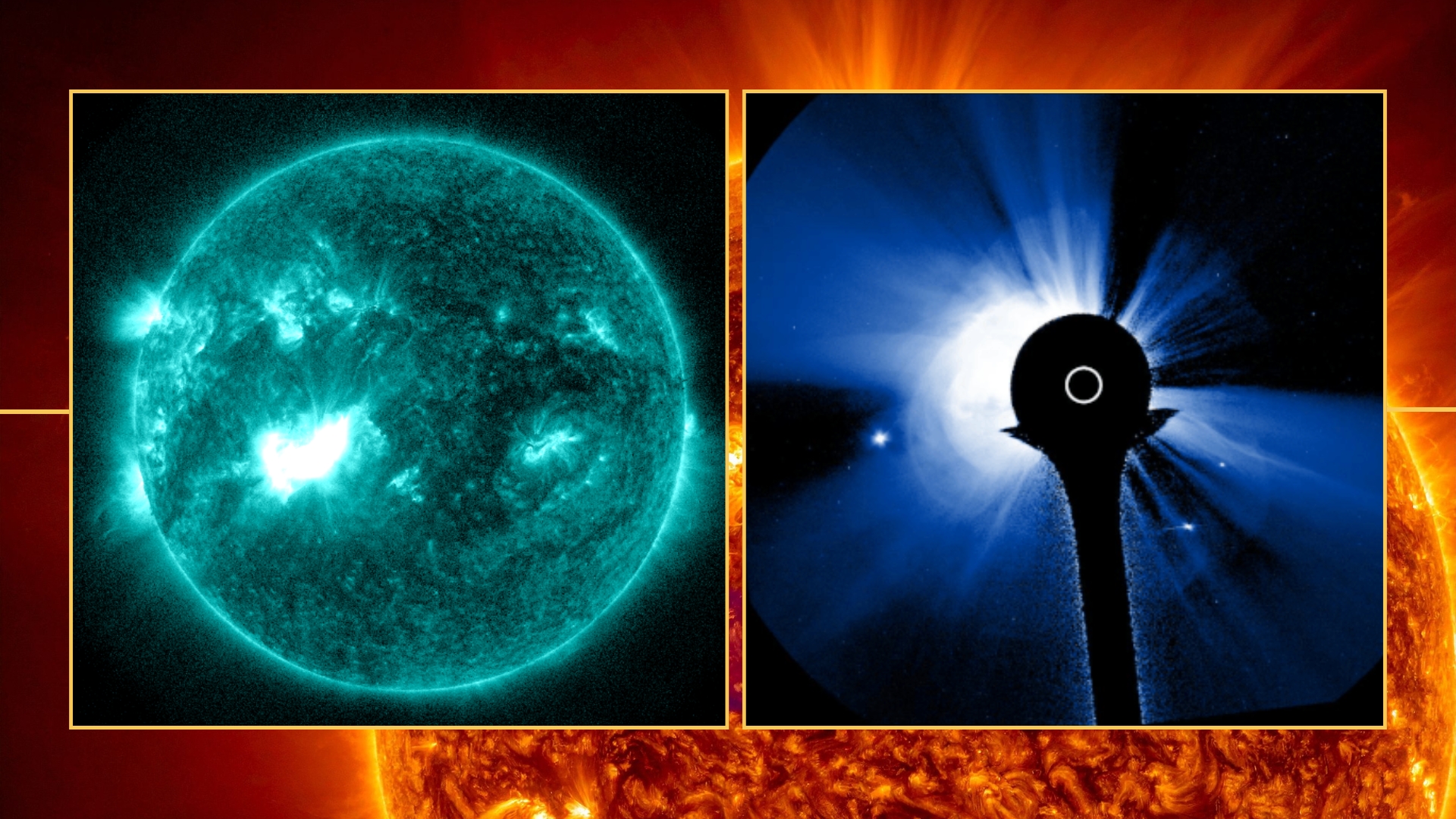
(Image credit: Image inset left: NASA SDO, right: NOAA SWPC, graphic made in Canva Pro.)
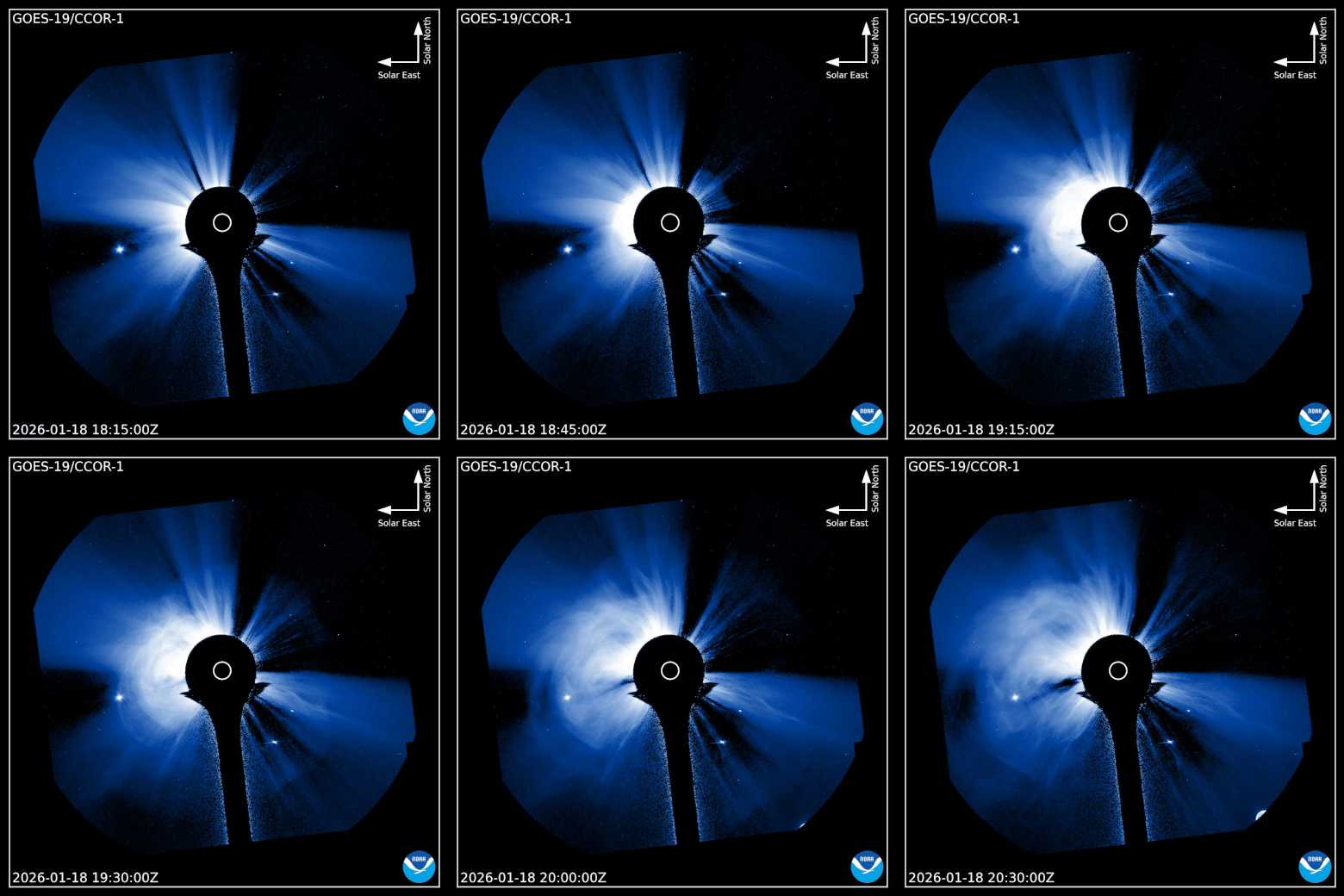
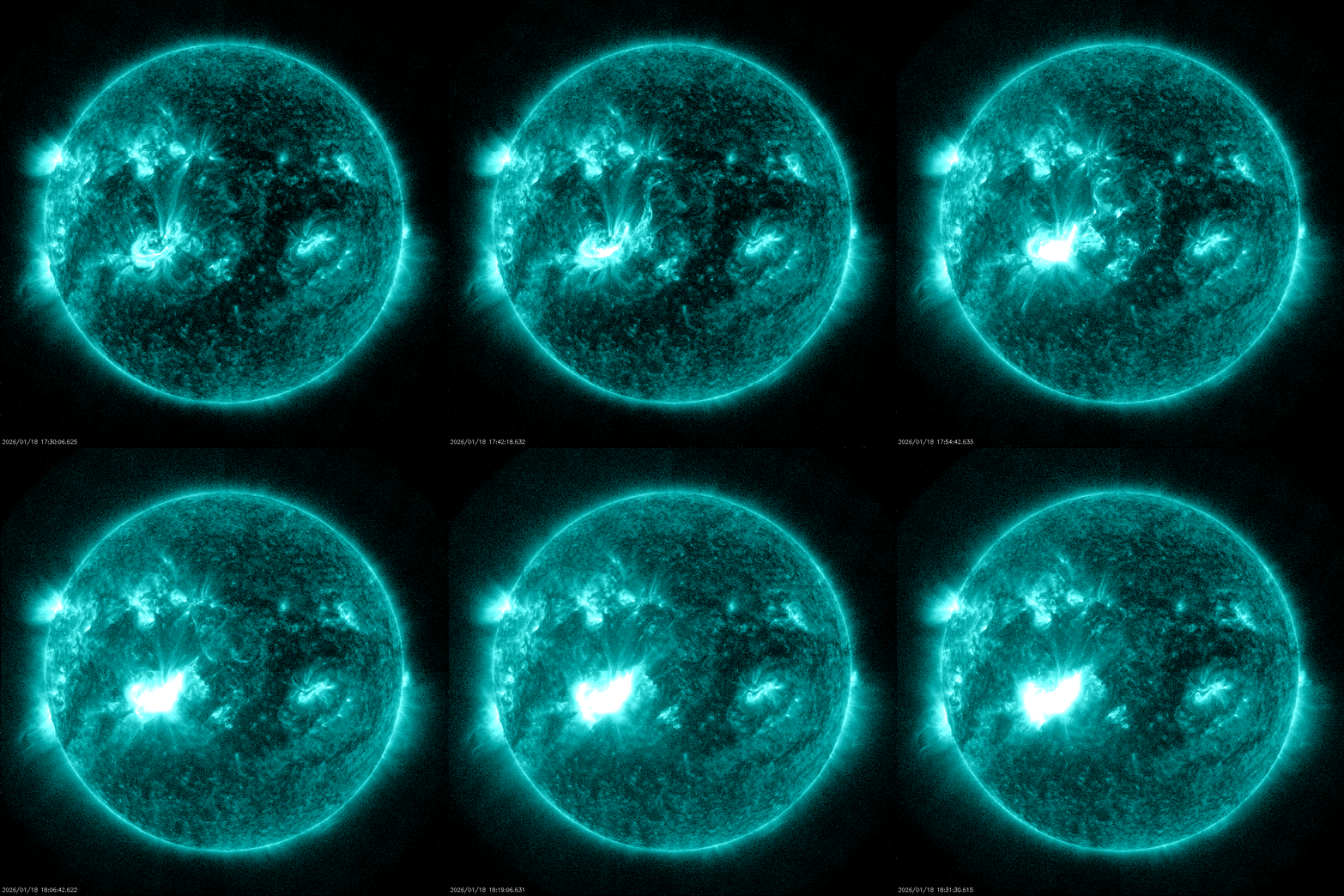
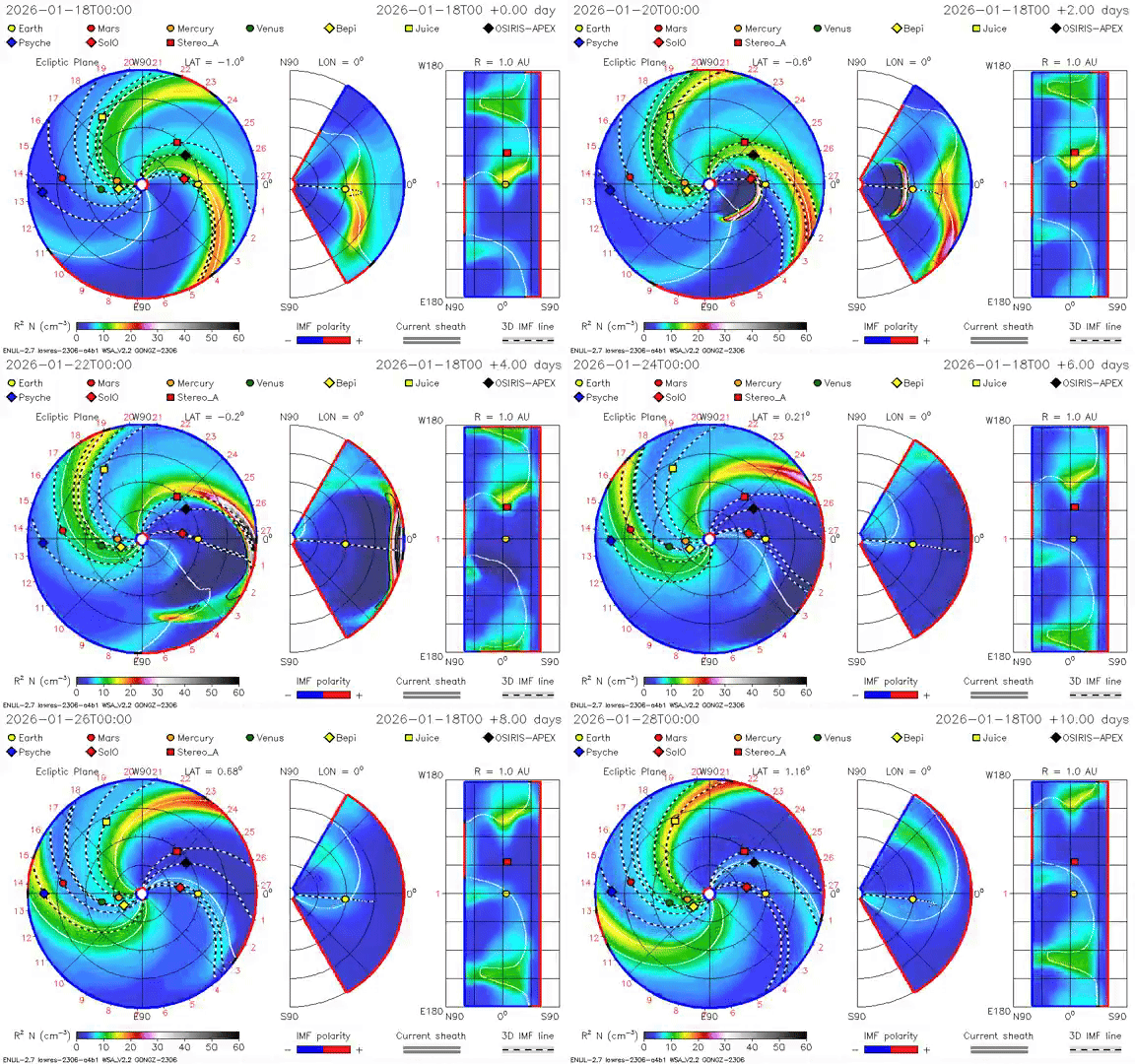
The sun sure has woken up this week, unleashing a powerful X-class solar flare on Jan. 18 that hurled a colossal, fast-moving coronal mass ejection (CME) directly toward Earth. That CME has now arrived, triggering severe (G4) geomagnetic storm conditions far earlier than initially forecast.
Full-halo CME from the X1.9 flare. The three bright specks of light (left to right) are Venus, Mercury and Mars.
(Image credit: NOAA Space Weather Prediction Center)
The shock wave from the CME struck at 2:38 p.m. EST (1938 GMT) on Jan. 19, according to NOAA's Space Weather Prediction Center, which confirmed that G4 storm levels were reached shortly after impact. The storm is ongoing, and space weather forecasters say CME passage will continue through the evening, keeping the door open for more aurora activity tonight.
Sun unleashes powerful X-flare, CME hits Earth sparking severe geomagnetic storm
Why the CME's impact depends on its magnetic orientation
CME arrivals are notoriously difficult to forecast. Their speed, direction of travel and — most importantly — their magnetic orientation all determine how strongly (if at all) they will interact with Earth's magnetic field.
If the CME's magnetic field is oriented southward, a component known as the Bz, it can more easily link up with Earth's northward-pointing magnetic field, allowing energy to pour into our planet's magnetosphere and trigger geomagnetic storm conditions.
X1.9 solar flare erupts from the sun on Jan. 18. (Image credit: NASA Solar Dynamics Observatory)
If the Bz is instead oriented northward, Earth's magnetic field largely deflects the incoming energy, effectively "closing the door," and what looked like a promising space weather event can end up being a bit of a nothing burger.
Some CMEs contain a mixture of southward and northward magnetic fields, which can lead to stop-start or fluctuating geomagnetic activity. These events keep space weather forecasters and aurora chasers very much on their toes.
Even now, after the CME has arrived, we won't fully understand its magnetic orientation until it's sampled in real time by solar wind monitoring spacecraft like DSCOVR and ACE, positioned upstream of Earth.
NASA model of the incoming CME and predicted arrival time. (Image credit: NASA)
What's an X-class solar flare?
Solar flares are ranked in ascending strength from A, B, C and M up to X, with each letter representing a tenfold increase in intensity. X-class flares are the strongest eruptions and the number following the X indicates how powerful the event is. Today's flare was measured at X1.9, putting it in the upper tier of solar outbursts.
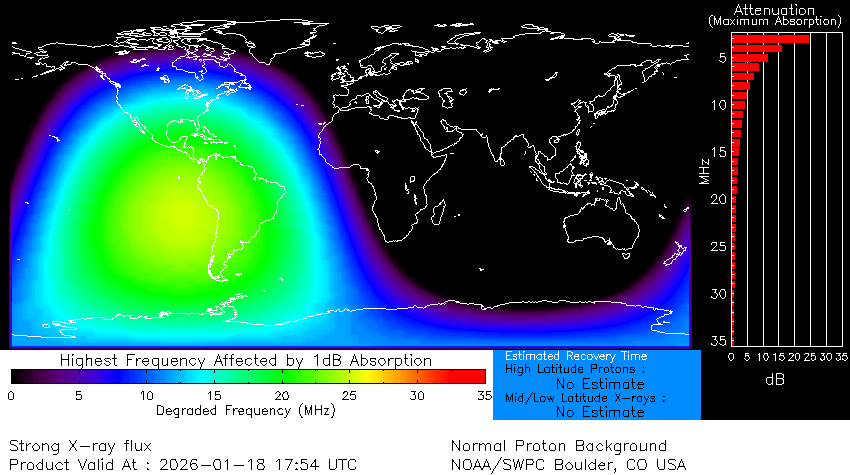
The powerful flare from sunspot region AR4341 peaked at 1:09 p.m. EST (1809 GMT), according to NOAA's Space Weather Prediction Center. The eruption triggered strong (R3) radio blackouts across the sunlit side of Earth, with the most severe disruptions concentrated over the Americas.
The X1.9 solar flare triggered radio blackouts across the Americas. (Image credit: NOAA Space Weather Prediction Center)
What is a CME and how can it affect Earth?
A CME is a massive expulsion of plasma from the sun that carries a magnetic field. If a CME hits Earth's magnetosphere — the protective magnetic "bubble" generated by our planet — it can trigger a geomagnetic storm.
These geomagnetic storms vary in intensity and are therefore classified on a scale from minor (G1) to extreme (G5). Current forecasts from the U.K. Met Office suggest the incoming CME could produce strong (G3) to severe (G4) geomagnetic storm conditions.
Storms of this magnitude can disrupt satellite operations, degrade GPS navigation and increase atmospheric drag on spacecraft. They can also supercharge auroral activity, potentially pushing the northern lights far beyond their usual high-latitude haunts and into mid-latitude regions near 45° latitude.
Editor's note: This article was updated on Jan. 19 at 4:30 p.m. EST (2130 GMT) to reflect that the coronal mass ejection (CME) has arrived and triggered G4 (severe) geomagnetic storm conditions, according to NOAA. Forecasts and visibility potential may continue to evolve as the storm progresses.
Sun unleashes powerful X-flare, CME hits Earth sparking severe geomagnetic storm
A mysterious UFO has been allegedly stored at a little-known US Navy base on the East Coast for decades as the military continues to reverse-engineer its secrets.
A new report has claimed that Naval Air Station Patuxent River in Maryland, better known as Pax River, has kept an 'exotic vehicle of unknown origin' secretly housed there, possibly since the 1950s.
According to anonymous sources tied to Naval Air Systems Command (NAVAIR), which is headquartered at Pax River, certain military programs at the base have been involved in analyzing and exploiting technology recovered from non-human craft for years.
NAVAIR is a major part of the US Navy, which handles everything related to naval aircraft, weapons, and aviation systems. It designs, builds, tests, buys, repairs, and keeps Navy and Marine Corps aircraft ready for use.
Speaking to the Liberation Times, the unnamed sources claimed that two types of aircraft have been trying to spy on what the US has at Pax River. One is allegedly drones from China, and the other are non-human UFOs.
Recently, this spying activity has allegedly increased and moved closer to land, including right around the Navy base on the Chesapeake Bay.
Although the claims could not be confirmed by the Daily Mail, UFO whistleblower Luis Elizondo stated in written testimony to Congress that a specially built hangar was constructed at Pax River specifically for the transfer of extraterrestrial technology.
Under oath, Elizondo described a plan where this hangar would help major defense contractor Lockheed Martin move non-human technology to another company called Bigelow Aerospace for further study and analysis.
Naval Air Station Patuxent River in Maryland (Pictured from space) has allegedly been used to store and study 'non-human' technology, including a craft of 'unknown origin'
UFO whistleblowers have continued to claim to Congress that the US military is in possession of advanced extraterrestrial technology it is working to reverse-engineer
The Daily Mail has reached out to Lockheed Martin for comment. Bigelow Aerospace went dormant as a company in 2020, laying off its entire workforce during the Covid pandemic.
According to the sources who spoke to Liberation Times, the US government allegedly has a secret contingency plan for moving the unidentified craft if its specific location at Pax River becomes publicly known or is threatened by further spying.
The report added that some of the activity seen taking place near the base is believed to be linked advanced drones or aircraft that use technology that's been copied and developed from the supposed exotic materials.
Although Elizondo claimed that a new facility was built at Pax River just for these UFO transfers, the anonymous sources said none of them took place after the CIA's former director of science and technology blocked companies from gaining access.
Elizondo is a former senior intelligence official who worked at the Pentagon, where he led a secret government program called the Advanced Aerospace Threat Identification Program (AATIP).
AATIP studied unidentified anomalous phenomena (UAP), the new name for UFOs, determining if they were a possible threat to national security.
Elizondo, a whistleblower since 2017, testified under oath in 2024 to Congresswoman Nancy Mace that the government maintains secret programs to recover crashed spacecraft.
Additionally, Elizondo's testimony noted that these programs have successfully reverse-engineered some of this technology and that the US was now in possession of advanced non-human equipment, including at bases like Pax River.
Pax River (Pictured) is the headquarters for NAVAIR, a major part of the US Navy that designs, builds, and tests, Navy and Marine Corps aircraft
Luis Elizondo (Pictured) led the government's Advanced Aerospace Threat Identification Program and has knowledge of America's UFO crash recovery missions
'These facilities included locations in the Las Vegas area and a newly built hangar at the Patuxent River Naval Air Station (“PAX”),' Elizondo said in his testimony.
'Specifically, the PAX River hangar was designed to facilitate the transfer of future materials via air and river.'
The Maryland base has been home to the Naval Air Warfare Center Aircraft Division (NAWCAD) since 1992, a group that conducts research, development, testing, and evaluation of new aircraft and weapons, including advanced and experimental projects.
Although the US military has said there has never been any physical evidence of UFOs recovered, multiple former government employees and scientists have come forward to claim that several vehicles have been recovered since the 1940s.
Last year, Dr Hal Puthoff, a physicist and electrical engineer who worked on the government's psychic spy and UFO research programs, revealed on the Joe Rogan Experience podcast that the US military has recovered more than 10 spacecraft since the infamous Roswell incident.
Although there was no evidence to confirm it, Puthoff claimed that some of these craft were actually fully intact craft that had been 'gifted' to humans by extraterrestrials.
Thousands of reports of large, silent drones (Pictured) over New Jersey and sensitive sights along the East Coast started in November 2024 and carried into 2025
The unverified claims about Pax River and potential spying overhead come just one year after hundreds of unidentified drones and UFOs were spotted flying over the East Coast by both the military and the American public.
The bizarre drone swarms appeared to focus on US military installations as well as other key sites, including President Trump's property in New Jersey.
Many Americans described them as 'car-sized drones', making no noise as they flew closely overhead of residential neighborhoods from November 2024 until early 2025.
To this day, the origin of the drones, their targets over New Jersey and the rest of the East Coast, and their research remain a mystery.
However, an unnamed private firm contracted by the US military eventually took responsibility for the drone swarms, claiming they were conducting tests of their advanced aerial craft, according to off-the-record comments at an Army summit in August 2025.
What are those unexplained objects zipping around in the sky? They could be aliens; they could be secret government aircraft; they might even be Superman. Or, if you believe the latest MAGA politician to appear on Joe Rogan’s podcast, they’re beings from another dimension.
Rep. Anna Paulina Luna, a Republican from Florida, has held hearings on Capitol Hill to investigate UAPs, unidentified aerial phenomena, and the congresswoman told Rogan on Wednesday’s episode that she’s seen evidence they could be “interdimensional beings.”
“Based on our interviews, and this has been something that you can go back and watch with the congressional hearings, but I was actually able to ask some of the witnesses, ‘What are these things?'” Luna told Rogan. “And they keep saying interdimensional and then when you talk about the interdimensional aspect of ‘are these things pre-existing maybe outside of what we currently know as our own dimension?’…”
Rogan was obviously curious and asked Luna to elaborate. The congresswoman, who earlier this year introduced legislation to put Trump’s face on Mount Rushmore, then tried to explain and seemed to suggest that these “interdimensional beings” were found in the Bible. Or at least they would’ve been, if the Bible hadn’t been censored.
Rep. Luna:Well, they call them interdimensional beings. I think that they can actually operate through the time-spaces that we currently have. And that’s not something that I came up with on my own. That’s based on stuff that we’ve seen, that’s based on information that we’ve been told. And then also too, I think that there’s this historical aspect of, you know, this gets into the deeper theories and concepts of religion and I think the history that we currently know. And that kind of spins off into another topic of, you know, you have the modern day Bible, you have this aspect of books of the Bible that have been removed that explain and kind of touch on these topics. And I think that we’re in a time and age where you have such a vast amount of information that we have access to via social media, via your cell phone, via the internet. And so it’s really changing the way that we understand, you know, the origins of life and the spiritual reality that we know.
Luna had a knack for rambling without saying much or providing evidence. So Rogan pressed her on what evidence there might be to prove that UAPs are actually beings from another dimension. She kept giving vague answers, but insisted that she’s seen evidence. Sadly, she just can’t tell you what it is.
Rep. Luna:Yeah, so look, have I seen a portal open? No. Have I seen a spaceship? Personally no. Have I seen evidence of this? Yes. Have I seen photo documentation of aircraft that I believe were not made by mankind? Yes. Is there historical significance to this? Yes. multiple events that go back to, I would argue, maybe even before the time of Christ that have documented this in text? Yes.
Luna acknowledged throughout the interview that the U.S. government may have advanced technology that could explain some of the UAP sightings, but she kept coming back to this idea that there was something supernatural about it all. And she floated conspiracy theories about how these kinds of beings had been censored in the editing of the Bible, specifically invoking the idea that the Book of Enoch had not been included as part of the Bible for shadowy reasons.
Luna, who said she’s read the Book of Enoch “multiple times,” insisted that she wasn’t saying these mysterious beings were angels, but noted there were “other creations that God made,” according to her understanding of Christianity.
Luna said she’s seen classified photos in a SCIF that she can’t talk about, something that clearly frustrated Rogan. “I’m very confident that there’s things out there that have not been created by mankind,” Luna said.
The congresswoman made other wild claims during the interview about the CIA discovering the Ark of the Covenant in the 1980s and strongly suggesting that remote viewing is a reality. She also mentioned that some autistic people had telepathic abilities, a reference to a popular podcast called the Telepathy Tapes. And everything she mentioned was cloaked in this conspiratorial thinking as she insisted that powerful people were hiding the truth from the American people.
“It seems crazy that people have access to information that shows that there’s something outside of us that is more intelligent, at least more capable than we are. And they hide it from everybody else,” Rogan said.
Crazy indeed, Mr. Rogan. Crazy indeed. Did you guys hear about those Epstein files?
A recent Congressional hearing revealed video of a Hellfire missile fired by a Reaper drone “bouncing off” an unidentified flying object, which has onlookers—Congress included—scratching their heads. The hearing took place in a House Oversight subcommittee meeting on UFO transparency that was partially hosted by MAGA congresswoman and state-sanctioned UFO investigator Rep. Anna Paulina Luna.
A House hearing on unidentified aerial phenomena (UAPs) stunned lawmakers when video evidence showed a U.S. drone firing a Hellfire missile at an orb off Yemen—only for the object to remain intact and keep moving, raising urgent questions about technology beyond known military capabilities.
The video was first shared publicly by Rep. Eric Burlison (R-Missouri), who noted that it was “taken [on] October 30 of 2024″ and characterized it as an “MQ-9 drone tracking an orb or this object off the coast of Yemen.” Burlison said the footage is “presented as received from a whistleblower. Independent review is ongoing.”
Calling this “orb” a UFO seems like a stretch, since it likely had something to do with the regional military conflicts around Yemen, where the footage was captured. But hey, it is a flying object that hasn’t been identified.
A few years ago, UFOs were re-branded as UAP (unidentified aerial phenomenon). The rebrand was, like most rebrands, followed by a re-launch of the core product (in this case, UFO stories), and an attempted cultural re-glow-up. By that I mean, there’s been a concerted effort to make UFOs “a thing” again, and Rep. Luna has been at the forefront of those efforts. Luna’s recently launched “Task Force on the Declassification of Federal Secrets” has been designed to resurrect many controversial “conspiracy theory”-tinged topics, UFOs included. Luna also hosted a hearing that featured claims made by supposed UFO whistleblower David Grusch
What does the above video actually show? Your guess is as good as mine. I doubt it shows a time-traveling entity from another realm or an extraterrestrial spacecraft (both things that people who have spoken at Luna’s various hearingshave offered as potential explanationsfor recent UFO sightings). However, one thing of material substance revealed at this hearing is that the U.S.’s unmanned aerial cadres are now being deployed to shoot unidentified objects out of the sky.The War Zone writes, of the recently released footage:
The footage and the circumstances behind it are otherwise unconfirmed, but this appears to be the first known instance of a Reaper engaging an aerial target of any kind in an operational setting…The idea of employing MQ-9s in the air-to-air role, at least for self-defense, is not new. In a test in 2017, a Reaper successfully downed a target drone using an AIM-9X Sidewinder air-to-air missile. There was a precedent already at that time for arming drones in this way, with at least some Predators having been modified to allow them to fire heat-seeking Stingers in the lead-up to the U.S.-led invasion of Iraq in 2003. In at least one instance in 2002, a Predator fired a Stinger at an Iraqi MiG-25 Foxbat fighter that was trying to shoot it down…
A story about a hostile engagement between aliens and a drone would, of course, be more interesting, but the evolution of unmanned aerial defense systems is pretty interesting, too. On that front, our flying killer robots just seem to keep getting better and better. That’s good news, I suppose, until the day one happens to come after you.
But for John Grossnickle, sheriff of Sweetwater County, Wyoming, this one’s getting a little stale. For over a year, Sweetwater officials have been trying to get to the bottom of a series of unexplained appearances by unidentified flying objects.
Alarmingly, the UFOs seem to have a peculiar interest in alocal power facility, the Jim Bridger Steam Plant, which houses four coal-fired generators.
“We’ve worked with everybody,” the sheriff’s spokesperson, Jason Mower told the Cowboy State Daily. “We’ve done everything we can to figure out what they are, and nobody wants to give us any answers.”
Sheriff Grossnickle, who began fielding calls about the sightings 13 months ago, says he’s now observed them with his own eyes. The objects are said to be “lighted” and “drone-like,” and congregate together in “coordinated formations,” CSD reports. They’re typically reported between 2am or 3am.
Shooting them down isn’t an option, as they fly thousands of feet above ground. A state investigation doesn’t seem to be on the table either, as Wyoming National Guard adjutant general Greg Porter said he “doesn’t think he could discuss [them] in open testimony,” per CSD.
“It’s like the new normal,” Mower explained. “It’s like this phenomenon that continues to happen, but it’s not causing any, you know, issues that we have to deal with — other than the presence of them.”
Officials in Sweetwater aren’t alone. Seven sheriffs of nearby counties canvassed by CSD said they’d either viewed similar mystery objects or received reports about them from locals. Back in January, three of those sheriffs had documented sightings above energy infrastructure such as oil fields and power plants, CSD reported at the time.
The strange Wyoming sightings come nearly a year after similar drone hysteria in New Jersey was seemingly put to rest. Despite a huge mystery back in late 2024, president Donald Trump claimed tho drones were authorized by the Federal Aviation Administration for research.
Whether the same can be said for the Wyoming UFO mystery? That’s anyone’s guess.
Less than a week ago, a unique discovery was made. Astronomers managed to find a comet from the Kreutz family at the greatest distance in history. The comet was given the temporary designation 6AC4721, and it is now the focus of attention for a large number of professionals and amateurs. Some comets from the Kreutz family become so spectacular that they are given the status of Great Comets. But will 6AC4721 succeed in doing so?
Unique discovery
On January 13, 2026, a new faint object with a magnitude of +17.8 was discovered using the 28-centimeter telescope at the AMACS1 observatory in San Pedro de Atacama (Chile), operating as part of the MAPS program. The object was moving against the backdrop of stars. It was added to the Minor Planet Center (MPC) database under the temporary designation 6AC4721, where it awaits confirmation by other observatories.
Renowned comet discoverer Alan Hale photographed 6AC4721 the day after its discovery, on January 14. Source: astronomynow.com.
Its uniqueness became apparent quite quickly. Professionals and amateurs agree that it is a sun-grazing comet belonging to the Kreutz (or Kroyts) family, one of the families whose comets approach the Sun at an extremely close distance. In this case, it will remain approximately 760,000 kilometers from the center of the star, which is only ~64,000 km from the photosphere. So, comets from the Kreutz family are very rarely found using ground-based telescopes. Success in the case of 6AC4721 gives hope that the comet will be very bright in just a few weeks.
Usually, comets from the Kreutz family are discovered in images taken by space solar coronagraphs. In this sense, the SOHO observatory is unrivalled. Physically, such comets are often very small, literally a few dozen meters in size, and therefore impossible to see from a great distance. They only become visible when they approach the Sun, when the heated ice of the nucleus actively sublimates, and the comet grows a tail and coma.
What is even more striking is the time that will pass between the discovery of 6AC4721 and its passage through perihelion, the point in its orbit closest to the Sun. According to available data, the comet will be near our star on April 4, which means that almost three months will pass between its discovery and perihelion! Accordingly, the distance from the Sun of 2.056 astronomical units, at which the comet was first seen, is an absolute record for Kreutz comets. Previously, this record was held by the legendary comet C/1965 S1 (Ikeya–Seki), discovered 33 days before perihelion.
Surprisingly, despite more than 120 observations accumulated by January 19, the comet has not yet been given a permanent designation and is still listed on the MPC database’s page for possible new comets. Most likely, it will be the first comet registered in 2026, so it will be designated C/2026 A1.
Gerald Rhemann and Michael Jäger were the first to obtain a color image of comet 6AC4721, photographing it on the evening of January 17.
Like a butterfly to the light
Being a sungrazing comet is very risky. These icy bodies often approach the Sun at a distance less than its radius. The intense stress from powerful gravity and heating often leads to the disintegration of the comet’s nucleus. However, at the same time, the comet puts on a real celestial show.
It is believed that comets of the Kreutz family, to which 6AC4721 belongs, originate from a single large cometary body. Their orbits are very similar to the trajectory of the Great Comet, which was observed near the Sun in the winter of 372–371 BC. It probably fragmented, and the fragments continued to move along similar trajectories.
In 1106, a true queen of comets appeared — it could be seen near the Sun even during the day. Nowadays, scientists mostly agree that the Great Comet of 1106 came from the one seen in 372–371 BC. There’s evidence that it also broke up, creating a big subgroup of cometary bodies.
Heinrich Kreutz noticed the similarity between the orbits of the Great Comets of 1843 and 1843 and the orbit of the comet of 1106, and suggested that they had a common origin. Therefore, the comet family was named after Kreutz.
Image of comet C/1965 S1 (Ikeya–Seki) taken by Roger Lynds in 1965. Source: Wikipedia
This family includes such famous comets as C/1965 S1 (Ikeya–Seki) and C/2011 W3 (Lovejoy). However, their fates were different. The first one broke up into at least three pieces before reaching perihelion. The second one managed to survive its encounter with the Sun mainly thanks to its large nucleus, which was about 500 m in size.
For now, scientists predict an unenviable fate for 6AC4721: as it approaches perihelion, the comet will most likely disintegrate. But only time will tell what will actually happen. After all, this is the first comet in the Kreutz family to be caught at such a great distance, so its behavior is difficult to predict.
Will we be able to see this comet?
Bad news for the Northern Hemisphere: the orbits of the Kreutz family comets are such that they are mainly visible from the Southern Hemisphere. However, near its perihelion, 6AC4721 may still give us a chance. The best conditions will occur around April 4, but the window of opportunity will be very short. In addition, the comet will be at a very small angular distance from the Sun, which will make observation significantly more difficult.
If the comet does not disintegrate as it approaches the Sun and survives to perihelion, it could become very bright and, in this sense, the most interesting comet of 2026. In a favorable scenario, we will see spectacular images from astrophotographers and space coronagraphs, and we will be able to admire its magnificent tail.
Based on materials from the Telegram channel “Всесвіт у кишені” (Universe in Your Pocket) which is administered by the public organization of astronomy popularizers “Шлях до Всесвіту.” (Way to the Universe).
On the night of January 19-20, residents of many regions of the Earth were able to see auroras. They were accompanied by the most powerful radiation storm of the 21st century.
Aurora borealis observed on January 19–20, 2026. The photo was taken in the Netherlands. Source: Josh Walet/SIPA/picture alliance
On January 18, the Sun produced a powerful X1.9 class flare. It was accompanied by a coronal mass ejection — a cloud of plasma that was directed toward Earth. Experts predicted that it would reach our planet on January 20. In reality, the emission came much faster — already on the evening of January 19. The reason was that the speed of the solar wind turned out to be much higher than predicted.
Aurora borealis observed on January 19–20, 2026. The photo was taken in Greenland. Source: Josefsen photo
After interacting with the Earth’s magnetosphere, the eruption resulted in a powerful G4-class geomagnetic storm. The resulting auroras were observed much further south than usual, including in Ukraine. Some photographs of this remarkable celestial spectacle were taken at around 30 degrees north latitude.
Aurora borealis observed on January 19–20, 2026, above Lviv. Source: Artur Abramiv/ZUMA/picture alliance
In theory, auroras could have been observed further south, but this was prevented by a change in the BZ index, which took on a positive value. This stopped their “advance”. Nevertheless, the storm that passed became one of the most powerful in the current cycle of solar activity.
The events of January 19–20 are also interesting as they were accompanied by a powerful radiation storm caused by an increase in the concentration of solar protons to record levels in the 21st century. Such events do not pose a threat to Earth, as charged particles are unable to reach the Earth’s surface. However, they can interfere with the operation of satellites, cause navigation errors, and disrupt radio communications. In addition, there is an increased radiation hazard for astronauts during spacewalks, as well as for passengers on transpolar flights.
NOAA warning of an S4-class radiation storm
The recent radiation storm was classified as S4 by the US National Oceanic and Atmospheric Administration (NOAA). Although a higher level of S5 is theoretically possible, it has never been recorded in the history of observations. So S4 is the actual maximum. The last time the S4-class radiation storm was observed was in 2003. However, the recent storm exceeded it in strength.
AP
For more details on how auroras occur and where and when they can be observed, read our article.
Zijn oude locaties portalen naar andere dimensies? Een wetenschappelijke analyse van de mogelijkheid van interdimensionale doorgangen in oude sites
Zijn oude locaties portalen naar andere dimensies? Een wetenschappelijke analyse van de mogelijkheid van interdimensionale doorgangen in oude sites
Inleiding
Het idee dat oude monumenten en sites fungeren als portalen naar andere dimensies of realiteiten heeft de laatste decennia veel aandacht getrokken binnen zowel de populaire cultuur als de wetenschappelijke wereld. Van de piramides van Egypte tot de megalithische standen van Stonehenge en het mysterieuze Gobekli Tepe in Turkije, verschijnen oude plekken herhaaldelijk in discussies over mogelijk interdimensionaal contact. Dit artikel onderzoekt de wetenschappelijke plausibiliteit van de hypothese dat bepaalde oude locaties fungeren als portalen of doorgangen naar niet-gekende realiteiten, gebaseerd op archeologisch, fysisch en metafysisch bewijs, en combineert dit met de huidige kennis binnen de natuurwetenschappen en theorieën over het universum.
1. Historisch en archeologisch overzicht van oude sites
1.1. De rol van oude sites in mythologie en cultuur
Historisch gezien worden oude locaties zoals piramides, sacrale grafvelden en megalithische structuren vaak gekoppeld aan religieuze en spirituele praktijken. In veel culturen hebben deze sites een centrale rol gespeeld in rituelen die gericht waren op het communiceren met goden, voorouders of andere werelden. Bijvoorbeeld, de Egyptische piramides werden niet alleen opgericht als grafmonumenten, maar ook als toegangspoorten tot het hiernamaals, die mogelijk metaforisch gezien de grens tussen verschillende realiteiten symboliseerden.
1.2. Archeologische bevindingen en bestaande theorieën
De archeologische bewijzen rond oude sites tonen dat de planners en bouwers mogelijk een diepgaand begrip hadden van astronomische en geografische factoren. Stonehenge lijkt bijvoorbeeld te zijn afgestemd op bepaalde astronomische gebeurtenissen zoals de zonnewendes, wat suggereert dat oude culturen misschien geloofden in een verbinding tussen de aarde en andere kosmische of spirituele domeinen.
2. Theoretische kaders over dimensies en realiteiten
2.1. Moderne fysica en multidimensionale theorieën
Volgens de theorieën binnen de moderne fysica, zoals snaartheorie en M-theorie, bestaat het heelal uit meer dan de gebruikelijke vier dimensies (enkele tijd en drie ruimte). Deze theorieën suggereren dat er op fundamenteel niveau verborgen dimensies kunnen bestaan, die niet rechtstreeks waarneembaar zijn met traditionele instrumenten. In deze context is het concept van doorgangen naar andere dimensies niet slechts sciencefiction, maar mogelijk een implicatie van de fundamentele structuur van het universum.
2.2. Wormgaten en portals in theoretische fysica
Wormgaten, theoretische tunnels die twee verschillende punten in de ruimte-tijd verbinden, worden in de relativiteitstheorie beschreven als mogelijke doorlaten naar andere delen van het universum of zelfs andere realiteiten. Alhoewel er geen experimenteel bewijs is voor het bestaan van wormgaten, vormen ze een legitiem theoretisch model voor ‘portalen’ tussen verschillende staten van bestaan.
3. Oude sites als portalen: Mythes, symboliek en mogelijke wetenschappelijke raakvlakken
3.1. Symboliek en architectuur van oude sites
Veel oude structuren bevatten symboliek die mogelijk verwijst naar het transcendente of het interdimensionale. In de Egyptische mythologie vertegenwoordigen piramides de opgaande verbinding tussen de aarde en de sterren, en kunnen ze worden geïnterpreteerd als architectonische manifestaties van een universele ‘ladder’ naar andere realiteiten. Megalithische monumenten zoals Carnac in Frankrijk of de Inca-sites in Zuid-Amerika dragen eveneens grote symboliek die mogelijk refereert aan kosmische poorten.
Kristallen die poorten openen naar parallelle tijdlijnen
3.2. De rol van energie en kristallen
Sommige moderne theorieën suggereren dat bepaalde kristallen en energievelden die in oude sites worden aangetroffen, wellicht functioneerden als natuurlijke energiefocuspunten of zelfs portals. Bijvoorbeeld, het gebruik van kristallen in bepaalde rituelen zou kunnen wijzen op pogingen om de bewustzijns- of energetische velden te beïnvloeden en toegang te krijgen tot andere dimensies.
Kristallen en poorten
4. Onderzoek en bewijsvoering
4.1. Geofysisch en energetisch onderzoek
Recente studies hebben geprobeerd om de energetische eigenschappen van oude sites te meten. Variaties in aardstraling, magnetische velden en elektromagnetische golven worden geanalyseerd om te bepalen of er sprake is van opzettelijke of natuurlijke energetische “poorten”. In sommige gevallen blijken structuren zoals de ‘Healing Well’ in Glastonbury of bepaalde megalithische cirkels opmerkelijke energetische anomalieën te vertonen, die mogelijk wijzen op een hogere energiefrequentie.
4.2. Spiritueel en bewustzijnsgerichte benaderingen
Onderzoekers in de veld van metafysica en bewustzijnsstudies analyseren nog steeds de ervaringen en rapportages van mensen die beweren portals te hebben ervaren. Hoewel deze subjectief zijn en moeilijk wetenschappelijk te bevestigen, suggereren ze dat sommige oude structuren mogelijk niet alleen symbolisch, maar ook functioneel kunnen zijn in het faciliteren van interdimensionale ervaringen.
5. Kritische analyse en sceptische standpunten
5.1. Wetenschappelijke beperkingen en de noodzaak van bewijs
Critici wijzen erop dat veel van de hypothesen over oude sites als portalen gebaseerd zijn op interpretaties die niet ondersteund worden door harde empirische gegevens. Het ontbreken van reproduceerbare experimenten en de subjectieve aard van veel bewijzen maken het moeilijk om deze theorieën te bevestigen binnen de wetenschappelijke methode.
5.2. Alternatieve verklaringen
De meeste archeologen en fysici stellen dat de energetische anomalieën mogelijk het resultaat zijn van natuurlijke aardkundige processen of menselijke intentie en ritueelgebruik, zonder dat dit hoeft te wijzen op interdimensionale portalen. Wat soms wordt geïnterpreteerd als ‘pad naar andere dimensies’, kan ook een symbolische of spirituele interpretatie zijn zonder fysische basis.
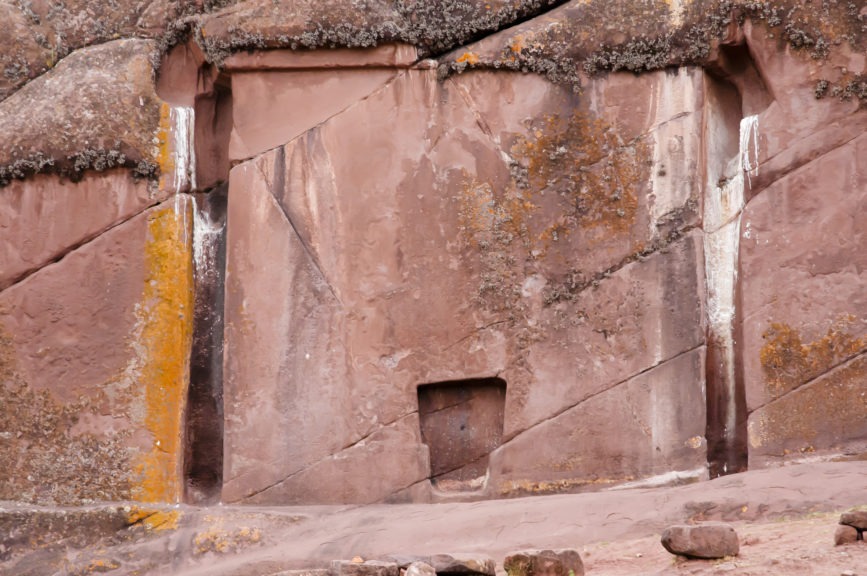
6. Poort van de Goden: Het Mysterie van de Aramu Muru Poort
Een locatie die aan deze beschrijving lijkt te voldoen is Puerta de Hayu Marca in Peru. Gelegen op een plateau net buiten de westelijke oever van het Titicacameer, betekent Puerta de Hayu Marca de Poort van de Goden. Met een hoogte en breedte van beide 23 voet, lijkt Hayu Marca, ook bekend als Aramu Muru, een deur of sterrenpoort naar nergens te zijn, uitgehouwen in de Hayu Marca-berg in een afgelegen gebied dat bekend staat als de Vallei van de Geesten of de Steenbos.
Poort van de Goden, Hayu Marca
De legende zegt dat toen Spaanse conquistadores naar Peru kwamen om het goud van de Inca’s te roven, een Inca-priester van de tempel van de Zeven Stralen Hayu Marca gebruikte als een portaal om te ontsnappen. Maru zou een gouden schijf, bekend als de “Sleutel tot de Goden van de Zeven Stralen,” in een uitsparing in het midden van de gebeeldhouwde deur van Hayu Marca hebben geplaatst, waardoor een portaal openging en hij erdoorheen kon lopen naar een nieuwe wereld, om nooit meer gezien te worden. Deze mysterieuze deur heeft sommigen doen speculeren of het een wormgat naar een andere dimensie zou kunnen zijn.
Hayu Marca ligt op een Ley-lijn, waar ook de beroemde Poort van de Zon in Tiwanaku op ligt in het naburige Bolivia, samen met verschillende andere belangrijke archeologische locaties van de Inca’s.
Bezoekers van Hayu Marca hebben opmerkelijk ongebruikelijke energievelden ervaren, waarbij sommigen zeggen dat ze pulserende energie voelen die van de rots uitstraalt wanneer ze hun hand in het midden plaatsen. Velen die de oude locatie online hebben bekeken, vermelden dit gevoel van verhoogde of intense energie daar.
Het nabijgelegen Titicacameer werd door de Inca's vereerd en beschouwd als de geboorteplaats van hun beschaving. Het is ook een van de diepste meren ter wereld en er wordt gezegd dat het een verloren stad en een overvloed aan schatten bevat die door de Spanjaarden zijn geplunderd. In 2000 werd de verloren tempel van Atahualpa diep onder het meer ontdekt, wat bijdroeg aan het mysterieuze karakter van deze oude cultuur.
7.Conclusie
Hoewel er momenteel geen direct empirisch bewijs is dat oude sites fungeren als fysieke portalen naar andere dimensies, bieden theoretische fysica, archeologisch onderzoek en metafysische theorieën een intrigerend kader voor deze hypothese. Het combineren van archeologische symboliek, energetisch onderzoek en hogere dimensietheorieën opent de mogelijkheid dat onze voorouders een inzicht hadden in het bestaan van meerdere realiteiten en pogingen ondernamen om toegang daartoe te verkrijgen, mogelijk via speciale locaties.
Het hedendaagse onderzoek moet zich richten op het integreren van geofysica, kwantumveldentheorie en bewustzijnsstudies om deze vragen verder te verkennen. Totdat meer bewijs wordt verzameld, blijft het idee dat oude sites poorten zijn naar andere werelden een fascinerende, zij het speculatieve, gedachtegang die onze nieuwsgierigheid naar de aard van realiteit en ons verleden blijft voeden.
Referenties
Green, M. (2018). De fysica van multidimensionale universums. Amsterdam: Universiteitsdruk.
Hofstadter, D. (2020). De oude wereld en de verborgen krachten. Leiden: Historisch Instituut.
Kaku, M. (2014). De theoretische fundamenten van wormgaten. New York: Oxford University Press.
Van der Meer, S. (2021). Energetische anomalieën bij megalithische sites. Journal of Archeoenergetics, 12(3), 45-67.
Watts, A. (2017). Bewustzijn en dimensies: de link tussen geest en materie. Filosofisch Tijdschrift, 45(2), 89-105.
Samenvatting: Dit artikel heeft een uitgebreide analyse gepresenteerd over de plausibiliteit dat oude locaties fungeren als portalen naar andere dimensies. Door archeologische, fysische en metafysische perspectieven te combineren, wordt duidelijk dat hoewel er geen sluitend bewijs is, de theorie een fascinerend inzicht biedt in onze geschiedenis en de mogelijke complexe structuur van het universum. Verdere interdisciplinair onderzoek is essentieel om deze wetenschap verder te ontwikkelen.
James Webb telescope reveals sharpest-ever look at the edge of a black hole — and it could solve a major galactic mystery
James Webb telescope reveals sharpest-ever look at the edge of a black hole — and it could solve a major galactic mystery
Story by Ivan Farkas
Astronomers have revealed theJames Webb Space Telescope's(JWST) sharpest-ever image of the area around a black hole. The spectacular view could help solve a decades-long mystery while reversing a long-held belief about space's most extreme objects.
Since the 1990s, astronomers have observed a curious brightness in infrared wavelengths surrounding the active supermassive black holes (SMBHs) at the centers of some galaxies. Previously, they attributed these excess infrared emissions to the outflows — superheated streams of matter blasted from black holes.
But in a new study published Jan. 13 in the journal Nature Communications, an international team of researchers used JWST to look into the heart of the nearby Circinus galaxy, located only about 13 million light-years from Earth, to reveal the area around the galaxy's SMBH.
The data from JWST, paired with numerous ground-based observations, reveal that the infrared excess is coming from the disk of dusty material that's falling into the Circinus galaxy's central SMBH, rather than from material flowing away from it.
This galactic revelation can help astronomers better understand the growth and evolution of SMBHs, as well as these massive dark monsters' influence on their host galaxies.
Of doughnuts and disks
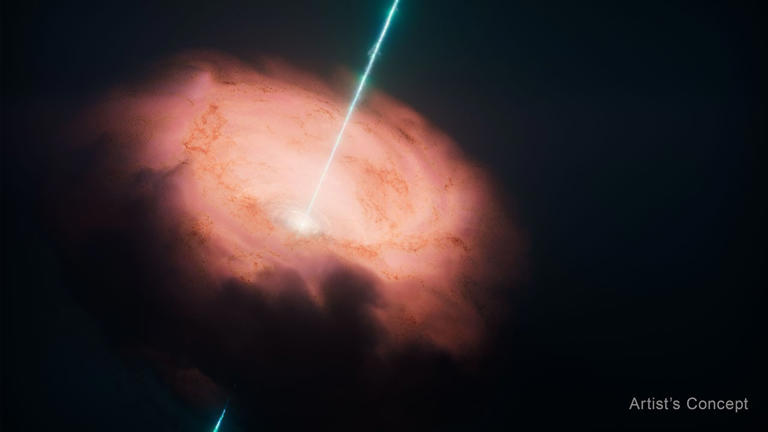
Active black holes like those at the centers of galaxies are fed by a giant ring of infalling gas and dust. As a black hole draws material from the inner wall of this "doughnut," known as a torus, the material forms a thinner accretion disk that spirals into the black hole like water spiraling into a drain.
An illustration of a supermassive black hole spewing an energetic outburst into space
(Image credit: NASA, ESA, CSA, Ralf Crawford (STScI))
The black hole's tidal forces accelerate the infalling matter to great speeds. The resulting friction within the disk causes the swirling matter to emit light that glows so brightly that it obscures astronomers' view of the inner region around the black hole.
Yet black holes are not vacuum cleaners, and even they have a feeding limit. So they blast some of the swirling material back into space, in the form of jets or "winds." Therefore, an understanding of the nature of a black hole's torus, accretion disk and outflows is key to knowing how black holes of various sizes accrete and expel matter to potentially shape their host galaxies by quenching or enhancing star formation across galactic scales.
This image from NASA’s Hubble Space Telescope shows the Circinus galaxy. A close-up of its core from NASA’s James Webb Space Telescope shows the inner face of the hole of the donut-shaped disk of gas disk glowing in infrared light. The outer ring appears as dark spots.
| Credit: NASA, ESA, CSA, Enrique Lopez-Rodriguez (University of South Carolina), Deepashri Thatte (STScI); Image Processing: Alyssa Pagan (STScI); Acknowledgment: NSF's NOIRLab, CTIO
Resolving a long-standing mystery
The dense gas and bright starlight in Circinus previously prevented astronomers from viewing the galaxy's central region and SMBH in detail.
"In order to study the supermassive black hole, despite being unable to resolve it, they had to obtain the total intensity of the inner region of the galaxy over a large wavelength range and then feed that data into models," lead study author Enrique Lopez-Rodriguez, a galaxy evolution researcher at the University of South Carolina, said in a NASA statement.
Earlier models separately fit the observed spectra of the torus, accretion disk and outflows, but they couldn't resolve the region in its entirety. As a result, astronomers could not explain which part of the SMBH's surroundings caused the excess emissions in infrared light.
JWST's advanced capabilities allowed astronomers to peer through the dust and starlight of Circinus so they could get a sharper view of the SMBH's environment. To do so, they used an imaging technique known as interferometry.
Ground-based interferometry generally requires an array of telescopes or mirrors that work together to gather and combine light from a celestial object over a large area. By combining light from multiple sources, this method causes the electromagnetic waves that form that light to create interference patterns that astronomers can analyze to reveal the sizes, shapes and other characteristics of those objects.
Unlike these terrestrial facilities, however, the space-based JWST can operate as its own interferometer array via its aperture masking interferometer (AMI), a component of the telescope's Near-Infrared Imager and Slitless Spectrograph (NIRISS) instrument. Like a camera aperture, AMI is an opaque physical mask with seven small, hexagonal holes that control the amount and direction of light entering JWST's detectors.
Overall, AMI effectively doubles JWST's resolution. "This allows us to see images twice as sharp," Joel Sanchez-Bermudez, an astrophysicist at the National University of Mexico and co-author of the study, said in the statement. "Instead of Webb's 6.5-meter [21 feet] diameter, it's like we are observing this region with a 13-meter space telescope."
By doubling its resolution, JWST captured its sharpest-ever view of a 33-light-year-wide area at the center of Circinus. This unprecedented image allowed researchers to calculate that the majority — around 87% — of the excess infrared emissions come from the dusty disk that's actively feeding the central black hole; "the inner surface of the hole of the doughnut," Lopez-Rodriguez said via email. Whereas previous research had suggested that the excess may have come from hot dusty winds, or even the galaxy’s residual starlight, the team found that less than 1% of these emissions come from the energetic outflows streaming away from the SMBH.
The accretion may be extinguishing star formation in the center of Circinus, but confirming this will require a different type of JWST-based observation, Lopez-Rodriguez said.
An invaluable perspective
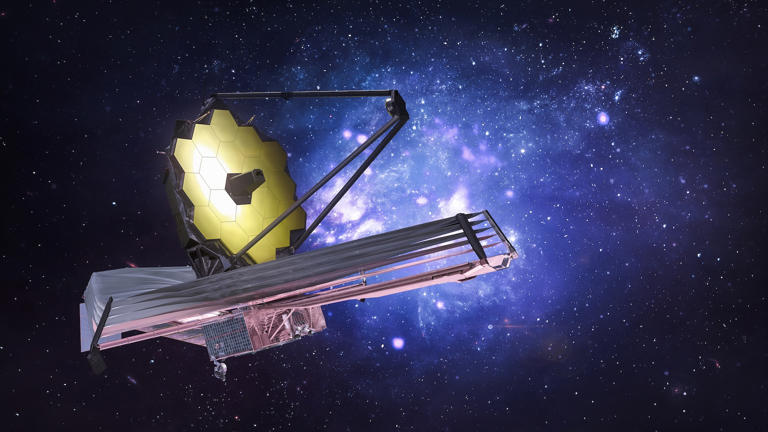
An illustration of the James Webb Space Telescope in orbit
(Image credit: Getty Images)
In addition to revealing previously hidden SMBH mechanics, this research highlights the potential of JWST-based interferometry for studying various celestial objects, including other active SMBHs at the cores of nearby galaxies. By increasing the sample size, astronomers hope to determine whether the infrared emissions from other SMBHs are due to their dusty disks or to their hot outflows.
"AMI has to be used — in order to get precious JWST time — on targets which cannot be done from the ground, or at wavelengths that are blocked by the Earth's atmosphere," study co-author Julien Girard, a senior research scientist at the Space Telescope Science Institute, told Live Science via email.
AMI-based observations can better illuminate our own solar system; they recently offered a detailed look at the volcanoes on Jupiter's hellish moon Io, Girard added. So AMI can observe diverse cosmic objects of varying shapes and sizes, from moons oozing with lava to black holes obscured by dust. In the future, it could help astronomers detect moons around prominent asteroids or reveal the orbits and masses of multistar systems, Girard added.
Like this article? For more stories like this, follow us on MSN by clicking the +Follow button at the top of this page.
NASA has revealed the sharpest ever look at the edge of a black hole, and it could solve a decades–old galactic mystery.
Located 13 million light–years from Earth, the Circinus Galaxy is home to a supermassive black hole that is constantly blasting radiation into space.
The clouds of hot gas surrounding this black hole are so bright that seeing any real details has previously been all but impossible.
Now, NASA has used the James Webb Space Telescope (JWST) to unveil the strange and powerful forces on the very edge of this black hole.
Supermassive black holes like the one in Circinus remain active by constantly consuming matter from the surrounding galaxy.
Scientists had observed that this process creates a huge amount of infrared energy, but most telescopes weren't sensitive enough to see where it was coming from.
Previously, scientists thought most of this radiation was coming from the black hole's 'outflow' – a stream of superheated matter fired out from the core.
Now, these new observations from the JWST have turned that expectation on its head.
NASA has revealed the closest ever look at the edge of a black hole 13 million light–years from Earth, and it could help solve a decades–old galactic mystery. Pictured: The new James Webb Space Telescope image overlaid on the Hubble image
A black hole is the ultra–dense heart of a dead star where gravity is so strong that not even light can escape.
Supermassive black holes, like the one in the Circinus Galaxy, become 'active' by consuming vast quantities of matter from their surrounding galaxy.
As this matter falls inwards, it forms a dense doughnut–shaped ring called a torus that orbits the black hole.
A supermassive black hole gathers material from the torus' inner walls to form an accretion disc, a swirling whirlpool of matter that circles the black hole like water going down a drain.
This accretion disk starts to get hotter through friction until it begins to glow bright enough to show up on our telescopes.
Although astronomers' models make predictions about how these different parts should interact, it is extremely difficult to see this process in action.
The light from the accretion disk blocks out any details, while the incredibly dense torus hides the inner region of infalling matter from view.
The Circinus galaxy is home to an active supermassive black hole that constantly blasts infrared radiation into space. However, scientists have struggled to determine exactly where around the black hole this radiation comes from
Scientists would try to fit the different wavelengths of light they observed to the emissions from different regions of the black hole, but not everything could be made to fit neatly.
Most notably, some telescopes could detect an excess of infrared light coming from somewhere in the black hole, but didn't have the resolution to work out where it was coming from.
Lead author Dr Enrique Lopez–Rodriguez, of the University of South Carolina, says: 'Since the 90s, it has not been possible to explain excess infrared emissions that come from hot dust at the cores of active galaxies, meaning the models only take into account either the torus or the outflows, but cannot explain that excess.'
Models assumed that most of the mass, and therefore most of the emissions, would be in the outflow.
But to test this, astronomers needed a way to both filter out the interfering starlight and distinguish the infrared emissions of the torus from those of the outflows.
Luckily, the JWST offered an innovative solution to both of these problems.
The scientists used a tool called the Aperture Masking Interferometer, which essentially converts JWST into several smaller telescopes that all work together.
On Earth, interferometers are usually many different radio or optical telescopes that work together as if they were a single, enormous observatory.
Using a new technique, scientists were able to determine that most of the radiation is coming from a swirling doughnut of matter known as the taurus, not from the jet of ejected matter as previous studies had believed
The JWST can replicate this same trick by using a special cover with seven hexagonal holes.
Dr Lopez–Rodriguez told the Daily Mail: 'Interferometry is the technique that provides us with the highest angular resolution possible.
'Using aperture masking interferometry with the JWST is like observing with a 13–meter space telescope instead of a 6.5–meter one.'
Gathering data with this technique, the scientists were able to create an image of the central region.
This is the first extragalactic observation from an infrared interferometer in space, and offers an unprecedented look into the core of an active galaxy.
Contrary to previous estimates, around 87 per cent of the infrared emissions from hot dust in Circinus come from the areas closest to the black hole, while the outflow contributes less than one per cent.
This is a total reversal of what had been predicted by astronomers' best models for supermassive black holes.
However, while the mystery of Circinus' black hole has been solved, there are billions more supermassive black holes out there in the universe.
These images were possible thanks to a technique that converts the James Webb Space Telescope's mirror (artist's impression) into several smaller lenses that all work together to provide extreme resolution in a very small area
Circinus' accretion disc was only moderately bright, so it makes sense that the torus would dominate its emissions.
But for brighter black holes, the opposite might still be the case, and far more case studies will be needed.
With this research, astronomers found a technique to investigate any black holes they chose, so long as they are bright enough for the Aperture Masking Interferometer to be useful.
Dr Lopez–Rodriguez says: 'We need a statistical sample of black holes, perhaps a dozen or two dozen, to understand how mass in their accretion disks and their outflows relate to their power.'
Black holes are so dense and their gravitational pull is so strong that no form of radiation can escape them - not even light.
They act as intense sources of gravity which hoover up dust and gas around them. Their intense gravitational pull is thought to be what stars in galaxies orbit around.
How they are formed is still poorly understood. Astronomers believe they may form when a large cloud of gas up to 100,000 times bigger than the sun, collapses into a black hole.
Many of these black hole seeds then merge to form much larger supermassive black holes, which are found at the centre of every known massive galaxy.
Alternatively, a supermassive black hole seed could come from a giant star, about 100 times the sun's mass, that ultimately forms into a black hole after it runs out of fuel and collapses.
When these giant stars die, they also go 'supernova', a huge explosion that expels the matter from the outer layers of the star into deep space.
Do people know what “Christ” really means in Jesus Christ?
Do people know what “Christ” really means in Jesus Christ?
Story by Olivia Harper
“His name would probably have been in Aramaic: Yeshua.” In this single statement, Professor Dineke Houtman returns a familiar character to an alien environment, one in which “Jesus” was not yet a word, in which a Galilean village might well have been home to more than one language.
Image Credit to wikipedia.org
In first-century Galilee, the language was Aramaic, a Semitic language closely related to Hebrew that was in common usage in the area. The first communities, in and around Nazareth and Capernaum, were Aramaic-speaking, and these communities are reflected in the Gospels in tiny, glancing moments: prayers, nicknames, and imperative verbs written in Greek but reflecting an earlier pronunciation. Candida Moss supplies a further, subversive, fact: “Most scholars also accept that his name was Yeshua or perhaps Yeshu, which was a very common name in first-century Galilee.” The word common is the pivot. The historical Jesus did not have a proper, trademark-style name; he shared one with his contemporaries.
It is its very ordinariness, its rootedness in the everyday, which helps explain the importance of the linguistic change. With the movement expanding beyond the Aramaic-speaking community, the name Jesus necessarily entered Greek, the alphabet of the eastern Mediterranean and the language of the New Testament itself. Greek offered its own set of restrictions. There is no “sh” sound, and the language doesn’t favor the masculine name suffix “-ah.” This is not translation but adaptation, and Yeshua became Iesous, the spelling which fit Greek hearing and syntax. Later, Latin reduced the spelling of Iesous to Iesus, and the English version of the name eventually changed the first letter from “I,” which didn’t exist in ancient times and entered the alphabet late, to “J,” which is the letter it is today.
Names, after all, rarely travel alone. The second half of “Jesus Christ” carried a different kind of freight.
“Christ” is not a surname but a title, taken from the Greek christos, or “anointed one.” In Jewish tradition, anointing denoted kings and prieststhe mark of their position was oil. “Christ” was a way of indicating that Jesus was the anticipated messiah, and in some of the oldest texts of the New Testament, such as the letters of Paul, the title is simply assumed to be known, and “Christ” is used as if it were a name that did not belong to another person. In such a linguistic gesture, a claim resides quietly within the grammar: a title becomes a name because of the way a community repeats it as if it could not possibly belong to another person.
However, this combination of title and given name also accounts for what confuses us today. “Jesus” has a unitary, specific ring to it, while “Christ” has an last-name finality to it, though it was really an announcementYeshua, the anointed one. The longer, more regional versions of it, “Yeshua” or “Yeshu,” can have a jarring quality to them not because they represent a different person but because they remind us of proportions man to place to origins, not last names.
There is also a second, less comfortable form of afterlife in those earlier traditions as well. In later Jewish literature, “Yeshu” is found as a name associated with discourses about identity and demarcation, and even who or what “Yeshu” is is in question. The use of “Yeshu” in rabbinic literature, and any connection of Jesus with people named Yeshu, has been characterized as being quite complex in historical terms, with more than one figure and timeline at work. This is only true in general, however, insofar as names in antiquity are tools of society before they are symbols of theology.
Rather than a pure sound that is passed down through each alphabetic handoff, it is a striving to declare the same person in different rooms. The transition from Yeshua through Iesous to Iesus and finally Jesus illustrates how a religion that reached out also had to be able to be pronounced that is, without relinquishing the claim implicit within its name.
What we know from decades of UFO government investigations
What we know from decades of UFO government investigations
Mysterious flying objects. Claims of crashed alien spacecrafts. The U.S. has spent decades inquiring into the unknown—here's what they've learned.
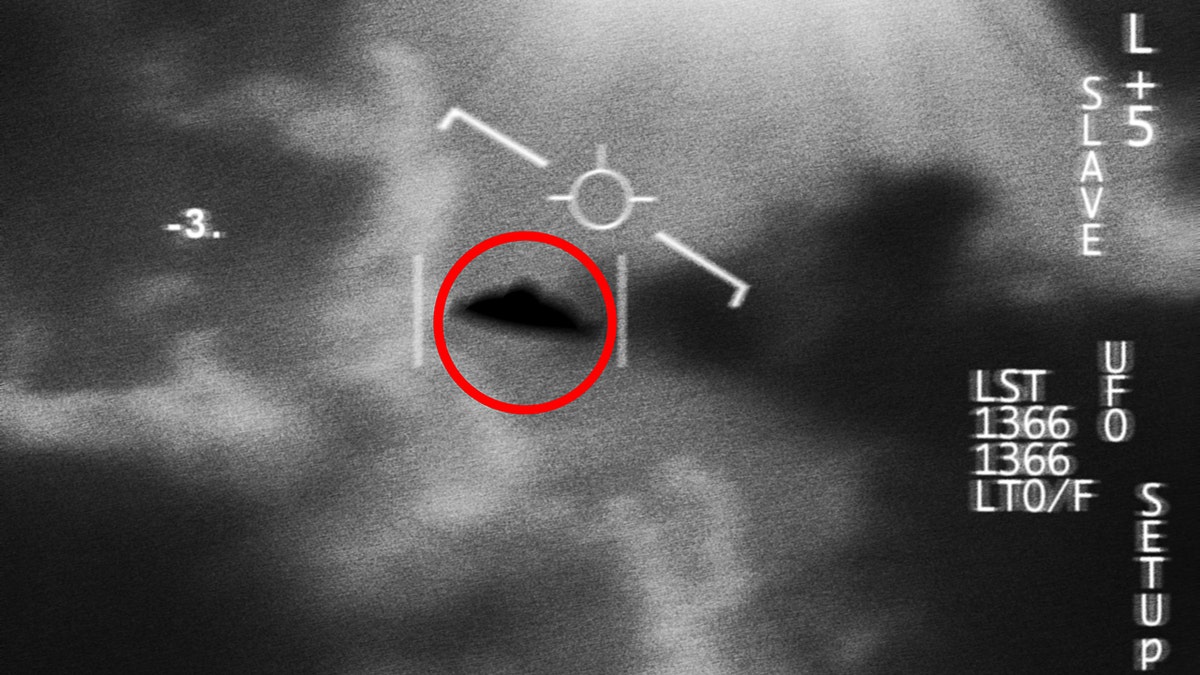
This image released by the U.S. Department of Defense shows a 2004 encounter between two Navy fighter jets and an unknown object near San Diego. But are UFO sightings like this one a sign of extraterrestrial life, spies from a rival nation—or just weird weather?
Photograph by DEPARTMENT OF DEFENSE/The New York Times/Redux
By Joel Mathis
Mysterious flying objects and claims of crashed alien spacecraft have long intrigued both the public and officials worldwide. In recent years, significant advancements have been made in understanding these phenomena.
There’s something strange going on in the sky, but what?
The Pentagon denied the report, but the U.S. Congress remained interested—and, in June, the House Oversight Committee announced it will hold a hearing on UFOS—or as the U.S. government calls them, “Unidentified Aerial Phenomena” (UAPs). “In addition to recent claims by a whistleblower,” a committee spokesperson said, “reports continue to surface regarding unidentified anomalous phenomena.”
Such reports have been surfacing for decades. The modern era of UFO sightings and investigations started after World War II with a sudden surge of unexplained reports.
U.S. officials didn’t necessarily dream of meeting extraterrestrials in their investigations: As the Cold War with the Soviet Union got underway, American leaders worried that UFOs represented a threat from a rival nation. Aliens never invaded, although new sightings happen all the time—as do investigations into those reports.
1947-1969: Project Blue Book
Over the course of two decades, the U.S. Air Force cataloged 12,618 sightings of UFOs as part of what is now known as Project Blue Book. These include lights, objects, and unexplained radar readings reported by military and civilian pilots, weather observers, astronomers and other sources.
The project came to an end in 1969 after a study by the University of Colorado concluded there was no evidence that UFOs came from other worlds, and that most sightings could be explained by natural phenomena, or even hoaxes. “Our general conclusion is that nothing has come from the study of UFOs in the past 21 years that has added to scientific knowledge,” said the study leader, Edward U. Condon. Further investigation, he said, “cannot be justified.”
Still, rumors and sightings persisted—sometimes to the annoyance of the original investigators. The Air Force announced in a 1985 fact sheet that “there are not now nor ever have been, any extraterrestrial visitors or equipment on Wright-Patterson Air Force Base,” where the investigation was headquartered.
1995: A U.S. senator takes interest
The Condon report didn’t put an end to interest in UFOs. So-called “UFOlogists” spent the next few decades filing open records requests with federal agencies to uncover what was known about the sightings.
“A lot of people said it would ruin my career,” Reid later said. That didn’t quite happen: Reid would eventually become a key figure in driving the U.S. government’s investigation of UFOs.
2004: An encounter off San Diego
In November 2004, two Navy pilots on a training mission were ordered to intercept a mysterious craft. They saw—and captured on video—an unusual oval-shaped craft, about 40 feet long, hovering over the Pacific Ocean about a hundred miles off San Diego. It streaked away before the pilots could get near. “I have no idea what I saw,” said one of the pilots, Cmdr. David Fravor, at the time. “It had no plumes, wings or rotors and outran our F-18s.”
“What was considered science fiction is now science fact,” the agency said in briefing papers. The program was run by a military intelligence official, Luis Elizondo, and worked hand-in-hand with an aerospace research company run by Bigelow.
2014: A near-collision on the East Coast
In a series of incidents during this time, Navy pilots reported—and made video recordings—of a series of encounters with unidentified craft near Florida and Virginia that could reach high altitudes and hypersonic speeds. One pilot reported a near-collision in 2014. Another later told 60 Minutes that the craft were hard to explain. “You have rotation, you have high altitudes. You have propulsion, right? I don't know. I don't know what it is, frankly.”
One possibility? Surveillance craft from another country.
2017: Going public
These incidents and investigations mostly went unreported to the broader public—until December 2017, when the New York Times reported the existence of the Pentagon’s Advanced Aerospace Threat Identification Program. Although Pentagon officials said the program had ended in 2012, Elizondo told the paper he continued its work informally with cooperation from the Navy and CIA until his resignation in the fall of 2017.
That sparked a new wave of interest in UFOs among the public, the media, and even scientists.
2020: A scientific call to action
In July 2020, Ravi Kopparapu and Jacob Haqq-Misra—a NASA scientist and astrobiologist, respectively—wrote in Scientific American that it was time to revisit the conclusions of the Condon report. “Perhaps some, or even most, UAP events are simply classified military aircraft, or strange weather formations, or other misidentified mundane phenomena,” they wrote. “However, there are still a number of truly puzzling cases that might be worth investigating.”
In August 2020, the Pentagon announced the Unidentified Aerial Phenomena Task Force to “improve its understanding of, and gain insight into, the nature and origins” of the unidentified objects.
In June, the Office of the Director of National Intelligence (DNI) released its “preliminary assessment” of UFO sightings from 2004 to 2021. The report suggested that the UFOs—now known as UAPs—could fall into five likely categories: airborne clutter, natural atmospheric phenomena, public and private aerospace developmental programs, foreign adversary systems, “and a catchall ‘other’ bin.” More funding and reporting was needed, the report said.
2022: NASA jumps in to investigate
In April 2022, the Pentagon announced the formation of the All-domain Anomaly Resolution Office to investigate objects “that might pose a threat to national security.”
The following June, NASA announced it was setting up an independent study program to cover the issue from a scientific perspective. “We will be identifying what data—from civilians, government, nonprofits, companies—exists, what else we should try to collect, and how to best analyze it,” said David Spergel, the study team leader.
And 2022 also brought another acronym change: “Unidentified Aerial Phenomena” are now officially called “Unidentified Anomalous Phenomena.”
2023: The truth is still out there
Whatever is happening up above, it still hasn’t entirely been explained. The DNI released a follow-up report in June 2023, identifying an additional 510 sightings—of which 171 remained unexplained. In those cases, unidentified craft often “appear to have demonstrated unusual flight characteristics or performance capabilities,” the report said.
Most explosively, a former intelligence official named David Grusch came forward in June with a whistleblower report alleging the U.S. government was in possession of “intact and partially intact vehicles” from UFO crash sites. The craft, he said, were of “non-human” origin. But he also said he had never personally seen the objects, inviting skepticism from outside experts.
“In the long history of claims of extraterrestrial visitors, it is this level of specificity that always seems to be missing,” said Boston University’s Joshua Semeter, a professor of electrical and computer engineering and a member of the NASA team examining these reports, told BU Today. The evidence may be wanting, but the questions—and the sightings, and the investigations—continue.
2024: Continued Investigations and Scientific Approaches
In 2024, the global effort to analyze and understand Unidentified Aerial Phenomena (UAP) has become more sophisticated and collaborative than ever before. Governments, space agencies, scientific organizations, and private companies are working together to collect high-quality data using advanced technology and scientific methods. For example, NASA has expanded its UAP research programs, partnering with international agencies such as the European Space Agency (ESA) and private organizations like SpaceX. These collaborations aim to deploy new satellite systems and advanced sensors that can capture high-resolution, multi-spectral images of mysterious objects in the sky, leading to more accurate analyses.
The Pentagon’s All-domain Anomaly Resolution Office (AARO) continues its important work of cataloging and monitoring sightings of UAPs across various environments—air, sea, and land. This office emphasizes transparency, regularly releasing declassified reports to the public and briefing government officials and scientists. For instance, recent reports include encounters involving military aircraft tracking swift, inexplicable objects that exhibit capabilities beyond current human technology. These ongoing investigations underscore the need for security and safety, as well as a scientific approach to debunk or understand these phenomena.
Technological improvements have played a pivotal role. New radar systems now offer greater detection ranges and precision, while artificial intelligence (AI) is used to analyze atmospheric data and identify patterns that might explain some sightings. For example, AI algorithms can process vast amounts of sensor data to distinguish between natural phenomena like weather balloons or drones and truly anomalous objects. Moreover, advances in deep learning enable scientists to classify visual sightings in real-time, helping to identify whether a UAP is potentially man-made, natural, or genuinely unknown.
Despite these technological and scientific developments, reports of unexplained flights and sightings still emerge regularly. Some examples include fast-moving lights that appear to change direction abruptly or hovering objects emitting no noise, defying conventional explanations. However, government agencies remain committed to applying rigorous scientific methods—such as analyzing flight characteristics, electromagnetic signatures, and environmental conditions—to demystify these objects.
In summary, 2024 marks a significant step forward in the scientific investigation of aerial anomalies. Through international collaboration, improved technology, and transparency, humanity is increasingly equipped to understand the origins and nature of these mysterious phenomena—paving the way for potentially groundbreaking discoveries about our universe.
2025: Rising Public and Government Engagement
By 2025, both public engagement and government transparency regarding unidentified anomalous phenomena (UAPs) have reached unprecedented levels. Citizens worldwide are increasingly interested in understanding these mysteries, driven by a surge in official disclosures and media coverage. Governments, previously hesitant to release classified information, are now declassifying reports that contain detailed data on UAP sightings, radar readings, and sensor analyses. For example, several national defense agencies have released previously confidential documents showcasing UAPs performing extraordinary maneuvers — such as sudden acceleration to hypersonic speeds or securely turning in ways that defy known aerodynamics. These revelations have sparked widespread curiosity and debate among scientists, journalists, and the public alike.
Most Unbelievable UFO Encounters Ever | The Proof Is Out There | History
In addition, whistleblower testimonies continue to surface, fueling speculation about whether these phenomena might involve advanced technology from unknown sources. For instance, several former military personnel have come forward claiming to have witnessed or interacted with UAPs in sensitive operations. One such case involved a retired fighter pilot describing encounters with objects capable of instantaneous acceleration and hovering silently at high altitudes, with some suggesting these could be evidence of breakthrough propulsion systems not yet understood by human science. While these testimonies are compelling, they have not yet led to conclusive proof of extraterrestrial origin, leaving the debate open-ended.
The international community has also initiated cooperation projects aimed at better understanding and managing UAP data collection. Countries like the United States, Canada, and European nations are working together to standardize reporting procedures, sharing databases, and developing common analysis protocols. For example, multinational task forces now collaborate to analyze radar and satellite data to identify patterns or anomalies. These efforts foster an environment of transparency and shared knowledge, encouraging collaboration rather than competition.
Despite the progress, the overall consensus remains one of cautious curiosity. Governments and scientists are wary of jumping to conclusions without concrete evidence. Each year, new investigations yield fresh insights—ranging from unexplained electromagnetic signals to the discovery of anomalous debris potentially linked to UAPs — yet definitive proof of extraterrestrial life remains elusive. This ongoing pursuit exemplifies humanity’s persistent desire for understanding, balanced with a cautious scientific approach that respects the mystery’s complexity.
Future Perspective 2026:
Looking toward 2026, the focus will shift dramatically toward enhanced technological integration and strengthened international partnerships to better understand mysterious phenomena. Advances in sensor technology, such as more sensitive and accurate radar and imaging devices, will enable scientists to detect and analyze unusual events with greater precision. For example, improvements in satellite-based sensors could allow for the continuous monitoring of aerial phenomena from space, providing crucial data that was previously unavailable. Additionally, the development of secure and open data-sharing platforms between countries will facilitate collaborative research efforts, making it possible to compile comprehensive global databases on unexplained sightings.
Government officials discuss UAPs, alien life in new documentary
Public interest in these phenomena is expected to continue to grow, driven by popular culture, media coverage, and individual accounts. This increasing curiosity will likely put pressure on governments to be more transparent, perhaps leading to official releases of previously classified information or the establishment of dedicated task forces. Although definitive proof remains elusive, ongoing scientific and technological advances foster hope that we will soon have clearer answers. For instance, breakthroughs in artificial intelligence could assist in identifying patterns within vast data sets, revealing clues that were hidden before.
Ultimately, by 2026, humanity may be closer than ever to answering the age-old question: Are we truly alone in the universe or merely observing phenomena that challenge our current understanding? The combination of cutting-edge technology, international cooperation, and public engagement sets a promising stage for groundbreaking discoveries in the near future.
Giant squid? Wild weather? Here’s what may—and may not—be behind the strange disappearances in the Bermuda Triangle.
In Wilhelm Blaeu’s circa 1650 Atlas illustrating the Caribbean Sea, the Bermuda Triangle is indicated between the Bermuda Archipelago, Miami, and Puerto Rico.
Giancarlo Costa/Bridgeman Images
By Hillary Mayell
The Bermuda Triangle is an area of the ocean roughly bounded by Miami, Bermuda, and Puerto Rico. No one keeps statistics, but in the last century, numerous ships and planes have simply vanished without a trace within this imaginary triangle.
Unusual features of the area had been noted in the past. Christopher Columbuswrote in his log about bizarre compass bearings in the area. In March 1918, the U.S. naval vessel the U.S.S. Cyclops disappeared without a trace.
But the region didn’t get its name until August 1964, when Vincent Gaddis coined the term Bermuda Triangle in a cover story for Argosy magazine about the disappearance of U.S. Navy Flight 19. The article stimulated a virtual cottage industry in myth-making.
A shipwreck sits off Bermuda’s shore.
EMIL P. ALBRECHT
Many exotic theories have attempted to explain what happened to vessels traveling in the area. The disappearances have been attributed to the machinations of enormous sea monsters, giant squid, or extra-terrestrials.
Alien abductions, the existence of a mysterious third dimension created by unknown beings, and ocean flatulence—the ocean suddenly spewingreat quantities of trapped methane—have all been suggested as culprits.
Lieutenant A. L. Russell, in the U.S. Coast Guard’s official response to Bermuda Triangle inquiries, wrote: “It has been our experience that the combined forces of nature and the unpredictability of mankind outdo science-fiction stories many times each year.”
Here’s the history and the reality of the Bermuda Triangle legend.
Flight 19 and the Bermuda Triangle
The legend of the Bermuda Triangle will be forever tied to the fateful flight that took place on December 5, 1945. At 2:10 p.m. on that sunny day, five TBM Avenger Torpedo Bombers carrying 14 men took off on a routine training mission from the U.S. Naval Air Station in Fort Lauderdale, Florida.
Led by instructor Lieutenant Charles Taylor, the assignment was to fly a three-legged triangular route with a few bombing practice runs over Hen and Chickens Shoals.
Five Grumman TBF-1 Avengers fly in formation over Norfolk, Virginia, in September 1942. Flight 19, which was lost in the Bermuda Triangle in December 1945, was flying the same type of aircraft seen here.
Horace Bristol, National Archives
Taylor, in an age before GPS became commonplace for navigation, got hopelessly lost shortly after the bombing run. Pilots flying over water in 1945 had to rely on compasses and knowing how long they’d been flying in a particular direction, and at what speed.
Both of the compasses on Taylor’s plane were apparently malfunctioning. Transcripts of in-flight communications suggest he wasn’t wearing a watch. There are no landmarks in the middle of the ocean.
The planes flew in one direction then another as balmy daylight turned to stormy seas in the darkness.
Taylor is heard formulating a plan; as soon as the first plane’s fuel level dipped below 10 gallons, all five planes were to ditch at sea.
The Avenger was known as an extremely rugged plane. Pilots sometimes called them “Iron Birds” or Grumman ironworks, said Mark Evans, a historian at Naval History & Heritage Command.
“They were built like tanks,” he said. “Time and again they’d come back from battle all shot up and still functioning. Pilots loved them.”
They were also very heavy, weighing more than 10,000 pounds (4,535 kilograms) empty. When ditched, the Avenger would go down hard and fast.
The possibility of anyone surviving a landing in high seas was slim, the chance of surviving the night in the cold waters was nil, the likelihood of the wreckage making a quick descent to the bottom was high.
A massive land and sea search was mounted, but neither bodies nor wreckage were ever found.
Adding to the tragedy, one of the rescue planes also disappeared along with its 13-man crew. Their plane, a PBM Mariner, was nicknamed the “flying gas tank”; the slightest spark or a lit match could cause an explosion.
A ship in the area reported seeing a huge fireball and crossing through an oil slick at the exact time and place where the plane would have been. The Navy halted production of that plane in 1949.
In the Navy’s final report, the disappearance of Flight 19 was blamed on pilot error. Taylor’s family protested and, after several reviews, the verdict was changed to “causes or reasons unknown.”
Over the years, more mysterious disappearances have occurred, adding to the triangle’s eerie reputation.
The Bermuda Triangle region has some unusual features. It’s one of only two places on Earth—the other being an area nicknamed the Devil’s Sea off the east coast of Japan, which has a similar mysterious reputation—where true north and magnetic north line up, which could make magnetic compass readings dicey.
It is also home to some of the deepest underwater trenches in the world; wreckage could settle in a watery grave miles below the surface of the ocean.
Most of the ocean floor in the Bermuda Triangle is about 19,000 feet (5,791 meters) down; near its southern tip, the Puerto Rico Trench dips at one point to 27,500 (8,229 meters) feet below sea level.
Treacherous shoals and reefs can be found along the continental shelf. Strong currents over the reefs constantly breed new navigational hazards, according to the Coast Guard.
Then there’s the weather.
An encounter between a Remotely Operated Vehicle Deep Discoverer (also known as “D2”) and a four-to-six-foot squid.
However, Feit pointed out, the Gulf Stream travels along the western edge of the triangle and could be a factor. The Gulf Stream is like a 40- to 50-mile-wide (64- to 80-kilometer-wide) river within the ocean that circulates in the North Atlantic Ocean. The warm water and two- to four-knot currents can create weather patterns that remain channeled within it.
“If you have the right atmospheric conditions, you could get quite unexpectedly high waves,” said Feit. “If wave heights are eight feet outside of the Gulf Stream, they could be two or even three times higher within it. Sailors can sometimes identify the Gulf Stream by the clouds and thunderstorms over it.”
The Coast Guard also notes that unpredictable Caribbean-Atlantic storms can yield waterspouts that often spell disaster for pilots and mariners.
Still, given a choice between the horrifying idea of a giant squid’s tentacles wrestling an innocent ship to the sea floor, or an alien abduction, versus human error, shoddy engineering, and a temperamental Mother Nature—who, even today, could resist the legend of the Bermuda Triangle?
Fans of The Secret of Skinwalker Ranch know Dr. Travis S. Taylor as the straight-talking physicist who shows up with laser arrays, data models, and a fearless curiosity that often lands him in danger. But beyond the cameras, Travis Taylor’s real life might be even more fascinating—and more mysterious—than anything you’ve seen on TV.
He’s been called everything from a “mad scientist” to a “government insider.” Some say he’s the show’s truth anchor. Others believe he’s part of a long game to slow-drip disclosure about aliens, portals, and advanced tech.
Whatever the truth is, one thing’s clear: Travis Taylor isn’t your average TV personality.
A Rocket Scientist Before He Could Drive
Born and raised in Decatur, Alabama, Travis S. Taylor was the kind of kid who read Carl Sagan for fun—and built lasers in his backyard before he hit puberty. According to Taylor, he was already working on amateur rocket launches and radio telescopes in high school.
That early obsession led him to a flurry of advanced degrees. And we’re not talking honorary diplomas—he earned multiple PhDs, including in optical science and engineering, as well as a Master’s in astronomy. Add aerospace engineering, physics, and electrical engineering to the list, and you start to understand why NASA and the Department of Defense took notice early.
It’s no exaggeration to say he could probably build a UFO in his garage.
Top-Secret Projects and Pentagon Ties
Before Skinwalker Ranch, Taylor was already deep inside the world of classified defense contracts and advanced weapon systems. He worked on everything from space-based lasers to propulsion systems for Mars missions. At one point, he was consulting with the U.S. Army’s Space and Missile Defense Command.
But things took a stranger turn in the early 2000s when Taylor’s name began surfacing in connection to Pentagon black projects related to UFOs—now known as UAPs (Unidentified Aerial Phenomena).
Most notably, Travis Taylor was later revealed to be a chief scientist for the Pentagon’s UAP Task Force, a previously top-secret group investigating aerial phenomena that defied explanation—including incidents involving Navy fighter pilots and fast-moving craft with no visible propulsion.
In other words: He wasn’t just speculating about UFOs. He was investigating them on behalf of the U.S. government.
Why Skinwalker Ranch?
So how did a high-level defense consultant end up on a Utah cattle ranch with a reputation for UFOs, poltergeists, and invisible creatures?
When The Secret of Skinwalker Ranch launched on the History Channel, producers wanted someone with real scientific chops, someone who could bring hard data to a place saturated with rumor and fear. Taylor was that guy.
He didn’t just bring a laptop and a skeptical eye. He brought spectrum analyzers, electromagnetic detectors, high-speed cameras, and his own team of scientists. Within weeks of arriving, the phenomena escalated—sudden radiation spikes, GPS blackouts, and what appeared to be objects in the sky that defied the laws of physics.
And yet, Taylor didn’t back down. He leaned in. "If there’s something going on here," he famously said, "we’re going to find out what it is—or die trying."
That wasn’t hyperbole. In one episode, Taylor suffered physical symptoms after entering a hot zone. Another time, his team watched in shock as an object moved vertically thousands of feet in seconds.
Was it alien tech? Interdimensional interference? Military experimentation? Taylor never gives a full answer. But the look in his eyes says he’s seen more than he lets on.
A Renaissance Man With a Sci-Fi Twist
Travis Taylor isn’t just a scientist. He’s also a best-selling author, with more than 20 science fiction novels under his belt. His writing fuses hard science with military thrillers and alien conspiracies—many of which now feel eerily prescient.
He’s also appeared on shows like Ancient Aliens, NASA’s Unexplained Files, and Rocket City Rednecks, a show where he literally built advanced weapons out of scrap metal and household parts.
Some fans think his sci-fi background gives him a flair for dramatics. Others believe it’s his way of disclosing real tech under the guise of fiction—a move that mirrors how many believe the U.S. government has been seeding truth through entertainment for decades.
Is Travis Taylor the writer of wild tales, or is he hiding secrets in plain sight?
The Double Life: Public Scientist, Private Operative?
One of the most controversial aspects of Taylor’s presence on Skinwalker Ranch is the question of trust. Is he there to reveal the truth… or control the narrative?
Skeptics point out that someone with Taylor’s level of government clearance wouldn’t be allowed to freely talk about alien tech, energy weapons, or interdimensional portals—unless, of course, he was given permission.
In that light, Taylor could be seen as a conduit—a trusted face feeding the public just enough truth to keep interest high, without ever pulling back the full curtain.
It’s a theory echoed in Reddit threads, YouTube exposés, and even some UFO disclosure circles. And Taylor? He plays it cool. “I can’t talk about that,” he’ll often say with a smile that suggests he knows more than he’ll ever say out loud.
Net Worth: How Much Is Travis Taylor Worth in 2025?
While Travis Taylor isn’t flashing Rolexes or L.A. mansions, make no mistake—he’s done very well for himself. Between his long-standing government contracts, TV deals, book sales, speaking fees, and possible producer credits, Taylor’s estimated net worth in 2025 is in the range of $5–7 million.
Let’s break that down:
TV salary from The Secret of Skinwalker Ranch: Likely $150K–$250K per season
Book royalties from 20+ novels: Steady passive income
Government and defense consulting: Possibly the most lucrative, and the most secretive
Speaking gigs & appearances: Highly paid on the science and conspiracy lecture circuit
And if rumors are true that he’s involved in the next phase of UAP research for the Department of Defense, that number could climb significantly.
Is He the Real Deal?
That’s the question fans ask every season: Is Dr. Travis Taylor legit—or is he part of the show?
Here’s the thing. Taylor is one of the few people in the UFO research space who’s walked both paths:
The scientific community, where he’s published peer-reviewed research and built aerospace systems
The entertainment world, where he’s embraced the stranger side of science
The government intelligence world, where he’s helped shape national UAP policy
That kind of crossover is rare—and powerful. It makes him uniquely credible and uniquely suspicious at the same time.
So is he a whistleblower? A gatekeeper? A genius with a taste for mystery?
Maybe he’s all three.
Final Thoughts: The Man, The Myth, The Mind Behind the Mystery
Whether you see Travis Taylor as a brave truth-seeker or a carefully placed insider, there’s no denying that he’s become one of the most fascinating figures in modern paranormal investigation.
The Secret of Skinwalker Ranch wouldn’t be what it is without him. His presence lends the show scientific weight, intellectual curiosity, and a sharp contrast to the folklore-heavy narrative.
And with each passing season, the question grows louder:
What does Travis Taylor really know… and will he ever be allowed to tell us?
Catch Dr. Travis Taylor on The Secret of Skinwalker Ranch—now streaming on History Channel and Discovery+. You might not get all the answers, but you’ll get closer than ever before.
NASA has debunked a wild conspiracy theory doing the rounds on social media.
The bizarre theory claims that on August 12, at exactly 14.33 GMT (9.33 ET), Earth will lose gravity for seven seconds.
According to its proponents, this 'secret' was revealed in a NASA document named 'Project Anchor', leaked in November 2024.
And the disaster could lead to at least '40 million deaths from falls'.
Unsurprisingly, thousands of concerned viewers took to X to discuss the claims.
'If this is fake, why does it have a date, a project name, and a budget?' one user asked on the platform.
While another concerned commenter added: 'There's gonna be a lot of injuries when everyone comes crashing back down then if it was to happen.'
Now, NASA's experts have put the case to bed once and for all – pointing out that the wacky theory fundamentally misunderstands how gravity works.
NASA has debunked a wild conspiracy theory that the world will lose gravity for seven seconds on August 12
According to NASA, there is no way that the Earth can 'lose' gravity without losing mass, which means this theory is totally without basis
Despite the conspiracy theorists' claims, there is absolutely no trace of any leaked document or mention of Project Anchor online prior to December last year.
A NASA spokesman told fact–checking website Snopes: 'The Earth will not lose gravity on August 12, 2026.
'Earth's gravity, or total gravitational force, is determined by its mass.
'The only way for the Earth to lose gravity would be for the Earth system, the combined mass of its core, mantle, crust, ocean, terrestrial water, and atmosphere, to lose mass.'
Although the exact origins of the conspiracy are unknown, one of the earliest references is from an Instagram user named @mr_danya_of.
In a lengthy post, the user wrote: 'On August 12, 2026, the world will lose gravity for seven seconds. NASA knows. They're preparing but won't tell us why.'
They claimed that this would cause '40 million deaths from falls. Infrastructure destruction. Economic Collapse lasting over ten years. Mass panic.'
The post suggests that this disruption would be caused by 'the intersection of gravitational waves' produced by colliding black holes.
On social media, conspiracy theorists have been sent into a frenzy. One claimed that the 'details are way too specific to ignore'
The post also included some of the supposed details of Project Anchor, claiming that it had a budget of '$89 billion' and was responsible for 'building underground bunkers'.
In their very next post, the user told an entirely fabricated story about 600 people disappearing from the town of Portlock, Alaska, in 2019.
In other posts, the user claimed to work at Google, a morgue, a crematorium, a hospice, as well as being a psychiatrist and a criminologist.
But these details were apparently lost on the numerous accounts that copied the exact text from the original post and spread it over social media.
As the conspiracy spread, other users added more details and embellishments.
For example, one user wrote: 'The Earth is expected to see "zero–gravity" condition on August 12, 2026, at 14.33 UTC, when a Total Eclipse of the Sun will pass over the Arctic Ocean.'
While another user posted a video to Instagram in which they suggested: 'Maybe that's why all these billionaires are building their bunkers.'
Soon, the conspiracy theorists began to turn on each other, accusing other users of being part of the conspiracy.
One concerned conspiracy theorist worried that there might be injuries when gravity returned
However, it wasn't long before the conspiracy theorists turned on one another and accused other theorists of being part of a conspiracy
Conspiracy theorists suggested that the disruption could be caused by gravitational waves produced by colliding black holes. While gravitational waves are real and do come from colliding black holes (artist's impression), they cannot cause Earth to 'lose' gravity
One social media user wrote: 'Gravity as theory is hollow. Nice psyop though. The Deep State is keeping the rabbits busy digging a hole.'
'Makes for a great psyop to get everyone indoors without forcing a lockdown,' added another.
However, there is absolutely no basis in reality for any of these elaborate claims.
Dr William Alston, a black hole expert from the University of Hertfordshire, told the Daily Mail: 'These ripples are so weak that we have had to build the most sensitive detection equipment to see them – known as the LIGO and Virgo observatories.
'These ripples routinely pass through Earth and ourselves, very subtly squeezing and stretching us; however, this is so small – many times smaller than the size of an atom – that this change goes by completely unnoticed.'
Additionally, since gravitational waves move at the speed of light, Dr Alston says these theorists would need a 'physics-defying mechanism' to predict the date of their arrival.
Likewise, while there will indeed be a solar eclipse on August 12, this will in no way affect Earth's gravity.
One user went so far as to claim that 'gravity as a theory is hollow', branding the idea of gravitational attraction as some sort of cover–up
The date of the supposed gravitational switch coincides with a solar eclipse (pictured), but experts say this will not affect Earth's gravity
A solar eclipse occurs when the moon aligns with the sun, so that it appears obscured from our perspective.
The sun and moon do exert a gravitational pull on Earth, but this doesn't change during an eclipse.
The NASA spokesman added: 'A total solar eclipse has no unusual impact on Earth's gravity.
'The gravitational attraction of the Sun and Moon on the Earth, which doesn't impact Earth's total gravity, but does impact tidal forces, is well understood and is predictable decades in advance.'
Over the course of three online-based studies, researchers at the University of Kent showed strong links between the belief in conspiracy theories and certain psychological traits.
Narcissism and self-esteem levels have a large impact on a persons belief in conspiracy theories.
The results showed that people who rated highly on the narcissism scale and who had low self-esteem were more likely to be conspiracy believers.
However, while low self-esteem, narcissism and belief in conspiracies are strongly linked, it is not clear that one - or a combination - causes the other.
But it hints at an interesting new angle to the world of conspiracy and those who reinforce belief.
There are widely believed to be three main reasons as to why people believe in conspiracy theories.
- The desire for control and security - Conspiracy theories can give their believers a sense of control and security.
- The desire to maintain a positive self-image - People who feel socially marginalised are more likely to believe in conspiracy theories and it gives them a sense of worth in the UFO community.
-The desire for understanding and certainty - Seeking explanations for events is a natural human desire.
These three things tie in with the previously stated qualities and combine to create an avid conspiracy theorist.
Viral video alleged NASA knows Earth will briefly lose gravity for seven seconds
The countdown to the first moon mission in more than 50 years officially started Saturday, as NASA rolled out the massive rocket set to blast off in just weeks.
The 11million pound Artemis II rocket reached the launch pad at the Kennedy Space Center in Cape Canaveral, Florida after nearly 12-hour crawl from its home in NASA's Vehicle Assembly Building.
The 10-day manned mission to orbit the moon is set to launch as early as February 6, marking the first manned mission to leave low Earth orbit since Apollo 17 in 1972.
Artemis II will not land on the moon, with NASA saying that the future Artemis III mission scheduled for 2027 will return humans to the lunar surface.
The space agency said Artemis, 'will send astronauts to explore the Moon for scientific discovery, economic benefits, and to build the foundation for the first crewed missions to Mars.'
The crawler-transporter 2 vehicle carried Artemis II's Space Launch System (SLS) rocket and Orion spacecraft along a four-mile route from an assembly building to Launch Pad 39B.
At the launch pad, engineers will spend the next few days preparing SLS and Orion for a 'wet rehearsal' test that includes loading all the propellants that will blast the rocket into space.
NASA Administrator Jared Isaacman said the mission would fulfill 'a promise to the American people that we will return to the moon.'
Artemis II (Pictured) arrived at NASA's Launch Pad 39B Saturday evening as the space agency prepares for its first moon mission in 53 years
Pictured: The rocket will propel a four-person team, comprised of three NASA astronauts and an astronaut from the Canadian Space Agency, out of Earth's atmosphere as soon as February 6
From L-R: Canadian Space Agency astronaut Jeremy Hansen stands alongside NASA astronauts Christina Koch, Victor Glover and Reid Wiseman. Wiseman will also serve as the mission's commander. The group of four address reporters with the rocket and spacecraft directly behind them
NASA astronauts Reid Wiseman, Victor Glover, and Christina Koch, and Canadian Space Agency astronaut Jeremy Hansen are scheduled to briefly orbit the Earth after detaching the Orion spacecraft from its rockets and then set off on their lunar flyby.
With Artemis II now at the launching site, NASA will soon load over 700,000 gallons of super-cold liquid hydrogen and oxygen into the SLS rocket, which are the propellants that ignite and blast the craft into orbit.
NASA will then run through a fake countdown to launch, practice holds and restarts, and then safely drain the tanks of the fuel until it's time for the real launch.
These rehearsals of the fueling procedures help check for any problems with the rocket, such as leaks in the rocket tanks or valves.
If any problems are spotted, NASA will likely need to run multiple rehearsals and possibly delay the launch to one of the many alternate dates already chosen by the space agency.
February 7, 8, 10, and 11 have been chosen as potential backup launch dates if problems or weather issues postpone the February 6 launch. If something prevents a launch in February, NASA has also picked out dates in early March and April.
In September 2025, former NASA Administrator Sean Duffy publicly announced that 'about a year and a half' after the Artemis II mission, the Artemis III astronaut mission would 'land and establish a long-term presence of life on the moon led by America'.
He continued by saying that what astronauts learn from the renewed missions to the moon will help in future efforts to 'put American boots on Mars'.
Pictured: Early in the morning on Saturday, January 17, NASA begins to move the Artemis II rocket out of the Vehicle Assembly Building at NASA's Kennedy Space Center. Next month, it will be used for the first manned mission to the moon since 1972
Over the first 24 to 48 hours in Earth orbit after blasting off, the four astronauts will conduct extensive tests of the Orion spacecraft's life support systems, guidance and navigation computers, and communications before attempting the moon mission.
The journey to the moon is scheduled to take about three to four days, ending with the spacecraft conducting a lunar flyby, looping around the far side of the moon roughly 5,500 miles above the surface.
Artemis II won't enter orbit around the moon, allowing the crew to test deep-space operations and gather data while traveling farther from Earth than any previous human mission.
The moon's gravity will help slingshot the spacecraft back toward Earth on the return leg of the trip, which will take another three to four days.
Pictured: The Artemis II rocket sits in the Vehicle Assembly Building prior to its move
Pictured: The Orion spacecraft sits atop the Artemis II rocket. The spacecraft will carry the astronauts to the moon and back
Pictured: NASA Administrator Jared Isaacman stands with the four astronauts during a press briefing
Koch emphasized how important adaptability is for an astronaut, especially since none of them have been to the moon and it's been decades since a mission like this has been undertaken.
'This idea that, yes, you train and prepare for everything, but the most important thing is that you're ready to take on what you haven't prepared for,' Koch said.
'The moon is like a witness plate for everything that's actually happened to Earth but has since been erased by our weathering processes and our tectonic processes and our other geologic processes,' the astronaut continued.
'We can actually learn more about solar system formation, more about how planets form maybe around other stars, more about the likelihood of life out there - starting with studying the moon.'
At the end of the mission, Artemis II will splash down in the Pacific Ocean, and the spacecraft and crew will be recovered with the help of the US Navy.
NASA mega-rocket for moon mission could launch in weeks
A rare 'Purple Star Sapphire' weighing a whopping 3,563 carats has been discovered in Sri Lanka.
The stunning gem has been named the 'Star of Pure Land', and is believed to be the world's biggest natural star sapphire of its kind.
As the name suggests, star sapphires are known for their star–like qualities, called asterism.
This optical effect creates a shimmering star pattern on the stone's surface.
'This is the largest purple star sapphire of its kind,' consultant gemologist Ashan Amarasinghe said.
'[It] shows a well–defined asterism. It has six rays asterism. That's something special out of all the other stones.'
While the value of the stone remains unclear, Mr Amarasinghe believes it could be worth at least $300 million (£223 million).
If that is the case, it would make the Star of Pure Land one of the most valuable gemstones ever found.
A rare 'Purple Star Sapphire' weighing a whopping 3,563 carats has been discovered in Sri Lanka
The stunning gem has been named the 'Star of Pure Land', and is believed to be the world's biggest natural star sapphire of its kind
Star sapphires appear to have a star in the middle thanks to asterism – an effect caused by small, needle–like inclusions of the mineral rutile.
'Ideally, the star in a star sapphire should be perfectly centered when viewed from directly above, with each ray of equal length,' explains The Natural Sapphire Company on its website.
'The rays should be bright, sharp, and clearly defined – not blurry or fuzzy – and they should reach from the crown of the cabochon to the base without interruption.'
The gem is owned by an unnamed team, who have decided to remain anonymous for security reasons.
One of the owners said the gem was found in a gem pit near the remote Sri Lankan town of Rathnapura, known as the 'city of gems,' back in 2023.
It was purchased together with other gems that year, and about two years later, the owners found that it was a special stone.
They then got it certified by two laboratories.
Mr Amarasinghe said the value of the stone has been estimated at $300 million to $400 million (£223 million to £298 million) by international valuers.
The gem is owned by an unnamed team, who have decided to remain anonymous for security reasons
Star sapphires appear to have a star in the middle thanks to asterism – an effect caused by small, needle–like inclusions of the mineral rutile
That would make the Star of Pure Land one of the most expensive stones in the world – well ahead several prized diamonds.
For example, the Oppenheimer Blue – a blue diamond weighing 14.62 carats – sold for $57.5 million (£42.8 million) in 2016.
Meanwhile, the Williamson Pink Star (11.15 carats) sold for an impressive $57.7 million (£43 million) in 2022.
'Diamonds, sapphires, rubies, and other gemstones are widely coveted throughout the world,' Jeweler's Touch explains on its website.
'While these gemstones are beautiful, the most valuable gemstones in the world offer specific qualities, such as rare details, unique colors, or rich history, that transcend them beyond typical value and into pricelessness.'
Diamonds fetch their lofty price tags because they form over millions of years under high pressures and temperatures deep within the Earth's crust.
But a number of companies are now growing the gems in laboratories across the world, threatening to shake up the diamond industry.
A small 'seed' diamond acts as a scaffolding for the process.
Scientists first place this seed into a vacuum chamber to remove impurities from the air.
Lab-made gems are threatening to upset the diamond industry, with several companies worldwide now growing the stones for jewellery. In this image Pure Grown Diamonds CEO Lisa Bissell unveils a lab-cultivated diamond in New York in 2015
They then funnel hydrogen and methane gas heat to 3,000°C (5,400°F) into the chamber to create a highly charged gas known as plasma.
The gases rapidly break apart, releasing carbon atoms from the methane that collected on the diamond 'seed'.
These atoms naturally copy the crystal structure of organic diamond, which is also made up of carbon atoms.
Each artificial stone grows at a rate of around 0.0002 inches (0.006mm) an hour.
Beste bezoeker, Heb je zelf al ooit een vreemde waarneming gedaan, laat dit dan even weten via email aan Frederick Delaere opwww.ufomeldpunt.be. Deze onderzoekers behandelen jouw melding in volledige anonimiteit en met alle respect voor jouw privacy. Ze zijn kritisch, objectief maar open minded aangelegd en zullen jou steeds een verklaring geven voor jouw waarneming! DUS AARZEL NIET, ALS JE EEN ANTWOORD OP JOUW VRAGEN WENST, CONTACTEER FREDERICK. BIJ VOORBAAT DANK...
Druk op onderstaande knop om je bestand , jouw artikel naar mij te verzenden. INDIEN HET DE MOEITE WAARD IS, PLAATS IK HET OP DE BLOG ONDER DIVERSEN MET JOUW NAAM...
Druk op onderstaande knop om een berichtje achter te laten in mijn gastenboek
Alvast bedankt voor al jouw bezoekjes en jouw reacties. Nog een prettige dag verder!!!
Over mijzelf
Ik ben Pieter, en gebruik soms ook wel de schuilnaam Peter2011.
Ik ben een man en woon in Linter (België) en mijn beroep is Ik ben op rust..
Ik ben geboren op 18/10/1950 en ben nu dus 75 jaar jong.
Mijn hobby's zijn: Ufologie en andere esoterische onderwerpen.
Op deze blog vind je onder artikels, werk van mezelf. Mijn dank gaat ook naar André, Ingrid, Oliver, Paul, Vincent, Georges Filer en MUFON voor de bijdragen voor de verschillende categorieën...
Veel leesplezier en geef je mening over deze blog.