The purpose of this blog is the creation of an open, international, independent and free forum, where every UFO-researcher can publish the results of his/her research. The languagues, used for this blog, are Dutch, English and French.You can find the articles of a collegue by selecting his category. Each author stays resposable for the continue of his articles. As blogmaster I have the right to refuse an addition or an article, when it attacks other collegues or UFO-groupes.
Druk op onderstaande knop om te reageren in mijn forum
Zoeken in blog
Deze blog is opgedragen aan mijn overleden echtgenote Lucienne.
In 2012 verloor ze haar moedige strijd tegen kanker!
In 2011 startte ik deze blog, omdat ik niet mocht stoppen met mijn UFO-onderzoek.
BEDANKT!!!
Een interessant adres?
UFO'S of UAP'S, ASTRONOMIE, RUIMTEVAART, ARCHEOLOGIE, OUDHEIDKUNDE, SF-SNUFJES EN ANDERE ESOTERISCHE WETENSCHAPPEN - DE ALLERLAATSTE NIEUWTJES
UFO's of UAP'S in België en de rest van de wereld Ontdek de Fascinerende Wereld van UFO's en UAP's: Jouw Bron voor Onthullende Informatie!
Ben jij ook gefascineerd door het onbekende? Wil je meer weten over UFO's en UAP's, niet alleen in België, maar over de hele wereld? Dan ben je op de juiste plek!
België: Het Kloppend Hart van UFO-onderzoek
In België is BUFON (Belgisch UFO-Netwerk) dé autoriteit op het gebied van UFO-onderzoek. Voor betrouwbare en objectieve informatie over deze intrigerende fenomenen, bezoek je zeker onze Facebook-pagina en deze blog. Maar dat is nog niet alles! Ontdek ook het Belgisch UFO-meldpunt en Caelestia, twee organisaties die diepgaand onderzoek verrichten, al zijn ze soms kritisch of sceptisch.
Nederland: Een Schat aan Informatie
Voor onze Nederlandse buren is er de schitterende website www.ufowijzer.nl, beheerd door Paul Harmans. Deze site biedt een schat aan informatie en artikelen die je niet wilt missen!
Internationaal: MUFON - De Wereldwijde Autoriteit
Neem ook een kijkje bij MUFON (Mutual UFO Network Inc.), een gerenommeerde Amerikaanse UFO-vereniging met afdelingen in de VS en wereldwijd. MUFON is toegewijd aan de wetenschappelijke en analytische studie van het UFO-fenomeen, en hun maandelijkse tijdschrift, The MUFON UFO-Journal, is een must-read voor elke UFO-enthousiasteling. Bezoek hun website op www.mufon.com voor meer informatie.
Samenwerking en Toekomstvisie
Sinds 1 februari 2020 is Pieter niet alleen ex-president van BUFON, maar ook de voormalige nationale directeur van MUFON in Vlaanderen en Nederland. Dit creëert een sterke samenwerking met de Franse MUFON Reseau MUFON/EUROP, wat ons in staat stelt om nog meer waardevolle inzichten te delen.
Let op: Nepprofielen en Nieuwe Groeperingen
Pas op voor een nieuwe groepering die zich ook BUFON noemt, maar geen enkele connectie heeft met onze gevestigde organisatie. Hoewel zij de naam geregistreerd hebben, kunnen ze het rijke verleden en de expertise van onze groep niet evenaren. We wensen hen veel succes, maar we blijven de autoriteit in UFO-onderzoek!
Blijf Op De Hoogte!
Wil jij de laatste nieuwtjes over UFO's, ruimtevaart, archeologie, en meer? Volg ons dan en duik samen met ons in de fascinerende wereld van het onbekende! Sluit je aan bij de gemeenschap van nieuwsgierige geesten die net als jij verlangen naar antwoorden en avonturen in de sterren!
Heb je vragen of wil je meer weten? Aarzel dan niet om contact met ons op te nemen! Samen ontrafelen we het mysterie van de lucht en daarbuiten.
20-01-2026
Great Comet of 2026? Newly discovered object 6AC4721 has a chance at this title
Great Comet of 2026? Newly discovered object 6AC4721 has a chance at this title
Less than a week ago, a unique discovery was made. Astronomers managed to find a comet from the Kreutz family at the greatest distance in history. The comet was given the temporary designation 6AC4721, and it is now the focus of attention for a large number of professionals and amateurs. Some comets from the Kreutz family become so spectacular that they are given the status of Great Comets. But will 6AC4721 succeed in doing so?
Unique discovery
On January 13, 2026, a new faint object with a magnitude of +17.8 was discovered using the 28-centimeter telescope at the AMACS1 observatory in San Pedro de Atacama (Chile), operating as part of the MAPS program. The object was moving against the backdrop of stars. It was added to the Minor Planet Center (MPC) database under the temporary designation 6AC4721, where it awaits confirmation by other observatories.
Renowned comet discoverer Alan Hale photographed 6AC4721 the day after its discovery, on January 14. Source: astronomynow.com.
Its uniqueness became apparent quite quickly. Professionals and amateurs agree that it is a sun-grazing comet belonging to the Kreutz (or Kroyts) family, one of the families whose comets approach the Sun at an extremely close distance. In this case, it will remain approximately 760,000 kilometers from the center of the star, which is only ~64,000 km from the photosphere. So, comets from the Kreutz family are very rarely found using ground-based telescopes. Success in the case of 6AC4721 gives hope that the comet will be very bright in just a few weeks.
Usually, comets from the Kreutz family are discovered in images taken by space solar coronagraphs. In this sense, the SOHO observatory is unrivalled. Physically, such comets are often very small, literally a few dozen meters in size, and therefore impossible to see from a great distance. They only become visible when they approach the Sun, when the heated ice of the nucleus actively sublimates, and the comet grows a tail and coma.
What is even more striking is the time that will pass between the discovery of 6AC4721 and its passage through perihelion, the point in its orbit closest to the Sun. According to available data, the comet will be near our star on April 4, which means that almost three months will pass between its discovery and perihelion! Accordingly, the distance from the Sun of 2.056 astronomical units, at which the comet was first seen, is an absolute record for Kreutz comets. Previously, this record was held by the legendary comet C/1965 S1 (Ikeya–Seki), discovered 33 days before perihelion.
Surprisingly, despite more than 120 observations accumulated by January 19, the comet has not yet been given a permanent designation and is still listed on the MPC database’s page for possible new comets. Most likely, it will be the first comet registered in 2026, so it will be designated C/2026 A1.
Gerald Rhemann and Michael Jäger were the first to obtain a color image of comet 6AC4721, photographing it on the evening of January 17.
Like a butterfly to the light
Being a sungrazing comet is very risky. These icy bodies often approach the Sun at a distance less than its radius. The intense stress from powerful gravity and heating often leads to the disintegration of the comet’s nucleus. However, at the same time, the comet puts on a real celestial show.
It is believed that comets of the Kreutz family, to which 6AC4721 belongs, originate from a single large cometary body. Their orbits are very similar to the trajectory of the Great Comet, which was observed near the Sun in the winter of 372–371 BC. It probably fragmented, and the fragments continued to move along similar trajectories.
In 1106, a true queen of comets appeared — it could be seen near the Sun even during the day. Nowadays, scientists mostly agree that the Great Comet of 1106 came from the one seen in 372–371 BC. There’s evidence that it also broke up, creating a big subgroup of cometary bodies.
Heinrich Kreutz noticed the similarity between the orbits of the Great Comets of 1843 and 1843 and the orbit of the comet of 1106, and suggested that they had a common origin. Therefore, the comet family was named after Kreutz.
Image of comet C/1965 S1 (Ikeya–Seki) taken by Roger Lynds in 1965. Source: Wikipedia
This family includes such famous comets as C/1965 S1 (Ikeya–Seki) and C/2011 W3 (Lovejoy). However, their fates were different. The first one broke up into at least three pieces before reaching perihelion. The second one managed to survive its encounter with the Sun mainly thanks to its large nucleus, which was about 500 m in size.
For now, scientists predict an unenviable fate for 6AC4721: as it approaches perihelion, the comet will most likely disintegrate. But only time will tell what will actually happen. After all, this is the first comet in the Kreutz family to be caught at such a great distance, so its behavior is difficult to predict.
Will we be able to see this comet?
Bad news for the Northern Hemisphere: the orbits of the Kreutz family comets are such that they are mainly visible from the Southern Hemisphere. However, near its perihelion, 6AC4721 may still give us a chance. The best conditions will occur around April 4, but the window of opportunity will be very short. In addition, the comet will be at a very small angular distance from the Sun, which will make observation significantly more difficult.
If the comet does not disintegrate as it approaches the Sun and survives to perihelion, it could become very bright and, in this sense, the most interesting comet of 2026. In a favorable scenario, we will see spectacular images from astrophotographers and space coronagraphs, and we will be able to admire its magnificent tail.
Based on materials from the Telegram channel “Всесвіт у кишені” (Universe in Your Pocket) which is administered by the public organization of astronomy popularizers “Шлях до Всесвіту.” (Way to the Universe).
On the night of January 19-20, residents of many regions of the Earth were able to see auroras. They were accompanied by the most powerful radiation storm of the 21st century.
Aurora borealis observed on January 19–20, 2026. The photo was taken in the Netherlands. Source: Josh Walet/SIPA/picture alliance
On January 18, the Sun produced a powerful X1.9 class flare. It was accompanied by a coronal mass ejection — a cloud of plasma that was directed toward Earth. Experts predicted that it would reach our planet on January 20. In reality, the emission came much faster — already on the evening of January 19. The reason was that the speed of the solar wind turned out to be much higher than predicted.
Aurora borealis observed on January 19–20, 2026. The photo was taken in Greenland. Source: Josefsen photo
After interacting with the Earth’s magnetosphere, the eruption resulted in a powerful G4-class geomagnetic storm. The resulting auroras were observed much further south than usual, including in Ukraine. Some photographs of this remarkable celestial spectacle were taken at around 30 degrees north latitude.
Aurora borealis observed on January 19–20, 2026, above Lviv. Source: Artur Abramiv/ZUMA/picture alliance
In theory, auroras could have been observed further south, but this was prevented by a change in the BZ index, which took on a positive value. This stopped their “advance”. Nevertheless, the storm that passed became one of the most powerful in the current cycle of solar activity.
The events of January 19–20 are also interesting as they were accompanied by a powerful radiation storm caused by an increase in the concentration of solar protons to record levels in the 21st century. Such events do not pose a threat to Earth, as charged particles are unable to reach the Earth’s surface. However, they can interfere with the operation of satellites, cause navigation errors, and disrupt radio communications. In addition, there is an increased radiation hazard for astronauts during spacewalks, as well as for passengers on transpolar flights.
NOAA warning of an S4-class radiation storm
The recent radiation storm was classified as S4 by the US National Oceanic and Atmospheric Administration (NOAA). Although a higher level of S5 is theoretically possible, it has never been recorded in the history of observations. So S4 is the actual maximum. The last time the S4-class radiation storm was observed was in 2003. However, the recent storm exceeded it in strength.
AP
For more details on how auroras occur and where and when they can be observed, read our article.
Zijn oude locaties portalen naar andere dimensies? Een wetenschappelijke analyse van de mogelijkheid van interdimensionale doorgangen in oude sites
Zijn oude locaties portalen naar andere dimensies? Een wetenschappelijke analyse van de mogelijkheid van interdimensionale doorgangen in oude sites
Inleiding
Het idee dat oude monumenten en sites fungeren als portalen naar andere dimensies of realiteiten heeft de laatste decennia veel aandacht getrokken binnen zowel de populaire cultuur als de wetenschappelijke wereld. Van de piramides van Egypte tot de megalithische standen van Stonehenge en het mysterieuze Gobekli Tepe in Turkije, verschijnen oude plekken herhaaldelijk in discussies over mogelijk interdimensionaal contact. Dit artikel onderzoekt de wetenschappelijke plausibiliteit van de hypothese dat bepaalde oude locaties fungeren als portalen of doorgangen naar niet-gekende realiteiten, gebaseerd op archeologisch, fysisch en metafysisch bewijs, en combineert dit met de huidige kennis binnen de natuurwetenschappen en theorieën over het universum.
1. Historisch en archeologisch overzicht van oude sites
1.1. De rol van oude sites in mythologie en cultuur
Historisch gezien worden oude locaties zoals piramides, sacrale grafvelden en megalithische structuren vaak gekoppeld aan religieuze en spirituele praktijken. In veel culturen hebben deze sites een centrale rol gespeeld in rituelen die gericht waren op het communiceren met goden, voorouders of andere werelden. Bijvoorbeeld, de Egyptische piramides werden niet alleen opgericht als grafmonumenten, maar ook als toegangspoorten tot het hiernamaals, die mogelijk metaforisch gezien de grens tussen verschillende realiteiten symboliseerden.
1.2. Archeologische bevindingen en bestaande theorieën
De archeologische bewijzen rond oude sites tonen dat de planners en bouwers mogelijk een diepgaand begrip hadden van astronomische en geografische factoren. Stonehenge lijkt bijvoorbeeld te zijn afgestemd op bepaalde astronomische gebeurtenissen zoals de zonnewendes, wat suggereert dat oude culturen misschien geloofden in een verbinding tussen de aarde en andere kosmische of spirituele domeinen.
2. Theoretische kaders over dimensies en realiteiten
2.1. Moderne fysica en multidimensionale theorieën
Volgens de theorieën binnen de moderne fysica, zoals snaartheorie en M-theorie, bestaat het heelal uit meer dan de gebruikelijke vier dimensies (enkele tijd en drie ruimte). Deze theorieën suggereren dat er op fundamenteel niveau verborgen dimensies kunnen bestaan, die niet rechtstreeks waarneembaar zijn met traditionele instrumenten. In deze context is het concept van doorgangen naar andere dimensies niet slechts sciencefiction, maar mogelijk een implicatie van de fundamentele structuur van het universum.
2.2. Wormgaten en portals in theoretische fysica
Wormgaten, theoretische tunnels die twee verschillende punten in de ruimte-tijd verbinden, worden in de relativiteitstheorie beschreven als mogelijke doorlaten naar andere delen van het universum of zelfs andere realiteiten. Alhoewel er geen experimenteel bewijs is voor het bestaan van wormgaten, vormen ze een legitiem theoretisch model voor ‘portalen’ tussen verschillende staten van bestaan.
3. Oude sites als portalen: Mythes, symboliek en mogelijke wetenschappelijke raakvlakken
3.1. Symboliek en architectuur van oude sites
Veel oude structuren bevatten symboliek die mogelijk verwijst naar het transcendente of het interdimensionale. In de Egyptische mythologie vertegenwoordigen piramides de opgaande verbinding tussen de aarde en de sterren, en kunnen ze worden geïnterpreteerd als architectonische manifestaties van een universele ‘ladder’ naar andere realiteiten. Megalithische monumenten zoals Carnac in Frankrijk of de Inca-sites in Zuid-Amerika dragen eveneens grote symboliek die mogelijk refereert aan kosmische poorten.
Kristallen die poorten openen naar parallelle tijdlijnen
3.2. De rol van energie en kristallen
Sommige moderne theorieën suggereren dat bepaalde kristallen en energievelden die in oude sites worden aangetroffen, wellicht functioneerden als natuurlijke energiefocuspunten of zelfs portals. Bijvoorbeeld, het gebruik van kristallen in bepaalde rituelen zou kunnen wijzen op pogingen om de bewustzijns- of energetische velden te beïnvloeden en toegang te krijgen tot andere dimensies.
Kristallen en poorten
4. Onderzoek en bewijsvoering
4.1. Geofysisch en energetisch onderzoek
Recente studies hebben geprobeerd om de energetische eigenschappen van oude sites te meten. Variaties in aardstraling, magnetische velden en elektromagnetische golven worden geanalyseerd om te bepalen of er sprake is van opzettelijke of natuurlijke energetische “poorten”. In sommige gevallen blijken structuren zoals de ‘Healing Well’ in Glastonbury of bepaalde megalithische cirkels opmerkelijke energetische anomalieën te vertonen, die mogelijk wijzen op een hogere energiefrequentie.
4.2. Spiritueel en bewustzijnsgerichte benaderingen
Onderzoekers in de veld van metafysica en bewustzijnsstudies analyseren nog steeds de ervaringen en rapportages van mensen die beweren portals te hebben ervaren. Hoewel deze subjectief zijn en moeilijk wetenschappelijk te bevestigen, suggereren ze dat sommige oude structuren mogelijk niet alleen symbolisch, maar ook functioneel kunnen zijn in het faciliteren van interdimensionale ervaringen.
5. Kritische analyse en sceptische standpunten
5.1. Wetenschappelijke beperkingen en de noodzaak van bewijs
Critici wijzen erop dat veel van de hypothesen over oude sites als portalen gebaseerd zijn op interpretaties die niet ondersteund worden door harde empirische gegevens. Het ontbreken van reproduceerbare experimenten en de subjectieve aard van veel bewijzen maken het moeilijk om deze theorieën te bevestigen binnen de wetenschappelijke methode.
5.2. Alternatieve verklaringen
De meeste archeologen en fysici stellen dat de energetische anomalieën mogelijk het resultaat zijn van natuurlijke aardkundige processen of menselijke intentie en ritueelgebruik, zonder dat dit hoeft te wijzen op interdimensionale portalen. Wat soms wordt geïnterpreteerd als ‘pad naar andere dimensies’, kan ook een symbolische of spirituele interpretatie zijn zonder fysische basis.
6. Poort van de Goden: Het Mysterie van de Aramu Muru Poort
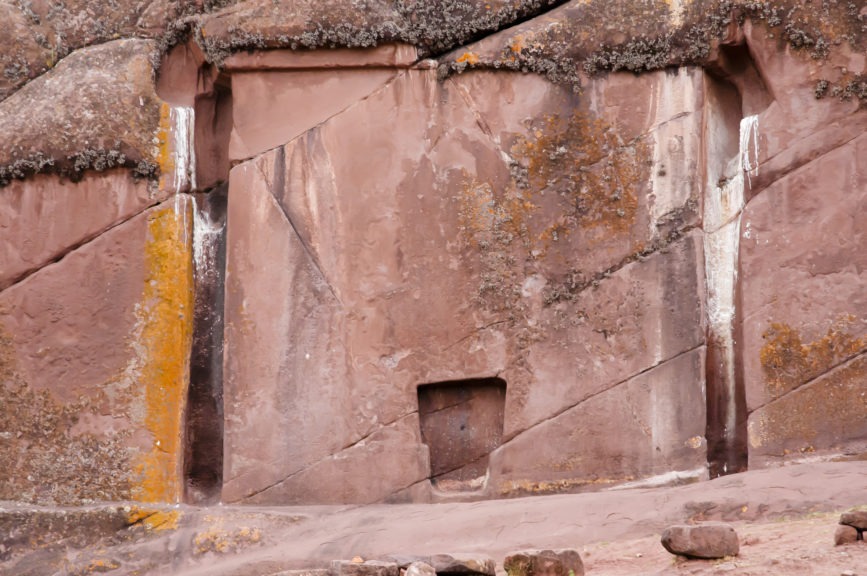
Een locatie die aan deze beschrijving lijkt te voldoen is Puerta de Hayu Marca in Peru. Gelegen op een plateau net buiten de westelijke oever van het Titicacameer, betekent Puerta de Hayu Marca de Poort van de Goden. Met een hoogte en breedte van beide 23 voet, lijkt Hayu Marca, ook bekend als Aramu Muru, een deur of sterrenpoort naar nergens te zijn, uitgehouwen in de Hayu Marca-berg in een afgelegen gebied dat bekend staat als de Vallei van de Geesten of de Steenbos.
Poort van de Goden, Hayu Marca
De legende zegt dat toen Spaanse conquistadores naar Peru kwamen om het goud van de Inca’s te roven, een Inca-priester van de tempel van de Zeven Stralen Hayu Marca gebruikte als een portaal om te ontsnappen. Maru zou een gouden schijf, bekend als de “Sleutel tot de Goden van de Zeven Stralen,” in een uitsparing in het midden van de gebeeldhouwde deur van Hayu Marca hebben geplaatst, waardoor een portaal openging en hij erdoorheen kon lopen naar een nieuwe wereld, om nooit meer gezien te worden. Deze mysterieuze deur heeft sommigen doen speculeren of het een wormgat naar een andere dimensie zou kunnen zijn.
Hayu Marca ligt op een Ley-lijn, waar ook de beroemde Poort van de Zon in Tiwanaku op ligt in het naburige Bolivia, samen met verschillende andere belangrijke archeologische locaties van de Inca’s.
Bezoekers van Hayu Marca hebben opmerkelijk ongebruikelijke energievelden ervaren, waarbij sommigen zeggen dat ze pulserende energie voelen die van de rots uitstraalt wanneer ze hun hand in het midden plaatsen. Velen die de oude locatie online hebben bekeken, vermelden dit gevoel van verhoogde of intense energie daar.
Het nabijgelegen Titicacameer werd door de Inca's vereerd en beschouwd als de geboorteplaats van hun beschaving. Het is ook een van de diepste meren ter wereld en er wordt gezegd dat het een verloren stad en een overvloed aan schatten bevat die door de Spanjaarden zijn geplunderd. In 2000 werd de verloren tempel van Atahualpa diep onder het meer ontdekt, wat bijdroeg aan het mysterieuze karakter van deze oude cultuur.
7.Conclusie
Hoewel er momenteel geen direct empirisch bewijs is dat oude sites fungeren als fysieke portalen naar andere dimensies, bieden theoretische fysica, archeologisch onderzoek en metafysische theorieën een intrigerend kader voor deze hypothese. Het combineren van archeologische symboliek, energetisch onderzoek en hogere dimensietheorieën opent de mogelijkheid dat onze voorouders een inzicht hadden in het bestaan van meerdere realiteiten en pogingen ondernamen om toegang daartoe te verkrijgen, mogelijk via speciale locaties.
Het hedendaagse onderzoek moet zich richten op het integreren van geofysica, kwantumveldentheorie en bewustzijnsstudies om deze vragen verder te verkennen. Totdat meer bewijs wordt verzameld, blijft het idee dat oude sites poorten zijn naar andere werelden een fascinerende, zij het speculatieve, gedachtegang die onze nieuwsgierigheid naar de aard van realiteit en ons verleden blijft voeden.
Referenties
Green, M. (2018). De fysica van multidimensionale universums. Amsterdam: Universiteitsdruk.
Hofstadter, D. (2020). De oude wereld en de verborgen krachten. Leiden: Historisch Instituut.
Kaku, M. (2014). De theoretische fundamenten van wormgaten. New York: Oxford University Press.
Van der Meer, S. (2021). Energetische anomalieën bij megalithische sites. Journal of Archeoenergetics, 12(3), 45-67.
Watts, A. (2017). Bewustzijn en dimensies: de link tussen geest en materie. Filosofisch Tijdschrift, 45(2), 89-105.
Samenvatting: Dit artikel heeft een uitgebreide analyse gepresenteerd over de plausibiliteit dat oude locaties fungeren als portalen naar andere dimensies. Door archeologische, fysische en metafysische perspectieven te combineren, wordt duidelijk dat hoewel er geen sluitend bewijs is, de theorie een fascinerend inzicht biedt in onze geschiedenis en de mogelijke complexe structuur van het universum. Verdere interdisciplinair onderzoek is essentieel om deze wetenschap verder te ontwikkelen.
James Webb telescope reveals sharpest-ever look at the edge of a black hole — and it could solve a major galactic mystery
James Webb telescope reveals sharpest-ever look at the edge of a black hole — and it could solve a major galactic mystery
Story by Ivan Farkas
Astronomers have revealed theJames Webb Space Telescope's(JWST) sharpest-ever image of the area around a black hole. The spectacular view could help solve a decades-long mystery while reversing a long-held belief about space's most extreme objects.
Since the 1990s, astronomers have observed a curious brightness in infrared wavelengths surrounding the active supermassive black holes (SMBHs) at the centers of some galaxies. Previously, they attributed these excess infrared emissions to the outflows — superheated streams of matter blasted from black holes.
But in a new study published Jan. 13 in the journal Nature Communications, an international team of researchers used JWST to look into the heart of the nearby Circinus galaxy, located only about 13 million light-years from Earth, to reveal the area around the galaxy's SMBH.
The data from JWST, paired with numerous ground-based observations, reveal that the infrared excess is coming from the disk of dusty material that's falling into the Circinus galaxy's central SMBH, rather than from material flowing away from it.
This galactic revelation can help astronomers better understand the growth and evolution of SMBHs, as well as these massive dark monsters' influence on their host galaxies.
Of doughnuts and disks
Active black holes like those at the centers of galaxies are fed by a giant ring of infalling gas and dust. As a black hole draws material from the inner wall of this "doughnut," known as a torus, the material forms a thinner accretion disk that spirals into the black hole like water spiraling into a drain.
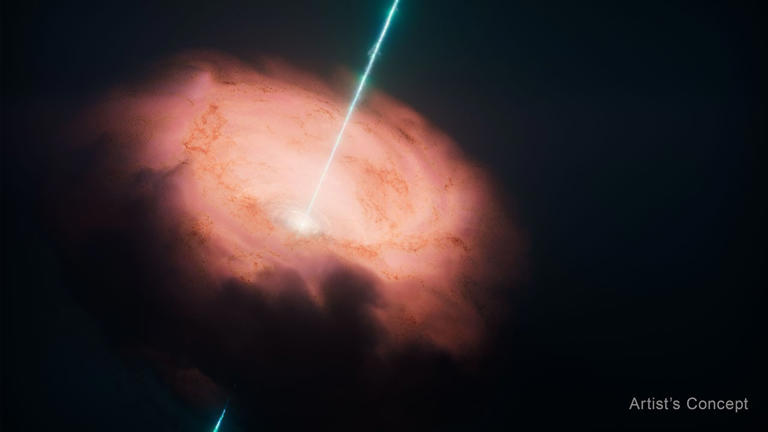
An illustration of a supermassive black hole spewing an energetic outburst into space
(Image credit: NASA, ESA, CSA, Ralf Crawford (STScI))
The black hole's tidal forces accelerate the infalling matter to great speeds. The resulting friction within the disk causes the swirling matter to emit light that glows so brightly that it obscures astronomers' view of the inner region around the black hole.
Yet black holes are not vacuum cleaners, and even they have a feeding limit. So they blast some of the swirling material back into space, in the form of jets or "winds." Therefore, an understanding of the nature of a black hole's torus, accretion disk and outflows is key to knowing how black holes of various sizes accrete and expel matter to potentially shape their host galaxies by quenching or enhancing star formation across galactic scales.
This image from NASA’s Hubble Space Telescope shows the Circinus galaxy. A close-up of its core from NASA’s James Webb Space Telescope shows the inner face of the hole of the donut-shaped disk of gas disk glowing in infrared light. The outer ring appears as dark spots.
| Credit: NASA, ESA, CSA, Enrique Lopez-Rodriguez (University of South Carolina), Deepashri Thatte (STScI); Image Processing: Alyssa Pagan (STScI); Acknowledgment: NSF's NOIRLab, CTIO
Resolving a long-standing mystery
The dense gas and bright starlight in Circinus previously prevented astronomers from viewing the galaxy's central region and SMBH in detail.
"In order to study the supermassive black hole, despite being unable to resolve it, they had to obtain the total intensity of the inner region of the galaxy over a large wavelength range and then feed that data into models," lead study author Enrique Lopez-Rodriguez, a galaxy evolution researcher at the University of South Carolina, said in a NASA statement.
Earlier models separately fit the observed spectra of the torus, accretion disk and outflows, but they couldn't resolve the region in its entirety. As a result, astronomers could not explain which part of the SMBH's surroundings caused the excess emissions in infrared light.
JWST's advanced capabilities allowed astronomers to peer through the dust and starlight of Circinus so they could get a sharper view of the SMBH's environment. To do so, they used an imaging technique known as interferometry.
Ground-based interferometry generally requires an array of telescopes or mirrors that work together to gather and combine light from a celestial object over a large area. By combining light from multiple sources, this method causes the electromagnetic waves that form that light to create interference patterns that astronomers can analyze to reveal the sizes, shapes and other characteristics of those objects.
Unlike these terrestrial facilities, however, the space-based JWST can operate as its own interferometer array via its aperture masking interferometer (AMI), a component of the telescope's Near-Infrared Imager and Slitless Spectrograph (NIRISS) instrument. Like a camera aperture, AMI is an opaque physical mask with seven small, hexagonal holes that control the amount and direction of light entering JWST's detectors.
Overall, AMI effectively doubles JWST's resolution. "This allows us to see images twice as sharp," Joel Sanchez-Bermudez, an astrophysicist at the National University of Mexico and co-author of the study, said in the statement. "Instead of Webb's 6.5-meter [21 feet] diameter, it's like we are observing this region with a 13-meter space telescope."
By doubling its resolution, JWST captured its sharpest-ever view of a 33-light-year-wide area at the center of Circinus. This unprecedented image allowed researchers to calculate that the majority — around 87% — of the excess infrared emissions come from the dusty disk that's actively feeding the central black hole; "the inner surface of the hole of the doughnut," Lopez-Rodriguez said via email. Whereas previous research had suggested that the excess may have come from hot dusty winds, or even the galaxy’s residual starlight, the team found that less than 1% of these emissions come from the energetic outflows streaming away from the SMBH.
The accretion may be extinguishing star formation in the center of Circinus, but confirming this will require a different type of JWST-based observation, Lopez-Rodriguez said.
An invaluable perspective
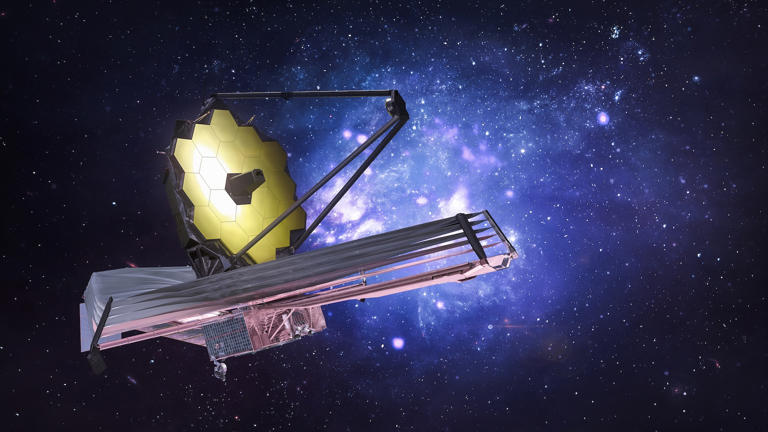
An illustration of the James Webb Space Telescope in orbit
(Image credit: Getty Images)
In addition to revealing previously hidden SMBH mechanics, this research highlights the potential of JWST-based interferometry for studying various celestial objects, including other active SMBHs at the cores of nearby galaxies. By increasing the sample size, astronomers hope to determine whether the infrared emissions from other SMBHs are due to their dusty disks or to their hot outflows.
"AMI has to be used — in order to get precious JWST time — on targets which cannot be done from the ground, or at wavelengths that are blocked by the Earth's atmosphere," study co-author Julien Girard, a senior research scientist at the Space Telescope Science Institute, told Live Science via email.
AMI-based observations can better illuminate our own solar system; they recently offered a detailed look at the volcanoes on Jupiter's hellish moon Io, Girard added. So AMI can observe diverse cosmic objects of varying shapes and sizes, from moons oozing with lava to black holes obscured by dust. In the future, it could help astronomers detect moons around prominent asteroids or reveal the orbits and masses of multistar systems, Girard added.
Like this article? For more stories like this, follow us on MSN by clicking the +Follow button at the top of this page.
NASA has revealed the sharpest ever look at the edge of a black hole, and it could solve a decades–old galactic mystery.
Located 13 million light–years from Earth, the Circinus Galaxy is home to a supermassive black hole that is constantly blasting radiation into space.
The clouds of hot gas surrounding this black hole are so bright that seeing any real details has previously been all but impossible.
Now, NASA has used the James Webb Space Telescope (JWST) to unveil the strange and powerful forces on the very edge of this black hole.
Supermassive black holes like the one in Circinus remain active by constantly consuming matter from the surrounding galaxy.
Scientists had observed that this process creates a huge amount of infrared energy, but most telescopes weren't sensitive enough to see where it was coming from.
Previously, scientists thought most of this radiation was coming from the black hole's 'outflow' – a stream of superheated matter fired out from the core.
Now, these new observations from the JWST have turned that expectation on its head.
NASA has revealed the closest ever look at the edge of a black hole 13 million light–years from Earth, and it could help solve a decades–old galactic mystery. Pictured: The new James Webb Space Telescope image overlaid on the Hubble image
A black hole is the ultra–dense heart of a dead star where gravity is so strong that not even light can escape.
Supermassive black holes, like the one in the Circinus Galaxy, become 'active' by consuming vast quantities of matter from their surrounding galaxy.
As this matter falls inwards, it forms a dense doughnut–shaped ring called a torus that orbits the black hole.
A supermassive black hole gathers material from the torus' inner walls to form an accretion disc, a swirling whirlpool of matter that circles the black hole like water going down a drain.
This accretion disk starts to get hotter through friction until it begins to glow bright enough to show up on our telescopes.
Although astronomers' models make predictions about how these different parts should interact, it is extremely difficult to see this process in action.
The light from the accretion disk blocks out any details, while the incredibly dense torus hides the inner region of infalling matter from view.
The Circinus galaxy is home to an active supermassive black hole that constantly blasts infrared radiation into space. However, scientists have struggled to determine exactly where around the black hole this radiation comes from
Scientists would try to fit the different wavelengths of light they observed to the emissions from different regions of the black hole, but not everything could be made to fit neatly.
Most notably, some telescopes could detect an excess of infrared light coming from somewhere in the black hole, but didn't have the resolution to work out where it was coming from.
Lead author Dr Enrique Lopez–Rodriguez, of the University of South Carolina, says: 'Since the 90s, it has not been possible to explain excess infrared emissions that come from hot dust at the cores of active galaxies, meaning the models only take into account either the torus or the outflows, but cannot explain that excess.'
Models assumed that most of the mass, and therefore most of the emissions, would be in the outflow.
But to test this, astronomers needed a way to both filter out the interfering starlight and distinguish the infrared emissions of the torus from those of the outflows.
Luckily, the JWST offered an innovative solution to both of these problems.
The scientists used a tool called the Aperture Masking Interferometer, which essentially converts JWST into several smaller telescopes that all work together.
On Earth, interferometers are usually many different radio or optical telescopes that work together as if they were a single, enormous observatory.
Using a new technique, scientists were able to determine that most of the radiation is coming from a swirling doughnut of matter known as the taurus, not from the jet of ejected matter as previous studies had believed
The JWST can replicate this same trick by using a special cover with seven hexagonal holes.
Dr Lopez–Rodriguez told the Daily Mail: 'Interferometry is the technique that provides us with the highest angular resolution possible.
'Using aperture masking interferometry with the JWST is like observing with a 13–meter space telescope instead of a 6.5–meter one.'
Gathering data with this technique, the scientists were able to create an image of the central region.
This is the first extragalactic observation from an infrared interferometer in space, and offers an unprecedented look into the core of an active galaxy.
Contrary to previous estimates, around 87 per cent of the infrared emissions from hot dust in Circinus come from the areas closest to the black hole, while the outflow contributes less than one per cent.
This is a total reversal of what had been predicted by astronomers' best models for supermassive black holes.
However, while the mystery of Circinus' black hole has been solved, there are billions more supermassive black holes out there in the universe.
These images were possible thanks to a technique that converts the James Webb Space Telescope's mirror (artist's impression) into several smaller lenses that all work together to provide extreme resolution in a very small area
Circinus' accretion disc was only moderately bright, so it makes sense that the torus would dominate its emissions.
But for brighter black holes, the opposite might still be the case, and far more case studies will be needed.
With this research, astronomers found a technique to investigate any black holes they chose, so long as they are bright enough for the Aperture Masking Interferometer to be useful.
Dr Lopez–Rodriguez says: 'We need a statistical sample of black holes, perhaps a dozen or two dozen, to understand how mass in their accretion disks and their outflows relate to their power.'
Black holes are so dense and their gravitational pull is so strong that no form of radiation can escape them - not even light.
They act as intense sources of gravity which hoover up dust and gas around them. Their intense gravitational pull is thought to be what stars in galaxies orbit around.
How they are formed is still poorly understood. Astronomers believe they may form when a large cloud of gas up to 100,000 times bigger than the sun, collapses into a black hole.
Many of these black hole seeds then merge to form much larger supermassive black holes, which are found at the centre of every known massive galaxy.
Alternatively, a supermassive black hole seed could come from a giant star, about 100 times the sun's mass, that ultimately forms into a black hole after it runs out of fuel and collapses.
When these giant stars die, they also go 'supernova', a huge explosion that expels the matter from the outer layers of the star into deep space.
Do people know what “Christ” really means in Jesus Christ?
Do people know what “Christ” really means in Jesus Christ?
Story by Olivia Harper
“His name would probably have been in Aramaic: Yeshua.” In this single statement, Professor Dineke Houtman returns a familiar character to an alien environment, one in which “Jesus” was not yet a word, in which a Galilean village might well have been home to more than one language.
Image Credit to wikipedia.org
In first-century Galilee, the language was Aramaic, a Semitic language closely related to Hebrew that was in common usage in the area. The first communities, in and around Nazareth and Capernaum, were Aramaic-speaking, and these communities are reflected in the Gospels in tiny, glancing moments: prayers, nicknames, and imperative verbs written in Greek but reflecting an earlier pronunciation. Candida Moss supplies a further, subversive, fact: “Most scholars also accept that his name was Yeshua or perhaps Yeshu, which was a very common name in first-century Galilee.” The word common is the pivot. The historical Jesus did not have a proper, trademark-style name; he shared one with his contemporaries.
It is its very ordinariness, its rootedness in the everyday, which helps explain the importance of the linguistic change. With the movement expanding beyond the Aramaic-speaking community, the name Jesus necessarily entered Greek, the alphabet of the eastern Mediterranean and the language of the New Testament itself. Greek offered its own set of restrictions. There is no “sh” sound, and the language doesn’t favor the masculine name suffix “-ah.” This is not translation but adaptation, and Yeshua became Iesous, the spelling which fit Greek hearing and syntax. Later, Latin reduced the spelling of Iesous to Iesus, and the English version of the name eventually changed the first letter from “I,” which didn’t exist in ancient times and entered the alphabet late, to “J,” which is the letter it is today.
Names, after all, rarely travel alone. The second half of “Jesus Christ” carried a different kind of freight.
“Christ” is not a surname but a title, taken from the Greek christos, or “anointed one.” In Jewish tradition, anointing denoted kings and prieststhe mark of their position was oil. “Christ” was a way of indicating that Jesus was the anticipated messiah, and in some of the oldest texts of the New Testament, such as the letters of Paul, the title is simply assumed to be known, and “Christ” is used as if it were a name that did not belong to another person. In such a linguistic gesture, a claim resides quietly within the grammar: a title becomes a name because of the way a community repeats it as if it could not possibly belong to another person.
However, this combination of title and given name also accounts for what confuses us today. “Jesus” has a unitary, specific ring to it, while “Christ” has an last-name finality to it, though it was really an announcementYeshua, the anointed one. The longer, more regional versions of it, “Yeshua” or “Yeshu,” can have a jarring quality to them not because they represent a different person but because they remind us of proportions man to place to origins, not last names.
There is also a second, less comfortable form of afterlife in those earlier traditions as well. In later Jewish literature, “Yeshu” is found as a name associated with discourses about identity and demarcation, and even who or what “Yeshu” is is in question. The use of “Yeshu” in rabbinic literature, and any connection of Jesus with people named Yeshu, has been characterized as being quite complex in historical terms, with more than one figure and timeline at work. This is only true in general, however, insofar as names in antiquity are tools of society before they are symbols of theology.
Rather than a pure sound that is passed down through each alphabetic handoff, it is a striving to declare the same person in different rooms. The transition from Yeshua through Iesous to Iesus and finally Jesus illustrates how a religion that reached out also had to be able to be pronounced that is, without relinquishing the claim implicit within its name.
What we know from decades of UFO government investigations
What we know from decades of UFO government investigations
Mysterious flying objects. Claims of crashed alien spacecrafts. The U.S. has spent decades inquiring into the unknown—here's what they've learned.
This image released by the U.S. Department of Defense shows a 2004 encounter between two Navy fighter jets and an unknown object near San Diego. But are UFO sightings like this one a sign of extraterrestrial life, spies from a rival nation—or just weird weather?
Photograph by DEPARTMENT OF DEFENSE/The New York Times/Redux
By Joel Mathis
Mysterious flying objects and claims of crashed alien spacecraft have long intrigued both the public and officials worldwide. In recent years, significant advancements have been made in understanding these phenomena.
There’s something strange going on in the sky, but what?
The Pentagon denied the report, but the U.S. Congress remained interested—and, in June, the House Oversight Committee announced it will hold a hearing on UFOS—or as the U.S. government calls them, “Unidentified Aerial Phenomena” (UAPs). “In addition to recent claims by a whistleblower,” a committee spokesperson said, “reports continue to surface regarding unidentified anomalous phenomena.”
Such reports have been surfacing for decades. The modern era of UFO sightings and investigations started after World War II with a sudden surge of unexplained reports.
U.S. officials didn’t necessarily dream of meeting extraterrestrials in their investigations: As the Cold War with the Soviet Union got underway, American leaders worried that UFOs represented a threat from a rival nation. Aliens never invaded, although new sightings happen all the time—as do investigations into those reports.
1947-1969: Project Blue Book
Over the course of two decades, the U.S. Air Force cataloged 12,618 sightings of UFOs as part of what is now known as Project Blue Book. These include lights, objects, and unexplained radar readings reported by military and civilian pilots, weather observers, astronomers and other sources.
The project came to an end in 1969 after a study by the University of Colorado concluded there was no evidence that UFOs came from other worlds, and that most sightings could be explained by natural phenomena, or even hoaxes. “Our general conclusion is that nothing has come from the study of UFOs in the past 21 years that has added to scientific knowledge,” said the study leader, Edward U. Condon. Further investigation, he said, “cannot be justified.”
Still, rumors and sightings persisted—sometimes to the annoyance of the original investigators. The Air Force announced in a 1985 fact sheet that “there are not now nor ever have been, any extraterrestrial visitors or equipment on Wright-Patterson Air Force Base,” where the investigation was headquartered.
1995: A U.S. senator takes interest
The Condon report didn’t put an end to interest in UFOs. So-called “UFOlogists” spent the next few decades filing open records requests with federal agencies to uncover what was known about the sightings.
“A lot of people said it would ruin my career,” Reid later said. That didn’t quite happen: Reid would eventually become a key figure in driving the U.S. government’s investigation of UFOs.
2004: An encounter off San Diego
In November 2004, two Navy pilots on a training mission were ordered to intercept a mysterious craft. They saw—and captured on video—an unusual oval-shaped craft, about 40 feet long, hovering over the Pacific Ocean about a hundred miles off San Diego. It streaked away before the pilots could get near. “I have no idea what I saw,” said one of the pilots, Cmdr. David Fravor, at the time. “It had no plumes, wings or rotors and outran our F-18s.”
“What was considered science fiction is now science fact,” the agency said in briefing papers. The program was run by a military intelligence official, Luis Elizondo, and worked hand-in-hand with an aerospace research company run by Bigelow.
2014: A near-collision on the East Coast
In a series of incidents during this time, Navy pilots reported—and made video recordings—of a series of encounters with unidentified craft near Florida and Virginia that could reach high altitudes and hypersonic speeds. One pilot reported a near-collision in 2014. Another later told 60 Minutes that the craft were hard to explain. “You have rotation, you have high altitudes. You have propulsion, right? I don't know. I don't know what it is, frankly.”
One possibility? Surveillance craft from another country.
2017: Going public
These incidents and investigations mostly went unreported to the broader public—until December 2017, when the New York Times reported the existence of the Pentagon’s Advanced Aerospace Threat Identification Program. Although Pentagon officials said the program had ended in 2012, Elizondo told the paper he continued its work informally with cooperation from the Navy and CIA until his resignation in the fall of 2017.
That sparked a new wave of interest in UFOs among the public, the media, and even scientists.
2020: A scientific call to action
In July 2020, Ravi Kopparapu and Jacob Haqq-Misra—a NASA scientist and astrobiologist, respectively—wrote in Scientific American that it was time to revisit the conclusions of the Condon report. “Perhaps some, or even most, UAP events are simply classified military aircraft, or strange weather formations, or other misidentified mundane phenomena,” they wrote. “However, there are still a number of truly puzzling cases that might be worth investigating.”
In August 2020, the Pentagon announced the Unidentified Aerial Phenomena Task Force to “improve its understanding of, and gain insight into, the nature and origins” of the unidentified objects.
In June, the Office of the Director of National Intelligence (DNI) released its “preliminary assessment” of UFO sightings from 2004 to 2021. The report suggested that the UFOs—now known as UAPs—could fall into five likely categories: airborne clutter, natural atmospheric phenomena, public and private aerospace developmental programs, foreign adversary systems, “and a catchall ‘other’ bin.” More funding and reporting was needed, the report said.
2022: NASA jumps in to investigate
In April 2022, the Pentagon announced the formation of the All-domain Anomaly Resolution Office to investigate objects “that might pose a threat to national security.”
The following June, NASA announced it was setting up an independent study program to cover the issue from a scientific perspective. “We will be identifying what data—from civilians, government, nonprofits, companies—exists, what else we should try to collect, and how to best analyze it,” said David Spergel, the study team leader.
And 2022 also brought another acronym change: “Unidentified Aerial Phenomena” are now officially called “Unidentified Anomalous Phenomena.”
2023: The truth is still out there
Whatever is happening up above, it still hasn’t entirely been explained. The DNI released a follow-up report in June 2023, identifying an additional 510 sightings—of which 171 remained unexplained. In those cases, unidentified craft often “appear to have demonstrated unusual flight characteristics or performance capabilities,” the report said.
Most explosively, a former intelligence official named David Grusch came forward in June with a whistleblower report alleging the U.S. government was in possession of “intact and partially intact vehicles” from UFO crash sites. The craft, he said, were of “non-human” origin. But he also said he had never personally seen the objects, inviting skepticism from outside experts.
“In the long history of claims of extraterrestrial visitors, it is this level of specificity that always seems to be missing,” said Boston University’s Joshua Semeter, a professor of electrical and computer engineering and a member of the NASA team examining these reports, told BU Today. The evidence may be wanting, but the questions—and the sightings, and the investigations—continue.
2024: Continued Investigations and Scientific Approaches
In 2024, the global effort to analyze and understand Unidentified Aerial Phenomena (UAP) has become more sophisticated and collaborative than ever before. Governments, space agencies, scientific organizations, and private companies are working together to collect high-quality data using advanced technology and scientific methods. For example, NASA has expanded its UAP research programs, partnering with international agencies such as the European Space Agency (ESA) and private organizations like SpaceX. These collaborations aim to deploy new satellite systems and advanced sensors that can capture high-resolution, multi-spectral images of mysterious objects in the sky, leading to more accurate analyses.
The Pentagon’s All-domain Anomaly Resolution Office (AARO) continues its important work of cataloging and monitoring sightings of UAPs across various environments—air, sea, and land. This office emphasizes transparency, regularly releasing declassified reports to the public and briefing government officials and scientists. For instance, recent reports include encounters involving military aircraft tracking swift, inexplicable objects that exhibit capabilities beyond current human technology. These ongoing investigations underscore the need for security and safety, as well as a scientific approach to debunk or understand these phenomena.
Technological improvements have played a pivotal role. New radar systems now offer greater detection ranges and precision, while artificial intelligence (AI) is used to analyze atmospheric data and identify patterns that might explain some sightings. For example, AI algorithms can process vast amounts of sensor data to distinguish between natural phenomena like weather balloons or drones and truly anomalous objects. Moreover, advances in deep learning enable scientists to classify visual sightings in real-time, helping to identify whether a UAP is potentially man-made, natural, or genuinely unknown.
Despite these technological and scientific developments, reports of unexplained flights and sightings still emerge regularly. Some examples include fast-moving lights that appear to change direction abruptly or hovering objects emitting no noise, defying conventional explanations. However, government agencies remain committed to applying rigorous scientific methods—such as analyzing flight characteristics, electromagnetic signatures, and environmental conditions—to demystify these objects.
In summary, 2024 marks a significant step forward in the scientific investigation of aerial anomalies. Through international collaboration, improved technology, and transparency, humanity is increasingly equipped to understand the origins and nature of these mysterious phenomena—paving the way for potentially groundbreaking discoveries about our universe.
2025: Rising Public and Government Engagement
By 2025, both public engagement and government transparency regarding unidentified anomalous phenomena (UAPs) have reached unprecedented levels. Citizens worldwide are increasingly interested in understanding these mysteries, driven by a surge in official disclosures and media coverage. Governments, previously hesitant to release classified information, are now declassifying reports that contain detailed data on UAP sightings, radar readings, and sensor analyses. For example, several national defense agencies have released previously confidential documents showcasing UAPs performing extraordinary maneuvers — such as sudden acceleration to hypersonic speeds or securely turning in ways that defy known aerodynamics. These revelations have sparked widespread curiosity and debate among scientists, journalists, and the public alike.
Most Unbelievable UFO Encounters Ever | The Proof Is Out There | History
In addition, whistleblower testimonies continue to surface, fueling speculation about whether these phenomena might involve advanced technology from unknown sources. For instance, several former military personnel have come forward claiming to have witnessed or interacted with UAPs in sensitive operations. One such case involved a retired fighter pilot describing encounters with objects capable of instantaneous acceleration and hovering silently at high altitudes, with some suggesting these could be evidence of breakthrough propulsion systems not yet understood by human science. While these testimonies are compelling, they have not yet led to conclusive proof of extraterrestrial origin, leaving the debate open-ended.
The international community has also initiated cooperation projects aimed at better understanding and managing UAP data collection. Countries like the United States, Canada, and European nations are working together to standardize reporting procedures, sharing databases, and developing common analysis protocols. For example, multinational task forces now collaborate to analyze radar and satellite data to identify patterns or anomalies. These efforts foster an environment of transparency and shared knowledge, encouraging collaboration rather than competition.
Despite the progress, the overall consensus remains one of cautious curiosity. Governments and scientists are wary of jumping to conclusions without concrete evidence. Each year, new investigations yield fresh insights—ranging from unexplained electromagnetic signals to the discovery of anomalous debris potentially linked to UAPs — yet definitive proof of extraterrestrial life remains elusive. This ongoing pursuit exemplifies humanity’s persistent desire for understanding, balanced with a cautious scientific approach that respects the mystery’s complexity.
Future Perspective 2026:
Looking toward 2026, the focus will shift dramatically toward enhanced technological integration and strengthened international partnerships to better understand mysterious phenomena. Advances in sensor technology, such as more sensitive and accurate radar and imaging devices, will enable scientists to detect and analyze unusual events with greater precision. For example, improvements in satellite-based sensors could allow for the continuous monitoring of aerial phenomena from space, providing crucial data that was previously unavailable. Additionally, the development of secure and open data-sharing platforms between countries will facilitate collaborative research efforts, making it possible to compile comprehensive global databases on unexplained sightings.
Government officials discuss UAPs, alien life in new documentary
Public interest in these phenomena is expected to continue to grow, driven by popular culture, media coverage, and individual accounts. This increasing curiosity will likely put pressure on governments to be more transparent, perhaps leading to official releases of previously classified information or the establishment of dedicated task forces. Although definitive proof remains elusive, ongoing scientific and technological advances foster hope that we will soon have clearer answers. For instance, breakthroughs in artificial intelligence could assist in identifying patterns within vast data sets, revealing clues that were hidden before.
Ultimately, by 2026, humanity may be closer than ever to answering the age-old question: Are we truly alone in the universe or merely observing phenomena that challenge our current understanding? The combination of cutting-edge technology, international cooperation, and public engagement sets a promising stage for groundbreaking discoveries in the near future.
Giant squid? Wild weather? Here’s what may—and may not—be behind the strange disappearances in the Bermuda Triangle.
In Wilhelm Blaeu’s circa 1650 Atlas illustrating the Caribbean Sea, the Bermuda Triangle is indicated between the Bermuda Archipelago, Miami, and Puerto Rico.
Giancarlo Costa/Bridgeman Images
By Hillary Mayell
The Bermuda Triangle is an area of the ocean roughly bounded by Miami, Bermuda, and Puerto Rico. No one keeps statistics, but in the last century, numerous ships and planes have simply vanished without a trace within this imaginary triangle.
Unusual features of the area had been noted in the past. Christopher Columbuswrote in his log about bizarre compass bearings in the area. In March 1918, the U.S. naval vessel the U.S.S. Cyclops disappeared without a trace.
But the region didn’t get its name until August 1964, when Vincent Gaddis coined the term Bermuda Triangle in a cover story for Argosy magazine about the disappearance of U.S. Navy Flight 19. The article stimulated a virtual cottage industry in myth-making.
A shipwreck sits off Bermuda’s shore.
EMIL P. ALBRECHT
Many exotic theories have attempted to explain what happened to vessels traveling in the area. The disappearances have been attributed to the machinations of enormous sea monsters, giant squid, or extra-terrestrials.
Alien abductions, the existence of a mysterious third dimension created by unknown beings, and ocean flatulence—the ocean suddenly spewingreat quantities of trapped methane—have all been suggested as culprits.
Lieutenant A. L. Russell, in the U.S. Coast Guard’s official response to Bermuda Triangle inquiries, wrote: “It has been our experience that the combined forces of nature and the unpredictability of mankind outdo science-fiction stories many times each year.”
Here’s the history and the reality of the Bermuda Triangle legend.
Flight 19 and the Bermuda Triangle
The legend of the Bermuda Triangle will be forever tied to the fateful flight that took place on December 5, 1945. At 2:10 p.m. on that sunny day, five TBM Avenger Torpedo Bombers carrying 14 men took off on a routine training mission from the U.S. Naval Air Station in Fort Lauderdale, Florida.
Led by instructor Lieutenant Charles Taylor, the assignment was to fly a three-legged triangular route with a few bombing practice runs over Hen and Chickens Shoals.
Five Grumman TBF-1 Avengers fly in formation over Norfolk, Virginia, in September 1942. Flight 19, which was lost in the Bermuda Triangle in December 1945, was flying the same type of aircraft seen here.
Horace Bristol, National Archives
Taylor, in an age before GPS became commonplace for navigation, got hopelessly lost shortly after the bombing run. Pilots flying over water in 1945 had to rely on compasses and knowing how long they’d been flying in a particular direction, and at what speed.
Both of the compasses on Taylor’s plane were apparently malfunctioning. Transcripts of in-flight communications suggest he wasn’t wearing a watch. There are no landmarks in the middle of the ocean.
The planes flew in one direction then another as balmy daylight turned to stormy seas in the darkness.
Taylor is heard formulating a plan; as soon as the first plane’s fuel level dipped below 10 gallons, all five planes were to ditch at sea.
The Avenger was known as an extremely rugged plane. Pilots sometimes called them “Iron Birds” or Grumman ironworks, said Mark Evans, a historian at Naval History & Heritage Command.
“They were built like tanks,” he said. “Time and again they’d come back from battle all shot up and still functioning. Pilots loved them.”
They were also very heavy, weighing more than 10,000 pounds (4,535 kilograms) empty. When ditched, the Avenger would go down hard and fast.
The possibility of anyone surviving a landing in high seas was slim, the chance of surviving the night in the cold waters was nil, the likelihood of the wreckage making a quick descent to the bottom was high.
A massive land and sea search was mounted, but neither bodies nor wreckage were ever found.
Adding to the tragedy, one of the rescue planes also disappeared along with its 13-man crew. Their plane, a PBM Mariner, was nicknamed the “flying gas tank”; the slightest spark or a lit match could cause an explosion.
A ship in the area reported seeing a huge fireball and crossing through an oil slick at the exact time and place where the plane would have been. The Navy halted production of that plane in 1949.
In the Navy’s final report, the disappearance of Flight 19 was blamed on pilot error. Taylor’s family protested and, after several reviews, the verdict was changed to “causes or reasons unknown.”
Over the years, more mysterious disappearances have occurred, adding to the triangle’s eerie reputation.
The Bermuda Triangle region has some unusual features. It’s one of only two places on Earth—the other being an area nicknamed the Devil’s Sea off the east coast of Japan, which has a similar mysterious reputation—where true north and magnetic north line up, which could make magnetic compass readings dicey.
It is also home to some of the deepest underwater trenches in the world; wreckage could settle in a watery grave miles below the surface of the ocean.
Most of the ocean floor in the Bermuda Triangle is about 19,000 feet (5,791 meters) down; near its southern tip, the Puerto Rico Trench dips at one point to 27,500 (8,229 meters) feet below sea level.
Treacherous shoals and reefs can be found along the continental shelf. Strong currents over the reefs constantly breed new navigational hazards, according to the Coast Guard.
Then there’s the weather.
An encounter between a Remotely Operated Vehicle Deep Discoverer (also known as “D2”) and a four-to-six-foot squid.
However, Feit pointed out, the Gulf Stream travels along the western edge of the triangle and could be a factor. The Gulf Stream is like a 40- to 50-mile-wide (64- to 80-kilometer-wide) river within the ocean that circulates in the North Atlantic Ocean. The warm water and two- to four-knot currents can create weather patterns that remain channeled within it.
“If you have the right atmospheric conditions, you could get quite unexpectedly high waves,” said Feit. “If wave heights are eight feet outside of the Gulf Stream, they could be two or even three times higher within it. Sailors can sometimes identify the Gulf Stream by the clouds and thunderstorms over it.”
The Coast Guard also notes that unpredictable Caribbean-Atlantic storms can yield waterspouts that often spell disaster for pilots and mariners.
Still, given a choice between the horrifying idea of a giant squid’s tentacles wrestling an innocent ship to the sea floor, or an alien abduction, versus human error, shoddy engineering, and a temperamental Mother Nature—who, even today, could resist the legend of the Bermuda Triangle?
Fans of The Secret of Skinwalker Ranch know Dr. Travis S. Taylor as the straight-talking physicist who shows up with laser arrays, data models, and a fearless curiosity that often lands him in danger. But beyond the cameras, Travis Taylor’s real life might be even more fascinating—and more mysterious—than anything you’ve seen on TV.
He’s been called everything from a “mad scientist” to a “government insider.” Some say he’s the show’s truth anchor. Others believe he’s part of a long game to slow-drip disclosure about aliens, portals, and advanced tech.
Whatever the truth is, one thing’s clear: Travis Taylor isn’t your average TV personality.
A Rocket Scientist Before He Could Drive
Born and raised in Decatur, Alabama, Travis S. Taylor was the kind of kid who read Carl Sagan for fun—and built lasers in his backyard before he hit puberty. According to Taylor, he was already working on amateur rocket launches and radio telescopes in high school.
That early obsession led him to a flurry of advanced degrees. And we’re not talking honorary diplomas—he earned multiple PhDs, including in optical science and engineering, as well as a Master’s in astronomy. Add aerospace engineering, physics, and electrical engineering to the list, and you start to understand why NASA and the Department of Defense took notice early.
It’s no exaggeration to say he could probably build a UFO in his garage.
Top-Secret Projects and Pentagon Ties
Before Skinwalker Ranch, Taylor was already deep inside the world of classified defense contracts and advanced weapon systems. He worked on everything from space-based lasers to propulsion systems for Mars missions. At one point, he was consulting with the U.S. Army’s Space and Missile Defense Command.
But things took a stranger turn in the early 2000s when Taylor’s name began surfacing in connection to Pentagon black projects related to UFOs—now known as UAPs (Unidentified Aerial Phenomena).
Most notably, Travis Taylor was later revealed to be a chief scientist for the Pentagon’s UAP Task Force, a previously top-secret group investigating aerial phenomena that defied explanation—including incidents involving Navy fighter pilots and fast-moving craft with no visible propulsion.
In other words: He wasn’t just speculating about UFOs. He was investigating them on behalf of the U.S. government.
Why Skinwalker Ranch?
So how did a high-level defense consultant end up on a Utah cattle ranch with a reputation for UFOs, poltergeists, and invisible creatures?
When The Secret of Skinwalker Ranch launched on the History Channel, producers wanted someone with real scientific chops, someone who could bring hard data to a place saturated with rumor and fear. Taylor was that guy.
He didn’t just bring a laptop and a skeptical eye. He brought spectrum analyzers, electromagnetic detectors, high-speed cameras, and his own team of scientists. Within weeks of arriving, the phenomena escalated—sudden radiation spikes, GPS blackouts, and what appeared to be objects in the sky that defied the laws of physics.
And yet, Taylor didn’t back down. He leaned in. "If there’s something going on here," he famously said, "we’re going to find out what it is—or die trying."
That wasn’t hyperbole. In one episode, Taylor suffered physical symptoms after entering a hot zone. Another time, his team watched in shock as an object moved vertically thousands of feet in seconds.
Was it alien tech? Interdimensional interference? Military experimentation? Taylor never gives a full answer. But the look in his eyes says he’s seen more than he lets on.
A Renaissance Man With a Sci-Fi Twist
Travis Taylor isn’t just a scientist. He’s also a best-selling author, with more than 20 science fiction novels under his belt. His writing fuses hard science with military thrillers and alien conspiracies—many of which now feel eerily prescient.
He’s also appeared on shows like Ancient Aliens, NASA’s Unexplained Files, and Rocket City Rednecks, a show where he literally built advanced weapons out of scrap metal and household parts.
Some fans think his sci-fi background gives him a flair for dramatics. Others believe it’s his way of disclosing real tech under the guise of fiction—a move that mirrors how many believe the U.S. government has been seeding truth through entertainment for decades.
Is Travis Taylor the writer of wild tales, or is he hiding secrets in plain sight?
The Double Life: Public Scientist, Private Operative?
One of the most controversial aspects of Taylor’s presence on Skinwalker Ranch is the question of trust. Is he there to reveal the truth… or control the narrative?
Skeptics point out that someone with Taylor’s level of government clearance wouldn’t be allowed to freely talk about alien tech, energy weapons, or interdimensional portals—unless, of course, he was given permission.
In that light, Taylor could be seen as a conduit—a trusted face feeding the public just enough truth to keep interest high, without ever pulling back the full curtain.
It’s a theory echoed in Reddit threads, YouTube exposés, and even some UFO disclosure circles. And Taylor? He plays it cool. “I can’t talk about that,” he’ll often say with a smile that suggests he knows more than he’ll ever say out loud.
Net Worth: How Much Is Travis Taylor Worth in 2025?
While Travis Taylor isn’t flashing Rolexes or L.A. mansions, make no mistake—he’s done very well for himself. Between his long-standing government contracts, TV deals, book sales, speaking fees, and possible producer credits, Taylor’s estimated net worth in 2025 is in the range of $5–7 million.
Let’s break that down:
TV salary from The Secret of Skinwalker Ranch: Likely $150K–$250K per season
Book royalties from 20+ novels: Steady passive income
Government and defense consulting: Possibly the most lucrative, and the most secretive
Speaking gigs & appearances: Highly paid on the science and conspiracy lecture circuit
And if rumors are true that he’s involved in the next phase of UAP research for the Department of Defense, that number could climb significantly.
Is He the Real Deal?
That’s the question fans ask every season: Is Dr. Travis Taylor legit—or is he part of the show?
Here’s the thing. Taylor is one of the few people in the UFO research space who’s walked both paths:
The scientific community, where he’s published peer-reviewed research and built aerospace systems
The entertainment world, where he’s embraced the stranger side of science
The government intelligence world, where he’s helped shape national UAP policy
That kind of crossover is rare—and powerful. It makes him uniquely credible and uniquely suspicious at the same time.
So is he a whistleblower? A gatekeeper? A genius with a taste for mystery?
Maybe he’s all three.
Final Thoughts: The Man, The Myth, The Mind Behind the Mystery
Whether you see Travis Taylor as a brave truth-seeker or a carefully placed insider, there’s no denying that he’s become one of the most fascinating figures in modern paranormal investigation.
The Secret of Skinwalker Ranch wouldn’t be what it is without him. His presence lends the show scientific weight, intellectual curiosity, and a sharp contrast to the folklore-heavy narrative.
And with each passing season, the question grows louder:
What does Travis Taylor really know… and will he ever be allowed to tell us?
Catch Dr. Travis Taylor on The Secret of Skinwalker Ranch—now streaming on History Channel and Discovery+. You might not get all the answers, but you’ll get closer than ever before.
NASA has debunked a wild conspiracy theory doing the rounds on social media.
The bizarre theory claims that on August 12, at exactly 14.33 GMT (9.33 ET), Earth will lose gravity for seven seconds.
According to its proponents, this 'secret' was revealed in a NASA document named 'Project Anchor', leaked in November 2024.
And the disaster could lead to at least '40 million deaths from falls'.
Unsurprisingly, thousands of concerned viewers took to X to discuss the claims.
'If this is fake, why does it have a date, a project name, and a budget?' one user asked on the platform.
While another concerned commenter added: 'There's gonna be a lot of injuries when everyone comes crashing back down then if it was to happen.'
Now, NASA's experts have put the case to bed once and for all – pointing out that the wacky theory fundamentally misunderstands how gravity works.
NASA has debunked a wild conspiracy theory that the world will lose gravity for seven seconds on August 12
According to NASA, there is no way that the Earth can 'lose' gravity without losing mass, which means this theory is totally without basis
Despite the conspiracy theorists' claims, there is absolutely no trace of any leaked document or mention of Project Anchor online prior to December last year.
A NASA spokesman told fact–checking website Snopes: 'The Earth will not lose gravity on August 12, 2026.
'Earth's gravity, or total gravitational force, is determined by its mass.
'The only way for the Earth to lose gravity would be for the Earth system, the combined mass of its core, mantle, crust, ocean, terrestrial water, and atmosphere, to lose mass.'
Although the exact origins of the conspiracy are unknown, one of the earliest references is from an Instagram user named @mr_danya_of.
In a lengthy post, the user wrote: 'On August 12, 2026, the world will lose gravity for seven seconds. NASA knows. They're preparing but won't tell us why.'
They claimed that this would cause '40 million deaths from falls. Infrastructure destruction. Economic Collapse lasting over ten years. Mass panic.'
The post suggests that this disruption would be caused by 'the intersection of gravitational waves' produced by colliding black holes.
On social media, conspiracy theorists have been sent into a frenzy. One claimed that the 'details are way too specific to ignore'
The post also included some of the supposed details of Project Anchor, claiming that it had a budget of '$89 billion' and was responsible for 'building underground bunkers'.
In their very next post, the user told an entirely fabricated story about 600 people disappearing from the town of Portlock, Alaska, in 2019.
In other posts, the user claimed to work at Google, a morgue, a crematorium, a hospice, as well as being a psychiatrist and a criminologist.
But these details were apparently lost on the numerous accounts that copied the exact text from the original post and spread it over social media.
As the conspiracy spread, other users added more details and embellishments.
For example, one user wrote: 'The Earth is expected to see "zero–gravity" condition on August 12, 2026, at 14.33 UTC, when a Total Eclipse of the Sun will pass over the Arctic Ocean.'
While another user posted a video to Instagram in which they suggested: 'Maybe that's why all these billionaires are building their bunkers.'
Soon, the conspiracy theorists began to turn on each other, accusing other users of being part of the conspiracy.
One concerned conspiracy theorist worried that there might be injuries when gravity returned
However, it wasn't long before the conspiracy theorists turned on one another and accused other theorists of being part of a conspiracy
Conspiracy theorists suggested that the disruption could be caused by gravitational waves produced by colliding black holes. While gravitational waves are real and do come from colliding black holes (artist's impression), they cannot cause Earth to 'lose' gravity
One social media user wrote: 'Gravity as theory is hollow. Nice psyop though. The Deep State is keeping the rabbits busy digging a hole.'
'Makes for a great psyop to get everyone indoors without forcing a lockdown,' added another.
However, there is absolutely no basis in reality for any of these elaborate claims.
Dr William Alston, a black hole expert from the University of Hertfordshire, told the Daily Mail: 'These ripples are so weak that we have had to build the most sensitive detection equipment to see them – known as the LIGO and Virgo observatories.
'These ripples routinely pass through Earth and ourselves, very subtly squeezing and stretching us; however, this is so small – many times smaller than the size of an atom – that this change goes by completely unnoticed.'
Additionally, since gravitational waves move at the speed of light, Dr Alston says these theorists would need a 'physics-defying mechanism' to predict the date of their arrival.
Likewise, while there will indeed be a solar eclipse on August 12, this will in no way affect Earth's gravity.
One user went so far as to claim that 'gravity as a theory is hollow', branding the idea of gravitational attraction as some sort of cover–up
The date of the supposed gravitational switch coincides with a solar eclipse (pictured), but experts say this will not affect Earth's gravity
A solar eclipse occurs when the moon aligns with the sun, so that it appears obscured from our perspective.
The sun and moon do exert a gravitational pull on Earth, but this doesn't change during an eclipse.
The NASA spokesman added: 'A total solar eclipse has no unusual impact on Earth's gravity.
'The gravitational attraction of the Sun and Moon on the Earth, which doesn't impact Earth's total gravity, but does impact tidal forces, is well understood and is predictable decades in advance.'
Over the course of three online-based studies, researchers at the University of Kent showed strong links between the belief in conspiracy theories and certain psychological traits.
Narcissism and self-esteem levels have a large impact on a persons belief in conspiracy theories.
The results showed that people who rated highly on the narcissism scale and who had low self-esteem were more likely to be conspiracy believers.
However, while low self-esteem, narcissism and belief in conspiracies are strongly linked, it is not clear that one - or a combination - causes the other.
But it hints at an interesting new angle to the world of conspiracy and those who reinforce belief.
There are widely believed to be three main reasons as to why people believe in conspiracy theories.
- The desire for control and security - Conspiracy theories can give their believers a sense of control and security.
- The desire to maintain a positive self-image - People who feel socially marginalised are more likely to believe in conspiracy theories and it gives them a sense of worth in the UFO community.
-The desire for understanding and certainty - Seeking explanations for events is a natural human desire.
These three things tie in with the previously stated qualities and combine to create an avid conspiracy theorist.
Viral video alleged NASA knows Earth will briefly lose gravity for seven seconds
The countdown to the first moon mission in more than 50 years officially started Saturday, as NASA rolled out the massive rocket set to blast off in just weeks.
The 11million pound Artemis II rocket reached the launch pad at the Kennedy Space Center in Cape Canaveral, Florida after nearly 12-hour crawl from its home in NASA's Vehicle Assembly Building.
The 10-day manned mission to orbit the moon is set to launch as early as February 6, marking the first manned mission to leave low Earth orbit since Apollo 17 in 1972.
Artemis II will not land on the moon, with NASA saying that the future Artemis III mission scheduled for 2027 will return humans to the lunar surface.
The space agency said Artemis, 'will send astronauts to explore the Moon for scientific discovery, economic benefits, and to build the foundation for the first crewed missions to Mars.'
The crawler-transporter 2 vehicle carried Artemis II's Space Launch System (SLS) rocket and Orion spacecraft along a four-mile route from an assembly building to Launch Pad 39B.
At the launch pad, engineers will spend the next few days preparing SLS and Orion for a 'wet rehearsal' test that includes loading all the propellants that will blast the rocket into space.
NASA Administrator Jared Isaacman said the mission would fulfill 'a promise to the American people that we will return to the moon.'
Artemis II (Pictured) arrived at NASA's Launch Pad 39B Saturday evening as the space agency prepares for its first moon mission in 53 years
Pictured: The rocket will propel a four-person team, comprised of three NASA astronauts and an astronaut from the Canadian Space Agency, out of Earth's atmosphere as soon as February 6
From L-R: Canadian Space Agency astronaut Jeremy Hansen stands alongside NASA astronauts Christina Koch, Victor Glover and Reid Wiseman. Wiseman will also serve as the mission's commander. The group of four address reporters with the rocket and spacecraft directly behind them
NASA astronauts Reid Wiseman, Victor Glover, and Christina Koch, and Canadian Space Agency astronaut Jeremy Hansen are scheduled to briefly orbit the Earth after detaching the Orion spacecraft from its rockets and then set off on their lunar flyby.
With Artemis II now at the launching site, NASA will soon load over 700,000 gallons of super-cold liquid hydrogen and oxygen into the SLS rocket, which are the propellants that ignite and blast the craft into orbit.
NASA will then run through a fake countdown to launch, practice holds and restarts, and then safely drain the tanks of the fuel until it's time for the real launch.
These rehearsals of the fueling procedures help check for any problems with the rocket, such as leaks in the rocket tanks or valves.
If any problems are spotted, NASA will likely need to run multiple rehearsals and possibly delay the launch to one of the many alternate dates already chosen by the space agency.
February 7, 8, 10, and 11 have been chosen as potential backup launch dates if problems or weather issues postpone the February 6 launch. If something prevents a launch in February, NASA has also picked out dates in early March and April.
In September 2025, former NASA Administrator Sean Duffy publicly announced that 'about a year and a half' after the Artemis II mission, the Artemis III astronaut mission would 'land and establish a long-term presence of life on the moon led by America'.
He continued by saying that what astronauts learn from the renewed missions to the moon will help in future efforts to 'put American boots on Mars'.
Pictured: Early in the morning on Saturday, January 17, NASA begins to move the Artemis II rocket out of the Vehicle Assembly Building at NASA's Kennedy Space Center. Next month, it will be used for the first manned mission to the moon since 1972
Over the first 24 to 48 hours in Earth orbit after blasting off, the four astronauts will conduct extensive tests of the Orion spacecraft's life support systems, guidance and navigation computers, and communications before attempting the moon mission.
The journey to the moon is scheduled to take about three to four days, ending with the spacecraft conducting a lunar flyby, looping around the far side of the moon roughly 5,500 miles above the surface.
Artemis II won't enter orbit around the moon, allowing the crew to test deep-space operations and gather data while traveling farther from Earth than any previous human mission.
The moon's gravity will help slingshot the spacecraft back toward Earth on the return leg of the trip, which will take another three to four days.
Pictured: The Artemis II rocket sits in the Vehicle Assembly Building prior to its move
Pictured: The Orion spacecraft sits atop the Artemis II rocket. The spacecraft will carry the astronauts to the moon and back
Pictured: NASA Administrator Jared Isaacman stands with the four astronauts during a press briefing
Koch emphasized how important adaptability is for an astronaut, especially since none of them have been to the moon and it's been decades since a mission like this has been undertaken.
'This idea that, yes, you train and prepare for everything, but the most important thing is that you're ready to take on what you haven't prepared for,' Koch said.
'The moon is like a witness plate for everything that's actually happened to Earth but has since been erased by our weathering processes and our tectonic processes and our other geologic processes,' the astronaut continued.
'We can actually learn more about solar system formation, more about how planets form maybe around other stars, more about the likelihood of life out there - starting with studying the moon.'
At the end of the mission, Artemis II will splash down in the Pacific Ocean, and the spacecraft and crew will be recovered with the help of the US Navy.
NASA mega-rocket for moon mission could launch in weeks
A rare 'Purple Star Sapphire' weighing a whopping 3,563 carats has been discovered in Sri Lanka.
The stunning gem has been named the 'Star of Pure Land', and is believed to be the world's biggest natural star sapphire of its kind.
As the name suggests, star sapphires are known for their star–like qualities, called asterism.
This optical effect creates a shimmering star pattern on the stone's surface.
'This is the largest purple star sapphire of its kind,' consultant gemologist Ashan Amarasinghe said.
'[It] shows a well–defined asterism. It has six rays asterism. That's something special out of all the other stones.'
While the value of the stone remains unclear, Mr Amarasinghe believes it could be worth at least $300 million (£223 million).
If that is the case, it would make the Star of Pure Land one of the most valuable gemstones ever found.
A rare 'Purple Star Sapphire' weighing a whopping 3,563 carats has been discovered in Sri Lanka
The stunning gem has been named the 'Star of Pure Land', and is believed to be the world's biggest natural star sapphire of its kind
Star sapphires appear to have a star in the middle thanks to asterism – an effect caused by small, needle–like inclusions of the mineral rutile.
'Ideally, the star in a star sapphire should be perfectly centered when viewed from directly above, with each ray of equal length,' explains The Natural Sapphire Company on its website.
'The rays should be bright, sharp, and clearly defined – not blurry or fuzzy – and they should reach from the crown of the cabochon to the base without interruption.'
The gem is owned by an unnamed team, who have decided to remain anonymous for security reasons.
One of the owners said the gem was found in a gem pit near the remote Sri Lankan town of Rathnapura, known as the 'city of gems,' back in 2023.
It was purchased together with other gems that year, and about two years later, the owners found that it was a special stone.
They then got it certified by two laboratories.
Mr Amarasinghe said the value of the stone has been estimated at $300 million to $400 million (£223 million to £298 million) by international valuers.
The gem is owned by an unnamed team, who have decided to remain anonymous for security reasons
Star sapphires appear to have a star in the middle thanks to asterism – an effect caused by small, needle–like inclusions of the mineral rutile
That would make the Star of Pure Land one of the most expensive stones in the world – well ahead several prized diamonds.
For example, the Oppenheimer Blue – a blue diamond weighing 14.62 carats – sold for $57.5 million (£42.8 million) in 2016.
Meanwhile, the Williamson Pink Star (11.15 carats) sold for an impressive $57.7 million (£43 million) in 2022.
'Diamonds, sapphires, rubies, and other gemstones are widely coveted throughout the world,' Jeweler's Touch explains on its website.
'While these gemstones are beautiful, the most valuable gemstones in the world offer specific qualities, such as rare details, unique colors, or rich history, that transcend them beyond typical value and into pricelessness.'
Diamonds fetch their lofty price tags because they form over millions of years under high pressures and temperatures deep within the Earth's crust.
But a number of companies are now growing the gems in laboratories across the world, threatening to shake up the diamond industry.
A small 'seed' diamond acts as a scaffolding for the process.
Scientists first place this seed into a vacuum chamber to remove impurities from the air.
Lab-made gems are threatening to upset the diamond industry, with several companies worldwide now growing the stones for jewellery. In this image Pure Grown Diamonds CEO Lisa Bissell unveils a lab-cultivated diamond in New York in 2015
They then funnel hydrogen and methane gas heat to 3,000°C (5,400°F) into the chamber to create a highly charged gas known as plasma.
The gases rapidly break apart, releasing carbon atoms from the methane that collected on the diamond 'seed'.
These atoms naturally copy the crystal structure of organic diamond, which is also made up of carbon atoms.
Each artificial stone grows at a rate of around 0.0002 inches (0.006mm) an hour.
Data from NASA's Polar spacecraft, circa 1998, provided crucial clues to finding magnetic X-points.
A favorite theme of science fiction is "the portal" -- an extraordinary opening in space or time that connects travelers to distant realms. A good portal is a shortcut, a guide, a door into the unknown. If only they actually existed...
It turns out that they do, sort of, and a NASA-funded researcher at the University of Iowa has figured out how to find them.
"We call them X-points or electron diffusion regions," explains plasma physicist Jack Scudder of the University of Iowa. "They're places where the magnetic field of Earth connects to the magnetic field of the Sun, creating an uninterrupted path leading from our own planet to the sun's atmosphere 93 million miles away."
Observations by NASA's THEMIS spacecraft and Europe's Cluster probes suggest that these magnetic portals open and close dozens of times each day. They're typically located a few tens of thousands of kilometers from Earth where the geomagnetic field meets the onrushing solar wind. Most portals are small and short-lived; others are yawning, vast, and sustained. Tons of energetic particles can flow through the openings, heating Earth's upper atmosphere, sparking geomagnetic storms, and igniting bright polar auroras.
NASA is planning a mission called "MMS," short for Magnetospheric Multiscale Mission, due to launch in 2014, to study the phenomenon. Bristling with energetic particle detectors and magnetic sensors, the four spacecraft of MMS will spread out in Earth's magnetosphere and surround the portals to observe how they work.
Just one problem: Finding them. Magnetic portals are invisible, unstable, and elusive. They open and close without warning "and there are no signposts to guide us in," notes Scudder.
Actually, there are signposts, and Scudder has found them.
Portals form via the process of magnetic reconnection. Mingling lines of magnetic force from the sun and Earth criss-cross and join to create the openings. "X-points" are where the criss-cross takes place. The sudden joining of magnetic fields can propel jets of charged particles from the X-point, creating an "electron diffusion region."
To learn how to pinpoint these events, Scudder looked at data from a space probe that orbited Earth more than 10 years ago.
"In the late 1990s, NASA's Polar spacecraft spent years in Earth's magnetosphere," explains Scudder, "and it encountered many X-points during its mission."
Because Polar carried sensors similar to those of MMS, Scudder decided to see how an X-point looked to Polar. "Using Polar data, we have found five simple combinations of magnetic field and energetic particle measurements that tell us when we've come across an X-point or an electron diffusion region. A single spacecraft, properly instrumented, can make these measurements."
This means that single member of the MMS constellation using the diagnostics can find a portal and alert other members of the constellation. Mission planners long thought that MMS might have to spend a year or so learning to find portals before it could study them. Scudder's work short cuts the process, allowing MMS to get to work without delay.
It's a shortcut worthy of the best portals of fiction, only this time the portals are real. And with the new "signposts" we know how to find them.
The work of Scudder and colleagues is described in complete detail in the June 1 issue of the Physical Review Letters.
A new ScienceCast video explains how hidden portals form--and how we can find them.
Fly over the 'Grand Canyon' of Mars in high-resolution orbiter imagery
Fly over the 'Grand Canyon' of Mars in high-resolution orbiter imagery
See the 2,500 mile-long (4000 km) Valles Marineris in imagery captured the Mars Reconnaissance Orbiter. Global topography: NASA/GSFC CTX global mosaic: NASA/MSSS/Caltech/ CTX topography: NASA/MSSS/USGS HiRISE: NASA/U.Arizona/USGS/Amazon
Moses & the Feathered Serpent: Did the Hebrew Lawgiver Secretly Inspire a Mexican Myth?
Moses & the Feathered Serpent: Did the Hebrew Lawgiver Secretly Inspire a Mexican Myth?
Moses, the ancient Hebrew Lawgiver, is certainly never associated with Mexico in any traditional texts, either religious or not, in either the Old or New Worlds. So when a Vermont pastor named Ethan Smith proposed in an 1825 book that Moses may have provided the basis for the Mexican legends of Quetzalcóatl, the famous “Feathered Serpent”, it seemed a radical theory to say the least.
He writes: “Though their ancient ‘legislator’ is called by a name importing the serpent of green feathers; yet he was an ancient man, a white man and bearded; called by Montezuma, a saint, who led them to this country, and taught them many things … Who could this be but Moses, the ancient legislator in Israel?”
The following is an excerpt from the new book Moses in Mexico, which explores this hypothesis.
The Aguada Fénix Connection
Hundreds of previously-unknown ancient settlements have been discovered recently in Mexico, and their apparent antiquity has forced archaeologists to rethink how civilization evolved in the New World. Hiding under a dense jungle canopy, the ruins of once-massive monumental stone constructions were detected using a sophisticated new survey technique called LiDAR. Who had built these structures, and when? The largest and most mysterious was called Aguada Fénix, the “Reservoir of the Phoenix”. It appeared to be oriented towards the rising sun on certain days of the year in February and October.
In a 2020 Nature article, Takeshi Inomata and his team explain how they found these sites:
“We describe an airborne LiDAR survey and excavations of the previously unknown site of Aguada Fénix (Tabasco, Mexico) with an artificial plateau, which measures 1,400 m in length and 10 to 15 m in height and has 9 causeways radiating out from it. We dated this construction to between 1000 and 800 BCE, while charcoal samples from the earliest deposits yielded dates of 1250–1050 BCE. To our knowledge, this is the oldest monumental construction ever found in the Maya area and the largest in the entire pre-Hispanic history of the region.”
LiDAR image of the ancient Maya site of Aguada Fénix, ~1000 BCE. The sprawling platform stands between 33 and 50 feet tall and measures almost a mile long.
Meanwhile, a 2023 study of the settlements’ solar alignments revealed:
“the distribution pattern of dates marked by solar alignments indicates their subsistence-related ritual significance … and represent the earliest evidence of the use of the 260-day calendar.”
These discoveries have forced a rethinking of the history of the New World. Where and when did civilization truly begin? At what point do we see the most accelerated cultural development? Was there a linear trajectory of development, or did it experience any burst of particular magnitude at any point that cannot be explained via standard cultural mechanisms?
There is yet another peculiarity about Aguada Fénix, the largest and earliest Maya structure: its orientation is skewed slightly south of east. While this does not immediately appear to connect with any obvious astronomical occurrence, such as the equinoxes, solstices, or minor or major lunar standstills - it is the same angle of orientation as observed at Tell-El Amarna, the ancient city of Pharaoh Akhenaten in Egypt (specifically between the Small Aten Temple and the Royal Wadi east of the city). Along this angle for twice a year in February and October the king could watch the Aten sun disk rise directly through the Royal Wadi, forming a symbol for the akhet (a hieroglyph that represented the sun rising between two mountains).
We therefore have not only massive stone buildings, which would have required a substantial amount of organized labor to complete, dating from the very earliest years of Mesoamerica culture, but they seem to share specific solar alignments that were used by Akhenaten in Egypt. What is going on here? What inspired a group of hunters and gatherers to suddenly construct the largest religious structures in the region’s history, oriented towards sunrises along the same angle as Akhenaten’s architecture in Egypt, and dating from not long after his historical period? Could it be that Akhenaten-Moses once visited Mesoamerica in the distant past? Could Moses have come to Mexico?
Sunrise over the jungles of Mexico, at the Maya site of Yaxuna, Yucatan. Observing sunrises on certain days in February and October were key aspects of the early 260-day calendar, which may have originated at the Egyptian site of Amarna.
(By author.)
Akhenaten was Moses … And Quetzalcóatl?
My first book Moses Restored (2017) argued how the Egyptian Pharaoh Akhenaten became the Hebrew Lawgiver Moses. It was the first complete biography of this astounding human being. It aimed to show how he continued his religious revolution, by taking the Israelites out of Egypt to Canaan, and laying the foundation for what would become the Judaism we know today.
The history of his kingship was concealed in the early chapters of the Book of Exodus, creating a “Moses mystery” that cried out for a solution. Fitting Moses to Akhenaten solves this mystery, along with so many others, and perhaps only one glaring enigma remains: his death. The Torah ends, as does Moses Restored, with the death of its central character Moses, just outside the boundaries of the Promised Land of Israel, as narrated in the book of Deuteronomy 34: 5-7:
“And Moses the servant of the Lord died there in Moab, as the Lord had said. He (the Lord) buried him in Moab, in the valley opposite Beth Peor, but to this day no one knows where his grave is. Moses was a hundred and twenty years old when he died, yet his eyes were not weak nor his strength gone.”
Akhenaten wears a crown he developed himself, based on the Atef crown of Osiris. It is festooned with sun discs and protective uraei cobras wearing ostrich feathers, literal feathered serpents! Could these motifs have prefigured the Feathered Serpent of Mexico? He burns incense before the sunrise, similar to some Maya priests today. (Plate VIII, Davies, N. de G., The Rock Tombs of El Amarna: Part II, The Tombs of Panehesy and Meryra II, London, Egypt Exploration Fund, 1905).
The book Moses in Mexico continues the amazing story of Moses. What, you ask? Continues the story? Didn’t Moses die? What’s going on? How can his story continue? Well, as will soon become apparent, the death of Moses is as mysterious as his origins. First, as the verse above makes clear, no human buried Moses, but the Lord himself did it. Second, no human knows the location of his grave. Third, despite Moses being of advanced years, his eyes were not weak nor was his strength gone. This seems to suggest that he was not ready to die.
View from the Small Aten Temple at Amarna, the ancient city built by Akhenaten around 1350 BCE, looking east towards the desert cliffs and the distinctive opening to the Royal Wadi, which archaeologists theorize represented the first half of the akhet symbol, the glyph for mountain, djw. Twice a year in February and October the sun appears to rise through the valley opening, completing the akhet symbol and forming a solar hierophany.
(By author. ADDED: The akhet hieroglyph, 2023. By Mazapan3210.)
We therefore have three aspects of the supposed “death” of Moses that immediately seem to cast doubt upon it. These unusual aspects have not gone unnoticed, and several scholars have brought into question whether Moses died as depicted in the Bible or if he actually lived on. Could the Bible be hiding yet another Moses mystery for us to rediscover? I believe the answer is yes, and Moses in Mexico represents the explanation for that answer. It chronicles the final stage of Moses’ life, which I believe brought him to the shores of the New World, specifically Mexico.
It was there, I believe, that he became the mythical hero remembered so fondly across Mesoamerica: the Feathered Serpent, Quetzalcóatl. It was there that his two previous lives, that of a rebellious Pharaoh of Egypt and a renegade Israelite leader and judge, collided to create a new manifestation of his previous likes and interests. It was there that his presence over three millennia ago created such an impact that memories of it rippled out across time and space, creating a strange Pan-Mesoamerican cultural form that retained its basic shape across thousands of miles and years, and has continued to baffle scholars to this day.
AI-generated image of a hypothetical Pharaoh Akhenaten in Mexican graffiti style.
(By author.)
What initiated this sweeping and bold new cultural program in Mexico after 1250 BCE, a program which saw the origins of so many of its diagnostic features, such as: intricate creation cosmologies, urban plans, monumental stone architecture oriented towards sunrises, the priesthood, writing, divine kingship, and even acts of revolution such as the mutilation and decapitation of idols and statues? I believe that it was Moses, who lived in the decades before 1250 BCE.
I believe that by understanding that Akhenaten became Moses, we can understand how Moses became Quetzalcóatl. Without understanding his youth and kingship, obscured in the Bible but nevertheless manifested in hundreds of tiny clues, we cannot understand how or why Moses would have desired to become the Feathered Serpent.
Ultimately, the idea of the historical Moses becoming the historical Quetzalcóatl has never been properly scrutinized because the character of Moses himself has never been properly scrutinized. Scholars have yet to paint in the details of his youth and adult life, before he became the desert exile in Midian. These details are infuriatingly sparse in the Bible. However, if we understand that the Bible was trying to conceal the fact that Moses had once been a King of Egypt (to avoid unwanted future questions), and that Akhenaten had lived on to become Moses, then we can begin to clearly see how he may have carried on to become Quetzalcóatl, bringer of civilization to the New World.
For instance, Quetzalcóatl has been called the Lord of Dawn, he combined serpent imagery with that of birds, feathers and flight, and was remembered as a lawgiver and bringer of civilization to the New World. Comparing this to Moses certainly yields interesting connections, since Moses was associated with giving the Law as well as serpent imagery, most famously regarding the Bronze Serpent he set up in the desert. But was Moses called the Lord of the Dawn? No. Was he associated with bird imagery? Not particularly.
The author and his sister Jennifer Stephenson in front of the Maya Pyramid of the Feathered Serpent at Chichén Itzá, Mexico. Mexican architecture is replete with depictions of feathered serpents, as well as solar hierophanies.
(By author.)
However, if Moses is connected to his former life as Akhenaten, then these aspects all assume powerful meanings. First, Akhenaten worshiped one lord called the Aten, the sun disk, called the “Lord of the Dawn”. Second, Akhenaten was strongly associated with bird imagery, as I have chronicled in a previous article called “Akhenaten the Bird King”. Third, I suggested in another article that Akhenaten was attempting to portray himself as a “new Osiris”, having discarded and outlawed the worship of the god of the dead.
Osiris, in Egyptian mythology, was Egypt’s first king, who once travelled the world bringing its peoples civilization and knowledge. He taught agriculture and law, arts and crafts, stone architecture, writing and religion. He was murdered by his jealous brother Set, resurrected by his sister and wife Isis as Egypt’s first mummy, and finally became the god of the Dead. It is therefore not surprising that Akhenaten, who once considered himself a “new Osiris” would have ultimately wished to travel across the ocean, to the west, to parts unknown, bringing and teaching knowledge and the civilizing arts to whomever he encountered.
It will be difficult at times to clearly see the trajectories of ideas from Akhenaten to Moses to Quetzalcóatl. The attributes of Quetzalcóatl in particular are difficult to quantify and classify because they have been much distorted through history, and there are no ancient written sources from Mesoamerica that clearly outline his life and to which we may turn for a single, unbiased account.
Rather, the information concerning Quetzalcóatl comes to us as fragments of memories and shards of stories, from Spanish-influenced codices and enigmatic stone architecture devoid of writing and lacking exact context or meaning. While these challenges appear daunting, they are not insurmountable. The fact that I have already connected Akhenaten to Moses will only help to bolster my argument that he ultimately became Quetzalcóatl.
By understanding that he was, at heart, a man of change, who constantly shifted and evolved his ideas of God, we can better understand how he could have adopted the persona of the Feathered Serpent. Just as the snake sheds its skin, so too did Akhenaten shed his many guises. First, as a youth when he shed his given name of Amenhotep IV, adopting a strange name that he seems to have invented himself: Akhenaten, “Shining Spirit of the Aten”. During his reign, he shed several older names of the Aten, becoming more and more abstract in his naming of his one God.
Six AI-generated images of the same person, Pharaoh Akhenaten, at six distinct stages of his life.
(By author.)
When he disappeared from Egypt after seventeen years on the throne, I believe he did not die as is popularly assumed, but shed his Egyptian past all together to become a new persona, Moses. Finally, decades later, when he had succeeded in bringing the Israelites to the Promised Land, I suggest he shed his persona once again, and adopted yet another new guise.
This one fused his beloved uraeus cobra, protective serpent that sat above the brow of every Egyptian king, with the feathers of his three favorite birds: the bennu bird of immortality (the Phoenix to later Greeks), the hawk of Ra-Horakhty, and the akh northern bald ibis. By combining serpents with birds, an idea already being developed in Egypt at that time (for example, in the tomb of Tutankhamun), I believe he created a powerful new image which would have left an indelible mark in the consciousness of New World populations for millennia: the Feathered Serpent.
Relief of Osiris from the Temple of Seti I, Abydos, Egypt. According to Egyptian mythology, Egypt’s first king Osiris sailed around the world spreading knowledge, exactly like the Feathered Serpent was believed to have later done.
(By author)
Possible Origin of the Feathered Serpent Myth:
In the guise of the Feathered Serpent, Moses could attempt to teach the peoples of the New World everything he knew, finally becoming the New Osiris he had always dreamt of becoming in his youth. By piecing together the vague and distant memories of Quetzalcóatl discernible from the Spanish codices along with physical clues from the archaeological record, we can begin to form a picture of what the historical Quetzalcóatl may have once been like when he arrived on the shores of Mexico from a distant land to the East.
Remarkably, he comes across exactly like how I would expect Akhenaten-Moses to come across: as a focused, intense religious leader, a king, a high priest, who was chaste, moral, ethical, just and wise, who taught reading, writing, the calendar, and how to live a holy and respectful life following divine laws. He also likely had a paradoxical dark side that called for periodic capital punishment and sacrifice when his religious edicts were not obeyed.
LEFT: Detail of the side of Tutankhamun’s golden throne showing the winged cobra motif common in royal New Kingdom art of the time. By Yveke, 2009. RIGHT: The image of the uraeus (i.e. protective cobra of the king) was common at Amarna, where they were often shown wearing sun disks and ostrich feathers, making them quite literally feathered serpents. They demonstrate that Akhenaten loved this blended magical motif for many years before he used it in Mexico.
(Left; Yveke/CC BY-SA 2.0, RIGHT: (Plate X, ‘Panehesy decorated by the King’, Davies, N. de G., The Rock Tombs of El Amarna: Part II, The Tombs of Panehesy and Meryra II, (London, Egypt Exploration Fund, 1905).
Moving beyond simple parallelism, connecting Akhenaten to Moses and ultimately to Quetzalcóatl requires an understanding of their temporal contexts. For example, Elliot Smith, the pastor who connected Moses to Quetzalcóatl two centuries ago, exclusively used parallelism. He argued that Native Americans were descendants of the Lost Tribes of Israel, who migrated to North America circa 720 BCE, after their defeat by the Assyrian Empire. This contradicted his argument that Moses was actually Quetzalcóatl, because Moses lived centuries before the Assyrian defeat. Smith was forced to conclude that only the memories of Moses were transferred to the Feathered Serpent myth encountered by the migrating Israelites, as it could not have been based on the historical Moses.
Conversely, I argue that yes, it actually was the historical Moses who traveled to the New World and became the Feathered Serpent, in the decades before 1250 BCE. No one has yet put forward any cogent argument that explains how Moses could have become Quetzalcóatl, and more importantly, why he would have wanted to become the Feathered Serpent. I believe it is only by understanding his past as Akhenaten - the “Bird King” who was protected by fiery serpents and wings and who cast himself as a “New Osiris” - that we can truly understand his final stage of life: the bearded Feathered Serpent who sailed across the Ocean.
Moses in Mexico argues that Moses in the Torah and the Bible did not die as depicted, but lived on, unbeknownst to the Israelites, who had assumed he had died. He lived on to bring ethics, rules, and religion to the peoples of the New World, creating yet another entirely unique and astounding new persona. These clues lie scattered across Mesoamerican jungles and ruins, throughout Spanish codices and Maya records, and within the deep memories of the people who still call that wonderful land home. Others lie buried in the sands of Amarna, or even hiding in plain sight in church stained glass windows, which so often feature Moses’ bizarre “feathered” serpent.
Who was this most inexplicable creature of myth and history, an aged prophet with a monstrous visage that needed concealment, a sage wizard and magician associated with the dawning sun and the wind, bringer of culture and religion, writing and law, who was wiser and more wonderful than any person in memory? Does a historical seed lie buried at the heart of the strange and twisted tree that is Quetzalcóatl mythology? Could a real human being have journeyed from “across the sea” (ch’aqa palow), as the Maya legends claim, bestowed culture upon the people, and then returned to the east, to “his father the Sun”, over three thousand years ago?
AI-generated image of King Quetzalcóatl in 13th century BCE Mexico.
(By author.)
If so, then he must have been an intellectually-towering individual, a man of immense insight and wisdom, ambition and drive, religious passion and devotional zeal. Placing a headdress of resplendent green quetzal feathers upon his head, incense smoke curling around his head, there can be no better candidate for the original Quetzalcóatl than Moses himself, Pharaoh Akhenaten.
This article is an an excerpt from the new book Moses in Mexico)
Top image: Montage (by author) of Akhenaten, Moses, and the Feathered Serpent, first priest-king of ancient Mexico. LEFT: Statue of Akhenaten from Karnak, 1355 BCE (By José-Manuel Benito Álvarez/CC BY-SA 2.5), CENTER: Moses Showing the Ten Commandments (By Gustave Doré, 1865/Public Domain), RIGHT: an AI-generated image of Moses as Quetzalcóatl in Mexico in the 13th-century BCE.
Jonathon Perrin is the author of five books on Amazon. His newest is Moses in Mexico (2025). A sequel to Moses Restored (2017), it examines the provocative theory that Moses sailed to the New World over three thousand years ago to become the Feathered Serpent of myth and legend. Visit www.jonathonperrin.com for more.
RELATED VIDEOS
The Legend of Quetzalcoatl: The Feathered Serpent God
The Secret of the Serpent in Genesis: What the Hebrew Text Reveals Will Shock You!
Tweny years ago, the New Horizons spacecraft launched from Cape Canaveral. Eight and a half years later, the whole world was talking about it when it transmitted the first-ever close-up images of Pluto’s surface back to Earth. However, its adventures actually began much earlier.
New Horizons spacecraft. Source: www.space.com
Who is interested in Pluto?
January 19 marks the 20th anniversary of the launch of the Atlas 5 rocket from the US Space Force base, which carried the New Horizons spacecraft beyond Earth’s gravitational sphere. Nowadays, it is mainly talked about in connection with the discoveries it made during its brief flyby of Pluto.
However, in reality, the interesting adventures of the probe designed to explore Pluto began long before the summer of 2015 and even long before its launch, although these adventures were a little unusual.
First, it should be noted that the first spacecraft could have reached Pluto several decades earlier. Voyager 1 could well have been that spacecraft. At least in the 1970s, during the mission planning stage, there was an idea to perform a gravitational maneuver during the flyby of Saturn, which would allow the probe to be directed towards the object that was then considered the ninth planet of the Solar System in a few years.
Voyager-1 could have been the first spacecraft to fly by Pluto. Source: www.planetary.org
However, at that time, Pluto was considered too distant and uninteresting, so preference was given to a trajectory that allowed for better exploration of Saturn’s largest moon, Titan. However, over the next 15 years, everything changed dramatically. In 1978, Pluto’s moon Charon was discovered, unusually large and close to the planet, and in 1985, its atmosphere was discovered. All this was already worth launching a spacecraft to what seemed at the time to be the most distant body in the Solar System.
In 1989-90, NASA established a working group that developed a project called Pluto 350. It was supposed to be a truly epic mission, designed to last 15 years. Initially, the spacecraft was to head for Venus and Mercury to gain speed, then perform another gravitational maneuver near Jupiter, and only then head for Pluto.
Such a cunning plan was necessary because the speed that can be achieved by the spacecraft during launch is quite limited, and the entire time it flies to Pluto, the Sun’s gravitational pull will slow it down. It will reach its destination, but it will take several decades.
of Trajectorythe New Horizons spacecraft
That is why, without an intermediate point in the form of Jupiter, which, with the right calculations, can be turned into acceleration, it is impossible to do without. But 15 years was still too long, so NASA’s Jet Propulsion Laboratory developed another plan called Pluto Fast Flyby. It involved flying two small spacecraft for a total of seven years and performing a gravitational maneuver near Jupiter. In fact, this plan was later implemented during the New Horizons mission.
Is the flight to Pluto justified?
However, at that very moment, in 1993, after the loss of Mars Observer, the number of people willing to pay $1 billion – the estimated cost of the mission to Pluto at the time – dropped sharply. Instead, scientists’ interest only grew. The fact is that in 1987, the planet passed its equinox, and in 1989, it passed its perihelion, i.e., the point in its orbit closest to the Sun.
In addition, Pluto’s orbit is not only highly elongated but also significantly inclined to the ecliptic. This means that the most favorable moment for launching a spacecraft from Earth was in the second half of the 1980s. This crazy celestial body completes a full revolution around the Sun in 247 years.
Pluto’s orbit. Source: astrobites.org
This means that with each passing year, the spacecraft’s flight path would become longer and higher above the plane in which the rest of the planets in the Solar System revolve. This would mean higher costs and less equipment that could be delivered to the target.
In an attempt to save the mission, a desperate option was proposed: it would be launched by a Russian rocket, and Germany would provide funding in exchange for the opportunity to place its own sub-probe on board. The plan was to drop it onto one of Jupiter’s moons as the spacecraft flew through the gas giant’s system.
So, in discussions about the flight to Pluto, the topic arose that on its way there, the spacecraft should not only “sleep” but also explore something interesting as it flew past. But the plan did not work out, and in the mid-1990s, the project was abandoned.
Pluto Kuiper Express. Source: Wikipedia
But not for long, because at that very moment, more and more new objects began to be discovered beyond Neptune’s orbit. The flight plan to Pluto was taken out of the drawer again and supplemented with a section in which, after exploring the planet, the probe was to fly further and take a closer look at one of the newly discovered asteroids.
The mission was renamed Pluto Kuiper Express, and only one of the two previously planned spacecraft remained, but this did not help the project. In 1999, it was rejected again. But this time, the public was on the side of the scientists, and soon NASA had to announce a new competition, which the New Horizons won: the Shedding Light on Frontier Worlds project from the Johns Hopkins University Applied Physics Laboratory. It was this project that was implemented.
New Horizons design
Ready for launch, the spacecraft weighed 478 kg, of which 77 kg was fuel, and was about the size of a small car. It was propelled by four main rocket engines and 12 orientation engines. All of them ran on hydrazine as a single fuel.
The payload consisted of a whole set of scientific instruments. The Alice camera provided observation of objects and spectroscopy in the ultraviolet range, Ralph performed similar studies in the infrared part of the spectrum, and the main LORRI telescope was responsible for the visible range.
NewHorizons collection. Source: Wikipedia
Also on board were the SWAP solar wind analyzer and PEPSSI. These two instruments captured all the high-energy particles that New Horizons encountered during its flight. They were designed to answer the question of how strongly solar radiation affects objects at such a distance from the sun.
The VBSDC device was responsible for studying much larger particles that the spacecraft might encounter. Also on board was the REX radio spectrometer, designed to study Pluto’s atmosphere by measuring the signal from Earth as it passed through it.
All of this was controlled by the onboard computer. Signals were sent to it from Earth via a communication system. Inside New Horizons, the temperature was maintained between 10 and 30°C.
All this required a lot of energy. Solar batteries could not be used due to Pluto’s considerable distance from the Sun. Therefore, a radioisotope thermoelectric generator with 72 plutonium “pills” was used to power New Horizons. It provided 245 watts of power.4
New Horizons radioisotope thermoelectric generator. Source: Wikipedia
Flight to Pluto
When New Horizons finally launched into space on January 19, 2006, it was launched using the most powerful modification of Atlas 5, called 551. It has five solid-fuel boosters. Thanks to this, the spacecraft was able to accelerate to 12.4 km/s. Then the acceleration unit kicked in, bringing the speed up to 16.207 km/s.
New Horizons headed for Jupiter, but only reached it a year later, in February 2007. A lot happened during that time. Back in February 2006, engineers tested the spacecraft’s cameras and used them to photograph an asteroid that at the time was known only by its number, 132524. The distance to it was then 102,000 km. Thus, at the beginning of its mission, the spacecraft enriched our collection of celestial bodies photographed from close range.
However, on August 24 of the same year, an event occurred that was significantly less pleasant for the spacecraft team. The 26th General Assembly of the International Astronomical Union adopted a new classification of bodies in the Solar System. The reason for this was the discovery of new bodies beyond Neptune’s orbit, which gave new impetus to the study of Pluto.
Lava fountain above Io. Source: Wikipedia
Ironically, under the new classification, Pluto was classified not as a large planet but as a dwarf planet. Eris’s discoverer, Michael Brown, was openly delighted about this. However, New Horizons team leader Alan Stern called the new classification complete nonsense.
This assessment is not surprising. If the new classification had been adopted a few years earlier, it would have been difficult for the New Horizons team to prove the importance of the project. However, the spacecraft was already flying in space and in September 2007 even began observing Jupiter.
The flyby itself, with its gravitational maneuver, took place in February 2007, and it was an extremely successful moment in terms of raising the mission’s prestige. Some spacecraft had already completed their exploration of the largest planet in the Solar System at that time, while others were still on their way to it. New Horizons turned out to be its main explorer.
Arrokoth. Source: Wikipedia
The probe took numerous photographs of the planet itself and its moons. The images of the four largest moons were particularly interesting, as it photographed a lava fountain on Io shooting hundreds of kilometers into space. Jupiter’s atmosphere and magnetosphere were also studied.
The mission continues
After flying past Jupiter, New Horizons went into “sleep” mode. Every two to three months, engineers would wake it up and check the systems. This continued until it approached Pluto. Then the whole world started talking about the probe, and this lasted for several weeks. And then, like any sensation, it disappeared from the public eye again.
But the spacecraft’s scientific mission did not end there. It continued to explore trans-Neptunian objects and on January 1, 2019, flew past the asteroid Arrokoth, photographing and studying it. This is the first study of such a body, and it is thanks to it that we know what the outskirts of the Solar System look like.
And the New Horizons mission continues. The radioisotope generator is expected to operate until at least 2035. We can expect that it will make many more discoveries before then.
The year 2026 should bring us many interesting events that will go down in the annals of world space exploration, from the first manned flight to the Moon in more than half a century to new Starship tests. Here are the main space expectations for the year.
The Artemis II mission
The Artemis II mission will likely be the most high-profile event of 2026. And there is hardly any need to explain why. After all, this will be the first manned flight beyond Earth’s orbit in 54 years, during which humanity will once again touch the Moon.
The Artemis II mission (concept). Source: NASA
The flight plan is as follows. The super-heavy SLS rocket will launch the Orion spacecraft with four astronauts (three representing NASA and one representing the Canadian Space Agency) into Earth orbit. After making sure that all systems are operating normally, the crew will perform a maneuver that will put the spacecraft on a trajectory for a free flyby of the Moon.
On the sixth day of the flight, Orion will fly around the Moon (the minimum approach distance will be approximately 7,400 km), after which it will turn back toward Earth under the influence of the Moon’s gravity. This will eliminate the need for the expedition to use engines to change course, which should reduce the risks for the expedition. On the tenth day of the flight, the capsule with four astronauts will enter the Earth’s atmosphere and splash down.
The Artemis II mission flight plan. Source: NASA
Of course, flying around the moon is not the same as landing on it. But still, it is difficult to deny the symbolic significance of this mission. Since the Apollo program, several generations have grown up without seeing humans fly to other celestial bodies. The flight to the Moon will clearly help to raise interest in space exploration and astronautics. Artemis II will also mark the beginning of the next stage in the new lunar race between the US and China. At the moment, the launch of the mission is scheduled for February – March 2026.
The new Starship
As in previous years, the attention of all space enthusiasts will be focused on Starship. This year, SpaceX plans to begin testing a new, even more powerful modification of the super-heavy rocket, designated V3. Its first flight is tentatively scheduled for February. It will follow the same pattern as previous tests.
Transporting Starship to the launch pad. Source: SpaceX
If V3 proves to be a more reliable rocket than its predecessor, SpaceX will begin working on the next key elements needed to transform Starship from an experimental to a working system. These include reaching orbit, landing on land, and orbital refueling.
The last element is critical for the Artemis program. Without a functioning orbital refueling system, SpaceX will not be able to fulfill its obligations to NASA. As a reminder, as part of the Artemis III mission, the Starship HLS lander, which will be refueled in near-Earth orbit by tanker ships, is to land two astronauts at the south pole of the Moon.
Given the complexity and ambition of the project, it is extremely difficult to predict how successful the V3 tests will be. But one thing is certain – they will remain one of the main events of the year.
The race for reusability
For almost ten years, SpaceX was the only company with a partially reusable orbital rocket. This allowed it to take an unprecedented position in the global launch market and start building the Starlink system, which not so long ago seemed like science fiction.
The first stage of the New Glenn rocket after landing on a barge.Source: Blue Origin
But in 2025, the situation began to change. Blue Origin became the second company in history to successfully return a rocket stage from space. The Chinese company LandSpace and the China Aerospace Science and Technology Corporation made their first attempts to land the stages of their Zhuque-3 and Long March 12A rockets. They failed – but it is clear that this is only the beginning. In 2026, they will make new attempts to return to the stages.
New rockets will also join the reusability race. Rocket Lab intends to launch its first medium-class Neutron carrier rocket. It features an interesting “sliding” nose cone design, which allows it to be returned to Earth together with the stage.
Artist’s impression of the Neutron rocket. Source: Rocket Lab
There are also plans to debut several other rockets with reusable first stages. These include Terran-R, Hyperbola-3, Long March 10A… Yes, the launch dates for most of them may subsequently be postponed until next year. And those rockets that do fly are unlikely to be able to return to Earth on their first attempt. Nevertheless, 2026 will likely bring us new reusable launch vehicles.
The first private orbiting station
For many years, discussions about private orbital stations did not go beyond attractive promises and concepts. Bigelow came closest to achieving this goal, even launching an experimental inflatable module that became part of the ISS. However, the company subsequently went bankrupt.
Artist’s impression of the Haven-1 orbital station. Source: Vast
Nevertheless, in 2026, we may witness the launch of the first private orbital station in history. Vast Space is attempting to accomplish this task.
Vast Space first announced its plans to build the Haven-1 orbital station in 2023. Its main difference from similar projects, which never made it past the drawing board, is its relative simplicity. While other companies typically announce complex multi-module orbital stations, Haven-1 will consist of just one 14-ton compartment with an internal volume of 80 m³, not designed for permanent human habitation. The station will rely on the Crew Dragon spacecraft’s life support system and will be able to accommodate four astronauts for 30 days.
Welding of the main body of Haven-1 has been completed. Vast Space is currently actively testing it, as well as various components of the future station, such as solar panels and the docking mechanism.
Haven-1 orbital station on a test bench. Source: Vast
Vast Space hopes to launch its station sometime in the second half of 2026. Of course, given the ambitious nature of the task, the date may change. It cannot be ruled out that the launch of Haven-1 will ultimately be postponed until 2027. But we hope that the wait will not be too long. The first commercial orbital station will clearly be a powerful stimulus for other similar projects and will accelerate their implementation.
Events in deep space
In 2026, we can also expect many interesting events in deep space. Four private missions to the Moon are planned (Blue Moon Pathfinder Mission 1, IM-3, Griffin Mission One, Blue Ghost Mission 2). China will also send its mission to our planet’s satellite. We are talking about Chang’e-7, which has a very complex architecture, including a relay satellite, a lander, a rover, and even a flying drone. It is scheduled to land on the south pole of the Moon at the end of 2026.
Selfie taken by the Tianwen-2 spacecraft. Source: CNSA
During 2026, we will also see several objects in the Solar System up close for the first time. In June, the Chinese Tianwen-2 mission will enter orbit around the asteroid Kamoʻoalewa. It is a quasi-satellite of Earth and is believed to be a fragment of the Moon that was knocked out as a result of some collision.
In June, the Japanese spacecraft Hayabusa2 will fly past the asteroid Torifune. And in December, the European spacecraft Hera will reach the double asteroid Didymos. In 2022, the DART probe crashed into its satellite Dimorph. In this way, NASA tested whether such an impact could change the orbit of a celestial body (in the future, this technology could be used to deflect dangerous objects away from Earth). Hera will carefully study Didymos and Dimorph to gather as much information as possible about how the impact affected the pair.
The Hera mission as imagined by an artist. Source: ESA
The launch of the Japanese MMX mission is also planned for the end of 2026. Its goal will be to deliver a sample of Phobos material to Earth. Along with it, a pair of ESCAPADE probes will travel to Mars, which are currently monitoring space weather at one of the Lagrange points. The European-Japanese BepiColombo mission will finally enter a permanent orbit around Mercury. After that, it will split into two separate spacecraft, which will begin studying the first planet from the Sun.
German UFO centre logged record number of sightings in 2025
German UFO centre logged record number of sightings in 2025
Photo: Frank Rumpenhorst/dpa
The UFO reporting centre CENAP located in western Germany this year recorded more sightings by puzzled citizens than ever before, its director said on Monday.
The Central Research Network for Extraordinary Sky Phenomena is a point of contact for members of the public seeking a scientific explanation for their spotting of a UFO - the abbreviation for "unidentified flying object."
According to its experts, most of these were planets or stars, rather than anything connected to extra-terrestrial civilizations.
CENAP, based in Lützelbach south of Frankfurt, recorded 1,348 UFO sightings last year from Germany, Austria and Switzerland, as well as a few from other countries, according to its director Hansjürgen Köhler.
Since 2019, reports have risen steadily every year. But even last year, there were no alien spaceships among them, Köhler said.
Sightings have many causes
According to him, bright planets such as Venus, Jupiter and the star Sirius continue to confuse many sky watchers.
In addition, meteors surprised many early risers and casual observers when they burned up with a conspicuous glow.
More than 120 sightings of tech billionaire Elon Musk's Starlink satellite communication systems were reported, including by pilots who were surprised during night flights, according to Köhler.
Other reports were attributed to rocket stage re-starts, when spent fuel is illuminated by the sun and creates bizarre luminous phenomena in the night sky.
In addition, satellites and rocket parts regularly burn up spectacularly in the atmosphere as space debris.
Reports that can be identified as drone flights have been increasing for five years, Köhler said. As well as small private drones, larger industrial drones and police drones are also in use.
Before the movies, before the comic books, and before Tommy Lee Jones andWill Smith brought their suits to the big screen, the Men in Black were known only in whispers.
The legend of these shadowy figures - men in dark suits who threatened people who reported UFO sightings - was born in 1947, when aWashington state logger claimed he saw six flying orbs over Puget Sound.
On June 21, Tacoma resident Harold Dahl was out on the bay with his son, their dog and two crewmembers when he claimed to have spotted six massive, metallic, doughnut-shaped aircraft - each about 100ft across and gliding roughly 2,000ft overhead.
Dahl later described the sighting to an undercover intelligence agent, someone he believed was simply his supervisor.
The very next morning, a man in a black suit appeared at Dahl's home and invited him to breakfast, delivering a warning that would echo through UFO lore for generations.
Dahl's account was printed in the Tacoma Times, and months later, the 29-year-old journalist who covered it was dead under mysterious circumstances.
The story, now known as the Maury Island incident, is detailed in the newly released book Catastrophic Disclosure: The Deep State, Aliens, and the Truth, which argues Dahl's may be one of the first 'modern' UFO sightings.
'This might mark the first appearance of mysterious figures, either from the military or what has become known as the "men in black,"' authors Kent Heckenlively JD and Michael Mazzola wrote.
A new book has detailed the origins of the legendary Men in Black, which started in 1947 when a man reported seeing six objects flying over Washington state. Pictured is an artist impression of what the man said he saw
On June 21, Tacoma resident Harold Dahl (pictured) was out on the bay with his son, their dog and two crewmembers when he spotted six massive, metallic, doughnut-shaped aircraft - each about 100ft across and gliding roughly 2,000ft overhead
The summer of 1947 became a landmark period for UFO sightings, from Ken Arnold's mysterious 'flying discs' near Mt Rainier to the infamous Roswell incident in New Mexico.
Across the nation, Americans were captivated by reports of objects that defied explanation, and the federal government was paying close attention.
But it was Dahl's encounter with the man in the black suit that cemented one of the most enduring legends in UFO history.
According to Heckenlively and Mazzola, such figures - whether military, intelligence or something altogether stranger - appeared in response to sightings like Dahl's, warning witnesses to keep quiet.
Dahl claimed he first saw five of the objects circling while a sixth appeared to be in distress. The craft made no sound, Dahl said, and he saw no propellers, motors or visible means of propulsion.
'A dull explosion followed, and the troubled craft ejected a stream of light metal that looked like thousands of newspapers, then heavier, darker rock, almost like lava,' the authors wrote.
Dahl reported that the damaged craft drifted out over the Pacific Ocean and vanished. He said the falling debris wrecked his boat, killed his dog and injured his son.
He relayed everything to his supervisor, Fred Crisman, who, the authors note, was actually a former intelligence agent with the Office of Strategic Services (OSS), precursor to the CIA. It is not known how long Crisman and Dahl had been working at the same company.
Before the movies, before the comic books, and before Tommy Lee Jones and Will Smith brought them to the big screen, the Men in Black were known only in whispers
Dahl's story appeared in the Tacoma Times the next day. The reporter, Paul Luntz, was said to have also been visited by two men in black suits who threatened him to stop writing about the incident
The next morning, Dahl claimed, a man in a black suit knocked on his door and escorted him to a local diner.
'This was not as unusual as it might seem,' the authors explained. 'Many lumber buyers visited men in Dahl's trade to negotiate for salvaged logs.'
Over breakfast, the mysterious visitor calmly repeated Dahl's entire story back to him, then added: 'I know a great deal more about this experience of yours than you will want to believe.'
According to the book, he leaned in and warned Dahl never to speak of the sighting again, insisting the incident 'never happened' and hinting that if Dahl valued his family's safety, he would remain silent.
The story ran in the Tacoma Times the next day, reported by journalist Paul Lantz, who printed Dahl's description of the objects and confirmed the logger had alerted Crisman.
Reports have suggested that Crisman shared the story with the news outlet.
Reports later suggested Lantz and his wife were also visited by two men in black suits after he published the article.
In a 2014 book, The Maury Island UFO Incident, authors Charlette LeFevre and Philip Lipson quote Lantz's granddaughter: 'My grandmother went into the kitchen to cook while they talked to Paul in the living room.
'She tried to listen. She said they were basically threatening Paul to stop… but Paul was bold and not afraid of them.'
What is now known as the Maury Island incident happened over Puget Sound (pictured)
A few months later, in August, Lantz published another startling report suggesting an Army plane crash in Kelso may have been 'sabotage.'
'The mystery of the 'Flying Saucers' soared into prominence again,' he wrote, after an informant claimed the aircraft was destroyed to prevent flying-disc fragments from reaching Hamilton Field for analysis.
The informant alleged the debris came from 'one of the mysterious platters' that had fallen near Maury Island.
Lantz died on January 10, 1948. Some accounts stated his cause of death was 'a short, unspecific illness,' while his death certificate reportedly cited meningitis.
His death was described by family as sudden and unexpected.
Dahl was later interrogated by the Seattle FBI, which publicly declared the story a hoax, though internal accounts painted a different picture.
Reports claim FBI Director J Edgar Hoover wrote: 'Please be advised that Dahl did not admit… his story was a hoax, but only stated that if questioned by authorities, he was going to say it was a hoax because he did not want further trouble in the matter.'
To this day, no one has definitively explained what Dahl saw on Maury Island, why an intelligence agent posed as his supervisor or why a man in a black suit knew details of the incident before Dahl ever repeated them.
The FBI closed the case, the debris vanished, and the people closest to the story either recanted under pressure or never spoke about it again.
But in the years that followed, dozens of witnesses across the country reported their own encounters with men in black suits who arrived without warning, knew too much and left no trace.
RELATED
Uncover the Truth | Men in Black: The Real Story | Full Documentary Mystery Movie | Free Movie
The True Story Behind The REAL Men In Black | Unveiled
Top UFO experts reveal 'whistleblower activity' will finally bring disclosure in 2026: 'The evidence is aligning'
Top UFO experts reveal 'whistleblower activity' will finally bring disclosure in 2026: 'The evidence is aligning'
By ROB WAUGH
A surge of whistleblowers, new congressional mandates and mounting political pressure are pushing the US toward what insiders say could be its first true UFO disclosure in 2026.
Researchers told the Daily Mail that a growing number of insiders from the military and intelligence community are now prepared to testify publicly, making continued secrecy increasingly difficult to maintain.
That pressure intensified after the November 2025 release of The Age of Disclosure, a documentary featuring 34 current and former US government, military, and intelligence officials discussing an alleged decades-long UFO cover-up.
The film's director, Dan Farah, said its revelations have placed the issue directly on President Trump's radar, reinforcing his campaign promise to declassify what the government knows about unexplained aerial phenomena.
At the same time, Congress has moved to force transparency through the 2026 National Defense Authorization Act, which mandates new briefings on UAP encounters dating back to 2004. The legislation also requires a review of whether key UFO-related data has been over-classified or improperly withheld from lawmakers.
Whistleblowers such as David Grusch continue advising congressional caucuses into 2026, adding legal and political weight to calls for disclosure.
Grusch, a former US Air Force intelligence officer and decorated veteran who became a prominent whistleblower, alleged the US government possesses secret programs for recovering and reverse-engineering crashed extraterrestrial spacecraft, including non-human 'biologics.'
Mark Christopher Lee, director of The Rendlesham UFO: Britain's Roswell, told Daily Mail that 2026 stands out as a pivotal year due to 'escalating congressional momentum, whistleblower activity, and cultural shifts that are building unstoppable pressure on government secrecy.'
Wagering on Polymarket recently skyrocketed, with predictions that the US will declassify documented encounters with UFOs (Pictured) by 2026
It has been suggested that Missouri Congressman Eric Burlison's claims of having a lead on 'new' UFO whistleblowers could be further evidence that disclosure is approaching.
Burlison previously drew attention after presenting video footage showing a U.S. military drone firing a Hellfire missile at an unidentified object, only for the weapon to appear to bounce off the craft with minimal damage.
Lee said recent legislative action is adding to that pressure.
'The fiscal year 2026 National Defense Authorization Act includes key provisions mandating the Pentagon's All-Domain Anomaly Resolution Office to brief Congress on UAP intercepts since 2004, review over-classification of related data, and streamline reporting,' he explained.
He added that much now depends on how far the current administration is willing to go in revealing some of the nation's most closely guarded secrets.
'With ongoing efforts like the proposed UAP Disclosure Act amendments and whistleblowers such as David Grusch continuing to advise congressional caucuses into 2026, the legislative push is intensifying,' Lee said, arguing that secrecy may be nearing a breaking point for the intelligence community.
Alongside official action, speculation has intensified in popular culture. Some conspiracy theorists believe Steven Spielberg's upcoming film Disclosure Day could act as a carefully staged reveal rather than a conventional leak.
UFO analyst Chris Ramsay claimed on X that Spielberg may have been granted 'unprecedented access to real UAP footage, or even an actual UFO.'
The November 2025 documentary 'The Age of Disclosure' alleged that there's been an 80-year cover-up on UFOs and alien technology
The coming release of Steven Spielberg's 'Disclosure Day' (Pictured) has convinced UFO fans that real disclosure is drawing near
Other observers, including That UFO Podcast, have linked recent congressional hearings, Trump's statements, and Spielberg's project, suggesting the pattern points to a shift in disclosure discussions in 2026.
Talk-show host Steve Deace predicted that at least one elected official may publicly claim to have communicated directly with non-human intelligence, highlighting what he described as escalating activity around UAPs.
Moving further into speculation, Lee also pointed to ancient prophecies that some interpret as signaling a pivotal moment.
He cited figures such as Nostradamus and Baba Vanga, whose visions have been linked by believers to extraterrestrial contact, noting that Vanga specifically referenced 2026 as a year marked by a major global event.
This vision by Baba Vanga, a blind Bulgarian mystic and clairvoyant, has previously been interpreted to suggest that alien contact should have been made in 2025, but no major televised event witnessed such an encounter.
Skeptics cautioned that 'disclosure' is often misunderstood.
Nigel Watson, author of Portraits of Alien Encounters Revisited, noted that while governments have released thousands of UFO files, none provide definitive proof of extraterrestrial visitors.
'Media hype and repeated unverified claims have fueled belief,' Watson said. 'Until concrete evidence emerges, what is called disclosure remains largely mythology.'
Despite skepticism, researchers argue the current combination of legislative action, whistleblower testimony, and heightened public attention makes 2026 different.
Even if the definitive proof some hope for does not appear, Lee said, the year could see major revelations about UAPs and government handling of anomalous phenomena.
Beste bezoeker, Heb je zelf al ooit een vreemde waarneming gedaan, laat dit dan even weten via email aan Frederick Delaere opwww.ufomeldpunt.be. Deze onderzoekers behandelen jouw melding in volledige anonimiteit en met alle respect voor jouw privacy. Ze zijn kritisch, objectief maar open minded aangelegd en zullen jou steeds een verklaring geven voor jouw waarneming! DUS AARZEL NIET, ALS JE EEN ANTWOORD OP JOUW VRAGEN WENST, CONTACTEER FREDERICK. BIJ VOORBAAT DANK...
Druk op onderstaande knop om je bestand , jouw artikel naar mij te verzenden. INDIEN HET DE MOEITE WAARD IS, PLAATS IK HET OP DE BLOG ONDER DIVERSEN MET JOUW NAAM...
Druk op onderstaande knop om een berichtje achter te laten in mijn gastenboek
Alvast bedankt voor al jouw bezoekjes en jouw reacties. Nog een prettige dag verder!!!
Over mijzelf
Ik ben Pieter, en gebruik soms ook wel de schuilnaam Peter2011.
Ik ben een man en woon in Linter (België) en mijn beroep is Ik ben op rust..
Ik ben geboren op 18/10/1950 en ben nu dus 75 jaar jong.
Mijn hobby's zijn: Ufologie en andere esoterische onderwerpen.
Op deze blog vind je onder artikels, werk van mezelf. Mijn dank gaat ook naar André, Ingrid, Oliver, Paul, Vincent, Georges Filer en MUFON voor de bijdragen voor de verschillende categorieën...
Veel leesplezier en geef je mening over deze blog.