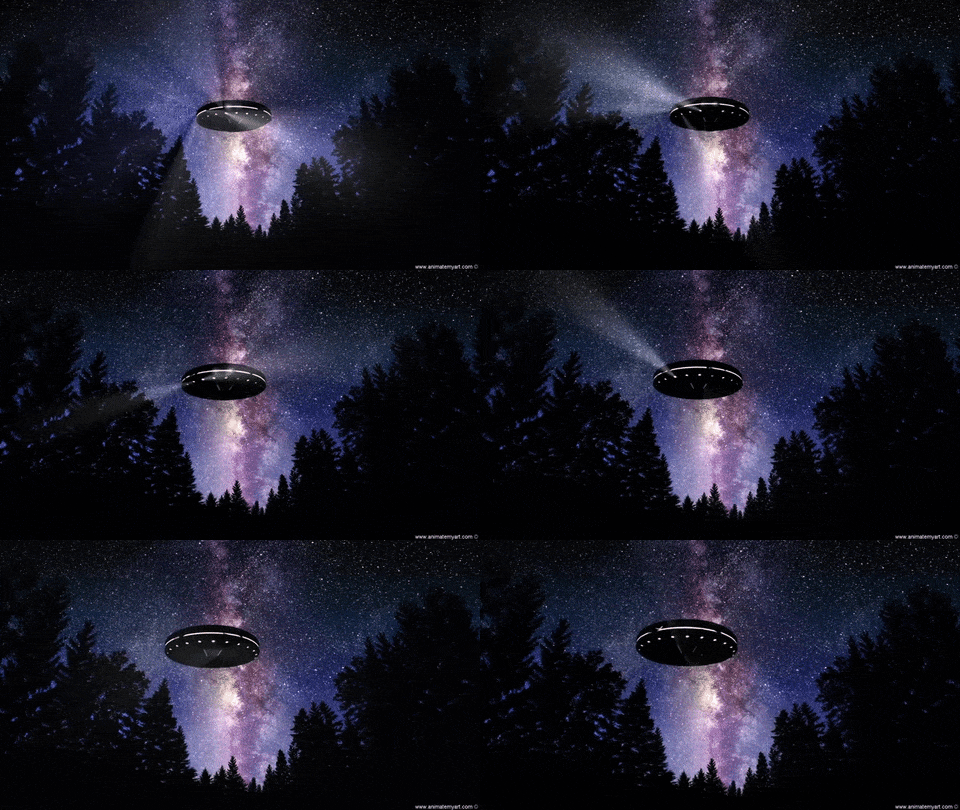
The purpose of this blog is the creation of an open, international, independent and free forum, where every UFO-researcher can publish the results of his/her research. The languagues, used for this blog, are Dutch, English and French.You can find the articles of a collegue by selecting his category. Each author stays resposable for the continue of his articles. As blogmaster I have the right to refuse an addition or an article, when it attacks other collegues or UFO-groupes.
Druk op onderstaande knop om te reageren in mijn forum
Zoeken in blog
Deze blog is opgedragen aan mijn overleden echtgenote Lucienne.
In 2012 verloor ze haar moedige strijd tegen kanker!
In 2011 startte ik deze blog, omdat ik niet mocht stoppen met mijn UFO-onderzoek.
BEDANKT!!!
Een interessant adres?
UFO'S of UAP'S, ASTRONOMIE, RUIMTEVAART, ARCHEOLOGIE, OUDHEIDKUNDE, SF-SNUFJES EN ANDERE ESOTERISCHE WETENSCHAPPEN - DE ALLERLAATSTE NIEUWTJES
UFO's of UAP'S in België en de rest van de wereld Ontdek de Fascinerende Wereld van UFO's en UAP's: Jouw Bron voor Onthullende Informatie!
Ben jij ook gefascineerd door het onbekende? Wil je meer weten over UFO's en UAP's, niet alleen in België, maar over de hele wereld? Dan ben je op de juiste plek!
België: Het Kloppend Hart van UFO-onderzoek
In België is BUFON (Belgisch UFO-Netwerk) dé autoriteit op het gebied van UFO-onderzoek. Voor betrouwbare en objectieve informatie over deze intrigerende fenomenen, bezoek je zeker onze Facebook-pagina en deze blog. Maar dat is nog niet alles! Ontdek ook het Belgisch UFO-meldpunt en Caelestia, twee organisaties die diepgaand onderzoek verrichten, al zijn ze soms kritisch of sceptisch.
Nederland: Een Schat aan Informatie
Voor onze Nederlandse buren is er de schitterende website www.ufowijzer.nl, beheerd door Paul Harmans. Deze site biedt een schat aan informatie en artikelen die je niet wilt missen!
Internationaal: MUFON - De Wereldwijde Autoriteit
Neem ook een kijkje bij MUFON (Mutual UFO Network Inc.), een gerenommeerde Amerikaanse UFO-vereniging met afdelingen in de VS en wereldwijd. MUFON is toegewijd aan de wetenschappelijke en analytische studie van het UFO-fenomeen, en hun maandelijkse tijdschrift, The MUFON UFO-Journal, is een must-read voor elke UFO-enthousiasteling. Bezoek hun website op www.mufon.com voor meer informatie.
Samenwerking en Toekomstvisie
Sinds 1 februari 2020 is Pieter niet alleen ex-president van BUFON, maar ook de voormalige nationale directeur van MUFON in Vlaanderen en Nederland. Dit creëert een sterke samenwerking met de Franse MUFON Reseau MUFON/EUROP, wat ons in staat stelt om nog meer waardevolle inzichten te delen.
Let op: Nepprofielen en Nieuwe Groeperingen
Pas op voor een nieuwe groepering die zich ook BUFON noemt, maar geen enkele connectie heeft met onze gevestigde organisatie. Hoewel zij de naam geregistreerd hebben, kunnen ze het rijke verleden en de expertise van onze groep niet evenaren. We wensen hen veel succes, maar we blijven de autoriteit in UFO-onderzoek!
Blijf Op De Hoogte!
Wil jij de laatste nieuwtjes over UFO's, ruimtevaart, archeologie, en meer? Volg ons dan en duik samen met ons in de fascinerende wereld van het onbekende! Sluit je aan bij de gemeenschap van nieuwsgierige geesten die net als jij verlangen naar antwoorden en avonturen in de sterren!
Heb je vragen of wil je meer weten? Aarzel dan niet om contact met ons op te nemen! Samen ontrafelen we het mysterie van de lucht en daarbuiten.
11-03-2026
This Man, Who Worked on the Voyager Missions, Said He Discovered Enormous, Living, Electromagnetic Vehicles Inhabiting Saturn’s Rings Last updated: September 16, 2025 3:36 am By Vicky Verma 7 months ago
This Man, Who Worked on the Voyager Missions, Said He Discovered Enormous, Living, Electromagnetic Vehicles Inhabiting Saturn’s Rings
The Strangest thing about Saturn is that this Man, who worked on the Voyager missions, said he discovered Enormous, Living, Electromagnetic Vehicles inhabiting its Rings.
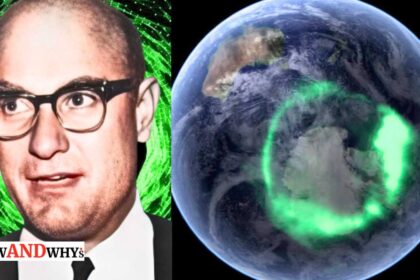
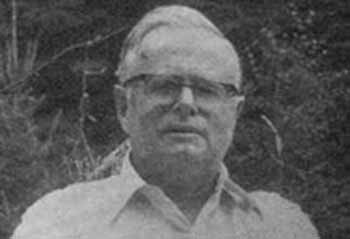
Dr. Norman Bergrun concluded, based on his analysis of Voyager 1 and 2 data, which he detailed in his 1985 book, Ringmakers of Saturn, that he discovered enormous, living, electromagnetic vehicles inhabiting the rings of Saturn.
Dr. Bergrun, who had worked for NASA, claimed that there were massive alien spacecraft proliferating in the rings of Saturn. He is the author of the books “Ringmakers of Saturn” and “Tomorrows Technology Today,” which document the existence of extraterrestrial vehicles of immense power. A scientist who pioneered the methodology of thermal ice prevention design, he is also credited with roll-stability laws for airplanes and missiles.
Dr. Bergrun was manager of test planning and analysis for the Polaris Underwater Launch Missile System and evaluated satellite system applications. Also a director of Information Systems, he founded his own company in 1971 and is cited in “Who’s Who in the World” and other reference works. He was an alumnus of Ames Research Laboratory, NACA (National Advisory Committee for Aeronautics), predecessor of Ames Research Center, NASA, where he worked for 12 years as a research scientist.
Dr. Norman Bergrun played a key role in the Voyager missions, the probes that were sent out to photograph Saturn, its rings, and its moons. There is a photo shown below from that mission, which he was able to obtain from the agency of a large unidentified flying object hovering just outside Saturn’s rings. It is huge, approximately the size of Earth, and is published in his book, “Ringmakers of Saturn.”
Dr. Bergrun claimed that these rings were not made of ice and rock as is commonly believed, but were actually the exhaust from these massive craft, which he calls “ringmakers.” He asserted that these vehicles are proliferating and are now also present at Jupiter and Uranus, creating new rings on planets that previously had none.
He suggested these vehicles had strong nuclear power sources and advanced electromagnetic technology. They appeared capable of creating massive electrical fields, lightning bolts larger than those on Earth, and disturbances across the entire ring system.
Dr. Bergrun recounted his professional history, mentioning his work at Lockheed on the first generation of the Polaris underwater launch vehicle. This had led him to work in a top-secret area behind closed doors, where he had been required to sign a 30-year non-disclosure agreement.
He explained that he eventually left this role due to “claustrophobia,” clarifying that it was not a fear of small spaces but rather the mental strain of being confined to the same secret room day after day.
It was during this period that he received his first clue about unusual things in space after being given a set of data that no one else could make sense of. When he plotted it, he realized that it showed something strange. (Source)
He claimed that he faced significant opposition and cover-ups from official bodies such as NASA. He recounted a story about a source allegedly connected to NASA who asked him how he had found a particular image from the moon, remarking, “I thought we darkened that enough that you wouldn’t find it.”
Dr. Bergrun also stated that his personal data and images, which he had stored in a supposedly impenetrable vault, were tampered with. He claimed that unknown parties had “garbled” his files on laptops and disks, sometimes erasing them completely. Despite this interference, he believed he did not need the old data because he was so familiar with the subject that he could reconstruct his work at any time.
He claimed that he faced significant opposition and cover-ups from official bodies such as NASA. He recounted a story about a source allegedly connected to NASA who asked him how he had found a particular image from the moon, remarking, “I thought we darkened that enough that you wouldn’t find it.”
Dr. Bergrun also stated that his personal data and images, which he had stored in a supposedly impenetrable vault, were tampered with. He claimed that unknown parties had “garbled” his files on laptops and disks, sometimes erasing them completely. Despite this interference, he believed he did not need the old data because he was so familiar with the subject that he could reconstruct his work at any time.
Regarding the purpose of these vehicles, Dr. Bergrun disagreed with the theory that they were mining the rings. Instead, he suggested that they were “nursing” from the rings, using them as a source of energy to power themselves and to create new, smaller vehicles that later grew, much like living organisms.
He was open to the idea that they might also fly close to the sun to “get pumped up” with energy, since their apparent ability to withstand extreme heat made that possible.
According to him, these could not be fully explained by natural processes. He suggested that the vehicles had electromagnetic capabilities and emitted streams of material, which then formed the rings and gaps seen around Saturn. He gave examples and measurements to support his claims, and pointed to historical observations by Galileo and others that showed unexplained phenomena.
Dr. Bergrun also claimed that similar effects were seen on some of Saturn’s moons. He described mysterious lighting and unusual markings, which he thought were possible “scars” left by the vehicles. He went even further, suggesting that Earth’s Moon, the Tunguska explosion in Siberia, and strange weather events might all be related to visits or actions by these powerful spacecraft.
He argued that these vehicles are evidence of a super-advanced intelligence in the universe and that they have been visiting our solar system for a long time. Bergrun warned that their power could pose risks if not understood, but also noted that they might not necessarily threaten humanity directly.
Dr. Bergrun believed that the situation was becoming “critical” because the activity was increasing, as evidenced by the new rings appearing around Uranus and Jupiter.
His urgency was not necessarily from the idea that the craft were coming to Earth, but from his sense that there was a strong possibility they could, and that the public and the scientific community had to be made to understand that these objects were real.
He noted that his conclusions were too controversial for his professional organization to address. He distinguished between his work, which he said was based on data, and the “theories” of others, such as John Lear’s idea that Saturn was a portal into another dimension.
He also touched on other topics, including his belief that humans were not capable of communicating with these entities, which rendered efforts by organizations like SETI ineffective.
He confirmed that plasma had been scientifically measured in Saturn’s rings, which he saw as supporting his claims. When asked about the hexagonal shape seen at Saturn’s north pole, he acknowledged it but regarded it simply as another geometric form that these advanced entities were capable of creating, rather than holding a special symbolic meaning.
Finally, he revealed that he had spent ten years earning a law degree so that he could better understand the mindset of the people “running the country,” whom he felt often made decisions without comprehending the underlying science.
He died on July 1, 2018, at Tracy Nursing and Rehabilitation Center at the age of 96. Unfortunately, Dr. Bergun was just another name on the list of NASA whistleblowers who are forgotten and ignored due to a lack of followers and media attention.
Afgetapt Bloed, Medisch Nauwkeurige Sneden, En Onbeantwoorde Vragen: De Verminkingen van Runderen
Afgetapt Bloed, Medisch Nauwkeurige Sneden, En Onbeantwoorde Vragen: De Verminkingen van Runderen (Cattle Mutilations }
Zijn zij de slachtoffers van een onbekend buitenaards experiment...
Inleiding
Sinds de jaren zeventig van de twintigste eeuw hebben mysterieuze en macabere gebeurtenissen de aandacht getrokken van onderzoekers, wetenschappers en wetshandhavers wereldwijd: de zogenaamde koeienmutilaties. Wat begon als sporadische incidenten in de Verenigde Staten, groeide uit tot een archetype van het onverklaarbare en het bovennatuurlijke, met meldingen die zich verspreidden over meerdere continenten. Ondanks decennia van onderzoek en talloze theorieën blijft het fenomeen onduidelijk en omgeven door speculatie.
In dit artikel zullen we het fenomeen van de koeienmutilaties gedetailleerd analyseren vanuit een wetenschappelijk perspectief. We onderzoeken de aard van de mutilaties, de gebruikte methoden, de mogelijke oorzaken, de bestudeerde gevallen en de relevante vragen die nog altijd onbeantwoord zijn. Daarbij zullen we voorbeelden aanhalen, bewijsstukken bespreken en verschillende hypothesen evalueren, zowel natuurlijke als bovennatuurlijke.
Zijn UFO's verantwoordelijk voor het doden van koeien? We onderzoeken het 'veeverminkings'-fenomeen | The Basement Office
De aard en kenmerken van de mutilaties
Medisch en forensisch profiel
Een kenmerkend aspect van koeienmutilaties is de uiterst precieze en doelgerichte wijze waarop de dieren gestript worden van bepaalde lichaamsdelen. Vaak zijn de volgende kenmerken waarneembaar:
AFGETAPT bloed: Het lichaam is bijna geheel bloedeloos, vaak met duidelijke bloeduitstortingen rondom de wondranden.
Precisie sneden: De wondpatronen vertonen chirurgische precisie. Sneden zijn recht, relatief glad en oppervlakkig, wat suggereert dat ze met een zeer scherp scherpmes of instrument zijn gedaan.
Verwijdering van specifieke organen: Vooral de ogen, tong, hart, longen, genitale organen, en gespeende spieren worden vaak verwijderd. De essentiële organen zoals het hart en de longen ontbreken meestal.
Geen tekenen van geweld of gescheurd: De wonden vertonen geen tekenen van vechtpartijen, beten of scherpe tanden. Er zijn geen sporen van ongevallen of roofdieren, oftewel dieren die dergelijke mutilaties zouden kunnen veroorzaken.
Ontbreken van bloedstolsels en sporen: Het bloed lijkt uit het lichaam te zijn gehaald met een chirurgische precisie, zonder dat sporen van bloedstolsels of gebruik van traditionele snijwapens zichtbaar zijn.
Voorbeeld van een mutilatie
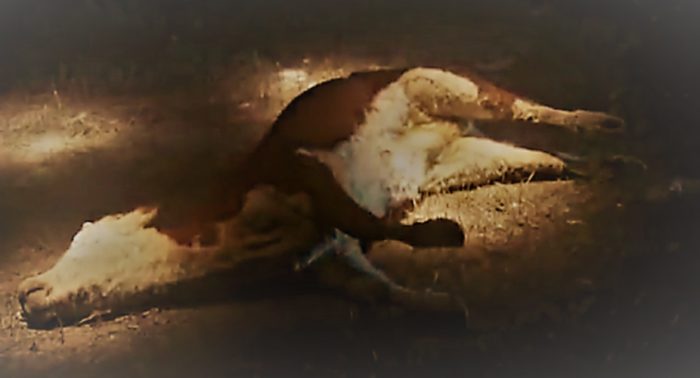
Een van de bekendste gevallen vond plaats in 1975 in Colorado, Verenigde Staten. Een rund werd gevonden in een weide, met een kleine, gladgesneden wond rond de nek en zonder enige tekenen van strijd. Het dier was bijna volledig ontladen van bloed, en zijn onderlichaam was leeggehaald: de ogen, tong en organen van de romp waren verdwenen. De wond was zo perfect dat sommige onderzoekers dachten aan de werkwijze van een chirurg.
Dezetweeverminktekoeienwerdenwoensdaggevondendoorboerenuit de omgeving van ParkerenWilford,terwijlhetaantalverminkingeninhetgebiedblijfttoenemen.Dedodejaarling,dieachtergelatenis,werdwoensdagindeomgeving van Wilfordgevondenenwasalenkeledagendood.Hetjaarlinghadzijnoren,tongengeslachtsorganenniet.FremontCounty-deputyTerryThompsoncontroleerthetlichaamvaneendodekoe,rechts,gevondenopdeMargaretMcMinn-boerderijinParker.Dekoewerdwoensdagochtendvroeggedoodenhaargeslachtsorganenwerdenverwijderdeneendeelvanhaarbloedwasafgevoerd.Hetkantoorvan de sheriffheeftgeenaanwijzingenoverwiedeverminkingenuitvoert.Onderschriftgedateerd2oktober1975.|MetdankaanIdahoFallsPostRegister
Verzameld bewijs en onopgeloste details
Naast de fysieke kenmerken biedt het bewijs dat vaak wordt verzameld, vragen op die nog altijd niet volledig beantwoord zijn:
Bloedanalyse: Het bloed dat werd gevonden, vertoonde vaak tekenen van ernstiger bloedverlies dan mogelijk met conventionele methoden te veroorzaken is. Soms was het bloed verder afgeleid van het lichaam door een soort “drainage.”
DNA-onderzoek: In sommige gevallen werden DNA-monsters uit de wonden gehaald. De resultaten toonden geen sporen van menselijke aanwezigheid of bekende parasieten of bacteriën.
Elektrisch en chemisch bewijs: Er zijn aanwijzingen dat sommige mutilaties met behulp van geavanceerd technisch of chemisch materiaal worden uitgevoerd, hoewel dit nietconsistent in alle gevallen wordt gevonden.
Meer dan 10.000 koeien gevonden met mysterieuze verwondingen | Mysterie van veeverminking
Mogelijke oorzaken en hypothesen
Omdat de mutilaties zo minutieus en doelgericht lijken, hebben onderzoekers verschillende hypothesen aangevoerd, variërend van natuurlijke tot bovennatuurlijke verklaringen.
Natuurlijke en biologische oorzaken
Predator- of roofdier-aanvallen
Een eerste en voor de hand liggende verklaring is dat roofdieren of andere dieren verantwoordelijk zijn. Echter, afgezien van de duidelijke sporen van dergelijke dieren — tanden, krassen, of sporen op het lichaam — ontbreken in veel gevallen bewijs dat een ander dier de mutilatie heeft uitgevoerd. Bovendien, de chirurgische precisie en het ontbreken van bloedstolsels zijn inconsistent met natuurlijke roofdier-aanvallen.
Infectie of ziekte
Sommigen suggereren dat bepaalde ziekten of parasieten kunnen leiden tot gedragsveranderingen die tot lichamelijke schade leiden. Maar dit verklaart zelden de specifieke sneden en verwijderde organen.
Toegepaste landbouwbehandelingen en medische ingrepen
In de jaren 80 werd gesuggereerd dat boeren of onderzoekers met militaire of farmaceutische technologieën experimenteren, bijvoorbeeld het gebruik van lasers of geavanceerde medische apparatuur, om dieren te markeren of te bestuderen.
Mysterieuze verminkingen teisteren deze ranch in Colorado
Technologische en buitenaardse theorieën
Ufo's en buitenaardse wezens
De meest iconische hypothese is dat buitenaardse wezens betrokken zijn bij de mutilaties. Volgens deze theorie zouden UFO’s of buitenaardse onderzoekers de dieren gebruiken voor experimenten, waarbij zij organen wegnemen voor genetisch onderzoek zonder de rest van het lichaam te beschadigen.
Voorbeeld: In de jaren 70 en 80 werden meerdere meldingen gedaan van Ufo’s die in de buurt van mutilatieplaatsen werden waargenomen. Sommige getuigen meldde dat ze lichtverschijnselen zagen of zelfs buitenaardse wezens.
Militair en geheime experimenten
Een andere verklaring is dat overheids- of militaire instanties geavanceerde technologieën testen, bijvoorbeeld laser- of plasmatechnologieën, en dat de mutilaties onderdeel zijn van experimenten met biologische en genetische technieken. Deze hypothese wordt ondersteund door het feit dat sommige mutilaties lijken op technische experimenten die niet voor het publiek bekend zijn.
Paranormale en bovennatuurlijke verklaringen
Naast de bovengenoemde theorieën bestaan er ook meer onconventionele overtuigingen dat de mutilaties verband houden met bovennatuurlijke factoren, zoals geesten, energieweerstanden of kosmische krachten. Echter, wetenschappelijk bewijs voor dergelijke verklaringen ontbreekt grotendeels.
Analyse van belangrijke casussen
De aard en complexiteit van de mutilaties maken ze tot intrigerende problemen voor wetenschappers en onderzoeksgroepen. Hier volgen enkele belangrijke casussen die illustreren hoe het fenomeen zich voordoet en waarom het nog steeds mysterieus blijft.
Case 1: The Carmichael Ranch (New Mexico, 1979)
In dit geval werd een koe gevonden met een bijna chirurgische snede rond de nek, zonder verwondingen die doen denken aan een aanval door roofdieren. Het bloed was bijna volledig verdwenen. Lab-analyses toonden een afwezigheid van DNA dat overeenkwam met menselijke of dierenlijke bronnen, behalve dat van het dier zelf. De politie concludeerde dat geen natuurlijke oorzaak kon worden vastgesteld.
Case 2: The Norton Farm (Verenigde Staten, 1980)
Een kalf werd gevonden met organen verwijderd onder chirurgisch schone omstandigheden. Dit en soortgelijke gevallen veroorzaakten een golf van publieke angst en media-aandacht. Desondanks bleven de onderzoekers ongelukkig met de afwezigheid van bewijs dat een natuurlijke verklaring konden ondersteunen.
De GROOTSTE Theorieën van Linda Moulton Howe Onthuld
Wetenschappelijke en praktische vragen
Ondanks uitgebreide onderzoeken blijven veel vragen onbeantwoord:
Hoe worden de wonden zo precies en doelgericht gemaakt?
Waarom worden organen verwijderd zonder enige zichtbare verwonding of bloedvergissing?
Welke technologie of middelen zouden hiervoor nodig zijn?
Hoe kunnen we de afwezigheid van bewijs voor menselijke of dierlijke betrokkenheid verklaren?
Zijn er overeenkomsten tussen verschillende mutilatiegevallen die op een gemeenschappelijke dader of oorzaak wijzen?
Conclusie
De koeienmutilaties blijven een raadsel dat vele theorieën oproept, van natuurlijke oorzaken tot bovennatuurlijke verklaringen. Hoewel de bewijsstukken vaak wijzen op een uiterst doelgerichte en chirurgisch precieze uitvoering, ontbreekt het aan overtuigend bewijs dat een natuurlijke of menselijke actor verantwoordelijk is.
Wat de ware oorzaak ook moge zijn, het fenomeen benadrukt onze beperkte kennis van biologische, technologische en misschien zelfs bovennatuurlijke processen. Het blijft een onderwerp van fascinerende speculatie en onderzoek, met de wetenschap zeker nog niet klaar met het ontrafelen van dit mysterie.
Aanbevelingen voor verder onderzoek
Om het onbegrijpelijke fenomeen van koeienmutilaties verder te kunnen doorgronden, worden de volgende aanpakken aanbevolen:
Gedetailleerde forensische analyse van nieuwe gevallen
Gebruik van geavanceerde DNA- en chemische testingstechnieken
Monitoring en observatie van mogelijke locaties met behulp van camera’s en drones
Interdisciplinair onderzoek dat nauwer samenwerkt tussen biologen, ingenieurs, forensisch experts, en astronomen
Bewustwording en educatie onder betrokken agrariërs en het publiek
In zekere zin biedt het fenomeen niet alleen een uitdaging voor de wetenschap, maar ook een diepere reflectie op onze kennis van de wereld en onze plaats daarin. Het blijft een waarachtig mysterie dat ons echoot dat sommige vragen mogelijk nooit volledig beantwoord zullen worden, tenzij er nieuwe technologieën of baanbrekende inzichten opdoemen.
OPMERKING PETER2011 : Deze uitgebreide analyse tracht zowel de bewezen feitelijke gegevens als de verschillende interpretaties te belichten, om zo een evenwichtig en informatief beeld te scheppen van de complexe en intrigerende kwestie van de koeienmutilaties.
Vreemde Ontmoetingen: Verminking van vee en Ontvoering van mensen Linda Howe, George Knapp
Underground shelters for the chosen, silence for the masses
Underground shelters for the chosen, silence for the masses
Back in 2013, we reported on the so-called elite survival bunkers and the notorious Deep Underground Military Bases — the D.U.M.B.s. Curiously, the rumors never faded. If anything, they feel more relevant today than ever.
Despite the public silence, world powers may already be aware of a looming global crisis, yet choose to say nothing. While the masses are distracted, preparations appear to continue behind closed doors.
Mainstream media keeps its spotlight fixed on geopolitical tension, conveniently ignoring escalating environmental and planetary risks. Governments offer no clear explanation. Scientists remain reserved. The pattern speaks for itself.
Evidence suggests the world’s major governments have been preparing for catastrophe far longer than most people realize.
Across continents, state agencies, defense contractors, and major corporations have accelerated underground construction to unprecedented levels. In the United States, massive subterranean complexes are being excavated in remote and restricted regions, well beyond public oversight. China has quietly built unusually deep subway networks beneath key cities, resembling a crash infrastructure program. Russia went public in 2011 with plans for roughly 5,000 new nuclear shelters for Moscow alone, while newer metro lines were designed to double as hardened bunkers.
More recently, former HUD official Catherine Austin Fitts alleged that the U.S. has been covertly constructing an underground “breakaway” civilization for the elite, designed for near extinction-level scenarios. She claimed trillions in unaccounted federal funds were diverted into subterranean infrastructure, including an underground command grid for continuity of government during nuclear war or worse, as well as advanced transit systems.
One acknowledged D.U.M.B. is the Cheyenne Mountain Complex, arguably America’s most secure and secretive military fortress. Imagine what else they've built. ( Video : take a look at the inside the Cheyenne Mountain Complex.)
Economist Mark Skidmore of Michigan State University reviewed federal financial discrepancies and concluded in 2017 that roughly $21 trillion in “unauthorized expenditures” occurred between 1998 and 2015 within the Department of Defense and the Department of Housing and Urban Development. One Army report alone listed $6.5 trillion in unsupported adjustments for fiscal year 2015 — fifty times its official budget.
After examining the missing trillions, Fitts estimated that at least 170 underground installations exist within U.S. territory, some rumored to extend beneath oceans and interconnect via classified high-speed transit systems. According to her, these would function as sanctuaries if governments anticipated a civilization level collapse.
Hollywood has long been accused of predictive programming, quietly introducing future technologies, events, or disclosures into films and entertainment well before they surface in reality. In the context of underground survival infrastructure, the film Greenland is frequently cited. Its storyline depicts an extinction-level disaster in which ordinary citizens are abandoned while selected individuals are quietly evacuated to fortified subterranean facilities, including a base beneath Greenland.
Confirmed or not, the pattern is hard to ignore: powerful institutions appear to be preparing for contingencies the public is not being informed about. And if the worst comes, one uncomfortable possibility emerges, the general population may be left to fend for itself.
The simulation theory In 2003, Oxford University philosopher Nick Bostrom proposed the simulation hypothesis. He published a paper discussing the possibility of humanity existing within a computer simulation.
Popularized The theory became famous thanks to films like 'The Matrix', and other science fiction works, but science communicators and researchers have also discussed it.
What it proposes The theory proposes that we could be the subjects of a simulation if a more advanced society created a highly complex simulation of how their ancestors lived.
A cascade of simulations The theory stemmed from the notion that our computers keep getting more advanced and allow us to process more complex simulations, like video games.
Odds Bostrom proposed the hypothesis as a trilemma, allowing other philosophers and even physicists to calculate the odds of reality being a simulation.
Three statements The trilemma is the counterposition of three statements, one of which must be true. Bostrom proposed three concepts related to simulation theory.
We can't The first statement described the possibility that humanity would go extinct before reaching the computing capability to develop a simulation complex.
We do The third and last statement was that there is such a simulation, and most humans living in the way we are now are part of it and not the base reality.
Most recent analysis However, a more recent analysis that reduced the problem to a dilemma by making the first two statements real reduced the possibilities: chances are close to 50-50.
It depends on the future of AI Still, the last analysis depends on advancing AI and computing capabilities. If they keep growing, the chances of our reality being simulated also increase.
Other ways of looking at it However, analyzing the odds is not the only way of looking at the simulation dilemma; other researchers have also studied it from an empirical point of view.
Is it worth it? Some have even wondered if it is worth investigating the simulation hypothesis, considering how unlikely it is to disprove it through evidence.
How can we know? Without considering the probabilities or the truth or false approach to the trilemma, it isn't easy to find ways to determine if our reality is simulated or the base reality.
A comedian's take During a guest appearance in Neild DeGrass Tyson's podcast, comedian Chuck Nice said something that could give science the empirical key: "What if the speed of light is a limit imposed by the programmer?"
Fouad Khan Fouad Khan, a senior editor at Nature Energy, believes the simulation hypothesis confirms that we cannot travel faster than the speed of light.
What is processor speed? It takes a computer the same time to make any addition, whether 2+2 or 3243+2323; the processor's speed determines how fast things go, not the complexity of the operation.
So, according to Khan, the speed of our processor would be the speed of light. He argues the same as Nice; it is not a random limit but one set up by the programmer.
It is tough to know, but maybe we should accept that. Philosopher Preston Greene has suggested not to look because, if it were true, such knowing might end the simulation.
Discovering the Moon: Unveiling Apollo's UFO Mysteries
Discovering the Moon: Unveiling Apollo's UFO Mysteries
Overview
The Apollo program, carried out by NASA between 1961 and 1972, remains a landmark in human spaceflight, delivering the first crewed landings on the Moon and returning over 380 kg of lunar rocks for scientific study. While the missions’ primary legacy is geological—mapping the lunar surface, confirming the presence of water ice in permanently shadowed craters, and refining models of the Moon’s formation— they have also become a focal point for UFO and UAP (unidentified aerial phenomena) speculation. Recent discussions on social media platforms, especially Twitter, have revived the claim that Apollo astronauts may have encountered “extraterrestrial artifacts” while on the Moon, prompting renewed scrutiny of the original mission footage and reports.
Apollo Data and Scientific Findings
The Apollo missions produced a robust data set that continues to underpin contemporary lunar research. Apollo 11’s historic landing in July 1969 yielded the first lunar samples, while Apollo 12’s precision touchdown near Surveyor 3 allowed engineers to retrieve components of an earlier unmanned probe for comparative analysis. Apollo 17, the program’s final crewed flight in December 1972, conducted extensive geological sampling across the Taurus‑Littrow valley, providing the most diverse collection of lunar material to date. These missions confirmed the Moon’s basaltic composition, identified a complex history of volcanic activity, and verified the existence of water ice in permanently shadowed regions, findings that have guided recent commercial and governmental plans for lunar bases. No official NASA documentation records the discovery of any non‑natural structures, anomalous devices, or unexplained aerial phenomena during any of the missions.
Investigating The Truth Behind The 1969 Moon Landing | FULL DOCUMENTARY
Reported UFO Sightings Near the Moon
Throughout the 20th century, reports of unidentified flying objects often coincided with heightened public interest in space exploration. The Moon, as Earth’s nearest celestial neighbor, has been cited in numerous anecdotal accounts of bright lights or moving objects appearing near its limb. A 2025 blog post on Alienated Media compiled several of these claims, noting that “numerous reports claim to have observed unidentified flying objects in the vicinity of the Moon.” However, the post also acknowledges that the majority of such sightings lack corroborating data and are typically based on amateur observations or misinterpretations of astronomical phenomena such as satellites, meteoroids, or atmospheric reflections.
Neil Armstrong's Untold Extraterrestrial Encounter on The Moon
Expert Assessment of the Evidence
Scientists and former NASA officials consistently emphasize the rigorous verification processes applied to Apollo telemetry, photographs, and sample analysis. Dr. Ellen Stofan, former NASA chief scientist, has stated that “the Apollo archives have been examined repeatedly for anomalies, and none have stood up to scientific scrutiny.” Independent researchers who have reviewed the publicly released mission footage report that the visual artifacts often cited as “UFOs” can be explained by camera lens flares, optical reflections, or the motion of the spacecraft’s own equipment. Moreover, the U.S. Department of Defense’s recent UAP task force, while acknowledging unexplained aerial observations in Earth’s atmosphere, has not linked any such phenomena to lunar operations.
Context and Outlook
The persistence of UFO narratives surrounding the Apollo missions reflects a broader cultural fascination with the unknown and a tendency to reinterpret historic events through contemporary lenses. While the allure of “alien artifacts on the Moon” makes compelling headlines, the available evidence remains firmly rooted in conventional scientific interpretation. As NASA prepares for the Artemis program and commercial partners plan sustained lunar presence, the focus is shifting from conjecture to concrete research objectives—such as in‑situ resource utilization and expanded geological surveys. Future missions equipped with higher‑resolution imaging and real‑time data transmission may finally put lingering questions to rest, offering definitive answers about both the Moon’s natural history and the origins of any anomalous sightings.
Zijn oude locaties portalen naar andere dimensies? Een wetenschappelijke analyse van de mogelijkheid van interdimensionale doorgangen in oude sites
Zijn oude locaties portalen naar andere dimensies? Een wetenschappelijke analyse van de mogelijkheid van interdimensionale doorgangen in oude sites
Inleiding
Het idee dat oude monumenten en sites fungeren als portalen naar andere dimensies of realiteiten heeft de laatste decennia veel aandacht getrokken binnen zowel de populaire cultuur als de wetenschappelijke wereld. Van de piramides van Egypte tot de megalithische standen van Stonehenge en het mysterieuze Gobekli Tepe in Turkije, verschijnen oude plekken herhaaldelijk in discussies over mogelijk interdimensionaal contact. Dit artikel onderzoekt de wetenschappelijke plausibiliteit van de hypothese dat bepaalde oude locaties fungeren als portalen of doorgangen naar niet-gekende realiteiten, gebaseerd op archeologisch, fysisch en metafysisch bewijs, en combineert dit met de huidige kennis binnen de natuurwetenschappen en theorieën over het universum.
1. Historisch en archeologisch overzicht van oude sites
1.1. De rol van oude sites in mythologie en cultuur
Historisch gezien worden oude locaties zoals piramides, sacrale grafvelden en megalithische structuren vaak gekoppeld aan religieuze en spirituele praktijken. In veel culturen hebben deze sites een centrale rol gespeeld in rituelen die gericht waren op het communiceren met goden, voorouders of andere werelden. Bijvoorbeeld, de Egyptische piramides werden niet alleen opgericht als grafmonumenten, maar ook als toegangspoorten tot het hiernamaals, die mogelijk metaforisch gezien de grens tussen verschillende realiteiten symboliseerden.
1.2. Archeologische bevindingen en bestaande theorieën
De archeologische bewijzen rond oude sites tonen dat de planners en bouwers mogelijk een diepgaand begrip hadden van astronomische en geografische factoren. Stonehenge lijkt bijvoorbeeld te zijn afgestemd op bepaalde astronomische gebeurtenissen zoals de zonnewendes, wat suggereert dat oude culturen misschien geloofden in een verbinding tussen de aarde en andere kosmische of spirituele domeinen.
2. Theoretische kaders over dimensies en realiteiten
2.1. Moderne fysica en multidimensionale theorieën
Volgens de theorieën binnen de moderne fysica, zoals snaartheorie en M-theorie, bestaat het heelal uit meer dan de gebruikelijke vier dimensies (enkele tijd en drie ruimte). Deze theorieën suggereren dat er op fundamenteel niveau verborgen dimensies kunnen bestaan, die niet rechtstreeks waarneembaar zijn met traditionele instrumenten. In deze context is het concept van doorgangen naar andere dimensies niet slechts sciencefiction, maar mogelijk een implicatie van de fundamentele structuur van het universum.
2.2. Wormgaten en portals in theoretische fysica
Wormgaten, theoretische tunnels die twee verschillende punten in de ruimte-tijd verbinden, worden in de relativiteitstheorie beschreven als mogelijke doorlaten naar andere delen van het universum of zelfs andere realiteiten. Alhoewel er geen experimenteel bewijs is voor het bestaan van wormgaten, vormen ze een legitiem theoretisch model voor ‘portalen’ tussen verschillende staten van bestaan.
3. Oude sites als portalen: Mythes, symboliek en mogelijke wetenschappelijke raakvlakken
3.1. Symboliek en architectuur van oude sites
Veel oude structuren bevatten symboliek die mogelijk verwijst naar het transcendente of het interdimensionale. In de Egyptische mythologie vertegenwoordigen piramides de opgaande verbinding tussen de aarde en de sterren, en kunnen ze worden geïnterpreteerd als architectonische manifestaties van een universele ‘ladder’ naar andere realiteiten. Megalithische monumenten zoals Carnac in Frankrijk of de Inca-sites in Zuid-Amerika dragen eveneens grote symboliek die mogelijk refereert aan kosmische poorten.
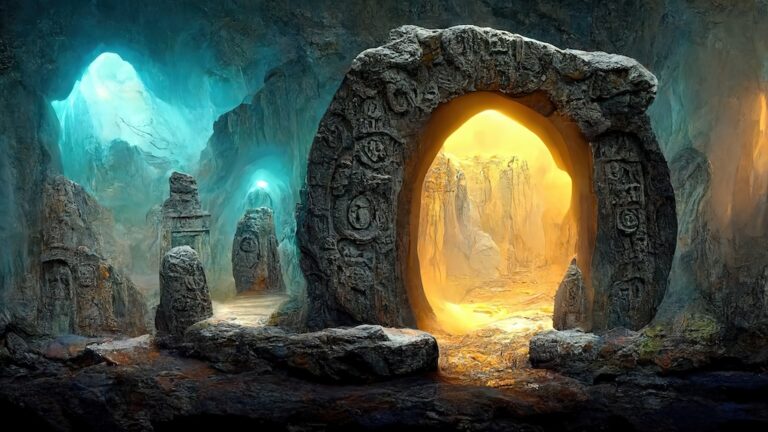
Kristallen die poorten openen naar parallelle tijdlijnen
3.2. De rol van energie en kristallen
Sommige moderne theorieën suggereren dat bepaalde kristallen en energievelden die in oude sites worden aangetroffen, wellicht functioneerden als natuurlijke energiefocuspunten of zelfs portals. Bijvoorbeeld, het gebruik van kristallen in bepaalde rituelen zou kunnen wijzen op pogingen om de bewustzijns- of energetische velden te beïnvloeden en toegang te krijgen tot andere dimensies.
Kristallen en poorten
4. Onderzoek en bewijsvoering
4.1. Geofysisch en energetisch onderzoek
Recente studies hebben geprobeerd om de energetische eigenschappen van oude sites te meten. Variaties in aardstraling, magnetische velden en elektromagnetische golven worden geanalyseerd om te bepalen of er sprake is van opzettelijke of natuurlijke energetische “poorten”. In sommige gevallen blijken structuren zoals de ‘Healing Well’ in Glastonbury of bepaalde megalithische cirkels opmerkelijke energetische anomalieën te vertonen, die mogelijk wijzen op een hogere energiefrequentie.
4.2. Spiritueel en bewustzijnsgerichte benaderingen
Onderzoekers in de veld van metafysica en bewustzijnsstudies analyseren nog steeds de ervaringen en rapportages van mensen die beweren portals te hebben ervaren. Hoewel deze subjectief zijn en moeilijk wetenschappelijk te bevestigen, suggereren ze dat sommige oude structuren mogelijk niet alleen symbolisch, maar ook functioneel kunnen zijn in het faciliteren van interdimensionale ervaringen.
5. Kritische analyse en sceptische standpunten
5.1. Wetenschappelijke beperkingen en de noodzaak van bewijs
Critici wijzen erop dat veel van de hypothesen over oude sites als portalen gebaseerd zijn op interpretaties die niet ondersteund worden door harde empirische gegevens. Het ontbreken van reproduceerbare experimenten en de subjectieve aard van veel bewijzen maken het moeilijk om deze theorieën te bevestigen binnen de wetenschappelijke methode.
5.2. Alternatieve verklaringen
De meeste archeologen en fysici stellen dat de energetische anomalieën mogelijk het resultaat zijn van natuurlijke aardkundige processen of menselijke intentie en ritueelgebruik, zonder dat dit hoeft te wijzen op interdimensionale portalen. Wat soms wordt geïnterpreteerd als ‘pad naar andere dimensies’, kan ook een symbolische of spirituele interpretatie zijn zonder fysische basis.
6. Poort van de Goden: Het Mysterie van de Aramu Muru Poort
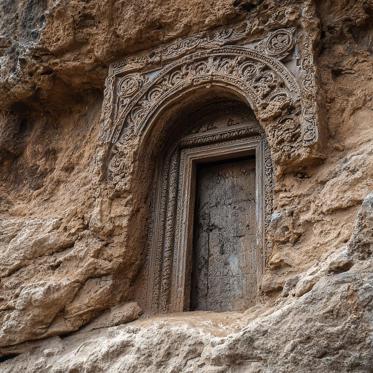
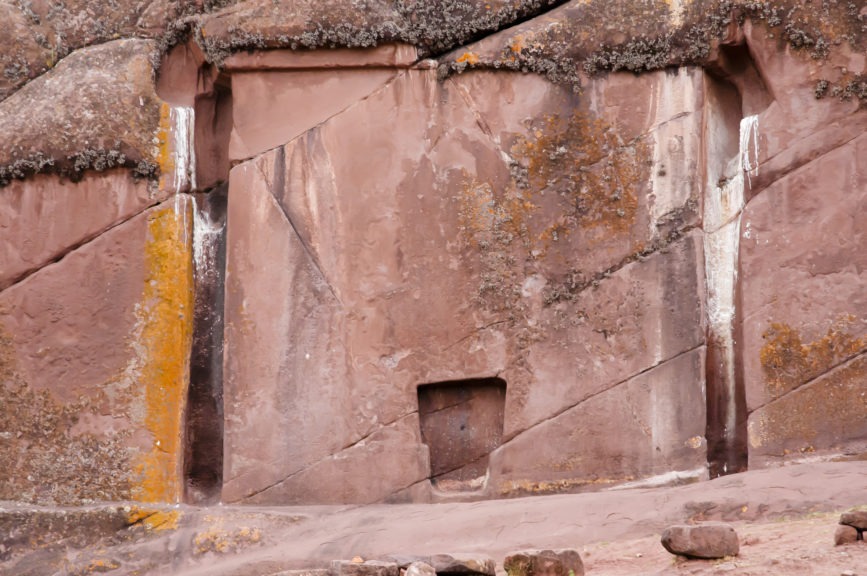
Een locatie die aan deze beschrijving lijkt te voldoen is Puerta de Hayu Marca in Peru. Gelegen op een plateau net buiten de westelijke oever van het Titicacameer, betekent Puerta de Hayu Marca de Poort van de Goden. Met een hoogte en breedte van beide 23 voet, lijkt Hayu Marca, ook bekend als Aramu Muru, een deur of sterrenpoort naar nergens te zijn, uitgehouwen in de Hayu Marca-berg in een afgelegen gebied dat bekend staat als de Vallei van de Geesten of de Steenbos.
Poort van de Goden, Hayu Marca
De legende zegt dat toen Spaanse conquistadores naar Peru kwamen om het goud van de Inca’s te roven, een Inca-priester van de tempel van de Zeven Stralen Hayu Marca gebruikte als een portaal om te ontsnappen. Maru zou een gouden schijf, bekend als de “Sleutel tot de Goden van de Zeven Stralen,” in een uitsparing in het midden van de gebeeldhouwde deur van Hayu Marca hebben geplaatst, waardoor een portaal openging en hij erdoorheen kon lopen naar een nieuwe wereld, om nooit meer gezien te worden. Deze mysterieuze deur heeft sommigen doen speculeren of het een wormgat naar een andere dimensie zou kunnen zijn.
Hayu Marca ligt op een Ley-lijn, waar ook de beroemde Poort van de Zon in Tiwanaku op ligt in het naburige Bolivia, samen met verschillende andere belangrijke archeologische locaties van de Inca’s.
Bezoekers van Hayu Marca hebben opmerkelijk ongebruikelijke energievelden ervaren, waarbij sommigen zeggen dat ze pulserende energie voelen die van de rots uitstraalt wanneer ze hun hand in het midden plaatsen. Velen die de oude locatie online hebben bekeken, vermelden dit gevoel van verhoogde of intense energie daar.
Het nabijgelegen Titicacameer werd door de Inca's vereerd en beschouwd als de geboorteplaats van hun beschaving. Het is ook een van de diepste meren ter wereld en er wordt gezegd dat het een verloren stad en een overvloed aan schatten bevat die door de Spanjaarden zijn geplunderd. In 2000 werd de verloren tempel van Atahualpa diep onder het meer ontdekt, wat bijdroeg aan het mysterieuze karakter van deze oude cultuur.
7.Conclusie
Hoewel er momenteel geen direct empirisch bewijs is dat oude sites fungeren als fysieke portalen naar andere dimensies, bieden theoretische fysica, archeologisch onderzoek en metafysische theorieën een intrigerend kader voor deze hypothese. Het combineren van archeologische symboliek, energetisch onderzoek en hogere dimensietheorieën opent de mogelijkheid dat onze voorouders een inzicht hadden in het bestaan van meerdere realiteiten en pogingen ondernamen om toegang daartoe te verkrijgen, mogelijk via speciale locaties.
Het hedendaagse onderzoek moet zich richten op het integreren van geofysica, kwantumveldentheorie en bewustzijnsstudies om deze vragen verder te verkennen. Totdat meer bewijs wordt verzameld, blijft het idee dat oude sites poorten zijn naar andere werelden een fascinerende, zij het speculatieve, gedachtegang die onze nieuwsgierigheid naar de aard van realiteit en ons verleden blijft voeden.
Referenties
Green, M. (2018). De fysica van multidimensionale universums. Amsterdam: Universiteitsdruk.
Hofstadter, D. (2020). De oude wereld en de verborgen krachten. Leiden: Historisch Instituut.
Kaku, M. (2014). De theoretische fundamenten van wormgaten. New York: Oxford University Press.
Van der Meer, S. (2021). Energetische anomalieën bij megalithische sites. Journal of Archeoenergetics, 12(3), 45-67.
Watts, A. (2017). Bewustzijn en dimensies: de link tussen geest en materie. Filosofisch Tijdschrift, 45(2), 89-105.
Samenvatting: Dit artikel heeft een uitgebreide analyse gepresenteerd over de plausibiliteit dat oude locaties fungeren als portalen naar andere dimensies. Door archeologische, fysische en metafysische perspectieven te combineren, wordt duidelijk dat hoewel er geen sluitend bewijs is, de theorie een fascinerend inzicht biedt in onze geschiedenis en de mogelijke complexe structuur van het universum. Verdere interdisciplinair onderzoek is essentieel om deze wetenschap verder te ontwikkelen.
Giant squid? Wild weather? Here’s what may—and may not—be behind the strange disappearances in the Bermuda Triangle.
In Wilhelm Blaeu’s circa 1650 Atlas illustrating the Caribbean Sea, the Bermuda Triangle is indicated between the Bermuda Archipelago, Miami, and Puerto Rico.
Giancarlo Costa/Bridgeman Images
By Hillary Mayell
The Bermuda Triangle is an area of the ocean roughly bounded by Miami, Bermuda, and Puerto Rico. No one keeps statistics, but in the last century, numerous ships and planes have simply vanished without a trace within this imaginary triangle.
Unusual features of the area had been noted in the past. Christopher Columbuswrote in his log about bizarre compass bearings in the area. In March 1918, the U.S. naval vessel the U.S.S. Cyclops disappeared without a trace.
But the region didn’t get its name until August 1964, when Vincent Gaddis coined the term Bermuda Triangle in a cover story for Argosy magazine about the disappearance of U.S. Navy Flight 19. The article stimulated a virtual cottage industry in myth-making.
A shipwreck sits off Bermuda’s shore.
EMIL P. ALBRECHT
Many exotic theories have attempted to explain what happened to vessels traveling in the area. The disappearances have been attributed to the machinations of enormous sea monsters, giant squid, or extra-terrestrials.
Alien abductions, the existence of a mysterious third dimension created by unknown beings, and ocean flatulence—the ocean suddenly spewingreat quantities of trapped methane—have all been suggested as culprits.
Lieutenant A. L. Russell, in the U.S. Coast Guard’s official response to Bermuda Triangle inquiries, wrote: “It has been our experience that the combined forces of nature and the unpredictability of mankind outdo science-fiction stories many times each year.”
Here’s the history and the reality of the Bermuda Triangle legend.
Flight 19 and the Bermuda Triangle
The legend of the Bermuda Triangle will be forever tied to the fateful flight that took place on December 5, 1945. At 2:10 p.m. on that sunny day, five TBM Avenger Torpedo Bombers carrying 14 men took off on a routine training mission from the U.S. Naval Air Station in Fort Lauderdale, Florida.
Led by instructor Lieutenant Charles Taylor, the assignment was to fly a three-legged triangular route with a few bombing practice runs over Hen and Chickens Shoals.
Five Grumman TBF-1 Avengers fly in formation over Norfolk, Virginia, in September 1942. Flight 19, which was lost in the Bermuda Triangle in December 1945, was flying the same type of aircraft seen here.
Horace Bristol, National Archives
Taylor, in an age before GPS became commonplace for navigation, got hopelessly lost shortly after the bombing run. Pilots flying over water in 1945 had to rely on compasses and knowing how long they’d been flying in a particular direction, and at what speed.
Both of the compasses on Taylor’s plane were apparently malfunctioning. Transcripts of in-flight communications suggest he wasn’t wearing a watch. There are no landmarks in the middle of the ocean.
The planes flew in one direction then another as balmy daylight turned to stormy seas in the darkness.
Taylor is heard formulating a plan; as soon as the first plane’s fuel level dipped below 10 gallons, all five planes were to ditch at sea.
The Avenger was known as an extremely rugged plane. Pilots sometimes called them “Iron Birds” or Grumman ironworks, said Mark Evans, a historian at Naval History & Heritage Command.
“They were built like tanks,” he said. “Time and again they’d come back from battle all shot up and still functioning. Pilots loved them.”
They were also very heavy, weighing more than 10,000 pounds (4,535 kilograms) empty. When ditched, the Avenger would go down hard and fast.
The possibility of anyone surviving a landing in high seas was slim, the chance of surviving the night in the cold waters was nil, the likelihood of the wreckage making a quick descent to the bottom was high.
A massive land and sea search was mounted, but neither bodies nor wreckage were ever found.
Adding to the tragedy, one of the rescue planes also disappeared along with its 13-man crew. Their plane, a PBM Mariner, was nicknamed the “flying gas tank”; the slightest spark or a lit match could cause an explosion.
A ship in the area reported seeing a huge fireball and crossing through an oil slick at the exact time and place where the plane would have been. The Navy halted production of that plane in 1949.
In the Navy’s final report, the disappearance of Flight 19 was blamed on pilot error. Taylor’s family protested and, after several reviews, the verdict was changed to “causes or reasons unknown.”
Over the years, more mysterious disappearances have occurred, adding to the triangle’s eerie reputation.
The Bermuda Triangle region has some unusual features. It’s one of only two places on Earth—the other being an area nicknamed the Devil’s Sea off the east coast of Japan, which has a similar mysterious reputation—where true north and magnetic north line up, which could make magnetic compass readings dicey.
It is also home to some of the deepest underwater trenches in the world; wreckage could settle in a watery grave miles below the surface of the ocean.
Most of the ocean floor in the Bermuda Triangle is about 19,000 feet (5,791 meters) down; near its southern tip, the Puerto Rico Trench dips at one point to 27,500 (8,229 meters) feet below sea level.
Treacherous shoals and reefs can be found along the continental shelf. Strong currents over the reefs constantly breed new navigational hazards, according to the Coast Guard.
Then there’s the weather.
An encounter between a Remotely Operated Vehicle Deep Discoverer (also known as “D2”) and a four-to-six-foot squid.
However, Feit pointed out, the Gulf Stream travels along the western edge of the triangle and could be a factor. The Gulf Stream is like a 40- to 50-mile-wide (64- to 80-kilometer-wide) river within the ocean that circulates in the North Atlantic Ocean. The warm water and two- to four-knot currents can create weather patterns that remain channeled within it.
“If you have the right atmospheric conditions, you could get quite unexpectedly high waves,” said Feit. “If wave heights are eight feet outside of the Gulf Stream, they could be two or even three times higher within it. Sailors can sometimes identify the Gulf Stream by the clouds and thunderstorms over it.”
The Coast Guard also notes that unpredictable Caribbean-Atlantic storms can yield waterspouts that often spell disaster for pilots and mariners.
Still, given a choice between the horrifying idea of a giant squid’s tentacles wrestling an innocent ship to the sea floor, or an alien abduction, versus human error, shoddy engineering, and a temperamental Mother Nature—who, even today, could resist the legend of the Bermuda Triangle?
Fans of The Secret of Skinwalker Ranch know Dr. Travis S. Taylor as the straight-talking physicist who shows up with laser arrays, data models, and a fearless curiosity that often lands him in danger. But beyond the cameras, Travis Taylor’s real life might be even more fascinating—and more mysterious—than anything you’ve seen on TV.
He’s been called everything from a “mad scientist” to a “government insider.” Some say he’s the show’s truth anchor. Others believe he’s part of a long game to slow-drip disclosure about aliens, portals, and advanced tech.
Whatever the truth is, one thing’s clear: Travis Taylor isn’t your average TV personality.
A Rocket Scientist Before He Could Drive
Born and raised in Decatur, Alabama, Travis S. Taylor was the kind of kid who read Carl Sagan for fun—and built lasers in his backyard before he hit puberty. According to Taylor, he was already working on amateur rocket launches and radio telescopes in high school.
That early obsession led him to a flurry of advanced degrees. And we’re not talking honorary diplomas—he earned multiple PhDs, including in optical science and engineering, as well as a Master’s in astronomy. Add aerospace engineering, physics, and electrical engineering to the list, and you start to understand why NASA and the Department of Defense took notice early.
It’s no exaggeration to say he could probably build a UFO in his garage.
Top-Secret Projects and Pentagon Ties
Before Skinwalker Ranch, Taylor was already deep inside the world of classified defense contracts and advanced weapon systems. He worked on everything from space-based lasers to propulsion systems for Mars missions. At one point, he was consulting with the U.S. Army’s Space and Missile Defense Command.
But things took a stranger turn in the early 2000s when Taylor’s name began surfacing in connection to Pentagon black projects related to UFOs—now known as UAPs (Unidentified Aerial Phenomena).
Most notably, Travis Taylor was later revealed to be a chief scientist for the Pentagon’s UAP Task Force, a previously top-secret group investigating aerial phenomena that defied explanation—including incidents involving Navy fighter pilots and fast-moving craft with no visible propulsion.
In other words: He wasn’t just speculating about UFOs. He was investigating them on behalf of the U.S. government.
Why Skinwalker Ranch?
So how did a high-level defense consultant end up on a Utah cattle ranch with a reputation for UFOs, poltergeists, and invisible creatures?
When The Secret of Skinwalker Ranch launched on the History Channel, producers wanted someone with real scientific chops, someone who could bring hard data to a place saturated with rumor and fear. Taylor was that guy.
He didn’t just bring a laptop and a skeptical eye. He brought spectrum analyzers, electromagnetic detectors, high-speed cameras, and his own team of scientists. Within weeks of arriving, the phenomena escalated—sudden radiation spikes, GPS blackouts, and what appeared to be objects in the sky that defied the laws of physics.
And yet, Taylor didn’t back down. He leaned in. "If there’s something going on here," he famously said, "we’re going to find out what it is—or die trying."
That wasn’t hyperbole. In one episode, Taylor suffered physical symptoms after entering a hot zone. Another time, his team watched in shock as an object moved vertically thousands of feet in seconds.
Was it alien tech? Interdimensional interference? Military experimentation? Taylor never gives a full answer. But the look in his eyes says he’s seen more than he lets on.
A Renaissance Man With a Sci-Fi Twist
Travis Taylor isn’t just a scientist. He’s also a best-selling author, with more than 20 science fiction novels under his belt. His writing fuses hard science with military thrillers and alien conspiracies—many of which now feel eerily prescient.
He’s also appeared on shows like Ancient Aliens, NASA’s Unexplained Files, and Rocket City Rednecks, a show where he literally built advanced weapons out of scrap metal and household parts.
Some fans think his sci-fi background gives him a flair for dramatics. Others believe it’s his way of disclosing real tech under the guise of fiction—a move that mirrors how many believe the U.S. government has been seeding truth through entertainment for decades.
Is Travis Taylor the writer of wild tales, or is he hiding secrets in plain sight?
The Double Life: Public Scientist, Private Operative?
One of the most controversial aspects of Taylor’s presence on Skinwalker Ranch is the question of trust. Is he there to reveal the truth… or control the narrative?
Skeptics point out that someone with Taylor’s level of government clearance wouldn’t be allowed to freely talk about alien tech, energy weapons, or interdimensional portals—unless, of course, he was given permission.
In that light, Taylor could be seen as a conduit—a trusted face feeding the public just enough truth to keep interest high, without ever pulling back the full curtain.
It’s a theory echoed in Reddit threads, YouTube exposés, and even some UFO disclosure circles. And Taylor? He plays it cool. “I can’t talk about that,” he’ll often say with a smile that suggests he knows more than he’ll ever say out loud.
Net Worth: How Much Is Travis Taylor Worth in 2025?
While Travis Taylor isn’t flashing Rolexes or L.A. mansions, make no mistake—he’s done very well for himself. Between his long-standing government contracts, TV deals, book sales, speaking fees, and possible producer credits, Taylor’s estimated net worth in 2025 is in the range of $5–7 million.
Let’s break that down:
TV salary from The Secret of Skinwalker Ranch: Likely $150K–$250K per season
Book royalties from 20+ novels: Steady passive income
Government and defense consulting: Possibly the most lucrative, and the most secretive
Speaking gigs & appearances: Highly paid on the science and conspiracy lecture circuit
And if rumors are true that he’s involved in the next phase of UAP research for the Department of Defense, that number could climb significantly.
Is He the Real Deal?
That’s the question fans ask every season: Is Dr. Travis Taylor legit—or is he part of the show?
Here’s the thing. Taylor is one of the few people in the UFO research space who’s walked both paths:
The scientific community, where he’s published peer-reviewed research and built aerospace systems
The entertainment world, where he’s embraced the stranger side of science
The government intelligence world, where he’s helped shape national UAP policy
That kind of crossover is rare—and powerful. It makes him uniquely credible and uniquely suspicious at the same time.
So is he a whistleblower? A gatekeeper? A genius with a taste for mystery?
Maybe he’s all three.
Final Thoughts: The Man, The Myth, The Mind Behind the Mystery
Whether you see Travis Taylor as a brave truth-seeker or a carefully placed insider, there’s no denying that he’s become one of the most fascinating figures in modern paranormal investigation.
The Secret of Skinwalker Ranch wouldn’t be what it is without him. His presence lends the show scientific weight, intellectual curiosity, and a sharp contrast to the folklore-heavy narrative.
And with each passing season, the question grows louder:
What does Travis Taylor really know… and will he ever be allowed to tell us?
Catch Dr. Travis Taylor on The Secret of Skinwalker Ranch—now streaming on History Channel and Discovery+. You might not get all the answers, but you’ll get closer than ever before.
Before the movies, before the comic books, and before Tommy Lee Jones andWill Smith brought their suits to the big screen, the Men in Black were known only in whispers.
The legend of these shadowy figures - men in dark suits who threatened people who reported UFO sightings - was born in 1947, when aWashington state logger claimed he saw six flying orbs over Puget Sound.
On June 21, Tacoma resident Harold Dahl was out on the bay with his son, their dog and two crewmembers when he claimed to have spotted six massive, metallic, doughnut-shaped aircraft - each about 100ft across and gliding roughly 2,000ft overhead.
Dahl later described the sighting to an undercover intelligence agent, someone he believed was simply his supervisor.
The very next morning, a man in a black suit appeared at Dahl's home and invited him to breakfast, delivering a warning that would echo through UFO lore for generations.
Dahl's account was printed in the Tacoma Times, and months later, the 29-year-old journalist who covered it was dead under mysterious circumstances.
The story, now known as the Maury Island incident, is detailed in the newly released book Catastrophic Disclosure: The Deep State, Aliens, and the Truth, which argues Dahl's may be one of the first 'modern' UFO sightings.
'This might mark the first appearance of mysterious figures, either from the military or what has become known as the "men in black,"' authors Kent Heckenlively JD and Michael Mazzola wrote.
A new book has detailed the origins of the legendary Men in Black, which started in 1947 when a man reported seeing six objects flying over Washington state. Pictured is an artist impression of what the man said he saw
On June 21, Tacoma resident Harold Dahl (pictured) was out on the bay with his son, their dog and two crewmembers when he spotted six massive, metallic, doughnut-shaped aircraft - each about 100ft across and gliding roughly 2,000ft overhead
The summer of 1947 became a landmark period for UFO sightings, from Ken Arnold's mysterious 'flying discs' near Mt Rainier to the infamous Roswell incident in New Mexico.
Across the nation, Americans were captivated by reports of objects that defied explanation, and the federal government was paying close attention.
But it was Dahl's encounter with the man in the black suit that cemented one of the most enduring legends in UFO history.
According to Heckenlively and Mazzola, such figures - whether military, intelligence or something altogether stranger - appeared in response to sightings like Dahl's, warning witnesses to keep quiet.
Dahl claimed he first saw five of the objects circling while a sixth appeared to be in distress. The craft made no sound, Dahl said, and he saw no propellers, motors or visible means of propulsion.
'A dull explosion followed, and the troubled craft ejected a stream of light metal that looked like thousands of newspapers, then heavier, darker rock, almost like lava,' the authors wrote.
Dahl reported that the damaged craft drifted out over the Pacific Ocean and vanished. He said the falling debris wrecked his boat, killed his dog and injured his son.
He relayed everything to his supervisor, Fred Crisman, who, the authors note, was actually a former intelligence agent with the Office of Strategic Services (OSS), precursor to the CIA. It is not known how long Crisman and Dahl had been working at the same company.
Before the movies, before the comic books, and before Tommy Lee Jones and Will Smith brought them to the big screen, the Men in Black were known only in whispers
Dahl's story appeared in the Tacoma Times the next day. The reporter, Paul Luntz, was said to have also been visited by two men in black suits who threatened him to stop writing about the incident
The next morning, Dahl claimed, a man in a black suit knocked on his door and escorted him to a local diner.
'This was not as unusual as it might seem,' the authors explained. 'Many lumber buyers visited men in Dahl's trade to negotiate for salvaged logs.'
Over breakfast, the mysterious visitor calmly repeated Dahl's entire story back to him, then added: 'I know a great deal more about this experience of yours than you will want to believe.'
According to the book, he leaned in and warned Dahl never to speak of the sighting again, insisting the incident 'never happened' and hinting that if Dahl valued his family's safety, he would remain silent.
The story ran in the Tacoma Times the next day, reported by journalist Paul Lantz, who printed Dahl's description of the objects and confirmed the logger had alerted Crisman.
Reports have suggested that Crisman shared the story with the news outlet.
Reports later suggested Lantz and his wife were also visited by two men in black suits after he published the article.
In a 2014 book, The Maury Island UFO Incident, authors Charlette LeFevre and Philip Lipson quote Lantz's granddaughter: 'My grandmother went into the kitchen to cook while they talked to Paul in the living room.
'She tried to listen. She said they were basically threatening Paul to stop… but Paul was bold and not afraid of them.'
What is now known as the Maury Island incident happened over Puget Sound (pictured)
A few months later, in August, Lantz published another startling report suggesting an Army plane crash in Kelso may have been 'sabotage.'
'The mystery of the 'Flying Saucers' soared into prominence again,' he wrote, after an informant claimed the aircraft was destroyed to prevent flying-disc fragments from reaching Hamilton Field for analysis.
The informant alleged the debris came from 'one of the mysterious platters' that had fallen near Maury Island.
Lantz died on January 10, 1948. Some accounts stated his cause of death was 'a short, unspecific illness,' while his death certificate reportedly cited meningitis.
His death was described by family as sudden and unexpected.
Dahl was later interrogated by the Seattle FBI, which publicly declared the story a hoax, though internal accounts painted a different picture.
Reports claim FBI Director J Edgar Hoover wrote: 'Please be advised that Dahl did not admit… his story was a hoax, but only stated that if questioned by authorities, he was going to say it was a hoax because he did not want further trouble in the matter.'
To this day, no one has definitively explained what Dahl saw on Maury Island, why an intelligence agent posed as his supervisor or why a man in a black suit knew details of the incident before Dahl ever repeated them.
The FBI closed the case, the debris vanished, and the people closest to the story either recanted under pressure or never spoke about it again.
But in the years that followed, dozens of witnesses across the country reported their own encounters with men in black suits who arrived without warning, knew too much and left no trace.
RELATED
Uncover the Truth | Men in Black: The Real Story | Full Documentary Mystery Movie | Free Movie
The True Story Behind The REAL Men In Black | Unveiled
A long-abandoned US military base known as Camp Century was recently rediscovered under the ice after a NASA pilot conducting airborne radar tests captured images of its underground remains.
The base, built in secret during the Cold War, lies about 118 feet below the surface and spreads across an area roughly 0.7 miles long and 0.3 miles wide.
Once described as a self-contained underground town, Camp Century housed a hospital, theater, church and shop, and was powered by a small nuclear reactor.
As Greenland's ice melts at accelerating rates, scientists have warned that hazardous waste left behind at the site could eventually be released into the environment.
That waste includes chemical pollutants, biological sewage, diesel fuel, and radioactive material once thought to be safely sealed in ice forever.
Researchers now say that assumption was deeply flawed. 'What climate change did was press the gas pedal to the floor,' said James White, a climate scientist at the University of Colorado Boulder.
Camp Century was constructed in the late 1950s with the knowledge of both the US and Danish governments under the 1951 Defense of Greenland Agreement.
NASA scientists captured an image of an abandoned US military base that has been hiding under ice in the
Camp Century was constructed in the late 1950s with the knowledge of both the US and Danish governments under the 1951 Defense of Greenland Agreement
Danish officials participated in planning and environmental monitoring, and historical reports indicate Denmark approved the disposal of some radioactive waste directly into the ice.
At the time, scientists and military planners believed Greenland's ice sheet would permanently entomb any contamination.
'That idea, that waste could be buried forever under ice, is unrealistic,' White said.
'The question is whether it's going to come out in hundreds of years, thousands of years, or tens of thousands of years. Climate change just means it's going to happen much faster than anyone expected.'
The environmental risk posed by Camp Century has taken on new urgency as geopolitical tensions in the Arctic intensify.
President Donald Trump renewed calls this week for US control of Greenland, citing national security concerns as Russian and Chinese activity in the region grows. 'It's so strategic,' Trump told reporters aboard Air Force One on Sunday.
But scientists said the buried base represents a very different kind of security threat, one tied not to military rivals, but to pollution unleashed by a warming climate.
Once described as a self-contained underground town, Camp Century housed a hospital, theater, church and shop, and was powered by a small nuclear reactor
Pictured are US soldiers climbing up to an escape hatch to enter Camp Century
A team of international researchers led by the Cooperative Institute for Research in Environmental Sciences (CIRES) at the University of Colorado Boulder estimated that Camp Century contains roughly 9,200 tons of physical waste, including abandoned buildings, tunnels, and rail infrastructure.
The site also holds about 200,000 liters of diesel fuel and significant amounts of polychlorinated biphenyls, or PCBs, toxic chemicals once widely used in paints and electrical equipment.
PCBs are especially concerning because they do not break down easily and are linked to cancer, immune system damage, and developmental problems.
The Arctic's cold climate has trapped these chemicals for decades, effectively turning the region into a global storage site for pollution released elsewhere.
As ice melts, however, scientists warned that glaciers could become a new source of toxic contamination.
Most former Arctic military sites have undergone cleanup efforts, but Camp Century is one of only five abandoned ice-sheet bases near Thule Air Base that have never been remediated, according to the 2016 study by the CIRES research team.
Camp Century is a US military base built in 1959 that consists of a network of 21 tunnels but just below the surface of the ice sheet ice
Pictured is the entrance to the base before it was decommissioned in 1967
At similar sites, PCB concentrations in some paints exceeded five percent by weight.
In addition to chemical and biological waste, Camp Century also contains radioactive material from the nuclear reactor's coolant system.
When it was buried in the early 1960s, the waste had a radioactivity of about 1.2 billion becquerels, roughly equivalent to the radiation used in a single medical scan.
While small compared to major nuclear accidents, researchers cautioned that its presence adds another layer of risk if containment fails.
The base's tunnel system twists and branches beneath the ice, making it difficult to fully map.
Airborne radar has detected strong reflections that align with known tunnel locations, but scientists say the technology cannot yet identify all buried waste.
Diesel fuel, stored in underground tanks, may still be liquid today, though researchers believe the tanks may have ruptured.
Models suggest that ice flow and snow accumulation could bury solid waste as deep as 220 feet and liquid waste around 305 feet by 2090.
While that means contamination may not surface for decades, scientists stressed that burial does not equal safety.
Camp Century was constructed in the late 1950s with the knowledge of both the US and Danish governments under the 1951 Defense of Greenland Agreement.
Beyond the environmental risks, Camp Century has become a source of political and legal uncertainty.
Responsibility for the cleanup remains disputed between the US, Denmark, and Greenland.
While the waste was left behind by the US, the original 1951 treaty did not account for climate change or Greenland's growing self-governance.
The agreement states that US property in Greenland may be removed or disposed of after consultation with Danish authorities.
But it remains unclear whether Denmark was fully consulted during Camp Century's decommissioning, raising questions about whether the abandoned waste is still legally US property.
Researchers said Camp Century may represent one of the first real examples of climate change triggering an international dispute over long-forgotten pollution, a preview of conflicts likely to emerge worldwide as rising seas and melting ice expose hazardous waste once thought safely buried.
The Unsettling Account of Max Spiers and Dark and Deadly Projects!
The conspiracies surrounding "super soldiers" are just as far-fetched as those involving secret space programs, at least to many people. In fact, these two theories are often closely linked for fairly obvious reasons. Running such programs without significant leaks would be nearly impossible. But what if these programs involved time travel, memory wiping, or even age reversal? Or if these missions occurred on another planet, perhaps even in another galaxy, in a different time?
As outlandish as these ideas might seem to most, some individuals believe they are not only plausible but also the reality of our world. According to Laura Eisenhower, the great-granddaughter of President Eisenhower, "There is this whole other reality going on that we don’t hear about." Those who discuss these alternate realities are often labeled as "crazy" and dismissed by the majority.
While we should approach these claims with skepticism, they are not necessarily grounds for outright dismissal. Despite their seemingly outrageous nature, some of these ideas align well with other conspiracy theories that have since been proven true. For instance, the CIA's remote viewing and mind control experiments, or the U.S. government's previous denial of any interest in UFO phenomena, despite a wealth of declassified files that tell a very different story.
One of the most intriguing and sobering claims in the realm of conspiracy theories comes from the late Max Spiers, a British conspiracy researcher whose sudden death occurred under ominous and suspicious circumstances. Just days before he died in Poland, Spiers sent a text message to his mother that read, "If anything happens to me, please investigate."
Spiers had become a regular speaker on the UFO and conspiracy circuit. While some dismissed his talks, others were drawn to his claims and the stories he shared. He asserted that in his early 30s, he began experiencing a sudden recovery of blocked memories, with long-forgotten - or possibly never consciously known - experiences flooding back to him.
Spiers claimed that as a young child, he was "taken" by government forces and trained to serve as a "Super Soldier" for a secret world government, one that did not have humanity’s best interests at heart. Like others with similar claims, he said he spent several years on other worlds and even in different dimensions. After his service, he was age-reversed, had his memories wiped, and was returned to his childhood. As these memories resurfaced, he also realized he had certain "commands" or "trigger words" embedded deep in his subconscious. If activated, these triggers could compel him to perform actions, such as assassinations, without his conscious awareness.
Interestingly, many who worked with Spiers on television appearances and interviews reported that he seemed genuinely concerned about being followed by "agents." On some occasions, they, too, noticed a menacing and persistent presence that seemed to appear wherever they went.
In early July 2016, Max Spiers traveled to Poland to speak at an event and appear on Polish radio. Tragically, it was a trip from which he would not return alive. According to subsequent investigations, Spiers stayed with Monika Duval, a science-fiction publisher who had suddenly taken an interest in him for reasons unknown. Spiers became unexpectedly ill during the radio interview, forcing the interview to be paused multiple times.
From this point, the details of what happened become unclear. Potentially crucial information regarding Spiers’ final 24 to 48 hours emerged through a series of email correspondences. One of the writers was Duval, who had hosted Spiers and seemed to have accompanied him throughout his ill-fated trip. The other correspondents were a woman known only as Madelaine and a third person referred to as Mr. Kristoff, a quantum physicist based on the content of the emails.
The email exchanges suggest that both women were aware of Spiers’ medical conditions. For instance, Madelaine informed Kristoff - presumably at a point when Spiers was too ill to speak for himself - that he suffered from a personality disorder and paranoid schizophrenia, for which he was on medication. Kristoff recommended Niacin supplements and arranged to meet with Spiers and the two women. This meeting was supposed to take place on July 16th. However, shortly thereafter, Spiers was found dead.
According to the official findings, some facts about Max Spiers' final 24 hours are established. At least one doctor visited the property where he was staying and noted that Spiers had an extremely high temperature. More ominously, he had vomited "dark brown fluid," the nature of which remains unknown.
However, numerous suspicious activities allegedly occurred in the weeks and months following his death. For instance, by the time his body was returned to the United Kingdom - just six days after his death - it showed signs of decomposition that seemed unusually advanced. The deterioration was so severe that his family was advised against a formal identification. One family member who did view his remains described him as "barely recognizable."
Additionally, there was an unexplained red mark on his forehead. This mark was not mentioned in the detailed notes of the Polish emergency crew who attended the scene and attempted to revive Spiers, suggesting it may have appeared after his death. The official autopsy results were also deemed "inconclusive."
Even more suspicious was the complete erasure of his laptop, with every file and folder wiped clean. This was a significant amount of data, as Spiers had been researching his topics for over a decade, accumulating a vast digital archive. While it's not impossible that Spiers himself wiped the computer, it seems unlikely. Furthermore, his phone was similarly wiped, and its SIM card was removed, which remains missing.
If we revisit the strange red mark on Spiers' forehead and the black (or dark brown) fluid, he reportedly vomited - over two liters, according to Duval - many questions remain unanswered. These questions become even more pressing when considering allegations of bizarre rituals being performed on Spiers' body immediately after his death.
Spiers' mother, Vanessa, claimed that she spoke with Duval just hours after her son’s passing. She is certain that she heard some kind of ritual taking place in the background where her son’s body was lying. Amidst the audible flurry of activity, she distinctly heard words like "salt" and "milk," both of which are commonly associated with rituals and ceremonies.
This not only suggests a deeper connection to Spiers' death but also raises concerns about what might have transpired in those final moments. According to Vanessa, there was "definitely something going on," and it was clear that more than one person was present with Duval in the home. Could Spiers' death have been the result of a ritualistic act, possibly tied to his claims of involvement in Project Mannequin? Given that his most recent investigations reportedly involved a satanic black magic ring connected to prominent politicians and celebrities, these allegations of "black magic" warrant serious consideration.
And what should we make of the black substance that Spiers vomited? As strange and unbelievable as it may sound, some in the UFO and alien community refer to this as "Black Goo." This substance, despite sounding like something out of a science fiction novel, is believed by some to be an alien life form residing on Earth. According to certain researchers, this alien entity entered the United Kingdom and, subsequently, Europe after the Falklands War and is in a constant state of learning.
It’s worth noting that even within the conspiracy community, some individuals questioned Spiers’ credibility. Adam Borowski, a Polish conspiracy researcher, has stated in the BBC documentary Fractured that many theorists do not regard Spiers as credible. He claims the main issue is that Spiers "collects the research of others and presents it as his own." While this may seem harsh, after all, research often involves building on existing work, Spiers was a highly polarizing figure.
Conventional views suggest that Max Spiers was an intelligent individual who grappled with mild addictions and severe mental health issues, leading to an unfortunate and regrettable death. The emails from Madelaine seem to support this perspective - were they simply educated guesses, or had Spiers confided his struggles to her?
On the other hand, conspiracy theorists and truth seekers, regardless of how outlandish their claims may be, argue that Spiers was uncovering something darker than he might have realized and paid the ultimate price. In his final interview, he mentioned feeling "attacked" and a "crushing" sensation around his throat. Should we be too quick to dismiss these claims as mere effects of drug use?
Numerous theories are circulating about what really happened to Max Spiers, and it’s possible that the truth may involve elements from many of these theories. It’s plausible to accept that Spiers - a man in poor health - could have suffered a tragic accidental death. Unless new information emerges, the official account of his death will likely remain unchanged.
However, certain actions raise suspicions. For instance, the complete erasure of files on Spiers’ laptop - his life's work - seems suspicious. Additionally, the removal of the SIM card from his phone after his death suggests that there were potentially sensitive contacts and information on those devices. Vanessa has indicated that this information may have been something "someone didn’t want people to see."
The “dark mark” on Spiers’ forehead, visible in his morgue photograph, adds to the mystery. This mark is noted in Vanessa’s possession, but it is absent from the otherwise detailed emergency notes. Its presence raises questions about who is responsible and why it appeared.
Even more disturbing are Vanessa's comments about hearing strange activity in the background during her phone conversation with Monika Duval in the hours after her son's death. It sounded like some sort of ritual might have been performed - either in an attempt to revive Spiers or as a final act in a premeditated plan.
One of the most compelling claims made by Max Spiers was his alleged involvement in the top-secret program known as Project Mannequin. According to Spiers, this program, which involves both the NSA and British intelligence services, is a comprehensive cloning, behavioral, and training initiative. It targets individuals from a young age, enrolling them in mind-control sessions akin to MKUltra programming.
Typically, these individuals have military connections, such as having a high-ranking officer as a relative, though some are abducted from homeless shelters and similar environments. It's also notable that thousands of teenagers and young adults go missing each year, particularly in the United States and parts of Europe.
Spiers claimed that the core of the project is based in a clandestine, unacknowledged underground facility in Peasemore, Berkshire, England. This site, referred to as “AL/499 Base” or “Base 499,” is reportedly situated over 200 miles underground.
Various activities occur at this facility under the Project Mannequin banner. It is a hub for remote viewing sessions, among other things. Additionally, the facility runs intense training programs influenced by "Illuminati" control, designed to create mind-controlled and remotely activated assassins. The mind-control is so profound that these individuals often return to their "normal" lives, unaware of their covert assassin roles sanctioned by shadowy government entities.
While many dismiss Spiers’ claims as unsubstantiated, he is not alone in making such assertions, despite their shocking nature.
Like Spiers, James Casbolt also asserts insider knowledge of covert and expansive programs, including Project Mannequin, which he claims he was “born into.” He also alleges that his family has deep connections with both intelligence services and secret societies collectively referred to as the Illuminati. Moreover, he states that his lineage traces back to the “royal family of the French Revolution.”
This claim is particularly intriguing. Those who study secret societies and the possibility of influential families and organizations exerting control over global affairs may find it noteworthy. Many of the prominent families from that era had connections to Freemasonry, and depending on the specific royal family he references, there could even be ties to the Knights Templar.
Casbolt himself notes that he was selected for the project due to “rare genetic attributes” sought by the project's handlers. This raises questions about what makes his (and potentially his family’s) DNA so unique, if we take his claims at face value.
Additionally, Casbolt claims that Project Mannequin employs “esoteric methods such as numerology and archaeometry,” an advanced form of remote viewing. Interestingly, his own name, James Casbolt, when analyzed using ancient numerology methods, translates to “valiant, decorated warrior of death and destruction.”
Given his allegations of involvement in secret mind-controlled assassination teams, this connection is darkly fascinating. Casbolt describes these mind control programs as “multi-generational,” with each successive generation being “more easily programmed.” If we consider claims of mind-controlled politicians, it might be worthwhile to investigate some of the multi-generational political families further.
The goal of those running these programs is to create “genetically enhanced assassins and espionage agents.” They aim to develop “inborn genetic traits such as psychic abilities” through generational programs and possible cloning. This vision of military advancement is evident. However, any excitement about these advancements might be dampened by Casbolt’s assertion that these “genetic enhancement methods are a continuation of the work of Third Reich geneticists and mind control experts from World War Two.” According to the whistleblower, the Reich’s fascination with the occult and its desire to harness paranormal and astral powers drove these programs.
This claim is particularly intriguing given that many Third Reich scientists were brought to the United States after the war as part of Operation Paperclip. Officially, these scientists were said to have joined the regime out of necessity rather than ideology, to avoid losing their funding or facing worse consequences. However, many believe this may not be entirely true. While most Paperclip scientists were likely not active Third Reich members, it’s plausible that some were. The United States could not afford to let such valuable technological and intellectual assets fall into Soviet hands during the Cold War.
It is almost certain that some of these highly skilled but morally questionable minds operated within the “grey areas” of military intelligence.
The Montauk Project surfaced like the Philadelphia Experiment conspiracies. Like Bielek, Long Island native Preston Nichols began experiencing unusual visions. These turned out to be the recovery of intentionally repressed memories.
Nichols claimed to have been involved in Project Rainbow during the late 1960s before continuing his top-secret work with the U.S. government on Project Montauk. Project Rainbow, officially active from 1948 to 1968, was supposedly focused on weather control. However, many researchers believe it was actually a continuation of the Philadelphia Experiment. They suggest that Project Rainbow also involved elements of mind control, possibly as a precursor to the more extensive experiments carried out under the Montauk Project.
One of Nichols' notable claims was working on the concept of uploading a person’s mind—or soul—onto a digital computer. Considering this occurred in the 1970s and the long-standing belief that government technologies are often decades ahead of public knowledge, it is intriguing that such concepts are now emerging in mainstream science and news as "possible."
Nichols first encountered Bielek at the Montauk Project, although neither was initially aware of their previous connection. Both later described a sense of familiarity and eventually had their memories restored, revealing their shared past.
Once again, consider those unsettling moments when you feel like you recognize a stranger but can't place them. Could it be that more of us lead hidden double lives, even from ourselves? This idea might seem too far-fetched to entertain, yet given what we know about mind control and its various methods, we might need to question more deeply than we currently do. For instance, how can we be certain that our memories, thoughts, and ideologies truly belong to us? Delving into such questions could drive one to the brink of madness, but dismissing these possibilities entirely might be to our collective disadvantage.
This becomes even more intriguing when we examine the ongoing mind-control experiments under the Montauk name, conducted at the Montauk Air Force Station on Long Island. Is it a mere coincidence that Nichols lived in such proximity to the center of these ultra-secret projects?
Furthermore, Nichols claimed significant involvement in specific aspects of the Montauk program, including the Montauk Chair and the Montauk Boys Program. The latter, in particular, raises dark questions about the origins of the young subjects involved. These boys were trained to become "PSI Warriors," essentially super soldiers. Bielek also collaborated with Nichols on these projects. While the training of young minds is unsettling in itself, the alleged activities associated with the Montauk Chair are both chilling and captivating.
Nichols describes the Montauk Chair as a device utilizing quantum fields, which, according to him, can read a person's mind. There are even rumors suggesting that experiments involved having subjects visualize an object, like a playing card, to use the quantum fields to make that object appear in reality. Considering the advancements in quantum fields and energies in modern science, it’s worth pondering how much further ahead this technology might have been decades ago, given that they were reportedly operating about 50 years ahead of their time.
Additionally, many ancient Egyptian legends speak of a winged throne used by the creator god Ptah, who was said to imagine the world into existence while seated on this mysterious chair. With the ongoing interest in ancient esoteric knowledge, this parallel might be worth exploring further, particularly if one considers the theory that the bloodlines of ancient Egyptian "God-King" Pharaohs persist in today's European royal families and influential figures, including many US presidents. As improbable as it may seem, could there be a connection between the Montauk Chair and the legendary throne of Ptah? If so, might this be another instance of ancient myths concealing elements of truth within their narratives?
Under the Montauk Project, individuals with psychic abilities were seated in The Montauk Chair and would enter a psychic trance. A specially designed set of coils was used to tune into the emanations from their minds. Interestingly, these coils bore a striking resemblance to designs attributed to Nikola Tesla, suggesting that intelligence agencies may have used Tesla’s research after his death. These coils would then “digitize” the thoughts, converting them into computer code and displaying them as images, much like how pictures are shown on a standard computer screen.
It remains uncertain whether later experiments aimed at turning specific thoughts into tangible objects continued. However, the Montauk Chair was used for various other experiments. For instance, the coils' interaction with quantum energy fields was explored as a means to create a “vortex for time travel.” Given Bielek’s claims and those of others regarding secret time-travel missions by intelligence agencies, there might be more substance to these seemingly improbable ideas than many are willing to acknowledge. It’s possible that these efforts were more successful than most would suspect.
One of the most disturbing aspects of The Montauk Chair’s use involved a program that resulted in many boys being “lost forever” to the device.
In addition to the apparently lethal outcomes for some individuals involved in this grim program, there are also troubling connections to other dark conspiracies. Nichols and Bielek claim that one of the most sinister applications of The Montauk Chair was to generate, amplify, and "collect" raw energy produced through fear.
Details about how fear was "generated" or "collected" are scarce. However, a crucial question is: What was the purpose of this program? For instance, could this "collection of fear" in energy form be used like a gas or poison, potentially inflicting sudden terror that could incapacitate an enemy? This idea is intriguing and raises questions about whether we might have witnessed such effects in recent, brief conflicts.
On an even darker note, consider the claims of researcher and author David Icke, particularly his theories about reptilians. According to Icke, these reptilian entities require "fear" and other negative energies—such as anger, jealousy, violence, hate, and even the energy from extramarital affairs—to sustain themselves. Icke suggests that these negative emotions, which resonate at frequencies aligned with the reptilians, grant them increased power. In extreme cases, this energy can lead to the "possession" of individuals by these entities.
Al Bielek's impressive educational background, including a PhD in physics. Anyone who has heard him speak can attest to his thorough knowledge of the subject and his apparent mental clarity, despite his unconventional claims.
Bielek is not alone in this regard. Preston Nichols, often associated with the Montauk Project theories, is also highly educated, holding degrees in Psychology, Parapsychology, and, like Bielek, Electrical Engineering. Whether this is merely a coincidence or not, it is noteworthy that two well-educated individuals with similar professional backgrounds are making comparable claims.
Additionally, there is the matter of Ed and Duncan Cameron. Official records confirm that a Duncan Cameron did indeed work for the National Security Agency in the mid-1980s. Some researchers suggest that Ed and Duncan Cameron served as “liaisons” between the Navy and intelligence agencies. While it might be a coincidence that a Duncan Cameron appears in NSA records, Bielek’s account suggests that Ed Cameron was “regressed out of existence,” though he cannot explain how this was accomplished. He mentions that he can “only remember what his brain allows him to.”
One of the most intriguing claims about secret CIA time-travel missions comes from Dr. Andrew Basiago, who asserts that he was involved in these operations from childhood. According to Basiago, the CIA’s time-travel experiments date back to the late 1960s and often involved “gifted schoolchildren” whom the agency specifically sought out. Scientists believed that children, with their unprejudiced minds and limited life experience, were ideal candidates for time travel. Basiago also claimed that most adults involved in these missions would typically “go insane” as their preconceived notions of reality could not handle the concept and experience of time travel.
One of Basiago’s most controversial statements is his claim that in 1971, he saw photographs brought back from the future depicting the 9/11 attacks. He stated that these pictures were used for “research” purposes. This claim is particularly intriguing when you consider how many times apparent “warnings” of the attacks appeared in major films. Given the connections between Hollywood and intelligence agencies, these warnings, while still unlikely, seem less far-fetched.
Similar claims have been made by Michael Relfe, a former U.S. Army serviceman who alleged that he was “recruited” for top-secret service in 1976. In a story reminiscent of Randy Cramer’s, Relfe claimed that a portal transported him to Mars, where he worked for twenty years at a military research facility (just like the claim of Randy Cramer). They supposedly took place many years into the future to further secure these programs. After his service, Relfe was age-reversed, had his memory wiped, and was returned to society. Only years later did he begin to recover his memories.
Although he didn’t speak about his experiences until the 2000s, Randy Cramer claims that one night in 1987, when he was 17 years old, a bright light appeared in his bedroom, abruptly waking him. As he gathered his senses, he realized the light was shaped like a doorway, seemingly a portal. Standing in front of the glowing door were two men. One of them reached out to Cramer, assuring him it was safe to join them. Despite his disbelief at what was happening, Cramer stepped out of bed and approached the men at the doorway.
The next thing he knew, he found himself in a strange, hangar-like room filled with about 50 other teenagers. Almost all of them were captivated by an impressive black triangular craft in the center of the room. They were instructed to board the craft, which they all did without hesitation. This detail is particularly intriguing, especially considering the later revelations of TR-3B patents and the military's apparent ownership of such a craft. Does this make Cramer’s account more credible? At the time he shared his story, these documents were not yet publicly known.
Cramer claims that one of the military men instructed them to look up. When they did, they could see Earth through a glass window, and it was clear they were moving away from it. The military man informed them that everything they were about to do was to "defend it!" Though seemingly trivial, this statement's phrasing carries an air of quiet military authenticity.
According to Cramer, they eventually landed on the Moon. Interestingly, much like Swann, he described seeing enormous glass dome-like structures as they approached. From there, they transferred to another spacecraft, which took them to Mars. Cramer claims he spent the next twenty years as part of a “specialized off-planet military unit!”
He also asserted that he, like all those “selected” for this specialized military duty, possessed a very specific genetic makeup. This detail is particularly intriguing, as another whistleblower who claims involvement in similar secret programs and who has direct ties to one of the families involved made similar claims. While Cramer’s account may seem hard to believe, these small details might eventually prove their authenticity.
After two decades of active service, Cramer was returned to Earth. He was age-reversed back to 17 years old and returned to his bed in 1987 through the portal device, arriving within 15 minutes of his "abduction." No one was even aware he had been gone. Due to memory wiping and mind-control techniques, Cramer initially believed any lingering memories were just dreams. However, about a decade later, he began to recall more and more fragments of his past from the future.
Over time, he eventually unlocked the majority of his memories from his time on Mars. We should note that many people were, and continue to be, highly critical of Cramer’s claims.
Let’s revisit the claims that remote viewing sessions are conducted from deep underground at Base 499. Both Spiers and Casbolt have asserted their participation in these sessions. While these sessions are typically described as being for reconnaissance purposes, there are reasons to suspect that some of them might have more sinister objectives.
Spiers, for instance, reported experiencing “astral attacks” from entities opposing his disclosures. These attacks occurred during several pre-scheduled radio interviews, sometimes causing such severe disorientation that sessions had to be paused. Although some critics suggest that Spiers' symptoms resembled intoxication, he is not alone in his claims of astral attacks. These types of attacks are said to be employed by various intelligence agencies.
David Icke, in his book The Biggest Secret, describes how the “controlling elite” allegedly uses these “psychic wars” against one another and against anyone who challenges their power. Icke claims to have experienced such attacks himself and asserts that they can be lethal. Considering the mysterious nature of Spiers’ death and the surrounding conspiracy theories, it is worth considering whether his claims of astral attacks might be more credible than initially thought, even among conspiracy theorists.
It is also important to highlight the connection between astral attacks and the Vril Society, as well as various members of the Third Reich regime. This group had a strong belief in astral energies and entities. Many who claim involvement in these secret programs speak of a dominant “power” that orchestrates events. For instance, David Icke refers to this force as the reptilians, suggesting that they use astral energies and vibrations to align with and control a person’s mind and body, effectively possessing them. Other alleged insiders also report extraterrestrial control over these covert operations. This may illustrate how different fields of interest are interconnected in complex ways.
Many researchers believe that both the CIA and the KGB conducted research into and utilized psychic warfare against each other throughout the Cold War. Additionally, individuals like Uri Geller, who claims to have the ability to influence objects and people with his mind, are said to have been used by these governments to exert influence on international political opponents and affect their decisions. Some suggest that such efforts might even occur at high-level international meetings, such as those held by the United Nations.
Indeed, Laura Eisenhower’s statements about a “reality most of us don’t know exists” seem increasingly relevant in this context.
While many of the so-called super soldiers may genuinely believe they have physically traveled through time and to other worlds - and they might have - it's possible that their journeys are not physical in the conventional sense.
Reflecting on Ingo Swann's experiences and the extensive research on remote viewing conducted by intelligence agencies, it could be that these experiences are more accurately described as astral journeys. Perhaps soldiers like Randy Cramer are placed into a form of suspended animation, allowing their consciousness or life force to travel forward in time. They might be aware of this process at the time, or it could be that their experiences involve a distortion of reality.
Although it sounds far-fetched, the concept of consciousness traveling through time might be more plausible than the physical body doing so. For instance, Swann has reported traveling to other planets in this manner.
Further supporting this idea is the case of Paul Amadeus Dienach, who claimed to have traveled to the future while his physical body was in a coma. According to his memoirs, he lived in the year 3096 and experienced the world through the perspective of Andrew Notham, a resident of that era. After falling into a coma in 1922, Dienach asserted that his consciousness journeyed to the future, potentially explaining the nature of his coma. Upon waking from the coma, he recorded his experiences and later gave them to his student, George Papahatzis, who made several attempts to publish them.
How should we approach the outlandish claims discussed above? Consider how, before the CIA's forced disclosures about mind-control programs, such claims were widely dismissed as mere conspiracy theories. We now know that these programs were very real. Additionally, most researchers agree that when such information is officially released or declassified, it typically leaves out a significant amount, kept hidden under the guise of "national security."
The same skepticism applies to the Kennedy assassination. Few people accept the official narrative that Lee Harvey Oswald acted alone. Yet, the official story remains unchanged, and the full release of related documents has yet to occur. Setting aside the technological logistics, it’s worth asking how easy it is to dismiss such claims as outlandish.
Furthermore, consider the advanced technological, biological, and genetic breakthroughs that would likely be involved in such claims. Most researchers believe that intelligence agencies would keep such advancements secret for a long time, especially if they have military applications. Many would argue that these agencies are likely decades ahead of what they publicly reveal. Given the cutting-edge technology available today, it’s intriguing to imagine the advancements that might exist in secret, behind closed doors.
If we consider the claims of recovered alien technology and potential extraterrestrial involvement, these assertions might start to seem more credible—if one believes in their validity.
The claims of Jack Shulman, for example, are particularly interesting. He argues that much of today’s advanced technology is derived from reverse-engineered alien technology, particularly from the Roswell crash. Shulman even posted what he claimed was evidence online and faced attempts by mysterious organizations to shut him down and his company. These attempts could be seen as a sign that there might be more truth to his assertions than many would think.
If Shulman and others with similar claims are correct, it raises intriguing questions about the nature of the alien technology being researched and tested by scientists in government black-budget programs. What kinds of experiments are being conducted, and for what purposes? Given the military's involvement, it's plausible that these experiments are linked to a covert “super soldier” program, either for space conquest or in response to a perceived external threat.
Ben Rich, former CEO of Lockheed’s Skunk Works, once said, “Anything you can imagine, we already have the technology to do.” He also noted, “These technologies are locked away in black budgets. It would take an Act of God to release them for the benefit of humanity!” Perhaps we should make of that what we will.
Within the fortified walls of Vatican City, beneath centuries of accumulated secrets and sacred relics, lies perhaps one of the most extraordinary claims of the modern era: a device capable of peering through the veils of time itself. The chronovisor, allegedly invented in the 1950s by a Benedictine monk named Father Pellegrino Ernetti, promised to revolutionize humanity's understanding of history by capturing three-dimensional holograms of past events. Among its most controversial achievements was reportedly witnessing and recording the crucifixion of Jesus Christ, a claim that sent shockwaves through both scientific and religious communities when it emerged in 1972.
Father Ernetti (1925-1994) was no ordinary clergyman. A distinguished musicologist who held the chair of Prepoliphony at the prestigious Benedetto Marcello Conservatory in Venice, he possessed credentials that lent considerable weight to his extraordinary assertions. His academic background included not only musical scholarship but also advanced degrees in quantum and subatomic physics, making him uniquely positioned to bridge the seemingly incompatible realms of faith and science. When journalist Vincenzo Maddaloni interviewed Ernetti for the Italian periodical La Domenica del Corriere on May 2, 1972, the monk revealed not only the existence of his remarkable device but also a photograph purportedly showing the anguished face of the dying Christ on the cross. The revelation sparked immediate fascination and skepticism in equal measure, launching one of the most enduring and debated mysteries of the twentieth century.
According to Ernetti's carefully detailed account, the chronovisor was not the work of a single individual but rather the collaborative effort of twelve distinguished scientists working in absolute secrecy. The alleged team included some of the most brilliant minds of the mid-twentieth century, among them Enrico Fermi, the Italian Nobel Prize-winning physicist who created the first nuclear reactor and revolutionized our understanding of atomic energy, and Wernher von Braun, the German rocket scientist whose groundbreaking innovations propelled humanity to the moon and transformed space exploration. This stellar roster of collaborators suggested that if the project existed, it represented serious scientific inquiry rather than mere fantasy or religious mysticism.
The ambitious work reportedly began in 1952 at the experimental physics laboratory of the Catholic University of Milan, where Father Ernetti collaborated closely with Father Agostino Gemelli and a select group of other researchers sworn to secrecy. The theoretical foundation of the device rested on a fascinating and surprisingly plausible principle of physics: that sound and visual waves, once emitted into the universe, are never truly destroyed but merely transformed into other forms of energy. According to this theory, these waves remain eternal and omnipresent, dispersed throughout space like cosmic fingerprints of past events, waiting to be detected and reconstructed. If one could develop technology sophisticated enough to capture and reconstruct these disintegrated waves, one could theoretically witness any moment in history, from the construction of the ancient pyramids to Caesar's assassination in the Roman Senate.
The chronovisor itself consisted of a complex array of specialized antennas designed to tune into specific historical frequencies, operating on principles similar to how astronomers calculate light years to observe stars that have long since burned out. The intricate system allegedly operated through electronic oscillography, analyzing sound waves with unprecedented precision and converting them back into their original forms. Light could be transformed into sound and vice versa, creating a comprehensive reconstruction of past events with both audio and visual components. Most remarkably and controversially, Ernetti claimed the device could even capture thoughts themselves, since thought represents an emission of energy detectable by sufficiently sensitive instruments. Every human being leaves behind a unique double trail - both sound and visual - as distinctive as fingerprints. The implications were staggering and deeply troubling: no secret could remain hidden, no historical event could stay obscure, and privacy as humanity understood it would cease to exist entirely.
The concept of transcending temporal boundaries is not new to human civilization. Ancient chronicles contain numerous accounts of individuals who apparently broke through the barriers of time, though their methods remained mysterious and unexplained. The Greek historian Herodotus recorded the perplexing tale of Aristea of Proconneso, who allegedly died in a shop in his hometown only to be seen alive and well elsewhere the very same day. When his distraught relatives went to the shop to recover his body for proper burial, they found absolutely nothing - no corpse, no evidence of death. Six years later, Aristea inexplicably reappeared in the same city, composed an epic poem detailing his supposed travels among the mythical Hyperboreans, and then vanished again without explanation. Most remarkably, a staggering 240 years after his apparent death, he materialized in the distant city of Metaponto, instructing its astonished inhabitants to build an elaborate altar to the god Apollo with a commemorative statue bearing his name.
Ancient bust depicting Herodotus, who chronicled mysterious time displacement stories.
Such accounts raise tantalizing questions that a functioning chronovisor could potentially answer definitively: Did Aristea truly exist in the sixth century BC, or was he merely legendary? Was he really Homer's teacher, as some classical scholars speculated? Could he genuinely time travel through unknown means, or did he possess the supernatural gift of ubiquity? Was he perhaps a shaman capable of harnessing mysterious powers beyond ordinary human comprehension? A working time machine could illuminate countless historical mysteries that have puzzled scholars for millennia. The Jewish historian Flavius Josephus documented equally perplexing phenomena in his Jewish War, describing war chariots and armies appearing in the sky over Jerusalem, visible to multiple witnesses. At Pentecost, priests heard disembodied voices declaring "We are leaving this place." A chronovisor could verify or debunk such accounts, finally separating fact from legend.
The Controversial Photograph and Growing Skepticism
The photograph published prominently in 1972, allegedly showing Christ's tortured face during the crucifixion, became the focal point of intense controversy and investigation. The grainy black-and-white image depicted a bearded man in apparent distress, his face turned upward with an expression of suffering. Almost immediately, skeptics emerged. An anonymous individual claimed the image was fraudulent, asserting it actually depicted a wooden crucifix housed in the Sanctuary of Merciful Love of Collevalenza in Todi, Italy - a devotional work created by Spanish artist Lorenzo Coullaut Valera following detailed instructions from Mother Speranza, a Spanish mystic known for her visions. This damaging revelation cast serious doubt on Ernetti's entire narrative and sparked fierce debate about the chronovisor's authenticity.
The photograph Pellegrino Ernetti claimed to be of Jesus Christ during his crucifixion produced by the chronovisor.
(Public Domain)
Sergio Conti, a respected scholar of parapsychology writing in the Italian periodical Il Giornale dei Misteri, proposed an intriguing alternative explanation that attempted to preserve Ernetti's integrity while accounting for the discrepancy. Rather than photographing actual past events, perhaps the device somehow captured unconscious mental vibrations - deeply buried visual memories stored in Father Ernetti's subconscious mind. If Ernetti had previously encountered the Collevalenza crucifix and consciously forgotten about it, his subconscious mind might have projected this stored image through the apparatus. While acknowledging this hypothesis had a distinct science fiction quality, Conti maintained that Father Ernetti's fundamental good faith and sincerity could not be questioned.
Father François Brune, Ernetti's longtime friend and staunch defender who chronicled the chronovisor story comprehensively in his 2002 book Le nouveau mystère du Vatican, rejected the parapsychological explanation entirely. According to Father Brune, Conti's theory failed to account for movement - people surrounding Christ on the cross were seen moving naturally. It couldn't explain other historical scenes Ernetti claimed to have witnessed, including recorded speeches by Mussolini and Napoleon. When Brune directly confronted his friend about the photograph's suspicious resemblance to the Collevalenza crucifix, Ernetti admitted the published image was indeed of that sculpture rather than chronovisor output. He explained he had met Mother Speranza, who directed the crucifix's creation based on her mystical visions of Christ's actual appearance. Yet he offered no satisfactory explanation for allowing the fraudulent photograph's publication or failing to immediately correct the misrepresentation.
The most compelling and mysterious aspect of the entire chronovisor affair may be the enforced silence that descended after the initial revelations. According to Father Brune's detailed account, Ernetti confided privately that his Vatican superiors had expressly forbidden him from making any further public statements about the device or its capabilities. When questioned why he couldn't provide clarification to journalists and skeptics who challenged his claims, Ernetti responded cryptically that he was "not free to speak," that he had "already spoken too much," and that higher authorities had prevented him from giving new explanations, responding to accusations, reaffirming the machine's reality, or discussing results achieved. The Catholic Church hierarchy, recognizing the potentially catastrophic implications of such technology, allegedly ordered the chronovisor completely dismantled and its components concealed in secure Vatican repositories.
In March 2000, when Peter Krassa published Father Ernetti's Chronovisor: The Creation and Disappearance of the World's First Time Machine, new complications emerged that deepened the mystery. An anonymous Italian man claiming to be Ernetti's "spiritual son" sent a confessional letter alleging Ernetti had fabricated key claims, including the ancient Roman play translation and Christ's image. Father Brune immediately denounced this confession as fraudulent, noting the mysterious correspondent had never contacted him during thirty years of friendship with Ernetti. Yet Ernetti had once broken his silence, sending a letter to colleague Don Luigi Borello stating that everything about the device and Christ's Passion was "the sacred truth." He never publicly recanted before his death in 1994. In a 2002 interview, Father Brune remained convinced of his friend's fundamental honesty, describing him as an extraordinary priest and exceptional scientist uniquely qualified for such ambitious research.
Historical Jesus and Profound Implications
The chronovisor controversy joins significantly with longstanding scholarly debates about the historical Jesus. Historical criticism has struggled for centuries to prove Christ's existence through non-Christian documentation. Flavius Josephus provided crucial testimony in Jewish Antiquities, describing Jesus as performing extraordinary works and appearing to disciples after crucifixion. In 1971, Professor Shlomo Pinès discovered an Arabic version considered free of later Christian interpolations, substantially confirming Josephus's account while noting disciples reported resurrection. If the chronovisor truly existed and recorded Christ's life comprehensively, what controversial details might it have captured? Could it have documented aspects contradicting established Church doctrine? The device could theoretically verify or refute fundamental claims of all religions, potentially destroying billions of believers' faith or vindicating long-dismissed beliefs. No wonder both religious and secular authorities might wish such dangerous technology permanently concealed…
Legacy of an Enduring Mystery
The chronovisor story ultimately raises more profound questions than it definitively answers. Was Father Ernetti a brilliant scientist ruthlessly silenced by fearful ecclesiastical authorities, or an elaborate storyteller perpetrating an intricate hoax for unknown motivations? The complete lack of physical evidence, combined with the admitted photograph fraud and enforced silence, makes belief in the machine highly dubious. No scientific papers describing construction details ever surfaced. No collaborators came forward after Ernetti's death to verify claims. According to Father Brune, the chronovisor remains hidden deep within Vatican repositories. Whether locked in ecclesiastical vaults, destroyed to prevent misuse, or existing only in imagination, Father Ernetti's chronovisor continues fascinating those who wonder: what would humanity discover if we could truly see through time itself? The tale reminds us that boundaries between science and faith, between possible and impossible, remain more permeable and mysterious than we might imagine.
Top image: The Crucifixion by André d'Ypres / Dreux Budé Master (before 1440), Getty Centre. Right; Alleged image of Christ from the chronovisor.
This Declassified CIA Book Reveals That Earth Undergoes Cataclysmic Events Approximately Every 6,500 Years, Leading to the Destruction and Rebirth of Civilizations
This Declassified CIA Book Reveals That Earth Undergoes Cataclysmic Events Approximately Every 6,500 Years, Leading to the Destruction and Rebirth of Civilizations
This declassified CIA document, “The Adam & Eve Story” by Dr. Chan Thomas, reveals that Earth undergoes cataclysmic events approximately every 6,500 years, leading to the destruction and rebirth of civilizations. He suggested that these cataclysms are natural, recurring events that reshape the planet’s surface and human history.
In 1966, Dr. Chan Thomas published abookcalled The Adam and Eve Story, but it soon disappeared from public access after the CIA classified it. The book talks about big disasters like pole shifts, mass extinctions, and the repeated destruction of advanced civilizations. It stayed mostly hidden until some parts were released years later.
Now, only 57 pages are available, but they are heavily edited, leaving many questions about what the book really says. People are curious about why this book might be considered dangerous and why the CIA wanted to keep it secret.
Dr. Chan Thomas
Dr. Chan Thomas was an American electrical engineer and psychic who authored a hypothesis of global cataclysms involving radical shifts in Earth’s electromagnetic fields that increase the viscosity of the crust, causing rapid continental drift.
This is most notably described in his book “The Adam and Eve Story.” During the 1950s, Dr. Thomas was a project engineer on Bell Aircraft’s RASCAL missile guidance system and Douglas Aircraft’s A4D Skyhawk program, and was later employed in the late 1960s by McDonnell Douglas to work with Robert Wood’s “Advanced Concepts” R&D team, which worked on UFO and other fringe science related projects.
The idea of pole shifts has interested scientists and caused discussions for many years. Charles Hapgood was one of the first to suggest this concept in the mid-1900s. He believed that the Earth’s outer layer could move over the inner layers, making the poles change position.
Hapgood’s theory of “Earth’s crustal displacement” said that these shifts could happen fairly quickly, resulting in major changes in the Earth’s geography and climate. At first, many scientists rejected Hapgood’s ideas, but he gained respect when Albert Einstein showed interest in his work. Even though Hapgood’s theory didn’t become widely accepted, it opened the door for more research on how the Earth’s magnetic poles might change.
Charles Hapgood
Today, we know that the magnetic poles do indeed shift, though typically at a slow rate. However, the possibility of rapid, catastrophic shifts remains a subject of ongoing research.
Dr. Chan Thomas, in his book The Adam and Eve Story, made a scary prediction about sudden pole shifts. He believed these shifts could happen quickly, even in one day, and cause major disasters. He said that these quick changes could lead to huge earthquakes, volcanic eruptions, and tsunamis, resulting in widespread damage. While most scientists are doubtful about such rapid shifts, the idea still captures the interest of researchers and the public.
Throughout Earth’s history, mass extinctions have wiped out many species, changing the course of life on our planet. Some scientists think these extinctions might be connected to pole shifts or other major geological events.
One example often mentioned is the Younger Dryas, a time of sudden cooling about 12,800 years ago. This period saw a big drop in global temperatures, which some believe was caused by a comet impact or a significant pole shift.
These disastrous events have also led to theories about ancient advanced civilizations that may have been destroyed by sudden catastrophes. Supporters of these theories argue that evidence of these lost civilizations can be found in myths and unexplained archaeological sites.
However, mainstream archaeologists are careful and stress the need for more solid evidence before changing our understanding of history.
Flood myths are stories about big floods that are found in many ancient cultures. These tales, which describe floods that destroyed entire civilizations, appear in religious texts, oral traditions, and ancient writings worldwide.
For example, Noah’s Ark in the Bible and the Epic of Gilgamesh from Mesopotamia share many similarities, even though they come from different places and times.
When we compare these myths to known geological events, like the Younger Dryas (a time about 12,800 years ago when the climate changed quickly), we see some interesting connections. The Younger Dryas involved sudden cooling and melting ice, which caused sea levels to rise significantly.
Some researchers think that these big changes in the environment might have inspired the flood stories in various cultures. They believe that ancient people, seeing the destruction from rising waters, passed down these stories to warn others about nature’s power.
Dr. Chan Thomas, in his book The Adam and Eve Story, goes further by saying these flood myths are not just exaggerated tales but are based on real disasters caused by shifts in the Earth’s poles and other catastrophic events. He argues that these myths are historical records of past disasters that nearly wiped out humanity. According to Thomas, our ancestors created these stories to remember these events and warn future generations about their recurrence.
The idea that advanced civilizations existed before written history fascinates both scholars and enthusiasts. Supporters of this theory point to archaeological evidence, like erosion patterns on the Great Sphinx of Giza and submerged cities off the coasts of Japan and India, suggesting these lost cultures were destroyed by disasters like the floods in ancient myths.
However, this idea is controversial and faces skepticism in the academic world. Many archaeologists and historians believe the evidence for these theories is either misinterpreted or not strong enough. The general view is that human civilization began about 6,000 years ago in Mesopotamia, with no credible evidence of advanced societies before then.
Still, the ongoing debate continues to interest people, and new discoveries sometimes spark discussions. While the concept of ancient advanced civilizations is still on the outskirts of scientific study, it encourages us to rethink what we know about the past and stay open to new evidence.
Dr. Chan Thomas’s predictions in The Adam and Eve Story show a dark future. He warns that a quick shift in the Earth’s poles could happen, causing disastrous events worldwide. He believes this shift could lead to huge earthquakes, volcanic eruptions, and tsunamis, possibly wiping out most of humanity in just a few hours. He thinks this disaster could happen soon, maybe even in our lifetime.
Scientists know that the Earth’s magnetic field is always changing, and the poles can move over time. However, most geophysicists think a sudden and disastrous shift like Dr. Thomas describes is very unlikely.
Right now, we understand that the poles may shift slowly or even reverse over thousands of years, but a quick shift causing a global disaster isn’t supported by current evidence.
If Dr. Thomas’s predictions were to come true, the effects on modern society would be terrible. Our essential systems — like power grids, communication, and transportation — would likely fail. This shift could lead to widespread destruction, chaos, and possibly a return to a dark age for survivors.
Dr. Thomas’s work makes us rethink our view of history. If he’s right about pole shifts and recurring disasters, it means that human civilization is much more fragile and has gone through cycles of rise and fall more than we think.
This view challenges the common belief that human progress is steady and uninterrupted. If disasters happen in cycles, it suggests that advanced civilizations have appeared and disappeared several times in Earth’s history, each time erased by a major event.
This idea changes how we see human history, suggesting that our current civilization is just the latest attempt at creating a lasting society.
Given Dr. Thomas’s theories, we should consider what we can learn for the future. If these disasters really do happen in cycles, it would be wise to prepare and build resilience, so that if another disaster occurs, humanity can survive and rebuild more effectively.
In 1966, the CIA classified The Adam and Eve Story soon after it was published. This decision has led to a lot of speculation about why a book about ancient disasters and pole shifts would catch the attention of a government agency.
One theory is that if people took the book seriously, it could cause a lot of panic. The idea of a coming global disaster, along with the government’s secrecy, might lead to unrest in society.
Another possibility is that the book had information related to secret government research. The author, Dr. Chan Thomas, worked on classified projects at McDonnell Douglas, and some think he knew more than what was publicly shared. The CIA might have been worried about revealing technologies or ideas that could threaten national security.
The “sanitization” of the 57 pages that were later declassified adds to the mystery. A lot of the text is blacked out, making people wonder what was removed and why. Some believe that the missing parts could contain more details about disasters or even government secrets. The exact reason for keeping much of the book hidden is still unclear.
De Onrustbarende Rapportage over Max Spiers en Donkere en Dodelijke Projecten
De Onrustbarende Rapportage over Max Spiers en Donkere en Dodelijke Projecten
Inleiding
In de hedendaagse samenleving wordt de zoektocht naar het onbekende vaak gekenmerkt door een mengeling van fascinatie en angst. Vooral op het snijvlak van buitenaardse verschijnselen, geheime overheidsprojecten en het onbekende in het algemeen, ontstaat een rijke bron van speculaties en theorieën. Een van de personen die recentelijk de aandacht van onderzoekers en het publiek heeft getrokken, is Max Spiers, een Britse paranormale onderzoeker en ufoloog. Zijn plotselinge dood en de daarmee samenhangende verhalen omtrent clandestiene projecten roepen vragen op die verdere wetenschappelijke inspectie vereisen. Deze artikel heeft tot doel om een gestructureerde, gedetailleerde en wetenschappelijk onderbouwde analyse te bieden van de gebeurtenissen rond Max Spiers en de vermeende duistere projecten, met als doel bij te dragen aan het begrip van deze complexe en mogelijk gevaarlijke kwesties.
Max Spiers
De levensloop en achtergrond van Max Spiers
Max Spiers werd geboren op 4 november 1974 in Kent, Verenigd Koninkrijk. Hij was een bekende figuur in de gemeenschap van paranormale onderzoekers, met een bijzondere interesse in buitenaardse fenomenen, geheime militaire projecten en bovennatuurlijke verschijnselen. Spiers stond bekend om zijn kritische blik op overheidsgeheimen en zijn voortdurende zoektocht naar de waarheid achter de verborgen agenda’s van machtige instanties. Zijn werk betrof onder meer het blootleggen van migrerende anomalieën, het onderzoeken van mogelijke buitenaardse beïnvloeding en het documenteren van rapporten over geheime projecten die zouden plaatsvinden onder de radar van de publieke aandacht.
Zijn diepgaande onderzoeksmethoden en zijn bereidheid om controversiële onderwerpen aan te pakken, brachten hem zowel bewondering als controverse. In de jaren voorafgaand aan zijn dood had hij verschillende getuigenissen verzameld over het bestaan van geheime, duistere projecten die potentieel gevaarlijk konden zijn voor de menselijke samenleving. Zijn kritische houding leverde hem ook vijanden op binnen bepaalde overheidskringen, wat de speculaties omtrent zijn dood verder aanwakkerde.
De gebeurtenissen voorafgaand aan de dood van Max Spiers
De laatste maanden van Max Spiers’ leven waren getekend door intensieve onderzoeksactiviteiten en het publiek maken van gevoelige informatie. Volgens ingewijden en bronnen die dicht bij hem stonden, had Spiers geruchten gehoord over de betrokkenheid van geheime overheidsinstanties bij het ontwikkelen van onbekende technologieën en het uitvoeren van experimenten op menselijke proefpersonen. Hij had aangekondigd dat hij bewijs had verzameld dat zou kunnen leiden tot revelations die aanzienlijke implicaties zouden hebben voor de nationale en internationale veiligheid.
Max Spiers werd dood aangetroffen in een appartement in Polen nadat hij zijn moeder een sms had gestuurd met de boodschap 'als er iets met me gebeurt, onderzoek het'.
SWNS.com
Op 16 juli 2016 werd Max Spiers gevonden op de vloer van een huis in Polen, in een toestand die medisch omschreven werd als bijna volledig bewusteloos, met aanwijzingen van mogelijke drugstoepassingen en fysieke trauma’s. Hij werd onmiddellijk naar het ziekenhuis gebracht, maar overleed enkele dagen later op 16 juli 2016. De officiële verklaring voor zijn dood was een “ongelukkig toeval” en “complicaties door een onbekende oorzaak”, wat door vele onderzoekers en betrokkenen werd betwijfeld en leidde tot intensieve speculaties over de achterliggende oorzaken.
De theorieën en geruchten rond de dood van Max Spiers
Verschillende theorieën zijn voorgesteld om de mysterieuze omstandigheden rond Spiers' dood te verklaren:
Overheidsinterventie en machtsconcurrenties Sommige deskundigen menen dat overheidsinstanties niet graag dat bepaalde geheime projecten aan het licht komen, en dat Spiers’ onderzoek deze belangen in gevaar bracht. Volgens deze theorie werd hij geëlimineerd om verdere onthullingen te voorkomen.
Gebruik van gevaarlijke substanties Anderen suggereren dat Spiers mogelijk het slachtoffer werd van chemische of farmacologische stoffen die hem bewusteloos maakten of zelfs onder de dood brachten, mogelijk in de context van geheime experimenten.
Bovennatuurlijke en buitenaardse betrokkenheid Een minder traditionele theorie stelt dat de dood verband houdt met bovennatuurlijke krachten of buitenaardse interventies, mogelijk gerelateerd aan de projecten die Spiers had ontdekt of onderzocht.
Psychologische en sociale factoren Sommige wetenschappers wijzen op de rol van psychologische druk en isolatie die Spiers ondervond, wat mogelijk heeft bijgedragen aan een situatie waarin hij gevaar liep.
Elk van deze theorieën vereist verdere, kritische analyse en bewijsvoering.
De vermeende “donkere en dodelijke projecten”
Een kernpunt dat onderwerp van veel discussie is, betreft de zogenoemde “donkere projecten”, die volgens diverse bronnen en geruchten bestaan. Deze projecten zouden uitgevoerd worden door geheime groepen binnen overheden en militaire instanties, en omvatten onder meer:
Buitenaardse technologietests: Experimenten met buitenaardse technologieën op aardse locaties, mogelijk in samenwerking met clandestiene buitenaardse groepen.
Geheime experimenten op mensen: Steriele experimenten op menselijke proefpersonen, soms met behulp van psychofarmaca of technische implantaten.
Experimenten met bewustzijn en telepathie: Onderzoek dat gericht is op het manipuleren van menselijke perceptie en communicatie met buitenaardse entiteiten.
Ontwikkeling van krachtige wapens en energiebronnen: Initiatieven die zich richten op het creëren van nieuwe, destructieve wapens en energiebronnen met potentieel wereldwijde implicaties.
Uit bewijsmateriaal dat via anonieme bronnen en gelekte documenten is verkregen, blijkt dat deze projecten mogelijk honderden miljoenen dollars aan investeringen vereisen en werken onder de radar van internationale toezichtorganisaties.
Wetenschappelijke evaluatie van de claims
Het is essentieel om de geruchten en theorieën rond deze geheime projecten kritisch te benaderen. Traditioneel wetenschappelijk onderzoek vereist herhaalbare data, bewijs en verificatie. In het geval van clandestiene projecten en fenomenen die zich buiten het publieke domein afspelen, is bewijs vaak moeilijk te verkrijgen en wordt het snel onderhevig aan interpretatie en subjectieve waarneming.
Niettemin kunnen bepaalde technieken gebruikt worden om de plausibiliteit te evalueren:
Analyse van gelekte documenten en rapporten Verschillende rapporten en documenten die online circuleren, worden geanalyseerd op authenticiteit en consistentie. Soms blijken deze documenten te verwijzen naar bekende concepten binnen geheime overheidsprogramma’s, zoals MKUltra of Project Stargate.
Verificatie van getuigenissen en anonieme bronnen Getuigenissen worden getoetst op geloofwaardigheid en consistentie binnen het geheel van het verhaal.
Wetenschappelijke verantwoorde benaderingen Hypothesen over geavanceerde technologieën worden geëvalueerd via bestaande kennis over fysica, chemie en biotechnologie.
Tot op heden ontbreekt het aan definitieve, door onafhankelijke instanties bevestigd bewijs van de grootschaligheid of clandestinitie van dergelijke projecten. Mogelijk bestaan er kleine geheime initiatieven die onder de radar blijven, maar het geheel blijft grotendeels in het domein van speculatie.
De impact en maatschappelijke implicaties
De verhalen over Max Spiers en de vermeende projecten hebben significante maatschappelijke en culturele gevolgen. Ze onderbouwen een diepgeworteld wantrouwen tegenover overheden en geheime diensten, en stimuleren een alternatieve kijk op de werkelijkheid waarin verborgen krachten en agendas een rol spelen.
Daarnaast beïnvloeden ze wetenschappelijke en technologische ontwikkelingen, aangezien geruchten over geavanceerde projecten kunnen leiden tot nieuwe onderzoeksvragen en ethische debatten over het gebruik van gevaarlijke technologieën.
Conclusie
De zaak rondom Max Spiers en de vermeende donkere en dodelijke projecten vormt een fascinerend, doch complex onderwerp dat vragen oproept over de grenzen van menselijke kennis, geheimhouding en ontrafeling van de waarheid. Hoewel er geen definitive bewijzen zijn die alle geruchten bevestigen, blijft het bestaan van geheime projecten en het gevaarlijke potentieel ervan een actueel onderwerp dat verder wetenschappelijk onderzoek vereist.
Het is essentieel dat toekomstige studies en exploraties in deze richting worden gestuurd door wetenschappelijke integriteit, kritische analyse en transparantie, zodat de ware aard van deze verhalen en de mogelijke risico’s op een verantwoorde wijze kunnen worden doorgrond.
Literatuurlijst
Johnson, P. (2017). Buitenaardse technologieën en geheime projecten: Een kritische evaluatie. Journal of Unexplained Phenomena, 10(2), 123-145.
Meijer, L. (2018). De psychologie van geheime projecten en paranormale verkenningen. Tijdschrift voor Psychologie en Mystiek, 25(3), 45-67.
Sanders, R. (2019). De controverse rond Max Spiers: Waarheid en fictie. Paranormale Onderzoeken, 12(4), 211-230.
Williams, S. (2020). Overheidsgeheimen en de zoektocht naar verborgen technologie. Modern Warfare Studies, 8(1), 78-95.
Eindwoord
Hoewel de volledige waarheid achter de gebeurtenissen rond Max Spiers en de vermeende projecten nog niet vaststaat, benadrukt dit onderzoek het belang van een wetenschappelijke benadering en open onderzoeksinspanningen. Alleen door het combineren van kritische analyse, verificatie en ethische overwegingen kunnen toekomstige onderzoekers bijdragen aan het blootleggen van mogelijk gevaarlijke geheime activiteiten en het versterken van de maatschappelijke kennis.
BOMBSHELL Anti-Gravity Documents Prove Classified Research Continued!
BOMBSHELL Anti-Gravity Documents Prove Classified Research Continued!
Overview
A resurfaced 1990 US Air Force study titled "Electric Propulsion Study" is challenging decades of mainstream scientific consensus by validating controversial research into anti-gravity propulsion. The document, prepared by Science Applications International Corporation, examines the Biefield-Brown Effect—a phenomenon long dismissed by academic physics as mere ion wind—as a genuine candidate for exotic propulsion. This revelation suggests that classified research into technologies with potential UFO-like capabilities persisted well into the late 20th century.
Biefield-Brown Effect: From Fringe to Feasible
For decades, the Biefield-Brown Effect, discovered by Thomas Townsend Brown in the 1920s, has been relegated to the fringes of physics. Brown claimed that high-voltage, asymmetric capacitors could produce thrust through an interaction with gravity, not just by pushing air. Mainstream science has typically explained reported effects as "ion wind," or electrical devices moving by pushing against surrounding air, thus dismissing any gravitational connection.
However, the 1990 Air Force study directly contradicts this view. "It places the Biefield-Brown configuration at the top of its list of legitimate propulsion candidates," the video transcript notes, highlighting the study’s willingness to endorse phenomena that academic institutions have long ignored or denied. The study evaluates the underlying physics of the effect as a real, potentially gravitational phenomenon deserving of further military research.
Mass Fluctuation and Reactionless Propulsion
One of the most striking proposals in the document is the idea that electrical charge and mass may be interconvertible. According to the study, rapidly modulating the energy stored in a capacitor could lead to "genuine fluctuations in mass." This suggests the possibility of dynamically reducing an object’s weight—a concept that, in lay terms, constitutes anti-gravity.
The report goes further, exploring the possibility of violating the traditional law of momentum conservation. "If momentum conservation is broken or bypassed, you can generate thrust without expelling anything," the video points out. This reactionless propulsion is precisely the kind of technology that could explain the silent, high-acceleration, and exhaust-free maneuvers often reported in UFO sightings.
Gravitational Engineering and Energy Potential
The study also delves into unified field theories, suggesting that "power densities 10 billion times greater than nuclear reactions become possible and accessible" under certain interactions. To put this in perspective, nuclear energy already eclipses chemical energy by several orders of magnitude. If such energy densities were achievable, it could revolutionize technology and society overnight.
Additionally, the document proposes that gravitational components of electromagnetic waves could be amplified at specific frequencies. This blurs the line between electromagnetism and gravity, hinting at the engineering of gravity itself by tuning electromagnetic systems. The report even claims that electromagnetic energy could penetrate a superconducting Faraday cage—a device typically impervious to such signals—if transformed into a mixed gravitational mode.
Implications and Continuing Research
While the resurfacing of this study does not provide direct evidence that operational anti-gravity craft exist, it does show that serious military and scientific investigation into these concepts continued far beyond their public dismissal. The presence of such ideas in a formal Air Force document, presented without sensationalism, suggests that classified research may have pursued technologies once thought impossible.
The findings link directly to the behaviors reported in numerous UFO encounters: silent operation, high acceleration, and lack of visible exhaust. While the true extent of the research remains classified, the study’s technical assertions present a significant crack in the facade of mainstream scientific narratives—raising new questions about the limits of physics and the potential for breakthrough propulsion systems.
Are Ancient Sites Interdimensional Doorways to Other Realms of Existence?
There are many ancient sites around the world, many of which have legends that appear to speak of portals and gateways to other realms of existence. So many, in fact, that they surely can’t be dismissed as nothing but a coincidence.
Perhaps a good place to start would be with the Gate of the Gods. Carved into the rock of Hayu Marca Mountain in the Andes Mountains of Peru near Lake Titicaca, the Aramu Muru – or Puerta de Hayu Marca, The Gate of the Gods – is one of the most intriguing and mysterious archaeological sites in South America. The mountain itself is believed to have been a place of worship or other importance to the Inca civilization, and so Aramu Muru is thought by many to have also been of great importance to them. We should note that some researchers have questioned whether the Incas created the Gate of the Gods, or whether it was created much earlier by an unknown civilization and then simply “used” by the Incas.
The Gate of the Gods was discovered in 1996 by Jose Luis Delgado Mamani, who stumbled upon the archaeological marvel while attempting to learn the area's layout, anticipating a new job as a tour guide. In a further strange twist, Mamani even stated that he had a peculiar recurring dream about this enigmatic location in the years leading up to its discovery. In this dream, Mamani would find himself on a pink marble pathway that led him to a large doorway in the rock. However, upon arriving at this doorway, he would see a second, smaller door open with a “brilliant blue light coming from what looked like a shimmering tunnel”.
In reality, this “doorway” is two separate T-shaped doorways carved into the rock of the mountain, with the larger one being 23 feet high and 23 feet across at its widest point, while the other, smaller door is just short of 7 feet high and across. According to legends of the region, the larger doorway was once used by the gods themselves to come and go from this world to their own realm of existence, while the smaller doorway was for “mortals” to pass through, although only very select mortals, with those who crossed then becoming immortal.
We might question whether this reference to “Immortality” is one that we should take at face value or not. Is it referring to the passing of a person into another dimension, a realm where they will truly exist forever? Or might the reference be to a person passing into the afterlife—essentially, the “soul” passing into the realm of the dead? And if the latter is true, might we consider that the site was some kind of funerary location?
One particularly interesting legend about the doorway, however, comes from the sixteenth century when Spanish explorers arrived in the region. As they made their way inland – looting Incan gold and riches as they did so – an Incan priest named Amaru Muru decided to flee his temple, taking with him a mysterious golden disk – The Key of the Gods of the Seven Rays.
Muru made his way to the Gate of the Gods, finding a Shaman priest guarding the entrance. He presented the golden disc to the priest, who then proceeded to perform a ritual with it before inserting it against the rocky wall beside the doorway. Upon doing so, the smaller doorway opened. According to the legend, a tunnel of shimmering blue light stretched beyond this doorway, and Amaru Muru then stepped inside, never to be seen again.
What is further interesting about this legend is that when archaeologists and investigators examined the Gate of the Gods following its discovery, they located a small, round indentation on the right side of the smaller doorway. Even more remarkable, the impressions were such that if a metallic disc like that described in the legend of Amaru Muru was placed in this indentation, it would almost certainly be held in place there, almost as if this indentation had been purposely made.
It is also worth mentioning another Incan ruin across the border with Peru that some have put forward could be another portal to the land of the gods – the Gate of the Sun in Tiahuanaco in Bolivia. This gate is shaped as a square arch and made from a single piece of stone, and it shows not only remarkable workmanship but also intriguing depictions of strange beams of light that could very well be interpreted as a portal.
In fact, legends state that the Sun God, Virachocha, first appeared at Tiahuanaco and began the human race. Of particular interest to us is that legend also states that he used the Gate of the Sun to travel between his world and ours. When the gate was discovered, there was a large crack in the top section near the archway, with one part toppled over. This has led many to believe that it was operational until this damage occurred, either intentionally or due to some kind of natural event (such as an earthquake). Of further interest to us here, the Gate of the Sun sits along the same grid line as the Gate of the Gods in Haya Marca. Something which, given the similarities of their design and equally similar legends, can’t be simply dismissed purely as a coincidence.
According to the Native American tribes that called the region home for hundreds of years, Sedona, a small town in Arizona that they called Nawanda, was once a sacred city. Furthermore, the Red Rock deserts that surrounded the town were “spiritually charged” and capable of creating “vortexes” that could transport a person immediately from one location to another, including to other dimensions or another world. Making these legends even stranger and unsettling are reports from many people of strange, haunting sounds coming from the desert at night, as well as strange, floating lights.
Perhaps strangest of all, though, is an alleged stone archway somewhere in the mountains around the town of Sedona known as the Doorway of the Gods – said to be a portal to another destination in spacetime.
One particularly thought-provoking encounter involving this archway occurred in 1956, when two treasure hunters, Rob and Chuck Quinn, ventured into the surrounding rocky desert in search of gold and lost treasure. After several days in the wilderness – during which time they too spotted strange floating lights during the night hours – they came across a strange stone archway.
They estimated that the archway was around seven feet high and five feet wide and contained columns of andesite around it. The pair further noted that around the bottom of the archway were many broken geodes that glittered brightly as they reflected the sun. They made a note of the archway and went on their way. When they returned to town, however, they learned much more about it.
A Native American guide known only as “John” heard the two treasure hunters speaking of the stone archway following their arrival back in Sedona, and he was more than happy to tell them what he knew of it.
He told of multiple stories of people throwing stones through the archway that would simply not fall at the other side and seemingly vanish, as well as a blue, shimmering light sometimes appearing within the arch.
One particularly disturbing tale dates back to the 1800s, when three members of his tribe stumbled onto the archway while out in the desert. According to John, one of the tribesmen walked through the arch and simply disappeared, never to be seen again. After seeing this, the remaining two tribesmen turned and ran, fearing they had encroached on sacred land.
John also offered that he had had his own bizarre encounter at the archway. He recalled that he was in the desert when a sudden rainstorm swept over the area. With previously bright blue skies now a dark grey, John turned to leave. However, as he did, he caught sight of the archway. To his amazement, the skies through the archway were a bright blue, as if it were a doorway to another world. Cautiously, he walked closer to the arch and peered through it. The scenery on the other side of it was completely the same as that he could see around the arch, with the only difference being the difference in the skies. At this point, he became fearful that something terrible would happen to him, and he turned and set out for home.
Now even more intrigued than ever, Rob and Chuck, along with several other men, decided to return to the area. They quickly located the archway once more and began to perform various experiments. They would throw rocks through it, for example, and even put their arms through. However, nothing out of the ordinary occurred, and they began to wonder if there was anything to John’s seemingly tall tales.
The following day, though, while investigating the site further, Rob and one of the other men saw a bizarre “shimmering” within the archway – a sight they would later describe as looking like a heat mirage. This lasted for several minutes, during which time both men could feel a pressure steadily building in their ears. Then, as soon as it had appeared, the shimmering stopped, and the archway returned to normal.
Although this was the only strange incident the men witnessed themselves, during the trip, they met with another group of treasure hunters who had their own story to tell about the archway. They claimed to have been camping near the archway several days previously when a barrage of stones rained down on them out of nowhere. They left the area not long after.
Just short of two decades later, in 1973, Chuck decided to return to the site once more. As he hiked into the desert, he suddenly had the realization that he could see a canyon that had not been there previously. A little confused, he climbed back down and found an alternative entrance into the canyon. When he entered from this different direction, he suddenly realized that he wasn’t seeing a different canyon, but that he had somehow been transported to the other side of the canyon – a distance of around 250 yards – and was facing a completely different direction. Needless to say, he was more than perplexed by these events, although he eventually concluded that he had somehow stepped through a portal that had immediately transported him from one part of the canyon to the other.
Not only are there claims of some kind of ancient portal existing somewhere deep in Davelis Cave just outside of Athens in Greece, but for several years in the late 1970s and early 1980s, the American and Greek military were involved in some kind of top-secret operation there. The cave and the surrounding Davelis Mountains have a long history of strange goings-on, with the Ancient Greeks dedicating the cave to their God of Nature, Pan. The Ancient Greeks also used the cave and the surrounding area of Penteli Mountain to quarry marble that was used to build the Parthenon in Athens. This rock, incidentally, contains quartz crystal, something we will return to later.
Over the centuries, there have been many reports of strange, shadowy figures being seen in the area, as well as the sound of strange voices emanating from the cave. In fact, all manner of paranormal activity has been noted in and around the cave as the decades have progressed, with reports still being made today in the early twenty-first century.
In 1977, a mystery military unit – who, incidentally, never officially identified themselves – suddenly arrived and put the area around the cave off-limits. The Greek magazine Tachydromos reported this mysterious activity in their October 6th, 1977 edition, highlighting that armed guards patrolled the barbed-wire fence around the area.
It didn’t take long for the locals to take an interest in the activities of this suddenly appearing group, and onlookers would regularly venture to the area. Rumors quickly began to circulate of heavy-duty machinery and explosives being taken into the cave, as well as suggestions that this unit was made up of American, Greek, and various other NATO soldiers.
One person who took an interest in the strange goings-on at Davelis Cave was Greek paranormal researcher Giorgos Balanos, who had been researching strange events on Penteli Mountain, including Davelis Cave, since the late 1960s. He documented many of these in the book The Riddle Of Penteli, with these events ranging from sightings of strange lights to suffering bizarre confusion and memory loss while in the cave.
He also revealed the existence of intricate tunnel networks and how they connected to the alleged NATO military presence. He made connections with the storage of nuclear weapons, as well as top-secret mind-control projects taking place inside Davelis Cave. Some people even began to question if the military had discovered the existence of an ancient portal in the cave, or if they were attempting to manipulate the naturally occurring energy there to open some kind of gateway for unknown reasons.
One further thing of interest regarding Girogos Balanos is that, in 1977, just before the military unit arrived in the area, Balanos was part of a television documentary about the mysteries of the Davelis Cave and Penteli Mountain. The documentary, however, never aired, and a short time after its cancellation, the entrance to the cave was behind barbed wire fencing.
Writing in an article titled The Riddle of Pendeli’s Cave: A Never Ending Saga in December 2002, Thanassis Vempos stated that the situation around Davelis Cace was “total chaos” with “Greek Air Force, Navy, Army, various secret agencies, NATO and the Americans, various technical companies” all being involved, “but nobody was officially responsible”.
Whatever was going on in Davelis Cave, in 1983, after six years of top-secret activity, the unit packed up the operation and abandoned the location almost literally overnight. In fact, they were seemingly in such a hurry to vacate the area that some of their equipment was left behind.
Following this sudden departure, many conspiracy enthusiasts and adventure seekers descended on the cave. They did indeed discover a network of tunnels, some of them “ruined”, perhaps even purposely. There were also several bunker-like chambers that had been carved into the rock, with some of these chambers appearing to be incomplete, as if they were half-finished when the location was suddenly abandoned.
It is worth noting that these tunnel systems were sealed shut over the years that followed, with the official reason being for the “protection of the public”.
There are several suggestions that have been put forward. Some researchers have suggested that nuclear weapons were stored in the cave in some kind of secure underground compound, and if we keep in mind the climate of the Cold War, such suggestions make a certain amount of sense. However, many experts have stated that the location was simply not at all suited for the storing of such weapons, and so it would be unlikely, at best, if this were the case. This is further corroborated by the fact that the cave and the area around it are of absolute archeological interest, so much so that the Greek authorities would almost certainly have refused permission for such storage simply due to the risk, however minimal, of the location being destroyed.
The fact is, though, the Greek authorities did give permission for some kind of activity involving the American military. Interestingly or not, when asked to comment on the secretive activity at Davelis Cave, the Greek government stated only that it was a “matter of national security”.
With that last point in mind, another suggestion was that the activity surrounding Davelis Cave revolved around mind control. And what’s more, at least according to some suggestions, the participants in these speculative mind control experiments were unwitting ones, to say the least.
According to some observations, after an initially tight security around Davelis Cave after the mystery military unit took it over in 1977, security suddenly began to become lapse after several years, almost too lapse for some. It was noted that many people who ventured into the grounds managed to get in remarkably easily, and once inside, often witnessed strange figures or heard bizarre voices and even music coming from nowhere around them, while others observed strange lights and orbs. Perhaps of most concern, many people reported how they felt sudden despair and fear, as if something was taking over their very emotions.
One particularly intriguing account featured a husband and wife who happened to be hiking in the area when they stumbled onto the cave’s entrance. However, what really captured their attention was the presence of a mysterious car that appeared to be parked above the cave’s entrance on a ledge.
They stared at the car for some time, viewing it from different locations and perspectives below. However, they couldn’t understand or work out just how someone had managed to drive the vehicle to its current location. The only sensible explanation, as bizarre as it sounded, even to them, would be if something had picked the car up and placed it above the entrance to the cave.
Out of curiosity, the couple went on the same hike for the next few days, each time noting that the mysterious car was in the same place above the cave’s entrance. One particular day, curiosity got the better of them, and they made the decision to climb up to the ledge and inspect the vehicle more closely.
They ventured up to the ledge and approached the car. They could immediately see that the vehicle was in brand new, pristine condition, almost as if it had been placed there straight off the factory production line. Literally every part of the vehicle appeared brand new, even the tires, as if it had never even been driven.
The gentleman walked toward the car to take a look inside. No sooner had he left his wife’s side, however, than she let out a piercing scream. He spun around to face her, turning his attention to where she was looking. Although he couldn’t see exactly what had terrified her, he could see movement in the nearby bushes.
After taking a few moments to compose herself, she eventually told her husband that she had seen a strange and menacing “oval-shaped creature” with a pair of large, red, glowing eyes. She further stated that the creature had rushed at her out of the bushes before retreating into them a second or so later.
Incidentally, several days later, the husband found himself in the middle of another unsettling encounter. He claimed that while he was near the cave, he witnessed a “black disc-shaped object” hovering overhead. Strangely, as soon as he set his eyes on the strange craft, he was filled with a sudden feeling of absolute dread. Equally bizarrely, when the object disappeared, the feeling of dread immediately left him.
Some have suggested that this sudden lapse of security was to encourage adventure-seekers to the land around the cave, so whatever technology was inside could be unleashed upon them and the results noted. While there is little proof of this, it certainly wouldn’t be the first time that intelligence agencies have used small groups of people as test subjects without their permission or knowledge.
Of course, other suggestions for the mysterious activity are that the cave was conducive to creating some kind of portal, either because of the discovery of some kind of ancient technology, or because of the unique composition of the marble rock in the region. Could the strange, paranormal behavior in the region have somehow alerted the United States military to the potential weaponization of such capabilities?
Could the large amount of ancient crystal in the mountainous region, coupled with the long history stretching back to antiquity of strange powers attributed to the area, as well as the many paranormal encounters reported in the modern age, have alerted the military or the powers that controlled them, to the possibility of utilizing the energy within the cave to create – or recreate – some kind of portal. Further rumors even suggested that the US military intelligence had worked out a connection between the ancient cave and an undisclosed location in West Virginia, in the United States.
What is interesting is that the latter two suggestions (mind control or a portal) could both be achieved, at least in theory, by the use of the manipulation of electromagnetic energy.
Could some kind of naturally occurring electromagnetic energy exist within the confines of Davelis Cave? Or perhaps the environment inside the cave is conducive to such energies being manipulated or tapped into. If this is the case, were the American military, with the Greek authorities, experimenting with opening portals to another realm of existence?
Abu Ghurab, known as the Place of the Gods, is a site steeped in intrigue, mystery, and controversy. While mainstream historians place its creation around the time of the fifth dynasty (around 2400 BC), other researchers, like William Henry, argue for a much older origin. In fact, Henry’s research suggests that Abu Ghurab, according to ancient Khemetian oral tradition, predates the fifth dynasty, making it one of the oldest ceremonial sites on Earth. This was purportedly a place where the Pharaoh could commune with the gods themselves.
This took place at the heart of Abu Ghurab, where there is an ancient platform consisting of ultra-precise circular markings – so precise, in fact, that it suggests to some researchers the use of advanced technology. Furthermore, this platform is made from alabaster, or Egyptian crystal, which is said to react in sympathy with the vibration of the Earth itself (we will return to the potential importance of crystal a little later). It is thought that by being on this alabaster platform, a person’s senses will be opened, allowing them to be “at one” with higher, sacred energies – or the Neters, otherwise known as The Gods.
Interestingly, these descriptions bear a striking resemblance to our modern understanding of portals or gateways. This similarity is further underscored by indigenous tradition, which claims that the Neters once materialized in physical form at Abu Grurab.
There are a few things of interest to keep in mind in relation to the above claims. Many Native American legends speak of similar communication with otherworldly entities, with some of the Cherokee legends being particularly interesting. They speak, for example, of formless “thought beings” who can travel to Earth on “waves of sound” from their home planet in the Pleiades Star System. The great Nikola Tesla also appeared to speak about the importance of energies and frequency. He stated:
“…If you want to find the secrets of the universe, think in terms of energy, frequency, and vibration…”
Was Tesla correct, and did the Ancient Egyptians know this also? And might our collective understanding of energies, frequencies, and vibrations help us to understand the potential reality of stargates and portals to other worlds?
Another intriguing location in ancient Egypt is the ancient city of Abydos, and perhaps specifically, the Temple of Seti I, not least because of some of the hieroglyphics that at least some people have interpreted as looking like modern flying machines, such as a helicopter, and even a saucer-shaped UFO.
Abydos is around six miles from the River Nile in Upper Egypt and was a necropolis for the earliest kings of the Ancient Egyptian civilization. Even more fascinating than that, in relatively recent years, private pilot and military aerospace historian, Michael Schratt, claimed that in 2003, the United States military was not only aware of a naturally occurring stargate or portal existing under the ancient city of Abydos, but that they utilized it to send an extraterrestrial entity back to its own realm of existence. Is this what Ben Rich, the one-time Lockheed Skunkworks Director, meant when he offered that “we now have the technology to send ET home”?
Schratt, incidentally, did make some intriguing references to the infamous Area 51. He claimed that the location didn’t house any extraterrestrials or UFOs, but was instead home to highly advanced experimental technologies – many of which were at least 50 years ahead of where we are today. In fact, he stated publicly that the “things you saw in Star Wars and Star Trek – we’ve been there, done that – and either put it to good use or realized it is not worth the effort”.
While some of this advanced technology is indeed experimental aircraft – including some that are similar to the advanced aerial craft described in ancient Hindu texts – other technologies revolve around the harnessing of natural energies to create portals and gateways to other worlds – just one of which resides at Abydos.
Schratt further offered that the government allowed, encouraged, and used the widespread belief in UFOs and alien visitors to hide any evidence or sightings of this technology. Schratt has conducted many talks on this subject at various conferences. And as we might imagine, his claims divide opinion somewhat.
The legends of the Sumerians are also some of the most thought-provoking of the ancient world, not least as they also hint very heavily at some kind of influence from “the gods” who were said to have arrived on Earth from elsewhere.
One researcher who firmly believes the kings, queens, and gods of the Ancient Sumerians were not only aware of such portals but actively used them is Elizabeth Vegh. She believes an ancient stargate is buried under the Euphrates River, likely lost under the ruins of the ancient city of Eridu thousands of years ago. Moreover, Vegh even points to a verse in Chapter 9 of the Book of Revelation as further proof of the existence of Stargate. The verse reads:
“…Then, the fifth angel sounded his trumpet, and I saw a star that had fallen from Heaven to Earth, and it was given the key to the pit of the abyss. The star opened the pit of the abyss, and smoke rose out of it like the smoke of a great furnace, and the sun and the air were darkened by the some from the pit. And out of the smoke, locusts descended on the earth…”
Vegh argues – against scholarly agreement – that the word “abyss” likely doesn’t refer to a body of water but to a portal or gateway to elsewhere.
It is also worth noting some of the Sumerian seals that appear to show, at least according to some interpretations of them, gateways to other worlds. One such seal shows a Sumerian god standing in a doorway with some kind of staircase appearing to stretch away from them on the other side of it. Around the edges of this doorway, there appears to be something shimmering. Another seal shows the Sumerian god, Ninurta, who is standing in a doorway and appears to be pressing a button on the wall, perhaps manipulating the potential portal.
As outlandish as the suggestion undoubtedly is, we should highlight that there have been persistent rumors for years of an “Iraqi Stargate”. Although we should treat the claims with a pinch of salt, the stargate in question was discovered in the 1920s and was said to have sent shockwaves around the archaeological world. As the 1930s progressed and war looked increasingly likely, it appeared that many governments around the world had taken a keen if discreet interest in the alleged stargate, not least the Third Reich.
Against this backdrop, several attempted recovery missions took place, usually under the guise of other military operations. One of these was said to be the 1941 Anglo-Iraqi war—a conflict that ultimately involved Britain fighting Germany and Italy, both of whom had aligned themselves with the Iraqi nationalists. To many, though, the real goal of the conflict was to provide cover for an attempted recovery operation.
There is, of course, no proof of this. We should note, though, that it is well-documented that the Third Reich had an active interest in hunting down and recovering ancient relics, and so considering that they might attempt to locate the Iraqi Stargate is not that much of a stretch of the imagination.
Of course, whatever the truth might be, we can assume that neither the Allies nor the Third Reich were successful in recovering the Iraqi Stargate when we consider some of the claims of the early twenty-first century, specifically that the Stargate was in the possession of Saddam Hussein at the time of the second Gulf conflict.
What’s more, an apparent whistleblower named Dan Burisch even claimed that he was part of an elite unit sent on a secret mission in the country to find and retrieve the portal. Burisch claims that information on creating artificial stargates from “cylinder seals” the military retrieved during the 1991 and 2003 Gulf Wars – information that some researchers claim is extraterrestrial in nature and was given to the ancient Sumerians, who then transferred this information to cuneiform texts. These artificial stargates are said to “tap into” the many natural stargates around the world.
He further asserts that, as well as transporting a person from one place to another, these stargates – of which he claims there are around 50 around the planet – allow people to “physically enter or move material through time and into different time streams”. He even goes as far as to say that extraterrestrials used this stargate technology to “enter into Earth’s timelines”.
This last detail is worth pondering for a moment or so. Most researchers agree, if there is an alien presence on Earth, then it has very likely been here for thousands of years, long before the start of the Modern UFO era that began in the late 1940s. Might that presence stretch across time in a different way than we might think – that is, rather than a prolonged presence, these alien beings are “landing” at different points in time? Might this explain their supposedly extraordinarily long lifetimes, for example?
Burisch himself did state that at least some alien entities were, for all intents and purposes, time-travelers, not least those involved in the Roswell UFO crash in July 1947. He claimed that the occupants of the Roswell crash were, in fact, humans from a future Earth, and that they had traveled back in time in order to alter the timelines due to an upcoming event in their history.
It is perhaps interesting to note here that there have been several other specific UFO events that have had claims of human occupants from the future connected to them. The alleged 1936 UFO crash in the Black Forest in Germany, for example, while a case that should be treated with a pinch of salt, is one such case. According to one researcher, who used “channeling” in order to obtain his information, the occupants of this downed craft were humans from the future. He elaborated that he had obtained a pair of field glasses worn by an SS officer who had attended the crash site, and used the glasses to channel the information, including that all of these human crew were “shot on sight”.
Perhaps more credible is the UFO incident at Rendlesham Forest in England in December 1980. One of the key witnesses to the events was US soldier Jim Penniston. Ultimately, upon investigating strange lights in the woods that night, he claimed a UFO landed in a clearing in the forest. Furthermore, he managed to get close to the object, even reaching out and touching it. When he did so, a surge of information rushed through him.
A little later, back at the base, he began to write a series of 1s and 0s that simply came to him in his mind. When this apparent binary code was analyzed, parts of it contained what appeared to be a message that the occupants of the vehicle were sending from the “Eyes of your Eyes” from the year 8100. This would mean that they were not only human but had traveled from 6000 years in the future.
Burisch makes further remarkable claims regarding stargate technology and different timelines. He claimed that a consequence of the discovery of these stargates was the program, Project Looking Glass, the technology of which came from the reverse-engineering of this ancient stargate technology. Bursich also spoke about the technology retrieved from these stargates enabled the development of a device that allowed people to see into the future. Not only that, but it allows the user to “view into different probabilities of future events or different time streams”.
It was worth noting other alleged advanced devices, such as Die Glocke of the Third Reich, which was said to also allow the viewer to see future and past events. Very similar details are offered for the Chronovisor, said to be developed by the Vatican. While we should treat the claims of these advanced devices with a pinch of salt, it is interesting that persistent claims surface about some kind of long-hidden technology allowing, at the very least, the ability to see upcoming future events, with some even claiming actual traveling in time.
It is further worth highlighting that another whistleblower – a man using the name Henry Deacon – specifically stated that the information given by Burisch on stargates was very accurate. In fact, he would corroborate several details offered by Burisch. It should be stressed that while much of what Dan Burisch says resonates with other apparent whistleblowers, many urge caution with his claims.
With this in mind, however, it is also worth noting the claims of Dr. Michael Salla, who also puts forward that a stargate does indeed exist in Iraq, and that the real reason for the 2003 invasion of the country by the United States was to obtain the ancient device for themselves.
It is claimed that the Stargate had been placed somewhere beneath Saddam’s palace, and so we might assume, if this were the case, American forces would have located it shortly after the fall of the Saddam regime. What is further interesting is that the location where the Stargate was said to reside sits inside what became known as The Green Zone following American forces taking control of Baghdad. This was a diplomatic area and one of the most heavily guarded in the country, leading many familiar with the Stargate claims to question just what was being guarded.
One thing is certain: following the invasion of Iraq in early 2003, widespread looting took place. Within days of the fall of the Saddam regime, something akin to lawlessness engulfed much of Iraq. What followed were days upon days of looting, with many museums and cultural institutions targeted and many archaeological sites destroyed and stripped of any valuable materials.
However, reports soon began to leak out that much of this looting was not done by rioting residents but by highly organized groups, with some people even going as far as to describe them as military units. Further reports mentioned that at many of the sites targeted, heavy-duty military-style trucks were seen near entrances to the respective buildings, with a team of people systematically loading vast amounts of boxes and ancient artifacts onto them.
Further still, many of these locations were not simply looted out of opportunism but had clearly been the subject of intricate planning. Many items, for example, were removed from hidden vaults deep inside the respective buildings, while others were so heavy that it would have taken a team of people to move them and heavy-duty vehicles to transport them (much like the heavy-duty vehicles many people claim to have seen).
Suppose we assume that at least some of these looters were highly organized military units that seemingly targeted specific buildings and locations. Might we also consider that at least one of the items removed was somehow connected to the Iraqi Stargate and that, at the very least, such lootings provided perfect cover for the speculative relocation of the Stargate from beneath Saddam’s palace?
We should also note some of the further statements from Dr. Michael Salla. He claims, for example, that the location of the Stargate was the ancient city of Babylon, around 50 miles to the south of Baghdad. Furthermore, this part of the country sustained some of the heaviest bombardments during the invasion, and this region remains heavily censored on Google Earth.
Salla further offers that “these technologies (stargates) are used quite regularly” and are “found all over the planet”. He elaborated that they are located, for example, in “places like Iran and Syria”, which is why, he asserts, “there is a push for America to go into Iran and (to) intervene in the Syrian civil war”. He described these events as “very significant in what drives international conflict”.
In the caves of Ranmasu Uyana (also known as Gold Fish Park) in Sri Lanka, curious symbols are carved into the stone in what appears to be an ancient star chart or star map. Opposite this stone star map are four stone seats. Some say these symbols are some kind of code that, if cracked, will open the stargate and provide access to another world or realm of existence.
Interestingly or not, this star map – if that’s what it is – is called Sakwala Chakraya, which translates to “The Rotating Circle of the Universe”. What is interesting here is that many depictions of portals or stargates are of rotating, swirling circles – many Native American cave art features such depictions, for example. Perhaps what makes this particular location all the more interesting is that little is known about its origins, age, or purpose. In light of the other locations we have explored here, though, and in terms of potential reference to portals in antiquity, it is certainly worthy of future study.
Perhaps one of the most controversial ancient sites of recent times, not least because its apparent age would alter what we know about civilization, is Gobekli Tepe in Turkey. And while there are no ancient writings of whatever culture inhabited the site to suggest so, some researchers have put forward that a portal existing, or having once existed at the ancient site, is, at the very least, a possibility. Some researchers, for example, point to how the T-shaped columns appear similar to an archway, much like the archways in South America. Furthermore, they point to the fact that the Pleiades star system appears in the shape of T, perhaps suggesting a possible otherworldly destination (we might also recall that many Native American legends speak of “gods” who came from the Pleiades star system). What’s more, the site is said to reside right where multiple ley lines meet, perhaps suggesting a purposeful attempt to harness the energy of the Earth.
In fact, many of these ancient locations sit along ley lines or a convergence of ley lines. In its most basic form, leylines are lines of energy that appear to criss-cross the Earth. What makes these lines particularly interesting is that many ancient sites sit in locations where these ley lines are said to cross. These include almost all of the sites we have explored above, perhaps particularly so with Stonehenge, for example, which has, according to some reckoning, as many as 14 ley lines running through it, making it a particularly potentially powerful location.
Taking this a stage further, it is the belief of some researchers that the ancient world was somehow aware of and tapped into an ancient energy grid, and that these leylines, as part of this grid, somehow connected many of these ancient sites. Indeed, we might ask just how these civilizations of the ancient world, many of whom were supposedly largely unaware of each other’s existence, all appeared to tap into the same lines of energy as each other for the same apparent purpose. Was this by pure chance, or does the recognition of these leylines and convergences of energy where they meet stretch much further back into pre-history – perhaps to an unknown, global civilization?
With all of this in mind, it is worth mentioning that NASA offered in 2014 that portals do appear to exist in the Earth’s magnetic field. According to plasma physicist Jack Scudder, these portals exist at “X-points” high above the planet and are created when the magnetic fields of the Earth and the sun meet. This “joining of magnetic fields can propel jets of charged particles from the X-point, creating an electron diffusion region – or a portal. Of course, where these portals might lead – if anywhere – remains open for debate.
With the suggestions of NASA in mind, might we contemplate that these naturally occurring portals could also exist on the Earth itself, if only temporarily? Could that be the reason so many people go missing without a trace and are, more often than not, never seen again? Could these temporary portals also explain why some people reappear just as mysteriously as when they vanished, often in places that have already been searched? Might this also be why these strange disappearances are often in cluster spots – because they occur near naturally occurring portals that come into existence along leylines of naturally converging energy?
Taking this a stage further, we might also consider that many of these cluster spots are also UFO hotspots and areas with increased Bigfoot sightings. If we consider for a moment that Bigfoot is a supernatural or interdimensional creature, might they, and UFOs, be gaining access to our world through these naturally occurring portals, hence why they are considered hotspots, because they are entry and exit points. Might that be why both UFOs and Bigfoot creatures are seen one minute and then are gone the next?
While the notion of portals and gateways to other dimensions existing at the locations of ancient sites might be far from being established as fact, the idea is perhaps not one that can be fully dismissed without further study. At the very least, the fact that many of these locations do appear to be connected by ley lines suggests a greater understanding of the power of the planet in antiquity than we perhaps have today. Did civilizations from the ancient world purposely tap into the natural energy of the Earth, building monuments and temples at key locations in order to enhance, harness, and manipulate that energy for their own ends, including, perhaps, the creation and utilization of portals? And if so, are these portals depicted in ancient seals and artwork, as well as spoken of in the legends and writings of the ancient world?
Perhaps of more concern to us in our modern world, we might ask just what our respective governments around the world know of this speculative ancient technology. Indeed, if there is any truth to the idea of recovered stargates from the Middle East and the utilization of portals at sites of Ancient Egypt, we might ask just what else this technology has been used for and what it might be used for in the future? The fact is, whatever might be going on behind closed doors, the possible existence of portals and other dimensions is openly discussed in mainstream science today. Indeed, we just might find that if we should understand this area of our very mysterious universe, then that understanding will likely shine a light on other areas of our enigmatic and nuanced reality.
The clip opens on a burning 1980s CRT television that flickers to life with the dancing ghost from Fleischer Studios' 1930 cartoon 'Swing You Sinners!'
Within seconds, the screen jumps to a dark forest where leaflets fall through the trees, followed by shots of soldiers standing among civilians as the words 'We are everywhere' flash across the frame.
The video then appears to rewind to a WWII-era bombing run, showing a plane dropping pamphlets over a crowd below.
A narrator says: 'There's another force applied in combat that we generally don't think of as a weapon of war. That weapon is words.'
His gravel-voiced warning repeats: 'We are everywhere. Words are our weapon.'
The reel ends on the unit's lightning-bolt patch and a pulsing QR code directing viewers to goarmy.com/PSYOP.
The 4th Psychological Operations-Airborne has released a new recruitment video, with the opening scene featuring a clip from a 1930s cartoon
The chilling tagline of the video is 'We are everywhere'
The video is being hailed as the Army's strongest pitch yet for its influence-warfare unit, designed to attract recruits who can craft viral memes as confidently as they can jump out of aircraft.
It opens with a grainy shot of an old Zenith TV in a dark void, VHS lines rolling as a ghostlike version of Koko the Clown flickers on the screen.
The cabinet edges glow with animated flames, and faint 1930s jazz plays under a modern beat
The pacing ramps up immediately. Arabic-script leaflets fall from an aircraft. A soldier rides in a tank strapped with a massive loudspeaker blasting distorted messages.
And there is a brief animated segment that appears to show a quill turning into a dagger.
Inside a dim command tent, PSYOP specialists type across multi-lingual dashboards that track sentiment and morale.
The video is packed with unexpected Easter eggs: nods to conspiracy theories, the WWII 'Ghost Army' that tricked Nazi generals, and even a Pepe the Frog GIF decked out in a clown suit. Pepe is a hate symbol by the alt-right movement.
The WWII 'Ghost Army' was a secret US Army unit officially called the 23rd Headquarters Special Troops.
The video shows what appears to be WWII, with bombers dropping leaflets from the skies
The 4th Psychological Operations-Airborne, based at Fort Bragg in North Carolina, specializes in influence campaigns aimed at shaping how enemies think, react and communicate.
Another part of the video conveys the idea of blasting messages to the public as soldiers move through worn-torn towns
Their mission was to deceive German forces about the location, size, and movements of Allied troops.
They used inflatable tanks, trucks, and artillery to create the illusion of large forces where there were none.
Soldiers also played pre-recorded sounds of troops and vehicles over loudspeakers to simulate army movements.
They sent fake radio traffic to trick German intelligence into thinking units were present. Live actors and props were sometimes used to stage fake headquarters.
Their deception efforts saved thousands of lives by diverting German troops from real operations.
The unit's work remained classified for decades and is only recently widely recognized.
The 4th PSYOP is known to conduct 'influence activities to target psychological vulnerabilities and create or intensify fissures, confusion, and doubt in adversary organizations.'
'We use all available means of dissemination – from sensitive and high tech to low-tech, to no-tech, and methods from overt, to clandestine, to deception,' the organization's official website reads.
Soldiers looking to join the PSYOP must endure a physically and mentally demanding training pipeline, which starts with a grueling assessment and selection that lasts for 10 days.
And there is a brief animated segment that appears to show a quill turning into a dagger
Master Sgt. Mathews, the Noncommissioned Officer (NCO) in Charge of the PSYOP Assessment and Selection course, told Task and Purpose: 'We're looking at soldiers who are adept at conducting research to understand target audiences.
'And use critical thinking to determine the best methods and arguments to influence and effectively communicate verbally and in writing using multimedia.'
The first 10 days of PYSOP focus on a candidate's physical fitness, mental resilience, critical thinking, communication skills and sustainability.
Candidates are not just doing physical challenges, but are writing reports, crafting narratives, or presenting arguments, simulating real-world PSYOP tasks.
These individuals also undergo psychological evaluations to determine their suitability for the demanding nature of the operation's roles.
A narrator says: 'There's another force applied in combat that we generally don't think of as a weapon of war. That weapon is words'
Candidates who meet the standards are invited to continue with the Psychological Operations Qualification Course.
This includes studying human psychology, sociology and cultural dynamics to design effective influence strategies, identifying and analyzing groups for tailored messaging and crafting messages that align with mission objectives and resonate with target audiences.
During this time, soldiers will test their abilities in dynamic environments, using tactics to confuse and find vulnerabilities within each other.
They also train on the ethical considerations of PSYOP missions, including avoiding manipulation that violates international law or military ethics.
After the 10-day assessment, soldiers are put through 41 weeks of physically and mentally demanding training, called the PSYOP Qualification Course.
The last few months have seen soldiers learn how to use propaganda and other methods to influence the thoughts, emotions, and behaviors of a target audience, often in an enemy territory.
A US Navy 'Doomsday plane' has vanished after embarking on a mysterious transatlantic mission.
The Boeing E-6B Mercury was last seen crossing the Atlantic east of Virginia Beach on public flight-tracking systems around 8.30am ET on Friday.
One of just 16 specialized 'Doomsday planes,' Mercury serves as a command-and-control hub for US Strategic Command, the Secretary of War and the President.
It can also transmit orders to carry out nuclear strikes if necessary.
Flight data showed the aircraft departed Naval Air Station Patuxent River, Maryland, and followed a routine southeast path over the Chesapeake Bay, skirting the Norfolk naval complex before heading offshore.
About 60 miles east of the Virginia Capes, its public transponder went dark, a normal practice during sensitive operations.
Once over the ocean, Mercury typically enters classified warning zones, lowers a multi-mile trailing wire antenna, and flies racetrack patterns for four to eight hours while sending secure test messages to submarines and ground stations.
Turning off its transponder during these operations has long led trackers to report the aircraft as 'gone dark.'
Flight tracking data spotted the plane taking off around 8.30am and soaring over the Atlantic before vanishing from radar
The aircraft, operating under the callsign AFD FE2, followed a familiar route used for TACAMO (Take Charge and Move Out) missions that keep US strategic forces, including ballistic-missile submarines, connected to national command authorities even during nuclear conflict.
It came just one day after Thanksgiving, a period when US strategic forces traditionally scale back operations before quickly returning to full readiness.
The 'Doomsday plane' fleet makes up part of Operation Looking Glass, officially known as the Airborne Command Post, which helps communicate with American nuclear forces if ground-based command centers are destroyed.
According to the squadron, its mission is to allow the President and the Secretary of War to directly liaise with US submarines, bombers, and missile silos in the event of a nuclear war.
Boeing built the Navy's fleet between 1989 and 1992.
'The TACAMO airplanes support the Navy's ballistic missile submarine force, providing a vital link to the force from national command authorities,' Boeing's description reads.
'The TACAMO E-6B airplanes are equipped with dual trailing wires that serve as transmitter and antenna, transmitting in the very low frequency spectrum.'
Mercury was built to withstand any large electromagnetic pulse generated by a nuclear disaster.
One of just 16 specialized 'Doomsday planes,' Mercury serves as a command-and-control hub for US Strategic Command, the Secretary of War and the President
The US Navy's 'Doomsday plane' conducted five mysterious flights in March. All missions saw the plane leave Oklahoma and circle Omaha, Nebraska
It relies on older analogue technology rather than digital technology, which would be fried by the pulse.
A previous sighting was in March, when flight radar tracked a Mercury leaving Tinker Air Force Base around 9am ET and soaring around Omaha, where Offutt Air Base is located.
Offutt Air Force Base is a nuclear command, control and communications base that supports national leadership and warfighters.
AirNav Radar, a flight tracker, captured the plane’s path as it circled and weaved in the skies over Nebraska.
The flight tracker spotted three other Mercury planes in the skies on Monday as well.
One of the planes did a shorter trip, circling outside Tulsa and returning to base one hour later.
Another flew south toward Dallas, and the last Mercury was spotted leaving from Maryland.
That flight also lasted no more than one hour. The purposes of the five Mercury flights are unknown.
Time travel and time machines have been a topic of science fiction and countless movies for many decades. In fact, it appears that the possibility to travel in time, either into the future or into the past, has appealed to the imagination of mankind for centuries. While many may think it is absurd to believe that we could travel backwards or forwards in time, some of the world’s most brilliant scientists have investigated whether it could one day be made a reality.
Research into Time Travel
Albert Einstein for example, concluded in his later years that the past, present, and future all exist simultaneously, and most are familiar with his well-known concept of relativity. That is, that time is relative and not absolute as Newton claimed. With the proper technology, such as a very fast spaceship, one person is able to experience several days while another person simultaneously experiences only a few hours or minutes. Yet the wisdom of Einstein's convictions had very little impact on cosmology or science in general.
The majority of physicists have been slow to give up the ordinary assumptions we make about time. However, if time travel really was possible, one can hardly contemplate what this may mean for humanity. Whoever had the power to move through time, would have the power to modify history. While this may sound attractive, it would be impossible to know the consequences of any alteration of past events, and how this would affect the future.
Illustration from the Menologion of Basil II of the Seven Sleepers, a medieval legend about a group of youths who hid in a cave to escape persecution and emerged over 300 years later.
If we look at ancient texts, we can find a number of references to time travel. In Hindu mythology, there is the story of King Raivata Kakudmi who travels to meet the creator Brahma. Even if this trip didn’t last long, when Kakudmi returned back to Earth, 108 yugas had passed on Earth, and it is thought that each yuga represents about 4 million years. The explanation Brahma gave to Kakudmi is that time runs differently in different planes of existence.
Similarly, we have references in the Quran about the cave of Al-Kahf. The story refers to a group of young Christian people, who in 250 AD tried to escape persecution and retreated, under God’s guidance, to a cave where God put them to sleep. They woke up 309 years later. This story coincides with the Christian story of the seven sleepers, with a few differences.
Another story comes from the Japanese legend of Urashima Taro, an individual who was said to visit the underwater palace of the Dragon God Ryujin. He stayed there for three days, but when he returned to the surface, 300 years had passed. In the Buddhist text, Pali Canon, it is written that in the heaven of the thirty Devas (the place of the Gods), time passes at a different pace where one hundred Earth years count as a single day for them. There are many more references to time travel to be found within ancient mythology.
Urashima Taro returning from the Dragon King's Palace, only to find that 300 years had passed.
Probably the most well-known story of accidental time travel is the Philadelphia experiment which allegedly took place in 1943 with the purpose of cloaking a ship and making it invisible to enemy radar. However, it was said that the experiment went terribly wrong – the ship not only vanished completely from Philadelphia but it was teleported to Norfolk and went back in time for 10 seconds.
When the ship appeared again some crew members were physically fused to bulkheads, others developed mental disorders, a few disappeared completely, and some reported travelling into the future and back. Allegedly, Nikola Tesla, who was the director of Engineering and Research at Radio Company of America at the time, was involved in the experiment by making all the necessary calculations and drawings and also providing the generators.
In 1960, we have another interesting case report of scientist Pellegrino Ernetti, who claimed that he developed the Chronivisor, a machine that would enable someone to see in the past. His theory was that anything that happens leaves an energy mark that can never be destroyed (something like the mystical Akashic Records). Ernetti allegedly developed this machine that could detect, magnify and convert this energy into an image – something like a TV showing what happened in the past.
Scientists have long been curious as to the possibility of time travel.
In the 1980s, there are reports of another controversial time travel experiment, the Montauk project, which again allegedly experimented with time travel among other things. Whether the Philadelphia and Montauk experiments actually took place is still under debate. However, it is common sense to assume that the military would definitely be interested in the possibility of time travel and would engage in extensive research on the subject.
In 2004, Marlin Pohlman, a scientist, engineer, and member of Mensa with a Bachelor, MBA and PhD, applied for a patent for a method of gravity distortion and time displacement. In 2013 Wasfi Alshdaifat filed another patent for a space compression and time dilation machine that could be used for time travel.
According to PHYS.ORG, the physicist Professor Ronald Lawrence Mallett of the University of Connecticut was working in 2006 on the concept of time travel, based on Einstein’s theory of relativity. At the time, Mallett was absolutely convinced that time travelling was possible. He predicted that human time travel will be possible in our century. Particle physicist Brian Cox, quoted in a 2013 article published in HuffPost, agreed that time travel is possible but only in one direction.
We also have the mysterious story of Ali Razeqi, managing director of the Iranian Centre for Strategic Inventions, who The Daily Mail reported had claimed to have developed a device that could see anywhere from 3 to 5 years in the future. His initial story disappeared from the internet a few hours after it was published.
In theory, time travel is possible, even if it is difficult to comprehend. Has the research cited above brought us closer towards making time travel a reality? If so, we can only hope that the technology does not get into the wrong hands.
What if — stick with us here — an unknown technological civilization is hiding right here on Earth, sheltering in bases deep underground and possibly even emerging with UFOs or disguised as everyday humans?
In a new paper that’s bound to raise eyebrows in the scientific community, a team of researchers from Harvard and Montana Technological University speculates that sightings of “Unidentified Anomalous Phemonemona” (UAP) — bureaucracy-speak for UFOs, basically — “may reflect activities of intelligent beings concealed in stealth here on Earth (e.g., underground), and/or its near environs (e.g., the Moon), and/or even ‘walking among us’ (e.g., passing as humans).”
Yes, that’s a direct quote from the paper. Needless to say, the researchers admit, this idea of hidden “crypoterrestrials” is a highly exotic hypothesis that’s “likely to be regarded skeptically by most scientists.” Nonetheless, they argue, the theory “deserves genuine consideration in a spirit of epistemic humility and openness.”
The interest in unexplained sightings of UFOs by military personnel has grown considerably over the past decade or so. This attention grew to a peak last summer, when former Air Force intelligence officer and whistleblower David Grusch testified in front of Congress, claiming that the US had already recovered alien spacecraft as part of a decades-long UFO retrieval program.
That hasn’t dissuaded these Harvard researchers, though. In the paper, they suggest a range of possibilities, each more outlandish than the next.
First is that a “remnant form” of an ancient, highly advanced human civilization is still hanging around, observing us. Second is that an intelligent species evolved independently of humans in the distant past, possibly from “intelligent dinosaurs,” and is now hiding their presence from us. Third is that these hidden occupants of Earth traveled here from another planet or time period. And fourth — please keep a straight face, everybody — is that these unknown inhabitants of Earth are “less technological than magical,” which the researchers liken to “earthbound angels.”
UFO sightings of “craft and other phenomena (e.g., ‘orbs’) appearing to enter/exit potential underground access points, like volcanoes,” they write, could be evidence that these cryptoterrestrials may not be drawn to these spots, but actually reside in underground or underwater bases.
The paper quotes former House Representative Mike Gallagher, who suggested last year that one explanation for the UFO sightings might be “an ancient civilization that’s just been hiding here, for all this time, and is suddenly showing itself right now,” following Grusch’s testimony.
The researchers didn’t stop there, even suggesting that these cryptoterrestrials may take on different, non-human primate or even reptile forms.
Beyond residing deep underground, they even speculate that this mysterious species could even be concealing themselves on the Moon or have mastered the art of blending in as human beings, a folk theory that has inspired countless works of science fiction.
Another explanation, as put forward by controversial Harvard astrophysicist Avi Loeb, suggests that other ancient civilizations may have lived on “planets like Mars or Earth” but a “billion years apart and hence were not aware of each other.”
Of course, these are all “far-fetched” hypotheses, as the scientists admit, and deserve to be regarded with plenty of skepticism.
“We entertain them here because some aspects of UAP are strange enough that they seem to call for unconventional explanations,” the paper reads.
“It may be exceedingly improbable, but hopefully this paper has shown it should nevertheless be kept on the table as we seek to understand the ongoing empirical mystery of UAP,” the researchers conclude.
Beste bezoeker, Heb je zelf al ooit een vreemde waarneming gedaan, laat dit dan even weten via email aan Frederick Delaere opwww.ufomeldpunt.be. Deze onderzoekers behandelen jouw melding in volledige anonimiteit en met alle respect voor jouw privacy. Ze zijn kritisch, objectief maar open minded aangelegd en zullen jou steeds een verklaring geven voor jouw waarneming! DUS AARZEL NIET, ALS JE EEN ANTWOORD OP JOUW VRAGEN WENST, CONTACTEER FREDERICK. BIJ VOORBAAT DANK...
Druk op onderstaande knop om je bestand , jouw artikel naar mij te verzenden. INDIEN HET DE MOEITE WAARD IS, PLAATS IK HET OP DE BLOG ONDER DIVERSEN MET JOUW NAAM...
Druk op onderstaande knop om een berichtje achter te laten in mijn gastenboek
Alvast bedankt voor al jouw bezoekjes en jouw reacties. Nog een prettige dag verder!!!
Over mijzelf
Ik ben Pieter, en gebruik soms ook wel de schuilnaam Peter2011.
Ik ben een man en woon in Linter (België) en mijn beroep is Ik ben op rust..
Ik ben geboren op 18/10/1950 en ben nu dus 75 jaar jong.
Mijn hobby's zijn: Ufologie en andere esoterische onderwerpen.
Op deze blog vind je onder artikels, werk van mezelf. Mijn dank gaat ook naar André, Ingrid, Oliver, Paul, Vincent, Georges Filer en MUFON voor de bijdragen voor de verschillende categorieën...
Veel leesplezier en geef je mening over deze blog.