The purpose of this blog is the creation of an open, international, independent and free forum, where every UFO-researcher can publish the results of his/her research. The languagues, used for this blog, are Dutch, English and French.You can find the articles of a collegue by selecting his category. Each author stays resposable for the continue of his articles. As blogmaster I have the right to refuse an addition or an article, when it attacks other collegues or UFO-groupes.
Druk op onderstaande knop om te reageren in mijn forum
Zoeken in blog
Deze blog is opgedragen aan mijn overleden echtgenote Lucienne.
In 2012 verloor ze haar moedige strijd tegen kanker!
In 2011 startte ik deze blog, omdat ik niet mocht stoppen met mijn UFO-onderzoek.
BEDANKT!!!
Een interessant adres?
UFO'S of UAP'S, ASTRONOMIE, RUIMTEVAART, ARCHEOLOGIE, OUDHEIDKUNDE, SF-SNUFJES EN ANDERE ESOTERISCHE WETENSCHAPPEN - DE ALLERLAATSTE NIEUWTJES
UFO's of UAP'S in België en de rest van de wereld Ontdek de Fascinerende Wereld van UFO's en UAP's: Jouw Bron voor Onthullende Informatie!
Ben jij ook gefascineerd door het onbekende? Wil je meer weten over UFO's en UAP's, niet alleen in België, maar over de hele wereld? Dan ben je op de juiste plek!
België: Het Kloppend Hart van UFO-onderzoek
In België is BUFON (Belgisch UFO-Netwerk) dé autoriteit op het gebied van UFO-onderzoek. Voor betrouwbare en objectieve informatie over deze intrigerende fenomenen, bezoek je zeker onze Facebook-pagina en deze blog. Maar dat is nog niet alles! Ontdek ook het Belgisch UFO-meldpunt en Caelestia, twee organisaties die diepgaand onderzoek verrichten, al zijn ze soms kritisch of sceptisch.
Nederland: Een Schat aan Informatie
Voor onze Nederlandse buren is er de schitterende website www.ufowijzer.nl, beheerd door Paul Harmans. Deze site biedt een schat aan informatie en artikelen die je niet wilt missen!
Internationaal: MUFON - De Wereldwijde Autoriteit
Neem ook een kijkje bij MUFON (Mutual UFO Network Inc.), een gerenommeerde Amerikaanse UFO-vereniging met afdelingen in de VS en wereldwijd. MUFON is toegewijd aan de wetenschappelijke en analytische studie van het UFO-fenomeen, en hun maandelijkse tijdschrift, The MUFON UFO-Journal, is een must-read voor elke UFO-enthousiasteling. Bezoek hun website op www.mufon.com voor meer informatie.
Samenwerking en Toekomstvisie
Sinds 1 februari 2020 is Pieter niet alleen ex-president van BUFON, maar ook de voormalige nationale directeur van MUFON in Vlaanderen en Nederland. Dit creëert een sterke samenwerking met de Franse MUFON Reseau MUFON/EUROP, wat ons in staat stelt om nog meer waardevolle inzichten te delen.
Let op: Nepprofielen en Nieuwe Groeperingen
Pas op voor een nieuwe groepering die zich ook BUFON noemt, maar geen enkele connectie heeft met onze gevestigde organisatie. Hoewel zij de naam geregistreerd hebben, kunnen ze het rijke verleden en de expertise van onze groep niet evenaren. We wensen hen veel succes, maar we blijven de autoriteit in UFO-onderzoek!
Blijf Op De Hoogte!
Wil jij de laatste nieuwtjes over UFO's, ruimtevaart, archeologie, en meer? Volg ons dan en duik samen met ons in de fascinerende wereld van het onbekende! Sluit je aan bij de gemeenschap van nieuwsgierige geesten die net als jij verlangen naar antwoorden en avonturen in de sterren!
Heb je vragen of wil je meer weten? Aarzel dan niet om contact met ons op te nemen! Samen ontrafelen we het mysterie van de lucht en daarbuiten.
21-03-2026
Are Pentagon-confirmed UFOs a National Security Threat?
Are Pentagon-confirmed UFOs a National Security Threat?
On Aug. 4, 2020, the U.S. Department of Defense approved the establishment of an Unidentified Aerial Phenomenon Task Force (UAPTF). "The mission of the task force is to detect, analyze and catalog UAPs that could potentially pose a threat to U.S. national security," according to the DoD website. HowStuffWorks
There's a reason why you may be hearing a lot about UFOslately. In June, the Pentagon and the Director of National Intelligence will present to Congress an unclassified report about unusual sightings by U.S. service members of UFOs — unidentified flying objects. National security folks, however, refer to them as unidentified aerial phenomena, or UAPs.
Apparently, there have been a lot of reports of UAPs in recent years. We — the general public — just haven't heard much about them. Any rumblings of flying saucers buzzing in our atmosphere have been vehemently denied by the government for decades. That is, until recently. So, what changed?
1. The U.S. Government Is Investigating Strange Sightings
In 2007, the U.S. government created the Aerospace Threat Identification Program, or AATIP, a hush-hush organization hidden away in the Pentagon. The program was charged with collecting and analyzing information regarding strange aerial objects that had been reported to the Department of Defense (DoD) by service members through the years.
In 2008, Luis Elizondo joined the effort with 20 years' experience running military operations under his belt. In 2010, he was tapped to lead the program and sharpened its focus on national security. He fielded reports of UAP sightings, doing due diligence to vet them.
One tucked-away report that caught his eye was that of a strange Tic-Tac-shaped object over the Pacific Ocean reported in November 2004 by two former U.S. Navy pilots. Commander David Fravor and Lt. Commander Alex Dietrich, were training with the Nimitz Carrier Strike Group. Radar from a ship that was part of the training group had detected "multiple anomalous aerial vehicles" in the horizon descending 80,000 feet (24,380 meters) in less than a second, according to a "60 Minutes" report earlier this month. Fravor and Dietrich were sent out in separate aircraft to investigate, each with a weapons system officer in their back seat.
As they approached, they saw an area of roiling water about the size of a 737 airplane. Hovering above it was the Tic-Tac-shaped object making "no predictable movement, no predictable trajectory," Dietrich said. The object had no markings, no wings, and no exhaust plumes. When Fravor flew in for a closer look, the object flew off so fast it seemed to disappear. It was spotted seconds later on radar approximately 60 miles (96 kilometers) away.
That was just the tip of the iceberg. There were many more reports by naval aviators who witnessed strange cubes or triangles doing things that no known aircraft were capable of doing — stopping rapidly, turning instantly, and accelerating immediately to speeds of 11,000 mph (17,700 kph) or more. And they were doing these things in restricted airspace, often in airspace designated for fighter-jet training, such as off the coast of San Diego, or off the coasts of Virginia and Jacksonville, Florida.
2. What Are UAPs Capable Of?
We talked to Elizondo in an email interview and, according to him, the UAP that have been tracked and monitored for decades exhibit what have become referred to as "The Five Observables." These are:
antigravity lift
sudden and instantaneous acceleration
hypersonic velocities without any visible signatures, sonic booms or observable means of propulsion
low observability or cloaking
trans-medium travel — the ability to operate in extraordinary ways from the vacuum of space to the depts of the oceans without impedance or aerodynamic limitations
It's these characteristics that baffle national security experts the most. "We do not have anything in our arsenal that can perform in these ways and we have a high degree of confidence that no known terrestrial ally or adversary possesses this technology either," Elizondo says.
3. What Could They Be?
Pilots have speculated that the objects were either secret U.S. technology or adversary spy crafts, according to Elizondo on "60 Minutes."
"Remember, we've been observing these performance characteristics for many decades," Elizondo assures. "If a foreign adversary had developed these technologies 75 years ago, and we were still unaware they possessed it, it would be the most extraordinary intelligence failure in United States history."
Then does that mean they're from outer space? Rather than jumping to conclusions, Elizondo suggests we open our minds to the possibilities.
"These vehicles may originate from outer space, inner space, or even the space in between," he says. "We could be dealing with an advanced, self-replicating AI which communicates with itself instantaneously across vast distances using a quantum internet. Perhaps an advanced underwater civilization is native to our planet, and we're now advanced enough to be observing them moving through our oceans, airspace and upper atmosphere."
4. Do UAPs Pose a Threat to National Security?
There's been no active hostility or aggressive action taken by these objects, though "they're clearly powerful enough to do harm if that were their intention," Elizondo says. Any time an advanced vehicle is operating in restricted airspace with impunity, you have to consider the possibility that they could be a threat if they wanted to be, he says.
"If we want to fully understand what we're observing, and to communicate those findings to the public, we need a whole-of-government approach that is collaborative and transparent," Elizondo says.
5. Is the U.S. Government Still Tracking UAPs?
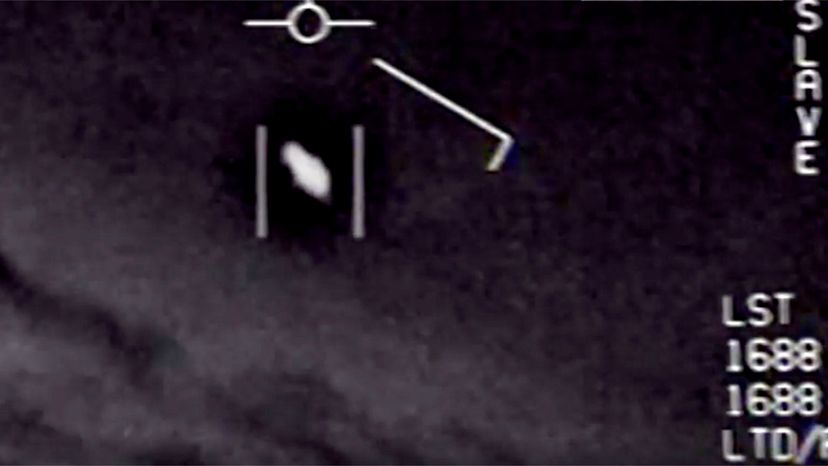
Funding for AATIP ran out in 2012, but Elizondo continued to investigate UAP sightings until 2017, when he got fed up with the Pentagon's skepticism, and quit. Before he left, however, he declassified three Navy videos of UAPs. And then he started to spread the word.
Meanwhile, Christopher Mellon, former deputy assistant secretary of defense for intelligence for presidents Bill Clinton and George W. Bush, acting as a civilian, shared those declassified videos with The New York Times. He had to do did it, he told "60 Minutes," to get the Defense Department to take this "national security issue" seriously.
Raising public awareness prompted Congress to take notice, and the Pentagon to admit the existence of AATIP. Last August, the Pentagon reenacted the program, changing the name to the UAP Task Force. Service members were finally given the green light to share reports of UAP sightings.
When then-intelligence committee chairman Sen. Marco Rubio of Florida was briefed on UAPs, he called on the Pentagon and the Director of National Intelligence to present Congress with an unclassified report of the sightings by June 2021.
"Fortunately, both Congress and the DoD are prepared to take this subject seriously, and the remaining pushback against transparency is confined to a very small cadre of individuals whose grasp over the secrecy is quickly weakening," Elizondo says. "We're hearing enough of an outcry from our men and women in uniform, and from the American people, and we have to take that seriously. ... It's become a liability for the Pentagon to exacerbate a coverup of these facts."
6. What Will the Report Say?
There's tons of data, videos, photos, telemetry, signatures collected and full electromagnetic spectrum analysis that will need to be sifted through in order to provide a complete report — "far too much to be properly collated within the 180-day Congressional mandate," Elizondo says. He expects the report to be just a teaser, with much more details in the months that follow.
"I expect that this initial report will draw attention to the reality of UAP, the potential scientific and technological value that exists in better understanding how they operate, and the need for a permanent office in the U.S. Government to examine the data we collect in order to present it to Congress and the American people."
Now That's Out of This World
Want to see where, when, and what types of UFOs people are reporting? Check out the National UFO Reporting Center's monthly reporthere.
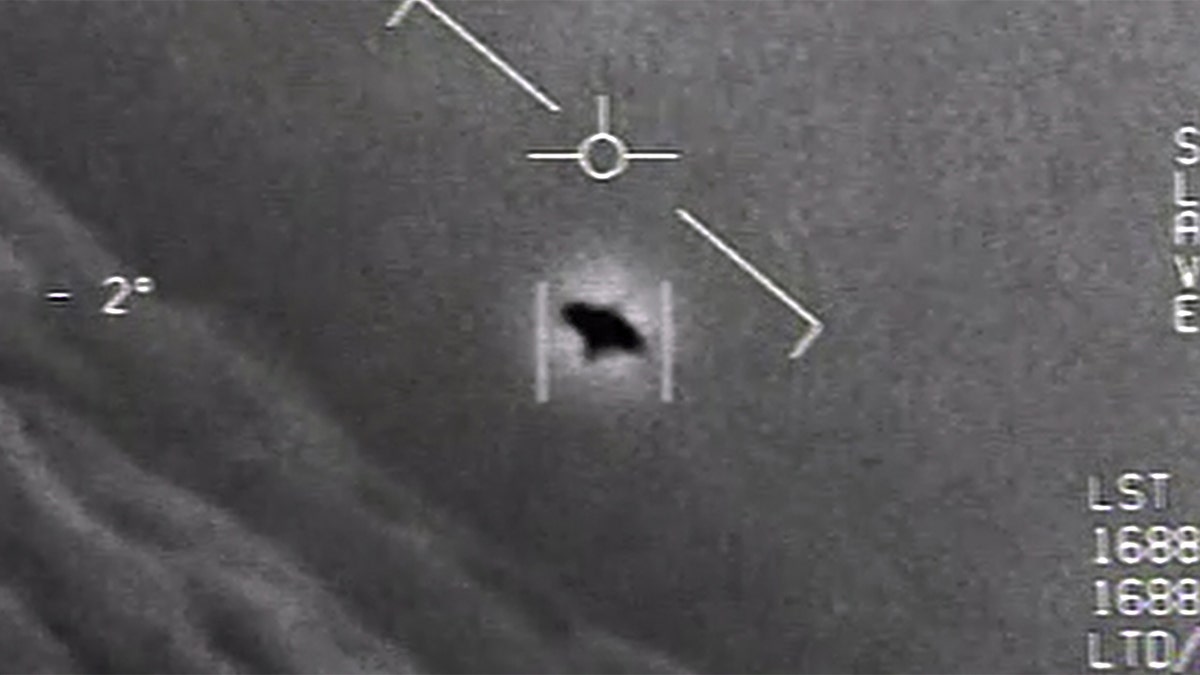
U.S. Navy pilots tracked and photographed what appeared to be a fast-moving object off the Florida coast in 2015.Department of Defense
As you gaze up at the vast night sky, spotting flying objects and flashing lights, you might wonder if you're witnessing evidence of extraterrestrialvisitors or simply natural phenomena. Historically, most people would label these mysterious objects as UFOs or Unidentified Flying Objects.
But did you know that there's a more modern terminology now in play? Enter "UAP" or Unidentified Aerial Phenomena. So, what exactly is the UAP meaning?
Throughout history, from ancient Greece to present times, people have reported sightings of unidentified objects in the sky. These events, often linked with extraterrestrial origin, have been the focus of many enthusiasts and government agencies alike.
But the term UFO isn't without its issues.
When we hear "UFO", our minds often jump straight to alien spacecraft. Blame it on pop culture or the association the term has built over the years.
A Brief History of UFOs
The term "UFO" came into our lexicon after a significant event on June 24, 1947. Pilot Kenneth Arnold reported nine bright, flying discs moving at high speeds near Mount Rainer.
This report birthed the terms "flying saucer" and "flying disc," laying the groundwork for what we commonly refer to as UFOs. Following Arnold's report, government officials and military units started establishing UFO investigation task forces.
Over the past decades, UFO sightings became synonymous with aliens. Reports from pilots, military personnel, and civilians alike about flying saucers, hovering lights and objects moving at high speeds always seemed to suggest visitors from outer space.
2. The UAP Era Begins
This screenshot of a leaked video of a flashing, triangle-shaped object that flew over a U.S. warship was confirmed by the Pentagon as real, though it declined to label it a UAP. SETI
The shift from "UFO" to "UAP" was subtle but significant. UAPs encompass a broader definition, including any unidentified anomalous phenomena in the sky. This change in terminology was partly due to recent years of data collected by national security departments and civilian star gazers.
This report mentioned the rigorous scientific methods applied to UAP research, using advanced technologies like radar. It was no longer just about eyewitness accounts. The focus had shifted to hard evidence and understanding the nature of these events.
In a leap towards understanding these phenomena better, NASA has now commissioned an independent team of 16 scientists and astrophysicists. They aim to analyze unclassified UAP data and work towards ensuring aircraft safety.
3. UFOs, UAPs and the Quest for Answers
Whether it's UFOs or UAPs, the essence remains the same: unidentified flying objects in the sky. Both terms, while carrying different connotations, point towards humanity's eternal exploration and desire to understand the unknown.
While UAPs might be the preferred term in government circles, it doesn't exclude the possibility of extraterrestrial origins. The UAP terminology might just be the scientific community's way of embracing these unidentified objects without fear of, well, sounding a bit out of this world.
The change in terminology represents a more data-driven, scientific approach to understanding mysterious flying objects in our sky. As the stars twinkle and mysterious objects continue to whizz by, our search for answers continues, regardless of what we call them.
This article was updated in conjunction with AI technology, then fact-checked and edited by a HowStuffWorks editor.
Now That's Interesting
One of the earliest knowndiscussions of the possibility of alien life appears in a book written around 50 B.C.E. by a protégé of Epicurius, Lucretius. In his book "De rerum natura," or "On the Nature of Things," he writes, "... 'Tmust be confessed in other realms there are / Still other worlds, still other breeds of men / And other generations of the wild."
In space technology, the power source is often just as important as the engine or the payload: a spacecraft can be launched into orbit or sent into deep space, but without a stable power supply, its mission will quickly come to the end. That is precisely why DARPA’s “Rads to Watts” program has attracted attention; its goal is to take nuclear batteries to the next level. The idea is to convert nuclear radiation energy directly into electricity, without the need for a conventional thermal cycle.
DARPA explicitly states that the ultimate goal of the program is to develop nuclear systems capable of operating with high-power radiation sources and, in the future, delivering kilowatt-level electrical power. Such power sources are particularly useful in environments where it is not possible to regularly maintain equipment, replace batteries, or rely on solar panels—specifically for spacecraft and remote underwater platforms. The main technical challenge today is the degradation of materials and semiconductor components due to radiation exposure, which reduces the device’s efficiency and lifespan.
A concept for a spacecraft equipped with a powerful, maneuverable plasma engine powered by the latest kilowatt-class power sources—devices that directly convert radiation into electricity. Source: DARPA | Alan Clarke
At the same time, similar solutions are already making their way from the laboratory to practical implementation. For example, the Australian GenX project (a 3D-printed battery that does not require charging), developed by entX and Adelaide University, combines additive manufacturing, advanced semiconductor deposition techniques, and the creation of highly efficient electrical junctions. The developers claim that this architecture delivers very high power density in a compact form factor and can be used for long-duration space and defense missions. If these approaches can be scaled up, nuclear micro-power sources could become a key enabler for equipment that operates for years without refueling, maintenance, or access to sunlight.
How does it work?
Inside this type of battery is a radioactive source that constantly emits particles. These particles enter a special semiconductor layer and knock out charge carriers there, while the electrical junction directs them into a useful current. In other words, the battery doesn’t burn up like fuel in an engine and doesn’t need to be recharged from an outlet—it generates electricity on its own, slowly but for a very long time. DARPA aims to make such systems significantly more powerful and radiation-resistant, while industrial developers, such as entX, are working to create thin, multilayer structures and efficient electrical junctions to improve energy efficiency.
Why is this important?
This technology is particularly valuable in space where solar panels are inefficient or vulnerable: on deep-space missions, in regions with high radiation levels, during prolonged solar eclipses, on the lunar surface, or on autonomous scientific platforms. In the future, such nuclear batteries could provide years of continuous operation for sensors, rovers, satellites, and observation instruments without the need for service missions, which fully meets the needs of space exploration and automated astronomy. This is partly confirmed by the fact that DARPA is considering such systems specifically for new energy-constrained environments, and entX explicitly mentions satellites, rovers, as well as space and lunar missions.
For several years now, the Perseverance rover has been exploring a river delta that once flowed into Jezero Crater. Scientists say that these sedimentary deposits may be the very place where life on this planet remains hidden to this day.
Sedimentary rocks in Jezero crater. Source: phys.org
Discovery of an ancient delta in the Jezero crater
Further evidence has emerged that water once flowed on Mars, thanks to the discovery of an ancient river delta deep beneath the surface. NASA’s Perseverance rover detected it more than 35 meters below the surface ofJezero Crater using ground-penetrating radar. Perseverance was launched in 2020 to search for signs of ancient life on Mars. Since landing in February 2021, it has been exploring Jezero Crater and collecting rock samples.
The crater, which is approximately 45 kilometers in diameter, is located north of the Martian equator, resulting from an asteroid impact nearly 4 billion years ago. NASA chose this site for exploration because numerous geological features indicate the presence of water in the past, which may have supported ancient life, particularly in a part of the crater known as the Margin Unit. This region is filled with carbonates, which on Earth typically form in stable aquatic environments, such as shallow seas or lakes.
Detection using radar
The rover used an instrument called RIMFAX (Radar Imager for Mars’ Subsurface Experiment) to peer nearly twice as deep as any previous radar survey of the crater. A team led by Emily Cardarelli of the University of California, Los Angeles, combined this radar data with satellite imagery and the rover’s GPS receiver to create a 3D map of the ancient layers beneath the dusty red surface.
The radar detected numerous fan-shaped features and inclined layers of sedimentary rock characteristic of deltas. These structures form when a river flows into a body of standing water, such as a lake, and deposits sand and silt. According to the researchers, this buried delta formed between 3.7 and 4.2 billion years ago and predates the fan-shaped deposit visible at the bottom of the crater, known as the Western Delta.
More opportunities to discover Martian life?
Perseverance’s latest discovery suggests that a much older river system existed in the same location millions of years ago. “RIMFAX has revealed an earlier subsurface deltaic environment under the present-day delta, thereby extending the period of potential habitability for Jezero back further in time,” the research team wrote in their paper.
The discovery of the delta may indicate that water flowed on Mars much earlier than previously thought, which could well increase our chances of finding preserved evidence of ancient Martian life.
Unidentified Drone Swarm Intrudes on US Nuclear Bomber Base, Raising Security Concerns
Unidentified Drone Swarm Intrudes on US Nuclear Bomber Base, Raising Security Concerns
In a series of unsettling incidents, the US Air Force’s primary hub for nuclear bombers faced repeated intrusions by elusive drone swarms. These unauthorized aerial vehicles managed to penetrate Barksdale Air Force Base in Louisiana, despite the military’s efforts to neutralize them using jamming technology.
Barksdale officials confirmed to the Daily Mail that from March 9 to March 15, multiple drones were detected breaching the base’s restricted airspace. The initial sighting of a single drone, referred to as an ‘unmanned aerial system,’ prompted a shelter-in-place directive along with heightened security measures, following FBI warnings of potential drone threats on American soil.
An internal military briefing has since disclosed that subsequent incursions involved clusters of 12 to 15 drones, which boldly entered the base’s no-fly zone, presenting a more formidable challenge to the base’s defenses.
The intruding drones were characterized as long-range models employing sophisticated signals, unlike those found in standard consumer drones. Notably, these drones demonstrated an ability to withstand or evade signal jamming attempts, complicating efforts to regain control over the airspace.
As the residence of the Air Force’s formidable B-52 bomber fleet, Barksdale Air Force Base plays a critical role in the country’s nuclear capabilities, making these breaches particularly concerning for national security.
Barksdale Air Force Base is home to the military’s fleet of B-52 bombers, capable of delivering nuclear strikes around the world.
A Barksdale AFB spokesperson said: ‘Flying a drone over a military installation is not only [a] safety issue, it is a criminal offense under federal law.’
‘We are working closely with federal and local law enforcement agencies to investigate these incursions. The security of our installation and the safety of our people are top priorities, and we will continue to vigilantly monitor our airspace.’
Personnel at Barksdale Air Force Base in Louisiana were ordered to shelter in place on March 9 due to a potential hostile drone in the area.
Barksdale AFB is home to three squadrons of B-52s (Pictured), a long-range bomber which can carry out global nuclear strikes
Although the Air Force did not elaborate on the number of drone incursions over Barksdale, the confidential report from March 15 revealed that the unidentified drones came in waves and flew over several key facilities at the base.
According to ABC News, who reviewed the document, military officials wrote: ‘BAFB Security Forces observed multiple waves of 12-15 drones operating over sensitive areas of the installation, including the flight line.’
The leaked report added that the drones appeared to be ‘custom built’ and those operating them remotely had a knowledge of advanced radio signals, which prevented the base from disabling the intruders using anti-drone technology.
After reaching multiple points across the installation, the drones dispersed across sensitive locations on the base,’ the document stated.
These swarms were spotted on multiple days last week, but the confidential report noted that no drones were spotted on March 13 or March 14.
Officials reportedly revealed that the drone invasions forced Barksdale to close their runway to incoming and outgoing planes, potentially putting aircraft preparing to land at the air base in danger.
US military bases use radio-frequency (RF) and electronic warfare (EW) jamming to bring unauthorized drones down when they stray into restricted airspace or threaten public safety.
This equipment broadcasts interfering signals to break the link between a drone and its operator or scrambles the aircraft’s GPS navigation.
Barksdale AFB officials said the multiple drone incidents during the week of March 9 are still under investigation by the military and the FAA
A leaked military document claims attempts to jam the unauthorized swarms failed, meaning they likely were not commercial drones.
he idea is to make the drone lose control, land, crash or fly away harmlessly.
It is unclear what type of signals the drone swarms over Barksdale were using that made them impervious to jamming devices.
A spokesperson from Barksdale did not confirm the details of the internal military briefing document on Friday.
It is also unknown what installations at the strategically vital base were being spied on by the drone swarms.
The B-52H Stratofortress is one of the country’s most terrifying aircraft, especially as tensions in the Middle East spark rhetoric of nuclear escalation.
It is a long-range, heavy bomber capable of flying at high subsonic speeds at altitudes of up to 50,000 feet.
The B-52 also has a range of approximately 8,800 miles without refueling, meaning it can take off from Barksdale and reach Europe, the Middle East or Asia without needing to land.
The bomber has become famous for its ability to carry up to 70,000 pounds of ordnance for both conventional and nuclear strikes and its round-the-clock patrols during times of extreme crisis, like during the Cold War.
The B-52s (Pictured) can fly from Barksdale Air Force Base to targets in Europe, the Middle East or Asia without needing to refuel or land
In July 2025, airmen from Barksdale’s legal office worked with Louisiana state lawmakers to update the state’s drone law, expanding restrictions on unauthorized flights to include Barksdale, US Navy ships, ports and other facilities across the state.
US Air Force Staff Sergeant Ramiro Valerosaid in a 2025 statement: ‘People who try to fly near a military base might have malicious intent. With the harsher punishments, they might think twice before trying it.’
The updated penalties covering the airspace over Barksdale now call for a fine of up to $250,000 and at least one year in prison for the drone flyer, according to the Air Force.
However, Louisiana state law R.S. 14:337(E)(5) states that a person convicted of flying an unauthorized drone over federal or military installations could also face ‘five years of hard labor imprisonment and court-ordered forfeiture of the drone.’
As US forces step up their bombardment of Iranian defences, the battered regime appears to have found a counter to one of America's most feared weapons.
Iran's military claims to have hit an F–35 Lightning II stealth fighter jet with anti–aircraft artillery.
'The aircraft landed safely, and the pilot is in stable condition,' Captain Tim Hawkins said. It is unclear if the pilot, who landed at a US base in the Middle East, was injured.
The F–35's stealth technology should render it all but undetectable by conventional military radar systems, making the hit enormously unlikely.
However, researchers say that Iranian air defences aren't relying on radar alone to keep tabs on America's invisible fighters – with a 'passive infrared' system also being used.
Iran's military claims to have scored a direct hit on a US F–35 Lightning II stealth fighter, marking the first time an American F–35 has been hit by enemy fire
The F–35 (pictured) should be all but undetectable by conventional military radar systems, but experts claim it is not entirely 'invisible'
What makes this long–range fighter so deadly is its ability to avoid or confound enemy radar systems, letting it strike targets without being hit back.
Radar systems work by sending out bursts of electromagnetic signals and listening carefully for how those waves bounce back – like a bat hunting by echolocation.
To avoid detection, the F–35 is specially shaped so that radar signals deflect off its surface like light on a slanted mirror.
The fighter also has the capacity to keep its weapons inside the body of the plane, safely protected by its radar–baffling panels.
This breaks up the plane's radar signature, making it significantly harder for enemy systems to spot.
To further enhance this effect, the entire plane is coated with a radar–absorbing material that soaks up incoming electromagnetic signals rather than bouncing them back.
The F–35's specially shaped panels and radar–absorbing coating mean that it only has the radar cross section of a small bird, making it extremely hard to detect and hit
The F–35 Lightning II
Primary function: Multirole fighter
Contractor: Lockheed Martin
Power plant: One Pratt & Whitney F135–PW–100 turbofan engine
Thrust: 43,000 pounds
Wingspan: 35 feet (10.7 meters)
Length: 51 feet (15.7 meters)
Height: 14 feet (4.38 meters)
Payload: 18,000 pounds (8,160 kilograms)
Top speed: Mach 1.6 (~1,200 mph)
Range: More than 1,350 miles with internal fuel (1,200+ nautical miles), unlimited with aerial refuelling
Ceiling: Above 50,000 feet (15 kilometres)
Maximum G–rating: 9.0
Standard armament: 25mm GAU–22/A cannon, two AIM–120C/D air–to–air missiles, two 2,000 lb GBU–31 JDAM guided bombs
Although the F–35's physical wingspan is 35 feet (10.7 metres), its radar cross–section is about the size of a small bird.
How invisible is the F–35?
Although stealth technology is often compared to an 'invisibility cloak', this greatly exaggerates the F–35's abilities.
Dr Can Kasapoğlu, senior fellow at the Hudson Institute, told the Daily Mail: 'The F–35 is not invisible; it is low observable.
'It is designed to delay detection, degrade tracking, and avoid engagement zones rather than eliminate detection entirely.'
Dr Kasapoğlu adds: 'Any aircraft can be detected under the right conditions; the key issue is when and with what quality.'
Certain types of radar, such as very–high frequency (VHF) and ultra–high frequency (UHF) systems, can beat most stealth systems.
However, the key is that these detections aren't 'weapons grade' – meaning they aren't high enough quality to guide a missile to impact.
Even as early as 2023, Iran claimed it had the capacity to detect American F–35s flying over the Gulf.
However, this doesn't mean that Iran had the ability to shoot down American stealth fighters, only to roughly know where they are.
A more plausible explanation for the reported hit on an F–35 is that the Iranian military was using a 'passive infrared' system.
Instead of actively sending out radar signals to spot jets, infrared systems scan the sky for the telltale heat signature of a fighter's engine.
Even though the F–35's engine is specially designed to reduce its infrared signature, it isn't enough to prevent short–range detection.
This means that the Iranian attack was more likely to have been an opportunistic close–range ambush rather than a deliberate long–range strike.
Dr Kasapoğlu suggests that the Iranian 358 loitering munition is a 'natural culprit'.
This nine–feet–long (2.7 m) surface–to–air missile flies slowly in a figure of eight over the battlefield, waiting to spot a target with its infrared detector.
Experts say the F–35 might have been hit by an Iranian 358 loitering munition (pictured). These missiles use a passive infrared detection system rather than radar, allowing them to beat the F–35's stealth technology at short range
If an F–35 had got close enough, it could have been struck with almost no warning as the 358 locked on to its engine signature.
In Yemen last year, Houthi rebels demonstrated how even relatively crude infrared systems could be used to great effect to counter stealth technology.
US F–35s flying against Houthi air defences were forced to take evasive actions to avoid being hit by surface–to–air missiles, with one pilot reportedly dodging several attacks.
However, Dr Kasapoğlu maintains that this is a one–off, unattributed case that doesn't require the US to radically change its strategy.
If passive infrared detectors are being used, they are likely part of a 'layered detection approach' rather than a standalone capacity.
This means the F–35's ability to strike targets long before it is detected will still be a valuable asset.
'No fundamental shift is required for now. It reinforces the need for disciplined mission planning and continuous suppression of enemy air defences in complex environments,' Dr Kasapoğlu says.
'The F–35 remains a reliable fifth–generation platform and a cornerstone of US airpower.'
As US forces step up their bombardment of Iranian defences, the battered regime appears to have found a counter to one of America's most feared weapons.
Iran's military claims to have hit an F–35 Lightning II stealth fighter jet with anti–aircraft artillery.
'The aircraft landed safely, and the pilot is in stable condition,' Captain Tim Hawkins said. It is unclear if the pilot, who landed at a US base in the Middle East, was injured.
The F–35's stealth technology should render it all but undetectable by conventional military radar systems, making the hit enormously unlikely.
However, researchers say that Iranian air defences aren't relying on radar alone to keep tabs on America's invisible fighters – with a 'passive infrared' system also being used.
Iran's military claims to have scored a direct hit on a US F–35 Lightning II stealth fighter, marking the first time an American F–35 has been hit by enemy fire
The F–35 (pictured) should be all but undetectable by conventional military radar systems, but experts claim it is not entirely 'invisible'
What makes this long–range fighter so deadly is its ability to avoid or confound enemy radar systems, letting it strike targets without being hit back.
Radar systems work by sending out bursts of electromagnetic signals and listening carefully for how those waves bounce back – like a bat hunting by echolocation.
To avoid detection, the F–35 is specially shaped so that radar signals deflect off its surface like light on a slanted mirror.
The fighter also has the capacity to keep its weapons inside the body of the plane, safely protected by its radar–baffling panels.
This breaks up the plane's radar signature, making it significantly harder for enemy systems to spot.
To further enhance this effect, the entire plane is coated with a radar–absorbing material that soaks up incoming electromagnetic signals rather than bouncing them back.
The F–35's specially shaped panels and radar–absorbing coating mean that it only has the radar cross section of a small bird, making it extremely hard to detect and hit
The F–35 Lightning II
Primary function: Multirole fighter
Contractor: Lockheed Martin
Power plant: One Pratt & Whitney F135–PW–100 turbofan engine
Thrust: 43,000 pounds
Wingspan: 35 feet (10.7 meters)
Length: 51 feet (15.7 meters)
Height: 14 feet (4.38 meters)
Payload: 18,000 pounds (8,160 kilograms)
Top speed: Mach 1.6 (~1,200 mph)
Range: More than 1,350 miles with internal fuel (1,200+ nautical miles), unlimited with aerial refuelling
Ceiling: Above 50,000 feet (15 kilometres)
Maximum G–rating: 9.0
Standard armament: 25mm GAU–22/A cannon, two AIM–120C/D air–to–air missiles, two 2,000 lb GBU–31 JDAM guided bombs
Although the F–35's physical wingspan is 35 feet (10.7 metres), its radar cross–section is about the size of a small bird.
How invisible is the F–35?
Although stealth technology is often compared to an 'invisibility cloak', this greatly exaggerates the F–35's abilities.
Dr Can Kasapoğlu, senior fellow at the Hudson Institute, told the Daily Mail: 'The F–35 is not invisible; it is low observable.
'It is designed to delay detection, degrade tracking, and avoid engagement zones rather than eliminate detection entirely.'
Dr Kasapoğlu adds: 'Any aircraft can be detected under the right conditions; the key issue is when and with what quality.'
Certain types of radar, such as very–high frequency (VHF) and ultra–high frequency (UHF) systems, can beat most stealth systems.
However, the key is that these detections aren't 'weapons grade' – meaning they aren't high enough quality to guide a missile to impact.
Even as early as 2023, Iran claimed it had the capacity to detect American F–35s flying over the Gulf.
However, this doesn't mean that Iran had the ability to shoot down American stealth fighters, only to roughly know where they are.
A more plausible explanation for the reported hit on an F–35 is that the Iranian military was using a 'passive infrared' system.
Instead of actively sending out radar signals to spot jets, infrared systems scan the sky for the telltale heat signature of a fighter's engine.
Even though the F–35's engine is specially designed to reduce its infrared signature, it isn't enough to prevent short–range detection.
This means that the Iranian attack was more likely to have been an opportunistic close–range ambush rather than a deliberate long–range strike.
Dr Kasapoğlu suggests that the Iranian 358 loitering munition is a 'natural culprit'.
This nine–feet–long (2.7 m) surface–to–air missile flies slowly in a figure of eight over the battlefield, waiting to spot a target with its infrared detector.
Experts say the F–35 might have been hit by an Iranian 358 loitering munition (pictured). These missiles use a passive infrared detection system rather than radar, allowing them to beat the F–35's stealth technology at short range
If an F–35 had got close enough, it could have been struck with almost no warning as the 358 locked on to its engine signature.
In Yemen last year, Houthi rebels demonstrated how even relatively crude infrared systems could be used to great effect to counter stealth technology.
US F–35s flying against Houthi air defences were forced to take evasive actions to avoid being hit by surface–to–air missiles, with one pilot reportedly dodging several attacks.
However, Dr Kasapoğlu maintains that this is a one–off, unattributed case that doesn't require the US to radically change its strategy.
If passive infrared detectors are being used, they are likely part of a 'layered detection approach' rather than a standalone capacity.
This means the F–35's ability to strike targets long before it is detected will still be a valuable asset.
'No fundamental shift is required for now. It reinforces the need for disciplined mission planning and continuous suppression of enemy air defences in complex environments,' Dr Kasapoğlu says.
'The F–35 remains a reliable fifth–generation platform and a cornerstone of US airpower.'
The research team behind the discovery said the ancient river and deltaic structures, which formed around 4.2 billion years ago, could provide fresh insights into the red planet’s watery ancient history. The discovery could also support efforts to search for signs of ancient extraterrestrial life hidden beneath the planet’s surface.
“From the stratigraphic features mapped by RIMFAX, we can conclude that Jezero crater hosted an aqueous, possibly habitable environment capable of biosignature preservation, prior to the formation of Jezero’s Western Delta,” the researchers write.
Ancient Martian River Among Several Historic Perseverance Discoveries
When NASA’s Perseverance rover first touched down on February 18, 2021, its primary mission included searching for signs of ancient microbial life. However, the nuclear-powered vehicle was also tasked with verifying previous studies suggesting that Mars was once much wetter than it is today.
While a sample-return mission is still needed to determine whether Perseverance’s primary life-hunting mission was successful, the rover has found several pieces of compelling evidence that further bolster the case for a wet ancient Mars, including surface rivers and lakes that may have supported Martian lifeforms.
“The surface of Mars hosts widespread evidence of ancient flowing water and paleolakes,” the research team explained, adding that orbital and in situ spacecraft observations have also confirmed the presence of ‘aqueous alteration minerals’ on the planet’s surface.
Still, the initial scans indicating the presence of ancient waterways only penetrated a few inches beneath the Martian surface, limiting the amount of dispositive data that could be collected from them. Now, the rover has performed a new set of ground-penetrating radar scans that provide further support for the presence of an ancient river near Jezero crater.
Scans reveal numerous subsurface features consistent with an ancient river
According to a statement announcing the discovery, the study’s leader, UCLA’s Emily Cardarelli, focused on scans detailing features found in a currently submerged sedimentary deposit called the Margin unit. Because this region is rich in magnesium carbonates, the study authors said the site preserves a record of the planet’s ancient, wet climate.
“We analyze the depositional setting of the Margin unit, a major magnesium-carbonate deposit near the fluvial inlet to Jezero crater using ground penetrating radar data collected by the Mars 2020 Perseverance Rover Radar Imager for Mars Subsurface Experiment (RIMFAX) instrument,” they write.
Along with its mineral composition, the Margin unit site was chosen because previous studies had revealed features “indicative of paleolakes and river deltas.” This includes a prominent feature that appears to have been shaped by flowing water, called the Western Delta.
Unlike earlier scans, the researchers said the RIMFAX ground-penetrating scans reached depths of “greater than 35 meters.” For comparison, the team notes that this is approximately 1.75 times as deep as “other Jezero geologic units explored to date.” The team also noted that the new scans were collected during an “approximately 6.1-km rover traverse.”
In the Margin Unit, strongly reflecting layers appear dark, and weakly reflecting lithologies appear light. The projected radargram is shown alongside HiRISE digital elevation model data, and layers are traced (cyan dotted lines) from the subsurface to their corresponding surficial topographic features.
Image Credit: NASA/JPL/UCLA/UiO/ETH Zurich.
After examining the new scans, the researchers discovered “numerous subsurface features” consistent with an ancient river. These features were revealed by scans taken at “submeter to hundred-meter scale layering,” offering a small- and large-scale view of the ancient Martian river. The team said they inferred that the features they located “are consistent with buried fluvial features and deltaic foresets, which have experienced multiple erosional-depositional episodes.”
“This work illuminates a well-preserved paleolandscape wherein a deltaic environment developed prior to the formation of the Jezero Western Delta, as early as the Noachian (~4.2 to 3.7 billion years ago),” they explained
Discovery “Improves the Chances of Finding Evidence for Past Life”
When discussing potential implications of an ancient Martian river delta hidden beneath the red planet’s surface, the team noted that the ground penetrating power of RIMFAX provided them with “a unique perspective into the shallow Martian subsurface.
The team also noted the work “may have implications for the preservation of potential biosignatures and habitability in the subsurface of Jezero crater,” by providing a potential window into habitable conditions on Mars. This includes widening the window of opportunity for ancient Martian lifeforms to take hold.
“RIMFAX has revealed an earlier subsurface deltaic environment under the present-day delta, thereby extending the period of potential habitability for Jezero back further in time,” the study authors explained. “This work also improves the chances of finding evidence for past life.”
Christopher Plain is a Science Fiction and Fantasy novelist and Head Science Writer at The Debrief. Follow and connect with him on X, learn about his books at plainfiction.com, or email him directly at christopher@thedebrief.org.
A lawmaker has made bold claims that NASA is 'lying' about UFOs, alleging the agency holds classified files on the matter.
Tennessee Congressman Tim Burchett, a member of the House Oversight Committee that has reviewed UFO reports, made the remarks during an appearance on One America News on Tuesday, where he claimed to have attended meetings with the space agency about extraterrestrial craft.
'The lying that goes on in these departments,' he said. 'NASA saying, 'We don't have any of this' or 'We haven't studied any of this.'
'I have been in meetings with them, or they've told me they studied it and that they have stuff that is classified that they can't share with the public.'
Burchett was also asked why more whistleblowers have not come forward, responding: 'I think they're afraid of being disappeared… I think being murdered is what they're afraid of. I think some of them truly are because of things they've seen.'
When Daily Mail contacted NASA for comment, the agency responded with a link to an X post from its press secretary, Bethany Stevens, which said: 'We continue to make all NASA data publicly available and welcome public participation using our data.
'As the NASA Administrator has said, there are certainly things he's come across in the job that he can't explain… but they relate more to unnecessarily costly programs than they do to extraterrestrial life.'
He also believes that the Pentagon is engaging in a cover-up, claiming they have 'non-human' technology, and has criticized the Department of Defense for not passing audits while spending money on these matters.
The lawmaker made the comments while speaking on the Matt Gaetz Show, where he said: 'I think it is a big cover-up. I think there are too many directions it is going.'
He claimed to have spoken with Trump about the matter this week to 'be forthcoming and bring this stuff out.'
'The problem is you have this arrogance... These people are so above the law on everything, they think that we're not fit to handle it,' Burchett added.
When asked how Trump reacted to his urging this week, the lawmaker avoided saying the president did not grasp it, but was 'on a lot of other things.'
Trump had ordered the release of all government files relating to UFOs and extraterrestrial life on February 19.
Secretary of War Pete Hegseth issued an update about five days later, saying: 'We've got our people working on it right now. I don't want to oversell how much time it will take, right?
Tennessee Congressman Tim Burchett, a member of the House Oversight Committee that has reviewed UFO reports, made the remarks during an appearance on One America News on Tuesday, where he claimed to have attended meetings with the space agency about extraterrestrial craft
'We're digging in. We're going to be in full compliance with that executive order, eager to provide that for the president.'
Hegseth didn't have an estimate of how long it would take for the Pentagon and US intelligence agencies to release every piece of information on unidentified aerial phenomena (UAP), which have been widely reported throughout the US since the 1940s.
Asked if he believes aliens exist, Hegseth replied: 'We'll see. I get to do the review and find out along with all of you.'
Congresswoman Anna Paulina Luna of Florida, who was put in charge of the House Oversight Committee's task force on declassifying secret records on UAPs, revealed that all of the incoming documents will be housed on the US National Archives' website.
Burchett's interview came just days before the White House registered the domain 'aliens.gov.'
The domain, linked to the Executive Office of the President, was flagged on Wednesday by an automated tracker of federal websites.
However, it is also listed in the government's official .gov registry maintained by the Cybersecurity and Infrastructure Security Agency.
Registry records show it was recently added under the White House Office alongside other official government sites, confirming it as a legitimate federal web address, though its purpose has not been publicly disclosed.
The website is not currently live, but the domain has been reserved.
It's one of the biggest unanswered questions in science – do aliens exist, and if so, where are they?
Now, scientists have taken a massive leap towards answering these queries once and for all.
Experts from the Carl Sagan Institute at Cornell University have pinpointed 45 Earth–like planets that could have perfect conditions for aliens.
The planets all lie within the so–called habitable zone – an area not too close to a host star that it's too hot, and not too far away that it's too cold.
Being in this zone raises the tantalising possibility that a planet has water at its surface, which is a key ingredient for life.
Excitingly, some of these worlds are only tens of light–years away, suggesting we might be able to reach them in the future.
'Life might be much more versatile than we currently imagine, so figuring out which of the 6,000 known exoplanets would be most likely to host extraterrestrials could prove critical,' said Professor Lisa Kaltenegger, an author of the study.
'Our paper reveals where you should travel to find life.'
Experts from the Carl Sagan Institute at Cornell University have pinpointed 45 Earth–like planets that could have perfect conditions for aliens
Scientists have already discovered more than 6,000 exoplanets, but until now, exactly which of these have the potential for life has remained a mystery.
In their new study, the team pinpointed 45 of these planets that may support life in the habitable zone, and another 24 in a narrower 3D habitable zone.
The worlds includes some you might have heard of before, such as Proxima Centauri b, TRAPPIST–1f and Kepler 186f.
Meanwhile, some of the others are not so well known, such as TOI–715 b – a planet located 137 light–years away that was spotted by the TESS satellite just three years ago.
According to the researchers, the most interesting planets are TRAPPIST–1 d, e, f and g, which are just 40 light–years from Earth.
Unfortunately, NASA says that it would currently take at least 800,000 years to reach the TRAPPIST–1 system.
However, as spacecraft begin to use more modern technologies like nuclear pulse propulsion, we could potentially reduce this time to a few centuries.
Meanwhile, the researchers are also interested in the planets that get light from their stars most similar to what Earth receives from the Sun today.
The planets all lie within the so–called habitable zone – an area not too close to a host star that it's too hot, and not too far away that it's too cold. Pictured: An artist's impression of a theoretical planet orbiting a redder star
According to the researchers, the most interesting planets are TRAPPIST–1 d, e, f and g, which are just 40 light–years from Earth
These are TRAPPIST–1 e, TOI–715 b, Kepler–1652 b, Kepler–442 b, Kepler–1544 b and the planets Proxima Centauri b, GJ 1061 d, GJ 1002 b, and Wolf 1069 b.
While the planets well within their habitable zones raise hopes of finding aliens, the researchers also hope the planets on the edge of the habitable zone will shed light on exactly where habitability ends.
'While it's hard to say what makes something more likely to have life, identifying where to look is the first key step,' explained study author Gillis Lowry.
'So the goal of our project was to say "here are the best targets for observation".
As part of the study, the team also pinpointed the best techniques for observing the 45 planets.
This includes the James Webb Space Telescope, the Nancy Grace Roman Space Telescope (set to launch in 2027), and the Extremely Large Telescope (set to see first light in 2029).
Dr David Armstrong, an expert on exoplanet detection from the University of Warwick, told the Daily Mail: 'On Earth, we find life almost everywhere there is liquid water, so the easiest place to look for extraterrestrial life is the same.
An artist's impression of a planetary system around a slightly hotter star than our Sun. In prior research, Carl Sagan Institute scientists have theorised that organisms could evolve biofluorescence to protect themselves from a more intense star
'The most likely place to find it would be in the subsurface oceans of some of the moons orbiting Saturn and Jupiter.'
Saturn's moon Enceladus is seen as a particularly promising candidate to look for extraterrestrial life because of plumes of liquid water constantly spewing from its South Pole.
Meanwhile, Titan, another of Saturn's icy moons, has also been put forward as a strong candidate in the search for extraterrestrial life.
The 45 Earth–like planets that could have perfect conditions for ALIENS
A discovery made more than two decades ago by Canadian marine engineers Paulina Zelitsky and Paul Weinzweig has resurfaced in recent discussions, sparking renewed interest and controversy. In 2001, while conducting an expedition to map the ocean floor near Cuba, the pair uncovered what they believed to be the remains of a long-lost city submerged over 2,000 feet underwater. The sonar scans revealed structures resembling pyramids, roads, and other buildings that suggested a sophisticated urban center. According to the DailyMail, this submerged city is believed to be more than 6,000 years old, potentially older than the Egyptian pyramids, and its discovery could reshape human history. However, since the initial findings, the site has been largely ignored, leaving many unanswered questions. The discovery has triggered debates about its authenticity, with experts divided on whether the site is a natural formation or evidence of an ancient civilization.
The Discovery: A Sunken City or Natural Formations?
When Zelitsky and Weinzweig first reported their findings, they described the structures as potential evidence of an advanced urban center that had been submerged beneath the sea over 6,000 years ago. The sonar scans revealed what appeared to be multiple pyramids and other carefully designed buildings. According to Zelitsky, “It’s a really wonderful structure which really looks like it could have been a large urban center.” With such a remarkable discovery, the team believed that the site could significantly alter our current understanding of human civilization.
However, the initial excitement soon gave way to skepticism from other scientists. One of the primary challenges to the authenticity of the discovery is the location itself: the structures are located over 2,000 feet underwater, far deeper than one might expect for a city that could have been submerged merely thousands of years ago. Skeptics argue that it would have taken much longer—possibly tens of thousands of years—for the area to sink to its current depth due to shifting tectonic plates.
“It would be totally irresponsible to say what it was before we have evidence,” Zelitsky added in a 2001 interview with the BBC, highlighting the complexity of interpreting the findings without more substantial data. Despite the initial reports, no follow-up research has been conducted to gather more concrete evidence to either confirm or debunk the theory that the site was an ancient city.
Sonar scans uncovered massive stone structures on the seabed near the Guanahacabibes Peninsula, resembling pyramids, circular formations, and large blocks.
Credit: ADC via Morien Institute.
Skepticism from Experts: Could the Structures Be Natural?
Among the loudest voices of skepticism is Cuban geologist Manuel Iturralde-Vinent, who has repeatedly dismissed the claim that the structures are man-made. “It’s strange, it’s weird; we’ve never seen something like this before, and we don’t have an explanation for it,” Iturralde told The Washington Post, acknowledging the unusual nature of the discovery, but also stressing the need for caution in interpreting the findings.
Iturralde and other experts have pointed out that the underwater formations could very well be the result of natural geological processes rather than the work of ancient civilizations. According to these critics, the regularity of the formations and their apparent symmetry could be coincidental, and not necessarily indicative of an artificial construction. Given the depth at which the ruins were found, some researchers suggest that the ocean currents and tectonic activity in the area might have shaped the stones in ways that mimic human-made structures.
The debate over the true nature of the site continues to rage, with some proposing that the discovery might be more evidence of ancient civilizations that were once lost to history, while others contend that the site is simply an odd but natural formation. The lack of conclusive evidence has led to an ongoing divide in the scientific community.
A Global Debate: Could This City Rewrite Human History?
While the mystery of the Cuban underwater city remains unsolved, it brings to the forefront one of the most intriguing questions in archaeology: How far back do human civilizations truly date? If the submerged ruins are indeed evidence of an ancient city, it could rewrite the conventional understanding of human history and civilization. Many believe that the discovery, if confirmed, would challenge the currently accepted timeline of human development, suggesting that advanced urban centers existed long before the Egyptians.
Michael Faught, a specialist in underwater archaeology at Florida State University, was among the experts expressing doubt about the authenticity of the ruins. “It would be cool if Zelitsky and Weinzweig were right, but it would be really advanced for anything we would see in the New World for that time frame. The structures are out of time and out of place,” Faught told the South Florida Sun-Sentinel, referencing the complexity of the structures that would have been unprecedented in the Americas at the time.
Despite these doubts, the possibility of rewriting human history remains an enticing prospect for many. Archaeological discoveries like Göbekli Tepe in Turkey, which predates the Egyptian pyramids by over 5,000 years, challenge our understanding of early human societies and their capabilities. Could the Cuban ruins be part of a similar, yet still undiscovered, civilization?
Mysterieuze 'vuurballen' gezien? Het was de raket van Elon Musk Uit diverse plaatsen in ons land kwamen meldingen over vreemde vuurballen in de nachtelijke hemel. De lichtgevende bollen waren rond 04:45 uur zichtbaar. Het gaat vermoedelijk om ruimteafval van SpaceX, het ruimtetransportbedrijf van Elon Musk. Volgens sterrenkundige Theo Jurriens is het mogelijk de tweede trap van draagraket Falcon 9 geweest, die op 1 januari 22 satellieten heeft gelanceerd.
Het heelal is een enorme en uitgestrekte plek, gevuld met de meest bizarre dingen die zelfs de verbeelding van de meest creatieve personen op de proef kunnen stellen. Van losgeslagen planeten die doelloos door de kosmos zwerven tot mysterieuze signalen die dromen over buitenaardse beschavingen veroorzaken, de hemel is gevuld met anomalieën die elke verklaring weerstaan. Deze vreemde en wonderlijke objecten bieden een blik in het onbekende en slepen ons dieper mee in het kosmische mysterie.Nieuwsgierig? Klik door deze galerij om enkele van de mysterieuze krachten, eigenaardige structuren en buitenaardse spektakels van het universum te zien die ons begrip uitdagen en onze verbeelding aanwakkeren.
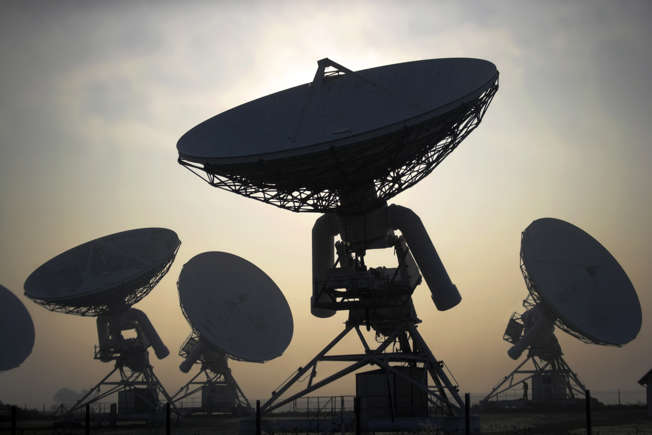
Mysterieuze radiosignalen Sinds 2007 hebben onderzoekers fast radio bursts (FRB's) gedetecteerd, intense radiosignalen die slechts milliseconden duren en op miljarden lichtjaren afstand ontstaan. Onlangs werd een zich herhalende FRB vastgelegd die zes keer flitste, maar het mysterie achter deze signalen is nog steeds niet opgelost.
Nucleaire pasta De sterkste stof in het heelal ontstaat uit de overblijfselen van een dode ster, waar extreme zwaartekracht protonen en neutronen samenperst tot een warrig, linguini-achtig materiaal. Simulaties wijzen erop dat deze stof slechts zou breken onder 10 miljard keer de kracht die nodig is om staal te versplinteren.
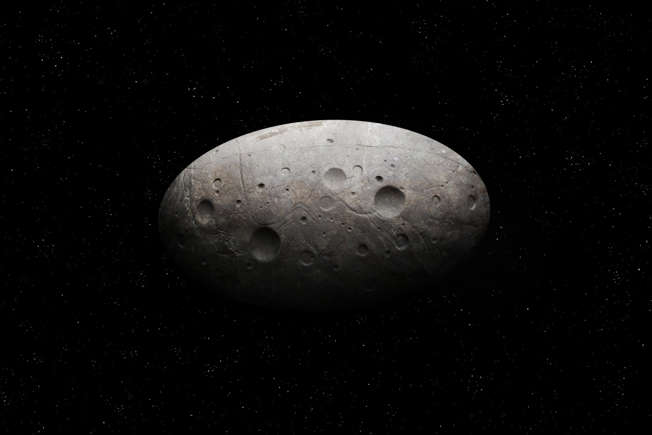
De ringen van Haumea Haumea, een dwergplaneet in de Kuipergordel, is uniek met zijn langgerekte vorm, twee manen en snelle rotatie van vier uur. In 2017 ontdekten astronomen dunne ringen rond Haumea, waarschijnlijk veroorzaakt door een botsing in het verleden, wat deze planeet nog bijzonderder maakt.
Donkere materie De onzichtbare kracht die bekend staat als donkere materie maakt 85% uit van de inhoud van het heelal en is raadselachtig maar alomtegenwoordig. In maart 2018 ontdekten astronomen een sterrenstelsel dat donkere materie leek te missen. Later onderzoek bevestigde de aanwezigheid ervan, en astronomen blijven verbijsterd!
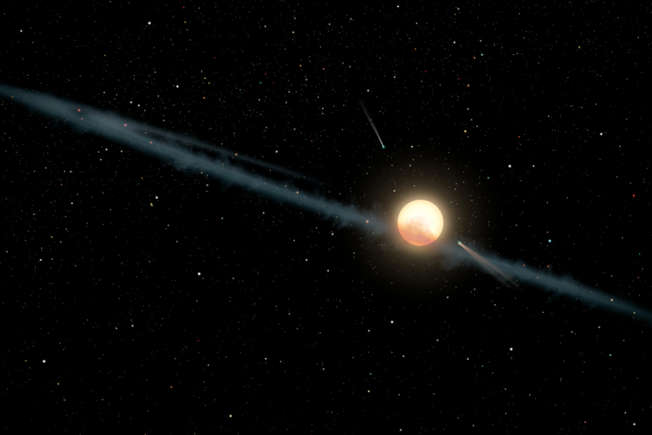
De meest bizarre ster Astronome Tabetha Boyajian en haar team waren verbaasd over KIC 846285, of Tabby's ster, die onregelmatige en aanzienlijke dips in helderheid vertoonde. Terwijl sommigen speculeerden over een buitenaardse megastructuur rondom de ster, geloven de meesten nu dat het dimmen wordt veroorzaakt door een ongebruikelijke ring van stof rondom de ster.
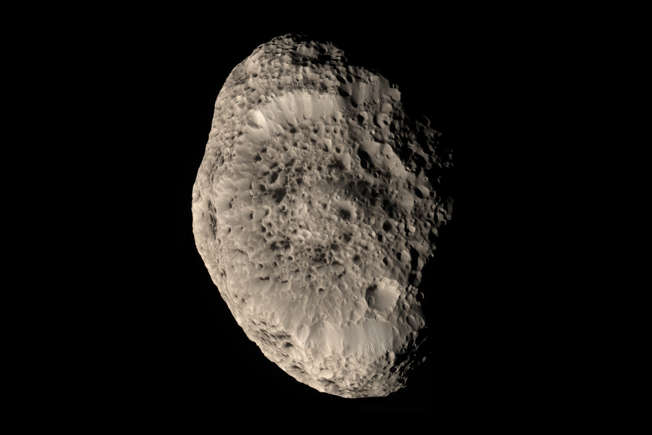
Zeer elektrische Hyperion Hyperion, de maan van Saturnus (met zijn puimachtige, onregelmatige vorm en vele kraters), behoort tot de vreemdste manen in het zonnestelsel. NASA's Cassini-ruimtevaartuig, dat tussen 2004 en 2017 Saturnus verkende, ontdekte ook dat Hyperion een “deeltjesstraal” van statische elektriciteit de ruimte in stuurt, wat de maan nóg vreemder maakt.
Een leidende neutrino Een hoogenergetisch neutrino (in feite een klein spookdeeltje) trof de aarde op 22 september 2017, wat op zich niet ongewoon was, maar het was wél de eerste met voldoende gegevens om de oorsprong ervan te achterhalen. Astronomen stelden vast dat het vier miljard jaar geleden werd weggeblazen door een vlammende blazar, een superzwaar zwart gat dat nabijgelegen materiaal opslokt.
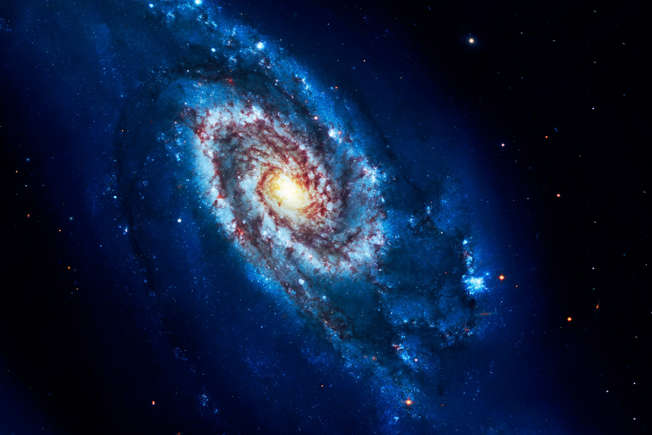
Het levende fossiele sterrenstelsel Een sterrenstelsel dat bekend staat als DGSAT I werd in 2016 ontdekt. Het is net zo groot als de Melkweg, maar bijna onzichtbaar vanwege de dun gespreide sterren. In tegenstelling tot typische sterrenstelsels in clusters, staat DGSAT I alleen. De eigenschappen doen vermoeden dat het ongeveer een miljard jaar na de oerknal is gevormd, waardoor het eigenlijk een levend fossiel is.
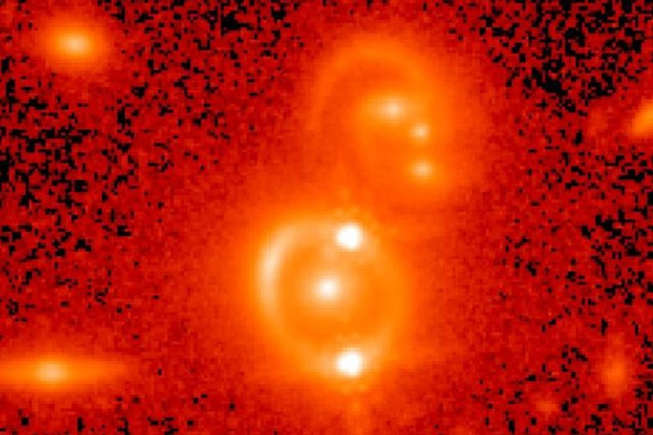
Afbeelding: NASA Hubble ruimtetelescoop, Tommaso Treu/UCLA
Dubbel quasarbeeld Massieve objecten kunnen licht krommen, waardoor het beeld van objecten erachter wordt vervormd. Met behulp van de Hubble-ruimtetelescoop namen onderzoekers een quasar (een lichtgevend sterrenstelsel) uit het vroege heelal waar en ontdekten dat het heelal nu sneller uitdijt dan toen. Natuurkundigen moeten nu vaststellen of hun theorieën niet kloppen of dat er iets ongewoons aan de hand is.
Infraroodstroom Neutronensterren zijn dichte overblijfselen van dode sterren, die meestal radiogolven of röntgenstraling uitzenden. In september van 2018 ontdekten astronomen een ongebruikelijke stroom van infrarood licht van een neutronenster op 800 lichtjaar afstand, iets wat nog niet eerder was voorgekomen. Ze vermoeden dat een omringende stofschijf dit zou kunnen veroorzaken, maar de precieze verklaring blijft onbekend.
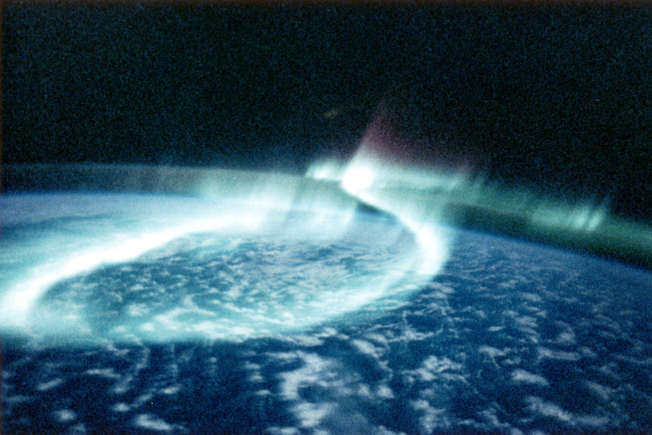
Solitaire planeet met aurora's Solitaire planeten die door de zwaartekracht van hun moederster worden geworpen, zwerven zonder baan door het melkwegstelsel. Een object ter grootte van een planeet (genaamd SIMP J01365663+0933473 en gelegen op 200 lichtjaar afstand) valt op met een magnetisch veld dat meer dan 200 keer sterker is dan dat van Jupiter. Dit krachtige veld creëert flitsende aurora's die zichtbaar zijn met een radiotelescooop.
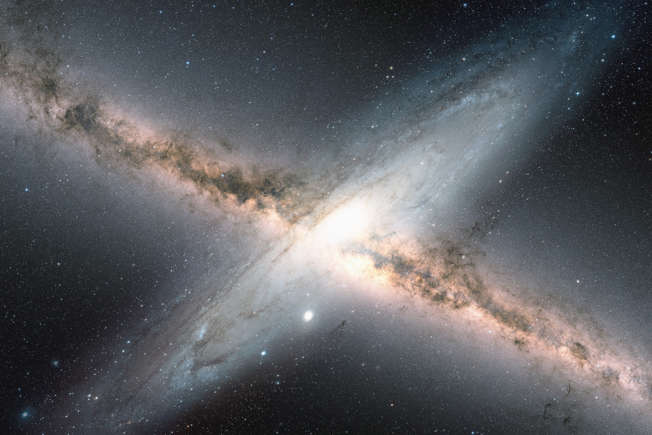
Zwart gat Sagittarius A* In het centrum van de Melkweg bevindt zich een superzwaar zwart gat, Sagittarius A* (Sgr A*), dat vier miljoen zonsmassa's bevat. In tegenstelling tot actievere zwarte gaten in andere sterrenstelsels is Sgr A* ongewoon rustig, verborgen achter gas en stof maar wel detecteerbaar via radiogolven. De extreme dichtheid van dit zwarte gat blijft een mysterie en vormt een uitdaging voor ons begrip van natuurkunde.
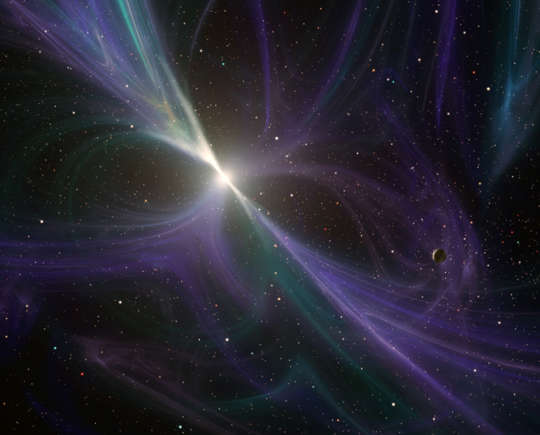
Pulsars De eerste planeten die buiten ons zonnestelsel werden ontdekt, werden in 1992 gevonden, niet rondom een normale ster, maar rond een milliseconde pulsar op 980 lichtjaar afstand. Pulsars zijn neutronensterren, ongelooflijk dichte objecten die snel ronddraaien en elektromagnetische energie uitzenden als de lichtstralen van een vuurtoren. Hoewel de planeten rond de pulsar cirkelen, is deze niet groter dan 32 kilometer breed.
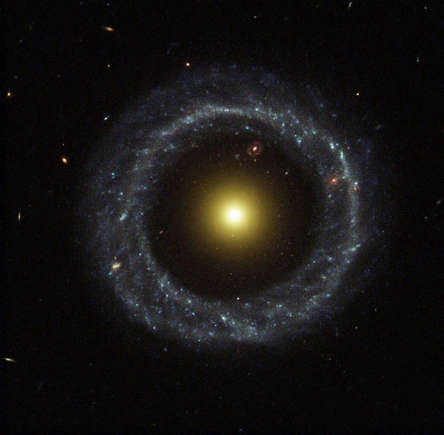
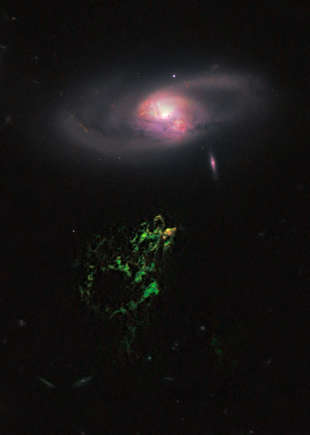
Hoag’s Object In 1950 ontdekte astronoom Arthur Hoag een sterrenstelsel met een centrale gele kern, gescheiden door 70.000 lichtjaar bijna-leegte van een buitenste ring van sterren, gas en stof. Het sterrenstelsel, dat bekend staat als Hoag's Object, heeft een kern en een buitenste ring die elk even groot zijn als delen van de Melkweg, waardoor het één van de meest merkwaardige galactische structuren van het heelal is.
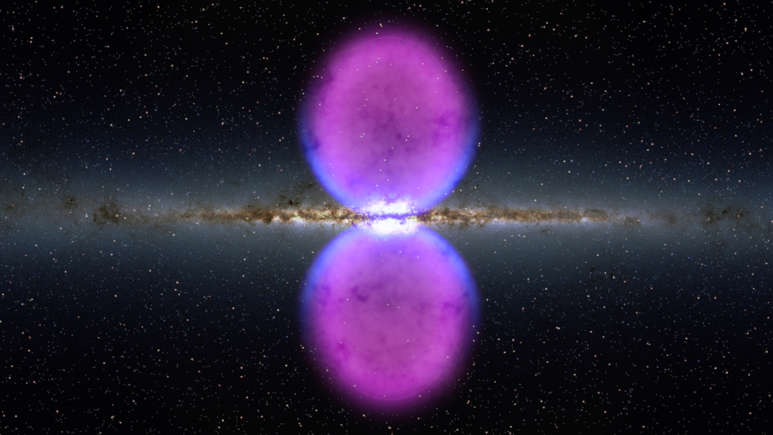
Fermi-bubbels In november 2010 hebben astronomen twee enorme bubbels gammastraling ontdekt die uit het centrum van de Melkweg komen. Deze bubbels, die zich uitbreiden met 2,2 miljoen km/u (3,5 miljoen km/u), vormen een zandlopervorm. Deze vreemde structuur wordt toegevoegd aan de groeiende lijst van mysterieuze fenomenen in de kosmos.
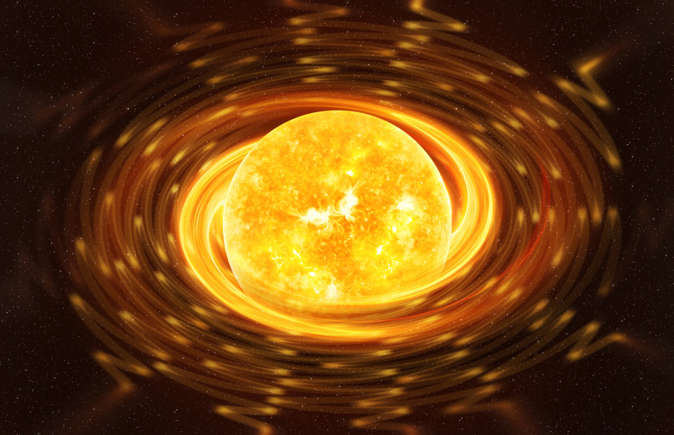
Magnetars Magnetars zijn een soort neutronensterren met ongelooflijk sterke magnetische velden, ongeveer een quadriljoen keer sterker dan het magnetische veld van de aarde. Deze magnetars zijn vreemd omdat ze zogenaamde “sterbevingen” kunnen veroorzaken door de verschuiving van hun magnetische veld. Hierbij komen enorme hoeveelheden energie vrij in intense uitbarstingen van stralingen die vanaf de aarde kunnen worden waargenomen.
Gat van Boötes Het Gat van Boötes is een enorm, bijna leeg gebied in de ruimte met een doorsnede van ongeveer 700 miljoen lichtjaar en weinig sterrenstelsels erin. Zijn grootte en leegte zijn behoorlijk vreemd, omdat zulke leegtes zeldzaam zijn in het heelal, dat grotendeels gevuld is met sterrenstelsels en materie.
De Grote Aantrekker De Grote Aantrekker is een zwaartekrachtanomalie die sterrenstelsels, inclusief onze eigen Melkweg, met ongelooflijke snelheden naar zich toe lijkt te trekken. Het bevindt zich op een vreemde plek in een deel van de hemel dat verborgen is door het stof van ons sterrenstelsel, waardoor hij moeilijk direct waar te nemen is. We weten dat het bestaat, maar zijn precieze eigenschappen blijven een mysterie.
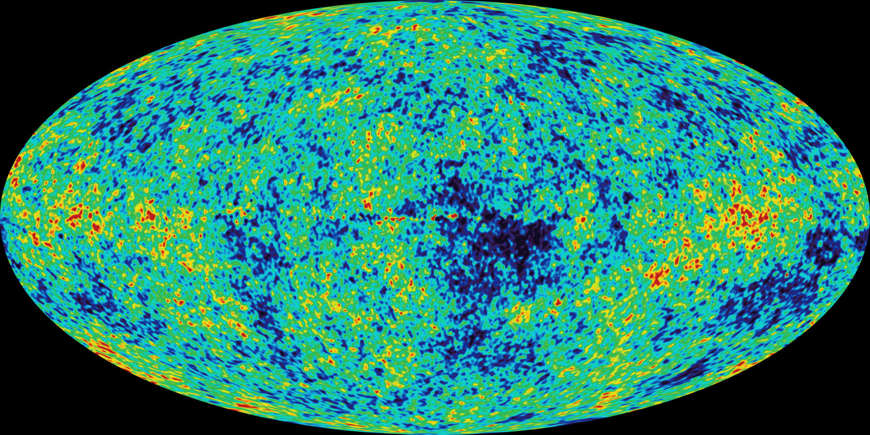
De koude vlek De koude vlek is een ongewoon koud gebied in de kosmische microgolfachtergrond (CMB) die door het heelal is opgenomen in de nasleep van de oerknal. Het is te zien in het midden van de afbeelding, en de temperatuur is aanzienlijk lager dan het omringende gebied. Maar wetenschappers weten niet zeker waarom. Het blijft één van de grootste raadsels in de sterrenkunde.
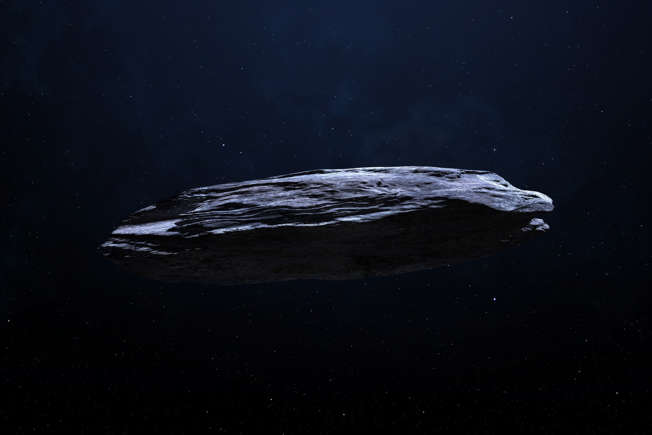
‘Oumuamua 'Oumuamua was een langwerpig, sigaarvormig object dat in 2017 door ons zonnestelsel raasde en het eerste bekende interstellaire object was dat werd gedetecteerd. Zijn vreemde vorm, hoge snelheid en het feit dat het zich niet als een typische komeet of asteroïde gedroeg, hebben geleid tot speculaties over zijn oorsprong. Sommige wetenschappers hebben zelfs gesuggereerd dat het een buitenaardse sonde zou kunnen zijn.
Hanny's Voorwerp Hanny's Voorwerp is een vreemd, gloeiend en groenachtig object waarvan wordt gedacht dat het een gaswolk is die wordt verlicht door een quasar die sindsdien inactief is. Het vreemde is dat het nog steeds gloeit, lang nadat de energie-output van de quasar zou moeten zijn vervaagd. Dit suggereert dat quasars echo's van hun activiteit kunnen achterlaten en de ruimte nog miljoenen jaren kunnen verlichten.
Hypersnelle sterren Wanneer sterren met zo'n hoge snelheid door de ruimte bewegen dat ze helemaal uit hun melkwegstelsel kunnen ontsnappen, worden ze hypersnelle sterren genoemd. De meeste sterren in sterrenstelsels draaien met relatief stabiele snelheden, maar van deze sterren wordt aangenomen dat ze zijn uitgestoten na een wisselwerking met superzware zwarte gaten.
Wormgaten Wormgaten zijn theoretische doorgangen door ruimtetijd die verre delen van het universum of zelfs verschillende universa met elkaar zouden kunnen verbinden. Hoewel ze nog nooit zijn waargenomen, komen ze voort uit oplossingen van de algemene relativiteitsvergelijkingen van Albert Einstein. Door er doorheen te reizen zou je sneller dan het licht kunnen reizen en mogelijk zelfs door de tijd kunnen reizen.
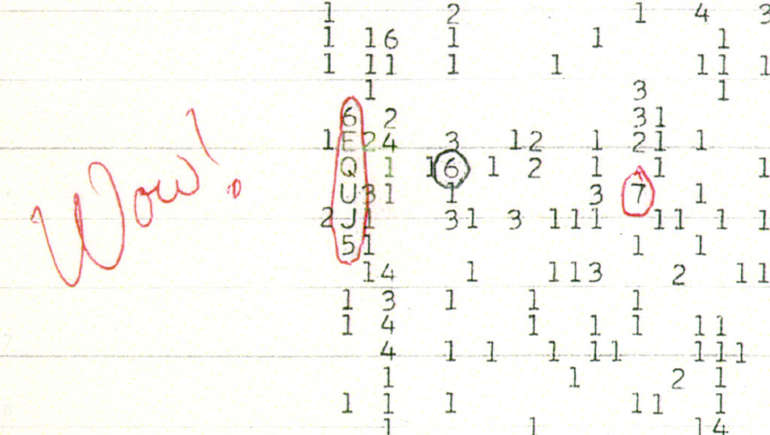
Het Wow!-signaal In 1977 werd 72 seconden lang een sterk smalbandig radiosignaal waargenomen voordat het verdween. Het was afkomstig van de constellatie Boogschutter en is tot op de dag van vandaag onverklaard gebleven. De plotselinge verschijning van het signaal en het feit dat het nooit meer werd gedetecteerd, hebben geleid tot wilde speculaties, waaronder de mogelijkheid dat het een transmissie was van een buitenaardse beschaving.
Galactisch kannibalisme Galactisch kannibalisme is een verschijnsel waarbij een groter sterrenstelsel een kleiner stelsel opslokt door het door zwaartekracht uit elkaar te trekken en zijn sterren, gas en stof op te nemen. Sterrenstelsels (die stabiele, op zichzelf staande systemen lijken te zijn) kunnen in werkelijkheid samensmelten en elkaar verslinden in kosmische botsingen die leiden tot grotere, zwaardere sterrenstelsels.
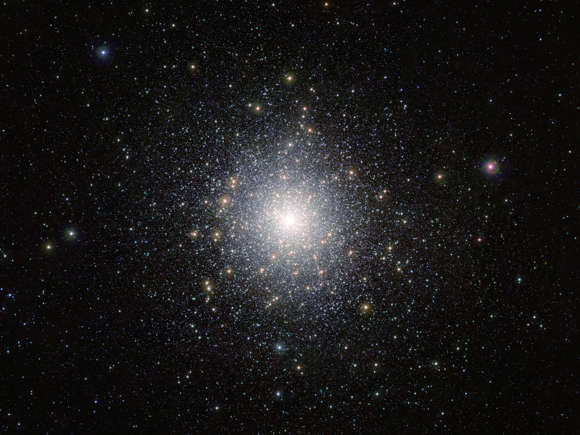
Blauwe achterblijvers Blauwe achterblijvers zijn sterren die jonger en zwaarder lijken dan de andere sterren in hun cluster, ondanks het feit dat ze van hetzelfde materiaal zijn gemaakt. Ze zijn vreemd omdat ze de verwachte levenscyclus van sterren tarten. Hoewel deze sterren al uitgebrand zouden moeten zijn, blijven ze helder en heet en reizen ze onvermoeibaar door het heelal.
Phoenix Cluster De Phoenix Cluster is een enorme cluster van melkwegstelsels met een ongewoon hoog tempo van stervorming en activiteit van zwarte gaten. In de meeste melkwegclusters is de stervorming aanzienlijk vertraagd, maar in de Phoenix Cluster worden in hoog tempo sterren gevormd en groeit het superzware zwarte gat in het centrum veel sneller dan verwacht.
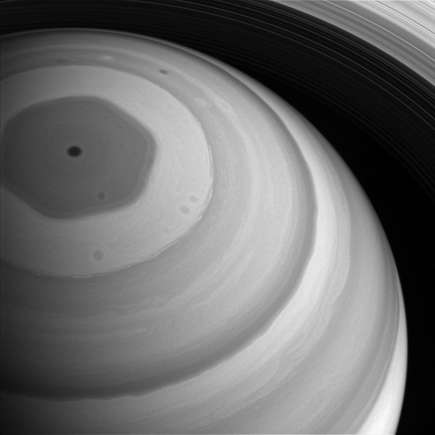
Hexagoon van Saturnus Op de noordpool van Saturnus bevindt zich een vreemde, standvastige wolkenformatie in de vorm van een zeshoek. Dit geometrische weerpatroon is bizar en onverklaarbaar, omdat de meeste stormen of atmosferische verschijnselen op planeten cirkelvormig of onregelmatig van vorm zijn. De zeshoek is meer dan 30.000 kilometer breed en kent winden tot 320 km/u.
Government apparently registers aliens.gov domain after Trump vows to release files on UFOs
Government apparently registers aliens.gov domain after Trump vows to release files on UFOs
Story by Antonio Pequeño IV, Forbes Staff
Topline
The Trump administration appeared to register the domain name aliens.gov on Tuesday, about a month after President Donald Trump said he would order relevant government agencies to release government files about alien life, unidentified aerial phenomena and unidentified flying objects.
Steven Greer, ufologist and founded of the Center for the Study of Extraterrestrial Intelligence and the Disclosure Project, delivers remarks on his UFO and Unidentified Aerial Phenomena (UAP) research under an artist rendering of an incident, during a press conference on June 12, 2023.
Photo by Kevin Dietsch/Getty Images
Key Facts
The Cybersecurity and Infrastructure Security Agency registered the domain Tuesday, according to GoDaddy registry data, though it was not live as of early Wednesday evening.
Trump said last month the files would be released, “Based on the tremendous interest shown,” making the announcement after he accused former President Barack Obama of spilling “classified information” when he said aliens were “real” during a rapid-fire question segment on a progressive podcast.
Forbes has reached out to the Cybersecurity and Infrastructure Security Agency for comment.
Crucial Quote
Obama later clarified his comment on the existence of aliens, saying he was “trying to stick with the spirit of the speed round,” adding in a social media post, “Statistically, the universe is so vast that the odds are good there's life out there. But the distances between solar systems are so great that the chances we've been visited by aliens is low, and I saw no evidence during my presidency that extraterrestrials have made contact with us. Really!"
Tangent
Rep. Thomas Massie, R-Ky., who has led the accountability charge on the release of the Epstein files alongside Rep. Ro Khanna, D-Calif., wrote on X following Trump’s comments, “They’ve deployed the ultimate weapon of mass distraction, but the Epstein files aren’t going away…even for aliens.”
A highly anticipated 2024 report from the Pentagon’s All-domain Anomaly Resolution Office, which was triggered by a wave of congressional and public pressure for more transparency around UFO sightings, found “no evidence of extraterrestrial beings, activity, or technology.” However, it did identify 21 cases that were unexplained due to "anomalous characteristics.”
Key Background
Trump also told reporters last month he did not know if aliens were real or not. In 2024, the president said he has not been a “believer,” though he acknowledged he has met “serious people” who have described their own encounters with UAPs. Congress has had a handful of hearings on alien life and UAPs in recent years. Retired U.S. Navy Rear Admiral Tim Gallaudet alleged to a congressional committee in 2024 that “elements of the government” conducted disinformation campaigns to discredit UAP whistleblowers. Gallaudet called for increased government transparency around UAPs, alongside former Department of Defense official Luis Elizondo, who claimed during the same hearing the U.S. and its adversaries possessed UAP technologies. The Trump administration has repeatedly created new government domains to announce or launch initiatives such as TrumpRx, a direct-to-consumer prescription drug site, and the Trump Gold Card, an expedited immigration program.
The White House has registered the domain 'aliens.gov,' sparking fresh speculation that President Donald Trump's long-awaited UFOdisclosure may be imminent.
The domain, linked to the Executive Office of the President, was flagged on Wednesday by an automated tracker of federal websites.
However, it is also listed in the government's official .gov registry maintained by the Cybersecurity and Infrastructure Security Agency.
Registry records show it was recently added under the White House Office alongside other official government sites, confirming it as a legitimate federal web address, though its purpose has not been publicly disclosed.
The website is not currently live, but the domain has been reserved.
The discovery has raised questions about whether it could be used as a future portal for documents tied to Trump's push for greater transparency on unidentified aerial phenomena.
In February, Trump directed federal agencies, including the Pentagon, to begin identifying and releasing files related to UFOs, also known as UAPs, and potential extraterrestrial activity.
'Based on the tremendous interest shown, I will be directing the Secretary of War... to begin the process of identifying and releasing Government files related to alien and extraterrestrial life, unidentified aerial phenomena (UAP), and unidentified flying objects (UFOs),' Trump wrote on Truth Social on February 19.
Records from that registry show the domain was recently added under the White House Office, alongside other official government sites, confirming it as a legitimate federal web address despite no public explanation for its purpose
The domain comes weeks after Trump announced he would order federal agencies and the Pentagon to begin releasing, or identifying for release, government files related to UFOs (UAPs) and extraterrestrial life
Trump has since gone quiet about his plans to release government files related to UFOs and extraterrestrial life. However, the war with Iran began shortly after he announced it in February.
Secretary of War Pete Hegseth issued an update about five days later, saying: 'We've got our people working on it right now. I don't want to oversell how much time it will take, right?
'We're digging in. We're going to be in full compliance with that executive order, eager to provide that for the president.'
Hegseth didn't have an estimate of how long it would take for the Pentagon and US intelligence agencies to release every piece of information on unidentified aerial phenomena (UAP), which have been widely reported throughout the US since the 1940s.
Asked if he believes aliens exist, Hegseth replied: 'We'll see. I get to do the review and find out along with all of you.'
Congresswoman Anna Paulina Luna of Florida, who was put in charge of the House Oversight Committee's task force on declassifying secret records on UAPs, revealed that all of the incoming documents will be housed on the US National Archives' website.
Until now, the Pentagon has maintained for decades that no physical evidence of extraterrestrial life has ever been found by the US, and videos capturing suspected UFOs have never been confirmed to be of a non-human origin.
Trump's order, however, followed statements made by former President Barack Obama, who had declared aliens were real.
Donald Trump said that he's directed Pete Hegseth to release government files related to aliens, extraterrestrial life and UFOs
The former president was asked if aliens are real while speaking with Brian Tyler Cohen, to which he responded: '
Uh, they're real, but I haven't seen them,' he said, before immediately addressing speculation surrounding Area 51, the secretive US military facility in Nevada that has long been at the center of extraterrestrial conspiracy theories.
'And they're not being kept in uh what is it? Area 51!' Obama continued. 'There's no underground facility unless there's this enormous conspiracy and they hid it from the president of the United States.'
His comments, delivered with a mix of humor and authority, amounted to a clear rejection of claims that the U.S. government is secretly housing alien life forms at the classified base.
Area 51 has fueled decades of speculation, particularly since the Cold War, when its remote desert location and classified operations made it a natural target for rumors about UFOs and extraterrestrial cover-ups.
The US government has acknowledged the facility's existence but has consistently said it is used for testing advanced military aircraft.
This is a developing story... More updates to come.
Wat Oude Ufo-waarnemingen Over Onthullen Over de Obsessie van de Mensheid Met Het Onbekende
Wat Oude Ufo-waarnemingen Over Onthullen Over de Obsessie van de Mensheid Met Het Onbekende
De menselijke fascinatie voor het mysterieuze en het onbekende is door de eeuwen heen een krachtig motief geweest dat diep verankerd ligt in onze cultuur, religie en wetenschap. Van de eerste beschrijvingen van hemelverschijnselen in oude beschavingen tot de hedendaagse fenomeen van onverklaarbare vliegende objecten (UFO’s), toont deze obsessie hoe onze nieuwsgierigheid ons drijft om de grenzen van het bekende te verkennen. In dit artikel wordt onderzocht wat de oude waarnemingen van vreemde hemelverschijnselen ons kunnen vertellen over de menselijke psyche, cultuur en de evolutie van het fenomeen UFO. We analyseren de historische context, de interpretaties en de veranderende percepties van deze fenomenen, en leggen een verband tussen de verhalen uit het verleden en onze hedendaagse zoektocht naar het onbekende.
Oude Hemelverschijnselen: Tekenen, Omen of Iets Anders?
De oudste schriftelijke bronnen over vreemde hemelverschijnselen dateren uit de beschavingen van Mesopotamië, waaronder de Sumeriërs en Babyloniërs. Op kleitabletten uit de tweede millennium voor Christus worden beschrijvingen vastgelegd van zich verplaatsende vormen en zwarte meteoren die de hemel doorkruisen. Deze verschijnselen werden destijds vaak geïnterpreteerd als goddelijke tekenen of omens, bedoeld om de mensheid te waarschuwen of te begeleiden. De interpretatie van dergelijke fenomenen was nauw verbonden met religieuze en spirituele overtuigingen.
Chris Aubeck, directeur van de Magonia Exchange—een archiefproject dat zich richt op de geschiedenis van UFO’s—benadrukt de moeilijkheid om oude beschrijvingen definitief te classificeren als UFO-waarnemingen. “Er bestaat geen consensus over wat de eerste geregistreerde UFO-waarneming precies was,” legt hij uit. “Hoewel oude bronnen vreemde hemelverschijnselen documenteren, was de betekenis ervan vaak sterk verbonden met de religieuze wereldbeelden van die tijd.”
Volgens Greg Eghigian, hoogleraar geschiedenis aan de Pennsylvania State University, moeten dergelijke oude beschrijvingen altijd binnen hun culturele context worden bekeken. “Wat wij nu misschien interpreteren als buitenaardse ontmoetingen, was vroeger vaak een symbool van goddelijke interventie, religieuze betekenis of natuurlijke fenomenen zoals kometen en meteorieten,” stelt hij. Deze interpretaties laten zien dat de menselijke interpretatie van het onbekende altijd is beïnvloed door de culturele en spirituele kaders waarin men leeft.
Het Nuremberg “Luchtgevecht” van 1561
Een van de meest markante historische rapporten over hemelverschijnselen betreft het zogenaamde “luchtgevecht” dat op 14 april 1561 plaatsvond in Nuremberg, Duitsland. Bewoners beschrijven een spectaculaire gebeurtenis waarin ronde, kruisvormige en andere vormen in de lucht met elkaar zouden hebben gevochten, vergezeld door een zwart, pijlvormig object. Hans Glaser, een lokale kunstenaar, maakte zelfs een houtsnede van de gebeurtenis, waarin de objecten lijken te “vallen uit de hemel en verbranden bij het raken van de grond.”
Hoewel de gebeurtenis op dat moment werd geïnterpreteerd als een goddelijk teken of apocalyptisch signaal, biedt de moderne interpretatie een andere blik. Onderzoekers zien in de beschrijving en de visuele documentatie vooral reflecties van de religieuze wereldbeelden van de 16e eeuw, en niet per se bewijs voor buitenaardse wezens. De gebeurtenissen kunnen bijvoorbeeld ook worden verklaard door natuurlijke verschijnselen zoals luchtscènes met ballonnen, vuurwerk of optische illusies, die destijds niet volledig konden worden begrepen of verklaard.
UFO’s in de Moderne Tijd: Van Mysterie tot Cultuurfenomeen
De perceptie van UFO’s veranderde drastisch in de tweede helft van de 20e eeuw. Een keerpunt was de waarneming van de Amerikaanse piloot Kenneth Arnold op 24 juni 1947. Arnold meldde negen snel bewegende objecten in de buurt van Mount Rainier, Washington, die hij beschreef als schijfvormige objecten die over het water “sprongen.” Zijn beschrijving leidde tot de term “flying saucer,” die wereldwijd bekend werd en de basis vormde voor de moderne UFO-cultuur.
Deze gebeurtenis markeerde het begin van een nieuwe fase, waarin UFO’s niet meer alleen als mysterie werden beschouwd, maar ook als onderdeel van een bredere maatschappelijke en culturele discussie. Tijdens de Koude Oorlog werden veel waarnemingen geïnterpreteerd in het licht van technologische en militaire rivaliteit, waarbij geheime vliegtuigen en nieuwe technologieën werden vermengd met de mogelijkheid van buitenaardse contacten.
Chris Aubeck benadrukt dat de Arnold-waarneming “het startpunt was van de moderne UFO-geschiedenis.” Sindsdien zijn talloze rapporten en observaties gedaan, variërend van eenvoudige lichtverschijnselen tot complexe, bijna chirurgisch nauwkeurige beschrijvingen van objecten die zich op onmogelijke manieren verplaatsen.
De Cultuur van de Ufo: Spiegel van de Menselijke Ziel
Hoewel het aantal UFO-waarnemingen blijft toenemen, blijkt uit wetenschappelijk onderzoek dat veel van deze waarnemingen meer vertellen over onze cultuur, angsten en verlangens dan over buitenaardse wezens. Volgens Aubeck zijn UFO-verhalen “de hedendaagse legendes,” die de onderliggende maatschappelijke narratieven en collectieve angsten weerspiegelen. Ze vormen een soort spiegel waarin we onze eigen onzekerheden en hoop projecteren.
Zo kunnen we in de manier waarop mensen UFO’s interpreteren, onderliggende culturele overtuigingen aflezen. Tijdens de Koude Oorlog bijvoorbeeld, werden veel waarnemingen geïnterpreteerd als geheime militaire technologieën of vijandige inlichtingenoperaties. Tegenwoordig worden sommige waarnemingen beschreven als mogelijke contactpogingen met buitenaardse beschavingen, wat een reflectie is van de hoop op buitenaardse intelligentie en de zoektocht naar een betekenis buiten onze aardse grenzen.
Het Universele Thema van Het Onbekende
Wat oude beschavingen en moderne UFO-enthousiastelingen verbindt, is de fundamentele menselijke drang om het onbekende te begrijpen. Of het nu gaat om de interpretatie van hemelverschijnselen als tekenen van de goden of om de zoektocht naar buitenaardse intelligentie, de kern blijft dezelfde: een diepe nieuwsgierigheid en de wens om te weten wat er buiten ons eigen bestaan ligt.
Deze obsessie met het onbekende is niet alleen een kwestie van nieuwsgierigheid, maar ook van identiteit en existentie. Het stelt ons in staat om vragen te stellen over onze plaats in het universum, over de aard van het bestaan en over de mogelijke aanwezigheid van andere bewuste wezens. Elke waarneming, of die nu wetenschappelijk wordt verklaard of niet, nodigt uit tot reflectie over deze grote vragen.
Conclusie: De Mens als Verteller en Zoeker
Oude hemelverschijnselen en moderne UFO-waarnemingen werken als culturele verhalen die onze collectieve psyche vormen en voeden. Ze illustreren de menselijke neiging om het onbekende te personifiëren, te rationaliseren of te mystificeren. Deze verhalen zijn niet alleen bedoeld om verklaringen te bieden, maar ook om onze angsten, hoop en verbeelding te voeden.
UFO’s representeren in wezen meer dan vreemde objecten in de lucht; ze zijn symbolen van onze zoektocht naar betekenis, onze angst voor het onbekende en onze hoop op contact met andere bewuste levensvormen. Door de geschiedenis heen blijven deze verhalen ons uitdagen om te reflecteren op onze plek in het universum en op de grenzen van onze kennis.
De voortdurende fascinatie voor het onverklaarbare bevestigt dat de menselijke geest onuitputtelijk is in haar zoektocht naar antwoorden. Het is deze nieuwsgierigheid die ons blijft drijven, en die onze verhalen, mythes en hypotheses voortstuwt. In het verkennen van het onbekende vinden we niet alleen antwoorden, maar ook een dieper begrip van wie wij zijn als mensheid.
Bronnen en Referenties:
Aubeck, Chris. De geschiedenis van UFO’s: Van oude beschavingen tot heden.
Eghigian, Greg. "Interpretaties van Hemelverschijnselen in Cultuur en Religie." Live Science.
Glaser, Hans. De Houtsnede van de Nuremberg Sky Battle.
Kennedy, J. “Kenneth Arnold en de Opkomst van de Moderne UFO Cultuur.” UFO Journal.
Maan, L. “Culturele Narratieven en UFO-waarnemingen.” Journal of Cultural Studies.
Opmerking PETER2011: Deze tekst is een gecondenseerde wetenschappelijke verhandeling gebaseerd op de oorspronkelijke samenvatting en interpretatie van historische en culturele bronnen over oude en moderne UFO-waarnemingen.
The Sun is now thought to have left its original location in the Milky Way as part of a mass migration (Credit : Matúš Motlo)
Our Sun is a middle aged, average star sitting in an unremarkable corner of the Milky Way. It fuses hydrogen into helium at its core, bathes its planets in light and heat, and has been doing so for around 4.6 billion years. Nothing about it immediately suggests a dramatic past. But look closer, and the questions start to stack up.
Artists impression of the interior of the Sun
(Credit : Kelvinsong)
Here's one question worth thinking about for a while. Why are we here? Not philosophically, but geographically. Our Sun sits in a relatively calm, suburban stretch of the Milky Way, far from the violent, radiation soaked environment at the galactic centre. It wasn't always this way, and scientists have long suspected that the Sun formed much closer to the core before migrating outward. What's been missing is the evidence for exactly how that happened. Now, a team from Tokyo Metropolitan University has found it, and the answer is stranger and more wonderful than anyone expected.
The researchers turned to one of astronomy's most remarkable datasets, the Gaia satellite's catalogue of almost two billion stars. From this extraordinary set of data, they identified 6,594 solar twins, stars so similar to our Sun in temperature, surface gravity, and chemical composition that they might almost be siblings. It's the largest collection of solar twins ever assembled, around thirty times bigger than previous surveys, and it gave them a family portrait of stars like ours, stretching back billions of years.
Artist impression of ESA's Gaia satellite observing the Milky Way
(Credit : ESA/ATG medialab)
When they mapped the ages of these twins, a striking pattern emerged. There is a pronounced cluster of solar twins aged between four and six billion years, positioned at roughly the same distance from the galactic centre as we are today. Our Sun falls squarely within that group. This isn't coincidence the team suggest. What the data reveals is a mass migration, a wave of Sun like stars that left the galactic core together during that same window of time, carrying our own star along with them.
That raises an obvious question. Why then? The answer may lie in the galactic bar, the enormous rotating bar like structure of stars that dominates the Milky Way's centre and creates what astronomers call a corotation barrier, effectively a gravitational fence that should make large scale stellar escape difficult. The timing of the migration suggests the bar was still forming during that period, perhaps temporarily lowering the fence just long enough for stars to slip through in large numbers.
The centre of the Milky Way is an extraordinarily hostile place, flooded with radiation and gravitational disruption. By escaping to quieter outskirts, our Sun found the stable conditions that life needs. We didn't just get lucky, we left at exactly the right moment, swept along in a tide of stars just like ours, bound for somewhere a little more habitable.
The Sun may have been part of a small group of stars that migrated from the core of our galaxy between 4 and 6 billion years ago, passing through what is now an impassable barrier on its journey to a more habitableregion of the Milky Way.
The new research, conducted by astronomers at Tokyo Metropolitan University, used data from the European Space Agency’s Gaiasatellite to produce the most accurate catalogue of solar twins ever assembled. Their detailed analysis of the star catalogue, reported in a recent paper published in Astronomy & Astrophysics, provides astronomers with crucial new information about theMilky Way’s evolution and bar-like central structure, shedding light on how the ancient cosmic escape occurred.
Origin of the Sun
Astronomers previously believed that our Sun formed about 10,000 light-years closer to the galactic center than its current position roughly 4.6 billion years ago.
However, how this migration occurred has long remained a question for researchers. Analysis of stellar composition suggests that stars like the Sun formed in a more central location, yet today a structure known as the corotation barrier appears to impede their movement outward from the galactic center.
“The physical mechanism behind the corotation barrier has been fairly well understood,” co-author Dr. Daisuke Taniguchi, of Tokyo Metropolitan University, told The Debrief. “However, what has been less clear is where exactly the barrier may have been located in the past.”
The researchers focused their study on solar “twins,” stars with temperatures, surface gravities, and chemical compositions similar to those of our Sun. Among the nearly two billion stars contained in the Gaia data set, the team identified 6,594 solar twins—roughly 30 times more such stellar analogues than had been found in previous studies.
Developing a Star Catalogue
“We selected stars whose atmospheric parameters (surface temperature, surface gravity, and metallicity) are very close to those of the Sun,” Taniguchi explained. “In addition, we applied several quality cuts using other physical parameters and data flags to ensure that only high-quality measurements were included in our final sample.”
A mass migration of stellar twins. Stars similar to our Sun form a mass migration from the center of the Milky Way, occurring approximately 4 to 6 billion years ago.
Credit: NAOJ
The large sample size enabled the researchers to determine the stars’ ages with much greater precision than earlier work allowed. Their analysis suggests that the formation of these types of stars peaked roughly 4 to 6 billion years ago, providing evidence that many may have formed in the same region near the center of the Milky Way.
The research also offers clues about the evolution of the galaxy’s central structure. Today, the corotation barrier associated with the Milky Way’s bar would prevent stars from migrating outward in the way the Sun appears to have done.
This suggests that the migration likely occurred before the barrier reached its current position. In other words, the corotation barrier itself may have shifted over time as the galaxy evolved.
“Our study proposed the possibility that the location of the barrier may have changed significantly around 4-6 billion years ago,” Taniguchi said. “If so, this could have allowed stars like the Sun to migrate outward more easily during that period.”
Further Research on Sun Twins
For life on Earth, it may be fortunate that the Sun migrated away from the galactic center before the corotation barrier stabilized, since the central regions of the Milky Way present a far more hostile environment for planetary systems.
The researchers plan to continue expanding their solar twin catalogue as new astronomical data becomes available.
“A natural next step will be to expand the sample using the upcoming Gaia DR4 data release planned for December 2026 (in this study, we used Gaia DR3 data),” Dr. Taniguchi said. “With a larger number of Solar twins and a wider observational volume (currently 6,594 Solar twins within about 1,000 light years around the Sun), we can improve the statistical significance of the results and also further investigate the spatial distribution of the sample.”
The team hopes their star catalogue will help other astronomers pursue new lines of research.
“Our catalog is currently the largest high-confidence catalog of Solar twins and contains a wide range of information, including ages, chemical compositions, distances, and other stellar properties,” Dr. Taniguchi concluded. “Because of this, I hope it will be used for many different kinds of studies beyond the questions we explored in our papers.”
Ryan Whalen covers science and technology for The Debrief. He holds an MA in History and a Master of Library and Information Science with a certificate in Data Science. He can be contacted at ryan@thedebrief.org, and follow him on Twitter @mdntwvlf.
On June 4, 2021, NASA’s leading Administrator Bill Nelson said on CNNthat scientists should study the nature of Unidentified Aerial Phenomena (UAP).
The following morning, I emailed Dr.Thomas Zurbuchen, NASA’s Associate Administrator for Science, about possible funding of a scientific research project that would make his boss happy. Thomas graciously called my phone and asked me to send a 2-page white paper. I followed his request within a few hours, but he never got back to me.
As a result of not hearing back, I decided to establish the Galileo Project, in collaboration with Dr. Frank Laukien two months later. This scientific research project followed the narrative of my original White Paper and is supported by private donations to my research fund at Harvard University.
The first time I learned about the outcome of my exchange with Dr. Zurbuchen was through a press conference held a year later, on June 9, 2022. I became aware of the pending announcement thanks to an email from the Galileo Project member, Dr. Alan Stern, who wrote, “I can’t imagine you aren’t aware of this, but just in case …” Contrary to Alan’s expectation, I did not know in advance about NASA’s press conference, so I immediately notified the rest of the Galileo Project community, which by now contains more than a hundred members.
In the press release, NASA announced a new independent study on UAP from a scientific perspective. The study will focus on identifying available data, how best to collect future data, and how NASA can use that data to move the scientific understanding of UAP forward. The study is not part of the Department of Defense’s Airborne Object Identification and Management Synchronization Group, and is expected to take about nine months to complete. It will secure the counsel of experts in the scientific, aeronautics, and data analytics communities to focus on how best to collect new data and improve observations of UAP.
I was delighted to see that some of the statements made at the press conference and the resulting news reports, echoed my writings. For example, the Guardian noted that, “We have to approach all these questions with a sense of humility,” a statement which echoes the theme of my book “Extraterrestrial”.
Or, as Oscar Wilde noted, “Imitation is the sincerest form of flattery.”
Overall, this outcome is gratifying and represents a “win-win” development. The Galileo Project is now likely to receive a boost to its funding from wealthy individuals and foundations with which I am in close contact. But most importantly, the Project’s scientific mission narrative is now echoed within the government.
It does not matter who tells the truth as long as it is being told. As I mentioned to the Jerusalem Post on the morning of NASA’s press release, “It is wonderful that NASA and scientists will be engaged in unraveling the nature of UAP … It is a fishing expedition and we will end up with a mixed bag of natural and human-made objects. But even if we have high-quality data on just a single object that demonstrates something else, such as an extraterrestrial technological origin, it would represent the most important discovery in human history.”
A day later, I received an email from the leadership team of NASA’s Science Mission Directorate, explaining that I was not selected to serve on this study because it represents a non-advocate review that will be conducted in accordance with the principles of the Federal Advisory Committee Act (FACA). In other words, my role in leading the Galileo Projectwould constitute an apparent conflict of interest.
Being true to the words of my White Paper after not getting a response from NASA, led me to establish a new scientific Project on UAP, but it now blocks me from contributing directly to NASA’s planning exercise on exactly the same research frontier. Perhaps it is a blessing in disguise, since the Galileo Project has currently no strings attached to the government. In the future, the Project will be able to apply to any relevant funds as they become available.
In gratitude for NASA’s explanatory email, I mentioned that I will be delighted to provide any input that could help NASA’s study, because it shares the intellectual DNA of the Galileo Project. Government agencies and academia should be working together towards the collection of new evidence-based knowledge on UAP.
It is possible that by the time NASA’s study completes its nine-month pregnancy and delivers its independent “baby”, the Galileo Project will discover evidence that will change the charter of NASA’s report. The Galileo Project is currently assembling its first telescope system on the roof of the Harvard College Observatory, planning an expedition to retrieve fragments from the first interstellar meteor, studying satellite data on UAP from above, and designing a space mission to rendezvous with the next anomalous (`Oumuamua-like) interstellar object.
Before NASA’s announcement, it was common practice among scientists to ridicule the scientific study of UAP. The ridicule was surprisingly strong and public within the traditional SETI community, with one exception – Seth Shostak who joined the Galileo Project after publishing a brave supportive article in Scientific American.
Open mindedness applies also to scientific research. We should explore the unknown by seeking evidence agnostically and not assuming what we might find. Gladly, we now know that both the Galileo Project and NASA agree on following this principle.
Avi Loeb is the head of the Galileo Project, founding director of Harvard University’s – Black Hole Initiative, director of the Institute for Theory and Computation at the Harvard-Smithsonian Center for Astrophysics, and the former chair of the astronomy department at Harvard University (2011-2020). He chairs the advisory board for the Breakthrough Starshot project, and is a former member of the President’s Council of Advisors onScience and Technology and a former chair of the Board on Physics and Astronomy of the National Academies. He is the bestselling author of “Extraterrestrial:The First Sign of Intelligent Life Beyond Earth” and a co-author of the textbook “Life in the Cosmos”, both published in 2021.
After years of debate, scientists have finally solved the mystery of a structure hidden under the North Sea. Researchers at Heriot-Watt University confirmed that the Silverpit Crater was created by an asteroid impact millions of years ago. Thisimpact caused a huge tsunami and left behind one of the rare underwaterimpactcraters found onEarth.
First identified in 2002, the Silverpit structure displays several features that are characteristic of impact craters, including a circular outline, a central peak, and concentric fault rings. Despite these clues, some scientists argued that the formation could have resulted from natural geological activity, such as the movement of underground salt deposits or volcanic forces, leaving the true origin of the crater unclear.
In 2009, a group of geologists reviewed the evidence and concluded that the crater was unlikely to have formed from an asteroid impact. The latest research not only challenges but also overturns that earlier conclusion.
Evidence Hidden Beneath the Seafloor
A team led by Dr. Uisdean Nicholson at Heriot-Watt University used high-resolution seismic imaging alongside detailed analysis of rock samples collected from beneath the seabed. The seismic data revealed the crater’s internal structure with a level of detail previously unattainable. Meanwhile, rock samples obtained from an oil well offered crucial evidence to resolve the question of the crater’s origin.
“We were exceptionally lucky to find these — a real ‘needle-in-a-haystack’ effort,” Nicholson said. “These prove the impact crater hypothesis beyond doubt.”
The samples contained shocked quartz and feldspar, minerals that only form under the intense pressures produced by asteroid impacts. These minerals confirm that a high-energy collision created Silverpit Crater.
A Violent Impact
The evidence shows that an asteroid about 160 meters wide hit the seabed between 43 and 46 million years ago. The team’s models suggest the asteroid came from the west at a low angle, creating a huge plume of rock and water.
Within minutes, the plume collapsed back into the ocean, producing a tsunami that reached heights of over 100 meters (about 330 feet). The impact released vast amounts of energy, sending waves across the surrounding region and reshaping the seafloor.
A Rare Preserved Impact Crater
Impact craters are rare on Earth because erosion and plate movements slowly erase them. Around 200 confirmed impact craters have been found on land, but only a few dozen have been found beneath the ocean.
Silverpit is notable as a well-preserved hypervelocity impact crater, offering a rare opportunity to study how such events shape the planet’s subsurface structure.
Professor Gareth Collins of Imperial College London, who contributed to the study’s modeling work, said the new evidence represents a decisive breakthrough. “It is very rewarding to have finally found the silver bullet,” Collins said.
Understanding Earth’s Impact History
This research settles a long-standing scientific debate and offers new insight into the forces that have shaped Earth’s history. The findings will help scientists understand how asteroid impacts influence planetary surfaces on Earth and elsewhere in the solar system.
“We can use these findings to understand how asteroid impacts shaped our planet throughout history, as well as predict what could happen should we have an asteroid collision in the future,” said Nicholson.
Austin Burgess is a writer and researcher with a background in sales, marketing, and data analytics. He holds a Master of Business Administration, a Bachelor of Science in Business Administration, and a Data Analytics certification. His work combines analytical training with a focus on emerging science, aerospace, and astronomical research.
UFOs 'disabled nuclear missiles' as Air Force veteran recalls terrifying base encounter
UFOs 'disabled nuclear missiles' as Air Force veteran recalls terrifying base encounter
Athena Dawson
Robert Salas
A retired U.S. Air Force veteran claimed he encountered UFOs that disabled multiple nuclear missiles while he served in the military during the Cold War.
Robert Salas claimed that an unknown entity subdued the military's ability to control 10 Minuteman I intercontinental ballistic missiles equipped with nuclear warheads at Malmstrom Air Force Base in 1967.
The 85-year-old former launch officer shared the harrowing story on the "Danny Jones Podcast" on Sunday.
Salas manned the monitoring and launch of nuclear missiles, "if given the order," during the tense Cold War era.
He recalled his alleged alien encounter, which occurred around 10 p.m. on March 24, 1967. Salas was underground with his partner when panicked guards called from above about a mysterious, unidentified aircraft.
"The main guard calls down, says, 'Sir, we've been seeing some strange lights in the sky, flying directly overhead,'" Salas said.
He added that guards insisted the aircraft wasn't a Soviet one because of its odd lights. It flew through the sky before abruptly stopping over the underground ICBMs.
Salas initially dismissed the guards, thinking it was a prank, but five minutes later, the guard called back, screaming into the phone.
"He's yelling. He's babbling. He's frightened," Salas recalled.
After he calmed down, the guard told Salas that he and his men had their weapons aimed at the craft floating above the base's front gate, which was emitting a "pulsating reddish light."'
Salas said the panicked guard asked what to do next, and he told him, "Do whatever you have to do."
Salas recalled that the guard said one of his men was injured before hanging up.
The octogenarian then recalled how the missiles had been shut down by the mysterious alien entities. As he went to wake up his sleeping partner, a loud horn at the controls suddenly began to blare.
The alarm signaled that an issue had emerged with the missiles, and Salas said when they looked at the board, "one of them went from green to red."
No ability to launch," Salas said. "Then, very quickly thereafter, bing bing bing bing, all 10 of them went down. They all went red."
An illustration of an intercontinental ballistic missile silo
(Image: Danny Jones/YouTube)
They jumped up and ran through their checklist, then realized two launch facilities miles away were showing that "someone or something" may have breached the fenced missile area.
Salas said that he reacted immediately, sending guards to the missile silos. He said they were "scared to death" after encountering the floating lights hovering over the launch areas nearly a mile away.
"They were scared to death," he said. "They didn't want to go any further. They were so frightened of these things."
Salas said he later heard the guard was injured from either hurting his hand while clearing his jammed rifle or cutting it on barbed wire during the spooky alien encounter.
He also learned that the guards had apparently seen the odd craft in the area mere days before the encounter. It was described as being able to fly in reverse, complete 90-degree turns, and fly in dead silence.
Salas said that, despite an investigation, it was never determined what shut down the warheads, even with systems designed to prevent jamming.
"They had no idea how this signal could have been injected into each of the missiles," he said. "The cabling system that we had was triply shielded against electromagnetic interference from the outside."
Salas said that he's convinced the extraterrestrial visitors traveled to Earth to stop a nuclear war from unfolding.
Salas's alleged alien encounter stayed a decades-long secret as Air Force investigators forced him and his commander to sign strict gag orders, warned that they could face prison time if they ever spoke about it.
He ultimately went public decades later after reading about a similar incident in a UFO book, concluding that the information had already been disclosed.
Beste bezoeker, Heb je zelf al ooit een vreemde waarneming gedaan, laat dit dan even weten via email aan Frederick Delaere opwww.ufomeldpunt.be. Deze onderzoekers behandelen jouw melding in volledige anonimiteit en met alle respect voor jouw privacy. Ze zijn kritisch, objectief maar open minded aangelegd en zullen jou steeds een verklaring geven voor jouw waarneming! DUS AARZEL NIET, ALS JE EEN ANTWOORD OP JOUW VRAGEN WENST, CONTACTEER FREDERICK. BIJ VOORBAAT DANK...
Druk op onderstaande knop om je bestand , jouw artikel naar mij te verzenden. INDIEN HET DE MOEITE WAARD IS, PLAATS IK HET OP DE BLOG ONDER DIVERSEN MET JOUW NAAM...
Druk op onderstaande knop om een berichtje achter te laten in mijn gastenboek
Alvast bedankt voor al jouw bezoekjes en jouw reacties. Nog een prettige dag verder!!!
Over mijzelf
Ik ben Pieter, en gebruik soms ook wel de schuilnaam Peter2011.
Ik ben een man en woon in Linter (België) en mijn beroep is Ik ben op rust..
Ik ben geboren op 18/10/1950 en ben nu dus 75 jaar jong.
Mijn hobby's zijn: Ufologie en andere esoterische onderwerpen.
Op deze blog vind je onder artikels, werk van mezelf. Mijn dank gaat ook naar André, Ingrid, Oliver, Paul, Vincent, Georges Filer en MUFON voor de bijdragen voor de verschillende categorieën...
Veel leesplezier en geef je mening over deze blog.