The purpose of this blog is the creation of an open, international, independent and free forum, where every UFO-researcher can publish the results of his/her research. The languagues, used for this blog, are Dutch, English and French.You can find the articles of a collegue by selecting his category. Each author stays resposable for the continue of his articles. As blogmaster I have the right to refuse an addition or an article, when it attacks other collegues or UFO-groupes.
Druk op onderstaande knop om te reageren in mijn forum
Zoeken in blog
Deze blog is opgedragen aan mijn overleden echtgenote Lucienne.
In 2012 verloor ze haar moedige strijd tegen kanker!
In 2011 startte ik deze blog, omdat ik niet mocht stoppen met mijn UFO-onderzoek.
BEDANKT!!!
Een interessant adres?
UFO'S of UAP'S, ASTRONOMIE, RUIMTEVAART, ARCHEOLOGIE, OUDHEIDKUNDE, SF-SNUFJES EN ANDERE ESOTERISCHE WETENSCHAPPEN - DE ALLERLAATSTE NIEUWTJES
UFO's of UAP'S in België en de rest van de wereld Ontdek de Fascinerende Wereld van UFO's en UAP's: Jouw Bron voor Onthullende Informatie!
Ben jij ook gefascineerd door het onbekende? Wil je meer weten over UFO's en UAP's, niet alleen in België, maar over de hele wereld? Dan ben je op de juiste plek!
België: Het Kloppend Hart van UFO-onderzoek
In België is BUFON (Belgisch UFO-Netwerk) dé autoriteit op het gebied van UFO-onderzoek. Voor betrouwbare en objectieve informatie over deze intrigerende fenomenen, bezoek je zeker onze Facebook-pagina en deze blog. Maar dat is nog niet alles! Ontdek ook het Belgisch UFO-meldpunt en Caelestia, twee organisaties die diepgaand onderzoek verrichten, al zijn ze soms kritisch of sceptisch.
Nederland: Een Schat aan Informatie
Voor onze Nederlandse buren is er de schitterende website www.ufowijzer.nl, beheerd door Paul Harmans. Deze site biedt een schat aan informatie en artikelen die je niet wilt missen!
Internationaal: MUFON - De Wereldwijde Autoriteit
Neem ook een kijkje bij MUFON (Mutual UFO Network Inc.), een gerenommeerde Amerikaanse UFO-vereniging met afdelingen in de VS en wereldwijd. MUFON is toegewijd aan de wetenschappelijke en analytische studie van het UFO-fenomeen, en hun maandelijkse tijdschrift, The MUFON UFO-Journal, is een must-read voor elke UFO-enthousiasteling. Bezoek hun website op www.mufon.com voor meer informatie.
Samenwerking en Toekomstvisie
Sinds 1 februari 2020 is Pieter niet alleen ex-president van BUFON, maar ook de voormalige nationale directeur van MUFON in Vlaanderen en Nederland. Dit creëert een sterke samenwerking met de Franse MUFON Reseau MUFON/EUROP, wat ons in staat stelt om nog meer waardevolle inzichten te delen.
Let op: Nepprofielen en Nieuwe Groeperingen
Pas op voor een nieuwe groepering die zich ook BUFON noemt, maar geen enkele connectie heeft met onze gevestigde organisatie. Hoewel zij de naam geregistreerd hebben, kunnen ze het rijke verleden en de expertise van onze groep niet evenaren. We wensen hen veel succes, maar we blijven de autoriteit in UFO-onderzoek!
Blijf Op De Hoogte!
Wil jij de laatste nieuwtjes over UFO's, ruimtevaart, archeologie, en meer? Volg ons dan en duik samen met ons in de fascinerende wereld van het onbekende! Sluit je aan bij de gemeenschap van nieuwsgierige geesten die net als jij verlangen naar antwoorden en avonturen in de sterren!
Heb je vragen of wil je meer weten? Aarzel dan niet om contact met ons op te nemen! Samen ontrafelen we het mysterie van de lucht en daarbuiten.
19-03-2026
Government apparently registers aliens.gov domain after Trump vows to release files on UFOs
Government apparently registers aliens.gov domain after Trump vows to release files on UFOs
Story by Antonio Pequeño IV, Forbes Staff
Topline
The Trump administration appeared to register the domain name aliens.gov on Tuesday, about a month after President Donald Trump said he would order relevant government agencies to release government files about alien life, unidentified aerial phenomena and unidentified flying objects.
Steven Greer, ufologist and founded of the Center for the Study of Extraterrestrial Intelligence and the Disclosure Project, delivers remarks on his UFO and Unidentified Aerial Phenomena (UAP) research under an artist rendering of an incident, during a press conference on June 12, 2023.
Photo by Kevin Dietsch/Getty Images
Key Facts
The Cybersecurity and Infrastructure Security Agency registered the domain Tuesday, according to GoDaddy registry data, though it was not live as of early Wednesday evening.
Trump said last month the files would be released, “Based on the tremendous interest shown,” making the announcement after he accused former President Barack Obama of spilling “classified information” when he said aliens were “real” during a rapid-fire question segment on a progressive podcast.
Forbes has reached out to the Cybersecurity and Infrastructure Security Agency for comment.
Crucial Quote
Obama later clarified his comment on the existence of aliens, saying he was “trying to stick with the spirit of the speed round,” adding in a social media post, “Statistically, the universe is so vast that the odds are good there's life out there. But the distances between solar systems are so great that the chances we've been visited by aliens is low, and I saw no evidence during my presidency that extraterrestrials have made contact with us. Really!"
Tangent
Rep. Thomas Massie, R-Ky., who has led the accountability charge on the release of the Epstein files alongside Rep. Ro Khanna, D-Calif., wrote on X following Trump’s comments, “They’ve deployed the ultimate weapon of mass distraction, but the Epstein files aren’t going away…even for aliens.”
A highly anticipated 2024 report from the Pentagon’s All-domain Anomaly Resolution Office, which was triggered by a wave of congressional and public pressure for more transparency around UFO sightings, found “no evidence of extraterrestrial beings, activity, or technology.” However, it did identify 21 cases that were unexplained due to "anomalous characteristics.”
Key Background
Trump also told reporters last month he did not know if aliens were real or not. In 2024, the president said he has not been a “believer,” though he acknowledged he has met “serious people” who have described their own encounters with UAPs. Congress has had a handful of hearings on alien life and UAPs in recent years. Retired U.S. Navy Rear Admiral Tim Gallaudet alleged to a congressional committee in 2024 that “elements of the government” conducted disinformation campaigns to discredit UAP whistleblowers. Gallaudet called for increased government transparency around UAPs, alongside former Department of Defense official Luis Elizondo, who claimed during the same hearing the U.S. and its adversaries possessed UAP technologies. The Trump administration has repeatedly created new government domains to announce or launch initiatives such as TrumpRx, a direct-to-consumer prescription drug site, and the Trump Gold Card, an expedited immigration program.
The White House has registered the domain 'aliens.gov,' sparking fresh speculation that President Donald Trump's long-awaited UFOdisclosure may be imminent.
The domain, linked to the Executive Office of the President, was flagged on Wednesday by an automated tracker of federal websites.
However, it is also listed in the government's official .gov registry maintained by the Cybersecurity and Infrastructure Security Agency.
Registry records show it was recently added under the White House Office alongside other official government sites, confirming it as a legitimate federal web address, though its purpose has not been publicly disclosed.
The website is not currently live, but the domain has been reserved.
The discovery has raised questions about whether it could be used as a future portal for documents tied to Trump's push for greater transparency on unidentified aerial phenomena.
In February, Trump directed federal agencies, including the Pentagon, to begin identifying and releasing files related to UFOs, also known as UAPs, and potential extraterrestrial activity.
'Based on the tremendous interest shown, I will be directing the Secretary of War... to begin the process of identifying and releasing Government files related to alien and extraterrestrial life, unidentified aerial phenomena (UAP), and unidentified flying objects (UFOs),' Trump wrote on Truth Social on February 19.
Records from that registry show the domain was recently added under the White House Office, alongside other official government sites, confirming it as a legitimate federal web address despite no public explanation for its purpose
The domain comes weeks after Trump announced he would order federal agencies and the Pentagon to begin releasing, or identifying for release, government files related to UFOs (UAPs) and extraterrestrial life
Trump has since gone quiet about his plans to release government files related to UFOs and extraterrestrial life. However, the war with Iran began shortly after he announced it in February.
Secretary of War Pete Hegseth issued an update about five days later, saying: 'We've got our people working on it right now. I don't want to oversell how much time it will take, right?
'We're digging in. We're going to be in full compliance with that executive order, eager to provide that for the president.'
Hegseth didn't have an estimate of how long it would take for the Pentagon and US intelligence agencies to release every piece of information on unidentified aerial phenomena (UAP), which have been widely reported throughout the US since the 1940s.
Asked if he believes aliens exist, Hegseth replied: 'We'll see. I get to do the review and find out along with all of you.'
Congresswoman Anna Paulina Luna of Florida, who was put in charge of the House Oversight Committee's task force on declassifying secret records on UAPs, revealed that all of the incoming documents will be housed on the US National Archives' website.
Until now, the Pentagon has maintained for decades that no physical evidence of extraterrestrial life has ever been found by the US, and videos capturing suspected UFOs have never been confirmed to be of a non-human origin.
Trump's order, however, followed statements made by former President Barack Obama, who had declared aliens were real.
Donald Trump said that he's directed Pete Hegseth to release government files related to aliens, extraterrestrial life and UFOs
The former president was asked if aliens are real while speaking with Brian Tyler Cohen, to which he responded: '
Uh, they're real, but I haven't seen them,' he said, before immediately addressing speculation surrounding Area 51, the secretive US military facility in Nevada that has long been at the center of extraterrestrial conspiracy theories.
'And they're not being kept in uh what is it? Area 51!' Obama continued. 'There's no underground facility unless there's this enormous conspiracy and they hid it from the president of the United States.'
His comments, delivered with a mix of humor and authority, amounted to a clear rejection of claims that the U.S. government is secretly housing alien life forms at the classified base.
Area 51 has fueled decades of speculation, particularly since the Cold War, when its remote desert location and classified operations made it a natural target for rumors about UFOs and extraterrestrial cover-ups.
The US government has acknowledged the facility's existence but has consistently said it is used for testing advanced military aircraft.
This is a developing story... More updates to come.
Wat Oude Ufo-waarnemingen Over Onthullen Over de Obsessie van de Mensheid Met Het Onbekende
Wat Oude Ufo-waarnemingen Over Onthullen Over de Obsessie van de Mensheid Met Het Onbekende
De menselijke fascinatie voor het mysterieuze en het onbekende is door de eeuwen heen een krachtig motief geweest dat diep verankerd ligt in onze cultuur, religie en wetenschap. Van de eerste beschrijvingen van hemelverschijnselen in oude beschavingen tot de hedendaagse fenomeen van onverklaarbare vliegende objecten (UFO’s), toont deze obsessie hoe onze nieuwsgierigheid ons drijft om de grenzen van het bekende te verkennen. In dit artikel wordt onderzocht wat de oude waarnemingen van vreemde hemelverschijnselen ons kunnen vertellen over de menselijke psyche, cultuur en de evolutie van het fenomeen UFO. We analyseren de historische context, de interpretaties en de veranderende percepties van deze fenomenen, en leggen een verband tussen de verhalen uit het verleden en onze hedendaagse zoektocht naar het onbekende.
Oude Hemelverschijnselen: Tekenen, Omen of Iets Anders?
De oudste schriftelijke bronnen over vreemde hemelverschijnselen dateren uit de beschavingen van Mesopotamië, waaronder de Sumeriërs en Babyloniërs. Op kleitabletten uit de tweede millennium voor Christus worden beschrijvingen vastgelegd van zich verplaatsende vormen en zwarte meteoren die de hemel doorkruisen. Deze verschijnselen werden destijds vaak geïnterpreteerd als goddelijke tekenen of omens, bedoeld om de mensheid te waarschuwen of te begeleiden. De interpretatie van dergelijke fenomenen was nauw verbonden met religieuze en spirituele overtuigingen.
Chris Aubeck, directeur van de Magonia Exchange—een archiefproject dat zich richt op de geschiedenis van UFO’s—benadrukt de moeilijkheid om oude beschrijvingen definitief te classificeren als UFO-waarnemingen. “Er bestaat geen consensus over wat de eerste geregistreerde UFO-waarneming precies was,” legt hij uit. “Hoewel oude bronnen vreemde hemelverschijnselen documenteren, was de betekenis ervan vaak sterk verbonden met de religieuze wereldbeelden van die tijd.”
Volgens Greg Eghigian, hoogleraar geschiedenis aan de Pennsylvania State University, moeten dergelijke oude beschrijvingen altijd binnen hun culturele context worden bekeken. “Wat wij nu misschien interpreteren als buitenaardse ontmoetingen, was vroeger vaak een symbool van goddelijke interventie, religieuze betekenis of natuurlijke fenomenen zoals kometen en meteorieten,” stelt hij. Deze interpretaties laten zien dat de menselijke interpretatie van het onbekende altijd is beïnvloed door de culturele en spirituele kaders waarin men leeft.
Het Nuremberg “Luchtgevecht” van 1561
Een van de meest markante historische rapporten over hemelverschijnselen betreft het zogenaamde “luchtgevecht” dat op 14 april 1561 plaatsvond in Nuremberg, Duitsland. Bewoners beschrijven een spectaculaire gebeurtenis waarin ronde, kruisvormige en andere vormen in de lucht met elkaar zouden hebben gevochten, vergezeld door een zwart, pijlvormig object. Hans Glaser, een lokale kunstenaar, maakte zelfs een houtsnede van de gebeurtenis, waarin de objecten lijken te “vallen uit de hemel en verbranden bij het raken van de grond.”
Hoewel de gebeurtenis op dat moment werd geïnterpreteerd als een goddelijk teken of apocalyptisch signaal, biedt de moderne interpretatie een andere blik. Onderzoekers zien in de beschrijving en de visuele documentatie vooral reflecties van de religieuze wereldbeelden van de 16e eeuw, en niet per se bewijs voor buitenaardse wezens. De gebeurtenissen kunnen bijvoorbeeld ook worden verklaard door natuurlijke verschijnselen zoals luchtscènes met ballonnen, vuurwerk of optische illusies, die destijds niet volledig konden worden begrepen of verklaard.
UFO’s in de Moderne Tijd: Van Mysterie tot Cultuurfenomeen
De perceptie van UFO’s veranderde drastisch in de tweede helft van de 20e eeuw. Een keerpunt was de waarneming van de Amerikaanse piloot Kenneth Arnold op 24 juni 1947. Arnold meldde negen snel bewegende objecten in de buurt van Mount Rainier, Washington, die hij beschreef als schijfvormige objecten die over het water “sprongen.” Zijn beschrijving leidde tot de term “flying saucer,” die wereldwijd bekend werd en de basis vormde voor de moderne UFO-cultuur.
Deze gebeurtenis markeerde het begin van een nieuwe fase, waarin UFO’s niet meer alleen als mysterie werden beschouwd, maar ook als onderdeel van een bredere maatschappelijke en culturele discussie. Tijdens de Koude Oorlog werden veel waarnemingen geïnterpreteerd in het licht van technologische en militaire rivaliteit, waarbij geheime vliegtuigen en nieuwe technologieën werden vermengd met de mogelijkheid van buitenaardse contacten.
Chris Aubeck benadrukt dat de Arnold-waarneming “het startpunt was van de moderne UFO-geschiedenis.” Sindsdien zijn talloze rapporten en observaties gedaan, variërend van eenvoudige lichtverschijnselen tot complexe, bijna chirurgisch nauwkeurige beschrijvingen van objecten die zich op onmogelijke manieren verplaatsen.
De Cultuur van de Ufo: Spiegel van de Menselijke Ziel
Hoewel het aantal UFO-waarnemingen blijft toenemen, blijkt uit wetenschappelijk onderzoek dat veel van deze waarnemingen meer vertellen over onze cultuur, angsten en verlangens dan over buitenaardse wezens. Volgens Aubeck zijn UFO-verhalen “de hedendaagse legendes,” die de onderliggende maatschappelijke narratieven en collectieve angsten weerspiegelen. Ze vormen een soort spiegel waarin we onze eigen onzekerheden en hoop projecteren.
Zo kunnen we in de manier waarop mensen UFO’s interpreteren, onderliggende culturele overtuigingen aflezen. Tijdens de Koude Oorlog bijvoorbeeld, werden veel waarnemingen geïnterpreteerd als geheime militaire technologieën of vijandige inlichtingenoperaties. Tegenwoordig worden sommige waarnemingen beschreven als mogelijke contactpogingen met buitenaardse beschavingen, wat een reflectie is van de hoop op buitenaardse intelligentie en de zoektocht naar een betekenis buiten onze aardse grenzen.
Het Universele Thema van Het Onbekende
Wat oude beschavingen en moderne UFO-enthousiastelingen verbindt, is de fundamentele menselijke drang om het onbekende te begrijpen. Of het nu gaat om de interpretatie van hemelverschijnselen als tekenen van de goden of om de zoektocht naar buitenaardse intelligentie, de kern blijft dezelfde: een diepe nieuwsgierigheid en de wens om te weten wat er buiten ons eigen bestaan ligt.
Deze obsessie met het onbekende is niet alleen een kwestie van nieuwsgierigheid, maar ook van identiteit en existentie. Het stelt ons in staat om vragen te stellen over onze plaats in het universum, over de aard van het bestaan en over de mogelijke aanwezigheid van andere bewuste wezens. Elke waarneming, of die nu wetenschappelijk wordt verklaard of niet, nodigt uit tot reflectie over deze grote vragen.
Conclusie: De Mens als Verteller en Zoeker
Oude hemelverschijnselen en moderne UFO-waarnemingen werken als culturele verhalen die onze collectieve psyche vormen en voeden. Ze illustreren de menselijke neiging om het onbekende te personifiëren, te rationaliseren of te mystificeren. Deze verhalen zijn niet alleen bedoeld om verklaringen te bieden, maar ook om onze angsten, hoop en verbeelding te voeden.
UFO’s representeren in wezen meer dan vreemde objecten in de lucht; ze zijn symbolen van onze zoektocht naar betekenis, onze angst voor het onbekende en onze hoop op contact met andere bewuste levensvormen. Door de geschiedenis heen blijven deze verhalen ons uitdagen om te reflecteren op onze plek in het universum en op de grenzen van onze kennis.
De voortdurende fascinatie voor het onverklaarbare bevestigt dat de menselijke geest onuitputtelijk is in haar zoektocht naar antwoorden. Het is deze nieuwsgierigheid die ons blijft drijven, en die onze verhalen, mythes en hypotheses voortstuwt. In het verkennen van het onbekende vinden we niet alleen antwoorden, maar ook een dieper begrip van wie wij zijn als mensheid.
Bronnen en Referenties:
Aubeck, Chris. De geschiedenis van UFO’s: Van oude beschavingen tot heden.
Eghigian, Greg. "Interpretaties van Hemelverschijnselen in Cultuur en Religie." Live Science.
Glaser, Hans. De Houtsnede van de Nuremberg Sky Battle.
Kennedy, J. “Kenneth Arnold en de Opkomst van de Moderne UFO Cultuur.” UFO Journal.
Maan, L. “Culturele Narratieven en UFO-waarnemingen.” Journal of Cultural Studies.
Opmerking PETER2011: Deze tekst is een gecondenseerde wetenschappelijke verhandeling gebaseerd op de oorspronkelijke samenvatting en interpretatie van historische en culturele bronnen over oude en moderne UFO-waarnemingen.
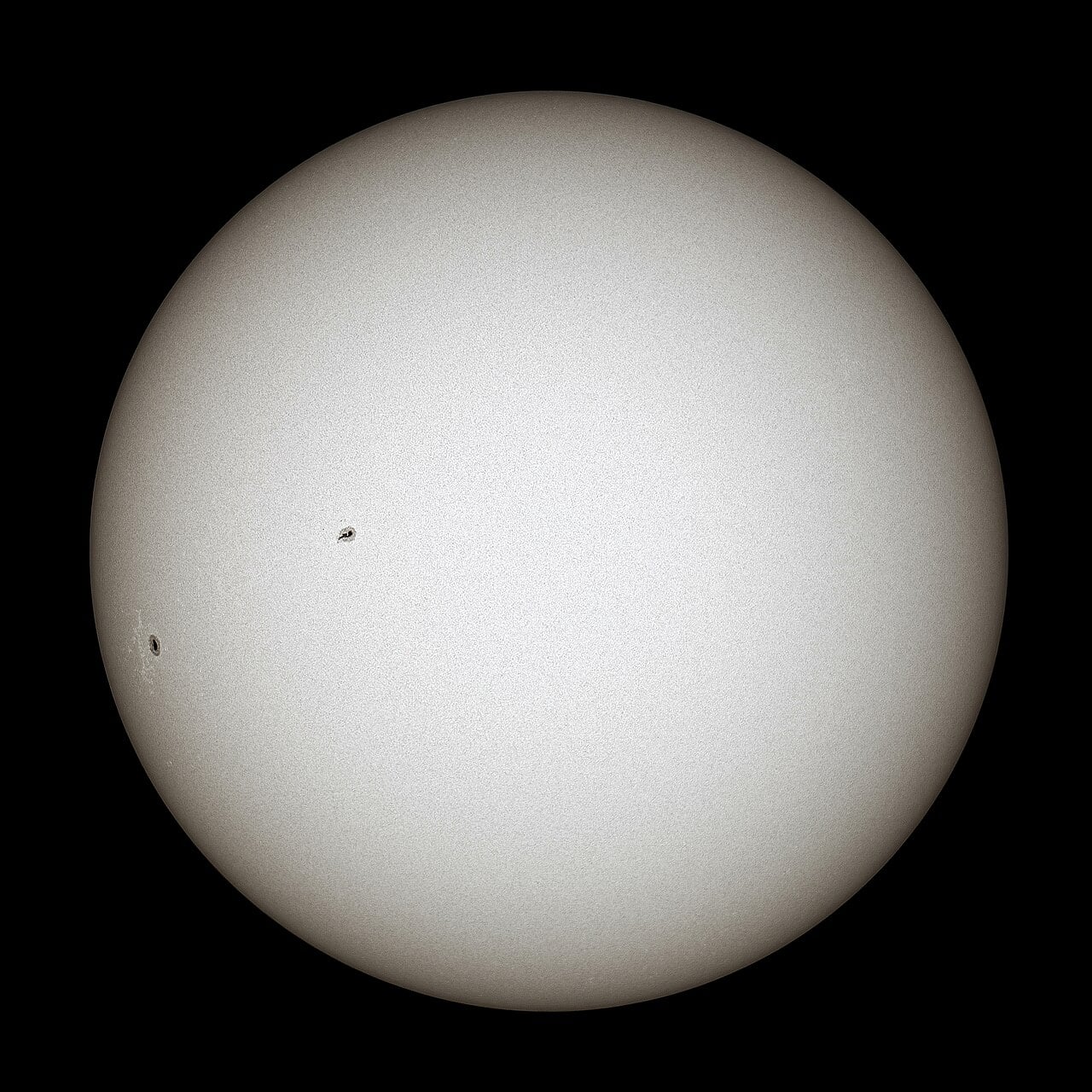
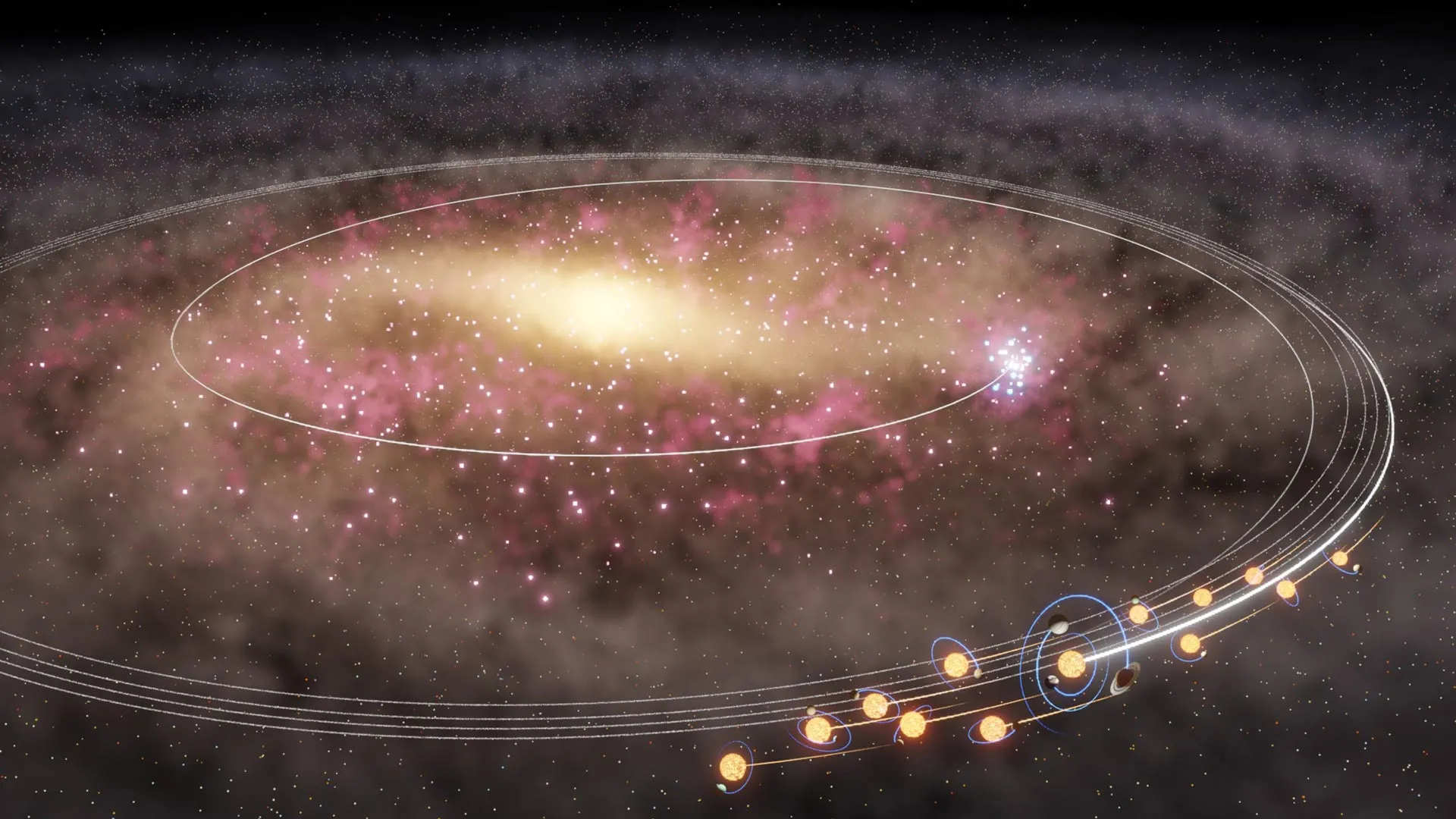
The Sun is now thought to have left its original location in the Milky Way as part of a mass migration (Credit : Matúš Motlo)
Our Sun is a middle aged, average star sitting in an unremarkable corner of the Milky Way. It fuses hydrogen into helium at its core, bathes its planets in light and heat, and has been doing so for around 4.6 billion years. Nothing about it immediately suggests a dramatic past. But look closer, and the questions start to stack up.
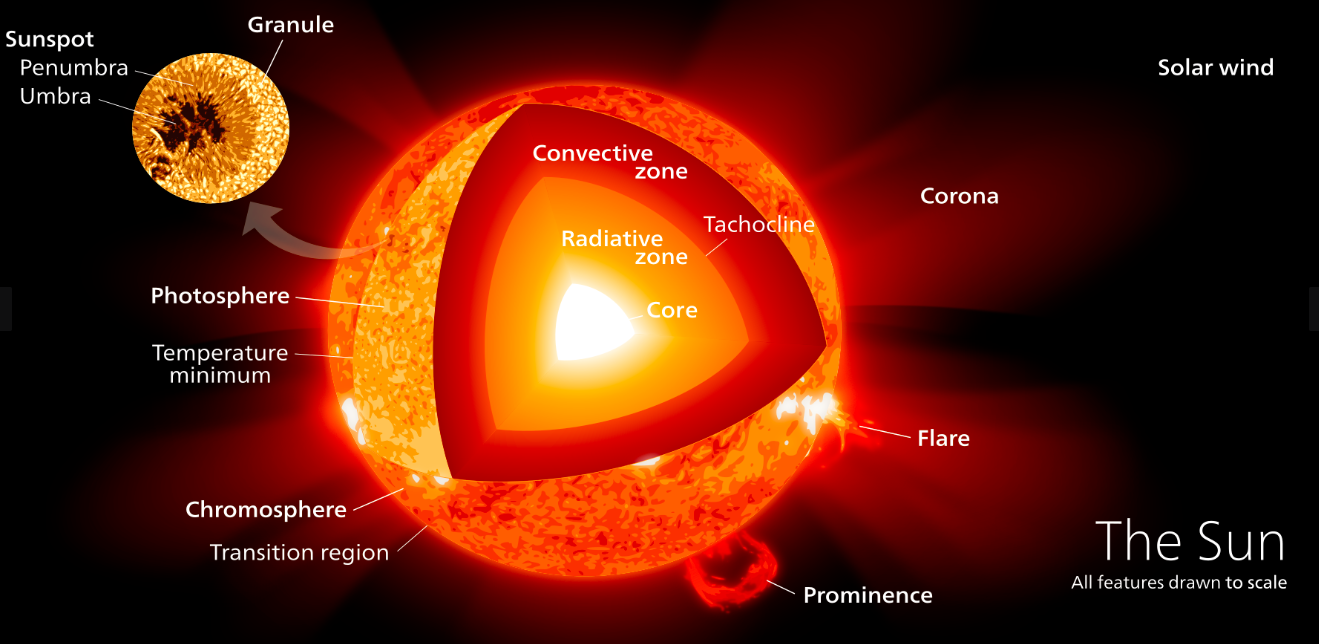
Artists impression of the interior of the Sun
(Credit : Kelvinsong)
Here's one question worth thinking about for a while. Why are we here? Not philosophically, but geographically. Our Sun sits in a relatively calm, suburban stretch of the Milky Way, far from the violent, radiation soaked environment at the galactic centre. It wasn't always this way, and scientists have long suspected that the Sun formed much closer to the core before migrating outward. What's been missing is the evidence for exactly how that happened. Now, a team from Tokyo Metropolitan University has found it, and the answer is stranger and more wonderful than anyone expected.
The researchers turned to one of astronomy's most remarkable datasets, the Gaia satellite's catalogue of almost two billion stars. From this extraordinary set of data, they identified 6,594 solar twins, stars so similar to our Sun in temperature, surface gravity, and chemical composition that they might almost be siblings. It's the largest collection of solar twins ever assembled, around thirty times bigger than previous surveys, and it gave them a family portrait of stars like ours, stretching back billions of years.
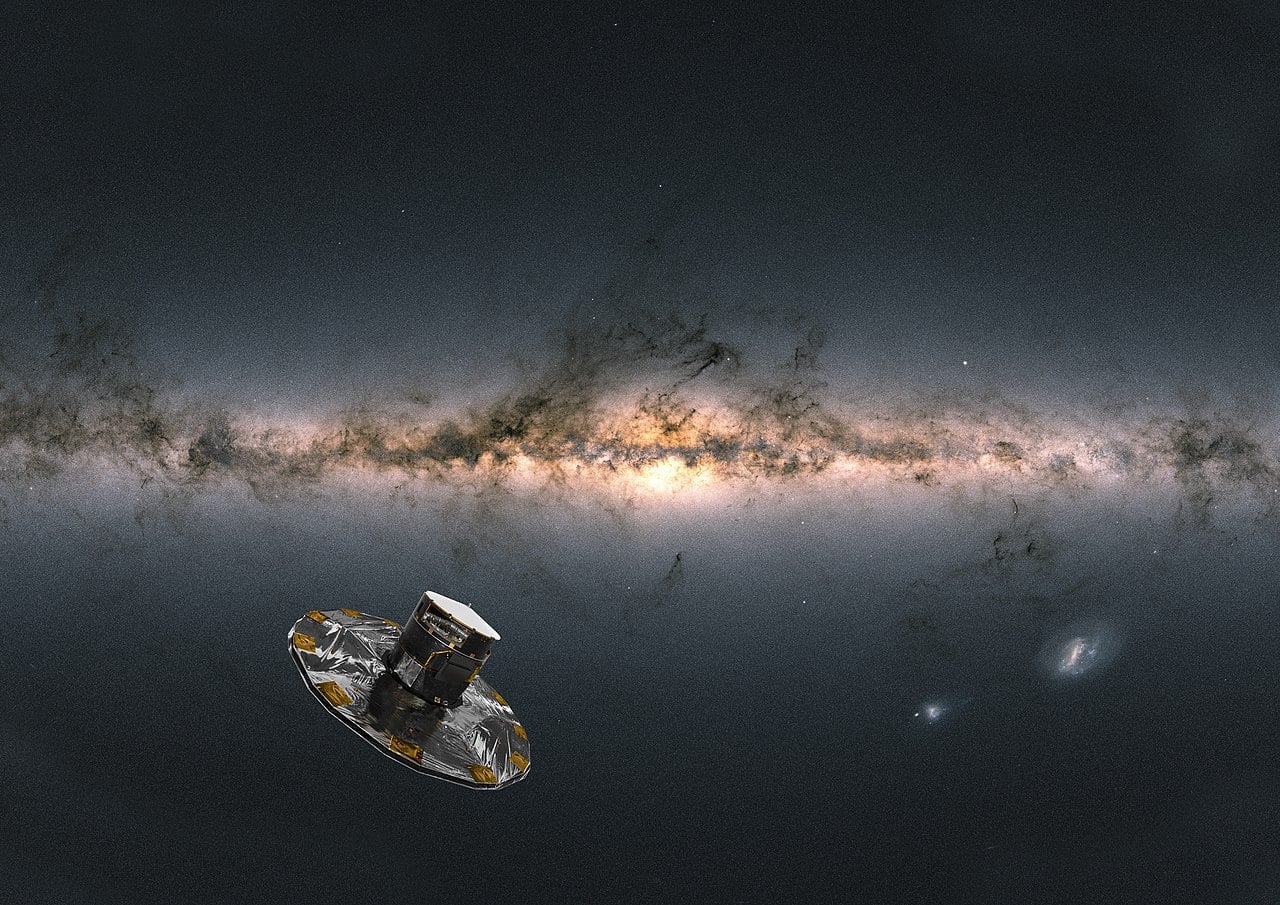
Artist impression of ESA's Gaia satellite observing the Milky Way
(Credit : ESA/ATG medialab)
When they mapped the ages of these twins, a striking pattern emerged. There is a pronounced cluster of solar twins aged between four and six billion years, positioned at roughly the same distance from the galactic centre as we are today. Our Sun falls squarely within that group. This isn't coincidence the team suggest. What the data reveals is a mass migration, a wave of Sun like stars that left the galactic core together during that same window of time, carrying our own star along with them.
That raises an obvious question. Why then? The answer may lie in the galactic bar, the enormous rotating bar like structure of stars that dominates the Milky Way's centre and creates what astronomers call a corotation barrier, effectively a gravitational fence that should make large scale stellar escape difficult. The timing of the migration suggests the bar was still forming during that period, perhaps temporarily lowering the fence just long enough for stars to slip through in large numbers.
The centre of the Milky Way is an extraordinarily hostile place, flooded with radiation and gravitational disruption. By escaping to quieter outskirts, our Sun found the stable conditions that life needs. We didn't just get lucky, we left at exactly the right moment, swept along in a tide of stars just like ours, bound for somewhere a little more habitable.
The Sun may have been part of a small group of stars that migrated from the core of our galaxy between 4 and 6 billion years ago, passing through what is now an impassable barrier on its journey to a more habitableregion of the Milky Way.
The new research, conducted by astronomers at Tokyo Metropolitan University, used data from the European Space Agency’s Gaiasatellite to produce the most accurate catalogue of solar twins ever assembled. Their detailed analysis of the star catalogue, reported in a recent paper published in Astronomy & Astrophysics, provides astronomers with crucial new information about theMilky Way’s evolution and bar-like central structure, shedding light on how the ancient cosmic escape occurred.
Origin of the Sun
Astronomers previously believed that our Sun formed about 10,000 light-years closer to the galactic center than its current position roughly 4.6 billion years ago.
However, how this migration occurred has long remained a question for researchers. Analysis of stellar composition suggests that stars like the Sun formed in a more central location, yet today a structure known as the corotation barrier appears to impede their movement outward from the galactic center.
“The physical mechanism behind the corotation barrier has been fairly well understood,” co-author Dr. Daisuke Taniguchi, of Tokyo Metropolitan University, told The Debrief. “However, what has been less clear is where exactly the barrier may have been located in the past.”
The researchers focused their study on solar “twins,” stars with temperatures, surface gravities, and chemical compositions similar to those of our Sun. Among the nearly two billion stars contained in the Gaia data set, the team identified 6,594 solar twins—roughly 30 times more such stellar analogues than had been found in previous studies.
Developing a Star Catalogue
“We selected stars whose atmospheric parameters (surface temperature, surface gravity, and metallicity) are very close to those of the Sun,” Taniguchi explained. “In addition, we applied several quality cuts using other physical parameters and data flags to ensure that only high-quality measurements were included in our final sample.”
A mass migration of stellar twins. Stars similar to our Sun form a mass migration from the center of the Milky Way, occurring approximately 4 to 6 billion years ago.
Credit: NAOJ
The large sample size enabled the researchers to determine the stars’ ages with much greater precision than earlier work allowed. Their analysis suggests that the formation of these types of stars peaked roughly 4 to 6 billion years ago, providing evidence that many may have formed in the same region near the center of the Milky Way.
The research also offers clues about the evolution of the galaxy’s central structure. Today, the corotation barrier associated with the Milky Way’s bar would prevent stars from migrating outward in the way the Sun appears to have done.
This suggests that the migration likely occurred before the barrier reached its current position. In other words, the corotation barrier itself may have shifted over time as the galaxy evolved.
“Our study proposed the possibility that the location of the barrier may have changed significantly around 4-6 billion years ago,” Taniguchi said. “If so, this could have allowed stars like the Sun to migrate outward more easily during that period.”
Further Research on Sun Twins
For life on Earth, it may be fortunate that the Sun migrated away from the galactic center before the corotation barrier stabilized, since the central regions of the Milky Way present a far more hostile environment for planetary systems.
The researchers plan to continue expanding their solar twin catalogue as new astronomical data becomes available.
“A natural next step will be to expand the sample using the upcoming Gaia DR4 data release planned for December 2026 (in this study, we used Gaia DR3 data),” Dr. Taniguchi said. “With a larger number of Solar twins and a wider observational volume (currently 6,594 Solar twins within about 1,000 light years around the Sun), we can improve the statistical significance of the results and also further investigate the spatial distribution of the sample.”
The team hopes their star catalogue will help other astronomers pursue new lines of research.
“Our catalog is currently the largest high-confidence catalog of Solar twins and contains a wide range of information, including ages, chemical compositions, distances, and other stellar properties,” Dr. Taniguchi concluded. “Because of this, I hope it will be used for many different kinds of studies beyond the questions we explored in our papers.”
Ryan Whalen covers science and technology for The Debrief. He holds an MA in History and a Master of Library and Information Science with a certificate in Data Science. He can be contacted at ryan@thedebrief.org, and follow him on Twitter @mdntwvlf.
On June 4, 2021, NASA’s leading Administrator Bill Nelson said on CNNthat scientists should study the nature of Unidentified Aerial Phenomena (UAP).
The following morning, I emailed Dr.Thomas Zurbuchen, NASA’s Associate Administrator for Science, about possible funding of a scientific research project that would make his boss happy. Thomas graciously called my phone and asked me to send a 2-page white paper. I followed his request within a few hours, but he never got back to me.
As a result of not hearing back, I decided to establish the Galileo Project, in collaboration with Dr. Frank Laukien two months later. This scientific research project followed the narrative of my original White Paper and is supported by private donations to my research fund at Harvard University.
The first time I learned about the outcome of my exchange with Dr. Zurbuchen was through a press conference held a year later, on June 9, 2022. I became aware of the pending announcement thanks to an email from the Galileo Project member, Dr. Alan Stern, who wrote, “I can’t imagine you aren’t aware of this, but just in case …” Contrary to Alan’s expectation, I did not know in advance about NASA’s press conference, so I immediately notified the rest of the Galileo Project community, which by now contains more than a hundred members.
In the press release, NASA announced a new independent study on UAP from a scientific perspective. The study will focus on identifying available data, how best to collect future data, and how NASA can use that data to move the scientific understanding of UAP forward. The study is not part of the Department of Defense’s Airborne Object Identification and Management Synchronization Group, and is expected to take about nine months to complete. It will secure the counsel of experts in the scientific, aeronautics, and data analytics communities to focus on how best to collect new data and improve observations of UAP.
I was delighted to see that some of the statements made at the press conference and the resulting news reports, echoed my writings. For example, the Guardian noted that, “We have to approach all these questions with a sense of humility,” a statement which echoes the theme of my book “Extraterrestrial”.
Or, as Oscar Wilde noted, “Imitation is the sincerest form of flattery.”
Overall, this outcome is gratifying and represents a “win-win” development. The Galileo Project is now likely to receive a boost to its funding from wealthy individuals and foundations with which I am in close contact. But most importantly, the Project’s scientific mission narrative is now echoed within the government.
It does not matter who tells the truth as long as it is being told. As I mentioned to the Jerusalem Post on the morning of NASA’s press release, “It is wonderful that NASA and scientists will be engaged in unraveling the nature of UAP … It is a fishing expedition and we will end up with a mixed bag of natural and human-made objects. But even if we have high-quality data on just a single object that demonstrates something else, such as an extraterrestrial technological origin, it would represent the most important discovery in human history.”
A day later, I received an email from the leadership team of NASA’s Science Mission Directorate, explaining that I was not selected to serve on this study because it represents a non-advocate review that will be conducted in accordance with the principles of the Federal Advisory Committee Act (FACA). In other words, my role in leading the Galileo Projectwould constitute an apparent conflict of interest.
Being true to the words of my White Paper after not getting a response from NASA, led me to establish a new scientific Project on UAP, but it now blocks me from contributing directly to NASA’s planning exercise on exactly the same research frontier. Perhaps it is a blessing in disguise, since the Galileo Project has currently no strings attached to the government. In the future, the Project will be able to apply to any relevant funds as they become available.
In gratitude for NASA’s explanatory email, I mentioned that I will be delighted to provide any input that could help NASA’s study, because it shares the intellectual DNA of the Galileo Project. Government agencies and academia should be working together towards the collection of new evidence-based knowledge on UAP.
It is possible that by the time NASA’s study completes its nine-month pregnancy and delivers its independent “baby”, the Galileo Project will discover evidence that will change the charter of NASA’s report. The Galileo Project is currently assembling its first telescope system on the roof of the Harvard College Observatory, planning an expedition to retrieve fragments from the first interstellar meteor, studying satellite data on UAP from above, and designing a space mission to rendezvous with the next anomalous (`Oumuamua-like) interstellar object.
Before NASA’s announcement, it was common practice among scientists to ridicule the scientific study of UAP. The ridicule was surprisingly strong and public within the traditional SETI community, with one exception – Seth Shostak who joined the Galileo Project after publishing a brave supportive article in Scientific American.
Open mindedness applies also to scientific research. We should explore the unknown by seeking evidence agnostically and not assuming what we might find. Gladly, we now know that both the Galileo Project and NASA agree on following this principle.
Avi Loeb is the head of the Galileo Project, founding director of Harvard University’s – Black Hole Initiative, director of the Institute for Theory and Computation at the Harvard-Smithsonian Center for Astrophysics, and the former chair of the astronomy department at Harvard University (2011-2020). He chairs the advisory board for the Breakthrough Starshot project, and is a former member of the President’s Council of Advisors onScience and Technology and a former chair of the Board on Physics and Astronomy of the National Academies. He is the bestselling author of “Extraterrestrial:The First Sign of Intelligent Life Beyond Earth” and a co-author of the textbook “Life in the Cosmos”, both published in 2021.
After years of debate, scientists have finally solved the mystery of a structure hidden under the North Sea. Researchers at Heriot-Watt University confirmed that the Silverpit Crater was created by an asteroid impact millions of years ago. Thisimpact caused a huge tsunami and left behind one of the rare underwaterimpactcraters found onEarth.
First identified in 2002, the Silverpit structure displays several features that are characteristic of impact craters, including a circular outline, a central peak, and concentric fault rings. Despite these clues, some scientists argued that the formation could have resulted from natural geological activity, such as the movement of underground salt deposits or volcanic forces, leaving the true origin of the crater unclear.
In 2009, a group of geologists reviewed the evidence and concluded that the crater was unlikely to have formed from an asteroid impact. The latest research not only challenges but also overturns that earlier conclusion.
Evidence Hidden Beneath the Seafloor
A team led by Dr. Uisdean Nicholson at Heriot-Watt University used high-resolution seismic imaging alongside detailed analysis of rock samples collected from beneath the seabed. The seismic data revealed the crater’s internal structure with a level of detail previously unattainable. Meanwhile, rock samples obtained from an oil well offered crucial evidence to resolve the question of the crater’s origin.
“We were exceptionally lucky to find these — a real ‘needle-in-a-haystack’ effort,” Nicholson said. “These prove the impact crater hypothesis beyond doubt.”
The samples contained shocked quartz and feldspar, minerals that only form under the intense pressures produced by asteroid impacts. These minerals confirm that a high-energy collision created Silverpit Crater.
A Violent Impact
The evidence shows that an asteroid about 160 meters wide hit the seabed between 43 and 46 million years ago. The team’s models suggest the asteroid came from the west at a low angle, creating a huge plume of rock and water.
Within minutes, the plume collapsed back into the ocean, producing a tsunami that reached heights of over 100 meters (about 330 feet). The impact released vast amounts of energy, sending waves across the surrounding region and reshaping the seafloor.
A Rare Preserved Impact Crater
Impact craters are rare on Earth because erosion and plate movements slowly erase them. Around 200 confirmed impact craters have been found on land, but only a few dozen have been found beneath the ocean.
Silverpit is notable as a well-preserved hypervelocity impact crater, offering a rare opportunity to study how such events shape the planet’s subsurface structure.
Professor Gareth Collins of Imperial College London, who contributed to the study’s modeling work, said the new evidence represents a decisive breakthrough. “It is very rewarding to have finally found the silver bullet,” Collins said.
Understanding Earth’s Impact History
This research settles a long-standing scientific debate and offers new insight into the forces that have shaped Earth’s history. The findings will help scientists understand how asteroid impacts influence planetary surfaces on Earth and elsewhere in the solar system.
“We can use these findings to understand how asteroid impacts shaped our planet throughout history, as well as predict what could happen should we have an asteroid collision in the future,” said Nicholson.
Austin Burgess is a writer and researcher with a background in sales, marketing, and data analytics. He holds a Master of Business Administration, a Bachelor of Science in Business Administration, and a Data Analytics certification. His work combines analytical training with a focus on emerging science, aerospace, and astronomical research.
UFOs 'disabled nuclear missiles' as Air Force veteran recalls terrifying base encounter
UFOs 'disabled nuclear missiles' as Air Force veteran recalls terrifying base encounter
Athena Dawson
Robert Salas
A retired U.S. Air Force veteran claimed he encountered UFOs that disabled multiple nuclear missiles while he served in the military during the Cold War.
Robert Salas claimed that an unknown entity subdued the military's ability to control 10 Minuteman I intercontinental ballistic missiles equipped with nuclear warheads at Malmstrom Air Force Base in 1967.
The 85-year-old former launch officer shared the harrowing story on the "Danny Jones Podcast" on Sunday.
Salas manned the monitoring and launch of nuclear missiles, "if given the order," during the tense Cold War era.
He recalled his alleged alien encounter, which occurred around 10 p.m. on March 24, 1967. Salas was underground with his partner when panicked guards called from above about a mysterious, unidentified aircraft.
"The main guard calls down, says, 'Sir, we've been seeing some strange lights in the sky, flying directly overhead,'" Salas said.
He added that guards insisted the aircraft wasn't a Soviet one because of its odd lights. It flew through the sky before abruptly stopping over the underground ICBMs.
Salas initially dismissed the guards, thinking it was a prank, but five minutes later, the guard called back, screaming into the phone.
"He's yelling. He's babbling. He's frightened," Salas recalled.
After he calmed down, the guard told Salas that he and his men had their weapons aimed at the craft floating above the base's front gate, which was emitting a "pulsating reddish light."'
Salas said the panicked guard asked what to do next, and he told him, "Do whatever you have to do."
Salas recalled that the guard said one of his men was injured before hanging up.
The octogenarian then recalled how the missiles had been shut down by the mysterious alien entities. As he went to wake up his sleeping partner, a loud horn at the controls suddenly began to blare.
The alarm signaled that an issue had emerged with the missiles, and Salas said when they looked at the board, "one of them went from green to red."
No ability to launch," Salas said. "Then, very quickly thereafter, bing bing bing bing, all 10 of them went down. They all went red."
An illustration of an intercontinental ballistic missile silo
(Image: Danny Jones/YouTube)
They jumped up and ran through their checklist, then realized two launch facilities miles away were showing that "someone or something" may have breached the fenced missile area.
Salas said that he reacted immediately, sending guards to the missile silos. He said they were "scared to death" after encountering the floating lights hovering over the launch areas nearly a mile away.
"They were scared to death," he said. "They didn't want to go any further. They were so frightened of these things."
Salas said he later heard the guard was injured from either hurting his hand while clearing his jammed rifle or cutting it on barbed wire during the spooky alien encounter.
He also learned that the guards had apparently seen the odd craft in the area mere days before the encounter. It was described as being able to fly in reverse, complete 90-degree turns, and fly in dead silence.
Salas said that, despite an investigation, it was never determined what shut down the warheads, even with systems designed to prevent jamming.
"They had no idea how this signal could have been injected into each of the missiles," he said. "The cabling system that we had was triply shielded against electromagnetic interference from the outside."
Salas said that he's convinced the extraterrestrial visitors traveled to Earth to stop a nuclear war from unfolding.
Salas's alleged alien encounter stayed a decades-long secret as Air Force investigators forced him and his commander to sign strict gag orders, warned that they could face prison time if they ever spoke about it.
He ultimately went public decades later after reading about a similar incident in a UFO book, concluding that the information had already been disclosed.
Otherworldly UFO Destinations For the Alien-Obsessed Are we truly alone in the universe? Some people assert that we've already made contact! Here are some of the best places to learn more about both real and fictional UFOs.
10. McMinnville, Oregon McMinnville is a great place to begin for several reasons. For starters, photos of the UFO that appeared over McMinnville are considered some of the most compelling, clear evidence of UFOs ever captured. Secondly, they have an annual UFO festival. There’s plenty of goofiness happening, but there are also serious discussions. The latest festival featured several witnesses and investigators of the Phoenix Lights, one of the most well-documented and widely-seen UFO events in history.
9. Aurora, Texas The story of UFOs in America doesn’t start with Roswell. It actually goes back much farther than that. In 1896, residents of Aurora, Texas, started seeing a cigar-shaped object floating in the sky. In 1897, the alleged craft collided with a windmill. According to local legend, the pilot—assumed to be from another planet—was buried in the town graveyard. While the gravestone that used to mark its plot is gone, there’s still a historical telling the story.
8. The Smithsonian Institution Washington, D.C. The Smithsonian has fascinating scientific and historical artifacts, but it also has a great deal of science fiction on display. Margaret Weitekamp is the Curator for Social and Cultural Dimensions of Spaceflight, which means that it’s her job to put together a collection of all the ways space travel has captured our imaginations. That’s not the only place to see UFOs at the Smithsonian, though. The Institute’s National Museum of African-American History and Culture holds a reconstructed incarnation of Parliament’s P-Funk Mothership, one of the most iconic stage props in history, and certainly the funkiest starship in the galaxy.
7. Kennedy Space Center, Florida Merritt Island, Florida Maybe the objects flying out of Kennedy are more known than unknown, but it’s still a cool place to be. This is an exciting time for spaceflight—SpaceX just launched a rocket that successfully landed on a boat at sea. Being able to reuse rockets instead of just crashing them makes space exploration much more affordable. They’re not the only private company helping advance spaceflight, just one of the many getting in on the action here at Kennedy and Cape Canaveral.
6. Devils Tower Crook County, Wyoming Devils Tower is an enormous igneous intrusion in Wyoming. Most people probably know it from Spielberg’s Close Encounters of the Third Kind, where Richard Dreyfuss and several others found themselves obsessed with the unique shape of the mountain, eventually flocking to the site just in time for UFOs to land. The movie turned the monument into a sci-fi icon, one that’s been parodied by everyone from “Weird Al” Yankovic to The Simpsons to even The X-Files.
5. Vasquez Rocks Los Angeles County, California Vasquez Rocks is one of those places more associated with fictional aliens than any real or alleged encounter. Still, it’s so iconic that it deserves a mention—as soon as you see this structure, it’s immediately familiar, even if you can’t place it. That’s because it’s been a filming location for over 50 films and countless TV shows. Captain Kirk famously fought that rubber-suited lizard monster here. But the rocks have also appeared in the likes of Roswell, Alien Nation, Battlestar Galactica, Buffy, and much more.
4. The Karl G. Jansky Very Large Array Socorro County, New Mexico The Karl G. Jansky Very Large Array is (you guessed it) a very large array of radio telescopes, trained at the Socorro County skies. The antennas here are so huge that they’re repositioned via a system of trains. They’ve helped us learn more about black holes, quarks, quasars, and even the gasses at the center of our galaxy. They’re not actually used to seek out UFOs, but they’re almost better.
3. The SETI Institute Mountain View, California Not all of the conversation around aliens has to do with little green men. SETI—the Search for Extra-Terrestrial Intelligence—has been exploring the universe for signs of life since it began operations in 1985. They use a telescope array (not the Very Large Array; a different one) to search for signs of technology, and a cross-disciplinary team of scientists explores forms of life that might exist but haven’t occurred to us.
2. Area 51 Lincoln County, Nevada Let’s get one thing clear—do NOT attempt to actually enter Area 51. Whether it has anything to do with UFOs or not, this is a very real military base, about which nearly everything is classified. Its proximity to Roswell has led people to cite it as the parking spot for the Roswell UFO. It's probably no surprise, then, that most of the kitschy tourist items around here are centered around the alien theme.
1. Roswell, New Mexico In 1947, one of two things occurred during the “Roswell Incident:" either (1) part of a weather balloon fell onto a rancher’s property or (2) a UFO crashed that incited an immediate government cover-up. That second theory is certainly not harmed by the fact that there is a top-secret air force base not too terribly far away. At a minimum, kitschy UFO imagery has seeped into just about every part of the town, and it makes for a good time.
Residents across multiple states were startled on Tuesday as a loud boom, believed to be a meteor crashing into Earth, echoed across the region.
Witnesses in Pittsburgh reported seeing what appeared to be a burning object streaking through the sky, describing it as 'a rocket or something like a meteor.'
One local wrote online: '911 calls in the city. I have relatives who heard the boom from Hinckley, Ohio, all the way to Sandusky.'
Totally reminded me of the sonic booms produced by the fighter-jet test pilots in the early 1960s,' another person shared.
The National Weather Service (NWS) later said the fiery object was likely a meteor entering Earth's atmosphere.
The meteor was spotted by space satellites around 9am ET and seen by human eyes about one hour later.
As of January 2026, the Meteoritical Bulletin Database has recorded 1,270 officially confirmed 'observed falls,' meteorites that were seen falling to Earth and later recovered.
Scientists estimate around 17,000 meteorites strike the planet each year, but most land in oceans or remote areas, meaning only about 1.8 percent of meteorites have actually been witnessed.
Witnesses in Pittsburgh reported seeing what appeared to be a burning object streaking through the sky, describing it as 'a rocket or something like a meteor.'
Residents across Ohio and Pennsylvania were startled Tuesday morning as a loud boom echoed across the region
Officials from the NWS Cleveland stated that the meteor likely burned up or disintegrated high in the atmosphere, approximately 25 miles up over the Northeast Ohio/Lake Erie region.
Some officials speculated that if any fragments survived, they could have landed in Lake Erie.
There have been no reports of injuries or property damage caused by the landing.
The 'explosion' reported across the region was a sonic boom created by the meteor shooting through the atmosphere at speeds over 25,000 mph.
Residents across the region flooded social media with reports of a powerful blast, with many describing a thunderous noise that shook homes and echoed for miles.
Some said it sounded like multiple explosions or rolling vibrations, while others reported spotting a glowing fireball and a bright streak tearing across the sky.
One Cleveland resident posted on X: 'Loud boom in Cleveland today. They are saying a meteor! The house shook; it was scary.'
'Heard and felt here on the west side of Cleveland. One loud boom followed immediately by a smaller or 'echo' boom,' another local shared.
The 'explosion' reported across the region was a sonic boom created by the meteor shooting through the atmosphere at speeds over 25,000 mph
The meteor was spotted by space satellites around 9am ET and seen by human eyes about one hour later
'Didn't quite shake the house; it more like reverberated through it. Thought it was a truck or something until my Sister messaged me that she heard it too.'
Meteoroids are small rocky objects that travel through space, ranging in size from tiny dust particles to fragments as large as small asteroids.
When one of these objects enters Earth's atmosphere at high speed, it burns up due to intense friction, creating a bright streak of light known as a meteor, often called a 'shooting star.'
If any part of the object survives its fiery descent and reaches the ground, it is then classified as a meteorite.
The film Hail Mary leaves a very positive impression overall. If someone likes science fiction, they might really enjoy this movie. This is exactly the kind of film that not only shows beautiful images of space but also keeps you on the edge of your seat for almost the entire runtime. The plot constantly throws in new twists, and the characters’ decisions keep you hooked on the story.
Ryan’s acting deserves special mention. Everything is portrayed very naturally: the characters feel like real people, not just vehicles for the plot. This makes it easier to believe both the story itself and the characters’ emotional reactions. Another important plus is the attention to detail. It was particularly pleasing that the film accurately depicts one of the basic principles of space: there is no sound in outer space. For a sci-fi film, this might seem like a minor detail, but it is precisely these details that greatly enhance the film’s believability.
Poster for the film Project Hail Mary
Hail Mary is a fantastic film that works on several levels: as a suspenseful adventure, as a story of survival, and as a film that strives to respect scientific logic. That’s exactly why the film resonates not only emotionally but also intellectually.
It is also interesting to compare it to the film U Are the Universe. One gets the sense that these films resonate with each other in some ways: both use space not merely as a backdrop, but as a realm of solitude, connection, hope, and human vulnerability. But while U Are the Universe is a more intimate, lyrical, and existential story, Hail Mary is a larger-scale, technically sophisticated, and plot-driven science fiction film. And there is an interesting point here: if the creators of U Are the Universe had delayed the film’s release just a little longer, and it had come out after Hail Mary, some viewers would surely have accused them of plagiarism. In reality, that would have been unfair: the Ukrainian film had already been released earlier as an independent work. And even Andy Weir’s book Hail Mary was not published until 2021.
Technical Analysis with Spoilers
From an engineering perspective, the film is particularly interesting because it invites analysis rather than just watching. And for the most part, this is a plus: if, after watching it, there is a desire to discuss fuel, the atmosphere, materials, and manufacturing technologies, then the science fiction has done its job.
The first – and perhaps the most controversial – point concerns the logistics of the protagonist’s return journey. This is the film’s weakest point. Even with full tanks – roughly two million liters of astrofuel – the return trip would take about four years, so questions about the mission’s supplies arise at this stage. Based on the plot’s logic, there was enough food for about two years, and after subsequent events, the available fuel supply is further reduced by two sections. As a result, the return mission begins to look less like an engineering-driven scenario devised by the protagonist and more like a very optimistic hope for a miracle. This does not ruin the film entirely, but it is here that the tension between the drama and the real-world logistics of interstellar flight is felt most acutely.
The docking of two spacecraft via a folding airlock was performed using an additive method. Source: Hail Mary trailer
The second point of contention is taumeba and xenonite. Conceptually, this is a very striking idea, but it raises the most questions precisely from the perspective of the world’s internal physics. If xenonite is presented as a reliable structural and airtight material, then taumeba’s ability to pass through it requires a very serious explanation. It is not enough here to say that this is unusual biology; there needs to be a clear mechanism that explains exactly how it happens, under what conditions, and due to which properties of the material and the organism. That is why this particular plot point raises the most scientific doubts for me. It works as a dramatic twist, but as a hard sci-fi premise, it looks noticeably weaker than many of the film’s other ideas.
That said, the atmosphere on the ship and the final dome actually struck as quite plausible. Here, the film, on the contrary, enters the realm of logical engineering solutions. When it comes to a pressurized environment for humans, the basic principles are quite clear: controlling pressure, gas composition, temperature, humidity, removing carbon dioxide, and maintaining a safe environment. In this sense, the dome in the finale can be seen as a development of the same ideas used in space life support systems (e.g., the ISS), only adapted to a different technological platform. Therefore, this aspect should be defended rather than criticized.
The protagonist’s interaction with an alien life form through a wall made of xenonite. Source: Hail Mary trailer
The idea of highly advanced 3D printing on an alien spacecraft struck as particularly compelling. The way tunnels, structures, and various objects are formed is an extremely advanced form of 3D printing or programmable manufacturing. And this is precisely one of those ideas that, in science fiction, does not seem like magic but rather a logical progression of real-world technologies. If a civilization is capable of building complex structures directly within the required environment, with high precision, using readily available materials, and tailored to a specific task, then this seems very realistic for a highly advanced engineering culture.
The same applies to the translator. The film presents him not as a magic button, but as the result of a gradual search for patterns, the comparison of signals, learning, and the development of a common language. It is precisely this approach that makes the idea convincing. This is no longer a fairy-tale “universal understanding of aliens,” but an engineering problem of communication that is solved step by step. And within the realm of science fiction, it makes perfect sense.
Rock-like alien Rocky is the protagonist’s main companion and new friend. Source: Hail Mary trailer
Ultimately, what makes Hail Mary great for me is that it can be viewed in two different ways. The first is simply a powerful, intense, and emotional science fiction film. The second is a film that invites technical analysis. And even its controversial moments are not so much a drawback as a reason for discussion. Because the most interesting sci-fi films are not the ones that leave no questions, but the ones that make viewers want to debate trajectories, materials, atmosphere, biology, and technology.
What differences and nuances did you notice? Let’s discuss them in the comments.
The Applied Physics Laboratory (APL) at Johns Hopkins University has officially begun assembling one of the most unusual spacecraft in the history of space exploration. TheDragonfly unmanned helicopter, whose design resembles the legendary ornithopters from Frank Herbert’s Dune universe, is preparing for a mission to Titan.
Dragonfly is a drone-based mission under NASA’s New Frontiers program designed to utilize Titan’s unique environment to collect material samples and determine the composition of the surface under various geological conditions. Image: dragonfly.jhuapl.edu
Although it is not the barren Arakis, Saturn’s largest moon will greet the explorer with vast expanses of sand dunes. And while the chances of encountering a sandworm there are practically nonexistent, the scientific potential of this mission is truly impressive.
Drone Lab
The Dragonfly drone from NASA’s New Frontiers program on the surface of Titan. Illustration: dragonfly.jhuapl.edu
Dragonfly isn’t just a drone. It’s a fully-fledged autonomous robot about the size of a small car. Unlike rovers, which take years to cover just a few dozen kilometers, the flying probe will be able to “hop” vast distances, exploring various regions of Titan in a single flight.
Once it reaches the moon’s surface in 2034, the spacecraft will conduct a comprehensive analysis, ranging from studying the composition of the atmosphere to taking seismic measurements. The chemical composition of the surface is of particular interest. Beneath Titan’s thick layer of ice lies a global ocean of salty water, making this world one of the most promising places to search for extraterrestrial life.
A slow and cold world
The Dragonfly drone landing on Titan’s surface as part of NASA’s New Frontiers program. Illustration: dragonfly.jhuapl.edu
Titan is truly an amazing place. It is the only moon in the Solar System with a dense atmosphere. The air there is four times denser than Earth’s, and gravity is seven times weaker. This creates some amazing conditions: if you were there in the rain, the methane droplets would fall extremely slowly, as if in slow motion.
However, waiting for such a downpour is no easy task, since centuries can pass between precipitation events on Titan. Such a stable, albeit cold, chemical environment is the ideal place for the formation of organic compounds. Scientists consider Titan to be “Earth in the freezer”—it looks just like our planet before the first living organisms appeared on it.
A costly mission
Exploring Titan is no cheap project. The total cost of the mission is estimated at $3 billion. Previous attempts to peer beneath the moon’s thick, foggy veil have been extremely limited: in 2005, the Huygens probe lasted only a few hours on the surface due to a lack of power.
Since Dragonfly is designed for long-term operation, solar power is not an option — there is too little light penetrating Titan’s thick haze. Therefore, Dragonfly will be powered by nuclear energy. The spacecraft will be equipped with a multi-mission radioisotope thermoelectric generator (MMRTG). Fuel rods containing plutonium will generate heat, which will be converted into electricity to power electronics, servos, and scientific instruments. This technology has already proven itself on the Curiosity and Perseverance rovers.
Beginning of the journey
The mission is scheduled to be launched in 2028 using a SpaceX Falcon Heavy rocket. After launch, the spacecraft will spend six long years traveling through the Solar System. When Dragonfly finally spreads its rotors over the lakes and rivers of liquid ethane in 2034, humanity will get its clearest view of this mysterious world yet.
In the meantime, engineers continue to assemble this nuclear-powered ornithopter, keeping in mind the golden rule for travelers across the dunes: “The spice must flow,” and science must move forward.
A terrifying study has predicted exactly how many people will die by 2050 if we don't take urgent action to curb climate change.
Researchers from the Catholic University of Argentina set out to understand how rising temperatures will affect physical activity – and as a result, premature deaths.
The team analysed data from 156 countries between 2000 and 2022, and used it to predict what the coming decades will look like.
Worryingly, their findings suggest that by 2050, each additional month with an average temperature above 27.8°C will increase physical inactivity by 1.5 per cent globally.
This translates to a predicted 470,000 to 700,000 additional premature deaths every year – and up to $3.68 billion in productivity losses.
Based on the findings, the researchers are calling for urgent action.
'Rising temperatures are projected to increase the prevalence of physical inactivity, translating into additional premature deaths and productivity losses, especially in tropical regions,' they said.
'Prioritising heat–adaptive urban design, subsidised climate–controlled exercise facilities, and targeted heat–risk communication is essential to mitigate these emerging health and economic burdens, in addition to ambitious emissions reductions.'
The team analysed data from 156 countries between 2000 and 2022, and used it to predict what the coming decades will look like
Climate change is making the world hotter, with the last three years confirmed to be the hottest on record.
As a result, exercising in many parts of the world is becoming more difficult.
Writing in their study, published in The Lancet Global Health, the researchers, led by Christian García–Witulski, explained: 'Heat exposure imposes physiological constraints through elevated cardiovascular strain and heightened perceived exertion, creating substantial barriers to outdoor physical activity.'
To understand how rising temperatures might impact the ability to exercise, the team analysed data from 156 countries from 2000 to 2022.
Their results paint a bleak picture of what's to come – particularly in low– and middle–income countries.
By 2050, each additional month with an average temperature above 27.8°C will increase physical inactivity by 1.5 per cent globally, and by 1.85 per cent in low– and middle–income countries, but with no clear impact in high–income countries.
Unsurprisingly, the biggest increase in inactivity will be in hotter regions, according to the researchers.
This includes Central America, the Caribbean, Eastern Sub–Saharan Africa, and Equitorial Southeast Asia – where inactivity could increase by as much as four per cent per month spent above 27.8°C.
Unsurprisingly, the biggest increase in inactivity will be in hotter regions, according to the researchers
'The implications for global health are immediate,' the researchers wrote.
'Without stronger mitigation, rising temperatures alone could undermine – or even reverse – a substantial share of WHO's target of cutting global physical inactivity by 15% by 2030, while simultaneously slowing economic growth through heatrelated drops in worker productivity.'
The researchers also provide several ideas for measures that could be taken to ease the impact of rising temperatures.
Heat–risk messages could be integrated into exercise guidelines, they suggest, while money could be funneled towards cooler exercise facilities.
'Treating physical activity as a climate–sensitive necessity – rather than a discretionary lifestyle choice – will be essential to prevent a heat–driven sedentary transition and its accompanying surge in cardiometabolic diseases and economic losses,' they concluded.
The Paris Agreement, which was first signed in 2015, is an international agreement to control and limit climate change.
It hopes to hold the increase in the global average temperature to below 2°C (3.6ºF) 'and to pursue efforts to limit the temperature increase to 1.5°C (2.7°F)'.
It seems the more ambitious goal of restricting global warming to 1.5°C (2.7°F) may be more important than ever, according to previous research which claims 25 per cent of the world could see a significant increase in drier conditions.
The Paris Agreement on Climate Change has four main goals with regards to reducing emissions:
1) A long-term goal of keeping the increase in global average temperature to well below 2°C above pre-industrial levels
2) To aim to limit the increase to 1.5°C, since this would significantly reduce risks and the impacts of climate change
3) Governments agreed on the need for global emissions to peak as soon as possible, recognising that this will take longer for developing countries
4) To undertake rapid reductions thereafter in accordance with the best available science
A former US Air Force missile launch officer has detailed the terrifying moments when UFOs allegedly shut down America's nuclear weapons without firing a shot.
Robert Salas, now 85, claimed that 20 of the military's Minuteman I intercontinental ballistic missiles were disabled by an unknown force which was able to break through all of the shielding at Montana's Malmstrom Air Force Base in 1967.
On March 16 and 24 of that year, Salas said guards at the base reported seeing strange, fast-moving lights in the sky that could stop and hover instantly, and emitted a bright red glow right before the US ICBMs hidden underground went offline.
Salas, who was one of two officers inside the underground launch control capsule during the Cold War, added that the guards calling for help were convinced the craft were not Soviet airplanes launching an attack.
The Air Force veteran told the Danny Jones Podcast he is convinced intelligent non-human civilizations visited Earth and attempted to prevent World War III from causing a nuclear holocaust.
Salas claimed: 'It's another civilization out there that is visiting us and are concerned about us destroying this planet through nuclear war, for many reasons, probably some we don't even understand.'
The former nuclear missile officer added that an investigation led by aerospace company Boeing could not determine what shut down the warheads because US missile complexes were specifically built to keep out jamming signals like this.
'They had no idea how this signal could have been injected into each of the missiles. The cabling system that we had was triply shielded against electromagnetic interference from the outside,' Salas explained.
US Air Force ICBM launch officer Robert Salas (Pictured) has testified before Congress about the UFO that disabled 10 warheads at Malmstrom Air Force Base in March 1967
Pictured: Malmstrom Airforce Base, home to 10 nuclear warheads which went offline after a strange craft approached the base and the missile silos
According to Salas, the first UFO sighting took place on March 16, 1967, when 10 ICBMs were simultaneously disabled without warning by the mystery swarm of UFOs.
Eight days later, Salas said the encounter started when the topside security guard called down to him in the underground launch control room around 10pm MT to report multiple strange lights flying in the sky over the nuclear weapons base.
The guards claimed these lights could reverse direction, make sharp 90-degree turns and were completely silent, making no engine noises.
After dismissing the guard's story, Salas would soon receive another frantic call from security saying a pulsating reddish light was being emitted from the UFO hovering right above the front gate of Malmstrom AFB.
After ordering security to prevent the UFO from entering the missile complex, guards reported seeing the same or similar lights hovering right above two of the missile silos about a mile away from the control room.
'All of a sudden, we get a large horn go off and we know what that means. That means that there's an issue with one of the missiles. Look at the board and sure enough, one of them went from green to red. No go. No launch, no ability to launch,' Salas told Jones during the March 13 episode.
'Very quickly thereafter, bing, bing, bing, bing, all 10 of them went down. They all went red.'
Salas revealed that incursion lights had also gone off, meaning something or someone had entered the fenced area where the missiles were kept.
A guard closing the gate to entrance of the control center of the missile base at Malmstrom, Montana, where the ballistic missile 'Minuteman' were kept, in December 1962
When he called on the guards to investigate the missile silos, they reported that the UFO had flown off just as they arrived.
Following his encounter, Air Force Office of Special Investigations (AFOSI) personnel ordered Salas and his commander to sign strict non-disclosure agreements threatening prison time if they ever discussed the event.
However, the veteran officer went public decades later after reading about a similar incident in a publicly available UFO book and deciding the information had already been leaked.
The Boeing engineers tasked with investigating the missile complex concluded that an external electromagnetic signal had somehow disrupted the guidance and control systems of the missiles, specifically affecting a device called the logic coupler in each one.
Despite discovering the likely cause, Boeing also noted it was impossible for any normal device or test to affect all 10 missiles at once because each missile was independently housed in a silo designed to block electromagnetic interference.
Officially, the Pentagon has maintained for decades that there is no proof UFOs or extraterrestrial beings exist and have visited Earth.
However, President Trump has ordered Secretary of War Pete Hegseth to release all government files related to the search for these unidentified craft so the public can examine the evidence for themselves.
Humanity has received a mysterious signal, described as a 'mega-laser' beam, from a violently merging galaxy more than 8 billion light-years away.
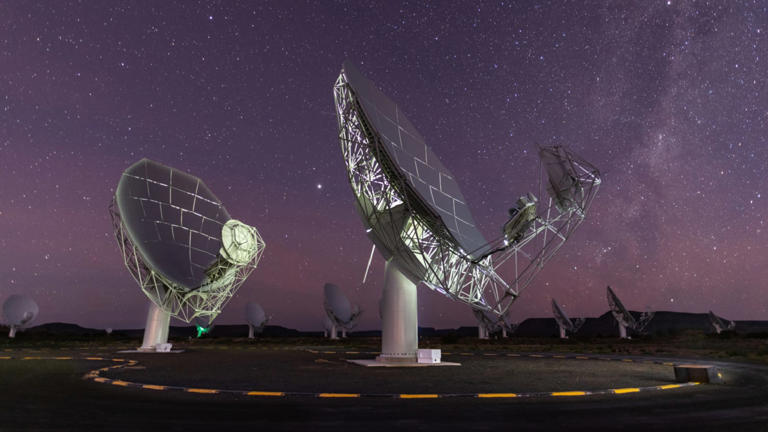
The signal, deemed the most distant hydroxyl megamaser ever detected, was intercepted by the MeerKAT radio telescope inSouth Africa, which features 64 antennas.
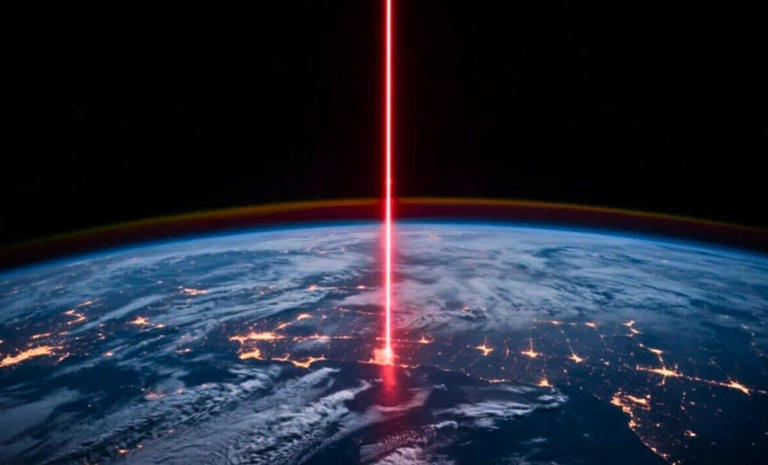
A hydroxyl megamaser is a giant natural laser in space. When galaxies full of gas collide, molecules called hydroxyl smash together and release very strong radio waves.
These waves behave like a laser, but instead of visible light, they produce radio signals that astronomers can detect with telescopes.
Because these signals are extremely bright, they can be seen from very far across the universe.
In this case, the object is so powerful that scientists said it may actually be a 'gigamaser,' which is even stronger than a megamaser.
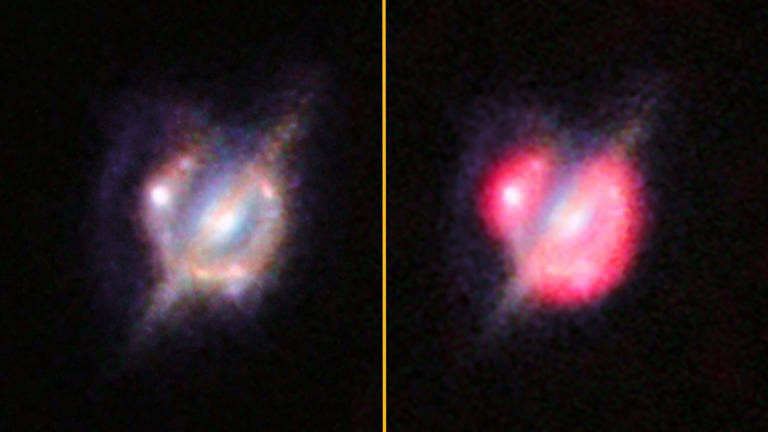
The system, called HATLAS J142935.3–002836, is so far away that we are seeing it as it looked more than 8 billion years ago, when the universe was less than half its current age.
Dr Thato Manamela, SARAO-funded postdoctoral researcher at the University of Pretoria and lead author of the new study, said: 'This system is truly extraordinary. We are seeing the radio equivalent of a laser halfway across the universe.'
Humanity has received a mysterious signal, described as a 'mega-laser' beam, from a violently merging galaxy more than 8 billion light-years away
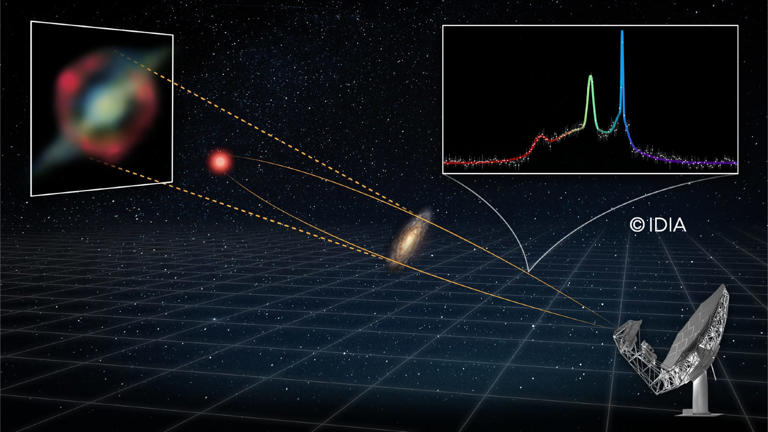
Manamela added that as the radio waves traveled toward Earth, they were also strengthened by a separate galaxy positioned directly along the line of sight.
'This galaxy acts as a lens, the way a water droplet on a window pane would, because its mass curves the local space-time,' he said.
'So we have a radio laser passing through a cosmic telescope before being detected by the powerful MeerKAT radio telescope – all together enabling a wonderfully serendipitous discovery.'
The radio signal contained four separate components, meaning it is coming from multiple regions within the galaxy system.
At least two of these areas appear to be strongly magnified by gravitational lensing, which makes the signal more than ten times brighter than it would normally appear.
In this case, a massive foreground galaxy sits between Earth and the distant system.
Its gravity bends space-time and acts like a cosmic magnifying glass, boosting the brightness of the radio emission.
This amplification allowed the signal to be detected by the MeerKAT radio telescope even though the source is over 8 billion light-years away.
Pictured is the galaxy system where astronomers said is the source of the signal
The signal, deemed the most distant hydroxyl megamaser ever detected, was intercepted using the MeerKAT radio telescope in South Africa (PICTURED), which consists of 64 antennas
Normally, signals from objects this far away are too weak for telescopes to detect.
But the powerful radio signal coming from HATLAS J142935.3–002836 was boosted by a rare effect called gravitational lensing, a phenomenon predicted by Albert Einstein.
Gravitational lensing happens when a massive object, such as a galaxy, sits between Earth and a distant source.
Its strong gravity bends space-time, which changes the path of the light or radio waves traveling through it.
This makes the distant signal appear brighter and magnified, allowing telescopes like the MeerKAT radio telescope to detect it even from billions of light-years away.
From Earth, this effect can sometimes create a ring-shaped halo of light around the foreground object, called an Einstein ring, named after the famed physicist.
The same effect also magnifies the distant source, in this case a radio or microwave signal, making it much easier for astronomers to study objects that would normally be too faint to detect.
A thin, stubbornly bright line showed up in data from the MeerKAT radio telescope that did not fit the usual rules of distance. The feature sat in a familiar part of the radio spectrum, but it was coming from so far away that signals like it typically fade into the background. Instead of smearing out, it stayed sharp enough to measure. That was the first hint that something was amplifying it.
The source already had a survey name that sounded more like a serial number than a destination: HATLAS J142935.3–002836. Astronomers had seen it before as a distorted, stretched-looking galaxy system, the kind that suggests gravity has bent the view. A report from Live Science described it as a “mega-laser,” but the real curiosity was why the line stayed detectable at all.
When the team calculated the distance, the scale became clearer. The system sits at redshift z = 1.027, placing it more than 8 billion light-years away in light-travel time. That means the radio waves began their journey when the universe was much younger than it is now. The MeerKAT radio telescope was effectively catching a signal that left long before Earth existed.
The 18-Centimeter Fingerprint
The crucial clue was the wavelength: about 18 centimeters. That specific “color” of radio light is strongly associated with the hydroxyl molecule (OH), a simple pairing of oxygen and hydrogen that can exist in vast clouds of gas. Under the right conditions, hydroxyl can behave like an amplifier, strengthening radiation at a very specific frequency.
Related video:James Webb Just Saw Something That Shouldn't Exist at Our Solar System's Boundary
That amplification works like a laser in principle, but at radio wavelengths. Astronomers call it a maser, short for microwave amplification by stimulated emission of radiation. When a maser is powerful enough to be seen in other galaxies, it becomes a hydroxyl megamaser. In this case, the team argues the signal is bright enough to push beyond that label into a proposed new tier: gigamaser.
A photo of two radio dishes pointed up at the night sky
The paper, published in arXiv, describes the emission as coming from the two main hydroxyl lines near 1667 MHz and 1665 MHz, which are the standard signatures astronomers look for. What mattered most was not just the presence of those lines, but how strong they appeared at this distance. That is what set this detection apart from earlier hydroxyl surveys.
A Merger Powering the Natural Amplifier
The host system is described as a violently merging galaxy. That matters because the brightest hydroxyl megamasers are often found where galaxies collide and gas becomes dense and chaotic. Mergers can compress clouds, stir turbulence, and create thick, dusty regions where molecules pile up. Those are exactly the conditions that can “pump” hydroxyl into the right state to amplify radio emission.
“This system is truly extraordinary,” said Dr Thato Manamela of the University of Pretoria. “We are seeing the radio equivalent of a laser halfway across the universe.” The phrasing is dramatic, but the mechanism is straightforward: a merger creates dense, energized gas, and hydroxyl molecules amplify radio emission at the 18-centimeter wavelength.
Diagram showing how the megamaser was observed via gravitational lensing
The researchers from the South African Radio Astronomy Observatory also point to signs of intense activity in the host. Earlier studies of the same system suggest a very high rate of star formation, consistent with a merger that is rapidly converting gas into new stars. That context helps explain why the hydroxyl signal could be so bright in the first place, even before any extra help from gravity along the line of sight.
The Foreground Galaxy Acting like a Lens
Distance alone still does not explain everything. The signal looks bright because it had help on the way to Earth. Between us and the merger sits an unrelated galaxy positioned almost perfectly along the same line of sight. Its gravity bends space-time and focuses the background emission, boosting what arrives at Earth.
This effect is called strong gravitational lensing. It does not create new light, but it redirects more of the existing light toward us, like a natural magnifying glass. That is why the same system looks distorted in images and unusually intense in radio data. In an explainer, Universe Today described the foreground galaxy as a kind of “cosmic telescope,” which matches how astronomers talk about lensing in practice.
Side by side images of the Einstein ring from the study taken by different telescopes
Because lensing boosts the brightness, the team is careful about what “brightest” means. The paper emphasizes how luminous the signal appears to us, not what it would look like without the lens. The proposed gigamaser label is tied to this observed power, combining an extreme environment in the background galaxy with a fortunate alignment in the foreground.
What Meerkat Saw, and What Comes Next
The detection did not require a long campaign. The team reports confirming the signal with only a few hours of observing time, using dozens of dishes working together as the MeerKAT radio telescope array. That short integration is one reason the find is being treated as a proof of capability, not just a one-off curiosity. It shows that wide surveys could uncover more distant hydroxyl systems if the telescope looks in the right way.
The same dataset also contained an additional clue: a separate absorption feature from neutral hydrogen (H I), another common gas tracer. That matters because it suggests the system contains multiple layers of gas, not just the molecular material producing hydroxyl emission. Together, the features help build a more complete picture of what a gas-rich merger looked like at this point in cosmic history.
Artemis II: NASA now targets March 20 for SLS rocket rollout to launchpad
Artemis II: NASA now targets March 20 for SLS rocket rollout to launchpad
Story by Pranjal Nath
Artemis II: NASA now targets March 20 for SLS rocket rollout to launchpad
The rollout of theArtemis II SLS rocket from the Vehicle Assembly Building (VAB) to Launch Pad 39B at the Kennedy Space Center in Florida has been postponed,NASA announced. The 4-mile crawl of the rocket stack atop the Crawler-Transporter 2 will now take place on March 20, 2026, at the earliest, instead of March 19. "A rollout on March 20 would still preserve the possibility of launching at the beginning of the April launch window, though teams also are keeping a close eye on the weather in the coming days," the space agency added. A total of 7 launch windows are available in the month starting with April 1, with April 2 having been added to the previous list oflaunch opportunities.
NASA attributed the delay to an electrical harness for the flight termination system on the SLS core stage that needed replacement. While teams have addressed the situation, preparations to ready the rocket for the move are still underway. The Exploration Systems team will handle the rollout, which could potentially take up to 12 hours.
NASA's Artemis II sits in the Vehicle Assembly Building at NASA’s Kennedy Space Center on January 16, 2026, in Cape Canaveral, Florida.
(Image Source: Getty Images | Joe Raedle)
The SLS rocket stack reached the VAB on February 25, 2026, so that teams could look into the helium flow issue that had surfaced after the second wet dress rehearsal. This rollback came as a disappointment to many because of how successful the second wet dress rehearsal was deemed to be, given how the agency had managed to keep the hydrogen leak well within safety limits. Once the rocket reached the VAB, engineers traced the issue to a quick-disconnect seal through which helium flows from the ground to the rocket.
The ICPS has two umbilicals. The lower, larger aft plate supplies liquid hydrogen and liquid oxygen and has a helium quick disconnect and hazardous gas sensing.
(Image Source: NASA; Image Edited by Starlust Staff)
"Our combined engineering teams across our ground systems and SLS teams came up with a design fix," explained Exploration Ground Systems Program Manager Shawn Quinn during the press briefing held on Thursday. That design fix was implemented on a test article, and we have successfully tested it, and we have qualified it for use on Artemis II, and the modified QD is already on the upper stage."
NASA Administrator Jared Isaacman looks out as NASA's Artemis II is rolled from the Vehicle Assembly Building to Launch Pad 39B at NASA’s Kennedy Space Center on January 17, 2026.
(Cover Image Source: Joe Raedle/Getty Images)
With the Artemis program, the aim is to restore a “golden age of innovation and exploration" to reach the Moon and eventually Mars with human explorers. Beginning with the launch of this particular mission, NASA hopes to increase its launch cadence to allow itself and its partners to make steady incremental steps towards reaching its goals, as opposed to steep learning curves with fewer launches. Owing to the numerous delays since Artemis I took off in 2022, many of the aspects of the program were called into question. This led NASA to make sweeping changes to its plans, which assigned the objective of human lunar touchdown to Artemis IV, slated for 2028.
The story of Moses is central to Jewish, Christian, and Islamic traditions.
He led the Israelites out of Egypt, received the Ten Commandments on Mount Sinai, and guided a wandering nation toward the Promised Land.
Yet, one of the most enduring mysteries about Moses is the fate of his body. According to the Bible, Moses died at the age of 120 on Mount Nebo, but “no one knows his burial place” (Deuteronomy 34:6).
This unique detail has sparked centuries of speculation, debate, and legend. Unlike other key figures whose tombs became sites of veneration, Moses’ grave remained hidden.
Scholars, theologians, and historians have suggested a variety of reasons for this secrecy.
Here are five compelling explanations for why Moses’ body was never found, each reflecting religious, symbolic, and historical interpretations of his life and death.
The Bible explicitly states that God Himself buried Moses and that no one knew the location of his grave.
Many scholars suggest this was deliberate to prevent idolatry or inappropriate veneration.
In ancient times, the graves of great leaders often became pilgrimage sites or places for offerings, and hiding Moses’ burial may have prevented such practices.
Another possible reason Moses’ body was never found relates to political concerns. The Israelites were a nomadic people entering a complex, often hostile region.
A known burial site of such a revered leader could have become a rallying point for rebellion or power struggles.
Rival factions might have attempted to use Moses’ remains to legitimize claims to leadership or to influence the community.
By hiding the grave, God may have protected the Israelites from internal division and external threats.
The absence of a physical tomb prevented the misuse of Moses’ authority for personal gain or political manipulation.
This explanation frames the hidden burial as a strategic act that preserved social cohesion and prevented exploitation of Moses’ symbolic status.
Moses’ significance lies primarily in his spiritual achievements and leadership, not in his physical presence.
Hiding his body ensured that future generations would focus on his teachings and the law rather than becoming fixated on relics or physical remains.
This approach aligns with the broader biblical pattern of emphasizing faith, obedience, and divine covenant over material objects.
By removing the possibility of a shrine or tomb, God ensured that Moses’ influence would remain rooted in moral guidance, scripture, and leadership principles.
The hidden burial shifts attention from the tangible to the eternal, reinforcing the idea that spiritual legacy matters more than earthly remains.
It serves as a reminder that Moses’ authority and inspiration were intended to be transmitted through teaching, story, and obedience to God’s commands.
Some theologians interpret Moses’ unmarked grave as highly symbolic.
It may represent humility, the impermanence of life, or the separation between human achievement and divine destiny.
Unlike kings or heroes who sought lasting monuments, Moses’ hidden burial emphasizes that ultimate honor comes from God rather than public recognition.
It also highlights the mysterious nature of divine intervention: even the greatest leader’s end can be concealed, reminding humanity of the limits of human understanding.
This symbolism has inspired interpretations in literature, art, and religious thought, suggesting that the unknown burial place serves as a metaphor for faith, mystery, and the eternal nature of God’s plan.
By keeping his grave secret, the narrative conveys lessons about humility, trust, and the ephemeral nature of earthly life.
From a historical perspective, some scholars suggest practical reasons for the absence of Moses’ tomb.
The Israelites were wandering in a desert environment, with limited capacity to perform elaborate burials.
Mount Nebo is steep and remote, which would have made marking or preserving a grave difficult.
Additionally, oral traditions and early record-keeping may have intentionally avoided specifying locations to protect sacred spaces from desecration.
Over time, any physical markers may have been lost due to natural erosion, human movement, or intentional concealment.
This practical explanation complements theological and symbolic interpretations, showing how environmental, cultural, and historical factors could have contributed to the enduring mystery of Moses’ unlocated burial.
It demonstrates that faith and historical circumstances often intersect to create lasting enigmas.
Has Steven Spielberg ever had his own alien encounter? The Disclosure Day director says…
Has Steven Spielberg ever had his own alien encounter? The Disclosure Day director says…
Story by Josh Weiss
You'd think that a man who has made four theatrical movies about contact with extra-terrestrial life, both benevolent and malevolent, would have had at least one close encounter in his lifetime.
Sadly, that hasn't been the case for Steven Spielberg, who is preparing for the release of his fifth alien-centric movie, Disclosure Day, which stars Emily Blunt (A Quiet Place), Josh O’Connor (Wake Up Dead Man), Colin Firth (Kingsman: The Secret Service), Eve Hewson (Behind Her Eyes), and Colman Domingo (The Running Man).
But if any non-human entities outside of Earth are interested in giving the director that experience ahead of the film's June 12 release, the storied Hollywood icon is more than ready to accept the invitation.
Disclosure Day director Steven Spielberg wants to see a real UFO
“I made a movie called Close Encounters of the Third Kind—I haven’t even had a close encounter or the first or second kind!” Spielberg said at a SXSW panel in Austin, Texas March 13 (via The Hollywood Reporter). “Why haven’t I seen anything? Half of my friends have seen UFOs or UAPs. Where’s the justice of that? If you’re listening out there..."
Based on an original story by Spielberg and written by the director's longtime collaborator David Koepp (Jurassic Park, War of the Worlds), Disclosure Day centers around the concept of humanity being made aware of the fact that it is not alone in the universe.
“I don’t know any more than any of you do, but I have a very strong suspicion that we are not alone here on Earth right now—and I made a movie about that,” the filmmaker said. "Because no one should ever think that we are the only intelligent civilization in the entire universe. So I’ve been thinking as a kid that we were not alone ... The big question is: Are we alone now? And have we been alone over the last 80 years? Have we been alone over the last few thousand years?”
As much as the government might want to cover things up (à la the infamous Roswell incident of 1947), people have the right to know the truth—even if that truth obliterates every preconceived notion they've ever held about their own existence.
“I’m not afraid of any aliens," Spielberg continued. "I have no fears about that whatsoever. I think our movie does take into consideration that social dislocation that could occur. If it was announced there is interaction [with aliens] that have been going on for decades, it’s going to cause a disruption in a lot of belief systems. But I don’t think it is a lethal disruption at all."
For decades, conversations about UFOs—now often referred to as unidentified anomalous phenomena (UAP)—have occupied an unusual place in public life. Many people are curious about the possibility of extraterrestrial intelligence, yet most people are cautious about discussing them with others because of stigma and fear of being judged.
New research suggests that this hesitation may reflect our psychology rather than skepticism.
Most Believe in Extraterrestrial Intelligence
A recent study by Avi Loeb at Harvard University, and colleagues, surveyed 6,060 participants recruited through the Prolific research platform, which is widely used in behavioral research [1]. The sample consisted largely of highly educated adults, many holding college or graduate degrees.
Instead of asking a simple yes-or-no question about extraterrestrial intelligence, participants were asked to estimate the probability that intelligent extraterrestrial life exists somewhere in the universe. Respondents provided numerical estimates between 0% and 100%.
When researchers averaged the responses, participants’mean estimate was about 67%, suggesting that on average people believe intelligent extraterrestrial life is more likely than not to exist.
Another way of examining the results highlights how widespread this belief is. The researchers found that about 95% of participants gave probability estimates greater than 50%, meaning they believed it is more likely than not that intelligent extraterrestrial life exists somewhere in the universe [1].
In other words, nearly everyone in the sample leaned toward believing intelligent life beyond Earth probably exists, even if their degree of certainty varied.
The Cosmic Closet: A Massive Perception Gap
The most striking finding in the study was not simply what people believed—it was what they thoht others believed.
After reporting their own probability estimate, participants were asked to estimate the probability that people in their social circles believed intelligent extraterrestrial life exists.
The difference was dramatic. Participants’ average personal estimate was about 67%. Their estimated belief of others was about 21%.
This produced a 46-percentage-point gap between personal belief and perceived social belief [1].
In other words, many people believed intelligent extraterrestrial life was plausible but assumed others were far more skeptical.
The researchers referred to this phenomenon as the “cosmic closet.” People privately hold a belief but assume it is socially unpopular, leading them to underestimate how widely it is actually shared.
The Psychology of Pluralistic Ignorance
This pattern closely resembles a well-known concept in social psychology called pluralistic ignorance.
Pluralistic ignorance occurs when individuals privately hold a belief but mistakenly assume that most other people disagree. Because individuals want to avoid social embarrassment or reputational risk, they often remain silent about their views. That silence then reinforces the illusion that the belief is uncommon even when many people privately share it [2].
Classic research demonstrates this dynamic in areas such as college drinking norms. Students often believe their peers are more comfortable with heavy drinking than they themselves are, even though most students privately feel similar reservations. Because everyone assumes others approve of the behavior, few people challenge the perceived norm [3].
The same mechanism may help explain the “cosmic closet.” If individuals assume curiosity about extraterrestrial intelligence will be dismissed as irrational, they may keep their views to themselves even when many others privately share that curiosity.
When Perception Shapes Reality
Norm misperception can have real consequences. When people underestimate how widely a belief is shared, they may hesitate to discuss it publicly, explore it academically, or pursue it professionally.
Psychologists have observed similar dynamics in other domains. Research shows that many people underestimate how common experiences such as anxiety, depression, or loneliness actually are, which can make individuals reluctant to talk about their own struggles. Fear of being judged or stigmatized often leads people to stay silent even though many others are experiencing similar challenges [4].
Researchers have also found that people frequently overestimate how extreme the views of political opponents are, contributing to perceptions of deeper polarization than survey data actually shows [5]. When individuals believe their views differ sharply from the perceived majority, they may stay silent to avoid social conflict.
This creates a feedback loop.
When people remain silent because they believe their views are uncommon, that silence prevents others from realizing how widely the belief is actually shared. As a result, skepticism appears more widespread than it really is.
In effect, people remain quiet to conform to a social norm that may exist largely because everyone else is also remaining quiet.
Expert Opinion Barely Changed People’s Views
The researchers also tested whether revealing expert opinion would influence participants’ beliefs.
Some respondents were shown survey results indicating that many astrobiologists—scientists who study the origins and distribution of life in the universe—consider extraterrestrial life plausible.
Interestingly, this information had only a small effect on participants’ probability estimates [1]. Even after seeing expert opinions, participants’ beliefs changed very little.
This suggests that people’s beliefs about extraterrestrial intelligence may not depend strongly on expert authority. Instead, individuals may rely more on intuitive reasoning about the vastness of the universe or broader worldview assumptions when forming their judgments.
Implications for UAP Disclosure
The “cosmic closet” may also have implications for how society responds to discussions about UFOs and UAP.
If people consistently underestimate how many others share their curiosity about extraterrestrial intelligence, public conversations may remain more constrained than public opinion actually warrants.
Research on pluralistic ignorance shows that when individuals learn their views are more widely shared than they assumed, they often become more willing to express them openly [2].
If that pattern holds here, the biggest barrier to open discussion may not be skepticism about extraterrestrial life itself.
It may simply be the widespread assumption that curiosity about the topic is socially stigmatized.
A Psychological Mirror
The biggest surprise in the study was not how many people thought extraterrestrial intelligence might exist.
It was how dramatically people misjudged what others believe.
The “cosmic closet” reminds us that social reality is shaped not only by what people believe—but by what they believe others believe.
Sometimes the strongest social norms are the ones that exist mostly in our assumptions about each other.
References
Loeb, A., Eldadi, O., & Tenenbaum, G. (2025). Surveys on the existence of extraterrestrial intelligent life and the effects of revealing expert beliefs. arXiv. https://arxiv.org/abs/2512.00364
Miller, D. T. (2023). A century of pluralistic ignorance: What we have learned. Frontiers in Social
Clement, S., Schauman, O., Graham, T., et al. (2015). What is the impact of mental health-related stigma on help-seeking? Psychological Medicine, 45(1), 11–27. https://doi.org/10.1017/S0033291714000129*
Ahler, D. J., & Sood, G. (2018). The parties in our heads: Misperceptions about party composition and their consequences. Journal of Politics, 80(3), 964–981. https://doi.org/10.1086/697253
Beste bezoeker, Heb je zelf al ooit een vreemde waarneming gedaan, laat dit dan even weten via email aan Frederick Delaere opwww.ufomeldpunt.be. Deze onderzoekers behandelen jouw melding in volledige anonimiteit en met alle respect voor jouw privacy. Ze zijn kritisch, objectief maar open minded aangelegd en zullen jou steeds een verklaring geven voor jouw waarneming! DUS AARZEL NIET, ALS JE EEN ANTWOORD OP JOUW VRAGEN WENST, CONTACTEER FREDERICK. BIJ VOORBAAT DANK...
Druk op onderstaande knop om je bestand , jouw artikel naar mij te verzenden. INDIEN HET DE MOEITE WAARD IS, PLAATS IK HET OP DE BLOG ONDER DIVERSEN MET JOUW NAAM...
Druk op onderstaande knop om een berichtje achter te laten in mijn gastenboek
Alvast bedankt voor al jouw bezoekjes en jouw reacties. Nog een prettige dag verder!!!
Over mijzelf
Ik ben Pieter, en gebruik soms ook wel de schuilnaam Peter2011.
Ik ben een man en woon in Linter (België) en mijn beroep is Ik ben op rust..
Ik ben geboren op 18/10/1950 en ben nu dus 75 jaar jong.
Mijn hobby's zijn: Ufologie en andere esoterische onderwerpen.
Op deze blog vind je onder artikels, werk van mezelf. Mijn dank gaat ook naar André, Ingrid, Oliver, Paul, Vincent, Georges Filer en MUFON voor de bijdragen voor de verschillende categorieën...
Veel leesplezier en geef je mening over deze blog.