The purpose of this blog is the creation of an open, international, independent and free forum, where every UFO-researcher can publish the results of his/her research. The languagues, used for this blog, are Dutch, English and French.You can find the articles of a collegue by selecting his category. Each author stays resposable for the continue of his articles. As blogmaster I have the right to refuse an addition or an article, when it attacks other collegues or UFO-groupes.
Druk op onderstaande knop om te reageren in mijn forum
Zoeken in blog
Deze blog is opgedragen aan mijn overleden echtgenote Lucienne.
In 2012 verloor ze haar moedige strijd tegen kanker!
In 2011 startte ik deze blog, omdat ik niet mocht stoppen met mijn UFO-onderzoek.
BEDANKT!!!
Een interessant adres?
UFO'S of UAP'S, ASTRONOMIE, RUIMTEVAART, ARCHEOLOGIE, OUDHEIDKUNDE, SF-SNUFJES EN ANDERE ESOTERISCHE WETENSCHAPPEN - DE ALLERLAATSTE NIEUWTJES
UFO's of UAP'S in België en de rest van de wereld Ontdek de Fascinerende Wereld van UFO's en UAP's: Jouw Bron voor Onthullende Informatie!
Ben jij ook gefascineerd door het onbekende? Wil je meer weten over UFO's en UAP's, niet alleen in België, maar over de hele wereld? Dan ben je op de juiste plek!
België: Het Kloppend Hart van UFO-onderzoek
In België is BUFON (Belgisch UFO-Netwerk) dé autoriteit op het gebied van UFO-onderzoek. Voor betrouwbare en objectieve informatie over deze intrigerende fenomenen, bezoek je zeker onze Facebook-pagina en deze blog. Maar dat is nog niet alles! Ontdek ook het Belgisch UFO-meldpunt en Caelestia, twee organisaties die diepgaand onderzoek verrichten, al zijn ze soms kritisch of sceptisch.
Nederland: Een Schat aan Informatie
Voor onze Nederlandse buren is er de schitterende website www.ufowijzer.nl, beheerd door Paul Harmans. Deze site biedt een schat aan informatie en artikelen die je niet wilt missen!
Internationaal: MUFON - De Wereldwijde Autoriteit
Neem ook een kijkje bij MUFON (Mutual UFO Network Inc.), een gerenommeerde Amerikaanse UFO-vereniging met afdelingen in de VS en wereldwijd. MUFON is toegewijd aan de wetenschappelijke en analytische studie van het UFO-fenomeen, en hun maandelijkse tijdschrift, The MUFON UFO-Journal, is een must-read voor elke UFO-enthousiasteling. Bezoek hun website op www.mufon.com voor meer informatie.
Samenwerking en Toekomstvisie
Sinds 1 februari 2020 is Pieter niet alleen ex-president van BUFON, maar ook de voormalige nationale directeur van MUFON in Vlaanderen en Nederland. Dit creëert een sterke samenwerking met de Franse MUFON Reseau MUFON/EUROP, wat ons in staat stelt om nog meer waardevolle inzichten te delen.
Let op: Nepprofielen en Nieuwe Groeperingen
Pas op voor een nieuwe groepering die zich ook BUFON noemt, maar geen enkele connectie heeft met onze gevestigde organisatie. Hoewel zij de naam geregistreerd hebben, kunnen ze het rijke verleden en de expertise van onze groep niet evenaren. We wensen hen veel succes, maar we blijven de autoriteit in UFO-onderzoek!
Blijf Op De Hoogte!
Wil jij de laatste nieuwtjes over UFO's, ruimtevaart, archeologie, en meer? Volg ons dan en duik samen met ons in de fascinerende wereld van het onbekende! Sluit je aan bij de gemeenschap van nieuwsgierige geesten die net als jij verlangen naar antwoorden en avonturen in de sterren!
Heb je vragen of wil je meer weten? Aarzel dan niet om contact met ons op te nemen! Samen ontrafelen we het mysterie van de lucht en daarbuiten.
01-03-2026
A US historian looked at the history of UFO sightings. This is what he found.
A US historian looked at the history of UFO sightings. This is what he found.
BY Iain Todd
The history of reports of 'flying saucers' and 'UFOs' is fraught with alleged conspiracy theories and cover-ups, claims by believers and de-bunks from non-believers.
Are people really seeing things in the sky that can't be explained? And if that is the case, does that necessarily mean they must be of extra-terrestrial origin?
Whether we believe in the idea that alien craft are visiting Earth or not, it's a fact that there are numerous eye-witness accounts from across the world in which people claim to have seen something beyond belief in the sky.
So what happens when you take a scientific, empirical look at reports of UFOs and flying saucers?
What patterns emerge, and do they tell us anything about the cultural or geopolitical trends at the time the reports were made?
Greg Eghigian is Professor of History and Bioethics at Penn State University in the United States and has written a book called After The Flying Saucers Came.
It's just that: a history of UFO reports and what they can tell us about belief in the extra-terrestrial.
We spoke to Greg to find out more about the flying saucer craze.
Interview about the history of flying saucers and UFOs with historian Greg Eghigian
What made you decide to look into the history of flying saucers?
I’m an historian of science and medicine by speciality, and over the years have looked primarily at the history of how scientific and medical establishments and governments have understood ideas, feelings, people and thoughts that were marginal, or deemed to be outside the mainstream.
I was led to the topic of flying saucers and UFOs in part by those interests, though it does deviate from what I normally work on.
I was always fascinated with this stuff when I was growing up.
I was a really voracious reader and consumer of anything about aliens and outer space visitors and things like that, though that interest waned as I got older and I grew interested in lots of other things unrelated to this.
But I was talking with a colleague of mine, an historian who was working on a book project that involved looking at the renaissance of the occult right after World War II in Europe.
I asked her: “was that whole flying saucer thing a craze in Europe at the time?”
She said “I don't know, you ought to look into it and write something about it.”
And I just dismissed it out of hand.
But one summer I was ill, so I couldn't do traveling as I normally do, and I started going through digital databases of newspapers in Germany in the late 1940s and 50s.
And bam: all these headlines about flying saucers.
I wrote an article on it and I thought there must be so many historians who have done work on this.
I found one. One sole book on the history of the subject in 1975 by a historian who, by the way, later becomes a subject in my own book because he becomes a true believer and a major figure in the alien abduction phenomenon.
And that's how I got hooked. I thought, okay, I'm diving in.
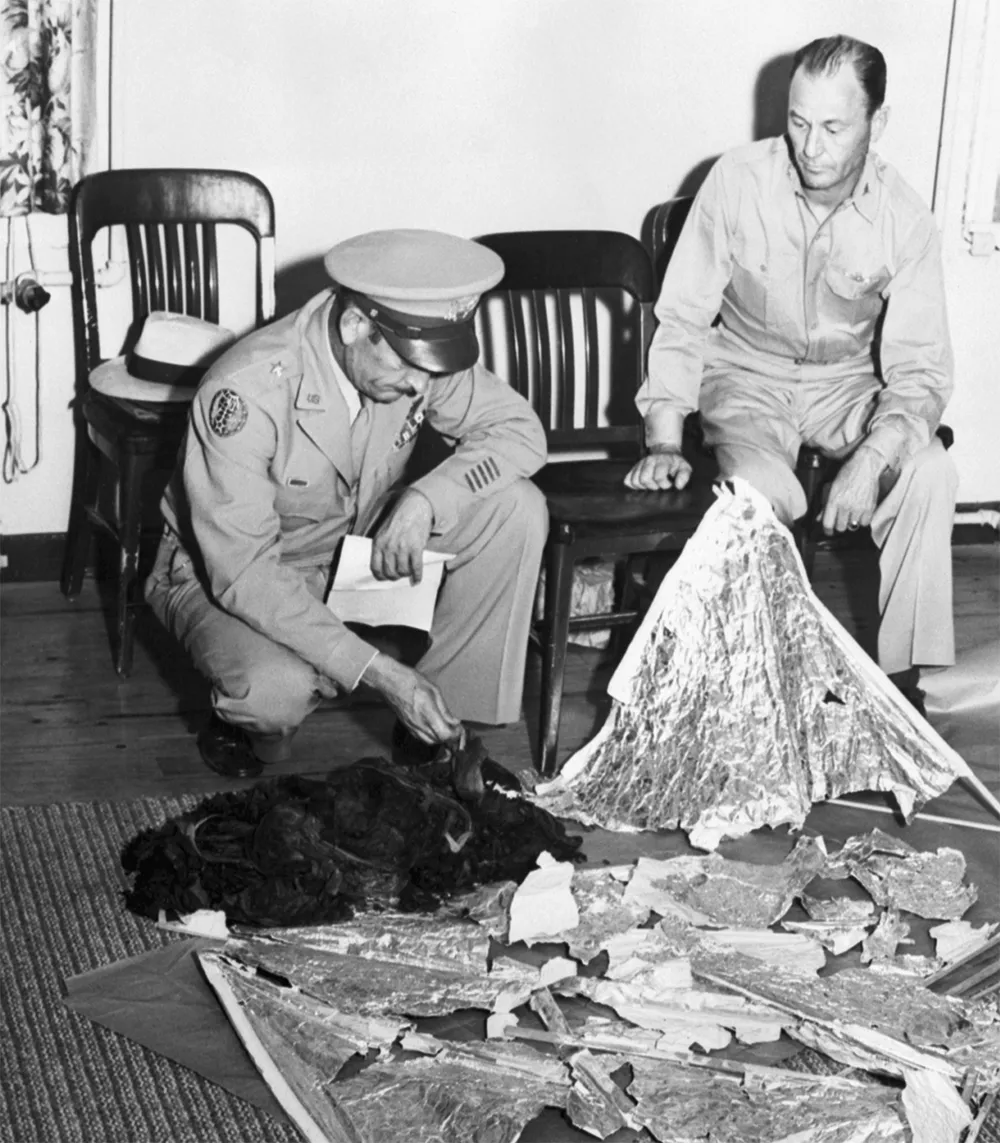
At Fort Worth Army Air Field on 8 July 1947, Brigadier General Roger M Ramey (left) and Colonel Thomas J Dubose, identify metallic fragments found at Roswell as pieces of a weather balloon. Credit: Bettmann / Getty Images
You don't have to believe the reports are true in order to factually catalogue the history of it, do you?
No, I come at this from that very perspective.
I make it very clear from the start, I'm not here to try to present evidence that aliens have been visiting us.
But I also don't come from the perspective of the debunker who's here to tear down every opinion.
I wanted to take the general ethos of most historians and say, I'm here to chronicle the way we've come to think about and talk about and debate this subject.
Especially in this day and age with a lot going on when it comes to discussions about exoplanets and SETI and things like that.
It seems to me it's the time to revisit that history and think about how we got to the point where we are now.
Does it all begin with Roswell?
No, it doesn't begin with Roswell! In fact, Roswell is a blip, a really minor blip. It's a very tiny footnote.
When you look at it in the wider perspective, it actually starts a little earlier than that with a private pilot by the name of Kenneth Arnold, who's flying around Washington State, around Mount Rainier, looking for a crashed plane.
And he sees these strange pan-shaped objects flying at high speeds.
He comes back, lands on the ground and tells people he’s seen some weird stuff, and reports it to the authorities and also the media.
And the media starts asking him questions about it. They ask him, how did these things fly? How would you describe it?
He said they flew like a saucer might if you skipped it over water.
And a very enterprising journalist knew a headline when they saw one and called them flying saucers.
Within 6 weeks, a survey said 9 out of 10 Americans had heard the term flying saucer.
Roswell pops up as a story for about 2 days and then disappears and is never heard of again, until you get into the late 1970s and early 80s.
(L-R) Pilots E.J. Smith, Kenneth Arnold and Ralph E. Stevens look at a photo of an unidentified flying object they sighted en route to Seattle, Washington. Credit: Bettmann / Getty Images
When you hear a report like that from a pilot, someone who’s an expert in aviation, do you find yourself struggling to remain neutral?
Yeah, reports like that pop up all the time and there are lots of head scratchers.
And there are times you read something and you say, this doesn't pass the sniff test.
When you're talking about historical cases where you can't talk to anybody anymore, you're left saying, geez, I wish there was a little more information about this, or I wish somebody had a camera at the time.
But when you hear seasoned pilots, for instance, who are very knowledgeable, talk and describe things that they see, that is really arresting and it makes you pause.
The great Swiss psychologist Carl Jung put it really, really well. He said "things are seen in the sky, but we don't know what".
And even the authorities, whether it's the UK Ministry of Defence or the United States Air Force, all have historically fully admitted there are cases we can never explain.
They make us scratch our heads; we're sort of left with a big question mark.
How do you approach a topic like this as an historian?
There are a couple of things that it's important to keep in mind.
One is that the language that's often used in the UFO world, if you will, is often very sloppy.
Just think of something like the term ‘UFO’: Unidentified Flying Object.
Even though it sounds precise, it was meant to replace ‘flying saucer’, because ‘flying saucer’ was seen as a kind of biased term.
‘UFO’ is biased in its own ways.
Is that really an object? Flying implies piloting and it implies design.
It's fair to say the same thing holds true with the distinction between sightings and reports.
A sighting is an experience that someone has, but we know that the vast majority of people who see something odd never say anything, not to officials, to the media, the police or the Air Force.
Something has to lead somebody to actually report it to some institution – it might be a UFO group, it might be authorities – and they then write it down in some form.
It could be in a messy form, it could be a police officer who's ho-humming it all the time.
So what I'm interested in is reports, these documents that we have.
They oftentimes aren't very detailed. So as an historian we are ultimately left with trying to work with records and documentation.
That can be a recording, that can be an interview, but it oftentimes it’s self reports and also reports by others.
How do we discuss reports of flying saucers? How have different institutions and different groups grappled with it?
And how have they made that into something that they see as worthy of a conversation, and sometimes worthy of some sort of action on the part of people who can take action?
The term 'flying saucer' has now entered our common vocabulary. Credit: KTSDesign / Science Photo Library
Do you find any narrative consistency throughout reports of UFOs?
What's interesting is that's one of the things that changes.
When you look particularly in, say, the first decade or decade and a half of the phenomenon, there is a lot of diversity, in terms of what's reported.
The most common thing that people see are lights. Maybe it's different colors. Maybe they flash off and on, but lights: very vague, very blurry.
Not much more detail than that.
You hear people talking about cigar-shaped things, saucer-shaped things, globes, hexagonal objects.
But you really see the diversity when people say they actually saw the occupants of these vehicles.
In the 1940s and 50s into the early 60s, it's a very wide range, very diverse group of beings that are talked about.
Everything from little men under four feet tall, sometimes as small as under 12 inches.
Other times they're large, hairy monsters that sort of look like Sasquatch.
There are robots, there are males, there are females, there are androgynous beings, there are bulbous heads.
Some are absolutely gorgeous and look like fashion models, all sorts of things.
What happens over time, and this is what's interesting to me, is that those images start to winnow down, and there becomes a kind of a homogeneity to it all, kind of a standardisation, if you will, in descriptions.
And that to me, in part, is something that signals a role that culture is increasingly playing in terms of helping to shape those images into images that are familiar to everyone.
Did you find correlation between the language that's used at the time of a report and current movies, songs, popular culture?
Well, again, what I love about this history is it confounds every preconception I had.
I, like most everybody else, was ready to think there must be so much influence of pop culture on UFO sightings and reports and the way people describe things.
And in part there is. There's no question that the pulp science fiction of the first half of the 20th century had a direct impact on the early alien visitor story, the way people engaged with it.
It's not a surprise that most all of those first few years of people pushing the UFO narrative, there seems to be inspiration from the pulp science fiction world.
But where you see something that doesn't quite connect that way is with film.
The idea has been always that films must have a real profound influence on, say, upticks in the number of sightings.
And that doesn't really bear out. You have a very big wave of sightings and reports in the United States, for instance, in 1952.
But there's no major big UFO film from that time period that takes place.
Or you could take something like Steven Spielberg's 1977 film Close Encounters.
I talked to one of the folks who leads one of the big organizations that were looking into UFOs at the time, and I asked him about it.
And he said, what we saw at the time was not an uptick in new sightings.
People weren't seeing UFOs right after the film, but what they did see an uptick in was the number of people coming forward saying "five years ago, or three years ago, I saw something that seemed like that".
So it triggered that.
And we know from the UK, for instance, that following Spielberg's film E.T., there was actually a downward movement in the number of UFO sightings.
So it doesn't neatly map on to popular culture as much as we like to think at times.
Close Encounters of the Third Kind. Popular UFO movies don't necessarily cause an increase in reported UFO sightings. Photo by Sunset Boulevard/Corbis via Getty Images
You hear people say it's not a coincidence it all kicked off during the Cold War and Space Age.
I definitely would argue that the Cold War plays a critical role in this.
The UFO as we know it is unimaginable without the Cold War, and it's a spectre that haunts the entire history.
People are constantly making references to UFOs.
For instance, in those early years, one of the questions that comes up is, okay, the flying saucers are here, they're aliens.
Why are they here in 1947, 1948? Why now and not five years earlier, 500 years earlier?
And the argument that starts being put forward is, well, the aliens have seen the atomic bomb explosions.
They've seen that we have unlocked the key to atomic energy and they are scared.
They're either scared for us or they're scared of us, but they realise we have reached this level of civilisation that makes us a qualitatively different species.
What I don't see is a lot of what some people have argued is the case, that bad times promote more flying saucer panics or flying saucer reports.
That seems to me a bit of a problematic argument because it seems to me prone to cognitive bias.
Pick up a newspaper from any time period you like, and outside of maybe when the Berlin Wall fell, you will see mostly bad news.
Journalists are very good at reporting bad news and sometimes have a hard time knowing how to make good news interesting!
Do you find a large majority of sightings and reports are from the US? And does that suggest it's to do with the culture of the society?
I would say the evidence shows that the United States plays a very critical role. It's a hub.
It's a hub in that the news emanating out of the United States is what triggers the UFO phenomenon.
Throughout the history of flying saucers and UFOs, whenever there's a new development, like the events occurring since 2017, it is something that gets reported everywhere else.
That said, it's very clear within a few years that there are hubs popping up throughout the world and other places, and the influence actually goes in the other direction at times.
There are places in Europe, in South America, where you see a really pronounced concentration, not only of sightings and reports, but also activities by UFO organisations.
So I would say in Europe, Great Britain, France, Italy, Spain all played a very, very big role.
Whereas in Germany, for instance, it was a much more muted phenomenon.
In South America, Brazil and Chile, Argentina play major roles.
And my argument would be, it has to do with whether or not you have a civilian UFO organization infrastructure.
In places where that gets built up and is sustainable, that's where you see this ability to articulate these narratives and lay out these programs to study the phenomenon, but also to have an impact worldwide on how these things are understood and viewed.
Some argue it's not a coincidence that UFO sightings increased during the Cold War. Photo by Camerique/Getty Images
Did you come across attempts to explain the strangest cases away?
Oh, I see that all the time.
Over the years I've been working on this, I've gotten to know lots and lots of 'ufologists', as they're called, UFO researchers of various kinds, and talked with people who say they've had experiences having contact with aliens or other kinds of beings.
It's a pretty diverse group of people.
I think there's a lack of appreciation just how many diverse perspectives there are when it comes to the flying saucer and UFO phenomenon in terms of how people approach it.
A lot of folks I know are not really altogether different from the people, say, over in the UK defence ministry who were very sceptical about this.
They themselves will tell you 95% of sightings, if not more, are easily explained.
And in fact, many UFO investigators I talk with, this is one of the things they do all the time.
They get a phone call or they get an email, they look into the case and they find out it's a rather mundane explanation.
Somebody was floating Chinese lanterns or somebody saw Starlink satellites which, if you see those things in the sky and don't know what that is, I would call that a UFO sighting.
One of the things I talk about in the book is the motivation for why people get involved in this stuff.
It’s that ability to be a detective, to crack a case.
It's really not altogether different from your favourite true crime podcast where everybody's invited to chime in and crack the case.
It keeps you going in the hope that maybe one day, a case is going to come along that makes you think “this is not going to go away”.
A group of SpaceX Starlink satellites in the night sky over Uruguay. Photo by Mariana SUAREZ / AFP via Getty Images
After you finished the book, was it hard to leave the subject alone?
Yeah, it is hard to leave it alone. I won't be leaving it alone because now I get a lot of people wanting to talk with me and contact me about discussing it.
And I'm going to be working on a new project, writing a book about the controversy surrounding the alien abduction phenomenon that was particularly lively in the 1970s, 1980s, and 1990s.
So no, once you've met the UFOs, they don't leave you alone!
What do you think about the argument that smartphones mean we should have irrefutable proof by now?
The ‘everyone carries a camera now’ argument is one I've heard a lot, and it's actually convinced some old-time UFO investigators that maybe there is not much to this anymore.
I've gotten a response from other UFO researchers who say, we know our smartphones are good at taking a picture of nice food at a restaurant or your friends at a party.
It's not a very refined or precise instrument for tracking something as complicated as a UFO.
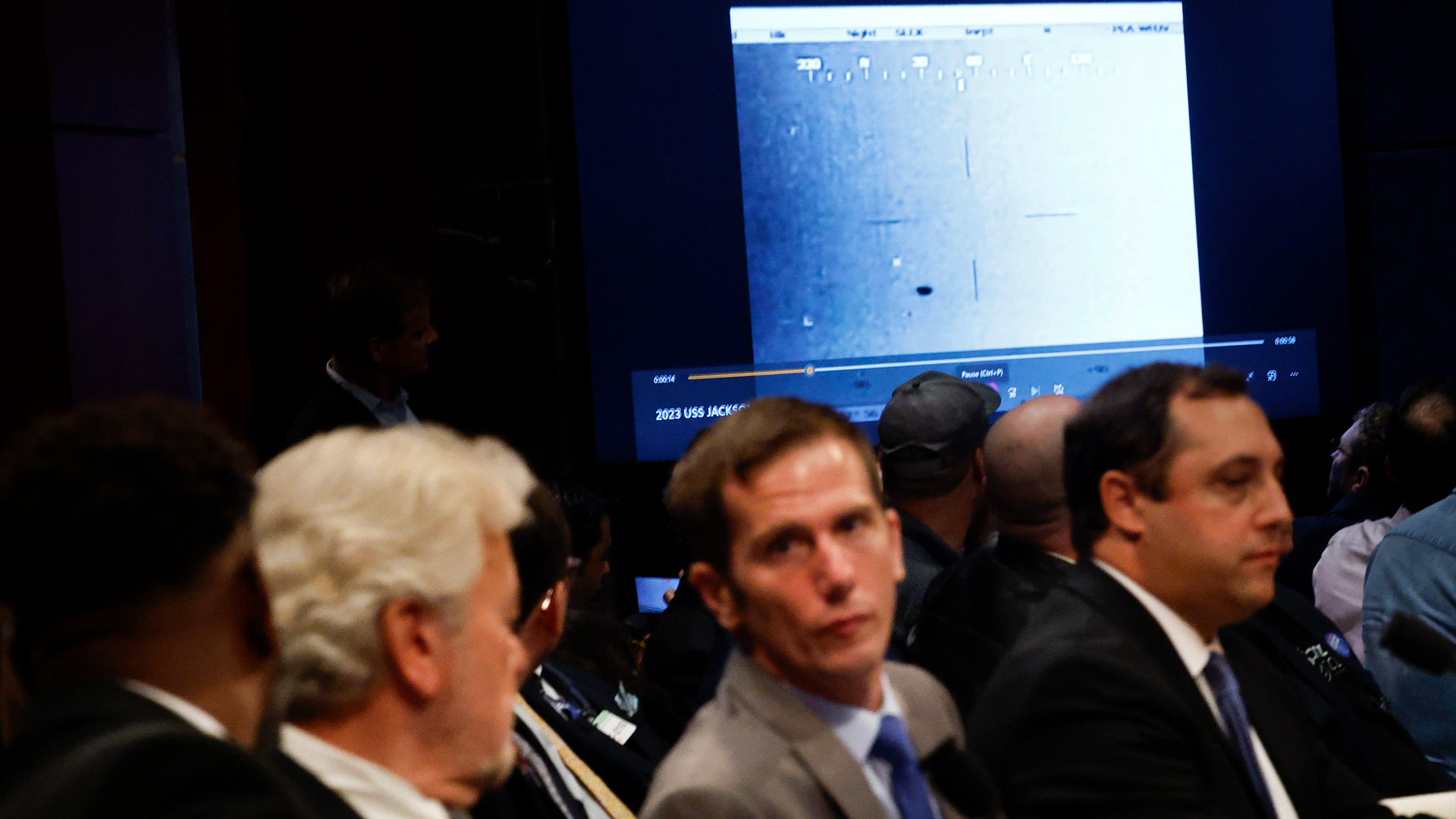
US Congress hearing ‘Unidentified Anomalous Phenomena: Implications on National Security, Public Safety, and Government Transparency’, on Capitol Hill, Washington DC, 26 July 2023. Photo by Drew Angerer/Getty Images
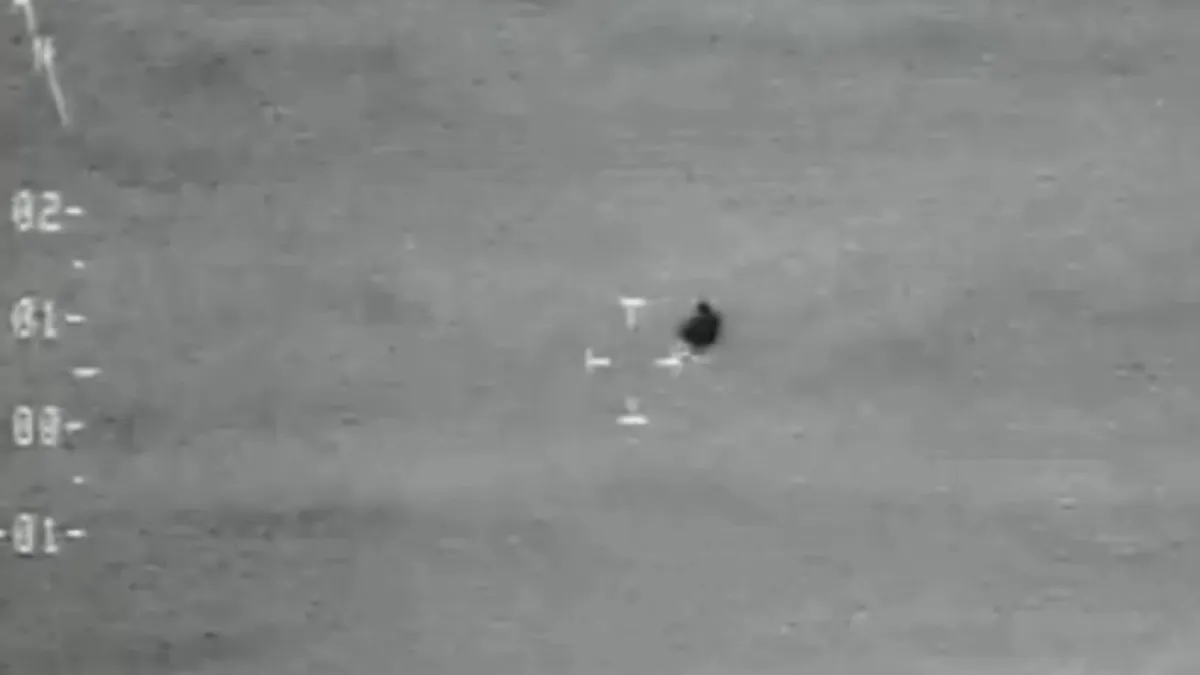
How do you feel about more recent reports like those that have occurred since 2017 with the US Navy footage and Pentagon briefings in the US?
First of all, the fact that intelligence officials in the United States have come forward to say unequivocally, these pilots saw real objects, these are not computer glitches, these are not optical illusions, something is there.
That's unusual. That you didn't tend to get over the decades, that kind of admission.
And also their admission that they have maybe been derelict in taking seriously the reports of pilots, that they've ridiculed them, that a certain amount of peer and hierarchical pressure has really influenced people not to report things.
From my position as an academic, what I really find exciting and interesting is NASA's intervention.
Because, you know, NASA is about civilian science, it's not about classified projects.
So adding that legitimacy to me seems to be the really unprecedented step.
That's the thing that I think opens the pathway for people from all sorts of disciplines to begin having conversations about what research projects might look like.
I think we'll see over the next, say five to 10 years, where this takes us.
After all, what our ears perceive as 'sound' is just a pressure wave that passes through a medium, be that medium a solid, liquid or gas, and agitates the molecules within it.
When that pressure wave hits our ears,it causes small hairs and bones within them to vibrate, which sends an electrical signal to the brain that we interpret as sound.
Soundwaves hit our ears, which our brain interprets as sound. Credit: Jun / Getty Images
But in a vacuum, where there are no molecules of liquid, solid or gas to agitate, that can’t happen – so there is no sound.
But when you’re talking about space, the simple, easy answer is seldom entirely correct – and that’s the case here, too.
That’s because space isn’t actually a vacuum at all.
Yes, huge regions of it are, particularly in interstellar and intergalactic space.
But within galaxies and nebulae are huge, swirling clouds of gas and dust, and the molecules within those clouds are just as capable of being agitated and so passing on a pressure wave – ie, sound – as their counterparts here on Earth.
As if to prove the point, in 2022 NASA released a sound recording of a black hole, extrapolated from observational data from the Chandra X-Ray Observatory.
It turns out black holes make a low-pitched warbling sound that sounds (appropriately enough) like something from the soundtrack of a 1950s sci-fi B-movie.
It’s such a low-pitched sound that your ear wouldn’t be able to hear it naturally, so NASA used a process called ‘sonification’ to render it audible.
Gravitational waves and plasma waves (such as the solar wind, the stream of charged particles that’s constantly being emitted by our parent star) also present a medium through which sound is able to travel.
Not loudly enough that you’d be able to hear it were you there, but clearly enough for it to be detected by Earth-based radio telescopes.
So yes, space is mostly silent – but not truly silent.
Artemis 3 Won’t Land Astronauts on the Moon as NASA Shifts Lunar Mission
Artemis 3 Won’t Land Astronauts on the Moon as NASA Shifts Lunar Mission
NASA has canceled the Artemis 3 moon landing, shifting its focus to testing key technologies and aiming for a safer, more reliable return to the Moon in 2028.
NASA has decided to revise its Artemis program, significantly altering its mission architecture and delaying the anticipated Artemis 3 astronaut landing on the Moon. The decision follows concerns over the readiness of key spacecraft components, such as the Human Landing System (HLS), as detailed in a report by NASA’s Aerospace Safety Advisory Panel (ASAP). Space.com reported this groundbreaking update, noting that NASA aims to reduce mission complexity and avoid rushing the process. As a result, the first crewed lunar landing isnow expected with Artemis 4 in 2028, rather than in the originally planned Artemis 3 mission.
NASA’s Shift in Strategy: A Move Toward Simplicity and Safety
NASA’s decision to cancel Artemis 3’s astronaut landing marks a significant turning point for the Artemis program, which was initially designed to return humans to the Moon by the mid-2020s. One of the main reasons for this shift is the need to reduce the complexity of the mission architecture, according to NASA officials.
“We want to reduce complexity to the greatest extent possible,” said Isaacman during a briefing. “We want to accelerate manufacturing, pull in the hardware and increase launch rate, which obviously has a direct safety consideration to it as well.”
This change in approach will help ensure that NASA can meet its goal of returning astronauts to the Moon safely, without compromising mission objectives.
One of the most important aspects of this decision is how it addresses the concerns raised by the ASAP report, which flagged issues related to the readiness of the Human Landing System (HLS) vehicles. These vehicles, which NASA had contracted from private companies like SpaceX and Blue Origin, are not yet ready to safely transport astronauts to the lunar surface. The delays in meeting critical milestones for these spacecraft, particularly SpaceX’s Starship, led to the decision to reevaluate the timeline and mission structure. The upcoming Artemis 3 mission will now focus on testing key technologies in low Earth orbit, setting the stage for a future crewed lunar landing with Artemis 4.
What Does This Mean for Artemis 3 and the Future of Lunar Exploration?
The cancellation of Artemis 3’s planned Moon landing has serious implications for the overall timeline of NASA’s lunar exploration ambitions. As originally envisioned, Artemis 3 was meant to be the first mission in the program to land astronauts on the Moon since Apollo 17 in 1972. However, NASA’s new strategy aims to take a more cautious, measured approach to ensure that the technology and hardware are fully ready before they are used in a high-stakes mission. In a briefing with Space.com, Isaacman expressed his confidence that this approach is aligned with the recommendations from the ASAP report:
“I think what we’re doing is directly in line with what ASAP asked us to do,” he said. “I think it should be incredibly obvious you don’t go from one uncrewed launch of Orion and SLS, wait three years, go around the moon, wait three years and land on it.”
By emphasizing incremental testing and readiness, NASA hopes to avoid the pitfalls that could undermine a mission of this magnitude.
The new timeline, now targeting Artemis 4 for the first crewed landing in 2028, reflects NASA’s focus on thorough preparation rather than rushing through steps. This delay, while disappointing for some, could ultimately lead to a safer, more successful return to the lunar surface. NASA’s decision underscores the need to ensure that the various components of the mission, including the Space Launch System (SLS) rocket and Orion spacecraft, work seamlessly together. With these changes, NASA hopes to replicate the success of previous space programs by increasing the launch cadence and gaining more experience before landing astronauts on the Moon again.
NASA Faces Delays: Technical Challenges and Solutions
Despite the setback in the Artemis 3 timeline, NASA remains committed to achieving its lunar exploration goals. The agency continues to make progress on the necessary hardware, including the Space Launch System (SLS) and Orion spacecraft, which are being tested in preparation for Artemis 2. However, there have been significant delays and challenges, particularly with the SLS rocket. During a recent briefing, Lori Glaze, NASA’s acting associate administrator for the Exploration Systems Development Mission Directorate, addressed an issue with the rocket’s helium flow system:
“The suspected system component for the helium flow will be removed, and they’re going to undergo detailed sections and assess the cause of the issue,” she said. “We hope to get down to the root cause of that and make changes, not just to the hardware, but to our operational procedures, so that we don’t encounter the same issue again when we roll back out to the pad.”
This technical difficulty, along with other challenges faced in the development of the HLS vehicles, underscores the complex nature of space exploration. While the delay is frustrating, it also provides an opportunity to make adjustments and learn from past mistakes to ensure that future missions are not hindered by avoidable issues.
NASA’s Perseverance Rover Caught Crackling Sounds on Mars. Researchers Think It Was Electricity
NASA’s Perseverance Rover Caught Crackling Sounds on Mars. Researchers Think It Was Electricity
Two separate NASA missions detected unusual signals on Mars, a strange sound on the surface and a rare reading from orbit, and scientists are still trying to understand what they mean.
Two NASA spacecraft have detected different signals that point to possible lightning on Mars. One clue comes from orbit, the other from the planet’s surface, together strengthening the case that electrical discharges flicker through the Red Planet’s dusty skies.
Lightning has already been observed on Jupiter, Saturn, and Neptune. Mars, by contrast, has remained ambiguous territory. Its atmosphere is thin, and its magnetic field exists only in small, scattered patches, conditions that make any lightning harder to detect and likely very different from the bright bolts seen on Earth.
Scientists have long hypothesized that if lightning occurs on Mars, it would resemble faint electrical sparks generated by swirling, electrostatically charged dust. Now, recent findings based on data from NASA’s MAVEN orbiter and the Perseverance rover suggest those sparks may indeed be real.
A Rare Radio “Whistler” Detected by MAVEN
The most recent evidence comes from a study published on February 27 in Science Advances. According to the research, scientists identified a possible lightning signature in data collected in June 2015 by NASA’s Mars atmosphere and volatile evolution (MAVEN) spacecraft.
Schematic representation of the conditions and processes that produce a whistler signal.
Credit: Science Advances
The team, led by Ondřej Santolíkof the Czech Academy of Sciences, searched for radio signals known as “whistlers.” When lightning strikes, it heats and ionizes surrounding air, allowing radio waves to travel through the atmosphere and into space. On a receiver, these waves produce a characteristic whistle-like tone. Researchers reviewed 108,418 data snapshots from MAVEN. Santolík explained that:
“That needs to be done visually because it’s very hard to do it by a machine because of the noise features in the data”. Out of that extensive dataset, the team identified only one candidate signal. “It’s very surprising that we found it at all.”
The scientists then spent a year confirming that the signal matched what would be expected from lightning. NASA has reportedly been out of contact with MAVEN for nearly three months, leaving open questions about whether similar observations will be obtained in the near future.
Perseverance Hears Crackling During Dust Storms
A few months earlier, a separate group of researchers presented another form of evidence based on recordings from a microphone aboard NASA’s Perseverance rover.
The team identified dozens of crackling sounds produced by small electrical discharges during dust storms near the rover. These sounds likely reflect localized electrical activity within charged dust clouds rather than large-scale lightning bolts.
Spectrogram showing the frequency evolution of electromagnetic waves detected by MAVEN.
Credit: Science Advances
Karen Aplin, a space physicist at the University of Bristol who was not involved in either study, said the two findings together give “a feeling that we’re closing in on Mars lightning.” She noted that on Earth, different types of electrical discharges exist, ranging from thunderstorm lightning to the glow known as Saint Elmo’s fire, suggesting that Mars could host varied electrical phenomena as well.
A Discovery With Bigger Implications Than It Seems
Electrical discharges also influence atmospheric chemistry. As reported by Scientific American, lightning has been shown to spark chemical reactions that may contribute to the development of life. Understanding whether similar processes occur on the Red planet could help scientists interpret the planet’s chemical environment.
For Santolík, the findings are bittersweet. He was part of a team that developed a dedicated lightning detector for the Russian-made lander of the Rosalind Franklin rover, part of the European Space Agency (ESA) program. The mission, initially planned for 2022, was disrupted after Russia’s full-scale invasion of Ukraine.
ESA is now building its own lander for a 2028 launch but chose not to include instruments on the platform to speed construction. The lightning detector has since been returned to its creators and is not expected to fly to Mars.
At this stage, asingle orbital “whistler”andcrackling sounds detectedat the surface stand as the strongest hints yet that the Red Planet may host elusive, dust-driven sparks in its skies.7
Researchers have identified powerful Martianelectrical discharges, similar tolightning, and strong enough to be observed from orbit, in new research bringing this extraterrestrial phenomenon to light.
Mars and Earth feature very different environments—namely, the Red Planet lacks a global magnetic field and possesses only a thin atmosphere. As a result, lightning does not form in rain clouds as it does on Earth; instead, intense activity in dust storms and dust devils produces the electrical charge that generates Mars’ lightning-like electrical discharges.
MAVEN Observes Martian Lightning
NASA’s MAVEN orbiter made the crucial observation a decade ago, but only in December 2024 did the significance of the signals become clear. Recently, Czech researchers completed their analysis and revealed the findings in a new paper published in Science Advances.
“I went through data from the beginning of the mission, and after automatically filtering records measured outside areas of strong magnetic fields or at excessively high altitudes,” František Němec of Charles University said in a press release. “I found only a single electromagnetic lightning signal—a so-called whistler—among thousands of possible records.”
“Based on previous calculations, laboratory experiments, and observations of lightning in the dust plumes of terrestrial volcanoes, we all expected electrical discharges in the Martian atmosphere, but until that moment, no one had recorded them,” said Ondřej Santolík of the Czech Academy of Sciences and Charles University.
MAVEN—short for Mars Atmosphere and Volatile Evolution—was designed to study the Martian atmosphere and its evolution. Operating from 2014 until NASA lost contact in December 2025, the spacecraft examined interactions between the solar wind and the atmosphere. To support this mission, it carried instruments capable of measuring electromagnetic waves, which ultimately detected the lightning signal.
A Lucky Observation
Observing the lightning-like discharge required unusually precise circumstances. The MAVEN orbiter had to be at the correct altitude and position, and in the proper observation mode, at the moment the event occurred. Conditions on Mars also had to allow the signal to escape into space. Without a global magnetic field, lightning appears to form only in regions with localized fields, and for detection, those fields must be both strong and largely vertical. The signal also had to reach the ionosphere without losing strength.
Later observations by the Perseverance rover in 2021 and 2024 detected lightning-like discharges as well, though the researchers believe those represent a different phenomenon.
“In the thin atmosphere of Mars, the accumulation of large potential differences is limited by the onset of small, local glow discharges. Such discharges may be those detected by Perseverance,” Němec told The Debrief. “However, they are too weak and too localized to be detected by an orbiter.”
“A discharge detectable from orbit would have to be significantly stronger, involving a larger potential difference distributed over comparatively large spatial scales,” Němec added. “This most likely indicates that the mechanism responsible for generating the corresponding voltage must be different.”
The Lightning of Mars
Martian lightning discharges produce a cascading effect. A short, powerful current generates fluctuating magnetic and electric fields that propagate outward as electromagnetic waves. When part of the wave reaches the ionosphere, it slows, and different frequencies travel at different speeds, arriving at the orbiter separately. Higher frequencies travel faster and reach MAVEN first.
PhD student Kateřina Rosická developed a simulation to test this hypothesis, combining a model of Earth with the assumed composition of the Martian ionosphere. The simulation showed that lower-frequency waves would be delayed while higher-frequency waves would attenuate—exactly what MAVEN observed. The spacecraft’s failure to detect higher frequencies matched the prediction.
Whether the phenomenon strictly qualifies as “lightning” remains uncertain. For now, researchers describe it as a lightning-like electrical discharge.
“The common understanding is that the phenomenon of lightning encompasses various related effects, such as a visible flash,” Němec explained. “Of all these effects, the available measurements allow us to demonstrate only the sudden release of low-frequency electromagnetic radiation.”
“In other words, there is nothing yet that clearly separates this phenomenon from lightning, but the available instrumentation does not allow us to observe all the effects that the common understanding of lightning encompasses,” Němec added. “We therefore cannot confirm or exclude them, and it is possible that in the thin atmosphere of Mars some of these effects may differ significantly from those known on Earth.”
Keeping an Eye On Mars Lightning
For now, the researchers say the phenomenon poses little threat to future crewed missions.
“Based on observations on Earth, lightning is generally not particularly deadly or dangerous, at least when reasonable precautions are taken,” Němec said. “It could, for example, endanger surface antenna equipment by destroying its electronics; however, I would say it is not too significant a concern.”
Currently, the European Space Agency (ESA) is considering an unscrewed Mars mission called M-MATISSE for a possible 2037 launch, which the team says would provide vital new information on any Mars lightning-like electrical discharges.
“It will be better equipped to search for traces of lightning discharges than its predecessor, MAVEN,” said study co-author Ivana Kolmašová, who also serves as a member of the ESA Scientific Study Team for the M-MATISSE mission. ESA is expected to decide by the end of this year whether it will pursue the mission.
Ryan Whalen covers science and technology for The Debrief. He holds an MA in History and a Master of Library and Information Science with a certificate in Data Science. He can be contacted at ryan@thedebrief.org, and follow him on Twitter @mdntwvlf.
Alien creature escaping from ice in Antarctica Feb 2026, UFO UAP paranormal sighting news 🚨
Alien creature escaping from ice in Antarctica Feb 2026, UFO UAP paranormal sighting news 🚨
Date of sighting: February 2026
Location of sighting: Antartica
Source: Twitter user @crazymoments01
Watch this recently recleased capture of an alien creature thats been preserved in ices for million of years and it looks like its going to escape from the ices and may revive very soon. Many sea creatures have a substance in the blood that prevents them from dieing when frozen, this alien creature probably is far advanced and is just waiting for the right moment to escape.
UFO abandoning earth, what do y tru hey know we don’t? 👀 UAP paranormal alien sighting news
UFO abandoning earth, what do y tru hey know we don’t? 👀 UAP paranormal alien sighting news
Date of sighting: February 13, 2026
Location of sighting: Middleburg, Florida, USA
Source: NUFORC
When UFOs start leaving the planet, you sure as heck know something bad is heading this way. Watch this recent video of a craft leaving earths and shooting way. It's proof that things on Earth are defiantly heading into a negative vibration and there might not be any turning back now.
Scott C. Waring
Eyewitness states:
Lights on object The light changes to two and acts erratically Light changes into two from one and shoots around erratically.
De Toenemende Verschijningen van UFO's op Live Televisie-uitzendingen
De Toenemende Verschijningen van UFO's op Live Televisie-uitzendingen
In de afgelopen decennia is het fenomeen van onverklaarbare vliegende objecten, beter bekend als UFO's, een onderwerp dat zowel wetenschappers als het grote publiek blijft fascineren. Wat ooit voornamelijk het terrein was van mysterieuze waarnemingen door piloten en amateur-onderzoekers, heeft zich in de loop der jaren uitgebreid tot opmerkelijke beelden die live op televisie worden uitgezonden. Deze ontwikkeling roept niet alleen vragen op over de aard en oorsprong van deze verschijnselen, maar ook over de manier waarop media en overheden hiermee omgaan.
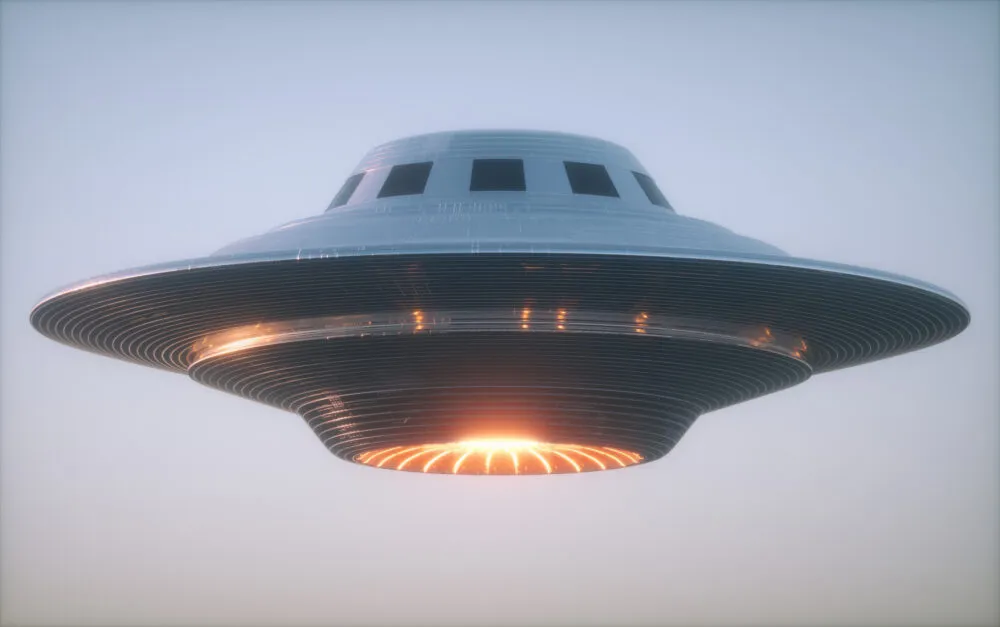
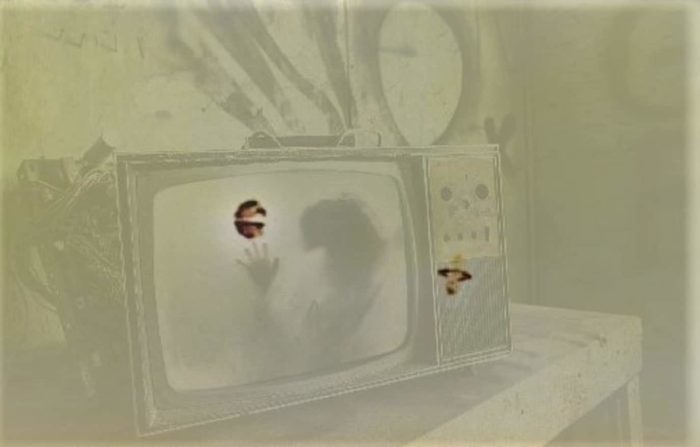
Een afbeelding van UFO's met een overgelegde foto van een televisie
In dit artikel zullen we de geschiedenis en de evolutie van UFO-waarnemingen op televisie onderzoeken, de meest opvallende incidenten bespreken, en de mogelijke verklaringen en implicaties van deze toenemende verschijningen analyseren. Daarnaast kijken we naar de rol van technologie, publieke perceptie en de wetenschap in het begrijpen van deze mysterieuze verschijnselen.
De geschiedenis van UFO-waarnemingen op televisie
De eerste bekende televisie-uitzendingen waarin UFO's werden getoond, dateren uit de jaren 1950 en 1960. Toen de televisie zich nog in de kinderschoenen bevond, waren de beelden vaak beperkt en werden ze vooral door amateurs en hobbyisten vastgelegd. Desalniettemin zorgden deze vroege waarnemingen al voor grote nieuwsgierigheid en speculaties.
Een van de meest iconische vroege incidenten was de "Kenneth Arnold-waarneming" uit 1947, waarbij piloot Kenneth Arnold vreemde vliegende objecten zag die snel beweegden en in formatie vlogen. Hoewel dit niet direct op televisie was vastgelegd, leidde het tot een golf van belangstelling en media-aandacht. In de jaren daarna werden er talrijke rapporten en beelden gedeeld, vaak door militaire en civiele luchtvaart organisaties.
De jaren 1980 en 1990 markeerden een nieuwe fase, waarin technologieën zoals videocamera's en digitale opnames het mogelijk maakten om UFO's vast te leggen en te delen op televisie. Een van de meest bekende gebeurtenissen uit deze periode was de "Phoenix Lights" in 1997, waarbij duizenden mensen in Arizona ongeïdentificeerde vliegende objecten zagen. Hoewel dit geen live-uitzending was, werden er later televisieverslagen en documentaires gemaakt die de gebeurtenis in de schijnwerpers zetten.
De opkomst van live UFO-waarnemingen
In de 21e eeuw zien we een opmerkelijke toename van live waarnemingen van UFO's op televisie, mede dankzij de snelle ontwikkeling van cameratechnologie, smartphones en sociale media. Deze platforms maken het mogelijk dat burgers snel beelden kunnen delen met een wereldwijd publiek, waardoor de kans op live uitzendingen en directe rapportages toeneemt.
Een belangrijk keerpunt was de uitzending van de "Nimitz-incident" in 2004, waarbij Amerikaanse marinepiloten tijdens een oefening ongeïdentificeerde objecten zagen die met hoge snelheid en ongewone manoeuvres door de lucht bewogen. Hoewel de gebeurtenissen niet live werden uitgezonden, werden de beelden later vrijgegeven door het Pentagon en wereldwijd gedeeld via nieuwsmedia en documentaires.
In meer recente jaren hebben we verschillende incidenten gezien waarbij UFO's rechtstreeks op televisie werden vastgelegd tijdens live-uitzendingen. Een voorbeeld is de "UFO-sighting" tijdens een voetbalwedstrijd in Brazilië in 2019, waarbij een object werd gezien dat snel door de lucht scheerde en door meerdere kijkers werd vastgelegd. Hoewel het bewijs beperkt was, zorgde het voor een storm van discussie op sociale media en in de pers.
Het fenomeen van 'live' UFO's: opvallende voorbeelden
1. UFO's oproepen in Las Vegas?
Las Vegas is een stad waar sommige mensen suggereren dat 'alles kan!' Dus het zou misschien niet al te verrassend moeten zijn dat, in tegenstelling tot alleen UFO-waarnemingen (waarvan er veel zijn), Vegas een persoon heeft die beweert deze objecten te kunnen oproepen wanneer hij wil.
Ramon Watkins, bekend als Profeet Yahweh, reageerde op een uitdaging van het lokale Las Vegas-station KTNV, dat hem vroeg een UFO live op televisie op te roepen in 2005. Hoewel hij enigszins terug leek te krabbelen door te zeggen dat hij ze niet op commando kon 'oproepen' en in plaats daarvan door 'stemmen' werd verteld wanneer en waar ze zouden verschijnen, resulteerde zijn optreden wel in de live-uitzending van onverklaarbare objecten boven Vegas.
Het station volgde Watkins naar Lake Meade, waar de objecten zouden verschijnen. Tot schrik van het nieuwscrewet en de vele kijkers thuis waren twee heldere bollen duidelijk zichtbaar aan de hemel.
Veel mensen zouden het evenement opnemen, en het leek erop dat de beslissing over Watkins’ authenticiteit i
2. Kleurrijke Lichten en Cirkels Aan de Hemel
2.1. Brazilië
TV Gazeta uit Brazilië zou in februari 2009 een vreemde waarneming op live televisie vastleggen. Het object straalde fel en zou meerdere keren van kleur veranderen. Naast de duizenden die thuis keken, en de honderdduizenden die het online zouden bekijken, zouden vijfentwintig mensen het object van dichtbij ter plaatse zien.
Het hele tafereel speelde zich af over een periode van twee uur voordat de UFO sereen in de nacht verdween. De korte video hieronder bevat een verslag en beeldmateriaal van het incident.
2.2. HOUSTON, TEXAS, USA
Op 11 augustus 2014 waren de luchten boven Houston, Texas, het decor voor een bizarre 'kring van lichten!' Veel mensen hebben video-opnames van de gebeurtenis gemaakt, waaronder verschillende lokale nieuwszenders. De lichten bewogen onafhankelijk van elkaar voordat ze weer in formatie terugkeerden.
Degenen die de lichten uit de eerste hand hebben gezien, hadden volgens de fragmenten van citaten die aan de lokale media werden gegeven, verschillende meningen over wat ze waren. Deze varieerden van de ontmoeting die van 'buitenaardse' aard zou zijn tot geheime tests van overheidsdrones.
Dr. Carolyn Sumners, die vicevoorzitter van astronomie is aan het Houston Museum of Natural Science, verklaarde dat voordat men de waarnemingen als buitenaards bestempelt, alle andere verklaringen zouden moeten worden uitgesloten. Het incident is nog steeds onverklaard.
Je kunt de beelden van de gebeurtenis hieronder bekijken.
3. De "Mexicaanse UFO-incidenten" (2020)
In Mexico werden meerdere live beelden gedeeld van grote, onregelmatige lichtobjecten die over de steden zweefden. Verschillende mensen filmden de verschijnselen vanuit hun huizen en op straat. Sommige beelden leken onverklaarbaar, terwijl anderen sceptisch waren en spraken over drones of ballonnen. Desalniettemin zorgde de zichtbaarheid en het live karakter voor een grote interesse en discussie.
Bekijk: Webcam Filmt Vreemde UFO Boven Mexico-Stad
Een webcam die uitkeek over Mexico-Stad legde beelden vast van een vreemde UFO die spookachtig door de nachtelijke hemel zweefde. Volgens een lokaal mediabericht werd de mysterieuze scène kort na 4 uur 's ochtends op 15 februari gezien in een livestream uitgezonden vanaf de historische Latin American Tower, het hoogste wolkenkrabber van de stad. Online gedeeld door een social media-account dat openbare webcams in Mexico monitort, toont de bijzondere clip (boven afgebeeld) wat lijkt op een donker, rond object, licht verlicht door de stad eronder, langzaam bewegend door de lucht voordat het schijnbaar daalde tot het niet meer te zien was.
Sinds het dit weekend online is geplaatst, heeft de nieuwsgierige clip een reeks theorieën opgeleverd over wat het vreemde object zou kunnen zijn geweest. Afgezien van de buitenaardse hypothese, omvatten enkele van de meer alledaagse mogelijkheden die door kijkers werden voorgesteld een vogel, een drone of, wellicht het meest plausibel, een verdwaalde Valentijnsdagballon die door iemand in de stad werd opgelaten. Wat vind je van het mysterieuze
Technologie en methoden voor het vastleggen van UFO's
De toename van live UFO-waarnemingen is niet toeval. Technologische ontwikkelingen hebben een grote rol gespeeld in het mogelijk maken van het vastleggen van deze verschijnselen.
Smartphones: De introductie van smartphones met hoge-resolutie camera's heeft het voor het grote publiek mogelijk gemaakt om snel en gemakkelijk beelden te maken en te delen.
Dashcams en beveiligingscamera's: In veel landen zijn dashcams en beveiligingscamera's standaard, wat resulteert in een uitgebreide verzameling beelden van ongeïdentificeerde objecten.
Drones: De opkomst van drones heeft het voor hobbyisten en amateurs mogelijk gemaakt om zelf UFO-achtige objecten te creëren, wat soms verwarring en misverstanden kan veroorzaken.
Live-streaming platforms: Websites en sociale media zoals YouTube, Facebook en Twitter maken het mogelijk om gebeurtenissen in real-time te delen, waardoor live UFO-waarnemingen snel verspreid worden.
Mogelijke verklaringen voor de toenemende verschijningen
De verschijnselen die op televisie worden vastgelegd, kunnen op verschillende manieren worden verklaard. Het is belangrijk om zowel sceptisch als open-minded te blijven.
1. Menselijke perceptie en interpretatie
Veel waarnemingen worden beïnvloed door menselijke perceptie. Mensen kunnen objecten verkeerd interpreteren, vooral onder stressvolle omstandigheden of bij beperkte informatie. Een vliegtuig, drone, ballon of zelfs een weerspiegeling kan worden aangezien voor een UFO.
2. Technologische artefacten en fouten
Camera's en cameratelefoons kunnen artefacten veroorzaken, zoals vlekken op de lens, reflecties of digitale ruis. Ook kunnen weersomstandigheden zoals mist, regen of zonlicht leiden tot misleidende beelden.
3. Drones en menselijke activiteit
Drones en andere menselijke technologieën worden vaak als verklaring aangewezen voor vermeende UFO's. De snelle ontwikkeling van drone-technologie betekent dat het steeds moeilijker wordt om onderscheid te maken tussen menselijk en onverklaarbaar gedrag.
4. Geopolitieke en militaire belangen
Sommige incidenten worden beïnvloed door militaire oefeningen of geheime projecten. Overheden kunnen beelden en informatie terughoudend delen, wat bijdraagt aan speculatie en het mysterie rondom UFO's.
5. Extraterrestraal leven
Hoewel er geen definitief bewijs is voor buitenaards leven, blijven sommige waarnemingen onverklaard en leiden ze tot de hypothese dat sommige objecten mogelijk niet van de aarde afkomstig zijn.
Wetenschappelijke benadering en kritische analyse
De wetenschap speelt een essentiële rol in het onderzoeken van UFO-verschijnselen. Hoewel veel waarnemingen kunnen worden verklaard door natuurlijke oorzaken of menselijke activiteiten, blijven enkele incidenten onverklaard.
Organisaties zoals het Mutual UFO Network (MUFON) en het To The Stars Academy werken aan het verzamelen en analyseren van gegevens, met als doel om objectief te begrijpen wat er gebeurt. Moderne technologieën zoals radar, infraroodcamera's en data-analyse worden ingezet om de patronen en kenmerken van deze verschijnselen te bestuderen.
Het is belangrijk om kritisch te blijven en niet te snel conclusies te trekken. Veel waarnemingen worden later verklaard, maar het feit dat sommige niet meteen kunnen worden verklaard, houdt de nieuwsgierigheid levend en stimuleert verder onderzoek.
BEKIJK ONDERSTAANDE VIDEO'S EN OORDEEL ZELF...
Implicaties van de toenemende verschijningen op televisie
De groei van live UFO-waarnemingen heeft verschillende maatschappelijke, culturele en politieke implicaties:
Publieke perceptie: Het publiek wordt steeds meer betrokken bij het fenomeen, wat leidt tot een toenemende vraag naar transparantie en antwoorden van overheden.
Overheidsrapportages: In recente jaren hebben overheden, waaronder die van de Verenigde Staten, verklaard dat ze UFO-incidenten onderzoeken en data vrijgeven. Dit wijst op een veranderende houding ten opzichte van het onderwerp.
Wetenschappelijke interesse: Meer wetenschappers tonen interesse en zoeken naar verklaringen binnen de astrofysica, atmosferische wetenschap en technologie.
Maatschappelijke discussie: De vraag of we alleen zijn in het universum blijft actueel, en de getuigenissen op televisie dragen bij aan de brede maatschappelijke discussie.
Conclusie
De toenemende verschijningen van UFO's op live televisie-uitzendingen illustreren zowel de technologische vooruitgang als de blijvende menselijke nieuwsgierigheid naar het onbekende. Hoewel veel incidenten kunnen worden verklaard door natuurlijke of menselijke oorzaken, blijft een deel onverklaard, wat het mysterie en de fascinatie rondom deze verschijnselen voedt.
Het is essentieel dat we deze gebeurtenissen met een kritische blik bekijken, openstaan voor nieuwe gegevens, maar ook rekening houden met de beperkingen en fouten van menselijke perceptie en technologie. De toekomst van UFO-onderzoek ligt in het combineren van geavanceerde wetenschap, transparantie en publieke interesse, zodat we hopelijk ooit het antwoord vinden op de vraag of we alleen zijn in het universum.
De voortdurende aandacht voor deze verschijnselen op televisie en in de media helpt om het bewustzijn te vergroten en het onderzoek te stimuleren. Of de UFO's nu buitenaards, technisch of natuurlijk van aard zijn, één ding is zeker: het fenomeen blijft ons uitdagen en inspireren tot verdere ontdekking.
New Discoveries on Mars and What They Say About Habitability and Life
New Discoveries on Mars and What They Say About Habitability and Life
By Nathalie A. Cabrol, Astrobiologist & Science Director, Carl Sagan Center, SETI Institute.
Gale crater: These pea-sized nodules were formed by minerals left behind as groundwater was drying out on Mars billions of years ago.
(Credit: NASA/JPL-Caltech/MSSS)
At a Glance:
New Discoveries on Mars and What They Say About Habitability and Life Nathalie A. Cabrol, SETI Institute
Two NASA rovers have strengthened the case that ancient Mars may have supported life.
Curiosity (Gale Crater)detected the largest organic molecules yet found on Mars—long carbon chains consistent with fragments of fatty acids.
These moleculeswere preserved in rocks altered by ancient groundwater, suggesting long-lived subsurface water activity.
Perseverance (Jezero Crater) identified silica-rich rocks, including quartz, minerals known on Earth for preserving biosignatures.
The rover also found kaolinite clay, evidence of sustained water–rock interaction and potentially habitable conditions.
Why it matters: While not evidence of life, these discoveries show that ancient Mars had complex organic chemistry, long-lasting water systems, and mineral environments capable of preserving potential signs of life—making the search more compelling and increasingly testable.
Mars dominates the planetary news with exciting reports. Two NASA rovers, working nearly 3,700 kilometers apart, made discoveries that addressed the question: how far did Mars come toward conditions that, on Earth, supported life?
On one side of the planet, new studies confirm last summer’s hint that Curiosity detected the largest organic molecules yet identified on Mars. These include decane, undecane, and dodecane found in the ancient Cumberland mudstone of Gale Crater. These C10–C12 carbon chains are consistent with the kinds of fragments you might expect from fatty acids, which are molecules that, on Earth, sit close to biology because they are basic building blocks of membranes and metabolic chemistry. But it now seems that these compounds were in sediments later modified by groundwater-driven diagenesis (when sediments turn into rocks), documented by Curiosity’s mineralogical and geochemical measurements. On the other side, Perseverance has identified silica-rich rocks in Jezero Crater, including opal/chalcedony and, critically, well-crystallized quartz, detected with SuperCam spectroscopy. Why does it matter? Silica-rich phases on Earth are famously good at preserving biosignatures, from molecular residues to microtextures. And we just learned that Perseverance also identified kaolinite in altered igneous rocks on the crater floor. This comes from combined SuperCam infrared spectroscopy and PIXL elemental chemistry, consistent with a feldspar-to-kaolinite transformation under sustained water activity. If both findings are mineralogical firsts, they are also a lot more than that. They point to abundant ancient groundwater–rock interaction and likely hydrothermal processes.
Taken together, these are not “We discovered life on Mars” headlines. They are subtler and, in many ways, more important. This is a strengthening of the case that ancient Mars had both (i) an organic carbon inventory and (ii) environments capable of concentrating, processing, and preserving chemical traces – and these environments were diverse and long-lasting, and that’s good news for the search for life on Mars.
Organic Molecules and Ancient Groundwater at Gale
The findings at Gale are exciting because they push Martian organic chemistry into a higher tier of complexity. Long carbon chains do not automatically mean biology, but they do mean that Mars can make, or at least retain, molecules that are closer to the chemical scaffolding of life than the simple organics we often discuss. On Earth, fatty acids are associated with life, but they are not exclusive to it. Abiotic pathways exist, including hydrothermal synthesis and Fischer–Tropsch-type reactions (chemical reactions on hot mineral surfaces that can build organic molecules capable of supporting life). Mars has the rocks, the heat sources (past and still some today), the CO/CO₂ and H₂ chemistry, and time, lots of it.
What now makes the Cumberlands organics particularly compelling is their geological context. Curiosity has shown that these mudstones underwent multiple episodes of groundwater circulation after burial. These episodes have been recorded in mineral veins, diagenetic textures, and chemical redistribution measured by CheMin and APXS. The organics detected by SAM therefore reside in rocks that remained chemically open systems for extended periods. That matters a lot because groundwater does more than wet rocks. It transports carbon, redistributes redox couples (paired chemicals that exchange electrons), and creates microenvironments where organic molecules can be synthesized, altered, concentrated, or shielded from oxidation. Subsurface aqueous systems are also among the most stable habitable niches on Earth, persisting long after surface environments become hostile. In Gale, this implies that potential habitable conditions did not end with the lake that deposited the mudstone but continued underground, in circulating water, for geologically meaningful timescales.
What nudged this discovery into deeper interest is not the mere detection of the molecules, but the attempt to ask whether known non-biological sources plausibly account for their abundance. A follow-on analysis reported by NASA describes a study arguing that the non-biological sources they evaluated (for example, delivery by meteorites) could not fully explain the measured abundance, making it “reasonable to hypothesize” that biology could have contributed, while stressing that this remains unresolved.
Jezero: Hot Springs, Clay, and Life-Friendly Environments
The Jezero quartz story is exciting for different reasons. It is less about “life ingredients” and more about environmental opportunity. Quartz and its silica cousins (opal, chalcedony) typically form under conditions that mobilize silica in water and precipitate it, often in hydrothermal settings. The Jezero detections are interpreted as part of a common hydrothermal system, potentially triggered by the impact that formed Jezero, with different silica phases representing precipitation at different depths and temperatures. Why does that matter with respect to habitability? Because hydrothermal systems are among the most compelling natural laboratories for prebiotic chemistry and microbial ecosystems. They supply heat, chemical gradients, and mineral surfaces that can drive synthesis and catalysis. And if life ever gained a foothold, hydrothermal circulation can both sustain it and entomb its traces. Silica-rich deposits are also preservation jackpots. On Earth, cherts and other siliceous rocks can lock away molecular organics and microscopic structures over immense timescales. The Jezero team explicitly frames these silica-rich rocks, especially opaline silica, as key targets for sampling and return, precisely because of their preservation potential.
That, in itself, is already a tremendous finding, but there is more. The identification of kaolinite announced a few days ago now expands the picture from hydrothermal pulses to prolonged water alteration. Kaolinite typically forms when feldspar-rich igneous rocks interact with liquid water over extended periods under relatively moderate temperatures and pH conditions. Its presence in Jezero’s altered crust indicates sustained water-rock interaction. Critically, Perseverance observes kaolinite spatially associated with silica-bearing alteration zones. Together, these minerals outline a continuum of water environments, from hydrothermal circulation to longer-lived alteration in percolating or standing waters. This kind of mineralogical diversity is exactly what on Earth correlates with habitable geochemical gradients and long-term fluid activity.
NASA's Perseverance rover discovers bleached kaolinite rocks on Mars, revealing clues of ancient climate conditions in Jezero Crater.
What Makes a Biosignature?
Here is the key: neither discovery stands alone. Organic molecules, by themselves, are not proof of life. Quartz, by itself, is not proof of life. Even both together are not proof of life. But they add weight to an accumulating argument that ancient Mars wasn’t merely “wet once,” or “chemically interesting in theory.” It was active, carbon cycling through environments, water moving through rocks, hydrothermal systems likely operating, and complex organics being produced, delivered, preserved, or all the above. The addition of groundwater-altered sediments at Gale and clay-forming alteration at Jezero further suggests that habitable conditions were not confined to short-lived surface lakes or impact events but extended into subsurface and long-duration aqueous systems across different regions of the planet. This is why astrobiology relies so heavily on context and the ladder of life-detection principles. The same molecule means different things in different rocks. The same mineral means different things in different settings. A signature of life is convincing only when it cannot be explained by the environment alone. What is not helping either is that we still do not have a universal definition of life that can be cleanly adopted for alien worlds. We recognize life on Earth because Earth is saturated with it and because we understand its biochemistry here. On Mars, we are forced to adopt a more cautious approach, inferring possibilities and building confidence only when multiple independent clues converge.
The Significance of these Discoveries
Gale’s organics grow the chemical inventory. Gale’s groundwater history and Jezero’s kaolinite now extend both inventories in time and environmental range, indicating that water activity and alteration persisted beyond the initial lake and impact phases, and occurred in multiple geochemical regimes. Together, they help narrow the space of plausible histories for Mars, histories in which complex carbon chemistry had time and place to unfold, and in which traces of life, if they ever existed, might still be readable. Ancient Mars, increasingly, looks less like a planet that was briefly habitable and more like one that sustained habitable settings in different places, at different depths, and for much longer than once thought. These findings do not tell us that life was present on Mars, but they tell us the question remains scientifically… alive and increasingly testable. And in Mars exploration, that is a very big deal.
What NASA’s Newest Discovery On Mars Means Mars has always been our neighbor in the universe but remained distant enough to remain a secret. Whenever NASA releases a new finding, people are curious once again. The latest findings about the Red Planet are not an exception. Although the details are still under research by scientists, there are good indications that there is something that could alter the way we mentally process Mars and its past in a rather gentle way. It does not suggest any dramatic conclusions or immediate answers. Rather, it initiates a philosophical debate on the possibility, the patience, and the gradual yet constant manner in which science proceeds. And that perhaps could be the most interesting of all.
A closer look at the Martian surface New information seems to point out strange surface patterns not evidently perceived previously. These structures might have been formed in the course of time. Although the researchers are cautious, the shapes and textures may provide some new information regarding the changes in the environment on Mars.
Hints of ancient water activity According to some experts, the new findings may be related to evidence of the movement of water in the past. In the event that that happens to be the case, it may support previous theories that Mars was once in wetter conditions. Nonetheless, it will take a greater analysis and time to be validated.
What the soil samples could reveal The samples of the soil collected can have traces of chemicals that assist the scientists in knowing the past of the planet. Minute combinations of minerals could indicate certain ecological factors. Nevertheless, the interpretation of these signals is complicated and not always easy.
Technology is making it possible This discovery has been made possible by advanced instruments on rovers and orbiters. These instruments are meant to screen finer details that could have been overlooked by the older missions. All the reading, however, should be carefully checked.
The role of rover exploration Missionary vehicles such as the Perseverance rover are still relaying useful information. They have mobility and are able to learn various terrains. The recent developments could be a component of the ongoing research on the selectively chosen areas.
Why location matters on Mars What is discovered might not be any more important than the location of the discovery. Some areas are more historical about geology than others. Scientists tend to concentrate on the locations that could have been water-bearing in the past.
The question of past life Life is always something that people are inquiring about whenever Mars unveils something new. Although this finding does not validate anything, it could be used to provide background for the bigger search. Researchers are rather slow in addressing such possibilities.
Learning the history of martian climate Climate significantly contributes to the formation of any planet. The new information may give an indication of the way Mars evolved millions of years ago. It may imply changes in temperature or atmosphere, but further studies are required.
Why scientists avoid quick conclusions Scientific findings do not often give immediate solutions. Any discovery has to be put to the test, scrutiny, and argument. This cautious approach prevents confusion. The latest find on Mars is bound to take the same deliberate direction
Interstellar comet 3I/ATLAS is soon to have a potentially course-altering encounter, before it heads out of our Solar System for good in the direction of the Gemini constellation.
Last year, the Solar System received its third confirmed interstellar object, in the form of interstellar comet 3I/ATLAS. This comet has traversed the galaxy for billions of years, and is likely older than the Solar System it is currently passing through.
The object has already had its closest encounters with Mars, Earth, and the Sun. The encounter with the Sun saw 3I/ATLAS change dramatically, with a massive release of organic molecules, while the approaches to Earth and Mars weren't close enough to have a large effect on the comet.
The Sun Just Cracked Open 3I/ATLAS Revealing New Surprises
But before our interstellar visitor leaves us for good, it has one last close encounter to go, and it's possible it might be a course-altering close shave. On March 16, the object's path will take it close to our largest gas giant. On that day, it will pass within 0.35832 astronomical units (AU) of Jupiter, with one AU being the average distance between Earth and the Sun.
Why is that significant? It is incredibly close to Jupiter's "Hill radius" or "Hill sphere". This is the region around a massive body where its gravity dominates over more distant objects like the Sun. Jupiter's Hill radius is around 0.355 AU, or around 53 million kilometers (33 million miles).
"The comet 3I will definitely suffer the perturbation from both Mars and Jupiter at their respective close approach epochs," the authors of one preprint study (a paper that has yet to be peer-reviewed), which used dynamic simulations to map 3I/ATLAS's path, explained ahead of the close encounter with Mars.
"The effect of Jupiter will be larger due to the fact that the comet is passing very close to the Hill radius of Jupiter," the team wrote.
Whether this encounter will significantly affect the course of 3I/ATLAS, however, depends on the non-gravitational acceleration of the object. Though this sounds kind of spaceshippy, all it means is the acceleration that isn't due to gravitational interactions alone, but factors such as outgassing and radiation pressure from the Sun.
"We find that the major effects on comet 3I’s orbit are seen when the nongravitational acceleration is of the order of 10 to 10 auday," the authors explained. "The non-gravitational acceleration of 10 auday and lower has negligible effect on the various parameters."
Mapping the comet's path back and forward over longer timescales, the team found that it likely came from the direction of the Sagittarius constellation, and it will depart in the direction of Gemini. Before that, we will have another opportunity to study the object as it approaches Jupiter. So long, very old friend.
UFOs and U.S. presidents: A 200-year history of sightings and secrets
UFOs and U.S. presidents: A 200-year history of sightings and secrets
Sean Sterling
On Feb. 14, former President Barack Obamawas asked a question during an interview with political podcaster Brian Tyler Cohen. “Are aliensreal?”
“They’re real,” Obama replied, “but I haven’t seen them. They’re not being kept in, what is it, Area 51. There’s no underground facility. Unless ... There’s this enormous conspiracy and they hid from the President of the United States.”
The internet went bananas.
Two days later, Obama clarified on Instagram. “Since it’s gotten attention let me clarify. Statistically, the universe is so vast that the odds are good there’s life out there. But the distances between solar systems are so great that the chances we’ve been visited by aliens is low, and I saw no evidence during my presidency that extraterrestrials have made contact with us. Really!”
Barack Obama
When asked for comment on Obama’s declaration, President Donald Trump said, “He’s not supposed to be doing that. He made a big mistake, he took it out of classified information.” Trump then continued with a slightly stifled smirk, “I may get him out of trouble by declassifying.”
Hours later, Trump posted on Truth Social that he was directing the Pentagon to identify and release government files “related to alien and extraterrestrial life, unidentified aerial phenomena (UAP), and unidentified flying objects (UFOs), and any and all other information connected to these highly complex, but extremely interesting and important, matters.”
The Pentagon has reported hundreds of UAP cases in recent years. Twenty-one of those reports have been tagged as needing further analysis due to “anomalous characteristics.” None, officials say, demonstrate extraterrestrial activity.
Presidential commentary on UFOs didn’t begin in the age of podcasts and social media. For more than 200 years, the question of extraterrestrial life has brushed up against the Oval Office.
Invasion Of The Saucer Men
Multiple presidents have joked, speculated, investigated, promised disclosure, and occasionally claimed personal sightings of UFOS. Some have remained mysteriously silent. Others have been dragged into some serious tall-sounding tales.
Whether extraterrestrial contact has been secretly made with our government or not, it’s still fun to reflect on how much influence the Commander-in-Chiefs have had on UFO conspiracy culture throughout the years.
Thomas Jefferson (1801–1809)
Thomas Jefferson
In 1800, while serving as Vice President, Thomas Jefferson recorded a “singular phenomenon” reported by the naturalist and astronomer William Dunbar. Dunbar described “a fast-moving, crimson-red, cigar-shaped, luminous object, roughly 70–80 feet long, traveling about 200 yards above the ground.”
This account appeared in the Transactions of the American Philosophical Society, Vol. 6 and is the earliest known reference by a U.S. President to unexplained objects in the sky.
Harry S. Truman (1945–1953)
Truman sitting in Library
In 1947, pilot Kenneth Arnold reported a sighting of fast-moving objects near Mount Rainier which ignited public fascination with UFOs. That same year, an Air Force balloon crashed near a New Mexico ranch and sparked the Roswell Incident, a conspiracy theory claiming the debris was a government cover-up of an alien spacecraft and crew.
Amidst the media frenzy, Truman was asked whether he had seen any flying saucers himself. “Only in the newspapers,” he quipped.
Behind the humor, his administration treated the sightings as national security concerns, launching investigations that evolved into Project Blue Book, the U.S. Air Force’s official program designed to investigate, analyze, and document reports of Unidentified Flying Objects.
The program ran from 1952 to 1969.
John F. Kennedy (1961–1963)
John F. Kennedy
No verified public statement shows JFK discussing alien life.
However, conspiracy theorists point to an alleged 1963 memo written by JFK and addressed to the CIA in which the president requests confidential information about UFOs.
NBC News noted that the memo was surfaced in 2011 by author William Lester.
Its authenticity is heavily disputed and widely considered a likely forgery... but it keeps JFK in the conversation.
Lyndon B. Johnson (1963–1969)
LBJ
LBJ rarely commented publicly on UFOs. However, he presided during intense Cold War aerospace development, when many sightings were likely tied to experimental aircraft. Under his presidency, the U.S. Air Force briefed officials that in 20 years of studying 11,000+ sightings, there was no evidence that UFOs posed a threat or were extraterrestrial. This report set the stage for closing Project Blue Book.
Richard Nixon (1969–1974)
President Nixon and Jackie Gleason
Keep in mind, this story was first reported in the National Enquirer and is based on secondhand accounts.
According to an urban legend, not official documentation, Nixon allegedly took comedian Jackie Gleason to Homestead Air Force Base in Florida to view alien bodies in 1973. Gleason reportedly told friends he was deeply disturbed by what he saw.
It remains lore, not official history.
Gerald Ford (1974–1977)
Gerald Ford
Before becoming president, Ford demanded answers about UFO sightings in Michigan, calling for congressional investigation. Unlike many presidents, he publicly pushed for transparency.
Jimmy Carter (1977–1981)
Jimmy Carter
Carter reported seeing a UFO in 1969 near Leary, Georgia, with at least ten witnesses. In 1973, he filed a report with the International UFO Bureau.
As a 1976 candidate, he pledged:“If I become President, I’ll make every piece of information this country has about UFO sightings available to the public and to scientists.”
Yet once in office, Carter cited potential defense implications and did not release classified files.
Carter may not have released UFO files, but he sent ‘humanity’s hello’ to anything listening in the universe. In 1977, Carter placed a message within the Voyager spacecrafts ‘Golden Records’. Along with Carter’s message, the disks contained 116 images, 55 language greetings, natural/human sounds, and 90 minutes of music, intended as peaceful salutations to possible extraterrestrial civilizations.
Ronald Reagan (1981–1989)
Ronald Reagan
Reagan said he witnessed a UFO during a 1974 plane flight while governor of California, a story that was corroborated by his pilot, Bill Paynter.
Reagan also flet that humanity might unite in the face of “some outside, universal threat.” He famously told the United Nations in 1987, “I occasionally think how quickly our differences worldwide would vanish if we were facing an alien threat from outside this world.”
George H.W. Bush (1989–1993)
George H.W. Bush
Before the presidency, Bush ran the CIA. That alone fuels speculation. If anyone had access, conspiracy theorists argue, it would’ve been him.
That said, he never publicly entertained UFO conspiracy theories.
Bill Clinton (1993–2001)
Jacobs Field opened 30 years ago this season. We look at how the deal was done, who was responsible, and its lingering effects.
In a 2014 interview with Jimmy Kimmel, Clinton admitted he “had people go look at the records on Area 51 to make sure there was no alien down there.”
He concluded, “There are no aliens there”.
“If we were visited someday, I wouldn’t be surprised,” he added , “I just hope it’s not like Independence Day.“
He also explained that the rumors surrounding Roswell and Area 51 were likely due to secrecy around stealth technology testing.
George W. Bush (2001–2009)
George W. Bush
George W. Bush also addressed UFO questions on Jimmy Kimmel Live by jokingly refusing to share information, saying “I’m not telling you nothing” when asked if he reviewed secret files.
No disclosures. Just smiles.
Are we alone?
Those who have sat in the Oval Office have responded to that question in many different ways. Some have denied it, others have sidestepped it, others left it open for personal contemplation. One thing remains certain, if extraterrestrial beings decide to reveal their existence to the world, the Commander in Chief will undoubtedly have a statement or two about it.
However, since at least World War 2, certain American presidents have dealt with questions surrounding the declassification of such information in different ways.
Some UFO people point to the John F. Kennedy assassination as an example of government agents attempting to prevent a president from releasing information on aliens (though many more popular theories exist). Kennedy certainly pushed for some of the most advanced space technology that would eventually help humans land on the moon.
President Reagan created a big stir in 1987 when he alluded to alien forces five different times in a speech to the United Nations, part of which is quoted below:
“I’ve often wondered, what if all of us in the world discovered that we were threatened by an outer … a power from outer space, from another planet? Wouldn’t we all of a sudden find that we didn’t have any differences between us at all?”
The presidencies of the Bush family were also illuminating. As former head of the CIA, George H.W. Bush would know more about any secretive UFO programs than presidents before or after him. The dissolution of the Soviet Union also occurred during his presidency and brought with it information previously unable to cross Cold War borders.
Dr. Eric Davis claims President George W. Bush not only oversaw secretive programs but even had a meeting with Davis where they discussed disclosing aliens to the general public.
The answer may be as simple as presidents not knowing as much as we think they do about the subject. The recent statements from President Obama and President Trump, however, suggest modern presidents are much more aware of the issue and the ramifications of disclosure.
Trump Promises Declassification of Long-Hidden UFO Files After Blasting Obama Over Alien Comments
Trump Promises Declassification of Long-Hidden UFO Files After Blasting Obama Over Alien Comments
A late-night social media post just set Washington on fire. President Trump says he’s moving to release classified UFO and extraterrestrial files, hours after blasting Obama over alien remarks.
The president of the United States used his social media account on Thursday evening to announce he would direct the Department of Defense to begin releasing classified records on unidentified flying objects. The post promised government files on “alien and extraterrestrial life, unidentified aerial phenomena, and unidentified flying objects.”
Hours earlier, the same president had accused his predecessor of committing a security violation by discussing the existence ofextraterrestrial lifeduring a podcast interview. The convergence of these two events has placed thePentagon‘s long-running investigations into unexplained aerial encounters at the intersection of presidential politics andclassification policy.
No administration in American history has formally committed to a systematic release of government records pertaining to potential non-human intelligence. The White House has not specified which documents might be made public, when any release might occur, or whether the review will encompass material from previous administrations dating back decades.
A Social Media Post, a Podcast, and a Political Crossfire
President Trump posted on his Truth Social platform on February 19 that he would be “directing the Secretary of War, and other relevant Departments and Agencies, to begin the process of identifying and releasing Government files related to alien and extraterrestrial life, unidentified aerial phenomena (UAP), and unidentified flying objects (UFOs), and any and all other information connected to these highly complex, but extremely interesting and important, matters.”
The full text of the directive on Truth Social remains accessible on the president’s account. The post cited “the tremendous interest shown” as the basis for the directive. White House press secretary Karoline Leavitt amplified the message on X, calling the announcement “OUT OF THIS WORLD NEWS.” Officials confirmed no timeline has been established for when any documents might be reviewed or made available to the public.
Credit: Donald J.Trump/TruthSocial
The president’s announcement followed his criticism of former President Barack Obama over comments Obama made during an appearance on Brian Tyler Cohen’s podcast, released February 15. On the program, Obama said: “They’re real, but I haven’t seen them, and they’re not being kept in Area 51. There’s no underground facility unless there’s this enormous conspiracy and they hid it from the president of the United States.”
Obama subsequently clarified his remarks in an Instagram post, explaining that he meant “the odds are good there’s life out there” and stated he had seen “no evidence” of alien existence during his term in office. The exchange between the two presidents was covered by Sky News, which detailed Trump’s accusation that Obama had leaked classified information.
When Fox News correspondent Peter Doocy asked President Trump about Obama’s comments on February 19, Trump responded: “He’s not supposed to be doing that. He made a big mistake.” Asked whether he personally believes aliens are real, Trump said: “I don’t know if they’re real or not. I don’t have an opinion on it. I never talk about it. A lot of people do. A lot of people believe it.” Trump later told Doocy: “I may get him out of trouble by declassifying.”
The discussion surrounding potential disclosure took an additional turn when Lara Trump, the president’s daughter-in-law, suggested on the Pod Force One podcast that Trump has prepared remarks on extraterrestrial life. “I’ve heard kind of around, I think my father-in-law has actually said it, that there is some speech that he has, that I guess at the right time, I don’t know when the right time is, he’s going to break out and talk about and it has to do with maybe some sort of extraterrestrial life,” she said. Leavitt responded to the claim on February 19, telling reporters: “A speech on aliens would be news to me.”
What the Government Already Said, What It Keeps Quiet, and What Happens Next
The House Oversight Committee held a hearing in July 2023 featuring David Grusch, a former military intelligence officer and whistleblower. Grusch alleged that the Pentagon and other agencies operated a “multi-decade” effort to reverse engineer nonhuman technology recovered from crash sites. He claimed direct involvement in retrieval programs. The Pentagon has denied these allegations. In 2022, a House Intelligence subcommittee convened the first congressional hearing on UFOs in more than 50 years. Officials overseeing a Pentagon task force investigating UAPs testified before lawmakers at that session.
The All-domain Anomaly Resolution Office, established in 2022, continues to investigate reported incidents. Its 2024 historical report, mandated by Congress, concluded that no investigation had confirmed the existence of extraterrestrial technology or recovered materials.
The report attributed most unresolved cases to sensor anomalies, misidentification, or insufficient data. The AARO’s most recent quarterly update, released in January 2026, indicated that 87 percent of newly reported UAP cases had been attributed to ordinary objects including drones, birds, weather balloons, and airborne debris. The remaining cases remain under active investigation due to insufficient data.
Federal declassification requires originating agencies to review documents for information protected under national security exemptions, including intelligence sources and methods, nuclear weapons data, or information that could compromise ongoing operations. The Presidential Records Act governs the release of documents from previous administrations, though former presidents retain certain privileges over their records.
Rachel and Hiko are the two closest towns to the Area 51 base. Credit: BBC
Pentagon records on UAP date back to the U.S. Air Force’s Project Blue Book, which investigated 12,618 reported sightings between 1947 and 1969. Of those, 701 cases remained officially classified as “unidentified” when the project closed. More recent records include observations documented by Navy and Air Force pilots between 2014 and the present, some of which have been confirmed in declassified videos released by the Pentagon between 2017 and 2020.
The president’s directive does not specify which agencies beyond theDepartment of Defensewill participate in document identification. No date has been set for any subsequent announcement, and the White House has not indicated whether released files would be made available through a centralized repository or processed through standard Freedom of Information Act channels.
Scientists Unearth Over 200 Fossilized Eggs Found in a Single Block in China, and What They Found Inside Is Rare
More than 200 fossilized eggs belonging to the flying reptile Hamipterus tianshanensis have been unearthed in northwestern China. The discovery includes at least 16 partial embryos, several preserved in three dimensions.
The find, reported in Science, marks one of the largest collections of pterosaureggs ever documented. According to the research team led by Xiaolin Wangof the Chinese Academy of Sciences, the eggs date back roughly 120 million years to the early Cretaceous period.
Until now, pterosaur reproduction had remained largely mysterious. Only a handful of eggs had previously been identified worldwide, five from the same Chinese site and two from Argentina, one of which contained a flattened but well-preserved embryo. This new concentration changes the scale of available evidence and allows researchers to move beyond isolated specimens.
A Rock Containing 215 Eggs
The eggs were recovered from a sandstone block measuring about three meters square. According to the study published in Science, at least 215 eggs were identified, all attributed to Hamipterus tianshanensis, a species that lived in what is now Xinjiang, China.
“The specimens can be attributed to Hamipterus tianshanensis, the sole species in this bonebed. The most important section is a sandstone block (3.28 m²) that yielded 215 eggs, but up to 300 may be present, because several more appear to be buried under the exposed ones,” said Xiaolin Wang.
Earlier discoveries at the site had yielded only five eggs, as previously reported in Science News. The new excavation dramatically expands the sample size. Researchers confirmed that at least 16 of the eggs contain partial embryos, some of them preserved in three dimensions rather than flattened.
Such preservation is unusual. Pterosaur eggs had soft, thin shells, more similar to those of modern lizards than to the rigid shells of dinosaurs or birds. That softness often led to deformation during fossilization, which helps explain why intact embryos are so rare.
Over 200 fossilized eggs of Hamipterus tianshanensis embedded in sandstone. Credit: Xiaolin Wang
Preserved by Flood and Rapid Burial
The eggs were not found in their original nesting positions. According to Alexander Kellner of the Museu Nacional/Universidade Federal do Rio de Janeiro, co-author of the study, they appear to have been jumbled and deformed after being transported by floodwaters during an intense storm.
Sediment carried by the water likely buried the eggs quickly. Kellner explained that rapid burial was necessary for preservation because the soft-shelled ones would otherwise have decomposed. The sandstone block itself suggests a high energy event capable of moving and concentrating the clutch.
Embryo preserved part of a wing and a complete lower jaw, shown in ventral and close-up views. Credit: Xiaolin Wang
Embryos Suggest Walking Before Flight
Researchers used computerized tomography to scan the find and examine their contents without damaging them. Two of the best-preserved embryos provided key anatomical details.
A wing structure known as the deltopectoral crest, critical for anchoring flight muscles, was not fully developed, even in an embryo interpreted as nearly at term. In contrast, the femur was well developed. Researchers behind the study sayid that:
“computed tomography scanning, osteohistology, and micropreparation reveal that some bones lack extensive ossification in potentially late-term embryos, suggesting that hatchlings might have been flightless and less precocious than previously assumed.”
That interpretation has drawn caution. D. Charles Deeming of the University of Lincoln, who was not involved in the research, noted in a column published in the same issue that determining whether an embryo was truly near term is difficult. He warned of “a real danger of overinterpretation.”
Still, the unusually large sample offers new opportunities. With hundreds of eggs available for measurement, researchers can now examine variation in size and shape.
Visual reconstruction of a nesting group of Hamipterus tianshanensis. Credit: Xinhua
The footage was captured on August 23, 2012, by an MQ-9 Reaper drone operated by the United States Air Force. The infrared sensors on the military aircraft recorded the objects just after 6pm local time as they moved through airspace between Saudi Arabia and Iran. The region has since become recognized as a significant hotspot for unexplained aerial phenomena, with personnel on US Navy vessels reporting multiple encounters with bright objects in the sky.
What makes this particular sighting stand apart from countless other UFO videos is its origin. This is not smartphone footage shot by an excited amateur but military-grade sensor data officially designated as UAP, which stands for Unidentified Anomalous Phenomena. Investigative journalist Jeremy Corbell, who obtained and released the footage along with colleague George Knapp on theirWEAPONIZEDpodcast, noted that the Department of War, formerly the Department of Defence, reportedly placed this recording in a separate archive specifically reserved for evidence considered non-human.
Three Lights That Move Like Nothing We’ve Built
The footage shows three distinct points of light moving across the drone’s field of view in what observers immediately recognized as a coordinated triangular formation. For most of the recording, the objects maintain equal distances from one another, holding their positions with a precision that suggested either intelligent control or an unknown physical connection. The visual presentation initially created the impression of a single triangular craft with lights at each corner.
George Knapp addressed this directly during the podcast analysis, explaining that what looks like one large triangular vehicle with three dots on the ends is clearly not what the footage actually shows. Watching the full sequence makes it evident that three separate objects are moving together rather than one unified structure. The military’s own classification described them as orbs flying in formation, according to Unilad, confirming the interpretation that multiple objects were involved.
Throughout the entire sequence, none of the objects displayed any visible wings, tails, fins, or engine exhaust. These are features that would be unavoidable on any conventional aircraft, yet the infrared sensors detected nothing of the sort. The objects simply existed as three points of light moving through the air with apparent disregard for how things normally fly.
A Playful Maneuver That Broke the Formation
The most intriguing moment arrives about halfway through the minute-long recording. One of the three lights suddenly drops back, breaking the perfect triangle it had maintained with the other two objects. It hangs behind for a brief moment before surging forward again, rejoining the formation and resuming its original position as if nothing unusual had happened.
Jeremy Corbell emphasized during the WEAPONIZED episode that this movement appeared almost playful in nature. He suggested the objects seemed aware of one another and were coordinating intelligently, maintaining equal distances throughout most of the flight. The way the orb dropped back and then came forward again seemed deliberate, almost as if demonstrating awareness and control rather than simply following a predetermined path.
The video of the orbs was taken by a US Air Force Reaper drone between Saudi Arabia and Iran
According to theDaily Mail, Corbell pointed out that this particular behavior matches one of the five observables often associated with UFO encounters, unusual flight movements that appear to violate basic physical laws. The orb showed clear signs of instant acceleration without any visible thrust, something no known aircraft can accomplish. There were no exhaust plumes, no engine glow, no heat signatures that would typically accompany such rapid movement in the atmosphere.
Why Military Footage Carries More Weight
The credibility of this observation rests heavily on the equipment that captured it. Military sensors, particularly those mounted on Reaper drones, accumulate far more data than standard cameras or commercial recording devices. They detect heat, track movement across multiple spectral bands, and maintain precise timing information that allows analysts to calculate speed and acceleration with high accuracy.
George Knapp argued during the podcast that this technological advantage makes military recordings inherently more reliable than civilian footage when evaluating claims of extraordinary performance. A military recorded sensor-generated image carries weight that someone’s shaky phone video simply cannot match. The objects were captured by equipment designed to track and identify potential threats, not by accident or through someone hoping to see something strange.
Congressman Eric Burlison of Missouri revealed video of a US military drone striking an orb-shaped UFO with a missile, which bounced off and did not stop the craft
Corbell made a point of telling listeners that their government designated this footage as depicting unidentified phenomena and that the public was never supposed to see it at all. The classification suggests ongoing official acknowledgment that some encounters remain genuinely unexplained, even if public statements continue to maintain otherwise.
Archived Separately as Potentially Non-Human
Perhaps the most significant detail to emerge involves how the military reportedly categorized the recording after its initial analysis. According to information obtained by Corbell and Knapp, this video was not filed alongside routine sightings of weather balloons, aircraft, or wildlife. Instead, it was placed in a separate archive specifically designated for evidence of non-human craft or objects.
This distinction matters because it indicates that whoever reviewed the original footage concluded that conventional explanations did not apply. The objects were not birds, not balloons, not atmospheric phenomena, and not known aircraft. They were something else entirely, something that merited special handling and restricted access. The existence of such an archive, if confirmed, would suggest the military encounters enough truly unexplained objects to require dedicated storage.
The Persian Gulf region has produced multiple such encounters over the years. One particularly dramatic incident occurred not far from where the 2012 drone footage was captured, off the coast of Yemen approximately one thousand miles away. During a congressional UAP hearing last year, Missouri Congressman Eric Burlison released never-before-seen footage from October 30, 2024, showing a military drone strike on an orb-shaped object similar to those seen in the Persian Gulf.
That black-and-white video captured a Hellfire missile, a hundred-pound class air-to-ground precision weapon, striking what appeared to be a similar object. The missile did not destroy the target. It bounced off. The orb continued traveling at extreme speed as if nothing had happened. Former Air Force military police officer Jeffrey Nuccetelli, who served for sixteen years, described that outcome as exceptional evidence supporting the reality of UFO existence.
It’s like something out of a Hollywood blockbuster: an astronaut looks out the window and suddenly notices a thin crack running across the glass, separating him from the deadly vacuum by just a few centimeters. But what happened to the crew of the Chinese Shenzhou-20 missionlast November was not a movie, but a harsh reality that nearly led to a catastrophe in orbit.
The Shenzhou-21 spacecraft capsule with the Shenzhou-20 crew at the landing site in the Inner Mongolia Autonomous Region in northern China on November 14, 2025. Source: Xinhua
Commander Chen Dong was the first to notice the danger. What at first appeared to him to be ordinary trash or a leaf stuck to the glass turned out to be much more sinister. A triangular mark was clearly visible on the inner surface of the window — a crack left by a collision with an unknown object.
“I went out to inspect it, and my eye immediately noticed this anomaly,” recalled the commander. In an instant, realization came with a chill of fear: their station had been attacked by a piece of space debris. Scientists still do not know its origin, but they assume that the deadly guest was no larger than a millimeter. This proved sufficient to break through the spacecraft’s strong defenses.
Don’t panic
Despite the dramatic nature of the situation, there was no panic on board. Taikonaut Wang Jie, who was responsible for safety, handled the incident with professional calm. He explained that the design of the porthole was not just simple glass, but a complex engineering system.
“The outer layer is just a protective screen, a kind of ‘shield’. The main pressure is held by two inner sealed layers,” he reassured the audience. For detailed analysis, the astronauts used a special microscope that looked like a pen. They were shocked by what they saw: a network of cracks, some relatively long, others shorter, but the most dangerous thing was that some of them went right through the material.
Rescue operation
Unlike in movies, where everything is decided in seconds, the real drama unfolded over several days. However, the consequences could have been catastrophic. The damaged Shenzhou-20 could no longer be used to return the crew home. The risk of depressurization during descent was too great.
The Chinese flight control center quickly developed a rescue plan. The crew of Shenzhou-20 was forced to abandon their spacecraft and temporarily “move” to the station. They returned home in the Shenzhou-21 capsule, which was originally intended for their replacements. This created a new problem: the new crew was left in orbit without a vehicle.
The situation was saved by the fact that the empty emergency Shenzhou-20 was later successfully undocked and returned to Earth in automatic mode.
Warning for the future
Photos of collisions show how destructive even minor impacts on a spacecraft’s hull can be. Photo: NASA
This incident is not just a story about successfully avoiding disaster. This is a stern warning to all those who are exploring near-Earth space today. Our orbit has turned into a crowded garbage dump, where thousands of objects are hurtling around at breakneck speed.
We will never know what exactly hit Shenzhou-20 — a microscopic fragment of an old rocket or paint from another satellite. But scientists unanimously warn that a chain reaction of collisions (Kessler syndrome) could render space unsuitable for flights for decades.
The Pentagon’s All-domain Anomaly Resolution Office (AARO) has outlined plans to standardize the collection and analysis of reports on unidentified anomalous phenomena (UAP), marking a shift toward greater collaboration with civilian researchers and more structured public data sharing.
The plans were conveyed in a new report that appeared on AARO’s website earlier this month, detailing an August 2025 private meeting with experts from government, academia, and civilian research organizations convened in the Washington, D.C., area.
Coordinated by AARO and hosted by Associated Universities, Inc. (AUI), the workshop marked a significant step in AARO’s engagement with civilian and independent research groups. The meeting sought to establish a more collaborative and professional process for standardizing the study of UAP within the Department of War (DoW), while potentially increasing transparency compared with previous years.
Topics discussed at the 2025 Workshop
Traditionally, many UAP gatherings involving academics or government officials have focused on presenting findings, historical analysis, or scientific data. The AARO workshop took a different approach, forming breakout groups to address a foundational challenge: how to collect, manage, integrate, and analyze UAP data using rigorous scientific methods—both internally at AARO and in collaboration with civilian datasets.
Areas that the August 2025 workshop focused on included:
Assessing the current landscape of UAP reporting systems and data repositories;
Identifying key challenges and gaps in UAP data collection, standardization, and accessibility;
Exploring methodologies for data analysis and pattern recognition in UAP reports.
Nurturing trust and collaboration among researchers, government agencies, and civilian organizations; and
Proposing recommendations for developing a robust UAP data infrastructure.
UAP Report Collection
UAP reports originate from a wide array of sources, including military logs, pilot reports, civilian testimony, archival records, social media posts, and sensor-based systems such as radar and imagery platforms.
In the past, challenges with UAP data collection have ranged from fragmentation and inconsistent formatting to the lack of standardized metadata and limited cross-correlation between datasets. Classification restrictions, language differences, social stigma, and inconsistent retention policies have further complicated access for both government and civilian researchers.
According to the report, participants in the 2025 workshop emphasized that progress in UAP research depends on building a shared data infrastructure between government and civilian researchers. One major recommendation was the development of standardized metadata templates that combine human expertise with AI tools, leverage existing infrastructure, support case triage, and integrate interviews and historical reports, while prioritizing new high-quality data.
These templates would record contextual information such as time, location, morphology, provenance, and environmental conditions.
Clear metadata standards would also make it easier for agencies and independent researchers to share datasets while protecting sensitive information and privacy. The white paper notes AARO seeks a “multi-disciplinary and community-engaged approach to UAP narrative data,” which may influence future sensor deployment strategies.
The white paper identifies artificial intelligence as both a potential solution and a potential hazard. AI could assist with transcription, clustering, and large-scale pattern detection, but also risks introducing bias, amplifying hoaxes, or producing inaccurate results—the classic “garbage in, garbage out” problem. The workshop strongly endorsed a hybrid human-AI model with human oversight.
Privacy First
The AARO whitepaper emphasizes that privacy was a central priority for the workshop. “Participant privacy was an important consideration throughout workshop planning, and Institutional Review Board (IRB) approval governed data collection and security for the workshop,” the report states.
Workshop participants were asked to adhere to the “Chatham House Rules,” and not to take photos or attribute statements to individuals without permission. Given these circumstances, civilian participants who attended the workshop and later spoke with The Debrief did so on background.
“Civilian participants were given genuine opportunities to contribute perspectives and technical insights, and there appeared to be a shared commitment—on the part of both AARO personnel and external researchers—to improving the quality and rigor of UAP data collection,” one participant told The Debrief. “The discussions and presentations were conducted in a constructive, solutions-oriented atmosphere that encouraged collaboration on best practices for future observational and analytical efforts.”
The breakout sessions also emphasized balancing quantitative data with qualitative witness narratives and incorporating cultural and experiential perspectives while allowing multiple analytical approaches to coexist.
“I was pleasantly surprised that AARO did a good job of getting a cross-section, not only of the UAP community, right, but also of people from other federal groups or agencies that attended. None of the three-letter agencies, at least none that I knew of, were represented,” said one participant who spoke with The Debrief.
“There was definitely more transparency compared to their public statements and postings,” another participant said. “I think that was attributed to the level of trust they had with their select invitees in a private session. ”
The Importance of Public Reporting
Improving reporting systems was another major priority discussed at the workshop. Recommendations included open-ended narrative submissions followed by AI-assisted structuring that witnesses could review; improved geolocation tools; standardized time inputs; flexible units; and optional metadata fields. Participants also encouraged the release of de-identified public data to build public trust and reduce stigma.
Following the report’s publication, The Debrief reached out to the Pentagon for comment on how AARO’s mission may incorporate public reports going forward.
“AARO anticipates using public reports to enhance overall UAP trend analysis and, when possible, to enrich open UAP cases from government and law enforcement sources,” said Sue Gough, a Department of War spokesperson, in an email to The Debrief.
According to AARO’s official website, it currently accepts UAP-related information from military and Department of War civilian personnel, although it adds that “AARO will announce when a reporting mechanism is available to the public.”
Asked about the potential timeline for completing this civilian-accessible UAP reporting mechanism, Gough told The Debrief that “We have nothing to announce at this time.”
A Change in Direction
Sean M. Kirkpatrick, a laser and materials physicist and inaugural director of AARO, presided over the office during the initial phase of its development. At that time, engagement with civilian UAP researchers had been limited and often viewed through a more cautious, security-focused lens. That approach appeared to reflect broader government concerns about data reliability, classification, and the challenges of integrating independent research into official investigative frameworks; however, it also left some outside researchers feeling excluded from the process, and at times drew criticism from some in the broader UAP research community.
Under its current director, Dr. Jon T. Kosloski, AARO appears to be moving toward a more collaborative model. The recent workshop brought together representatives from academia, government, and civilian research communities, offering participants an opportunity to contribute perspectives on data collection practices, reporting standards, and analytical methods. For many independent researchers, the possibility of participating in discussions about government UAP data infrastructure and national security implications marks a notable shift from previous engagement.
Overall, the workshop concluded that continuous collaboration and community-building are needed to establish a sustainable “community of practice” across disciplines.
“AARO recognizes that input from the scientific and academic community is critical to its work and hopes to convene future workshops and collaborative opportunities, as needed, to foster an interdisciplinary community for UAP analysis,” Gough told The Debrief.
“The long-term success of these efforts will be measured by higher-quality UAP reporting, the use of new analytical tools, and improved understanding of UAP sightings, drawing on the expertise of a wide range of stakeholders,” Gough added.
Chrissy Newton is a PR professional and the founder of VOCAB Communications. She currently appears on The Discovery Channel and Max and hosts the Rebelliously Curious podcast, which can be found on YouTube and on all audio podcast streaming platforms. Follow her on X: @ChrissyNewton, Instagram: @BeingChrissyNewton, and chrissynewton.com. To contact Chrissy with a story, please email chrissy @ thedebrief.org.
Al het complexe leven op aarde deelt een gemeenschappelijke oorsprong. Maar hoe meercellig leven exact is ontstaan uit eencelligen, was lange tijd een raadsel.
Diep in de zee leven microscopisch kleine organismen die Asgard-archaea heten. De beestjes zijn vernoemd naar de mythologische wereld van de Noorse goden. Deze oeroude microben zijn de verre voorouders van alle complexe levensvormen, inclusief wijzelf. Wetenschappers van de Universiteit van Texas hebben deze microben bestudeerd en hebben zo een oeroude vraag beantwoord.
Hoe werden twee onverenigbare microben één?
Neem even een stap terug. Alle planten, dieren en schimmels (wetenschappelijk samengevat als eukaryoten, alle organismen waarvan de cellen een celkern hebben) zijn vermoedelijk ontstaan doordat twee totaal verschillende microben samensmolten. Eén daarvan was een Asgard-archaeon, de andere een bacterie. Die bacterie leefde uiteindelijk verder als het mitochondrium, vandaag de dag het mini-orgaantje in onze cellen dat energie aanmaakt.
Het grote probleem waar wetenschappers hun hersenen over kraakten was dat de Asgard-archaea altijd werden gevonden op plekken zonder zuurstof, bijvoorbeeld op de bodem van de diepe oceaan. De bacterie waarmee ze samensmolten had echter zuurstof nodig om te overleven. Hoe kwamen die twee dan ooit bij elkaar?
“De oorsprong van eukaryoten is een van de langlopende mysteries binnen de biologie”, vertelt Kathryn Appler, postdoctoraal onderzoeker aan het Institut Pasteur in Parijs en medeauteur van de studie, aan Scientias.nl. “Welke microbiële afstammingslijnen betrokken waren, wat hun samenwerking op gang bracht en waar dit precies plaatsvond: dat waren allemaal nog openstaande vragen.”
Een verrassende vondst
Voor het onderzoek verzamelde het team enorme hoeveelheden genetisch materiaal van microben uit allerlei omgevingen. Uit die data konden ze meer dan 13.000 nieuwe microbiële genomen in kaart brengen. Een genoom is de complete genetische blauwdruk van een organisme. Daarmee konden ze het aantal bekende Asgard-genomen bijna verdubbelden.
En uit de data bleek iets onverwachts: de Asgard-archaea die het nauwst verwant zijn aan eukaryoten en dus het meest op onze gemeenschappelijke voorouder lijken, werden aangetroffen in ondiepe kustgebieden, waar wél zuurstof aanwezig is dus. Sterker nog, hun genen wijzen erop dat ze zuurstof actief kunnen gebruiken bij hun stofwisseling.
“We waren verrast dat een meerderheid van de genomen uit bepaalde Asgard-groepen afkomstig was uit ondiepe kustomgevingen”, zegt Appler. “De meeste eerdere studies suggereerden dat Asgard-archaea geen zuurstof verdroegen.”
Zuurstof als sleutel tot complex leven?
De timing van deze bevinding sluit aan op wat geologen al wisten. Zo’n 1,7 miljard jaar geleden maakte de aardatmosfeer een radicale omslag door: zuurstofniveaus schoten toen omhoog. Kort daarna verschenen de eerste sporen van eukaryoten in het fossielenarchief. Dat is geen toeval, zo blijkt nu.
Appler is voorzichtig in haar conclusies: “Het is mogelijk dat zuurstof de omgeving vormgaf waarin eukaryoten ontstonden. Ik kijk uit naar verdere gesprekken met geologen terwijl we de omgevingscontext van deze cruciale evolutionaire stap verder ontrafelen.”
Wat mogen we hier wel en niet uit concluderen?
De studie lost misschien een belangrijk raadsel op, maar Appler zegt wel dat voorzichtigheid geboden blijft. “Het is belangrijk te benadrukken dat het om moderne nakomelingen gaat en dat wij als wetenschappelijke gemeenschap proberen een gebeurtenis te reconstrueren die miljarden jaren geleden plaatsvond.” En dat vergt de nodige bescheidenheid.
"Science doesn't always go as planned. In any case, there's a lot of work to be done."
A photo taken at the recent US Congressional UAP hearing on September 9.
(Image credit: Kevin Dietsch / Getty Images staff)
After years of making headlines, air vehicles of nameless origin, unknown intent, and seemingly odd capabilities are still being reported within America's national airspace, allegedly flying over sensitive facilities and interfering with commercial air traffic.
All of this aerial weirdness involves unidentified anomalous phenomena, or UAP for short. Whatever they are, UAP continue to be seen, reported and even documented through various sensor technologies. However, despite years of whistleblowers testifying before Congress, there seems to have been a bottleneck in getting to the bottom of the UAP issue in 2025. Why so?
Key specialists appraising the issue UAP have yet to untangle the mystery, but do appear to agree on what needs to be done now to further resolve what UAP are and from where they might originate.
Plurality of minds
The UAP phenomenon benefits from having a plurality of minds engaged in disciplined debate, suggests Michael Cifone, founding executive director and President of the Society for UAP Studies, based in Los Angeles, California.
Today, there's a division emerging between classical Unidentified Flying Object (UFO), aka "flying saucer," incidents and studying UAP from the point of view of observational and experimental science. But engaging scientific methods and instruments turns out to be neither trivial nor cheap, Cifone said.
"Perhaps the holdup is reluctance to dump time, energy and money into what looks to some like a wild goose chase," said Cifone.
Cold cases
"Like any other scientific venture, both funding and institutional support is required," Cifone said. "Given the historical stigma associated with the topic that has been hard to achieve. But now with the emphasis no longer on chasing forensic cold cases, and relying on reports of UAP, serious scientists and student researchers are getting involved."
The upshot is to deploy scientific methodology to establish the observational framework with the proper instrumentation, Cifone added, "in order to generate the data on UAP from which more secure conclusions can be derived."
Cifone said that progress, like in any other science or research area, will be slow but hopefully steady, albeit incremental.
"What will likely happen is that there will be downstream benefits that aren't foreseeable exactly now. Maybe new sciences will break away. So it will be a win for the growth of knowledge and for science in particular," Cifone senses.
For Cifone, his view is to keep the eye on the ball and work out the observational framework design and required instruments and observational modalities before we can have the reliable datasets we need. "But science doesn't always go as planned. In any case, there's a lot of work to be done."
Cifone points to an increasing number of institutions that are studying UAPs. Indeed, work underway on UAP has blossomed into a world-wide field of research, he said.
A still from a video reportedly showing a "transmedium" UAP that appears to travel between air and water and split in half. During testimony on Nov. 19, 2024 the head of the Pentagon's UFO office AARO said it actually shows an infrared camera's inability to tell two objects' temperature apart from the ocean behind them. (Image credit: AARO/DOD)
All sky, all the time
To Cifone's point, there's the University of Würzburg in northern Bavaria, one of the oldest universities in Germany. An Interdisciplinary Research Center for Extraterrestrial Studies (IFEX) has been established.
One effort the university is developing is an "AllSkyCAM" able to capture UAP. An automated reporting system is currently under construction with the university cooperating with the Luftfahrt-Bundesamt, the national civil aviation authority of Germany, to research unusual phenomena in the country's airspace.
Then there's the Galileo Project led by astrophysicist Avi Loeb of Harvard University. They have designed and built an array of sensors to scan the sky for aerial phenomena and assess atmospheric anomalies that may not be of terrestrial origin.
This type of research can produce data on UAP, Cifone said, "then we need to experiment with the data and produce theories, or what you call explanations, and perhaps even understanding! We're only at the observational framework design and testing phase. Then we need to let the systems run, probably for many years."
Test a hypothesis
There's need to be able to scientifically test a hypothesis that some UAP are potentially extraterrestrial craft, said Robert Powell, executive board member of the Scientific Coalition for UAP Studies (SCU).
"I consider extreme acceleration to be the best characteristic that has the potential to eliminate a terrestrial explanation for a UAP," said Powell. But measurement of high accelerations of UAP, he said, requires high-precision scientific gear and data.
"The cost of putting out a network of calibrated and characterized equipment, maintaining it, obtaining placement rights on land, and analyzing the data will cost tens to hundreds of millions of dollars," said Powell.
Military systems
One estimate by an engineer in SCU forecasts that given 300 "actual" UAP sightings per year — and assuming random distribution of sightings — that with 930 automated camera systems distributed across the U.S., one would have a 95% chance of detecting a UAP of 50 foot or larger size within a year.
"To date, the financial resources to achieve this are not available," said Powell. "The military has the capability with radar, satellite, and optical systems, but the scientific community does not have access to these systems." He thinks the work ahead could be done now via military systems, but only if there were no national security concerns.
"I think it will take many years to do it through privately-financed civilian systems but that doesn't mean we shouldn't continue working at it," Powell concluded.
"Highly credible people and professional observers are seeing objects that appear to exhibit capabilities beyond the state of the art," Graves told Space.com. "In the data received, there seems to be this core anomalous aspect that we can't just ignore or rationalize away."
Graves speaks with UAP eye-witness authority as a former Lt. U.S. Navy and F/A-18F pilot. He was the first active-duty pilot to publicly point to his own encounters and spotlights his military colleagues regarding their UAP sightings.
In July 2023, Graves testified about UAPs before the House Oversight Committee's National Security Subcommittee in Congress, a hearing centered on UAP and the implications for national security, public safety, and how best to attain government transparency on the issue.
Ryan Graves, the chair of the American Institute of Aeronautics and Astronautics. (Image credit: BRENDAN SMIALOWSKI/Getty Images)
Pay attention
"We need to pay attention to this and recognize the national security implications," Graves said. Objects are operating in sovereign air space, he said, potentially collecting intelligence and trying to break into or set the stage to counter our defenses and set the country up for strategic surprise.
In blunt talk, Graves said UAP are engaged in actions "that would be recognized as acts of war or at the minimum preparation for an attack."
For its part, the AIAA UAP Integration & Outreach Committee is a strictly agnostic, science-first committee inside the AIAA.
"Our remit is to bring aerospace rigor to an area with real safety-of-flight implications," Graves said. The committee has been convening experts across AIAA's technical committees, publishing peer-reviewed and conference papers, and producing policy guidance that standardizes how aviation professionals document and share safety-relevant observations, Graves added.
Retention of data
While AIAA provides technical expertise rather than lobbying, Graves said the work on UAP has helped clarify best-practice reporting standards as well as set standards for retention of data on what's being reported.
One early payoff is that AIAA's UAP effort parallels what Congress has been considering in the standalone bill "Safe Airspace for Americans Act," introduced in January 2024 and reintroduced in September of this year. "Our focus remains the same," said Graves, "and that is credible data, clear procedures, and aviation safety."
That bipartisan Act is championed by U.S. representatives Robert Garcia of California and Glenn Grothman of Wisconsin, legislation crafted to support civilian UAP reporting.
"Transparency surrounding UAP is crucial for national security, public safety, and making sure people trust that our government is taking these reports seriously," Congressman Garcia said in a statement. "This bill creates a clear, protected pathway for pilots and other aviation professionals to report UAP incidents without having to fear stigma or worry about retaliation. This is a vital step forward to make sure our skies are safe and our government is responsive."
Closure on the topic?
Graves also points to the current leadership of the Department of Defense All-domain Anomaly Resolution Office, or AARO. It too is established to minimize technical and intelligence surprise by "synchronizing identification, attribution, and mitigation of UAP in the vicinity of national security areas," the AARO states.
"I'm optimistic. There is significant organizational change across the government that I think will bare fruit. There process is maturing to the point where they can start delivering on their expectations," said Graves.
Overall, Graves is heartened by current UAP interest and on-going activities.
"I don't know if there's been a better time to hope for closure on this topic. I don't think we've ever been in quite the situation we're in today," Graves said.
Beste bezoeker, Heb je zelf al ooit een vreemde waarneming gedaan, laat dit dan even weten via email aan Frederick Delaere opwww.ufomeldpunt.be. Deze onderzoekers behandelen jouw melding in volledige anonimiteit en met alle respect voor jouw privacy. Ze zijn kritisch, objectief maar open minded aangelegd en zullen jou steeds een verklaring geven voor jouw waarneming! DUS AARZEL NIET, ALS JE EEN ANTWOORD OP JOUW VRAGEN WENST, CONTACTEER FREDERICK. BIJ VOORBAAT DANK...
Druk op onderstaande knop om je bestand , jouw artikel naar mij te verzenden. INDIEN HET DE MOEITE WAARD IS, PLAATS IK HET OP DE BLOG ONDER DIVERSEN MET JOUW NAAM...
Druk op onderstaande knop om een berichtje achter te laten in mijn gastenboek
Alvast bedankt voor al jouw bezoekjes en jouw reacties. Nog een prettige dag verder!!!
Over mijzelf
Ik ben Pieter, en gebruik soms ook wel de schuilnaam Peter2011.
Ik ben een man en woon in Linter (België) en mijn beroep is Ik ben op rust..
Ik ben geboren op 18/10/1950 en ben nu dus 75 jaar jong.
Mijn hobby's zijn: Ufologie en andere esoterische onderwerpen.
Op deze blog vind je onder artikels, werk van mezelf. Mijn dank gaat ook naar André, Ingrid, Oliver, Paul, Vincent, Georges Filer en MUFON voor de bijdragen voor de verschillende categorieën...
Veel leesplezier en geef je mening over deze blog.