The purpose of this blog is the creation of an open, international, independent and free forum, where every UFO-researcher can publish the results of his/her research. The languagues, used for this blog, are Dutch, English and French.You can find the articles of a collegue by selecting his category. Each author stays resposable for the continue of his articles. As blogmaster I have the right to refuse an addition or an article, when it attacks other collegues or UFO-groupes.
Druk op onderstaande knop om te reageren in mijn forum
Zoeken in blog
Deze blog is opgedragen aan mijn overleden echtgenote Lucienne.
In 2012 verloor ze haar moedige strijd tegen kanker!
In 2011 startte ik deze blog, omdat ik niet mocht stoppen met mijn UFO-onderzoek.
BEDANKT!!!
Een interessant adres?
UFO'S of UAP'S, ASTRONOMIE, RUIMTEVAART, ARCHEOLOGIE, OUDHEIDKUNDE, SF-SNUFJES EN ANDERE ESOTERISCHE WETENSCHAPPEN - DE ALLERLAATSTE NIEUWTJES
UFO's of UAP'S in België en de rest van de wereld Ontdek de Fascinerende Wereld van UFO's en UAP's: Jouw Bron voor Onthullende Informatie!
Ben jij ook gefascineerd door het onbekende? Wil je meer weten over UFO's en UAP's, niet alleen in België, maar over de hele wereld? Dan ben je op de juiste plek!
België: Het Kloppend Hart van UFO-onderzoek
In België is BUFON (Belgisch UFO-Netwerk) dé autoriteit op het gebied van UFO-onderzoek. Voor betrouwbare en objectieve informatie over deze intrigerende fenomenen, bezoek je zeker onze Facebook-pagina en deze blog. Maar dat is nog niet alles! Ontdek ook het Belgisch UFO-meldpunt en Caelestia, twee organisaties die diepgaand onderzoek verrichten, al zijn ze soms kritisch of sceptisch.
Nederland: Een Schat aan Informatie
Voor onze Nederlandse buren is er de schitterende website www.ufowijzer.nl, beheerd door Paul Harmans. Deze site biedt een schat aan informatie en artikelen die je niet wilt missen!
Internationaal: MUFON - De Wereldwijde Autoriteit
Neem ook een kijkje bij MUFON (Mutual UFO Network Inc.), een gerenommeerde Amerikaanse UFO-vereniging met afdelingen in de VS en wereldwijd. MUFON is toegewijd aan de wetenschappelijke en analytische studie van het UFO-fenomeen, en hun maandelijkse tijdschrift, The MUFON UFO-Journal, is een must-read voor elke UFO-enthousiasteling. Bezoek hun website op www.mufon.com voor meer informatie.
Samenwerking en Toekomstvisie
Sinds 1 februari 2020 is Pieter niet alleen ex-president van BUFON, maar ook de voormalige nationale directeur van MUFON in Vlaanderen en Nederland. Dit creëert een sterke samenwerking met de Franse MUFON Reseau MUFON/EUROP, wat ons in staat stelt om nog meer waardevolle inzichten te delen.
Let op: Nepprofielen en Nieuwe Groeperingen
Pas op voor een nieuwe groepering die zich ook BUFON noemt, maar geen enkele connectie heeft met onze gevestigde organisatie. Hoewel zij de naam geregistreerd hebben, kunnen ze het rijke verleden en de expertise van onze groep niet evenaren. We wensen hen veel succes, maar we blijven de autoriteit in UFO-onderzoek!
Blijf Op De Hoogte!
Wil jij de laatste nieuwtjes over UFO's, ruimtevaart, archeologie, en meer? Volg ons dan en duik samen met ons in de fascinerende wereld van het onbekende! Sluit je aan bij de gemeenschap van nieuwsgierige geesten die net als jij verlangen naar antwoorden en avonturen in de sterren!
Heb je vragen of wil je meer weten? Aarzel dan niet om contact met ons op te nemen! Samen ontrafelen we het mysterie van de lucht en daarbuiten.
24-02-2026
“What I Saw Was Not Our Technology”: A Navy Officer Breaks the Silence on Mysterious Underwater UFOs
“What I Saw Was Not Our Technology”: A Navy Officer Breaks the Silence on Mysterious Underwater UFOs
From the depths of the ocean, UFOs surface as a Navy officer warns of a threat too real to be ignored.
An extraordinary new investigation, originally published by Popular Mechanics is drawing fresh attention to a string of unexplained encounters between U.S. Navy personnel and unidentified submerged objects (USOs). These sightings—recorded over decades and across multiple oceans—are now being described by former officers as a legitimate threat and part of a global pattern that defies conventional physics.
Unexplained Encounters During Training Missions
In 2014, Lieutenant Ryan Graves, a U.S. Navy F/A-18 pilot stationed off the coast of Virginia Beach, began to detect anomalies during flight training missions. Initially dismissed as radar glitches, the signals reappeared repeatedly—only this time, they were backed by infrared and optical confirmation.
In Just a Week, Over 7 Billion People Will Witness The Most Spectacular Total Lunar Eclipse
According to Graves, these unidentified objects could hover completely still or accelerate to supersonic speeds. They were seen across all altitudes, always above or near the ocean. Graves reported seeing a particularly strange object: a black or dark gray cube enclosed in a clear sphere, estimated to be 5 to 15 feet in diameter. It passed within 50 feet of one of the jets. That incident, he later explained, “was the turning point.”
When Graves later spoke with pilots stationed on the USS Nimitz and USS Princeton off the West Coast, he discovered that similar sightings had occurred for years.
Craft That Travel Between Air And Sea
The military has since adopted the term unidentified anomalous phenomena (UAPs) to describe objects like those witnessed by Graves. A growing number of them appear to be transmedium—able to travel from air to sea without slowing down, splashing, or generating turbulence. These transitions contradict what we know about aerodynamics and hydrodynamics.
Rear Admiral Tim Gallaudet, a retired oceanographer and Navy commander, was among the first to review footage of these transmedium encounters, captured in 2015 by jets from the USS Theodore Roosevelt. The craft shown in those videos moved at extraordinary speeds, rotated midair, and left no propulsion trail.
“What I saw was not our technology,” Gallaudet said. “No nation has craft that can move like that.” For him, these phenomena represent a national research priority. He now collaborates with Graves and former Pentagon officials to push for transparency and investigation.
Four Major Incidents Still Unexplained
Several high-profile military encounters continue to raise questions about unidentified submerged objects. In 2004, Navy pilots aboard the USS Nimitz witnessed a Tic Tac–shaped craft that dropped from 80,000 feet to sea level in under one second, with no wings or engines.
In 2013, infrared footage from Aguadilla, Puerto Rico captured a spherical object entering the ocean without a splash, resurfacing, then splitting into two before submerging—defying known flight and fluid dynamics.
A 1990s incident involved a CH-53 Sea Stallion helicopter crew near Puerto Rico. As they retrieved a drone, a massive dark object rose from below and pulled it back underwater, leaving the pilot stunned.
In 2019, the USS Omaha recorded a spherical object hovering over the Pacific before it dropped into the water without any visible splash. A sailor later confirmed similar sightings aboard the USS Jackson in 2023.
This New U.S. Law Could Expose Alien Technology
The volume and consistency of these reports have led to real political action. In 2023, Congress passed the UAP Disclosure Act, mandating federal agencies to catalog, analyze, and disclose data about recovered nonhuman craft and biologics. The legislation marks a shift in how the U.S. treats this topic, acknowledging the possibility of nonhuman intelligence and hinting at secret recovery programs.
Graves and Gallaudet recently briefed Washington officials on the national security implications of USOs. “We’re at a unique moment in history,” Graves said. “People have access to tools that can reveal things. The momentum is building.”
Reflecting on what lies beneath, Gallaudet posed a final theory: “Maybe they lived here for a long time, before we even evolved, and sought safety from the Earth’s atmospheric and geologic cataclysms by creating a habitat or place to live beneath the seafloor… That’s one hypothesis.”
NASA’s Curiosity rover has unveiled an incredible feature on Mars: intricate geological formations resembling giant spiderwebs, known as boxwork ridges, that stretch across the Martian surface. For the past six months, Curiosity has been carefully exploring this region, and its findings are raising some very interesting questions about the possibility of life on Mars long before it became the dry, desert world we see today.
Theseboxwork formations, with ridges ranging from three tosix feet tall, aren’t just a weird visual anomaly. They tell a story about Mars’ watery past. The discovery comes at a time when scientists are trying to piece together the history of water on Mars and how it may have supported life, or at least provided the conditions that could have.
What the Ridges Might Reveal?
Curiosity’s mission on Mars is focused on one big question: Did water ever flow on Mars in a way that might have supported life? According to NASA, Curiosity has been exploring an area of Mount Sharp where these boxwork formations can be found, and the data it’s collecting is helping answer that question in unexpected ways.
“The formations suggest ancient groundwater flowed on this part of the Red Planet later than scientists expected. This possibility raises new questions about how long microbial life could have survived on Mars billions of years ago.”
Curiosity’s detailed exploration of these ridges has added some important evidence.
“Seeing boxwork this far up the mountain suggests the groundwater table had to be pretty high,” said Tina Seeger, one of the scientists leading the investigation. “And that means the water needed for sustaining life could have lasted much longer than we thought looking from orbit.”
This image of boxwork formations was captured by NASA’s Curiosity rover on Mars.
Credit: NASA/JPL-Caltech/MSSS
Rover Exploration: Navigating the Tight Ridges
But getting to the bottom of this discovery isn’t exactly easy. Curiosity, an SUV-sized rover, is rolling across a landscape with ridges just a few feet wide. For the team at NASA’s Jet Propulsion Laboratory, navigating this terrain is a bit like threading a needle.
“It almost feels like a highway we can drive on. But then we have to go down into the hollows, where you need to be mindful of Curiosity’s wheels slipping or having trouble turning in the sand,” explained Ashley Stroupe, an operations systems engineer.
It’s a constant balancing act to make sure the rover doesn’t get stuck or damaged, all while trying to collect as much data as possible from these fascinating Martian features.
Despite the challenges, the rover has been able to gather rock samples and analyze them with some seriously sophisticated equipment.
Minerals left behind by drying groundwater billions of years ago on Mars created these bumpy nodules.
Credit: NASA/JPL-Caltech/MSSS
What the Boxwork Reveals?
As Curiosity ascends the mountain, it’s uncovering signs of a climate that fluctuated between wet and dry conditions. The boxwork formations themselves are evidence of a time when water was more abundant, even if it wasn’t around in the way we see it on Earth today. By analyzing the mineral content and the structure of the boxwork ridges, scientists are starting to put together a more nuanced timeline of Mars’ climate history.
The minerals that the rover has found in the ridges, such as clay and carbonate, suggest that groundwater may have been active for much longer than researchers initially thought.
“We can’t quite explain yet why the nodules appear where they do.” As Seeger suggested. “Maybe the ridges were cemented by minerals first, and later episodes of groundwater left nodules around them,” hinting at the possibility of multiple wet periods across Mars’ history.
American alligators in the Florida Everglades use their snouts and claws to create massive trenches known as "gator holes." Paul Giamou/Getty Images
Nutrients, water and living space. Those are some of life's basic needs. Anything that alters their distribution is going to be a key factor in the struggle for survival. Change the waterways, the landscape or the availability of food and an entire ecosystem can be reshaped.
Certain species wield that power to great effect. One of the most fascinating topics in biology is the role of ecosystem engineers. Scientists define these as "organisms that directly or indirectly modulate the availability of resources to other species by causing physical state changes to biotic or abiotic materials."
In simple terms, ecosystem engineers alter their physical surroundings in ways that have major impacts on the livelihood of other organisms. A perfect example would be the American alligator (Alligator mississippiensis).
Out in the wild, the big reptiles like to make their own swimming pools. Using their snouts and claws, they create massive trenches known as "gator holes" in the limestone around Florida's Everglades. In short order, these things flood with water. The depressions also tend to remain full of water, even well into the dry season — a time when standing water is scarce.
For other life forms, these gator holes provide badly-needed oases. Frogs and turtles pour into these convenient little ponds, while plants surround their rims, attracting all kinds of insects. So, as unlikely as it sounds, Florida alligators are environmental stewards. They create brand-new homes for their neighbors and — in the process — strengthen the biodiversity of the Everglades.
Other ecosystem engineers leave different marks. Today, we're looking at five that reshape rivers, link ponds together and transform mangrove creeks. Mapmakers of the world, you'll want to keep your erasers handy when these beasties come to town.
Beavers can wreak havoc digging canals and building dams that often block rivers. Dean Fikar/Getty Images
The term "busy as a beaver" is high praise indeed. Beavers are insanely hard-working rodents; a lone individual can cut down up to 200 trees in a single year. Famously, they build sturdy homes — or "lodges" — for themselves out of branches, mud and other materials. They can also make their own large-scale ponds by damming streams.
With a well-placed dam, a beaver family will be able to regulate water flow. On the structure's upstream side, backlogged water may give rise to a standing pond where none previously existed. This not only gives beavers a place to build their lodges, it also affords easy access to surrounding trees. Often, a couple of inches (5 centimeters) or feet (0.6 meters) of water covers the bases of nearby pines and hardwoods that once stood on dry ground. As a result, beavers can swim right up to these trees. They also like to dig canals that branch out of the new ponds, penetrating deeply into the local forests.
These new beaver-created wetlands provide homes for smaller animals like amphibians. Plus, the rodents' dams make great natural filters, blocking excess nitrogen from our creeks and streams.
However, not all the side-effects are positive. When a beaver dam fails, it's liable to flood towns or farms. The aftermath can be expensive: In the southeastern U.S. alone, these floods are responsible for an estimated $22 million in yearly damages to the timber industry. It's not surprising, then, that many people view beavers as pests. If you've got a beaver problem, know that humane solutions are out there.
4: Hippos
Hippos carve up and revamp Africa's waterways just by going about their daily business. Arterra/Getty Images
Landscaping is child's play for these guys. Put a group of hippos into a floodplain with lots of nice, soft soil and they'll start reconfiguring the turf like crazy. The massive creatures like to plow through the reed beds that ring bodies of water. This creates deep depressions in the underlying soil, which in turn become channels. Also, on hot days, hippos will sometimes relax in the cool comfort of freshwater pools.
However, these don't offer much in the way of food. So when hunger strikes, the hippos leave their little pools to feed elsewhere. All of this coming and going produces what Discover magazine once called "hippo highways."
Worn down into deep, plant-free ravines by wandering hippos, these footpaths can be as much as 16 feet (5 meters) wide and — just like gator holes — they're quick to fill up with water. What's more, hippo highways linking the pools to big rivers can also be established. If the area should flood, these connection points may become an outlet for surging water. They also enable swamplands to expand. And under the right circumstances, the trench-like trails will divert a great deal of sediment from rivers into lagoons or ponds.
So to make a long story short, just by going about their daily business, hippos can carve up and revamp Africa's waterways. Neat. But if hippopotamuses are true blue ecosystem engineers, then how do they affect other organisms?
Well, one 2015 analysis determined that hippo dung is an important source of nutrition for at least some of the fish and insects that share the animal's native range. Don't underestimate the power of poop.
3: Muskrats
The burrows muskrats build have big implications for the waterways because they promote erosion, which can cause riverbanks to collapse. Design Pics/David Ponton/Getty Images
Beavers may be the poster children for ecosystem engineers, but other rodents also deserve some acknowledgement for their roles in shaping habitats.
Consider the muskrat. Like beavers, muskrats are known to create dome-shaped lodges out of things like twigs and leaves. But this isn't their only method of building shelters. Muskrats who live alongside rivers, ponds or ditches tend to eschew lodges in favor of deep holes they've burrowed into the banks. The critters begin by diving under the water, where they start working on a tunnel about 6 to 18 inches (15.2 to 45.7 centimeters) below the surface. From there, the muskrats dig farther and farther at an upward slant. Eventually, they produce a warm, dry living chamber that's only accessible through underwater entrances. Not a bad way to keep uninvited guests out.
Such burrows can have big implications for the waterways they're connected to. For one thing, the structures promote erosion, which can cause banks to collapse. This prompts water to race into the afflicted area, disrupting the river flow. Over time, if enough water is re-routed toward the collapsed bank, the river's curvature might change — thanks partly to the rodents. And much to the annoyance of human land developers, when a muskrat burrows into a manmade dam, unwanted drainage often follows.
2: Elephants
African elephants transform the landscape and waterways in multiple ways. Wim van den Heever/Getty Images
It's hard to keep a full belly when you weigh 7 tons (6.35 metric tons). African elephants are larger than life and have appetites to match. On a typical day, an adult will spend 12 to 18 hours eating, devouring as much as 600 pounds' (272 kilograms') worth of food in the process. All that munching is vital to the ecosystem. So are the bowel movements that come later.
Elephant dung is a nutritious fertilizer for the soils of Africa; it's also a vehicle by which many seeds are dispersed. Furthermore, by knocking down trees and eating shrubs, these colossal animals convert forests into grasslands.
A 2009 study revealed even more about the transformative powers that African elephants have over their habitats. Appearing in an issue of the journalBioScience, this study reported on the ecosystem engineers in Botswana's Okavango Delta. Elephants, the co-authors noted, are great at building water channels. The tusked herbivores like to cover the same land routes over and over again, making trails in the process. Sometimes, multiple generations of elephants will re-use the exact same footpaths. As time goes by, the heavy animals can't help but compress the soil, turning their walkways into trenches.
According to study authors, when elephants move back and forth between two bodies of water, their sunken trails become nice conduits. Thus, rivers or ponds that were once isolated can be merged via elephant-made canals.
And that's not the only service that elephant routes provide. In 2010, environmental scientists Roy Sidle and Alan Ziegler published a seven-year study on an Asian elephant trail in northern Thailand. By inspecting both water and sediment levels, they determined that this pathway helped send monsoon runoff directly into the local streams.
1: Burrowing Crabs
Burrowing crabs trenches along mangrove swamp shorelines so deep they often collapse. Nortondefeis via Wikimedia Commons
It's time to take a break from our own phylum. A number of crustaceans are great diggers, including the so-called fiddler crabs (genus Uca), which shelter in tunnels measuring up to 3 feet (0.9 meters) or more in depth. (The holes are quite a construction project, given the fact that most fiddler species are less than 2 inches (5 centimeters) wide.
And then we've got the "burrowing crabs" of the genus Chasmagnathus. Unrelated to the fiddlers, these guys live in the mangrove swamps, salt marshes and estuaries of eastern Asia. For many years, a South American species formerly known as Chasmognathus granulatus was assigned to this genus, but in 2006, it was reclassified and renamedNeohelice granulata — though, confusingly, some scientists still use the old name.
Often found in the mangrove swamps of Brazil and Argentina, Neohelice granulata is an efficient, deep-digging burrower. Like muskrat holes, the tunnels these small crabs builds are liable to weaken the surrounding turf. On mangrove swamp shorelines, this has the effect of widening tidal creeks, whose mud and clay-based banks are rendered more vulnerable to erosion by the digging invertebrates. And that's just part of the story. Because burrowing crabs have such a pronounced effect on sediment composition, their tunnels can also cause completely new creeks to form within these mangrove systems.
So despite being rather miniscule animals, burrowing crabs can shake up entire waterway networks. Will nature ever cease to amaze us?
Interstellar object 3I/ATLAS provided scientists with an exceptionally rare opportunity to study the nature of other planetary systems beyond our own. It was first discovered in July of last year, heading straight past the Sun and making itsclosest approach to our star in late October.
It’s been speeding out of the solar system ever since, releasing copious amounts of carbon dioxide and water vapor that potentially date back billions of years.
But scientists think it’s technically still possible to send a probe and have a closer look, as Space.com reports. It’s admittedly a long shot: the mission would have to launch by 2035 to catch up with 3I/ATLAS by 2085, at which point it will be over 700 times the distance between the Sun and Earth away from us, or over four times the distance NASA’s Voyager 1 spacecraft has covered over the last 48 years.
To gain enough speed, such a probe would have to perform close flybys of the Sun, making use of the Oberth effect to borrow energy from the star’s extreme gravitational field. As former NASA staffer and Space Initiatives chief scientist Marshall Eubanks told Space.com, it’s common for spacecraft to use the effect. However, as detailed in a new yet-to-be-published paper, he and his colleagues proposed performing a major burn during the closest approach to reach massive levels of acceleration — a delta-V, or a change in velocity, of over five miles per second.
Besides reaching potentially record-breaking speeds for any spacecraft, it would also have to endure searing temperatures as it brushes by the Sun.
After its daring solar flyby, the spacecraft would then need to perform several flybys of Venus to speed up even more, not unlike NASA’s Parker Solar Probe. In their paper, the researchers propose using a “refueled Starship Block 3” in low-Earth orbit, referring to SpaceX’s enormous launch platform, which would have “sufficient performance for such a mission.”
But whether it would be worth the effort to careen after 3I/ATLAS for decades remains debatable. The interceptor would also only be able to perform a flyby some 50 years from now due to the difference in velocities, greatly undermining the usefulness of such a major undertaking.
Fortunately, as more powerful space telescopes like the Vera C. Rubin Observatory come online, 3I/ATLAS probably won’t be the last interstellar object to be detected cruising by in the near future.
“We’ll just have to see,” Eubanks told Space.com. “Maybe after, say, ten interstellar objects have been found, 3I will seem commonplace and it won’t seem worthwhile to mount an expedition to chase it.”
However, any future interstellar objects should be chased by spacecraft that are already in orbit, Eubanks and his colleagues argued.
“There are better mission architectures, using a probe already in orbit in space, which would intercept an interstellar object around perihelion in much less time, rendering an Oberth unnecessary,” Adam Hibberd, Optimum Interplanetary Trajectory Software creator and coauthor of the latest paper, told Space.com.
Conveniently, the European Space Agency is already planning to launch its Comet Interceptor mission as soon as late 2028 and “park” it while it awaits its target, opening the door for studying future interstellar visitors.
“I feel quite confident that when we develop the ability to reach these interstellar objects, there will be a strong desire to directly explore at least some of them,” Eubanks told the outlet.
The Curiosity rover has studied a network of Martian “webs” — structures formed by ancient underground water. This raises the question once again of whether life could have existed on the Red Planet.
Panorama showing the Boxwork ridges on Mars. Source: NASA/JPL-Caltech/MSSS
One of the distinctive features of Mars are geological formations called “boxworks,” which look like giant spider webs from space. They are low ridges stretching for many kilometers, with heights ranging from 1 to 2 meters, with sandy depressions between them.
To explain their shape, scientists have hypothesized that underground water once flowed through large cracks in the bedrock, leaving minerals behind. These minerals then reinforced the areas that became ridges, while other areas that did not have mineral reinforcement were eroded over time.
Martian “highway”
However, until recently, this was only a hypothesis. Although boxwork ridges also exist on Earth, they rarely exceed a few centimeters in height and are usually found in caves or dry sandy environments. To reveal the nature of these formations, it was necessary to examine them closely.
Selfie taken by the Curiosity rover. Source: NASA/JPL-Caltech/MSSS
The Curiosity rover was used to solve this problem, which proved to be a real challenge for the team controlling it. They needed to plan the route for the 900-kilogram rover so that it could travel along the tops of ridges whose width was not much greater than the rover’s own width.
“It almost feels like a highway we can drive on. But then we have to go down into the hollows, where you need to be mindful of Curiosity’s wheels slipping or having trouble turning in the sand,” said Ashley Stroup, an operations systems engineer at NASA’s Jet Propulsion Laboratory. “There’s always a solution. It just takes trying different paths.”
Water on Mars
Orbital images of the boxwork showed characteristic dark lines. In 2014, it was suggested that there were cracks in the rocks where groundwater seeped in and allowed minerals to concentrate. After examining the ridges up close, Curiosity confirmed that these lines are indeed cracks.
These bumpy nodules formed from minerals left behind after groundwater on Mars dried up billions of years ago. Source: NASA/JPL-Caltech/MSSS
The rover also discovered irregular formations called nodules, which are a clear sign of the presence of underground water in the past. Unexpectedly, these nodules were found not near the central cracks, but along the walls of the ridges and in the depressions between them.
This discovery is particularly important given the geography of the region. Curiosity is climbing the slope of the 5-kilometer-high Mount Sharp. Each layer was formed during different geological eras. The higher Curiosity climbs, the more signs of alternating periods of water drying up and wet periods with rivers and lakes appear in the landscape.
“Seeing boxwork this far up the mountain suggests the groundwater table had to be pretty high,” said Tina Seeger of Rice University in Houston, one of the mission scientists leading the boxwork research. “And that means the water needed for sustaining life could have lasted much longer than we thought looking from orbit.”
Sometime in March, Curiosity will leave the boxwork and begin studying the sulfate layer covering Mount Sharp. It consists of salt minerals formed as a result of water drying up. Studying it will help us learn even more about what the climate of the Red Planet was like billions of years ago.
What do Obama and Trump’s alien comments actually reveal?
What do Obama and Trump’s alien comments actually reveal?
During an interview with podcaster Brian Tyler Cohen released last Saturday (February 14), former president Barack Obama didn’t shy away from the question, when asked whether extraterrestrials exist, he replied simply, “They’re real, but I haven’t seen them.”
Donald Trump responded to Obama’s comments by suggesting the former president may have revealed classified information, saying Obama “gave classified information — he’s not supposed to be doing that. He made a big mistake.”
Trump later wrote on his social media platform Truth Social that, due to the tremendous public interest, he would direct the Secretary of War and other relevant departments and agencies to begin identifying and releasing government files related to alien and extraterrestrial life, unidentified aerial phenomena (UAP), and UFOs.
Concerns about secrecy intensified when a massive public archive from The Black Vault, run by researcher and ufologist John Greenewald Jr., reportedly containing 3.8 million declassified U.S. government files, vanished just one day after Trump ordered the release of all UFO-related documents.
Critics, however, claim the move to release all files tied to UFOs and extraterrestrial contact is merely a distraction from other political controversies.
In the video below, Richard Dolan assesses what Obama actually said, why the reaction was wildly overblown, and why Trump’s instinctive response made the issue more interesting. More importantly, Richard examines the deeper structural problem behind UFO disclosure: a labyrinth of federal agencies, special access programs, and private defense contractors that may sit largely beyond presidential reach. This story is really power, secrecy, and what history tells us about how difficult it really is to break through the system.
In the end, many believe it may be the same old story, with little, if anything, about aliens truly being revealed… but who knows?
Obama thinks extraterrestrials exist and he’s not the only former president to think so... here’s what the scientists believe
In an early episode of the TV show The X Files, a government informer known as “Deep Throat” poses a question to FBI agent Fox Mulder:
“Mr. Mulder, why are those like yourself, who believe in the existence of extraterrestrial life on this Earth, not dissuaded by all the evidence to the contrary?”
Mulder answers: “Because, all the evidence to the contrary is not entirely dissuasive.”
The exchange neatly sums up the problem with conspiracy theories, notably that it is far harder to prove something is definitely not true than to show that it may be true. The door of possibility for the incredible, always remains slightly ajar.
This week Barack Obama poured more fuel on the alien conspiracy fire, admitting that extraterrestrials are “real”, although insisting none are housed at Area 51 – a top secret air force base in the Nevada desert where ufologists believe alien technology from the 1947 “Roswell Incident” is stored.
The Roswell Incident involved a supposed extraterrestrial spacecraft crashing into the New Mexico desert, with the debris – and possibly alien bodies – recovered by the US government.
Mr Obama is arguably the most sober and well-informed public figure to entertain the existence of alien life in recent years, although he is not the first president to acknowledge that aliens could be real.
Jimmy Carter reported seeing a UFO when he was governor of Georgia in 1969, while Ronald Reagan had a similar experience while flying his Cessna in California in 1974. He later asked Mikhail Gorbachev whether Russia would help, should the US be attacked by “someone from outer space”.
Most scientists believe that alien life is possible – even if it is just microbial – but many also think that intelligent life is likely. After all, the universe is huge and has been around for a very, very long time.
There are billions of stars similar to the Sun in our galaxy – the Milky Way – with a high probability that some have planets like Earth, orbiting in the habitable zone, where life could have evolved.
If Earth-like planets are typical then some have had the time to develop intelligent life, and interstellar travel.
After all, it took 67 years from the first flight of the Wright brothers for humans to reach the Moon, and Nasa’s Voyager probes have now left our Solar System.
One of the alleged Roswell crash sites Credit: Justin Sutcliffe
Many of the Sun-like stars in the Milky Way are billions of years older than the Sun, which means alien civilisations had plenty of time to evolve and work out how to travel to other worlds. Yet there is little sign of them.
This is known as the Fermi Paradox. If all this intelligent alien life exists, where is it? Are we to believe it is hiding from us, its existence revealed only to a few in the upper echelons of government?
Certainly there have been ongoing sightings of strange technology that could be alien.
In the 1940s, Allied pilots during the Second World War reported being hounded by fast-moving blobs, which they dubbed “foo fighters”.
Astronauts Ed White and James McDivitt spotted a huge “metallic object” approaching the Gemini 4 orbiter in June 1965 while James Lovell reported a “Bogey at 10 o’clock high” on a mission six months later.
In 2021, Lt Cdr Alex Dietrich, a US navy pilot, went public for the first time to describe how she had seen multiple UFOs while stationed off the coast of southern California on the USS Nimitz aircraft carrier in 2004.
The objects moved impossibly fast, she said, dropping a distance of 80,000ft in less than a second and jumping dozens of miles in seconds, in an incident that was caught on infrared camera and radar.
Britain even has its own “Roswell”, known as the Rendlesham Forest incident, in 1980. US air force troops stationed at RAF Woodbridge reported sightings of a floating, glowing object that was metallic in appearance with coloured lights.
But attempts to get to the bottom of what is dogging our skies have proved inconclusive.
US air force troops stationed at RAF Woodbridge reported sightings of a floating, glowing object Credit: Drew Gardner/Eyevine
In 2023, Nasa released a report following a 15-month inquiry into UFOs – now known as Unidentified Anomalous Phenomena – warning that the data were too limited to make “definitive scientific conclusions”.
In an interview with The Telegraph, Nasa’s Thomas Zurbuchen, who initially headed up the UFO task force back in 2023, said he believed stories of “unexplained phenomena”.
“Not only did I talk to pilots, I talked to individuals who had sightings and they were really convinced. I really felt they told me the subjective truth. They were not lying, they were not making things up. I think they were telling me what they saw.”
But he said there could be multiple explanations, such as foreign technology – such as Chinese spy balloons - or natural phenomena, like luminescent clouds.
A 2024 paper from the universities of California, Arizona and the Harvard-Smithsonian argues that reports of UFO phenomena could be plasmas, or ionised gases, which are drawn to the electrical charge of aircraft, spacecraft and satellites.
It is not clear what aliens Mr Obama is referring to, or whether what he has been told is even accurate. After all, he admits to not seeing any himself. It would not be the first time that the US government has invoked a UFO conspiracy to mask secret technology, or a more unpalatable truth.
Mr Obama later clarified his comment to say that he had no evidence that aliens had made contact, but said the odds were good that “there’s life out there” somewhere.
In the book The Hunt for Zero Point, Nick Cook, an editor for the Jane’s Defence Weekly, spent 10 years investigating classified US government projects to build an anti-gravity aircraft.
It is thought that the US air force deliberately fostered reports of UFOs at this time to distract from the testing of this or other stealth technologies.
In the next few years, multiple probes, rovers and spacecraft will be visiting bodies in our own Solar System on the hunt for life, and we will probably soon obtain conclusive proof that life is possible elsewhere, even if it is tiny or extinct.
Last year, Nasa said it found colourful spots on Mars that may have been excreted by ancient microbes, in what was described as the “clearest evidence” yet that life once thrived on the Red Planet.
A paper published in the Journal of Astrophysics and Aerospace Technology in 2023 suggested that fossilised sponges, corals, worm eggs, algae, fungi, lichen, shrimp, crabs, sea spiders, scorpions, the tell-tale green glow of living cyanobacteria and even a translucent millipede, had all been seen on the surface of Mars.
Intelligent life is another matter, and I suspect if it is visiting us, it will be little grey machines rather than little green men. It makes far more sense to send AI into the rigours of interstellar space than an organic being with a limited lifespan.
But I am still sceptical. UFO sightings have not significantly increased since the advent of smartphones, CCTV and satellites, which are surely good enough to have provided definitive proof by now.
And we have telescopes across the globe listening for the faintest hint of a radio signal or message from another civilisation. So far, silent. And maybe that is a good thing.
The late Stephen Hawking was concerned that direct contact with advanced alien civilisations would inevitably lead to the colonisation of Earth by extraterrestrials.
In spite of Mr Obama’s claims, I suspect we are still alone. It may be safer for us to stay that way.
For Bill Diamond, the president and chief executive of the Search for Extraterrestrial Intelligence Institute (Seti) in California, Obama’s beliefs are hardly radical. Seti is the world’s leading research organisation dedicated to the scientific search for life beyond our planet – and Diamond insists that aliens are out there.
“Oh yes,” says the 69-year-old scientist. “I do believe aliens are real. Definitely… It is one of the questions we ask if you want to get a job at Seti. If you don’t believe in aliens, there’s probably no point having a job with us.” Diamond’s job involves overseeing teams of scientists working on various projects and sifting through torrents of data from radio telescopes, searching for patterns that nature alone cannot explain.
Bill Diamond, current president of Seti in California, spends his days contemplating vast distances and civilisations he may never see
Stuart Bebb/Seti
Diamond is careful, though, to draw distinctions in what he means by aliens. He is not talking about flying saucers and abductions. “Life is probably very common in the universe,” he says. “It’s when you start talking about complex organisms, intelligence and then, ultimately, technology that it becomes a different matter.
“The conditions that would allow for [aliens] to exist, which are mostly time and evolution, are probably not going to be as common as the conditions that allow just basic cellular life to emerge. But statistically speaking, there will be many examples of intelligent and ultimately technological life on other worlds.”
So if they do exist, what will they look like? Public imagination of aliens in film and fiction are of little men flying through our skies in spaceships and etching elaborate patterns into wheat fields. Diamond smiles at the cliché. Reality, he believes, is both less theatrical and far harder to picture.
“It’s very hard for us to imagine what aliens would be like,” he says, but points to the biodiversity of our own planet which may offer clues. Aliens may even be similar to creatures like jellyfish, he suggests. “We have jellyfish that, from my point of view, are pretty extraordinary looking, a bit like aliens – and various sea creatures and birds and reptiles and mammals and so forth.” On Earth alone, evolution has produced creatures that seem almost otherworldly. Octopuses with nervous systems that extend into their arms, whales capable of complex communication. If such diversity exists under one sky, perhaps it’s not so difficult to imagine stranger things still under another.
The same physical laws apply everywhere, Diamond notes. Gravity, chemistry and energy behave the same way across the known universe. This does not mean that aliens would look human but it does mean that they would be shaped by similar constraints. “They will obviously be shaped by their environment. A bigger planet than Earth is going to have a stronger gravitational field that’s going to require an organism that is capable of withstanding that gravitational pull so likely to be a more robust physical species. A planet slightly smaller would have a lower gravitational field that might allow for more spindly, less structurally solid beings.”
In a recent interview, former US president Barack Obama affirmed his belief in the existence of extraterrestrial life
YouTube
So if aliens do exist, how would they get in touch? Diamond is clear about what he does not expect. “I think crop circles are rather unlikely,” he says. “If you’re an advanced civilisation, and you are able to be here in some capacity, having a presence or impact on our planet and you wanted to get our attention or have the technology to visit Earth in some direct or impactful way, you have technology far beyond our ability to imagine.”
Such a civilisation would not stumble upon us. It would already know we were here. It would have studied our atmosphere, our radio signals. It would understand our level of technology and, almost certainly, our languages, Diamond says.
Instead, he believes that contact is far more likely to come as a signal. “First contact is most certainly going to be an observation of a phenomena that nature doesn’t produce, that we can say that’s technology,” he says. “Certainly, if an advanced civilisation wanted to get in touch or contact us, radio transmission would be one of the most efficient and effective ways.”
However, he jokes that even if aliens could contact us, they might not want to. “There is a joke amongst some researchers,” he says. “When alien spacecraft fly by the Earth, they lock the doors.”
At Seti, Diamond describes three ways that scientists search for life. The first is “in situ” exploration, sending instruments directly to a place of interest. Nasa’s Perseverance rover is currently exploring Mars to determine whether life exists or once existed there. That approach, for now, is limited to our own solar system. The second is remote observation. The James Webb Space Telescope can examine the atmospheres of distant planets up to around 1,000 light years away. The third is the search for extraterrestrial intelligence itself, though Diamond prefers a more precise description. What Seti is really seeking, he says, is extraterrestrial technology, something that acts as a proxy for life and intelligence.
So, when might all of this happen? “A Seti discovery could happen tomorrow, it might not happen for a thousand years, we don’t know,” Diamond says. “But one of the things we also say in this business is that the probability for finding life beyond Earth if you don’t look for it is zero.”
The challenge, he explains, is scale. If a signal was sent from Alpha Centauri, the closest star system to our solar system, it would only take four years to get here. Yet if an alien civilisation 1,000 light years away sent a message today, it would not reach us for 10 centuries. If we replied, our response would take just as long. Therefore, any exchange would unfold across generations rather than lifetimes.
The probability for finding life beyond Earth if you don’t look for it is zero,’ says Diamond
Diana Robinson
That does not dampen his optimism. Humanity has been technologically capable for barely a century. In that time, we have gone from inventing radio to building space telescopes that can study worlds hundreds of light years away. Given enough time, our reach will expand.
A confirmed detection would be historic. Diamond and his colleagues are already thinking about what it would mean. What will that discovery do to humanity as we know it? Change it for the better, Diamond hopes.
“Whatever the nature of the discovery, almost certainly it will have an impact on us,” he says. “How will it impact religious beliefs and how will it impact governments and international diplomacy?”
For a man who spends his days contemplating vast distances and civilisations he may never see, the conclusion is strikingly human. “I hope we will be excited by the news and not threatened by it. Maybe people would finally realise we are all on this one planet as one little island and in this together so it might be smart for us to co-operate instead of fighting with each other.”
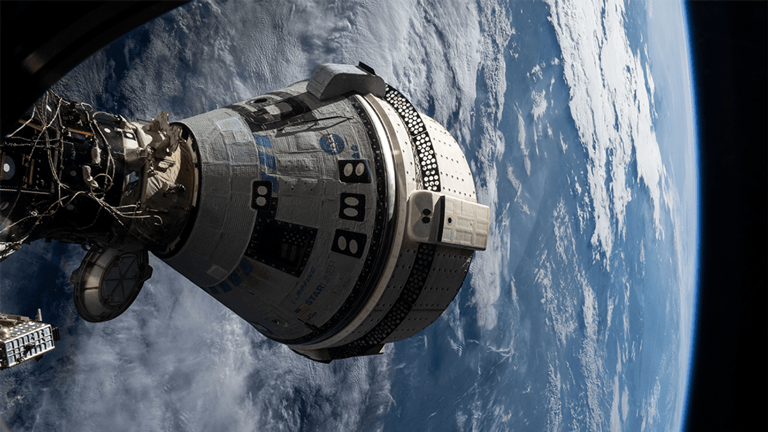
NASA has reviewed the infamous Starliner incident that saw astronauts Sunita "Suni" Williams and Barry "Butch" Wilmore stuck on the International Space Station for 278 days longer than intended. According to the new report, the organization places the "anomalies" in the same category as the Challenger and Columbia disasters.
On 5 June 2024, Wilmore and Williams were launched into space for an eight-day-long mission on board the orbiting laboratory. The two US astronauts were flying onboard Boeing's Starliner spacecraft, the third test of the new vehicle, which was supposed to demonstrate its safety for shuttling astronauts to and from the ISS. But that part didn't go so well.
Before they had docked with the ISS, the crew took over control of the spacecraft for an hour of flight demonstrations. The spacecraft performed well, but the following day saw several troubling anomalies.
"And then we got into day 2. The start of day 2 was the same starting off, and then we did have some failures as we are all aware. We lost an RCS jet, then we lost another one. And then you could tell the thrust, the control, the capability was degraded. The handling qualities were not the same," Wilmore said from the ISS in June 2024.
"From that point on you could tell that the thrust was degraded," Wilmore added. "At the time we didn't know why."
Starliner docked safely with the ISS, and Williams and Wilmore climbed on board what would turn out to be their home for the next nine months. NASA and the astronauts aboard the space station attempted to figure out the issue while the spaceship was still docked, but eventually Starliner returned to Earth without a crew.
In a new report and press conference, NASA revealed that it considers the incident a "Type A" mishap. This is the most serious category of incidents outlined by the agency.
“The Boeing Starliner spacecraft has faced challenges throughout its uncrewed and most recent crewed missions. While Boeing built Starliner, NASA accepted it and launched two astronauts to space. The technical difficulties encountered during docking with the International Space Station were very apparent,” NASA Administrator Jared Isaacman said in a statement.
“To undertake missions that change the world, we must be transparent about both our successes and our shortcomings. We have to own our mistakes and ensure they never happen again. Beyond technical issues, it is clear that NASA permitted overarching programmatic objectives of having two providers capable of transporting astronauts to-and-from orbit, influence engineering and operational decisions, especially during and immediately after the mission. We are correcting those mistakes. Today, we are formally declaring a Type A mishap and ensuring leadership accountability so situations like this never reoccur. We look forward to working with Boeing as both organizations implement corrective actions and return Starliner to flight only when ready.”
To qualify as a Type A mishap, an incident must result in mission failure, the loss of crew or a spacecraft hull, or "unexpected aircraft or spacecraft departure from controlled flight for all aircraft except when departure from controlled flight has been pre-briefed".
"This was a really challenging event," associate administrator of NASA, Amit Kshatriya, said during the press conference. "We almost did have a really terrible day."
NASA revealed that while en route to the ISS, several thrusters failed, leaving the crew without "six degrees of freedom" or the ability to control the craft's orientation and direction.
"During the rendezvous and proximity operations, propulsion anomalies cascaded into multiple thruster failures and a temporary loss of six degree of freedom control," NASA Administrator Jared Isaacman explained.
"Now, the controllers and the crew performed with extraordinary professionalism. Flight rules were appropriately challenged, control was recovered, and docking was achieved. It is worth restating," he added. "What should be obvious at that moment had different decisions been made, had thrusters not been recovered, or had docking been unsuccessful, the outcome of this mission could have been very, very different."
Ultimately, NASA acknowledges that there were problems in prior tests of Starliner that weren't properly understood before the crewed mission.
"A mission elapsed timing error prevented the guidance software from calculating orbital insertion burn timing, which triggered excessive thruster firings, incorrect orbital insertion, major propellant use, and ten thrusters that were declared failed off," Isaacman explained of the first orbital flight test in December 2019. "This mission was declared a high visibility close call."
Commercial Crew accepted risks in the [Service Module] propulsion system and the [Crew Module] propulsion system that were not fully understood prior to [Crewed Flight Test]," the report concludes. "These risks included variances to requirements and unexplained anomalies from the previous flight tests. There were no unstated technical concerns among the NASA team during the commit to flight process, but there was a shared underestimation of the likelihood of future thruster failures."
Ultimately, the report concludes that there are issues that need to be addressed and thoroughly tested with Starliner before it is allowed to fly again.
"Starliner has design and engineering deficiencies that must be corrected, but the most troubling failure revealed by this investigation is not hardware," Isaacman added in a letter to NASA colleagues. It is decision making and leadership that, if left unchecked, could create a culture incompatible with human spaceflight."
"Even with our best efforts and programs, like [Commercial Crew Program], that have seen great success, mistakes will occur,” he added. “What defines us is whether we learn from them, improve because of them, and strengthen confidence across this workforce and the nation we serve. That requires transparency and accountability, neither of which can be selectively applied."
It's unclear how much opportunity Boeing will have to ferry further crew to the station with Starliner, given that the ISS is currently due to crash down into Point Nemo in the Pacific Ocean in 2031 (assuming we don't turn it into a space museum). But if they can sort out the issues, there may be opportunities to use the spacecraft beyond the end of the ISS. At the moment, further investigations into the cause of its problems continue.
Greenewald shared the news online, explaining that some server directories had their permissions, the safeguards on who can access or edit them, and the file ownership logs changed without explanation.
Black Vault has become a go-to resource for anyone wanting to see exactly what the government has quietly made public over the last 80 years.
Greenewald has spent three decades organizing information on hidden programs and little-known incidents that suggest the US has been involved in top secret efforts to recover and take advantage of alien technology.
Troves of declassified files the public can freely search through on the Black Vault detail military base reports, witness testimonies, and even CIA directives since the 1940s and 50s which have been unsealed without widespread public knowledge.
The researcher has also publicly revealed every time a Freedom of Information Act (FOIA) request was returned by the CIA, FBI, and other government organizations with little or no response.
The timing of the potential sabotage came just hours after the president's history-making declaration, ordering the Pentagon to disclose anything 'related to alien and extraterrestrial life, unidentified aerial phenomena (UAP), and unidentified flying objects (UFOs).'
Hours after saying Barack Obama acted improperly by allegedly sharing classified information when he said that aliens exist, President Trump ordered the Pentagon to declassify all UFO files
Creator of The Black Vault, John Greenewald Jr, wrote on social media that the website containing 3.8 million declassified files was wiped hours after Trump's UFO order
In a statement released on X, Greenewald said he did not 'fully suspect foul play' but noted that he couldn't rule out the possibility because of the suspicious information he had received from the website hosting provider.
'[They] had no idea what happened, and on their side, they said it was a deletion, not corruption,' the researcher posted on Saturday.
In simpler terms, someone or something intentionally removed every single file from the Black Vault's server, deleting all the records released by the CIA and other groups, without fully shutting down the site so alarms wouldn't go off right away.
Until recently, the US government has flat-out denied that UFOs or extraterrestrial beings existed, maintaining for decades that there has never been any physical evidence recovered that proves something non-human has ever landed on Earth.
Greenewald has previously filed over 11,000 FOIA requests with the US government to obtain these documents, including some declassified reports that date back to the alleged UFO crash landing at Roswell in 1947.
His investigations have also provided legitimate paper trails, detailing how former administrations and the intelligence community created secret task forces of high-ranking military and scientific officials to research UFO incidents.
These groups include the Majestic 12 (MJ-12), which was allegedly formed after the Roswell crash and worked for over two decades investigating sightings of alien spacecraft, working with non-human technology, and contacting extraterrestrials.
The Black Vault contains millions of pages of declassified information from the CIA and other sources on UFOs, secret government projects, and investigations into high-profile assassinations
The Black Vault's records stretch back to early files detailing the US government's actions following the alleged crash of a UFO in Roswell, New Mexico in 1947
Luckily for The Black Vault, Greenewald revealed that all of the more than 3.8 million files were backed up in secure locations and the site was restored soon after the mysterious wiping took place.
'It is a stark reminder to us all, me included. Keep backups. Keep them in multiple places. And never be intimidated by anything that comes our way, no matter what we expect may have happened,' the researcher wrote on X.
The Daily Mail has reached out to Greenewald for comment on the incident, which the researcher called a 'very oddly timed server maintenance.'
'In my honest opinion, I feel it was a very odd-timed server maintenance done by the hosting provider, that went awry,' Greenewald posted Saturday.
'They didn't catch it, and when I did, they didn't take blame, and there was no way to fully prove what happened, and by whom. Could I be wrong? Yes. Could it have been foul play? I can't rule it out.'
Data wipes like this can occur in a few ways, often without it being a malicious attack. However, these file wipes can be done intentionally by bad actors.
The most common problem happens when hosting companies perform routine updates or data cleanups.
If a software glitch, human error, or incompatible changes take place, it could accidentally delete files or alter permissions.
Hardware issues, such as failing hard drives, software bugs, or even power outages, could also corrupt or erase data. However, The Black Vault's host allegedly ruled out corruption, pointing to a deliberate erasing of the declassified files.
That leaves the possibility of hackers breaching the server through vulnerabilities, including weak passwords, outdated software, or phishing attacks.
Once in the system, the attackers might delete files to cause chaos, especially if the site deals with sensitive data that some groups might want suppressed.
Critics of the Trump Administration's promise to release all files tied to UFOs and extraterrestrial contact have claimed the move is merely a stunt to distract the public from other political controversies and nothing about aliens will actually be learned.
Many on social media have pointed to the previous releases of the documents detailing President Kennedy's assassination and the Jeffrey Epstein files both containing heavily redacted information that provided no definitive 'smoking gun.'
In 2016, Secret Service agents caught this man outside the White House. He was throwing papers and a flash drive over the fence because he believed he had to warn the whole country about aliens from Mars.
30‑year‑old former US Marine Kyle Odom, from Idaho, became wanted for the attempted murder of Pastor Tim Remington in Coeur d’Alene, Idaho. Witnesses and police said Odom ambushed Remington in the church parking lot after Sunday services, shooting him multiple times in the head, back, hand, and side at close range before fleeing, yet the pastor survived, which his congregation viewed as a “miracle.” (Source)
The day before the shooting, Remington had prayed onstage with US presidential candidate Ted Cruz at a campaign event, which initially led some people to suspect a political motive. Police soon identified Odom as the only suspect and launched a two‑day manhunt.
Kyle Andrew Odom
Two days after the shooting, on a Tuesday evening, Odom appeared unexpectedly at the White House in Washington, D.C., where tourists were taking photos. Secret Service agents saw him throwing items—documents and a flash drive—over the White House fence and detained him.
When they checked his name, they discovered the Idaho arrest warrant for attempted murder, and his arrest in Washington suddenly ended the nationwide search. Investigators then learned that he had driven from northern Idaho to Boise, boarded a flight, and traveled across the country to deliver his message to the US president, even though he was already wanted for the shooting.
At the same time, Odom had mailed or sent a 21‑page or 40‑plus‑page “manifesto” to his parents and several Idaho TV stations, and he also posted on Facebook about aliens from Mars, changing his profile picture to an alien image.
In the manifesto, he introduced himself as a bright, successful person: born and raised in North Idaho, raised in a loving family, joined the Marine Corps after high school, developed a strong interest in science, studied biochemistry at the University of Idaho, won scholarships and awards, and graduated magna cum laude before being invited to Baylor College of Medicine to work on genetics. He insisted that he was “100% sane, 0% crazy,” but the rest of the document clearly showed an increasingly paranoid, delusional state of mind.
Odom wrote that his problems began in spring 2014, during his final semester at the University of Idaho, when he was stressed by a heavy course load and turned to daily meditation to cope. As he practiced more, he believed he was achieving “extreme states of consciousness,” and during one meditation session, he described an out‑of‑body experience: complete darkness, loss of physical awareness, and then a blue light approaching that he interpreted as another being. After this, he felt his classes suddenly became very easy, as if he had tapped into some new power, and he said he performed far beyond what he had before.
Later, Odom accepted a PhD offer in human genetics at Baylor College of Medicine in Houston but quickly decided to leave, claiming the work had become too easy after his “awakening.”
He wrote that the day after deciding to leave, his life turned into “a living hell”: he could not sleep, he felt he was being targeted, and he believed people around him—including classmates—were not real humans but aliens trying to provoke him into becoming “the next school shooter.” Feeling persecuted, he left Texas and returned to his hometown of Coeur d’Alene, convinced that unknown forces were manipulating his life.
During flights and everyday situations, Odom began to think that strangers were sending him secret messages and that newspaper headlines carried hidden meanings directed at him. Because he had applied to several government agencies, he initially thought this strange communication might be some covert government contact method.
Once back in Idaho, he received a text message from John Padula, an outreach pastor from the Altar Church, inviting him to attend services. When he went, he immediately felt that something was terribly wrong, as if his life was in danger inside the church, so he left.
Odom then began receiving text messages from Pastor Tim Remington, which in reality were Bible verses and spiritual encouragement, but he interpreted them as threatening communications from a hidden group. He believed the verses referred to “their power,” that Remington was sending coded warnings, and that the word “angels” in one message was somehow linked to helicopters flying over his house, which he saw as a sign that powerful beings were after him.
Around this time, he began experiencing intense involuntary physical sensations, which he described as feeling as though external forces were affecting his body. He also reported hearing music and later voices in his head.
As his symptoms intensified, the inner voice, which he believed came from aliens, told him he would be “sacrificed like Jesus and beheaded.” When a stranger with a religious pamphlet knocked on his door, he became delirious and convinced that his death was imminent.
He fled on a one‑way flight to visit family in Albuquerque but believed that the man sitting next to him was reading his mind and that, at the baggage claim, he was “surrounded” by aliens identified by their constant sniffing, which he thought was a dominance behavior. He came to believe that these beings were everywhere, disguised as humans but truly giant green frog‑like creatures with a snout‑like proboscis on their heads.
Odom wrote that the aliens kept pressuring him to go outside alone, and when he refused out of fear they would kill him, they allegedly threatened his family. To protect his family, he claimed he agreed to do whatever they wanted, and he believed they responded telepathically by telling him to “Go to church,” which he took as a command to return to the Altar Church.
At the church, he noticed a smell like “reptile and vinegar” and concluded that whoever he was dealing with was an extraterrestrial species. He admitted that he was hearing voices more often and seeing hallucinations that he intellectually knew were not real, yet he still insisted these were caused by telepathic aliens, not by any mental illness.
A strong adult-themed element ran through his delusions. He described these alleged Martian beings as “hypersexual” and claimed that both male and female entities acted out inappropriate fantasies within his mind.
In one episode, he described being in a grocery store bakery surrounded by older men whom he believed were aliens who mentally stimulated him and instructed him to imagine inappropriate acts. These experiences, along with persistent voices and visions, severely affected his mental health and led him to attempt to take his own life twice.
In one incident, he described trying to harm himself inside his car but later said the perceived entities intervened before he could follow through. Afterward, he admitted himself to a local Veterans Affairs hospital for help. The article notes that it was not immediately confirmed what treatment he received.
After being discharged from the hospital, Odom returned to the Altar Church, where he later said he had a face-to-face meeting with Pastor Remington around August of the year before the shooting. According to Odom’s account, he believed the pastor revealed what he described as a “true” alien form during their conversation. He wrote that the pastor’s appearance seemed to change, with his facial features looking different and his eyes appearing unusual.
Odom later claimed he became convinced that members of the church were involved in a plot against him. He left the church and did not return for some time. In his writings, he described ongoing fears that he was being followed or harassed, including when he attempted to resume his studies.
Odom tried to rebuild his life by studying pharmacology at North Idaho College and said he began to feel some recovery. However, he believed that the aliens followed him into every class, interfered with his ability to study, and harassed him during tests, making it impossible to succeed.
In his view, they targeted him specifically because of his intelligence and his knowledge of genetics, fearing he might spark a “scientific revolution” that would expose them. He wrote that they had trouble controlling his mind because he was “too smart,” so they decided to remove him from society altogether.
After the repeated suicide attempts and ongoing torment, Odom concluded that the only remaining option was to “take action” against the beings he believed were ruining his life. He wrote that his life had been destroyed by “an intelligent species of amphibian‑humanoid from Mars” and said Remington and Pastor Padula were either these aliens themselves or their puppets.
The manifesto did not clearly explain why he chose that specific Sunday to attack, but he openly admitted that he had plotted to shoot Remington. On the day of the attack, he later boasted on Facebook that he had shot the pastor 12 times and claimed no normal human could survive, using this to support his belief that Remington was not human.
In the same manifesto and social‑media posts, Odom expanded his theory into a global conspiracy. He said the world was secretly ruled by an ancient Martian civilization that had infiltrated all levels of human society, and that Pastor Remington was one of them and the reason his life was ruined.
He claimed these Martians are “ubiquitous,” living as both blue‑collar workers and powerful leaders, controlling governments, militaries, and corporations while monitoring every “wild” human like animals in a zoo; he said our freedom is only a carefully crafted illusion. He put together a list of “noteworthy Martians” that included about 50 members of the US Congress from both parties and dozens of Israeli leaders, “every prime minister since 1948,” and he said this list was far from complete.
Part of the manifesto was addressed directly to US President Barack Obama. Odom began by thanking him for his sacrifice to the country, then claimed that aliens were controlling and humiliating the president, boasting to Odom about what they supposedly did to him. He urged Obama to stop letting them humiliate him and framed himself as someone taking a stand to end this nonsense, asking if there could be a better legacy than exposing the Martians. He said his “last resort” was to act to bring all of this to the public’s attention, insisted he was a good and innocent person, and added that the “people” he killed were not what others thought.
After sending his manifesto to family and media and posting online that the world is ruled by an ancient civilization from Mars, Odom traveled to Washington, D.C., to get his information into the president’s hands. When he was arrested at the White House fence, authorities found he had been throwing documents and a flash drive—likely containing the same manifesto—over the fence, and police in Idaho said this document heightened their concern about him during the manhunt.
Not long before his arrest, he had written on Facebook that he was being chased, was sending his story to major news organizations, and had no time left. His capture ended any immediate threat he might pose to the many people he had identified as “Martians” in Congress and elsewhere.
In November 2017, the legal outcome of his actions was decided. In the Idaho state court, then‑32‑year‑old Kyle Odom pleaded guilty to an enhanced aggravated battery charge for shooting Pastor Tim Remington and was sentenced to 25 years in prison, with a requirement that he serve at least 10 years before being eligible for parole.
Remington testified that being shot in the head, hand, and side left him with memory lapses and ongoing health problems that affected every part of his life, yet in court, he publicly forgave Odom, called him the real victim, and said he wished him no harm and would remain his friend despite the attack. (Source)
At sentencing, Odom told the court he was deeply remorseful and explained that, at the time of the shooting, he believed his delusions were real, including the idea that Martians were interfering in his life and controlling people around him. He said he felt like he was dreaming and could not wake up, and that he still sometimes felt that way, emphasizing how lost in his own hallucinations he had been. The judge ordered him to pay more than $216,000 in restitution to cover Remington’s medical expenses, with the possibility of more as new bills came in, reflecting the serious long‑term damage caused by the attack.
Some examples of "geraisites," named after the state of Minas Gerais where they were found, in their different forms. Credit: Álvaro Penteado Crósta/IG-UNICAMP
For the first time in Brazil, researchers have identified a field of tektites. These are natural glasses formed by the high-energy impact of extraterrestrial bodies against Earth's surface. These structures, named geraisites in honor of the Brazilian state of Minas Gerais, where they were first discovered, constitute a new strewn field. This expands the incomplete record of impacts in South America.
The discovery was described in an article published in the journal Geology by a team led by Álvaro Penteado Crósta, a geologist and senior professor at the Institute of Geosciences at the State University of Campinas (IG-UNICAMP). Crósta collaborated with researchers from Brazil, Europe, the Middle East, and Australia.
Until now, only five large tektite fields had been recognized on the planet: in Australasia, Central Europe, the Ivory Coast, North America, and Belize. The Brazilian field now joins this select group.
Where geraisites are found in Brazil
The geraisites were initially located in three municipalities in northern Minas Gerais—Taiobeiras, Curral de Dentro, and São João do Paraíso—in a strip about 90 kilometers long. Since the article was submitted, new occurrences have been recorded in the Brazilian states of Bahia and, more recently, Piauí. According to Crósta, this expands the known area to more than 900 kilometers in length.
"This growth in the area of occurrence is entirely consistent with what is observed in other tektite fields around the world. The size of the field depends directly on the energy of the impact, among other factors," the researcher explains.
By July 2025, the authors had collected approximately 500 specimens, a number that has since grown to over 600 with the most recent findings. The fragments range in size from less than 1 gram to 85.4 grams and reach about 5 centimeters on the longest axis. Their shapes are typical of aerodynamic tektites: spherical, ellipsoidal, drop-shaped, discoid, dumbbell-shaped, or twisted.
Although they appear black and opaque at first, they become translucent under intense light and display a grayish-green color. This color is distinct from that of European moldavites, which have been used in jewelry since the Middle Ages due to their characteristic intense green color. Their dark surfaces are marked by many small cavities.
"These small cavities are traces of gas bubbles that escaped during the rapid cooling of the molten material as it traveled through the atmosphere, a process also observed in volcanic lava but especially characteristic of tektites," says Crósta.
Geochemical fingerprint of geraisites
Geochemical analyses show that geraisites have a high silica (SiO₂) content ranging from 70.3% to 73.7%. The combined content of sodium (Na₂O) and potassium (K₂O) oxides ranges from 5.86% to 8.01%, which is slightly higher than in other tektite fields. Small variations in trace elements, such as chromium (10–48 parts per million) and nickel (9–63 ppm), were identified, indicating that the original material was neither pure nor homogeneous. The presence of rare inclusions of lechatelierite, a form of glassy silica produced at extreme temperatures, further supports an impact origin.
"One of the decisive criteria for classifying the material as a tektite was its very low water content, as measured by infrared spectroscopy: between 71 and 107 ppm. For comparison, volcanic glasses, such as obsidian, usually contain from 700 ppm to 2% water, whereas tektites are notoriously much drier," Crósta points out.
Dating based on the ratio of argon isotopes (⁴⁰Ar/³⁹Ar) indicates that the event occurred approximately 6.3 million years ago, at the end of the Miocene epoch. Three groups of very similar ages were obtained (6.78 ± 0.02 Ma, 6.40 ± 0.02 Ma, and 6.33 ± 0.02 Ma), which is consistent with a single impact event.
"The age of 6.3 million years should be interpreted as a maximum age since some of the argon may have been inherited from the ancient rocks targeted by the impact," the researcher comments.
Hunt for the missing crater
To date, no associated crater has been identified. According to Crósta, this is not unusual; only three of the six large classical tektite fields have known craters. In the case of the largest field, located in Australasia, the crater is believed to be oceanic. In Brazil, isotopic geochemistry indicates that the molten material originated in Archean continental crust between 3.0 and 3.3 billion years old. This directs the search to the São Francisco craton, an ancient and geologically stable portion of the continental crust and one of the oldest regions of the South American continent.
"The isotopic signature indicates a very ancient continental, granitic source rock. This greatly reduces the universe of candidate areas," says Crósta. In the future, aerogeophysical methods such as magnetic and gravimetric surveys may reveal circular anomalies associated with a buried or eroded crater.
Modeling the impact and its scale
While it is not yet possible to accurately estimate the size of the impacting body, researchers consider it unlikely that it was small. The large amount of molten material and the wide area of dispersion indicate a significant impact event, albeit smaller than the event responsible for the Australasia field, which extends for thousands of kilometers.
The team is currently working on a mathematical model of impacts to estimate parameters such as the energy released, the velocity, the angle of entry, and the volume of molten rock. They are doing this as new data on the spatial distribution of geraisites becomes available. The discovery of the geraisites fills an important gap in the record of impacts in South America. Only about nine large impact structures are known there, and almost all of them are much older and located in Brazil. This discovery also reinforces the idea that tektites may be more common than previously thought, but often go unnoticed or are mistaken for ordinary glass.
To combat sensationalist interpretations of cosmic impacts, Crósta manages the @defesaplanetaria Instagram profile with undergraduate students. The profile is dedicated to scientific dissemination and differentiating real risks from irresponsible speculation about meteorites and asteroids. Impacts were frequent during the formation of the solar system when a large amount of debris was scattered and planetary orbits were undefined. Large bodies migrated from one position to another, projecting smaller bodies in various directions. However, today, with the system stabilized, impacts are incomparably less frequent.
"Understanding these processes is essential to separating science from speculation," the researcher concludes.
Publication details
Alvaro P. Crósta et al, Geraisite: The first tektite occurrence in Brazil, Geology (2025). DOI: 10.1130/g53805.1
NASA’s Perseverancerover can now determine its location on the Red Planet independently, using its own “brain” and cameras. This saved it from having to “call” Earth every time to find out where it was. Engineers at the Jet Propulsion Laboratory (JPL) have essentially created a local navigation system for it that operates in real time.
Perseverance Mars rover. Photo: NASA/JPL
Imagine you find yourself in the middle of a vast desert with no landmarks or maps, and you are only allowed one phone call per day to ask, “Where am I?” This is how JPL robotics expert Vandi Verma describes the many years of work done by rovers.
Blind navigation
This panorama, taken by Perseverance, consists of five stereo pairs of images from the navigation camera, which the rover matched with orbital images to pinpoint its location on February 2, 2026, using a technology called Mars Global Localization. NASA/JPL-Caltech
Until recently, Perseverance, which has been exploring Jezero Crater for five years, relied on a combination of data: it analyzed images from its own cameras, measured wheel slip in dust, and cross-referenced satellite photos sent from Earth. However, due to the enormous distance of approximately 225 million kilometers, the signal took too long to arrive, so it took an entire Martian day to correct the route. If the rover was unsure of its position, it would simply stop and wait for “permission” from Earth. Over time, navigation errors accumulated and could reach more than 35 meters.
Space Google Maps
To solve this problem, engineers led by Jeremy Nash and Vandy Verma developed the Mars Global Localization system. It’s a kind of “space Google Maps” for the Mars rover.
How does it work? Perseverance is now taking pictures of the surrounding area, and a built-in algorithm compares them with detailed maps obtained from orbital spacecraft such as the Mars Reconnaissance Orbiter in just two minutes. The system automatically finds common features in the landscape — rocks, craters, sand dunes — and determines the rover’s coordinates with an accuracy of 25 cm. Human intervention in this process is no longer necessary.
Breakthrough that has been decades in the making
Development of the technology began in 2023. Archival images from 264 rover stops were used to test the algorithm — the system never made a mistake. In early February 2024, the function was successfully applied in practice for the first time in real conditions on Mars.
“We have given the Mars rover a new ability. This has been an open problem in robotics for decades, and it is incredibly exciting to finally see it solved in space,” said Jeremy Nash.
This update came shortly after Perseverance learned to plan routes using generative artificial intelligence. The AI independently assesses the terrain for hazards — boulders, steep slopes — and plots a safe route.
The future of autonomous missions
Now that the rover knows its exact location online, it can move much faster and cover greater distances every day. As scientists note, it was uncertainty about coordinates, rather than the dangers of the landscape, that was the main limitation on its travels.
This technology opens up a new era in the exploration of the Solar System. According to Vandy Verma, this algorithm is universal: “It can be used by almost any other rover that moves quickly and far.” This means that future missions to Mars and other planets will be able to work more efficiently, spending their time on real scientific discoveries rather than waiting for instructions from Earth.
Astronomers working with the James Webb Space Telescope (JWST) have published a spectacular new image. It shows the galaxy NGC 5134.
Galaxy NGC 5134 (photo by James Webb). Source: ESA/Webb, NASA & CSA, A. Leroy
NGC 5134 is located 65 million light-years from Earth in the direction of the constellation Virgo. This is a gigantic figure by human standards — we see the galaxy as it was at the time of the extinction of the dinosaurs. But by cosmological standards, NGC 5134 is quite close to us. And thanks to this relative proximity, JWST was able to see many details of its spiral structure.
JWST conducts observations in the near and mid-infrared range. The main source of “near” infrared waves are stars and star clusters scattered throughout the spiral arms of the galaxy. As for “medium” waves, they are emitted by warm dust, which saturates the gas clouds filling the galaxy. Dust particles consist of complex organic molecules called polycyclic aromatic hydrocarbons. They form flat ring-shaped structures, very similar to honeycombs in beehives. On Earth, they are found in smoke from fires, car exhaust fumes, or, say, burnt toast.
By combining the data collected by JWST, astronomers were able to obtain a portrait of the life cycle of a galaxy. The gas clouds stretching along the spiral arms of NGC 5134 are sites of star formation. Each star that forms gradually depletes the available gas reserves. They are partially replenished in the process of the death of old stars. The largest stars, whose mass exceeds that of the Sun by more than eight times, do so in spectacular ways, as a result of catastrophic supernova explosions, ejecting their matter hundreds of light years away.
Stars similar to the Sun also return some of their material, although not as spectacularly. They become red giants, after which they shed their atmosphere into space, forming planetary nebulae. In the future, this ejected material may become part of a new generation of stars. The same fate awaits our Sun in the future.
Everyone knows that there are volcanoes on Mars. Everyone knows that there are glaciers on Mars. But now scientists suggest that, at least on some volcanoes on the red planet, glaciers may be hidden under a layer of ash.
Hecates Tholus. Source: Wikipedia
Prevalence of glaciers on Mars
When we think of ice on Mars, we usually mean the poles, where it can be seen with probes and even ground-based telescopes. But the poles are difficult to reach, and even more so because of restrictions on research there due to potential biological contamination. Scientists had long hoped to find water closer to the equator, which would make it more accessible to human explorers. There are parts of Mars’ mid-latitudes that look like glaciers covered with thick layers of dust and rocks.
So, do these formations really conceal large reserves of water near the place where humans may first set foot on the Red Planet? Perhaps, yes, according to a new article by M.A. de Pablo and his co-authors, recently published in the journal Icarus.
The key may be a small volcanic peninsula in Antarctica. Known as Deception Island, this volcano covered part of the surrounding huge glaciers with ash and dust from a series of eruptions in the 1960s and 1970s. The authors believe they have found a volcano with a similar history on Mars, known as Hecates Tholus.
Hecates Tholus. is an ancient shield volcano on Mars that shares many of the same features as the volcano on Deception Island. And since we know that there is ice beneath the debris in Antarctica, this could mean that similar features may be found beneath the debris around Hecates Tholus.
Evidence of a glacier near Hecates Tholus
There is some compelling evidence on Mars that suggests the presence of glacial ice, rather than just loose rock or even rock cemented together with a small amount of ice. First and foremost, there are the crevasses. Any researcher will tell you how absurdly dangerous these features are on Earth, but the key characteristic on Deception Island is their visibility from space, especially near the so-called “headwalls” of the glacier — steep, almost vertical cliffs at the upper end of the glacier.
Such features are visible from space on Hecates Tholus, and such clear, visible fractures would not be noticeable if there were simply rock beneath them. In particular, these fractures mean that the solid ice core is still moving beneath the surface of volcanic debris.
Another direct piece of evidence is the presence of bergschrunds. These are distinct, deep cracks that form at the top of a glacier. Technically, all bergschrunds are a type of crack, although they are significantly larger and are formed by a very specific process compared to ordinary cracks. This process consists of separating movable ice from frozen ice. Some examples of bergschrunds near Hecates Tholus reach lengths of 600 m and are clear evidence that, at least at a certain point in time, there was active ice movement.
The final proof is the bulldozer effect, or, more precisely, the presence of “push moraines” at the bottom of the valleys of both Deception Island and Hecates Tholus. When glaciers move, they act like bulldozers, pushing huge rocks in front of them and leaving hilly terrain behind. Similar formations, such as those seen on Deception Island, are again visible around the volcano, indicating that a glacier once actively existed in this area.
Overview and context of Hecates Tholus, Mars (left) and the terrestrial analog, Deception Island (right).
Credit: Icarus (2026).
DOI: 10.1016/j.icarus.2026.116966
How to find hidden glaciers?
So if these glaciers really exist, how have they managed to survive for millions of years without evaporating? The authors propose a two-stage process. Initially, when cracks formed, some of the water actually sublimated, but these holes were then covered with dust, protecting the newly exposed water from further sublimation. Ultimately, this led to the formation of shallow “troughs,” which we actually see on Mars instead of real cracks.
One obvious question for people who closely follow Mars exploration is: why didn’t SHARAD see anything there? If there is a subsurface glacier at the equator, then the ground-penetrating radar on the Mars Reconnaissance Orbiter would undoubtedly be able to detect a signal from it. The physics of SHARAD radar does not work well on the steep slopes of volcanoes, making it difficult to obtain a clear image of what lies beneath the dust and debris. In order to truly understand the situation better, we will need samples from the surface, both from robots and from humans.
Fraser talks about the restriction of exploration missions to the Martian South Pole.
Avoid contamination
If there really are huge glaciers on Mars hidden beneath the dome of Hecate, there may be many others hidden beneath other massive volcanoes. Article IX of the 1967 Outer Space Treaty requires that exploration of other bodies in the Solar System be conducted in such a way as to avoid “harmful contamination” of celestial bodies. Many interpreted this article as a requirement for researchers to avoid the Martian poles, where there is evidence of large amounts of water. If it turns out that there is water all over Mars, hidden under volcanic debris, does that mean that these areas are now also off-limits to researchers?
Only time will tell the answer to this question — we may never know if there is water around these volcanoes unless we send researchers there — everything we can do remotely is limited. There are some proposals for missions that could resolve this question, such as FlyRADAR, but we will have to wait for the final word on whether Martian volcanoes are covered by glaciers — and perhaps look at the deceptive volcano on our own planet in the meantime.
The Karl G. Jansky Very Large Array (VLA) in New Mexico at night. Credit: NRAO
More than sixty years ago, Dr. Frank Drake and his colleagues conducted the very first experiment dedicated to the Search for Extraterrestrial Intelligence (SETI). Since then, astronomers have continued to scan space for signs of alien transmissions, predominantly in the radio spectrum. In more recent years, the search has expanded to include thermal signatures and optical flashes, and additional forms of technological activity ("technosignatures") are already being incorporated. So far, all these experiments have produced null results, prompting SETI researchers to consider what they might be missing.
One possibility that repeatedly comes up is the notion that we are not looking in the right places. This certainly makes sense, since all SETI surveys to date have only covered a limited range of the radio spectrum. Following that logic, could it be that Earth has already received signals, but we didn't realize it because we weren't listening on the right frequency? According to a new study by Claudio Grimaldi, a researcher at the Laboratory of Statistical Biophysics at the Swiss Federal Technology Institute of Lausanne (EPFL), it's unlikely that we have.
The study, "Undetected Past Contacts with Technological Species: Implications for Technosignature Science," recently appeared in *The Astrophysical Journal*. Using Bayesian Analysis, a statistical technique that updates probabilities based on evolving data sets, Grimaldi examined how undetected past signals would have implications for current SETI surveys. In particular, he examined how past signals would increase the odds of detecting one today, and the likely source of those transmissions.
*The Milky Way galaxy, showing the central bulge at its center.
Credit: NASA*
As a starting point, he modeled technosignatures as active emissions or artifacts from an advanced civilization that then spread at the speed of light, lasting for brief periods (a matter of days) or for very long ones (millennia). He also considered how detection would only happen if the transmission is within range for the signal to be strong enough for our instruments to detect. He also considered omnidirectional signals (waste heat from megatructures) and highly focused signals (beacons, laser flashes, etc.). The resulting model addressed three possible elements:
The number of past contacts with Earth
The typical lifetime of technosignatures
The distance range that current or near-future instruments can probe
For "contact optimists," the results were not encouraging, suggesting that a very large number of undetected signals would have had to reach Earth in the past for there to be a high probability of detecting technosignatures closer to our Solar System today. In some cases, the number of signals exceeded the number of potentially habitable planets within a few hundred to a few thousands light-years from Earth, making any past or future signals highly unlikely. However, the results were different when extended to much greater distances.
Assuming technosignatures are long-lived and propagate across the entire Milky Way, detection becomes more likely at distances of several thousand light-years or more. However, the number of detectable signals across the entire galaxy at any given time remains very low. These results indicate that our inability to detect signals in the past does not mean detection will likely occur in the near future. Instead, they suggest that transmissions from advanced civilizations are likely to be rare, distant, and long-lasting, rather than local and frequent.
In other words, the field of SETI appears to be destined for a long wait before any discernible technosignatures (intentional or the result of "spillover") will be detected. Far from discouraging SETI efforts, however, the results suggest that future SETI efforts should focus on deeper, broader surveys that scan large parts of the Milky Way rather than individual stars or star clusters located a short distance away (in cosmic terms).
Not AGAIN! NASA's Artemis II moon mission is delayed for a second time after several last–minute issues are spotted on the SLS rocket – as furious fans call for SpaceX to step in
Not AGAIN! NASA's Artemis II moon mission is delayed for a second time after several last–minute issues are spotted on the SLS rocket – as furious fans call for SpaceX to step in
NASA's Artemis II moon mission has been delayed for a second time after several last–minute issues were spotted on the Space Launch System (SLS) rocket.
Mr Isaacman says that the reason for the delay is an 'interruption in helium flow in the SLS interim cryogenic propulsion stage'.
The system worked during both wet dress rehearsals, but engineers were unable to get helium flow through the vehicle during routine maintenance on Saturday night.
Now, as the long–awaited moon mission is pushed back once again, some frustrated fans have called for Elon Musk's SpaceX to step in with assistance.
Taking to X, one fan vented: 'Time to scrap the 1960s tech and innovate to build next gen space launch vehicles and to stay on par with SpaceX.'
NASA's Artemis II moon mission has been delayed for the second time, as last–minute technical issues are found in the Space Launch System (SLS) rocket
NASA administrator Jared Isaacman said that the issue had been caused by an 'interruption in helium flow in the SLS interim cryogenic propulsion stage'
Fed–up space enthusiasts have taken to social media to vent their irritation over the persistent delays.
One commenter wrote: 'At this rate, the Chinese will soundly beat us to the Moon.'
Others explicitly suggested that SpaceX should be called on to lend assistance or even replace the SLS rocket altogether.
On X, which is owned by SpaceX CEO Elon Musk, one commenter wrote: '@SpaceX Those guys need a ride to the moon, please help them.'
Another asked: 'When will NASA stop the financial haemorrhaging and turn this program over to SpaceX?'
'Can we get out of this contract and save money with SpaceX,' suggested another.
In particular, a number of space fans suggested that the experimental Starship rocket could make a viable replacement.
Mr Isaacman (left) says that the setback will 'almost assuredly' affect the intended March launch date, ruling out the Artemis II launch until April
Mr Isaacman says the systems performed well during both wet dress rehearsals, but unexpectedly failed during a 'routine operation'
On X, frustrated space fans have called for Elon Musk's SpaceX to provide assistance to the Artemis II programme
Why does NASA use hydrogen fuel?
The SLS rocket uses a mixture of liquid hydrogen and liquid oxygen.
Since hydrogen is such a small molecule, it is extremely prone to leaking.
However, hydrogen is also cheap, naturally abundant, and produces a phenomenal amount of energy.
According to NASA, this mix gives the 'highest specific impulse, or efficiency in relation to the amount of propellant consumed, of any known rocket propellant'.
Another important factor is that the SLS rocket inherits a lot of its hardware and systems from the Shuttle era rockets.
These engines were built to run on hydrogen, so NASA can't change fuels without an expensive redesign of the entire rocket and engine system.
'I beginning to think that the SpaceX Starship will be launching astronauts to space before the Artemis program,' one commenter suggested.
While one added: 'Time to replace SLS with Falcon Heavy. Might even actually do it faster with Starship.'
For context, SpaceX has been contracted by NASA to provide a modified version of Starship for the lunar landing during the Artemis III mission.
In April 2021, NASA awarded Elon Musk's company a $2.9 billion contract to provide the first crewed lunar lander, but SpaceX is widely expected to miss the 2027 target date.
Last year, acting NASA administrator Sean Duffy threatened to open up the contract to other countries due to persistent delays, saying at the time: 'The problem is, they're behind.'
However, NASA's immediate problems are the ongoing delays afflicting the problem–plagued SLS rocket.
Mr Isaacman says that the source of the problem could be located in one of the filers or quick–disconnect 'umbilicals' that pass gases between the ground and the rocket.
Alternatively, he says that the issue could have been caused by a 'failed check valve onboard the vehicle, which would be consistent with Artemis I'
Angry commenters lamented the costs of the SLS rocket and its persistent delays, arguing that the mission should be turned over to SpaceX
One commenter asked why America could 'get out of this contract' in order to save money with SpaceX
The SLS rocket will now need to roll back to the Vehicle Assembly Building at the Kennedy Launch Centre for repairs, meaning that another wet dress rehearsal is almost certain
After problems with the helium system were discovered overnight, NASA has now made the disappointing decision to roll SLS back to the Vehicle Assembly Building (VAB) at Kennedy Space Centre.
While the agency has a limited capacity to fix issues at the launch tower, more serious problems need to be addressed in the VAB, which gives engineers better access to the vehicle.
The vibrations caused by rolling the rocket in or out of the VAB risk loosening or disturbing seals and valves, meaning that one or two more wet dress rehearsals are almost certain.
After the success of the second wet dress rehearsal, the Artemis II crew entered quarantine in Houston, Texas, on Friday night.
During quarantine, the crew limit their exposure to other people so that they can stay in good health for the flight.
This procedure usually starts 14 days out from the launch date, but NASA has not said whether the crew will be able to leave quarantine before the April launch date.
Writing on X, Mr Isaacman added: 'I understand people are disappointed by this development. That disappointment is felt most by the team at NASA, who have been working tirelessly to prepare for this great endeavor.'
Launch date: NASA initially identified three possible launch windows for Artemis II: From February 6 to February 11, from March 6 to March 11, and from April 1 to April 6. The space agency is now targeting the April window.
Mission objective: To complete a lunar flyby, passing the 'dark side' of the moon and test systems for a future lunar landing.
Total distance to travel: 620,000 miles (one million km)
Mission duration:10 days
Estimated total cost: $44 billion (£32.5 billion)
- NASA Space Launch System rocket: $23.8 billion (£17.6 billion)
An exceptionally hungry black hole from the dawn of the universe is growing at 13 times the cosmic 'speed limit', experts say.
Astronomers have used high–tech telescopes to 'look back in time' to around 12 billion years ago, not long after the universe was born.
There, they spotted something unexpected – a supermassive black hole that already weighed 440 million solar masses.
This means it was growing at an unimaginably fast rate, they said, absorbing gas and dust quicker than it was believed possible.
According to theory, there should be a limit on how fast black holes can grow because the act of 'ingesting' matter creates an opposing force which prevents more matter from being absorbed.
But this cosmic giant, known as ID830, is defying expectations – and could mark the discovery of the fastest–growing supermassive black hole of a similar mass found to date.
Researchers suggest the black hole may have 'collided' with a star or clump of gas, giving it enough energy for this remarkable growth spurt.
'This discovery may bring us closer to understanding how supermassive black holes formed so quickly in the early universe,' lead author Sakiko Obuchi said.
A graph displaying ID830's uniquely brilliant luminosity, compared to previously observed objects. The solid line shows the upper 'limit' of how it should be growing
An artist's impression of a supermassive black hole. Gas accretes onto the central black hole, forming an accretion disk and jets
The team, from Waseda University and Tohoku University in Japan, used the Subaru Telescope to analyse the black hole.
What makes this one even more striking is its multiwavelength behaviour, the researchers, who published their findings in The Astrophysical Journal, said.
When black holes undergo growth spurts, most models predict that their structure changes in ways that can reduce X–ray emissions and that their plasma and radiation jets may be less obvious.
However, this particular black hole shines brightly in both X–rays and radio wavelength.
This unexpected combination suggests scientists still have more to learn about the mechanisms of early black hole growth, the team said.
'Going forward, we hope to explore the mechanisms of X–ray and radio wave emission from this quasar and determine whether there are any similar objects yet to be discovered,' Dr Obuchi said.
They suggest they may have observed the black hole during a short transitional period, possibly following a sudden influx of gas.
This could prompt both the X–ray–emitting corona and the radio jet to become highly energised before the system gradually settles into a more typical mode of growth.
In a press release from the universities, the researchers said: 'Data from the Subaru Telescope show a surprising mix of traits.
'The quasar is pulling in matter at an exceptionally high rate while also emitting intense X–rays and launching a strong radio jet.
Black holes are so dense and their gravitational pull is so strong that no form of radiation can escape them - not even light.
They act as intense sources of gravity which hoover up dust and gas around them. Their intense gravitational pull is thought to be what stars in galaxies orbit around.
How they are formed is still poorly understood. Astronomers believe they may form when a large cloud of gas up to 100,000 times bigger than the sun, collapses into a black hole.
Many of these black hole seeds then merge to form much larger supermassive black holes, which are found at the centre of every known massive galaxy.
Alternatively, a supermassive black hole seed could come from a giant star, about 100 times the sun's mass, that ultimately forms into a black hole after it runs out of fuel and collapses.
When these giant stars die, they also go 'supernova', a huge explosion that expels the matter from the outer layers of the star into deep space.
A series of encounters between US Navy fighter jets and strange, unknown aerial phenomenon (UAP) in 2004 and 2015, together with more recent incursions into American military exercise areas, has stirred up both interest and debate in the UFO subject since the now-infamous FLIR videos were released into the public domain in 2017. Of course, these were not the first instances of pilots seeing strange flying objects at close quarters, as numerous accounts of American and British military pilots being sent aloft to investigate sightings of UFOs have been recorded since the late 1940s and early 1950s.
What is not generally appreciated by those engaged with the subject is that even these encounters were not the first time that military aircrew had witnessed odd lights and even stranger-looking craft in the skies at close range. In some cases, pilots even fired at these mysterious aerial intruders. To properly examine these cases, we have to go back to World War Two and the stories of what had been known at the time as Foo Fighters (that’s right, Dave Grohl didn’t come up with his band’s name on his own).
Background: What You Know About The Foo Fighters May Well Be Wrong
Ask most UFO enthusiasts about the Foo Fighters and you will probably hear vague stories about US Army Air Force night-fighter crews who saw balls of light following their aircraft over Germany during the last months of World War Two. They may cite the Smokey Stover cartoon, popular among aircrew at the time, as the origin of the name “Foo Fighter”. Some may even throw in cases from the Pacific Theatre of Operations, again dating from the final year of the war, when crews watched “balls of fire” pacing their B-29 Superfortresses on missions over Japan.
While this is a good start, the established narrative regarding the Foo Fighters has been largely incorrect for as long as I can remember, especially when it comes to identifying when the phenomenon began. Pick up a UFO book that covers the subject and you will likely be told that sightings of Foo Fighters started at the end of November 1944 when the term was invented by a member of the 415th Night Fighter Squadron serving in France. We have an article printed in the December 1945 edition of American Legion Magazine to thank for this. It listed the 415th NFS mystery light reports beginning in November 1944, stating “this is the way they began”. Authors in the 1950s and 1960s seemed to take this statement at face value, and so the legend of the Foo Fighters began on a false premise.
What is less well known is that Royal Air Force bomber crews had been reporting strange lights, luminous objects, and large “aeroforms” in the skies over Germany since March 1942. The small number of UFO researchers who have looked at the subject in depth have discovered a huge number of sightings spanning the globe from 1942 onwards, although if you look hard enough, there are also reports of strange lights dating back to the time of the German invasion of Belgium in May 1940. Although the American night-fighter crews used the term Foo Fighters, the phenomenon had been known by many other names prior to that phrase being coined. Terms such as “meteors” and “rockets” were often used in official reports, but many RAF pilots simply referred to the phenomenon as “The Light” or “The Thing”. What is also not widely known is that lights were not the only items aircrews reported seeing. Huge cylindrical objects with portholes, inverted “bathtubs” and huge “blankets” were also sighted.
“You guys must be nuts! Nobody up there but your own plane. Aint seeing things, are you?” – Ground radar station reply to American night-fighter pilot after report of strange lights, November 1944
Over the last twelve months, I have been revisiting and re-evaluating the known Foo Fighter cases, and in the course of my research, have also found some new encounters in preparation for a book I am writing on the subject. Much of the information is buried in Air Intelligence files and squadron war diaries, most of which is barely legible due to the ravages of time on the flimsy wartime grade of paper used. However, many cases never saw official recognition, and researchers have to rely upon aircrew logbooks and personal interviews, in many cases conducted decades after the events being recalled. The vast majority of wartime witnesses are now deceased, and a large proportion took the details of their sightings to their graves, electing to keep quiet about their encounters.
There are well over one hundred known Foo Fighter sightings from the three main battlefronts during World War Two (Western Europe, Mediterranean, and Pacific), but strange lights and unidentifiable craft were also witnessed over both North Africa and the Eastern Front. To give an idea of the encounters that transpired during the war, here are three of those cases, all of which occurred long before the traditionally accepted start of the Foo Fighter phenomenon in November 1944.
“Several projectiles seemed to enter the luminous disc, but without result, although the object was well within range, approximately 150 metres.” – March 1942 encounter over the Ruhr Valley, Germany
A Polish-crewed Vickers Wellington bomber was returning from a raid on Essen just before midnight on 25th March 1942 when the aircraft’s rear gunner spotted a bright light approaching their aircraft. However, instead of a Luftwaffe night-fighter, it resembled a large fuzzy copper-colored ball, about the size of the Moon. Approaching within 200 yards of the bomber, the gunner opened fire, watching helplessly as his tracer rounds entered the ball of light to no visible effect. They did not come out the other side, nor did they inflict any appreciable damage. The strange light then shot forward and took up position off the Wellington’s port wingtip.
Now the aircraft’s nose turret guns could be brought to bear on the strange light, and both gunners blazed away at what was still thought to be a Luftwaffe night-fighter. The pilot executed a series of evasive maneuvers but could not shake the ball of light. It remained at the same fixed distance, seemingly undamaged, for several minutes until it finally flew around to a point ahead of the Wellington, remaining in place for a few seconds before shooting off into the distance and disappearing. Another crew flying behind the bomber also had their own encounter with the object but refused to report the incident for fear of ridicule.
“By turning suddenly and steeply, I was able to chase the light around in a circle until I could aim my four 20mm cannons at it. This I did several times until my ammunition was exhausted, but each time I observed, no apparent change in the behaviour of the light.” – RAF fighter pilot’s 1943 sighting
In the spring of 1943 over North Africa, a New Zealand fighter pilot was followed by an orange-red glow, a light that then moved to sit off his wingtip, matching his every turn, including a series of violent evasive maneuvers designed to throw off potential attackers. Taking advantage of an apparent time lag before the object matched his actions, he managed to fire his Hawker Hurricane’s guns at the light on a few occasions, but to no effect. The pilot could not distinguish what kind of aircraft or object was generating the light, as it was so bright. It grew dimmer as they crossed the front line but once beyond the firing it glowed with its original intensity. The RAF pilot’s mysterious companion vanished as he returned to base. He knew of numerous colleagues who also had run-ins with “The Light”. This encounter, similar in many respects to Commander David Fravor’s now-infamous dogfight with the “Tic Tac”, predated that event by more than sixty years.
“He was terrified, as white as a ghost. Something up there sure scared the hell of out him, he was nearly frantic when he got out of his aircraft.” – The effect on an American night-fighter crewman, October 1944
The US Army Air Force’s 422nd Night-Fighter Squadron had its fair share of sightings in late 1944 and early 1945, including a notable event over western Germany during the first week of October 1944 when an extremely rapid object latched onto the tail of one of the unit’s Northrop P-61 Black Widows. The mysterious ball of light followed the crew’s machine as the pilot threw it into a violent set of evasive maneuvers. Despite his best efforts, he could not shake off his pursuer, and in desperation finally dove into a bank of cloud. The ball of light did not follow. Colleagues in the squadron stated that the pilot’s radar observer was badly shaken by the experience and was “still sucking wind 24 hours later”. The mysterious ball of light was officially logged as a Messerschmitt Me 163 Komet rocket-propelled interceptor. There would be many more bizarre encounters with strange lights before the year was out.
Analysis: Were the Foo Fighters Enemy Secret Weapons?
The night skies over the industrial cities of Germany were filled with lights when a raid was in progress. Multi-colored flares were dropped to mark targets and were replaced during attacks as they burned out. The Germans employed decoy flares to distract RAF bomber crews, and Luftwaffe night-fighter crews used “fighter flares” to silhouette enemy aircraft against the clouds, rendering them more visible to their colleagues. Sudden explosive balls of light, accompanied by sparkling lights, were often seen falling slowly towards the ground. RAF crews believed they were German attempts to simulate bombers being shot down in an attempt to lower morale. Nicknamed “Scarecrows”, they featured prominently in intelligence bulletins, and crews were encouraged to believe they were indeed German scare tactics. In reality, they were aircraft being blown out of the sky by flak and night-fighters. However, Allied aircrew had been very familiar with all of these flares and lights. They did not resemble the Foo Fighters in any way, shape, or form.
Because of wartime secrecy and censorship, most reports of strange lights and unconventional flying craft were never publicized due to the possibility that they may have been German secret weapons. Also, individual unit intelligence officers decided whether such reports were officially recorded and then sent up the chain of command for analysis. They frequently dismissed crew testimony and instead asked them whether they had been drinking. If official reports were filed, ribald comments and ribbing from colleagues followed, at least until they too saw something weird and unsettling. The Foo Fighter reports that do exist are a fraction of a much larger number of sightings.
“[The enemy] have several land service rocket weapons, and the introduction of anti-aircraft rockets seems a likely and logical development.” – 1943 Air Intelligence briefing
Both the British and American Air Intelligence staff were completely flummoxed by the reports of strange flying objects and the balls of fire that followed aircraft without committing hostile acts. The early reports of 1942 and 1943, including “rockets” that altered course when pursuing RAF bombers, plus a 200-foot long object with red lights spaced at regular intervals along its length, were thought to be examples of new German secret weapons. Extra-terrestrials and so-called “flying saucers” were still several years off into the future, and they were never considered as a possible explanation. Most reports of mysterious lights were believed to be sightings of decoy flares, airborne searchlights, or rudimentary surface-to-air missiles, items which the enemy were believed to be developing at that time. With the available information to hand, these were rational and sensible suggestions, but with the benefit of hindsight, and a working knowledge of German wartime weapons research and deployment, these suggestions were actually way off the mark.
The RAF had experimented with fitting searchlights into night-fighters but found that they blinded their pilots, rendering the scheme useless, and the Germans refused to devote resources to the subject, instead relying on ground-based installations. Several surface-to-air missile projects were being developed in late 1943 and throughout 1944, however frequent engine and guidance problems, together with political interference, prevented any achieving operational status. Most test launches were failures. Air-to-air rocket mortars were fired at B-17 Flying Fortresses and B-24 Liberators on daylight raids over Germany by defending fighters by mid-1943 onwards, although again these weapons were never used at night. The Luftwaffe almost deployed a wire-guided air-to-air missile in early 1945 but the factory producing the rocket motors was destroyed in a bombing raid.
Once the Luftwaffe started to fly their early jet and rocket-powered interceptors in the autumn of 1944, the strange nocturnal lights were frequently referred to as “jets” in both American and British official records. This, despite the fact that the crews were actually witnessing balls of light, not aircraft, and in any case, the Germans did not operate their jet or rocket types at night at that time. A small number of Messerschmitt Me 262s jet fighters, converted to the night-fighter role, operated in the defense of Berlin from mid-December 1944 but they never flew in areas where Foo Fighters were encountered. The rocket-propelled Me 163 Komet appears in numerous combat reports by RAF night bomber crews, but it was never flown in the dark, as it was almost too dangerous to fly even by day. However, none of these German secret weapons matched the witness reports describing the Foo Fighters’ maneuvers and capabilities.
“Intelligence reports seem to indicate it is radio-controlled from the ground and can keep pace with planes flying 300 miles per hour.” – US newspaper report, 1945
Labeled as new Nazi secret weapons, reports of Foo Fighters started appearing in American newspapers during December 1944, but the armchair experts called upon by editors to comment on the stories were just as clueless as the Air Intelligence staff. As Allied ground forces pushed into Germany during the spring of 1945, the number of sightings dropped almost to zero. When the war finally ended in May 1945, the Foo Fighters seemed to disappear from Western Europe, suggesting that they were indeed German secret weapons. However, scrutiny of captured aircraft factories and testing facilities found nothing that resembled the Foo Fighters. None of the aircraft or missile designs that were discovered, or design plans that were found, matched the tremendous capabilities displayed by the balls of light. Captured scientists and technicians were interviewed but could not shed any light on the matter either. It turned out that the Germans were as much in the dark about the phenomenon as the Allies were.
The focus of the war changed to the Pacific, where similar sightings of strange balls of light, impervious to machine-gun fire, had been witnessed since August 1944, although sporadic reports of odd-looking objects had been filed since the end of 1942. Crews from Major William (“Butch”) Blanchard’s 40th Bomb Group saw mysterious “balloons” over Japan in October 1944, and Blanchard himself would be at the center of the Roswell UFO crash controversy almost three years later. Air Intelligence believed that some sightings in the Pacific were of German technology supplied to the Japanese. Plans for various weapons were indeed donated by Germany towards the end of the war, however, it was too late to put them into production. Once hostilities in the Pacific ended with the dropping of the two atomic bombs, the number of reports dwindled too. Interest in the Foo Fighters waned, and the wartime reports were filed away and forgotten. No one ever managed to put forward an explanation that stood the test of time. The Foo Fighters are as much a mystery to today’s researchers as they were to the intelligence officials of 1944.
Outlook: The More UFOs Change, The More They Stay The Same
Looking back to incidents that occurred nearly eighty years ago may seem like a waste of time to people caught up in the current heady rush of US Navy encounters, UAP photos, and future government briefings. What appears to be forgotten is that the accounts of November 1944 and November 2004 are not too dissimilar when you boil them down to their basics. Drop a P-61 Black Widow pilot into the front seat of a F/A-18F Super Hornet and he might gaze in awe at the new technology on display in front of him. Put him in David Fravor’s position and the P-61 pilot would realize that the “Tic Tac” demonstrates a much higher level of sophistication than the machine he was now flying. Military aircraft may have vastly improved over the intervening sixty years, but whatever our pilots are continuing to come up against during training flights, the mysterious lights and objects are still running rings around them. To this observer at least, it also appears as if those who are supposed to be “in the know” still don’t have a clue what is going on, something else which hasn’t changed since 1944.
“We have encountered a phenomenon which we cannot explain.” – Secret 1945 memo sent from XII Tactical Air Command intelligence staff to the First Tactical Air Force
Trying to ascertain the origin and motives of the Foo Fighters is akin to figuring out what is going on with the current UAP phenomenon. Stories suggest that German pilots also encountered the Foo Fighters during World War Two, but I have not been able to find any reports that stand up to even the briefest scrutiny. Without trying to sound like a debunker, the photographic “evidence” that exists is probably faked, is a film defect, or another mundane occurrence. Pictures that pass these tests subsequently fail in terms of a lack of supporting information. None of the photos I have found in the course of my research have accompanying notes about locations, dates, or names of the aircrew involved, and are therefore treated with a healthy dose of skepticism. Without context, they are practically meaningless. I like to think that if annotated photos exist in a military archive somewhere, they presumably sit on a shelf next to pictures of the crashed Roswell craft and the Kecksburg “Acorn”.
Despite a lack of photographic evidence, the Foo Fighter phenomenon is redeemed in terms of the sheer number of witness statements, logbooks, and intelligence reports that confirm the existence of strange lights and other odd flying objects during World War Two, if not their nature. Reports of Foo Fighter encounters are compelling but leave plenty of scope for argument and debate over their veracity, origin, and purpose. Fast forward to April 2021 and a quick read through postings on UFO Twitter tells me that nothing has changed in this respect. UAPs remain unidentified, and people continue to argue over what they represent.
If and when the current spate of UAP sightings is explained to the satisfaction of most commentators and onlookers, perhaps the information we receive will help us understand historical encounters such as the Foo Fighters, Roswell, and Socorro. One could argue that the Foo Fighters are still with us. They might have changed their shape and name, but they are still the same elusive phenomenon that has baffled military personnel who have confronted them in the skies for almost eighty years.
Follow and connect with author Graeme Rendall on Twitter:@Borders750
Orbs Over Stojeszyn, Lublin Voivodeship, Poland – January 19, 2026 (approx. 5:00 PM) UFO UAP Sighting News.
Orbs Over Stojeszyn, Lublin Voivodeship, Poland – January 19, 2026 (approx. 5:00 PM) UFO UAP Sighting News.
Date of sighting:Jan 19, 2026
Location of sighting: Stojeszyn, Poland
UFOs are constantly being seen around the world, often being mistaken for something else when in reality...it's an alien craft. Here we have several orbs moving about knowing full well that there are people down below watching and recording them. Aliens know the time for full disclosure is very near, and they no longer want to wait. These are alien entities ai technology recording and sometimes controlled by biological entities at an alien base somewhere underground or under the ocean floor.
Beste bezoeker, Heb je zelf al ooit een vreemde waarneming gedaan, laat dit dan even weten via email aan Frederick Delaere opwww.ufomeldpunt.be. Deze onderzoekers behandelen jouw melding in volledige anonimiteit en met alle respect voor jouw privacy. Ze zijn kritisch, objectief maar open minded aangelegd en zullen jou steeds een verklaring geven voor jouw waarneming! DUS AARZEL NIET, ALS JE EEN ANTWOORD OP JOUW VRAGEN WENST, CONTACTEER FREDERICK. BIJ VOORBAAT DANK...
Druk op onderstaande knop om je bestand , jouw artikel naar mij te verzenden. INDIEN HET DE MOEITE WAARD IS, PLAATS IK HET OP DE BLOG ONDER DIVERSEN MET JOUW NAAM...
Druk op onderstaande knop om een berichtje achter te laten in mijn gastenboek
Alvast bedankt voor al jouw bezoekjes en jouw reacties. Nog een prettige dag verder!!!
Over mijzelf
Ik ben Pieter, en gebruik soms ook wel de schuilnaam Peter2011.
Ik ben een man en woon in Linter (België) en mijn beroep is Ik ben op rust..
Ik ben geboren op 18/10/1950 en ben nu dus 75 jaar jong.
Mijn hobby's zijn: Ufologie en andere esoterische onderwerpen.
Op deze blog vind je onder artikels, werk van mezelf. Mijn dank gaat ook naar André, Ingrid, Oliver, Paul, Vincent, Georges Filer en MUFON voor de bijdragen voor de verschillende categorieën...
Veel leesplezier en geef je mening over deze blog.