The purpose of this blog is the creation of an open, international, independent and free forum, where every UFO-researcher can publish the results of his/her research. The languagues, used for this blog, are Dutch, English and French.You can find the articles of a collegue by selecting his category. Each author stays resposable for the continue of his articles. As blogmaster I have the right to refuse an addition or an article, when it attacks other collegues or UFO-groupes.
Druk op onderstaande knop om te reageren in mijn forum
Zoeken in blog
Deze blog is opgedragen aan mijn overleden echtgenote Lucienne.
In 2012 verloor ze haar moedige strijd tegen kanker!
In 2011 startte ik deze blog, omdat ik niet mocht stoppen met mijn UFO-onderzoek.
BEDANKT!!!
Een interessant adres?
UFO'S of UAP'S, ASTRONOMIE, RUIMTEVAART, ARCHEOLOGIE, OUDHEIDKUNDE, SF-SNUFJES EN ANDERE ESOTERISCHE WETENSCHAPPEN - DE ALLERLAATSTE NIEUWTJES
UFO's of UAP'S in België en de rest van de wereld Ontdek de Fascinerende Wereld van UFO's en UAP's: Jouw Bron voor Onthullende Informatie!
Ben jij ook gefascineerd door het onbekende? Wil je meer weten over UFO's en UAP's, niet alleen in België, maar over de hele wereld? Dan ben je op de juiste plek!
België: Het Kloppend Hart van UFO-onderzoek
In België is BUFON (Belgisch UFO-Netwerk) dé autoriteit op het gebied van UFO-onderzoek. Voor betrouwbare en objectieve informatie over deze intrigerende fenomenen, bezoek je zeker onze Facebook-pagina en deze blog. Maar dat is nog niet alles! Ontdek ook het Belgisch UFO-meldpunt en Caelestia, twee organisaties die diepgaand onderzoek verrichten, al zijn ze soms kritisch of sceptisch.
Nederland: Een Schat aan Informatie
Voor onze Nederlandse buren is er de schitterende website www.ufowijzer.nl, beheerd door Paul Harmans. Deze site biedt een schat aan informatie en artikelen die je niet wilt missen!
Internationaal: MUFON - De Wereldwijde Autoriteit
Neem ook een kijkje bij MUFON (Mutual UFO Network Inc.), een gerenommeerde Amerikaanse UFO-vereniging met afdelingen in de VS en wereldwijd. MUFON is toegewijd aan de wetenschappelijke en analytische studie van het UFO-fenomeen, en hun maandelijkse tijdschrift, The MUFON UFO-Journal, is een must-read voor elke UFO-enthousiasteling. Bezoek hun website op www.mufon.com voor meer informatie.
Samenwerking en Toekomstvisie
Sinds 1 februari 2020 is Pieter niet alleen ex-president van BUFON, maar ook de voormalige nationale directeur van MUFON in Vlaanderen en Nederland. Dit creëert een sterke samenwerking met de Franse MUFON Reseau MUFON/EUROP, wat ons in staat stelt om nog meer waardevolle inzichten te delen.
Let op: Nepprofielen en Nieuwe Groeperingen
Pas op voor een nieuwe groepering die zich ook BUFON noemt, maar geen enkele connectie heeft met onze gevestigde organisatie. Hoewel zij de naam geregistreerd hebben, kunnen ze het rijke verleden en de expertise van onze groep niet evenaren. We wensen hen veel succes, maar we blijven de autoriteit in UFO-onderzoek!
Blijf Op De Hoogte!
Wil jij de laatste nieuwtjes over UFO's, ruimtevaart, archeologie, en meer? Volg ons dan en duik samen met ons in de fascinerende wereld van het onbekende! Sluit je aan bij de gemeenschap van nieuwsgierige geesten die net als jij verlangen naar antwoorden en avonturen in de sterren!
Heb je vragen of wil je meer weten? Aarzel dan niet om contact met ons op te nemen! Samen ontrafelen we het mysterie van de lucht en daarbuiten.
23-02-2026
Martian volcanoes may conceal enormous glaciers beneath a layer of ash
Martian volcanoes may conceal enormous glaciers beneath a layer of ash
Everyone knows that there are volcanoes on Mars. Everyone knows that there are glaciers on Mars. But now scientists suggest that, at least on some volcanoes on the red planet, glaciers may be hidden under a layer of ash.
Hecates Tholus. Source: Wikipedia
Prevalence of glaciers on Mars
When we think of ice on Mars, we usually mean the poles, where it can be seen with probes and even ground-based telescopes. But the poles are difficult to reach, and even more so because of restrictions on research there due to potential biological contamination. Scientists had long hoped to find water closer to the equator, which would make it more accessible to human explorers. There are parts of Mars’ mid-latitudes that look like glaciers covered with thick layers of dust and rocks.
So, do these formations really conceal large reserves of water near the place where humans may first set foot on the Red Planet? Perhaps, yes, according to a new article by M.A. de Pablo and his co-authors, recently published in the journal Icarus.
The key may be a small volcanic peninsula in Antarctica. Known as Deception Island, this volcano covered part of the surrounding huge glaciers with ash and dust from a series of eruptions in the 1960s and 1970s. The authors believe they have found a volcano with a similar history on Mars, known as Hecates Tholus.
Hecates Tholus. is an ancient shield volcano on Mars that shares many of the same features as the volcano on Deception Island. And since we know that there is ice beneath the debris in Antarctica, this could mean that similar features may be found beneath the debris around Hecates Tholus.
Evidence of a glacier near Hecates Tholus
There is some compelling evidence on Mars that suggests the presence of glacial ice, rather than just loose rock or even rock cemented together with a small amount of ice. First and foremost, there are the crevasses. Any researcher will tell you how absurdly dangerous these features are on Earth, but the key characteristic on Deception Island is their visibility from space, especially near the so-called “headwalls” of the glacier — steep, almost vertical cliffs at the upper end of the glacier.
Such features are visible from space on Hecates Tholus, and such clear, visible fractures would not be noticeable if there were simply rock beneath them. In particular, these fractures mean that the solid ice core is still moving beneath the surface of volcanic debris.
Another direct piece of evidence is the presence of bergschrunds. These are distinct, deep cracks that form at the top of a glacier. Technically, all bergschrunds are a type of crack, although they are significantly larger and are formed by a very specific process compared to ordinary cracks. This process consists of separating movable ice from frozen ice. Some examples of bergschrunds near Hecates Tholus reach lengths of 600 m and are clear evidence that, at least at a certain point in time, there was active ice movement.
The final proof is the bulldozer effect, or, more precisely, the presence of “push moraines” at the bottom of the valleys of both Deception Island and Hecates Tholus. When glaciers move, they act like bulldozers, pushing huge rocks in front of them and leaving hilly terrain behind. Similar formations, such as those seen on Deception Island, are again visible around the volcano, indicating that a glacier once actively existed in this area.
Overview and context of Hecates Tholus, Mars (left) and the terrestrial analog, Deception Island (right).
Credit: Icarus (2026).
DOI: 10.1016/j.icarus.2026.116966
How to find hidden glaciers?
So if these glaciers really exist, how have they managed to survive for millions of years without evaporating? The authors propose a two-stage process. Initially, when cracks formed, some of the water actually sublimated, but these holes were then covered with dust, protecting the newly exposed water from further sublimation. Ultimately, this led to the formation of shallow “troughs,” which we actually see on Mars instead of real cracks.
One obvious question for people who closely follow Mars exploration is: why didn’t SHARAD see anything there? If there is a subsurface glacier at the equator, then the ground-penetrating radar on the Mars Reconnaissance Orbiter would undoubtedly be able to detect a signal from it. The physics of SHARAD radar does not work well on the steep slopes of volcanoes, making it difficult to obtain a clear image of what lies beneath the dust and debris. In order to truly understand the situation better, we will need samples from the surface, both from robots and from humans.
Fraser talks about the restriction of exploration missions to the Martian South Pole.
Avoid contamination
If there really are huge glaciers on Mars hidden beneath the dome of Hecate, there may be many others hidden beneath other massive volcanoes. Article IX of the 1967 Outer Space Treaty requires that exploration of other bodies in the Solar System be conducted in such a way as to avoid “harmful contamination” of celestial bodies. Many interpreted this article as a requirement for researchers to avoid the Martian poles, where there is evidence of large amounts of water. If it turns out that there is water all over Mars, hidden under volcanic debris, does that mean that these areas are now also off-limits to researchers?
Only time will tell the answer to this question — we may never know if there is water around these volcanoes unless we send researchers there — everything we can do remotely is limited. There are some proposals for missions that could resolve this question, such as FlyRADAR, but we will have to wait for the final word on whether Martian volcanoes are covered by glaciers — and perhaps look at the deceptive volcano on our own planet in the meantime.
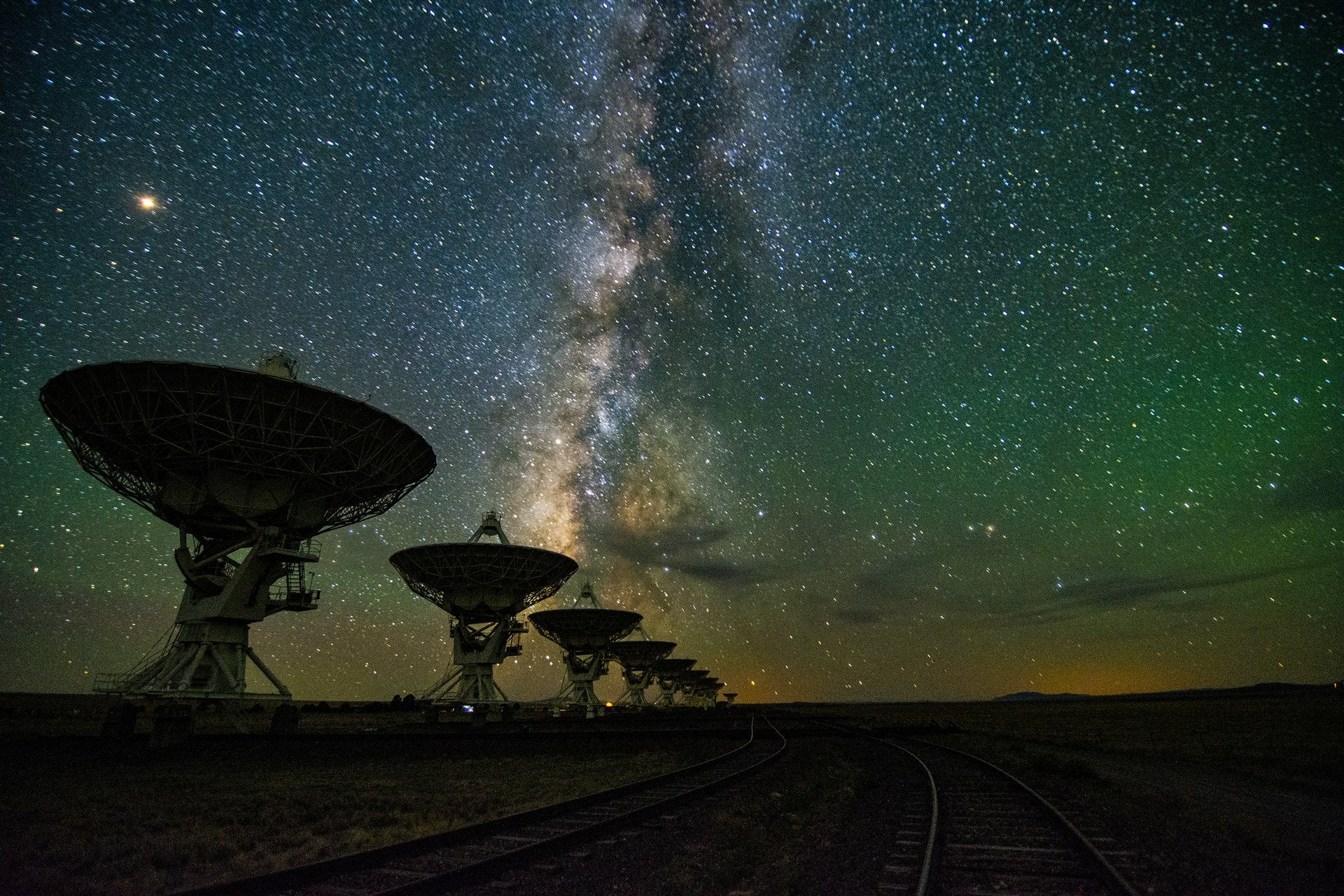
The Karl G. Jansky Very Large Array (VLA) in New Mexico at night. Credit: NRAO
More than sixty years ago, Dr. Frank Drake and his colleagues conducted the very first experiment dedicated to the Search for Extraterrestrial Intelligence (SETI). Since then, astronomers have continued to scan space for signs of alien transmissions, predominantly in the radio spectrum. In more recent years, the search has expanded to include thermal signatures and optical flashes, and additional forms of technological activity ("technosignatures") are already being incorporated. So far, all these experiments have produced null results, prompting SETI researchers to consider what they might be missing.
One possibility that repeatedly comes up is the notion that we are not looking in the right places. This certainly makes sense, since all SETI surveys to date have only covered a limited range of the radio spectrum. Following that logic, could it be that Earth has already received signals, but we didn't realize it because we weren't listening on the right frequency? According to a new study by Claudio Grimaldi, a researcher at the Laboratory of Statistical Biophysics at the Swiss Federal Technology Institute of Lausanne (EPFL), it's unlikely that we have.
The study, "Undetected Past Contacts with Technological Species: Implications for Technosignature Science," recently appeared in *The Astrophysical Journal*. Using Bayesian Analysis, a statistical technique that updates probabilities based on evolving data sets, Grimaldi examined how undetected past signals would have implications for current SETI surveys. In particular, he examined how past signals would increase the odds of detecting one today, and the likely source of those transmissions.
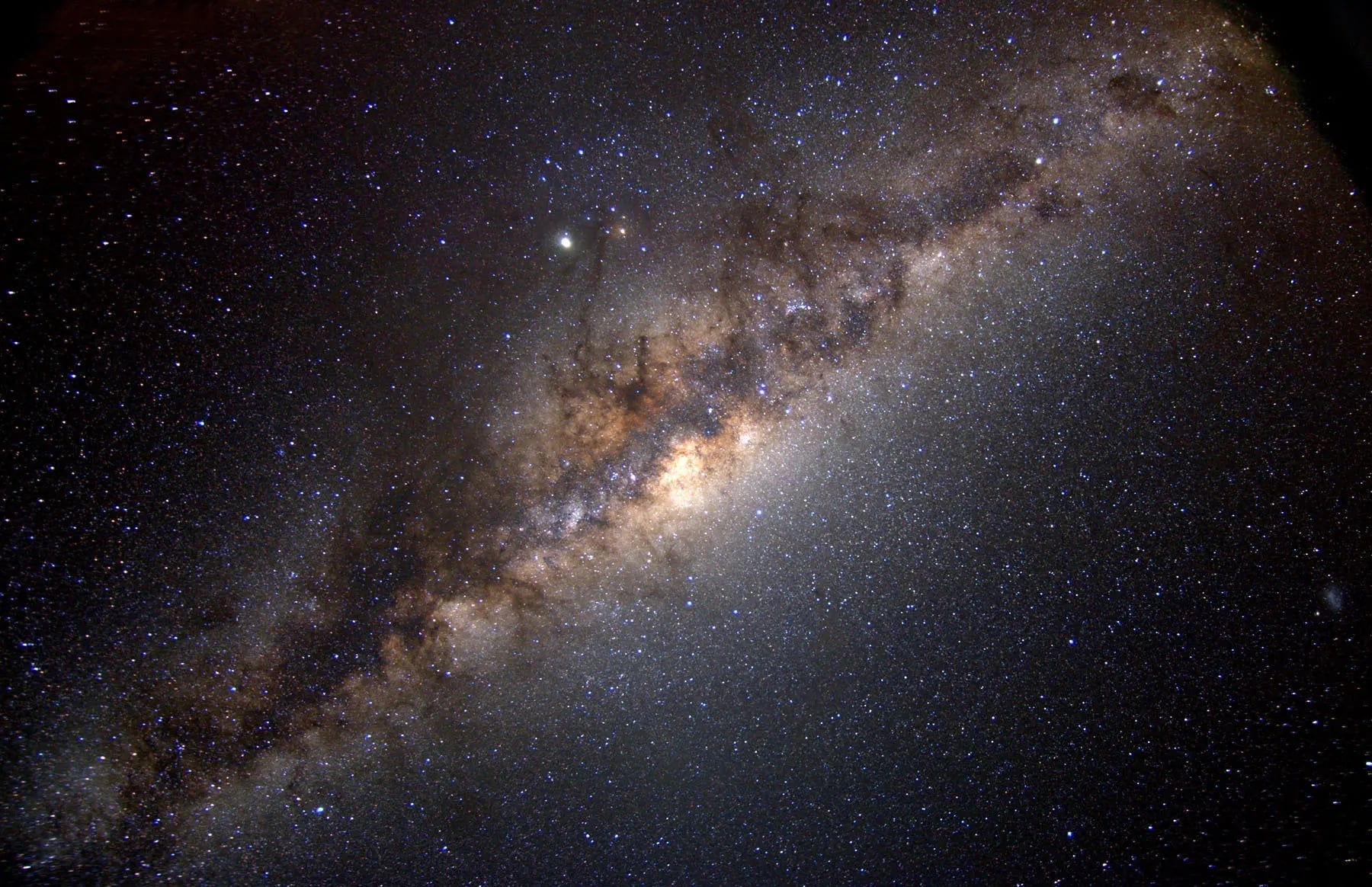
*The Milky Way galaxy, showing the central bulge at its center.
Credit: NASA*
As a starting point, he modeled technosignatures as active emissions or artifacts from an advanced civilization that then spread at the speed of light, lasting for brief periods (a matter of days) or for very long ones (millennia). He also considered how detection would only happen if the transmission is within range for the signal to be strong enough for our instruments to detect. He also considered omnidirectional signals (waste heat from megatructures) and highly focused signals (beacons, laser flashes, etc.). The resulting model addressed three possible elements:
The number of past contacts with Earth
The typical lifetime of technosignatures
The distance range that current or near-future instruments can probe
For "contact optimists," the results were not encouraging, suggesting that a very large number of undetected signals would have had to reach Earth in the past for there to be a high probability of detecting technosignatures closer to our Solar System today. In some cases, the number of signals exceeded the number of potentially habitable planets within a few hundred to a few thousands light-years from Earth, making any past or future signals highly unlikely. However, the results were different when extended to much greater distances.
Assuming technosignatures are long-lived and propagate across the entire Milky Way, detection becomes more likely at distances of several thousand light-years or more. However, the number of detectable signals across the entire galaxy at any given time remains very low. These results indicate that our inability to detect signals in the past does not mean detection will likely occur in the near future. Instead, they suggest that transmissions from advanced civilizations are likely to be rare, distant, and long-lasting, rather than local and frequent.
In other words, the field of SETI appears to be destined for a long wait before any discernible technosignatures (intentional or the result of "spillover") will be detected. Far from discouraging SETI efforts, however, the results suggest that future SETI efforts should focus on deeper, broader surveys that scan large parts of the Milky Way rather than individual stars or star clusters located a short distance away (in cosmic terms).
Not AGAIN! NASA's Artemis II moon mission is delayed for a second time after several last–minute issues are spotted on the SLS rocket – as furious fans call for SpaceX to step in
Not AGAIN! NASA's Artemis II moon mission is delayed for a second time after several last–minute issues are spotted on the SLS rocket – as furious fans call for SpaceX to step in
NASA's Artemis II moon mission has been delayed for a second time after several last–minute issues were spotted on the Space Launch System (SLS) rocket.
Mr Isaacman says that the reason for the delay is an 'interruption in helium flow in the SLS interim cryogenic propulsion stage'.
The system worked during both wet dress rehearsals, but engineers were unable to get helium flow through the vehicle during routine maintenance on Saturday night.
Now, as the long–awaited moon mission is pushed back once again, some frustrated fans have called for Elon Musk's SpaceX to step in with assistance.
Taking to X, one fan vented: 'Time to scrap the 1960s tech and innovate to build next gen space launch vehicles and to stay on par with SpaceX.'
NASA's Artemis II moon mission has been delayed for the second time, as last–minute technical issues are found in the Space Launch System (SLS) rocket
NASA administrator Jared Isaacman said that the issue had been caused by an 'interruption in helium flow in the SLS interim cryogenic propulsion stage'
Fed–up space enthusiasts have taken to social media to vent their irritation over the persistent delays.
One commenter wrote: 'At this rate, the Chinese will soundly beat us to the Moon.'
Others explicitly suggested that SpaceX should be called on to lend assistance or even replace the SLS rocket altogether.
On X, which is owned by SpaceX CEO Elon Musk, one commenter wrote: '@SpaceX Those guys need a ride to the moon, please help them.'
Another asked: 'When will NASA stop the financial haemorrhaging and turn this program over to SpaceX?'
'Can we get out of this contract and save money with SpaceX,' suggested another.
In particular, a number of space fans suggested that the experimental Starship rocket could make a viable replacement.
Mr Isaacman (left) says that the setback will 'almost assuredly' affect the intended March launch date, ruling out the Artemis II launch until April
Mr Isaacman says the systems performed well during both wet dress rehearsals, but unexpectedly failed during a 'routine operation'
On X, frustrated space fans have called for Elon Musk's SpaceX to provide assistance to the Artemis II programme
Why does NASA use hydrogen fuel?
The SLS rocket uses a mixture of liquid hydrogen and liquid oxygen.
Since hydrogen is such a small molecule, it is extremely prone to leaking.
However, hydrogen is also cheap, naturally abundant, and produces a phenomenal amount of energy.
According to NASA, this mix gives the 'highest specific impulse, or efficiency in relation to the amount of propellant consumed, of any known rocket propellant'.
Another important factor is that the SLS rocket inherits a lot of its hardware and systems from the Shuttle era rockets.
These engines were built to run on hydrogen, so NASA can't change fuels without an expensive redesign of the entire rocket and engine system.
'I beginning to think that the SpaceX Starship will be launching astronauts to space before the Artemis program,' one commenter suggested.
While one added: 'Time to replace SLS with Falcon Heavy. Might even actually do it faster with Starship.'
For context, SpaceX has been contracted by NASA to provide a modified version of Starship for the lunar landing during the Artemis III mission.
In April 2021, NASA awarded Elon Musk's company a $2.9 billion contract to provide the first crewed lunar lander, but SpaceX is widely expected to miss the 2027 target date.
Last year, acting NASA administrator Sean Duffy threatened to open up the contract to other countries due to persistent delays, saying at the time: 'The problem is, they're behind.'
However, NASA's immediate problems are the ongoing delays afflicting the problem–plagued SLS rocket.
Mr Isaacman says that the source of the problem could be located in one of the filers or quick–disconnect 'umbilicals' that pass gases between the ground and the rocket.
Alternatively, he says that the issue could have been caused by a 'failed check valve onboard the vehicle, which would be consistent with Artemis I'
Angry commenters lamented the costs of the SLS rocket and its persistent delays, arguing that the mission should be turned over to SpaceX
One commenter asked why America could 'get out of this contract' in order to save money with SpaceX
The SLS rocket will now need to roll back to the Vehicle Assembly Building at the Kennedy Launch Centre for repairs, meaning that another wet dress rehearsal is almost certain
After problems with the helium system were discovered overnight, NASA has now made the disappointing decision to roll SLS back to the Vehicle Assembly Building (VAB) at Kennedy Space Centre.
While the agency has a limited capacity to fix issues at the launch tower, more serious problems need to be addressed in the VAB, which gives engineers better access to the vehicle.
The vibrations caused by rolling the rocket in or out of the VAB risk loosening or disturbing seals and valves, meaning that one or two more wet dress rehearsals are almost certain.
After the success of the second wet dress rehearsal, the Artemis II crew entered quarantine in Houston, Texas, on Friday night.
During quarantine, the crew limit their exposure to other people so that they can stay in good health for the flight.
This procedure usually starts 14 days out from the launch date, but NASA has not said whether the crew will be able to leave quarantine before the April launch date.
Writing on X, Mr Isaacman added: 'I understand people are disappointed by this development. That disappointment is felt most by the team at NASA, who have been working tirelessly to prepare for this great endeavor.'
Launch date: NASA initially identified three possible launch windows for Artemis II: From February 6 to February 11, from March 6 to March 11, and from April 1 to April 6. The space agency is now targeting the April window.
Mission objective: To complete a lunar flyby, passing the 'dark side' of the moon and test systems for a future lunar landing.
Total distance to travel: 620,000 miles (one million km)
Mission duration:10 days
Estimated total cost: $44 billion (£32.5 billion)
- NASA Space Launch System rocket: $23.8 billion (£17.6 billion)
An exceptionally hungry black hole from the dawn of the universe is growing at 13 times the cosmic 'speed limit', experts say.
Astronomers have used high–tech telescopes to 'look back in time' to around 12 billion years ago, not long after the universe was born.
There, they spotted something unexpected – a supermassive black hole that already weighed 440 million solar masses.
This means it was growing at an unimaginably fast rate, they said, absorbing gas and dust quicker than it was believed possible.
According to theory, there should be a limit on how fast black holes can grow because the act of 'ingesting' matter creates an opposing force which prevents more matter from being absorbed.
But this cosmic giant, known as ID830, is defying expectations – and could mark the discovery of the fastest–growing supermassive black hole of a similar mass found to date.
Researchers suggest the black hole may have 'collided' with a star or clump of gas, giving it enough energy for this remarkable growth spurt.
'This discovery may bring us closer to understanding how supermassive black holes formed so quickly in the early universe,' lead author Sakiko Obuchi said.
A graph displaying ID830's uniquely brilliant luminosity, compared to previously observed objects. The solid line shows the upper 'limit' of how it should be growing
An artist's impression of a supermassive black hole. Gas accretes onto the central black hole, forming an accretion disk and jets
The team, from Waseda University and Tohoku University in Japan, used the Subaru Telescope to analyse the black hole.
What makes this one even more striking is its multiwavelength behaviour, the researchers, who published their findings in The Astrophysical Journal, said.
When black holes undergo growth spurts, most models predict that their structure changes in ways that can reduce X–ray emissions and that their plasma and radiation jets may be less obvious.
However, this particular black hole shines brightly in both X–rays and radio wavelength.
This unexpected combination suggests scientists still have more to learn about the mechanisms of early black hole growth, the team said.
'Going forward, we hope to explore the mechanisms of X–ray and radio wave emission from this quasar and determine whether there are any similar objects yet to be discovered,' Dr Obuchi said.
They suggest they may have observed the black hole during a short transitional period, possibly following a sudden influx of gas.
This could prompt both the X–ray–emitting corona and the radio jet to become highly energised before the system gradually settles into a more typical mode of growth.
In a press release from the universities, the researchers said: 'Data from the Subaru Telescope show a surprising mix of traits.
'The quasar is pulling in matter at an exceptionally high rate while also emitting intense X–rays and launching a strong radio jet.
Black holes are so dense and their gravitational pull is so strong that no form of radiation can escape them - not even light.
They act as intense sources of gravity which hoover up dust and gas around them. Their intense gravitational pull is thought to be what stars in galaxies orbit around.
How they are formed is still poorly understood. Astronomers believe they may form when a large cloud of gas up to 100,000 times bigger than the sun, collapses into a black hole.
Many of these black hole seeds then merge to form much larger supermassive black holes, which are found at the centre of every known massive galaxy.
Alternatively, a supermassive black hole seed could come from a giant star, about 100 times the sun's mass, that ultimately forms into a black hole after it runs out of fuel and collapses.
When these giant stars die, they also go 'supernova', a huge explosion that expels the matter from the outer layers of the star into deep space.
A series of encounters between US Navy fighter jets and strange, unknown aerial phenomenon (UAP) in 2004 and 2015, together with more recent incursions into American military exercise areas, has stirred up both interest and debate in the UFO subject since the now-infamous FLIR videos were released into the public domain in 2017. Of course, these were not the first instances of pilots seeing strange flying objects at close quarters, as numerous accounts of American and British military pilots being sent aloft to investigate sightings of UFOs have been recorded since the late 1940s and early 1950s.
What is not generally appreciated by those engaged with the subject is that even these encounters were not the first time that military aircrew had witnessed odd lights and even stranger-looking craft in the skies at close range. In some cases, pilots even fired at these mysterious aerial intruders. To properly examine these cases, we have to go back to World War Two and the stories of what had been known at the time as Foo Fighters (that’s right, Dave Grohl didn’t come up with his band’s name on his own).
Background: What You Know About The Foo Fighters May Well Be Wrong
Ask most UFO enthusiasts about the Foo Fighters and you will probably hear vague stories about US Army Air Force night-fighter crews who saw balls of light following their aircraft over Germany during the last months of World War Two. They may cite the Smokey Stover cartoon, popular among aircrew at the time, as the origin of the name “Foo Fighter”. Some may even throw in cases from the Pacific Theatre of Operations, again dating from the final year of the war, when crews watched “balls of fire” pacing their B-29 Superfortresses on missions over Japan.
While this is a good start, the established narrative regarding the Foo Fighters has been largely incorrect for as long as I can remember, especially when it comes to identifying when the phenomenon began. Pick up a UFO book that covers the subject and you will likely be told that sightings of Foo Fighters started at the end of November 1944 when the term was invented by a member of the 415th Night Fighter Squadron serving in France. We have an article printed in the December 1945 edition of American Legion Magazine to thank for this. It listed the 415th NFS mystery light reports beginning in November 1944, stating “this is the way they began”. Authors in the 1950s and 1960s seemed to take this statement at face value, and so the legend of the Foo Fighters began on a false premise.
What is less well known is that Royal Air Force bomber crews had been reporting strange lights, luminous objects, and large “aeroforms” in the skies over Germany since March 1942. The small number of UFO researchers who have looked at the subject in depth have discovered a huge number of sightings spanning the globe from 1942 onwards, although if you look hard enough, there are also reports of strange lights dating back to the time of the German invasion of Belgium in May 1940. Although the American night-fighter crews used the term Foo Fighters, the phenomenon had been known by many other names prior to that phrase being coined. Terms such as “meteors” and “rockets” were often used in official reports, but many RAF pilots simply referred to the phenomenon as “The Light” or “The Thing”. What is also not widely known is that lights were not the only items aircrews reported seeing. Huge cylindrical objects with portholes, inverted “bathtubs” and huge “blankets” were also sighted.
“You guys must be nuts! Nobody up there but your own plane. Aint seeing things, are you?” – Ground radar station reply to American night-fighter pilot after report of strange lights, November 1944
Over the last twelve months, I have been revisiting and re-evaluating the known Foo Fighter cases, and in the course of my research, have also found some new encounters in preparation for a book I am writing on the subject. Much of the information is buried in Air Intelligence files and squadron war diaries, most of which is barely legible due to the ravages of time on the flimsy wartime grade of paper used. However, many cases never saw official recognition, and researchers have to rely upon aircrew logbooks and personal interviews, in many cases conducted decades after the events being recalled. The vast majority of wartime witnesses are now deceased, and a large proportion took the details of their sightings to their graves, electing to keep quiet about their encounters.
There are well over one hundred known Foo Fighter sightings from the three main battlefronts during World War Two (Western Europe, Mediterranean, and Pacific), but strange lights and unidentifiable craft were also witnessed over both North Africa and the Eastern Front. To give an idea of the encounters that transpired during the war, here are three of those cases, all of which occurred long before the traditionally accepted start of the Foo Fighter phenomenon in November 1944.
“Several projectiles seemed to enter the luminous disc, but without result, although the object was well within range, approximately 150 metres.” – March 1942 encounter over the Ruhr Valley, Germany
A Polish-crewed Vickers Wellington bomber was returning from a raid on Essen just before midnight on 25th March 1942 when the aircraft’s rear gunner spotted a bright light approaching their aircraft. However, instead of a Luftwaffe night-fighter, it resembled a large fuzzy copper-colored ball, about the size of the Moon. Approaching within 200 yards of the bomber, the gunner opened fire, watching helplessly as his tracer rounds entered the ball of light to no visible effect. They did not come out the other side, nor did they inflict any appreciable damage. The strange light then shot forward and took up position off the Wellington’s port wingtip.
Now the aircraft’s nose turret guns could be brought to bear on the strange light, and both gunners blazed away at what was still thought to be a Luftwaffe night-fighter. The pilot executed a series of evasive maneuvers but could not shake the ball of light. It remained at the same fixed distance, seemingly undamaged, for several minutes until it finally flew around to a point ahead of the Wellington, remaining in place for a few seconds before shooting off into the distance and disappearing. Another crew flying behind the bomber also had their own encounter with the object but refused to report the incident for fear of ridicule.
“By turning suddenly and steeply, I was able to chase the light around in a circle until I could aim my four 20mm cannons at it. This I did several times until my ammunition was exhausted, but each time I observed, no apparent change in the behaviour of the light.” – RAF fighter pilot’s 1943 sighting
In the spring of 1943 over North Africa, a New Zealand fighter pilot was followed by an orange-red glow, a light that then moved to sit off his wingtip, matching his every turn, including a series of violent evasive maneuvers designed to throw off potential attackers. Taking advantage of an apparent time lag before the object matched his actions, he managed to fire his Hawker Hurricane’s guns at the light on a few occasions, but to no effect. The pilot could not distinguish what kind of aircraft or object was generating the light, as it was so bright. It grew dimmer as they crossed the front line but once beyond the firing it glowed with its original intensity. The RAF pilot’s mysterious companion vanished as he returned to base. He knew of numerous colleagues who also had run-ins with “The Light”. This encounter, similar in many respects to Commander David Fravor’s now-infamous dogfight with the “Tic Tac”, predated that event by more than sixty years.
“He was terrified, as white as a ghost. Something up there sure scared the hell of out him, he was nearly frantic when he got out of his aircraft.” – The effect on an American night-fighter crewman, October 1944
The US Army Air Force’s 422nd Night-Fighter Squadron had its fair share of sightings in late 1944 and early 1945, including a notable event over western Germany during the first week of October 1944 when an extremely rapid object latched onto the tail of one of the unit’s Northrop P-61 Black Widows. The mysterious ball of light followed the crew’s machine as the pilot threw it into a violent set of evasive maneuvers. Despite his best efforts, he could not shake off his pursuer, and in desperation finally dove into a bank of cloud. The ball of light did not follow. Colleagues in the squadron stated that the pilot’s radar observer was badly shaken by the experience and was “still sucking wind 24 hours later”. The mysterious ball of light was officially logged as a Messerschmitt Me 163 Komet rocket-propelled interceptor. There would be many more bizarre encounters with strange lights before the year was out.
Analysis: Were the Foo Fighters Enemy Secret Weapons?
The night skies over the industrial cities of Germany were filled with lights when a raid was in progress. Multi-colored flares were dropped to mark targets and were replaced during attacks as they burned out. The Germans employed decoy flares to distract RAF bomber crews, and Luftwaffe night-fighter crews used “fighter flares” to silhouette enemy aircraft against the clouds, rendering them more visible to their colleagues. Sudden explosive balls of light, accompanied by sparkling lights, were often seen falling slowly towards the ground. RAF crews believed they were German attempts to simulate bombers being shot down in an attempt to lower morale. Nicknamed “Scarecrows”, they featured prominently in intelligence bulletins, and crews were encouraged to believe they were indeed German scare tactics. In reality, they were aircraft being blown out of the sky by flak and night-fighters. However, Allied aircrew had been very familiar with all of these flares and lights. They did not resemble the Foo Fighters in any way, shape, or form.
Because of wartime secrecy and censorship, most reports of strange lights and unconventional flying craft were never publicized due to the possibility that they may have been German secret weapons. Also, individual unit intelligence officers decided whether such reports were officially recorded and then sent up the chain of command for analysis. They frequently dismissed crew testimony and instead asked them whether they had been drinking. If official reports were filed, ribald comments and ribbing from colleagues followed, at least until they too saw something weird and unsettling. The Foo Fighter reports that do exist are a fraction of a much larger number of sightings.
“[The enemy] have several land service rocket weapons, and the introduction of anti-aircraft rockets seems a likely and logical development.” – 1943 Air Intelligence briefing
Both the British and American Air Intelligence staff were completely flummoxed by the reports of strange flying objects and the balls of fire that followed aircraft without committing hostile acts. The early reports of 1942 and 1943, including “rockets” that altered course when pursuing RAF bombers, plus a 200-foot long object with red lights spaced at regular intervals along its length, were thought to be examples of new German secret weapons. Extra-terrestrials and so-called “flying saucers” were still several years off into the future, and they were never considered as a possible explanation. Most reports of mysterious lights were believed to be sightings of decoy flares, airborne searchlights, or rudimentary surface-to-air missiles, items which the enemy were believed to be developing at that time. With the available information to hand, these were rational and sensible suggestions, but with the benefit of hindsight, and a working knowledge of German wartime weapons research and deployment, these suggestions were actually way off the mark.
The RAF had experimented with fitting searchlights into night-fighters but found that they blinded their pilots, rendering the scheme useless, and the Germans refused to devote resources to the subject, instead relying on ground-based installations. Several surface-to-air missile projects were being developed in late 1943 and throughout 1944, however frequent engine and guidance problems, together with political interference, prevented any achieving operational status. Most test launches were failures. Air-to-air rocket mortars were fired at B-17 Flying Fortresses and B-24 Liberators on daylight raids over Germany by defending fighters by mid-1943 onwards, although again these weapons were never used at night. The Luftwaffe almost deployed a wire-guided air-to-air missile in early 1945 but the factory producing the rocket motors was destroyed in a bombing raid.
Once the Luftwaffe started to fly their early jet and rocket-powered interceptors in the autumn of 1944, the strange nocturnal lights were frequently referred to as “jets” in both American and British official records. This, despite the fact that the crews were actually witnessing balls of light, not aircraft, and in any case, the Germans did not operate their jet or rocket types at night at that time. A small number of Messerschmitt Me 262s jet fighters, converted to the night-fighter role, operated in the defense of Berlin from mid-December 1944 but they never flew in areas where Foo Fighters were encountered. The rocket-propelled Me 163 Komet appears in numerous combat reports by RAF night bomber crews, but it was never flown in the dark, as it was almost too dangerous to fly even by day. However, none of these German secret weapons matched the witness reports describing the Foo Fighters’ maneuvers and capabilities.
“Intelligence reports seem to indicate it is radio-controlled from the ground and can keep pace with planes flying 300 miles per hour.” – US newspaper report, 1945
Labeled as new Nazi secret weapons, reports of Foo Fighters started appearing in American newspapers during December 1944, but the armchair experts called upon by editors to comment on the stories were just as clueless as the Air Intelligence staff. As Allied ground forces pushed into Germany during the spring of 1945, the number of sightings dropped almost to zero. When the war finally ended in May 1945, the Foo Fighters seemed to disappear from Western Europe, suggesting that they were indeed German secret weapons. However, scrutiny of captured aircraft factories and testing facilities found nothing that resembled the Foo Fighters. None of the aircraft or missile designs that were discovered, or design plans that were found, matched the tremendous capabilities displayed by the balls of light. Captured scientists and technicians were interviewed but could not shed any light on the matter either. It turned out that the Germans were as much in the dark about the phenomenon as the Allies were.
The focus of the war changed to the Pacific, where similar sightings of strange balls of light, impervious to machine-gun fire, had been witnessed since August 1944, although sporadic reports of odd-looking objects had been filed since the end of 1942. Crews from Major William (“Butch”) Blanchard’s 40th Bomb Group saw mysterious “balloons” over Japan in October 1944, and Blanchard himself would be at the center of the Roswell UFO crash controversy almost three years later. Air Intelligence believed that some sightings in the Pacific were of German technology supplied to the Japanese. Plans for various weapons were indeed donated by Germany towards the end of the war, however, it was too late to put them into production. Once hostilities in the Pacific ended with the dropping of the two atomic bombs, the number of reports dwindled too. Interest in the Foo Fighters waned, and the wartime reports were filed away and forgotten. No one ever managed to put forward an explanation that stood the test of time. The Foo Fighters are as much a mystery to today’s researchers as they were to the intelligence officials of 1944.
Outlook: The More UFOs Change, The More They Stay The Same
Looking back to incidents that occurred nearly eighty years ago may seem like a waste of time to people caught up in the current heady rush of US Navy encounters, UAP photos, and future government briefings. What appears to be forgotten is that the accounts of November 1944 and November 2004 are not too dissimilar when you boil them down to their basics. Drop a P-61 Black Widow pilot into the front seat of a F/A-18F Super Hornet and he might gaze in awe at the new technology on display in front of him. Put him in David Fravor’s position and the P-61 pilot would realize that the “Tic Tac” demonstrates a much higher level of sophistication than the machine he was now flying. Military aircraft may have vastly improved over the intervening sixty years, but whatever our pilots are continuing to come up against during training flights, the mysterious lights and objects are still running rings around them. To this observer at least, it also appears as if those who are supposed to be “in the know” still don’t have a clue what is going on, something else which hasn’t changed since 1944.
“We have encountered a phenomenon which we cannot explain.” – Secret 1945 memo sent from XII Tactical Air Command intelligence staff to the First Tactical Air Force
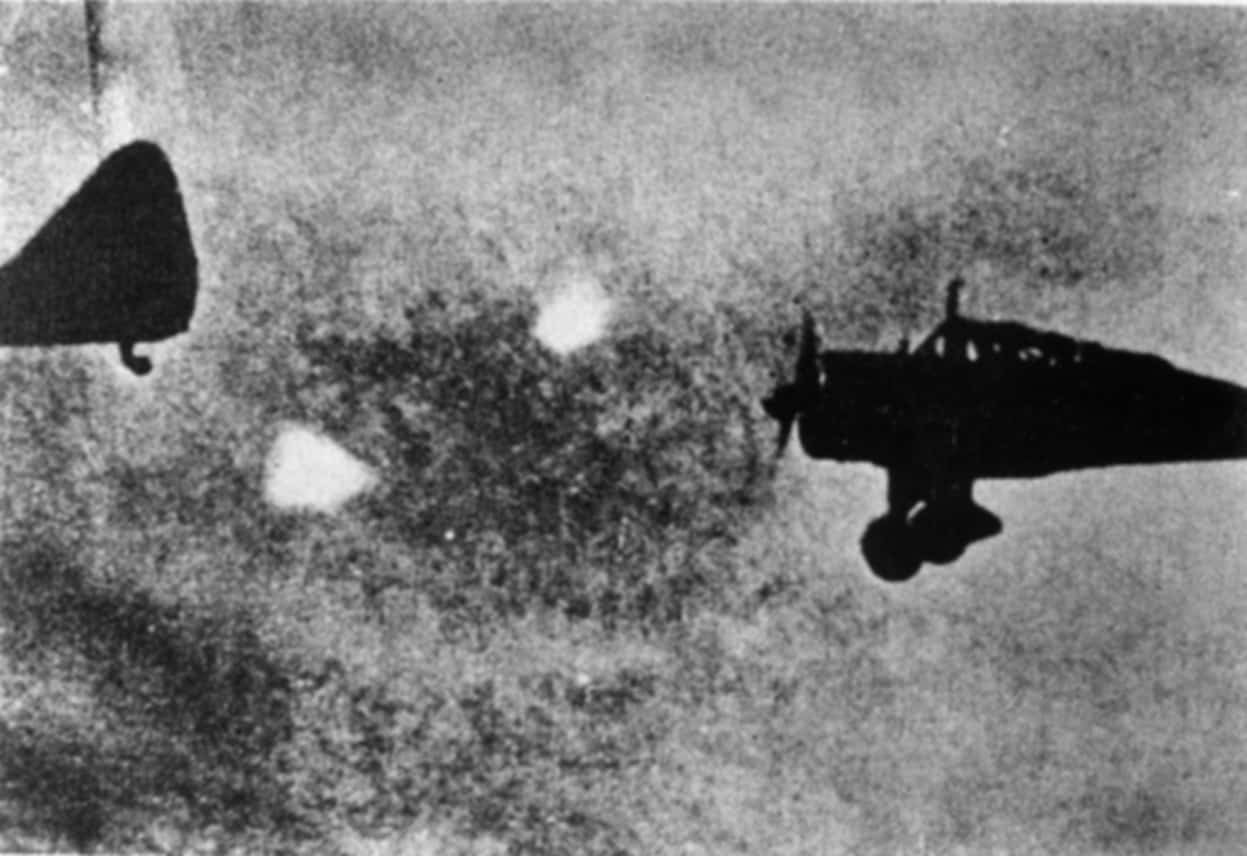
Trying to ascertain the origin and motives of the Foo Fighters is akin to figuring out what is going on with the current UAP phenomenon. Stories suggest that German pilots also encountered the Foo Fighters during World War Two, but I have not been able to find any reports that stand up to even the briefest scrutiny. Without trying to sound like a debunker, the photographic “evidence” that exists is probably faked, is a film defect, or another mundane occurrence. Pictures that pass these tests subsequently fail in terms of a lack of supporting information. None of the photos I have found in the course of my research have accompanying notes about locations, dates, or names of the aircrew involved, and are therefore treated with a healthy dose of skepticism. Without context, they are practically meaningless. I like to think that if annotated photos exist in a military archive somewhere, they presumably sit on a shelf next to pictures of the crashed Roswell craft and the Kecksburg “Acorn”.
Despite a lack of photographic evidence, the Foo Fighter phenomenon is redeemed in terms of the sheer number of witness statements, logbooks, and intelligence reports that confirm the existence of strange lights and other odd flying objects during World War Two, if not their nature. Reports of Foo Fighter encounters are compelling but leave plenty of scope for argument and debate over their veracity, origin, and purpose. Fast forward to April 2021 and a quick read through postings on UFO Twitter tells me that nothing has changed in this respect. UAPs remain unidentified, and people continue to argue over what they represent.
If and when the current spate of UAP sightings is explained to the satisfaction of most commentators and onlookers, perhaps the information we receive will help us understand historical encounters such as the Foo Fighters, Roswell, and Socorro. One could argue that the Foo Fighters are still with us. They might have changed their shape and name, but they are still the same elusive phenomenon that has baffled military personnel who have confronted them in the skies for almost eighty years.
Follow and connect with author Graeme Rendall on Twitter:@Borders750
Orbs Over Stojeszyn, Lublin Voivodeship, Poland – January 19, 2026 (approx. 5:00 PM) UFO UAP Sighting News.
Orbs Over Stojeszyn, Lublin Voivodeship, Poland – January 19, 2026 (approx. 5:00 PM) UFO UAP Sighting News.
Date of sighting:Jan 19, 2026
Location of sighting: Stojeszyn, Poland
UFOs are constantly being seen around the world, often being mistaken for something else when in reality...it's an alien craft. Here we have several orbs moving about knowing full well that there are people down below watching and recording them. Aliens know the time for full disclosure is very near, and they no longer want to wait. These are alien entities ai technology recording and sometimes controlled by biological entities at an alien base somewhere underground or under the ocean floor.
UFO caught in NASA images over moons surface, Apollo 10. UAP Sighting News.
UFO caught in NASA images over moons surface, Apollo 10. UAP Sighting News.
Strange UFO Sighting of cone caught in NASA image over moons surface, Apollo 10 Mission.
Location: Moons Surface Date: May 18 until 26, 1969
While looking over some NASA images in their archives of Apollo 10 moon mission I found these Five interesting photos. Remember the purpose of this mission was to be a "dry run" for the Apollo 11 mission, testing all of the procedures and components of a Moon landing without actually landing on the Moon itself. See the UFO orb on far right? The first and second photos show the module floating near two UFO orbs that apparently came to investigate them. These photos are labeled "flyby sequence" because they are flying over the moon to investigate future landing spots. Now two orbs on right.The third through fifth images shows a UFO that is shaped like an upside-down cone. This giant UFO also seems to have the two orbs flying around it. Notice the orbs position changes in each photo.
Onverwachte verschuiving van de magnetische noordpool
De magnetische noordpool van de aarde is aan het verschuiven. Hoewel dit eeuwenlang een geleidelijk proces is geweest, hebben recente waarnemingen een verandering in het tempo van de beweging aan het licht gebracht. Maar waarom gebeurt dit en wat zijn de gevolgen voor onze planeet?
Van de manier waarop onze smartphones werken tot de navigatie van vliegtuigen, de verschuivende magnetische noordpool heeft een verrassende invloed op ons dagelijks leven.
Geïntrigeerd? Klik door deze galerij om het zwervende magnetische veld van de aarde en de verrassende implicaties ervan te ontdekken.
Wat is het magnetische veld van de aarde? De aarde is een gigantische, bolvormige magneet. De aarde is omgeven door een magnetisch veld dat in de tijd en in de ruimte verschuift. Dit veld is afkomstig van verschillende bronnen binnen en buiten de aarde.
Als een staafmagneets Het lijkt erg op het veld dat wordt gecreëerd door een staafmagneet, maar dan geplaatst in het middelpunt van de aarde. Magnetische velden worden gecreëerd door bewegende elektrische ladingen. In een staafmagneet zijn deze ladingen elektronen die rondjes draaien in atomen.
William Gilbert Wetenschappers bestuderen het magnetisme van de aarde al eeuwenlang. William Gilbert, een 17e-eeuwse Engelse natuurkundige, was een pionier op dit gebied. Zijn experimenten en het gebruik van termen als 'elektrische kracht' en 'magnetische pool' legden de basis voor de moderne elektriciteit.
Reuzenmagneet Gilberts boek uit 1600, 'De Magnete', zorgde voor een revolutie in het begrip van magnetisme. Na uitgebreid onderzoek stelde hij voor dat de aarde zich gedraagt als een reusachtige staafmagneet, wat het gedrag van kompasnaalden en magnetische variaties gekoppeld aan geografische kenmerken verklaart.
Bevindingen Hij besprak het magnetisme van de aarde aan de hand van een model: een bolvormig stuk laststeen dat een terrella (kleine aarde) wordt genoemd. Magnetische naalden op een terrella wijzen naar de noordpool (aangeduid als punt A). Zelfs op een oneffen oppervlak, zoals bij punt O, wijzen de naalden nog steeds naar het noorden.
Vintage uitrusting In het begin van de 19e eeuw bestudeerden wetenschappers het magnetisme van de aarde met behulp van dipnaalden. Deze maten de hoek van het magnetische veld van de aarde op een willekeurig punt. Naalden staan horizontaal op de evenaar en verticaal op de polen. Wetenschappers gebruikten dompelnaalden op expedities vanaf de 18e eeuw.
Ontdekking De Schotse schout-bij-nacht Sir James Clark Ross ontdekte de Noordelijke Magnetische Pool in het noorden van Canada voor het eerst in 1831, na een aantal Arctische expedities.
Technische vooruitgang Een beter begrip van de magnetische polen van de aarde leidde tot vooruitgang in de navigatie. De 'True Course Finder', bijvoorbeeld, automatiseerde berekeningen voor zeelieden, waardoor ingewikkelde formules niet meer nodig waren. Vóór deze apparaten konden zeelieden alleen het magnetische noorden bepalen met een kompas, waardoor ze extra berekeningen nodig hadden voor het ware noorden.
In beweging Eeuwenlang hebben wetenschappers de magnetische noordpool gevolgd. In tegenstelling tot de stationaire geografische noordpool is de magnetische noordpool voortdurend in beweging. Tussen 1600 en 1900 bewoog hij ongeveer 10-15 kilometer per jaar.
Siberië-gebonden In de jaren 1990 dreef het naar de Atlantische Oceaan voordat het versnelde richting Siberië. Aan het begin van de jaren 2000 was de snelheid toegenomen tot ongeveer4 kilometer per jaar.
Siberië-gebonden In 2005 probeerden de Canadese geofysicus Larry Newitt en de Franse geoloog Jean-Jacques Orgeval het magnetische veld van de aarde vast te stellen tijdens een expeditie naar het Canadese noordpoolgebied. Ze bevestigden dat de dolende pool internationale wateren was binnengedrongen en op weg was naar Siberië.
Magnetisch Wereldmodel Het World Magnetic Model (WMM), gezamenlijk ontwikkeld door het Amerikaanse National Geophysical Data Center en de British Geological Survey (BGS), is een grootschalig model van het magnetisch veld van de aarde dat wordt gebruikt om de locatie van de pool te voorspellen. Het WMM wordt elke vijf jaar bijgewerkt en de nieuwste versie is nu beschikbaar.
Op de rem Terwijl de reis richting Rusland doorgaat, is de magnetische migratie van de Noordpool de afgelopen vijf jaar vertraagd tot ongeveer 35 kilometer per jaar. Deze snelheid van vertraging is volgens wetenschappers ongekend.
Canada vs. Rusland Een team onder leiding van professor Phil Livermore van de Universiteit van Leeds heeft een verklaring voorgesteld voor het recente gedrag van de magnetische Noordpool. Hij suggereert dat de pool gevangen zit in een touwtrekwedstrijd tussen twee concurrerende magnetische krachten, de ene onder Canada en de andere onder Siberië.
Canada vs. Rusland Livermore suggereert dat de Canadese magnetische patch uitgerekt en gesplitst is, waardoor de Siberische patch mogelijk sterker is geworden. Deze verschuiving in het evenwicht zou de verschuiving van de pool naar Rusland kunnen verklaren.
Wat veroorzaakt de beweging? De buitenkern van de aarde bestaat voornamelijk uit gesmolten ijzer, een vloeibaar metaal. Als warmte uit de kern ontsnapt, beweegt dit gesmolten ijzer en wordt het magnetische veld van de aarde opgewekt.
Ronddwarrelend Onvoorspelbare veranderingen in de wervelende beweging van dit gesmolten ijzer, dat zich ongeveer 3.218 kilometer onder het oppervlak bevindt, beïnvloeden het magnetische veld van de aarde en de positie van de magnetische pool.
Warme thee "Het is net een reusachtige kop thee," legt William Brown uit, een wereldwijde modelleur van het aardmagnetisch veld bij de British Geological Survey. "Het is een hete vloeistof met de substantie van water."
Implicaties voor de echte wereld De beweging van de noordelijke magnetische pool is cruciaal voor nauwkeurige navigatie. De gegevens die worden verzameld door de beweging te volgen, worden gebruikt om kompassen en andere navigatieapparaten te kalibreren.
Militaire navigatie Het leger vertrouwt ook op het World Magnetic Model voor nauwkeurige navigatie van onderzeeërs, vooral in moeilijke omgevingen zoals de Noordpool.
Luchthavens Landingsbanen van luchthavens zijn genummerd op basis van hun kompasrichting. Als het magnetisch veld van de aarde verschuift, moeten deze nummers worden bijgewerkt. De noordbaan van Berlin Brandenburg Airport veranderde bijvoorbeeld van 25R/07L naar 24R/06L in oktober 2024.
Constante bewaking Hoewel het onmogelijk is om exacte bewegingen te voorspellen, blijft de BGS het magnetische veld van de aarde in de gaten houden. Ze gebruiken een netwerk van grondstations en satellieten om het veld op verschillende locaties in kaart te brengen.
Pool flip? Wetenschappers weten dat het gesmolten ijzer in de kern van de aarde voortdurend wervelt en dat de magnetische polen altijd bewegen. Is het dan mogelijk dat er een volledige omkering plaatsvindt, waarbij het noorden het zuiden wordt en omgekeerd?
Magneetveld spiegelen De laatste volledige omkering vond 780.000 jaar geleden plaats. Een tijdelijke omkering vond 41.000 jaar geleden plaats, maar die duurde slechts 250 jaar voordat hij terugkeerde naar, de positie waar de polen zich vandaag de dag nog steeds bevinden.
Geen reden tot zorgen Hoewel omkeringen van de aardmagnetische polen alarmerend kunnen klinken, vinden ze over een lange periode plaats en vormen ze geen directe bedreiging voor het leven. Wetenschappers hebben bevestigd dat dergelijke gebeurtenissen geen significante kortetermijnveranderingen veroorzaken in het milieu van de aarde.
Alittle over eight years ago The New York Times published a story that had profound implications for the way in which the UFO topic was perceived.1 It also began, at least in the U.S., a process by which the subject became increasingly more mainstream. In this article I want to address three questions:
(1) How did ufology get here?
(2) Where does ufology stand now?
(3) What does the future hold for ufology?
1. How did ufology get here?
On December 16, 2017, The New York Times broke two related stories. The first was the existence of forward-looking infrared videos of UAP (the U.S. government uses the term UAP—Unidentified Anomalous Phenomenon—as opposed to UFO) taken from U.S. Navy jets and confirmed by the Department of Defense as being authentic footage.2
The second part of the story was the existence of a shadowy intelligence program known as the Advanced Aerospace Threat Identification Program (AATIP), that supposedly researched and investigated UAP. This was newsworthy in and of itself, because for years the official position of the U.S. government was that there was no longer any interest in UAP, and that no programs had existed to study the phenomenon since the end of the 1960s, when a long running U.S. Air Force program known as Project Blue Book was terminated. Many people in the UFO community believed this was a lie and that covert programs existed, so it seemed like a clear-cut example of a conspiracy theory that turned out to be true.
The truth was rather more complex, and there’s still no universally accepted narrative here. Some skeptics say AATIP was more of an unofficial effort undertaken by a group of believers in the Intelligence Community. Whatever its true nature, AATIP was clearly a spin-off of an earlier Defense Intelligence Agency (DIA) program called the Advanced Aerospace Weapon System Applications Program (AAWSAP). AAWSAP was demonstrably a genuine program, and some official documents use the terms AAWSAP and AATIP interchangeably.3In January 2020, Pentagon public affairs spokesperson Susan Gough issued a statement attempting to clear up the confusion. It stated:
The Advanced Aerospace Threat Identification Program (AATIP) was the name of the overall program. The Advanced Aerospace Weapons Systems Application Program (AAWSAP) was the name of the contract that DIA awarded for the production of all technical reports under AATIP.
I sought further clarification, and on January 13, 2020, Susan Gough followed this up with a statement that:
DIA managed the Advanced Aerospace Threat Identification Program. All of the work performed under AATIP was done via a single contract vehicle called AAWSAP. The total work effort for AATIP consisted of the 38 technical reports produced under the contract vehicle. DIA was the sole lead for management of AATIP via AAWSAP. Congress was briefed on the total work conducted for AATIP—the aforementioned 38 technical reports.
The authors of these 38 reports include Hal Puthoff, Eric Davis, and Kit Green—names well-known to those who follow government dabbling in fringe science and the paranormal.
My personal assessment is that all the euphemistic “advanced aerospace” references were a way of disguising a UFO or paranormal research program as being a program looking at next-generation foreign aerospace weapon threats, to try to protect it from skeptical Pentagon financiers and Congressional oversight folks who would have been horrified to learn that taxpayers’ money was being spent on such matters. This attempt was ultimately unsuccessful, because while $10M was appropriated in FY2008 and a further $12M in FY2010, funding ended in FY2012, after an earlier official review concluded that “the reports were of limited value to DIA.”
The roots of AAWSAP trace back to Intelligence Community personnel Jay Stratton and James Lacatski, as well as to Skinwalker Ranch in Utah, often portrayed as a hotbed of UFO sightings and paranormal phenomena. Following the DIA’s 2008 issue of a contractual solicitation (carefully worded to focus on breakthrough technologies that might underpin future aerospace weapon systems, while avoiding mention of UFOs or the paranormal), the contract was awarded to Bigelow Aerospace Advanced Space Studies (BAASS).4 Billionaire space entrepreneur Robert Bigelow was, at the time, the owner of Skinwalker Ranch.
Robert Bigelow had a longstanding interest in UFOs and the paranormal, and had previously funded the National Institute for Discovery Science (NIDS).5 The Chairman of the Board was the aforementioned Hal Puthoff, a parapsychologist who’d previously managed (with Russell Targ) a program at the Stanford Research Institute (not affiliated with Stanford University) to investigate paranormal phenomena. This work likely led to the U.S. government’s dabbling in such areas as remote viewing through Project Stargate, run by the DIA and CIA during the Cold War.
NIDS looked at a range of fringe science topics, and some have argued that AAWSAP was essentially a way to secure government funding for a continuation of the sort of work that had been done by NIDS. Senator Harry Reid (who knew Robert Bigelow) was instrumental in securing official status and funding for AAWSAP.
The New York Times story was quickly picked up by other mainstream media outlets around the world, and this caught the attention of numerous Congressional representatives and staffers. A key reason for this interest was the fact that aside from Harry Reid and two Senatorial colleagues, there seemed to have been no Congressional knowledge of AAWSAP or AATIP, and certainly no oversight.
In terms of UFOs, folks in Congress likely aren’t that different from society as a whole, in that there’s a wide range of opinions across the spectrum from skeptic to believer. Furthermore, irrespective of beliefs, it’s hardly surprising that an unknown but clearly significant number of people in Congress saw The New York Times article and thought to themselves something like, “Wait, the government has a UFO program, but didn’t tell us? It was run by Intelligence Community personnel and there’s no Congressional oversight? What are they doing and what have they found out?”
What followed was multifaceted Congressional interest in and engagement on the topic of UAP, to the extent that a critical mass built up. I believe a key factor here was that this engagement was bipartisan, covered both the Senate and the House, and involved several committees, mainly the Armed Services committees, the Intelligence committees, and the Oversight committees. This Congressional engagement led to classified briefings and public hearings. Witnesses at the public hearings included whistleblowers like Luis Elizondo (a retired counter-intelligence operative prominently featured in The New York Times article and described therein as being the individual who had run AATIP) and David Grusch, a former Intelligence Community member who had been attached to the UAP Task Force under the directorship of Jay Stratton.
Perhaps the most important part of Congressional UAP engagement was the insertion of multiple UAP-related provisions into several of the recent, annual National Defense Authorization Acts (NDAA). In part to meet these legislative remits, the DOD set up an office (the aforementioned UAP Task Force) to handle the response and to lead on the topic across government. This task force published a number of official reports and was eventually replaced by the All-domain Anomaly Resolution Office (AARO). AARO’s website hosts a wealth of reports, briefings, and other UAP-related materials, sourced both from the DOD and Congress, that perfectly illustrate both the breadth and depth of Congressional engagement and the government response to this Congressional interest.6
As an interesting side note, one of the directors of the UAP Task Force was the aforementioned Jay Stratton, who had previously been involved in AAWSAP and who had an anomalous experience at Skinwalker Ranch. Stratton’s upcoming memoir, apparently to be published in 2026 by HarperCollins, may shed some light on unresolved questions concerning the evolutionary process from NIDS to BAASS to AAWSAP to AATIP, as well as other not-yet-resolved questions.
Every intelligence analyst on the face of the planet knows the importance of differentiating between what they know and what they think, yet these very people often seem to be blurring the line.
It’s certainly interesting to note the connections between the various individuals involved and to see how the same names pop up repeatedly. This gives some potential insights into who the key players are and what the overall agenda is. The New York Times story, for example, had a long gestation period. The story was shopped around for some months prior to publication, not only to The New York Times, but also to The Washington Times and Politico, both of which were thus able to run fairly detailed stories very shortly after The New York Times got the scoop.
Further insights can be gained by looking at the three names that appeared on the byline for The New York Times story: Helene Cooper, Ralph Blumenthal, and Leslie Kean.
Helene Cooper was a Pentagon correspondent with The New York Times, with no previous UAP interest; The New York Times veteran reporter Ralph Blumenthal’s interest predated the December 2017 article and began with his research into Harvard Professor of Psychiatry John Mack, who had conducted research into the alien abduction mystery. This led to the 2021 publication of Blumenthal’s book on Mack, The Believer. Leslie Kean comes from a wealthy political family and had a prior interest in UAP and alien abductions, illustrated by her previous writings and by the fact that she lived for some years with abduction researcher Budd Hopkins, who first introduced John Mack to the topic.
It was Leslie Kean who was instrumental in bringing the story to The New York Times. Luis Elizondo had resigned from government service in the fall of 2017, but very shortly before leaving had passed the three best-known U.S. Navy UAP videos to Christopher Mellon, a former Deputy Assistant Secretary of Defense for Intelligence. Elizondo believed he had obtained official security clearance for their release, though it seems there was a misunderstanding and that the clearance was not intended to authorize public release. To illustrate this, an April 27, 2020, statement from the DOD referred to “unauthorized releases” of the videos in 2007 and 2017.7 In 2007, one of the videos leaked online on the Above Top Secret discussion forum, while 2017 referred to the process that led to The New York Times running the story.
Mellon and Elizondo then joined an organization called the To The Stars Academy of Arts and Science (TTSA), ostensibly headed by Blink-182 musician Tom DeLonge. TTSA was a sort of collaborative hub for a number of individuals, many with backgrounds in government UAP and fringe science research, including Hal Puthoff and retired CIA officer Jim Semivan.
It was Christopher Mellon who facilitated a meeting between Kean, Elizondo, and others, which then gave Kean enough to take the story to The New York Times, via Ralph Blumenthal, setting in motion a series of events that was to forever change the field of ufology.8
2. Where does ufology stand now?
This is how ufology in the U.S. went from fringe to mainstream, though it’s a simplified version, and not all the twists and turns of the story are universally agreed upon. If I had to summarize what I think happened and why, my best assessment would be as follows: A loose coalition of believers in UAP and the paranormal, often with backgrounds in government, military, and the Intelligence Community, sought and obtained official funding for their work. When that funding was terminated, they continued the work in a quasi-official capacity. Finally, when they felt they’d taken matters as far as they could without official funding, they decided to go public, successfully gambling that the resultant firestorm would generate other ways to take things forward. The goals may have included funding (TTSA certainly raised some money through a share issue) and Congressional engagement. The latter has clearly been a big success.
However, eight years into this process, there’s still no smoking gun and we appear to have hit some speed bumps, with several new and parallel events putting things in a rather different light.
Further ex-government whistleblowers have come forward. This sounds like a good thing, and in one sense, it is, but the unintended consequence has been that this has added to the information overload and created a landscape so complicated that even veteran commentators like myself, who follow the situation very closely, find it difficult to keep up. Furthermore, not all whistleblowers are equal. While one can be reasonably confident that those who have testified to Congress are who they say they are (staffers vet such people fairly thoroughly, not least by quizzing their former employers), others haven’t had their backgrounds investigated in such depth.
It should also be remembered that even when someone’s government background checks out, their specific role is often harder to pin down and their information can be all but impossible to verify. That’s partly because many of these folks have a background in the military and the Intelligence Community, where issues of classification often arise and where deception was literally in some of these people’s job descriptions. It’s also because much of the information is second hand, but where those concerned don’t make it clear that this is something that somebody else told them. Every intelligence analyst on the face of the planet knows the importance of differentiating between what they know and what they think, yet these very people often seem to be blurring the line. No wonder one occasionally hears some civilian UFO researchers complain that the whole thing is a PSYOP.
This already murky situation has been further complicated by factional infighting. There’s clearly a struggle for narrative control within the field. Even among the various whistleblowers and other key players, who are ostensibly polite with each other, there are clearly some tensions. By way of a personal anecdote, I’ve had more than one TV producer tell me how Individual A told them he’d appear on a show, provided Individual B wasn’t featured (the requests backfired because producers don’t usually play that game). I’m similarly aware that some of the key players who are ostensibly being polite to me are briefing against me, perhaps seeing my mainstream media platform as a potential threat, especially given that I’m independent in all this and don’t take anybody’s side. Because it so perfectly describes the situation, I can’t resist quoting a lyric from the O’Jays song Back Stabbers: “They smile in your face. All the time they want to take your place.”
There’s nothing new about infighting in the UFO community. What is new, however, is that folks with a background in military intelligence know a few dirty tricks that their civilian counterparts don’t. Plus, social media has acted as a force multiplier, with 𝕏 in particular having turned into a veritable battlefield between some of the key players, often using proxies and sock puppet accounts. Cliques, harassment, and doxxing seem to be the order of the day. Neither should we sweep under the carpet the uncomfortable truth that some of the people who’ve recently jumped aboard the ufology train clearly have psychological issues, while others sense a money-making opportunity.
To pick one example of all this infighting, the December 2025 appearance of Jay Anderson on Joe Rogan’s podcast seems to have set off a particularly nasty squabble.9 Jay criticized Luis Elizondo (among others), accusing him of orchestrating an aggressive campaign to control the narrative, as well as making reference to what he’s sometimes called a “UFO Hate Group.”10 In response, a group of Elizondo supporters, sometimes dubbed “the Lue Crew,” hit back against Jay Anderson.11
A related development is that a new generation of influential podcast hosts and YouTube channel owners saw the topic become increasingly mainstream and entered the fray. While many are honest brokers, their podcasts and channels are often the arena in which the struggle for narrative control plays out. Again, despite being a veteran commentator who follows all this closely, I struggle to work out who’s supporting which faction, how many factions there are, and the true nature of their respective agendas.
Cartoon by Oliver Ottitsch for SKEPTIC
What is the result of all this information overload, confusion, and infighting? Speaking personally, I’m fatigued. Moreover, I see from social media that other people are fatigued too. I’m a free speech absolutist, so I’m certainly not advocating any controls on this. I completely reject the idea (which has been floated several times over the years) that ufology should set up some sort of governing body, or somehow police itself. After all, who gets to decide who’s on the governing body, and quis custodiet ipsos custodes?
There are other developments that give me cause for concern. One of them relates to a couple of narrative shifts that I’ve noticed creeping into the topic.
Ufology has always been a big tent. In whistleblower David Grusch’s testimony to Congress, and in some of his media interviews, he used the terms “nonhuman” and “non-human intelligence.”12 In the Schumer-Rounds Amendment (a legislative proposal intended for insertion into FY2024 NDAA, but which did not find its way into the final bill), the term “non-human intelligence” was used multiple times.13 Grusch has said that this leaves the door open for other possibilities aside from the extraterrestrial hypothesis. And this has opened the door to some highly speculative discussions about cryptoterrestrials, ultraterrestrials, extratempestrials, and interdimensionals. It’s also led to something a little more on the dark side, with a theological bent.
The idea that aliens are fallen angels, or demons, isn’t new. But this once-niche theory has gotten a little more traction lately. Luis Elizondo has previously told the story of how, when he lobbied a senior Pentagon official to take more action over UAP, the official told him he should read his Bible. This appeared to reflect a belief that some aspects of UAP are demonic and that to study it would be to give it energy and feed it.
Such opinions have gained more mainstream traction with Representative Marjorie Taylor Greene expressing the views that aliens could be fallen angels,14 while high-profile broadcaster Tucker Carlson has also talked about UAP in terms of spiritual forces and entities like angels and demons.15 All of this plays into a neoreligious interpretation of ufology. Chris Bledsoe—author of UFO of God—talks about how an entity he dubs “The Lady” told him how glowing orbs would intervene to stop the missiles if Israel and Iran go to war. There’s an “end times” theme to a lot of this.16
Again, as a free speech absolutist, I wouldn’t dream of telling people what they can and can’t say about UAP, let alone what they should believe. Again, I’m merely commenting on the current state of play and expressing a personal opinion that I think some of the current narrative isn’t necessarily healthy or helpful. And I certainly doubt that it holds any validity.
Another narrative shift is the use of the term “psionics”—the idea that one can use the power of one’s mind to summon UAP. It’s a scientific-sounding term, but is it really that different from Steven Greer’s CE5 (Close Encounter of the Fifth Kind) protocols, whereby one can supposedly use meditation and other techniques to initiate contact with extraterrestrials? The danger, of course, is that certain individuals can then insert themselves as intermediaries; you can access the phenomenon, but only through them, because of their special abilities. Again, there’s a sort of quasi-religious, cultish feel to all this, in which one can only access the divine through the intermediary of the priest.
3. What does the future hold for ufology?
Given my assessment that ufology has to some extent moved from fringe to mainstream, but has hit some speed bumps, where do we go from here? I don’t have a crystal ball, but based on statements from a range of people involved in the process, it seems that further Congressional hearings and more whistleblowers would be a fairly good bet. The problem, of course, is that, short of a “smoking gun” (actual evidence and not just more stories), this runs the risk of reinforcing the view that it’s all talk and no action. Where’s the beef?
The Task Force on the Declassification of Federal Secrets is looking at UAP. There’s considerable overlap between personnel involved with the Task Force and personnel serving on the House Oversight Committee, which has been particularly vociferous on UAP. This brings up a potential problem, because while the Task Force is bipartisan, it skews toward Republicans. Thus, it wouldn’t take much to jeopardize the bipartisan nature of Congressional engagement, which would be a setback.
If Donald Trump’s presidency ends without disclosure, I’ll be 99.9 percent convinced that there’s nothing to disclose.
The UFO community continues to hope for Disclosure—the official acknowledgement of an extraterrestrial presence. The Age of Disclosure, a documentary produced by Dan Farah and released late in 2025 plays into this.17 So does Steven Spielberg’s upcoming film Disclosure Day.18 But it goes further than this, and 2027 is a potential date that’s been frequently mentioned.
Disclosure in 2027 would mean that Donald Trump would be the Disclosure President. There’s a curious kind of logic in this, because if there truly is a decades-long official cover-up of an extraterrestrial presence, the secret has been scrupulously kept by successive administrations of both political parties. By inference, therefore, the reasons for secrecy must be exceptionally compelling. Perhaps only a populist, maverick, second-term President would disclose in such circumstances—more so, given that Trump will soon be in his 80s and is doubtless mindful of his legacy. I agree that if the U.S. government is aware of an extraterrestrial presence, Trump is more likely than any previous president to spill the beans. President Trump has occasionally hinted that he’s privy to some interesting information about UFOs, but has yet to elaborate on the topic.19
Some argue that the secret of an extraterrestrial presence is kept even from presidents (perhaps to maintain plausible deniability) and is in the hands of an unelected set of gatekeepers, perhaps in the government, but possibly in the private sector. I find this unconvincing. Most Western governments operate on the basis of what the UK civil service calls the culture of “no surprises,” by which political leaders need to be briefed on all big, impactful issues that might require quick decisions and action.
If Donald Trump’s presidency ends without Disclosure, I’ll be 99.9 percent convinced that there’s nothing to disclose. I’d have to accept that if extraterrestrials are visiting Earth, nobody in the government is aware of it. The acceptance of such a state of affairs might actually be rather good for ufology. After all, while some conspiracies are real, most conspiracy theories are false, and encourage a negative, accusatory approach. Removing—or at least reducing—this mindset from ufology might lead to a healthier, less aggressive approach. It would also remove a lot of redundant effort, which could be better used elsewhere, such as in encouraging more scientists and academics to engage on the topic.
As I see it, ufology stands at an interesting crossroads. While some of the details remain disputed, the topic has undoubtedly transitioned from fringe to mainstream in the last few years. However, a mixture of information overload, infighting, and quasi-religious narratives may conspire to undo this progress. Allied to this, mainstream media interest in most topics waxes and wanes. The UFO community can’t expect their current fascination with the subject to last indefinitely. This is particularly true if Congressional engagement falls away, as it may well do if the perception is that the subject is becoming more partisan and more fringe, with the attendant dangers of reputational damage attaching to those Representatives who continue to express an interest.
Ufology has come out of the fringe and into the mainstream, but I believe there’s a distinct possibility that it will move out of the mainstream and back into the fringe.
UFOs, aliens and ‘little green men’: A primer on everything extraterrestrial
UFOs, aliens and ‘little green men’: A primer on everything extraterrestrial
Trump’s announcement of unsealing all files related to possible life beyond Earth has put the spotlight back on one of the most enduring mysteries that has baffled humans for a long time.
“The truth,” one iconic TV series would have us believe, “is out there.”
For decades, conspiracy theorists, UFO enthusiasts and even the commoner have been seeking the “truth” about so-called alien life, accusing authorities of hiding evidence of the existence of life beyond Planet Earth.
The “truth” might finally be upon us.
On Thursday, US President Donald Trump announced that he is directing the federal agencies to “identify and release” all government files related to so-called aliens, extra-terrestrial life, unidentified anomalous phenomena (UAP), and unidentified flying objects (UFOs).
Citing “tremendous interest” in the topic, Trump said that the files would cover “any and all other information connected to these highly complex, but extremely interesting and important, matters”.
The announcement – which follows recent commentary by former US president Barack Obama – has reignited global fascination in a topic that blends science, culture, and politics.
Famous ‘sightings’ of extra-terrestrial objects
Reports of strange objects in the sky date back centuries, but modern UFO sightings exploded in the mid-20th century.
The 1947 Roswell incident in New Mexico remains the most famous: debris from a crashed object was initially described by the US military as a “flying disc”.
The story quickly grew into claims of a downed alien spacecraft and recovered bodies, even though officials later attributed it to a weather balloon from a secret project.
In 1961, Betty and Barney Hill claimed abduction by humanoid beings who performed medical examinations aboard a UFO. Their story popularised the abduction narrative and influenced how we imagine alien encounters.
The 1980 Rendlesham Forest incident in the UK involved US Air Force personnel reporting strange lights and a metallic object in the forest. Witnesses described radiation and physical traces, while sceptics pointed to a nearby lighthouse or experiments to harness an energy field in the forest.
The 1997 Phoenix Lights saw thousands in Arizona witness distinct V-shaped lights hovering silently. Officials blamed military flares, but many remain unconvinced.
Other notable cases include the 1994 Ariel School sighting in Zimbabwe, where dozens of children reported a UFO and beings with large eyes, and the 1977 Broad Haven event in Wales, involving schoolchildren and a silver craft.
Scientists approach extraterrestrial life with cautious optimism that emphasises probability over proof.
The Drake Equation (1961), created by astronomer Frank Drake, estimates the number of “communicative civilisations” in the Milky Way, the galaxy including our solar system, by considering factors like star formation, habitable planets, and the likelihood of intelligent life.
But the equation yields no concrete answer, given the large number of unknown variables. In simpler words, the number of intelligent civilisations can range from zero to thousands.
While the Drake Equation aims to come up with a specific number for intelligent civilisations on other planets, the Fermi Paradox asks one simple question: If the universe is so vast and old, where has Earth never been visited by aliens?
Explanations vary. One reason can be the immense distance between Earth and the other planet hosting another intelligent civilisation.
Or perhaps there was intelligent life somewhere that progressed so much that it went into the self-destruction mode.
NASA has confirmed over 5,000 exoplanets – a planet that orbits a star outside the solar system – since the 1990s, many in potentially habitable zones where liquid water can exist.
The James Webb Space Telescope – the largest telescope in space capable of viewing objects too old, distant, or faint – now searches for biosignatures like oxygen in exoplanet atmospheres.
Astrobiology missions are looking at Mars, Europa, and Enceladus for signs of microbial life.
While simple life seems plausible, the existence of intelligent extra-terrestrials remains speculative.
SETI, a US-based non-profit that searches for life beyond Earth, continues scanning for radio signals. But no evidence has emerged so far.
Most scientists agree that there is no conclusive proof of alien life, even though the universe’s massive scale makes the existence of life elsewhere statistically possible.
So-called alien hotspots
Certain locations draw intense UFO interest due to secrecy and reported sightings.
Area 51, a classified Nevada military base, is the most famous.
Officially used for testing advanced aircraft like the U-2 and F-117, it has long been linked to alien conspiracy theories, including claims of reverse-engineered UFO technology from Roswell, where debris from a crashed object in 1947 was initially described by the US military as a “flying disc”. The CIA confirmed the existence of Area 51 in 2013.
A 2019 viral “raid” event drew some crowds, but the attempt to forcibly enter Area 51 failed.
Roswell, New Mexico, embraces its 1947 crash legacy with museums and festivals, even though official explanations point to spy balloons from a secret project.
Similarly, Rendlesham Forest in Suffolk, UK, offers the “UFO trail” that lets people revisit the “famous UFO sighting” tied to the 1980 incident involving a reported triangular craft.
The Extraterrestrial Highway in Nevada, near Area 51, sees frequent sighting reports, often linked to military testing.
Governments, especially the US, have shifted from dismissal to a structured investigation into UFOs.
Project Blue Book (1947-1969) reviewed 12,000 sightings, concluding most were explainable and posed no alien threat.
Interest waned until 2017, when leaked Navy videos showed objects displaying unusual flight characteristics.
A 2021 US government report examined 144 incidents and found most unexplained, though not extra-terrestrial.
The Pentagon’s All-domain Anomaly Resolution Office (AARO), created in 2022, now tracks UAPs for national security reasons.
Its 2024 historical review found no evidence of alien technology. Most cases were of misidentifications, drones, or classified programmes.
NASA’s 2023 independent study also concluded that there was no proof of extra-terrestrials.
Aliens, UFOs in popular culture
Extra-terrestrials have long inspired books, films, and TV shows.
Their depiction in the mainstream media began in 1947 when pilot Kenneth Arnold described disc-like objects flying near Washington state, coining the term “flying saucer” and sparking widespread press coverage.
The 1950s brought Cold War-era classics like The Day the Earth Stood Still (1951), featuring a peaceful alien warning people in Washington DC that they must live peacefully or be destroyed as a danger to other planets.
Similarly, The Thing from Another World (1951) showed the US Air Force fend off a bloodthirsty alien organism from a remote arctic outpost.
Movies and TV series of Star Trek and Star Wars depicting alien life and humanoids in space have kept a global fandom glued to their TV screens since the 1960s.
Television shows contributed to amplifying the mystery around extra-terrestrials. The X-Files (1993–2002) made government conspiracies and abductions mainstream.
Recent films like Independence Day (1996) show Earth-invading aliens attempting to destroy human life.
While most movies portray aliens as benevolent creatures, the blockbuster movie series Alien was among the first to show them as deadly lifeforms.
The interest in extraterrestrial life has produced a trove of science-fiction books, starting with The War of the Worlds (1898), an alien-invasion story by H. G. Wells, one of the genre’s most important authors.
Later works like The Hitchhiker’s Guide to the Galaxy by British writer Douglas Adams further cemented the place of alien species, which are referred to as “little green men” in countless books, movies, and TV series.
RELATED VIDEOS
NASA’s investigation of numerous UFO sightings revealed no proof of aliens, but the agency isn't ruling out their existence
4 Big U.F.O. Questions for the White House - The New York Times
4 Big U.F.O. Questions for the White House - The New York Times
Overview
In a recent opinion column, The New York Times urges the White House to address four foundational questions about unidentified aerial phenomena (UAP), commonly known as UFOs. The piece comes amid a surge of congressional hearings, de‑classified Pentagon reports, and mounting public curiosity about objects that appear to defy conventional explanations. By framing the issue as one of transparency, national security, scientific opportunity, and inter‑agency coordination, the column argues that a coherent federal response is now both feasible and necessary.
The Four Core Questions
What is the government’s current knowledge of UAPs, and why has it not been fully disclosed? The author notes that the Pentagon’s 2023 preliminary assessment acknowledged “a limited amount of data that remains unexplained,” yet the administration has offered only vague briefings. The column asks whether a systematic release of vetted information could restore public trust without compromising sensitive sources.
Do UAPs pose a credible threat to national security? Recent testimony before the House Intelligence Committee highlighted concerns that foreign adversaries might be using advanced drones or hypersonic platforms. The op‑ed stresses that without a clear risk assessment, policymakers cannot allocate resources or develop counter‑measures effectively.
What scientific value do UAP investigations hold, and how can they be integrated into existing research frameworks? The piece points to the National Academies’ 2023 report, which called for “rigorous, interdisciplinary study” of anomalous aerial observations. It asks the administration to consider partnerships with civilian research institutions, NASA, and the scientific community at large.
How will the government coordinate across agencies to study, track, and respond to UAPs? The author cites the establishment of the All‑Domain Anomaly Resolution Office (AARO) as a step forward but warns that “fragmented reporting lines risk duplicating effort and obscuring accountability.” A clear chain of command and reporting protocol is presented as essential for a unified response.
Policy Implications
The column underscores that answering these questions is not merely a matter of curiosity; it has tangible policy ramifications. Transparency could mitigate misinformation and reduce the political weaponization of the UFO narrative. A definitive national‑security assessment would guide defense budgeting and inform intelligence priorities. Meanwhile, embracing scientific inquiry could unlock novel data on atmospheric physics, sensor technology, and even potential extraterrestrial phenomena—areas that could yield commercial and academic breakthroughs. Finally, a robust inter‑agency framework would streamline data collection, reduce bureaucratic bottlenecks, and ensure that any credible threat is addressed swiftly.
Congressional and Public Momentum
Lawmakers from both parties have signaled a willingness to move beyond partisan posturing. Senate Majority Leader Chuck Schumer and Representative Tim Burchett have both called for “full‑scale, bipartisan oversight” of UAP investigations. Public polls show that nearly 70 % of Americans favor greater disclosure, according to a recent Pew Research Center survey. The op‑ed argues that the administration’s response—or lack thereof—will shape public confidence in governmental transparency for years to come.
Recommendations for the White House
The Times piece concludes with a concise set of actions:
Issue a comprehensive, redacted briefing to the public that outlines what is known, unknown, and the rationale for any classification.
Commission an independent scientific panel—modeledon the National Academies’ approach—to evaluate data and recommend research pathways.
Mandate regular reporting from AARO to both the National Security Council and congressional oversight committees.
Allocate dedicated funding for UAP research, including sensor upgrades and data‑analysis infrastructure, to avoid ad‑hoc budgeting.
By confronting these four questions head‑on, the White House could transform a topic long relegated to the fringe into a structured, accountable element of national policy—balancing security imperatives with the public’s right to know.
Scott Bray, former deputy director of Naval Intelligence, testifies during a House hearing on UAPs in 2022.
Photo: Kevin Dietsch/Getty Images
President Trump's decision to release government files related to aliens and UFOs is reigniting one of America's longest-running mysteries.
The big picture: While it's unclear whether any new significant surprises await, the belief that government secrets may prove extraterrestrial life exists has fueled curiosity and speculation for decades.
The latest chapter started when former President Obama said last week that aliens are real. He later clarified that he hadn't seen any evidence of aliens making contact with Earth.
But his remarks prompted Trump to suggest this was classified information and promise to release new records.
Here's what the government has previously shared:
What's confirmed by the government
Between the lines: Much of what's been confirmed has been about unidentified anomalous phenomena (UAPs) rather than "UFOs." UAPs are airborne objects that are not immediately identifiable.
The Office of the Director of National Intelligence (ODNI) confirmed in a 2021 report that UAPs are real, but there's no confirmation they stem from some extraterrestrial origin.
The Pentagon has largely maintained that there is no evidence of alien technology nor any hidden programs within the government related to UAPs.
UFOs have been on Congress' radar for years, mostly due to bipartisan concerns about transparency and national security.
Congress held a seriesof hearings from 2022 to 2024 as part of an investigation into UAPs and national security.
Several officials testified that UAP sightings have simple explanations — that they were actually balloons, drones and optical effects.
Officials also confirmed that hundreds of UAP reports exist, including military cases.
What they said:Sean Kirkpatrick, director of AARO, testified in April 2023 that many sightings involved "metallic orbs" — though he did not confirm extraterrestrial technology.
Whistleblower David Grusch testified in July 2023 that he believed the government was withholding evidence and information about UAPs.
A video of unidentified aerial phenomena plays during a House Intelligence subcommittee hearing in 2022. Photo: Kevin Dietsch/Getty Images
NASA, Pentagon downplay sightings
Flashback: In 2023, NASA released a report from its UAP study team that found no evidence of aliens.
However, the government agency said they aren't sure what UAP technically are and that more research could be done into defining the unidentified objects.
An unclassified 2024 Pentagon reportgave the public insight into what we know and don't know about UFOs.
The report mainly found that several of the sightings in the 1950s and '60s were likely caused by tests of advanced U.S. spy planes and other tech.
The report said there was no evidence of confirmed extraterrestrial activity related to UAPs.
Reported UFO sightings per 100k residents
Jan. 1, 1995, to Feb. 19, 2026; Approximate locations of 140,406 sightings submitted to the National UFO Reporting Center
A U.S. state map of reported UFO sightings per 100,000 residents from 1995 to 2026, as of February 19, 2026. About 140,000 sightings were reported in that time period, with the most sightings relative to population in Vermont (100 per 100,000 residents), Washington (95) and Montana (94).
Americans share reported sightingsall the time to the National UFO Reporting Center, which catalogs all reports for the public to read.
The most recent claim was on Feb. 10, when someone reported seeing a UAP in Cave Junction, Oregon, that was "a shooting star" that made "a zigzag pattern."
Of course, these reports are unconfirmed and anyone can file them.
By the numbers:The NUFORC collects data on where the most sightings have happened throughout the world.
California remains the state with the most reported sightings at 17,061 as of February 2026, per NUFORC.
The NUFORC reportsoffer varying details of what the unidentified objects look like.
More than 10,000 people described the UFOs as a "fireball," with 14,000 spotting a "triangle."
The bottom line: The truth is out there, and Trump's order could provide new evidence for believers and skeptics to seize on.
(NewsNation) — President Trump’s promise to disclose any government-held information about UFOs and extraterrestrials will be no simple lift if it comes to fruition, says Luis Elizondo, a former Pentagon insider who has long advocated for the feds to be transparent.
He notes the government has amassed a secret trove of information for more than 80 years and suggests the potential quantity of information could dwarf the millions of documents in the Epstein files.
“Now, the real hard work begins,” Elizondo told “CUOMO” on Friday. “The government has been sitting on this information for so long. There’s so much documentation right now, within our own holdings — within the intelligence community, within the defense communities, within the Department of Energy — that this is going to be a tremendous undertaking.”
First, Elizondo said, Trump will need to sign an executive order that obligates agencies under his control to comply with his transparency directive.
On Thursday, the president said on Truth Social he would direct the Pentagon and other government agencies to release files about “alien and extraterrestrial life”; unidentified anomalous phenomena, aka UAPs; UFOs; and “any and all other information connected to these highly complex, but extremely interesting and important, matters.”
Among skeptics who doubt Trump will ultimately make good on his promise is investigative journalist Ross Coultart of NewsNation’s “Reality Check” podcast.
“It’s very important to note Donald Trump is not saying, in what he’s announced to date, that he is going to declassify anything,” he says. “All they are talking about is reviewing records.”
The issue of UFOs — purists prefer the broader term UAP, which includes objects traveling in bodies of water — has gained traction in recent years after several whistleblowers have stepped forward to claim the government has covered up vital information. The whistleblowers include David Grusch, who told lawmakers the federal government is operating a UFO retrieval program.
A widely publicized 2025 documentary, “The Age of Disclosure,” featuring a bipartisan roster of policymakers and officials, suggested the U.S. and rival nations are in a race to reverse-engineer alien tech that has been recovered.
The UAP category can also include drones, which have become increasingly sophisticated.
Public ready for truth on UFOs, extraterrestrials: Journalist
Journalist Marik Von Rennenkampff, a former State Department analyst who writes about UAPs, says Trump’s timing is perfect given the “critical mass” the issue seems to have achieved.
“I think we’re ready for it,” Von Rennenkampff says of the public at large. “I think the big question is what happens the day after — geopolitically, economically, socially and culturally.”
Scientists could help evaluate UFO info: Avi Loeb
The Harvard astrophysicist who made a splash with his study of the comet 3I/ATLAS said the government files, if they see the light of day, could yield higher-quality images than the public is used to seeing when discussions about UFOs come up.
“In addition, there could be some materials that were retrieved and are puzzling,” Avi Loeb told “Jesse Weber Live” on Friday. “The best way to figure things out to share it, if we are sure it’s not coming from adversarial nations.”
George Knapp investigates: Drone swarm mystery and new UAP revelations
George Knapp investigates: Drone swarm mystery and new UAP revelations
Overview
Chief Investigator George Knapp of 8 News Now has produced an investigative report on a series of unidentified drone swarms that appeared over U.S. civilian and military sites between late 2024 and early 2025. The sightings spanned multiple states—including New Jersey, Nevada, Florida, Texas and California—and affected high‑security installations such as Langley Air Force Base and Wright‑Patterson AFB, where air traffic was briefly halted. While federal officials initially described the events as “no known national‑security threat,” a White House briefing on January 29, 2025 claimed the FAA had authorized the flights for research purposes, a conclusion that Knapp and other analysts say raises further questions about inter‑agency coordination and public disclosure.
George Knapp investigates: Drone swarm mystery and new UAP revelations
The FAA Explanation and Immediate Reactions
National Security Communications Advisor John F. Kirby and other officials asserted that the government could not trace the origin of the craft, prompting criticism from state and local leaders. New Jersey Assemblyman Brian Bergen labeled the response “amateur hour,” and President‑elect Donald Trump suggested the administration was withholding information. The White House spokesperson Karoline Leavitt later announced that the “mystery had been solved” by attributing the drones to FAA‑approved research missions. Knapp highlighted a key inconsistency: if the FAA had indeed authorized the flights, why did the FBI, Department of Defense and the FAA jointly issue statements in December 2024 describing the swarms as an unknown phenomenon requiring advanced detection technology?
Historical Context of UAP Incidents
The 2024 drone swarms echo earlier unidentified aerial phenomena (UAP) events that have drawn congressional and Pentagon attention. In July 2019, more than 100 unknown objects were reported near ten U.S. Navy warships off the Pacific coast, many appearing as wingless orbs with no detectable propulsion. The June 2021 Pentagon report on 144 UAP incidents concluded that most were not attributable to classified U.S. programs, while leaving open the possibility of foreign or non‑human origins. A separate 2023 incident at Langley AFB saw dozens of objects operating for two weeks despite sophisticated radar and defense systems. These precedents have fueled calls for a permanent, well‑funded UAP investigative body.
Expert Commentary and Legislative Concerns
Rep. Tim Burchett (R‑TN) warned that the drone incursions represent a “test” of America’s air‑space security that the nation is currently failing. Former Nevada Senator Harry Reid, a long‑time advocate for UAP transparency, noted that the government’s admission of “not knowing” what the objects are marks a “significant, albeit preliminary, step.” Former AATIP director Lue Elizondo argued that the technology observed by pilots exceeds known terrestrial capabilities, suggesting a global phenomenon rather than a domestic secret project. Former Navy commander David Fravor added that the persistence of such technology over decades makes it unlikely to be a covert U.S. program, given the difficulty of maintaining secrecy for 15‑20 years.
Conclusion and Outlook
The investigation concludes that the White House’s attribution of the late‑2024 swarms to FAA‑approved research drones does not fully resolve the underlying issues of transparency and inter‑agency communication. Lawmakers and UAP experts continue to press for a permanent, adequately funded investigative office capable of identifying and analyzing objects that demonstrate flight characteristics beyond current human technology. As the public and congressional committees await further clarification, the broader mystery of unidentified aerial phenomena remains open, underscoring the need for systematic, scientifically rigorous study of America’s skies.
Think you've seen a UFO in the sky? Consider the following possibilities...
BY Ezzy Pearson
Thousands of people across the world have reported unidentified objects in the night sky, many under the impression that they have witnessed a visiting alien spacecraft.
Reports often feature lights zipping across the sky, changing direction in manoeuvres that seem to defy the laws of physics, not to mention huge shapes that move silently overhead and strange objects that suddenly explode.
We've all heard the stories of the Roswell UFO incident, or the supposed alien species that many 'believers' think inhabits a star orbiting Zeta Reticuli.
The term 'flying saucer' has now entered our common vocabulary. Credit: KTSDesign / Science Photo Library
UFO sightings have a long history. In 1950, the UK Ministry of Defence opened an official desk to investigate every flying saucer report in the UK.
Rather than looking for little green men, however, it was tasked with investigating possible hostile aircraft that may have secretly entered UK airspace.
The desk was closed in November 2009 and after nearly 60 years of reports, not one resulted in a genuine threat to the UK.
But rather than uncovering an extra-terrestrial conspiracy, the last batch of files released by the National Archives revealed that at the time of the closure the MoD had "no opinion" on the existence of extra-terrestrial beings, and seemed a little fed up by the hundreds of reported UFO sightings that they were receiving each year.
But the truth is that the vast majority of UFO sightings have Earthly origins – optical illusions and rare weather among them. Here we'll look at some of the most likely suspects.
So, the next time you see something in the sky and you think it might be a UFO, consider the following possibilities.
A yellow-ish object appears out of nowhere, flying fast and silent across the sky and leaving a glowing trail behind it.
The object suddenly breaks into smaller pieces before vanishing into thin air – all in under a minute.
Over-anxious witnesses might run screaming to the media, but astronomers will be content to have seen a spectacular meteor fireball.
Lens flare
Have you captured a strange glowing orb in a photo? Might it just be lens flare? Credit: Strixcode / Getty Images
If you’ve been observing for a long time you’ll be all too aware that light sometimes bounces off the lens elements in your camera, binoculars or telescope, causing a lens flare.
Some flares can look like solid objects and, if they’re accidentally framed in the right place, a newbie might well mistake them for an unworldly spacecraft.
The Moon
Credit: Dan Fleetwood, Rugby, Warwickshire, 27 July 2020.
Sometimes all rational thought seems to go out of the window.
In 2007, a woman phoned South Wales Police to report a ‘bright stationary object’ that had been floating in the air for 30 minutes.
Later that evening, the police control room radioed to check what an officer had found.
The officer replied: “It’s the Moon. Over.”
The International Space Station
International Space Station over Ribblehead Viaduct by Pete Collins, Yorkshire Dales. Equipment: Canon 6D, Samyang 14mm f2.8 lens at f4, iso200.
The International Space Station is larger than Wembley’s football pitch and significantly brighter than most night sky objects.
It moves fast, taking just a few minutes to cross the sky from one horizon to the other.
It’s also silent, perhaps startling and confusing onlookers who are used to the din of aeroplane engines.
A lenticular cloud can look remarkably like a flying saucer or UFO. Credit: Atosan / Getty Images
The closest you’ll get to seeing a classic flying saucer shape is the so-called lenticular cloud (Altocumulus lenticularis).
They form at high altitudes, near or atop mountains that have moist air blowing over them.
Although the wind speeds are high, the clouds remain stationary.
It’s not hard to imagine you’re seeing a hovering UFO, or a saucer concealed inside the cloud.
A SpaceX frozen exhaust plume
Jeremy Tuck witnessed this strange cloud spiral over North Yorkshire, 8pm UTC, 24 March 2025. It turned out to be the exhaust plume from a SpaceX Falcon 9 rocket.
They’ve been used in Asia for centuries, and now sky lanterns are now becoming increasingly popular around the world. Using the heat generated by a small candle, the paper lanterns can rise up to over 1km in altitude – and if there is little wind when they are released, they can appear to hover overhead.
Several lanterns are often released at once, sometimes tied together so they appear to fly in formation. From the ground it’s easy to mistake this for a single solid object. Today, sky lanterns are the number one cause of UFO reports. In 2009, the number of sightings reported to the MoD’s UFO desk tripled, with most eventually being attributed to these floating lights.
Military satellites
In the 1970s, the US Navy launched a series of surveillance satellites to track Russian vessels.
Dubbed NOSS (Naval Ocean Surveillance System) by civilians, these consist of a trio of satellites that orbit in a triangle formation and are sometimes visible to the naked eye.
Venus
Venus and a starry night sky over the Cotswolds. Photo by Tim Graham/Getty Images
Seen either before sunrise or after sunset, Venus is so bright it’s often mistaken for the landing lights of an aeroplane.
Unlike a plane, though, Venus is pretty much stationary, which gives imaginative observers the impression of something ‘hovering’.
Bright, orangey red Jupiter is another planet frequently taken to be a UFO.
Ball lightning
Credit: ThinkStock
No one is sure what causes this electrical phenomenon, which can measure as much as 1m across. Though often associated with thunderstorms, ball lightning tends to last much longer than a lightning bolt – up to a minute rather then a split-second. It has been reported to move erratically, or hover in place, before either silently fading from view or exploding loudly.
Due to its rare and unpredictable nature there has been little study of ball lightning, but reported sightings date back centuries. There are even reports that the glowing spheres have come into people’s homes down chimneys and through windows.
Space debris
Credit: janiecbros / Getty Images
Junk in low Earth-orbit has become a major problem, with inoperable satellites left behind to become what is collectively known as space junk.
Eventually, atmospheric drag slows them down to the point that they fall to Earth, streaking across the sky as huge fireballs that can last for up to a minute.
Different materials in the debris can create brightly coloured trails as they burn up, adding to their otherworldly appearance.
Sometimes pieces can make it to the ground, leaving behind strangely shaped debris, which some mistake as wreckage from spacecraft of a less terrestrial origin.
Weather balloons
Credit: MileHighTraveller / Getty
Weather stations all around the world release balloons on a daily basis, to monitor current conditions and provide better forecasts. However, an increasing number of weather balloons are being used by members of the public for scientific experiments, educational purposes or simply to capture video from the upper atmosphere.
The balloons can rise to altitudes of 40km, at which point they burst and fall to Earth. From the ground this is often mistaken for an exploding plane or spacecraft. A balloon was responsible for the most famous of all UFO sightings, the 1947 Roswell incident.
Rocket misfires
A Russian bulava missile misfired in December 2009 to produce this strange spectacle. Credit: Jan Petter Jorgensen / REX
In the early hours of the morning on 9 December 2009, a strange white spiral appeared in the skies over Norway. It seemed to be emitting a blue beam from its centre. The weird formation was the result of a Russian Bulava missile test, in which the missile malfunctioned high in the atmosphere. The rocket went wild, venting gas from the side, making the craft spin.
Though it was still night for people on the ground, the Sun had reached the upper atmosphere, illuminating the gas as a white spiral. The light also caused fuel leaking from the missile to glow blue, giving the illusion of a ray beam emanating from the spiral.
Flares from aircraft
A plane shooting flares shooting flares, Qatar, 9 May 9, 2018. Photo by Smith Collection/Gado/Getty Images
In 1997, several hundred people saw a V of lights flying over Phoenix, Arizona. It was later revealed that the lights were the result of a routine training exercise run by the Maryland Air National Guard, in which a group of planes flew in formation, dropping flares.
This kind of exercise is commonly undertaken without being noticed, but on clear nights the flares can be seen from up to 50km away. The intense heat from the flares can create currents in the surrounding air, causing them to hover. If the conditions are mild then the flares can hold their formation, creating the optical illusion of a solid object.
Searchlights
Credit: Andrew TB Tan / Getty Images
Massive searchlights outside clubs, theme parks and festivals are a common sight, sweeping back and forth across the clouds, but when viewed from several miles away they can look like mysterious objects moving in the night. The light
beam is so weak that it cannot be seen, leaving only the bright spots of white light.
These can be mistaken as shining through the clouds, rather than being cast on them. They often appear to be darting back and forth across the sky, but are in reality the work of a lighting technician.
Contrails
Vapour trails lit by the setting Sun. Credit: Ashley Cooper / Getty
Perspective can easily fool the untrained eye. When a plane is flying at right angles towards the horizon and leaving a trail of artificial clouds known as a contrail behind, it can appear to be an object crashing to the ground. The effect of the wind blowing the cloud formations wider emphasises this illusion, and red light from a setting Sun can make them glow red, as if on fire.
Light glinting off the underside of a plane can make it appear as if there is a bright core to the cloud. However the object will appear to be moving very slowly. If something is really falling to Earth, it will move very quickly across the sky, even when seen from a distance.
If we made contact with aliens, what would happen? UFO defence expert reveals how prepared we really are
If we made contact with aliens, what would happen? UFO defence expert reveals how prepared we really are
Alien contact: Is there a playbook? Or is it time to create one? A real-life alien defence expert reveals the truth
BY Nick Pope
What would happen if humanity encountered aliens? If there a plan? And if not, should we have one?
Numerous movies and TV shows feature humanity encountering extraterrestrials.
In films such as Independence Day and War of the Worlds, the scenario is an alien invasion.
Elsewhere, encounters are more ambiguous and the extraterrestrials more enigmatic, as we see in movies such as Contact or Arrival. But what if any of this happened for real?
Over the past few years in the US, the subject of UFOs (or UAPs – unidentified anomalous phenomena – as they're officially designated) has transitioned from fringe to mainstream.
This resulted from the release of photos and videos of UAP taken from various military platforms, and led to classified briefings and public hearings in Congress.
The Pentagon set up a unit to investigate UAP called the All-Domain Anomaly Resolution Office (AARO), and the subject is now being treated as a defence and national security issue.
Are we prepared?
All this brings into focus the question of what would happen if we actually found aliens – or if they found us.
It would be the biggest scientific discovery in history, and would likely have profound – but difficult to predict – effects on every aspect of society, from politics and religion, through to science, technology, the economy and philosophy.
Individuals would probably react in different ways, some with fear and panic; others with awe and wonder.
Surprisingly perhaps, there doesn't seem to be a co-ordinated, overall plan for an eventuality like this.
While the Search for Extraterrestrial Intelligence (SETI) Institute authored a document titled the Declaration of Principles Concerning the Conduct of the Search for Extraterrestrial Intelligence, these protocols only cover what to do if a radio signal from another civilisation is detected, and the document isn't legally binding on nation states.
The Allen Telescope Array in California is dedicated to the search for extraterrestrial intelligence. Credit: Simon Steel / SETIBeyond this, it's theoretically possible that there's a highly classified government plan, the existence of which is known only to a few key personnel.
However, I got no hint as to the existence of any such document when I handled the UAP issue for the British Ministry of Defence in the 1990s, and neither has such a plan been mentioned in any of the Congressional hearings on UAP.
The nearest Britain came to a plan for making contact with aliens was in 2023, when the Department for Science, Innovation and Technology (DSIT) produced an outline report titled ‘UK readiness for black swan scientific events: Case Study – The discovery of life beyond Earth’.
DSIT's Ideas Lab wrote an eight-page draft before the study was indefinitely paused in 2024.
'Alien' could mean the discovery of microbes on an icy moon like Europa, or it could mean finding an advanced, intelligent species. Credit: NASA/JPL/DLR
What do we mean by alien?
A key problem in devising any plan is the wide range of variables when it comes to alien life.
Discovering microbial life in our Solar System, for example, would raise the issue of planetary protection – we don't want to be wiped out by the Venusian flu.
Detecting a radio signal from another civilization would raise very different issues: could we decipher a message from aliens; should we reply; what should we say; and who should reply?
The last question raises the issue of who could truly speak for Planet Earth.
No political or religious leader could speak for everyone, and while a scientist or an academic might be a better choice, what about the billions of people who effectively have no voice? Who speaks for them?
These issues were explored during two meetings at Britain’s Royal Society, held in 2010.
The first was titled, ‘The detection of extra-terrestrial life and the consequences for science and society’ and the second, ‘Towards a scientific and societal agenda on extra-terrestrial life’.
These were multidisciplinary events with participation not only from astronomers and astrophysicists, but also from psychologists, anthropologists and theologians.
It was apparent that the religious implications of finding alien life would be profound and potentially controversial in terms of the possible challenges posed to faith and doctrine.
Some senior theologians are already thinking about how to incorporate alien life into their belief systems.
Father José Gabriel Funes, a Jesuit priest who served as director of the Vatican Observatory, has stated: "How can we rule out that life may have developed elsewhere?
"Just as we consider Earthly creatures as ‘brother’ and ‘sister’, why should we not talk about an ‘extraterrestrial brother’? It would still be part of creation."
But what if aliens don't come in peace? Stephen Hawking once warned: "If aliens visit us, the outcome would be much as when Columbus landed in America, which didn't turn out well for the Native Americans."
This ties in with the Dark Forest hypothesis, which suggests alien civilizations generally remain silent, for fear of encountering a more advanced hostile civilization.
As Cambridge University palaeontology professor Simon Conway Morris said at the first of the Royal Society meetings: "If the cosmic phone rings, don't answer."
Science fiction writer Arthur C Clarke said that "any sufficiently advanced technology is indistinguishable from magic".
So, we can forget about those Hollywood movies where Earth defeats an alien invasion, because one of the few good assumptions we can make about extraterrestrials is that, if they arrive here, having mastered interstellar travel, their technology will be orders of magnitude above anything we have.
In a 1987 address to the United Nations, President Reagan suggests that a universal threat from alien life could unite humanity. Find it towards the end, at 29 minutes
Reagan’s UN address
The idea that we might encounter hostile extraterrestrials was raised by President Ronald Reagan in a 1987 address to the United Nations General Assembly.
Towards the end of his speech, he remarked: "I occasionally think how quickly our differences worldwide would vanish if we were facing an alien threat from outside this world."
And returning to the question of who speaks for Planet Earth, it's the United Nations that many believe should take a lead role in formulating policy on this issue.
The United Nations Office for Outer Space Affairs (UNOOSA) would be the logical focal point but, speaking at the second of the Royal Society meetings held in 2010, UNOOSA's then director, Dr Mazlan Othman, was lukewarm.
Understandable, perhaps, as this followed light-hearted media speculation that she was to be appointed as an ‘alien ambassador’.
Artist's impression of a UFO visiting Earth. Credit: Ray Massey / Getty Images
Dangers to avoid
If a plan was drawn up, it would have to cover the different possible scenarios, then identify and address risks and opportunities.
Risks include the danger of contaminating the biosphere with alien germs, or alerting a super-predator civilisation to our existence by sending a targeted radio signal.
Opportunities include discovering what science writer Timothy Ferris calls a ‘galactic internet’ – a repository of knowledge from other civilizations.
This might include information that could solve terrestrial problems such as hunger, disease and energy needs, though there are risks here too, as advanced technologies might be capable of being weaponised.
Contingency planners would probably regard finding alien life as a ‘low probability, high impact’ event, where even if the chances of it occurring are judged to be small, the consequences would be immense – and potentially catastrophic.
So, let's start a conversation about such a plan. After all, it's better to have one and not need it, than need one and not have it.
Wat Zou Er Gebeuren Als We Conta{ct Maken Met Buitenlanders? Een Ufo-Verdedigingsexpert Onthult Hoe Goed We Echt Voorbereid Zijn
Wat Zou Er Gebeuren Als We Contact Maken Met Buitenlanders? Een Ufo-Verdedigingsexpert Onthult Hoe Goed We Echt Voorbereid Zijn
Inleiding
Het idee dat wij als mensheid mogelijk in contact kunnen komen met buitenaards intelligent leven, is al langer een onderwerp van intrigue en fantasie. Van sciencefictionfilms tot serieus wetenschappelijk onderzoek, de gedachte eraan roept zowel opwinding als bezorgdheid op. Recentelijke gebeurtenissen en rapportages over onverklaarde fenomenen aan de hemel hebben de discussie over deze mogelijkheid echter naar een nieuw niveau getild, waarbij het niet meer enkel om speculatie gaat, maar om relevante veiligheids- en beleidskwesties.
In dit artikel bekijken we wat er zou gebeuren als we daadwerkelijk contact maken met buitenaards leven, welke voorbereidingen er momenteel bestaan, waar de tekortkomingen liggen, en wat de politieke en veiligheidsuitdagingen zijn. We bespreken ook de aanbevelingen voor een betere voorbereiding en waartoe we ons zouden moeten richten als we niet willen dat dit moment een chaos of ramp wordt.
De Evolutie van de Ufo-discussie en het Bewustzijn
Voor decennia werd het veld van ufo-onderzoek gezien als marginaal en vol mysterie en complottheorieën. Echter, de laatste jaren heeft een hernieuwde interesse geleid tot meer officiële erkenning van onverklaarde luchtverschijnselen. De Amerikaanse overheid heeft bijvoorbeeld in 2020 haar Apex-onderzoek naar UAP’s (Onbekende Anomale Phenomenen) herzien en de bevindingen gedeeld. Het Pentagon richtte een nieuw kantoor op: het All-Domain Anomaly Resolution Office (AARO). Ook in het Verenigd Koninkrijk wordt de zaak serieuzer genomen, met bewakingssystemen en een toenemende publieke discussie.
De aanwezigheid van video’s en sensordata die niet meteen kunnen worden verklaard, heeft geleid tot een verschuiving van de publieke perceptie. Wat voorheen werd weggezet als ‘onverklaarbare rookpluimen’ of ‘storm in een glas water’, krijgt nu meer serieuze aandacht omdat het bewijs lijkt te blijven toenemen. Tegelijkertijd wordt de vraag actueel: zijn wij goed voorbereid op een eerste contact?
Wat We Weten Over Onze Huidige Monitoring en Reactie‑strategieën
Momenteel beschikken zowel de Verenigde Staten als het Verenigd Koninkrijk over mechanismen om onverklaarde luchtverschijnselen op te sporen en te analyseren. De Amerikaanse AARO verzamelt gegevens van de luchtmacht, marine en inlichtingendiensten, en rapporteert aan de hoogste defensieleiding. Dit systeem is vooral gericht op het identificeren van potentiële bedreigingen voor de nationale veiligheid.
In het Verenigd Koninkrijk wordt nog steeds zowel civiele als militaire waarnemingen verzameld door het Ministerie van Defensie, alhoewel de publieke communicatie beperkt is door beperkte middelen en middelen voor onderzoek. Deze systemen zijn vooral gericht op het beschermen van de nationale luchtvaart en het voorkomen van gevaarlijke botstingen, niet op wetenschappelijke of diplomatieke doeleinden.
Gaten in Voorbereiding en Beleid
Er bestaat geen universeel en bindend internationaal protocol dat duidelijk regelt hoe te handelen bij het eerste contact met buitenaards leven. Hoewel het SETI-instituut een ‘Declaration of Principles’ heeft opgesteld met richtlijnen voor passieve zoektocht naar buitenaardse intelligentie via radiosignalen, blijft dit een niet-bindend document dat geen concrete procedures bevat voor actieve communicatie of reactie.
In 2023 publiceerde het Verenigd Koninkrijk een ‘readiness’ rapport dat de mogelijke wetenschappelijke en veiligheidsuitdagingen van een onverwachte ontdekking besprak. Dit document werd echter in 2024 stopgezet, waardoor een belangrijke beleidsruimte onbenut blijft. In de Verenigde Staten is er geen openbaar plan dat vergelijkbare richtlijnen biedt, en de hoorzittingen over UAP’s hebben slechts zijdelings uitzicht gegeven op de inhoud van eventuele geheime plannen.
Politieke en Veiligheidsuitdagingen
Indien er een ontmoeting plaatsvindt, zal de reactie waarschijnlijk verdeeld en chaotisch zijn. Mensen kunnen reageren met angst, verwondering, maar ook met paniek of onzekerheid. Overheden weten niet altijd welke instantie de leiding moet nemen: defensie, wetenschap, diplomatie, of een nieuwe inter-agency commissie.
Veiligheid is daarbij een grote zorg. Een onbekende technologie zou als een bedreiging worden gezien en defensieve maatregelen zouden snel worden genomen, mogelijk zonder overleg. Dit kan leiden tot escalatie, militaire conflicten, of het missen van wetenschappelijke kansen. Het ontbreken van een vooraf vastgestelde strategie verhoogt het risico op ongecontroleerde of ongecoördineerde acties, met alle gevolgen van dien.
De Weg Naar Een Betere Paraatheid
Wetenschappers, beleidsmakers en defensieadviseurs benadrukken dat het tijd is om proactiever te worden en structureel te plannen. Het ontwikkelen van internationaal bindende protocollen, vergelijkbaar met het Verdrag inzake het bananenruimtevaart, zou kunnen helpen om een gezamenlijke, overzichtelijke aanpak te formuleren.
Het opzetten van een permanent intergouvernementeel team dat snel kan reageren op eventuele waarnemingen of contactpogingen, is een andere cruciale stap. Dit team zou bestaan uit vertegenwoordigers van defensie, wetenschap, diplomatie en inlichtingendiensten, die onderling goed kunnen samenwerken en communiceren.
Daarnaast wordt gewezen op het belang van regelmatige scenario-oefeningen. Simulaties van contact-scenario’s kunnen de voorbereiding verbeteren en het vertrouwen vergroten dat de juiste stappen worden gezet. Ook zou openbaar onderwijs en communicatie helpen om paniek en misinformatie te voorkomen, door het publiek te informeren over de mogelijke risico’s en voordelen van contact.
De Toekomst: Waarschijnlijkheid en Implicaties
Hoewel veel wetenschappers en beleidsmakers nog steeds sceptisch zijn over de mogelijkheid van contact met buitenaards leven, geloven de meesten dat het slechts een kwestie van tijd is voordat het gebeurt. De snelheid waarmee onverklaarde fenomenen worden bestudeerd en gedeeld, suggereert dat het moment van echte communicatie misschien dichterbij is dan we denken.
Wanneer dat moment aanbreekt, zal het grote vraag blijven of wij klaar zijn – niet alleen technisch en logistiek, maar ook mentaal en diplomatiek. Een vreedzame en ordentelijke aanpak vereist een goede voorbereiding, transparantie en internationale samenwerking.
Conclusie: Klaar voor de Onzekerheid
De realiteit is dat we momenteel niet volledig voorbereid zijn op een eerste contact met buitenaards leven. Hoewel er verschillende systemen en plannen bestaan, ontbreken er nog universele, bindende protocollen en uitgebreide voorbereidingen. De risico’s van onnadenkend handelen, misverstanden, en escalaties zijn aanzienlijk.
Het is daarom cruciaal dat internationale samenwerkingen worden versterkt, dat er duidelijke en transparante plannen komen, en dat we zowel wetenschappelijk als maatschappelijk klaar zijn voor dat ene onvermijdelijke moment: de dag dat we een antwoord krijgen uit de sterren. Het bieden van een solide fundament voor dit unieke encounter kan bepalen of het een epochale mijlpaal wordt voor de mensheid of een gebeurtenis die onbedoeld chaos en gevaar met zich meebrengt.
Door proactief te plannen, educatie te stimuleren en open te staan voor internationale samenwerking, kunnen wij hopelijk de controle behouden en het beste uit de mogelijke ontmoeting met buitenaardse beschavingen halen. Want als het moment ooit aanbreekt, willen we niet achterblijven, maar voorbereid en stevig in ons schoenen staan.
NOTA ;Dit artikel is een uitgebreide verkenning van de huidige stand van zaken rondom de voorbereiding op contact met buitenaards leven, en dient als waarschuwings- en actiepunt voor beleidsmakers, onderzoekers en het publiek. De toekomst ligt in onze handen, en het is tijd om de juiste stappen te zetten.
Investigative journalist Steven Greenstreet has released a series of exclusive reports on the New York Post alleging that U.S. government agencies and mainstream media have deliberately concealed information about unidentified aerial phenomena (UAP) for decades. The pieces, published over the past month, claim that coordinated “psy‑ops” campaigns were used to discredit credible witnesses and shape public perception. The revelations have sparked intense discussion on social‑media platforms, especially within the #ufotwitter community, where users are circulating excerpts and demanding official accountability.
Key Findings
Greenstreet’s investigation draws on dozens of Freedom of Information Act (FOIA) requests, leaked internal memos, and interviews with former defense‑department analysts. Among the most striking allegations are:
Systematic suppression of radar datafrom Navy and Air Force encounters dating back to the 1990s, with senior officials allegedly ordering the files to be classified under “national security” without clear justification.
A covert media‑influence programrun by a joint task force of the Pentagon and the Department of State, designed to promote skeptical narratives and label UFO reports as “hoaxes” or “misidentifications.”
Psychological‑operations (psy‑ops) briefingsdelivered to journalists, encouraging the use of dismissive language such as “flying saucer” or “alien conspiracy” to steer public discourse away from serious inquiry.
Greenstreet cites a 2018 internal briefing titled “Strategic Narrative Management for Unidentified Aerial Phenomena” that outlines a “consistent messaging framework” aimed at preserving “operational secrecy” while minimizing public alarm.
Reactions from Officials and Experts
The Department of Defense (DoD) issued a brief statement acknowledging the existence of a “UAP Task Force” but denied any coordinated effort to mislead the public. “The DoD remains committed to transparency while safeguarding legitimate national‑security interests,” the statement read. A spokesperson for the Office of the Director of National Intelligence declined to comment on the specific documents cited by Greenstreet.
UFO researchers have expressed mixed views. Dr. Jacques Vallée, a veteran in the field, called the claims “concerning and worth further scrutiny,” emphasizing the need for independent verification. Conversely, astrophysicist Dr. Emily Zhao warned that “without access to the original classified files, it is difficult to assess the veracity of these allegations, and we must guard against speculation that could erode public trust.”
Context and Historical Background
The UAP topic has gradually moved from fringe speculation to congressional attention. In 2021, the Senate Intelligence Committee released a report acknowledging “unexplained aerial objects” and recommending a more systematic approach to data collection. In 2023, the DoD formally declassified several Navy videos showing anomalous flight characteristics, prompting the establishment of the All‑Domain Anomaly Resolution Office (AARO). Greenstreet’s exposé suggests that these recent steps may be part of a broader strategy to control the narrative rather than a genuine shift toward openness.
The #ufotwitter surge reflects a broader cultural moment where citizens demand transparency about phenomena that intersect national security, scientific inquiry, and public curiosity. Hashtags such as #UFOTruth and #UAPCoverup have amassed millions of impressions, prompting several lawmakers to request additional hearings on the matter.
Next Steps and Outlook
While Greenstreet’s series has ignited public debate, the lack of direct access to the classified documents means that definitive conclusions remain elusive. Advocacy groups have filed new FOIA suits seeking the release of the “Strategic Narrative Management” briefing and the suppressed radar logs. Meanwhile, the House Oversight Committee has announced a hearing for later this year to examine potential “information suppression” regarding UAPs.
Whether these developments will lead to substantive policy changes or simply reinforce existing secrecy protocols is uncertain. What is clear, however, is that the conversation about UFOs is now anchored in both investigative journalism and legislative scrutiny, marking a departure from the era when the topic was relegated to late‑night talk shows. As the debate unfolds, stakeholders—from government agencies to scientific institutions—will need to balance national‑security concerns with the public’s right to know.
Trump says he's directing the Pentagon to release files related to UFOs and aliens
Trump says he's directing the Pentagon to release files related to UFOs and aliens
Trump's comments came hours after he claimed that former President Barack Obama shared "classified information"' when he told a podcaster recently that he believed aliens were real.
President Donald Trump said Thursday that he was directing agencies to release files pertaining to “alien and extraterrestrial life.”
Trump wrote on Truth Social that “based on the tremendous interest shown,” he would be directing Defense Secretary Pete Hegseth and officials at other relevant agencies “to begin the process of identifying and releasing Government files related to alien and extraterrestrial life, unidentified aerial phenomena (UAP), and unidentified flying objects (UFOs), and any and all other information connected to these highly complex, but extremely interesting and important, matters.”
President Donald Trump speaks during an event with Environmental Protection Agency director Lee Zeldin announcing that the EPA will no longer regulate greenhouse gases, in the Roosevelt Room of the White House, Thursday, Feb. 12, 2026, in Washington.
(AP Photo/Evan Vucci)
Trump’s announcement comes after former President Barack Obama said in a podcast interview that aliens were real, later clarifying that he meant “the odds are good there’s life out there.” Obama added in his clarification that he had seen “no evidence” of alien existence during his time in office.
Obama was answering a series of questions during a "lightning round" of the podcast interview, when he was asked whether aliens were real.
"They're real," Obama said, "but I haven't seen them, and they're not being kept in Area 51. There's no underground facility unless there's this enormous conspiracy and they hid it from the president of the United States."
The podcaster, Brian Tyler Cohen, then asked Obama what was the first question he had wanted answered when he took office.
"Where are the aliens?" Obama responded.
Trump, asked by a reporter about Obama’s remarks Thursday, said Obama had given classified information.
“He’s not supposed to be doing that,” Trump added.
Following a 2024 hearing, the Pentagon said it received hundreds of reports on UAPs and 21 that merited “further analysis” because of “anomalous characteristics and/or behaviors” — but found no evidence of extraterrestrial activity.
Responding to Trump’s directive Thursday night, Hegseth posted a screenshot of Trump’s post with an alien emoji and a saluting emoji.
Some lawmakers reacted to Trump's announcement Thursday. Sen. John Fetterman, D-Pa., said in an interview on Fox News, "If he’s going to release all of the X-Files, I think that could be a bipartisan thing," referring to the 1990s television show about FBI agents investigating — among other things — government conspiracies about aliens, which Fetterman said he "grew up watching."
Rep. Anna Paulina Luna, R-Fla., thanked Trump, writing: "Looks like we are about to have a ton of hearings on this :)!"
In the latest setback to return astronauts to the moon, NASA delayed the highly anticipated flight yet again after a new problem cropped up with the rocket Saturday.
April is now the earliest that the four Artemis II astronauts could fly to the moon.
NASA revealed the latest problem a day after targeting March 6 for Artemis II, the first manned flight to the moon in more than half a century. Overnight, the flow of helium to the rocket’s upper stage was interrupted, officials said. Solid helium flow is essential for purging the engines and pressurizing the fuel tanks.
This helium issue has nothing to do with the hydrogen fuel leaks that marred a countdown dress rehearsal of the Space Launch System rocket earlier this month and forced a repeat test.
NASA Administrator Jared Isaacman said a bad filter, valve or connection plate could be to blame for the stalled helium flow. Regardless of the cause, he noted, the only way to access the area and fix the problem is in the Vehicle Assembly Building at Kennedy Space Center.
“We will begin preparations for rollback, and this will take the March launch window out of consideration,” Isaacman said via X. NASA's next opportunities would be at the beginning or end of April.
“I understand people are disappointed by this development,” Isaacman said. “That disappointment is felt most by the team at NASA, who have been working tirelessly to prepare for this great endeavor.”
Earlier in the day, NASA said it was preparing to move the 322-foot rocket back to the Vehicle Assembly Building at Kennedy Space Center while raising the possibility of the work being done at the pad.
The situation is dynamic, said spokeswoman Cheryl Warner. Whether the fixes are at the pad or in the hangar, the rollback preparations alone rule out any chance of a March launch, she said.
Hydrogen fuel leaks had already delayed the Artemis II lunar fly-around by a month. A second fueling test on Thursday revealed hardly any leaks, giving managers the confidence to aim for a March liftoff. The four astronauts went into their two-week quarantine Friday night, mandatory for avoiding germs.
The interrupted helium flow is confined to the SLS rocket's interim cryogenic propulsion stage. This upper stage is essential for placing the Orion crew capsule into the proper high-altitude orbit around Earth for checkout, following liftoff. After that, it's supposed to separate from Orion and serve as a target for the astronauts inside the capsule, allowing them to practice docking techniques for future moon missions.
During NASA's Apollo program, 24 astronauts flew to the moon from 1968 through 1972. The Artemis program has completed only one flight so far, a lunar-orbiting mission without a crew in 2022. That first test flight was also plagued by hydrogen fuel leaks before blasting off, as well as a helium issue similar to the one that arose Saturday.
The upcoming mission will not involve landing on or orbiting the moon. The first lunar landing with a crew under Artemis is at least a few years away.
Beste bezoeker, Heb je zelf al ooit een vreemde waarneming gedaan, laat dit dan even weten via email aan Frederick Delaere opwww.ufomeldpunt.be. Deze onderzoekers behandelen jouw melding in volledige anonimiteit en met alle respect voor jouw privacy. Ze zijn kritisch, objectief maar open minded aangelegd en zullen jou steeds een verklaring geven voor jouw waarneming! DUS AARZEL NIET, ALS JE EEN ANTWOORD OP JOUW VRAGEN WENST, CONTACTEER FREDERICK. BIJ VOORBAAT DANK...
Druk op onderstaande knop om je bestand , jouw artikel naar mij te verzenden. INDIEN HET DE MOEITE WAARD IS, PLAATS IK HET OP DE BLOG ONDER DIVERSEN MET JOUW NAAM...
Druk op onderstaande knop om een berichtje achter te laten in mijn gastenboek
Alvast bedankt voor al jouw bezoekjes en jouw reacties. Nog een prettige dag verder!!!
Over mijzelf
Ik ben Pieter, en gebruik soms ook wel de schuilnaam Peter2011.
Ik ben een man en woon in Linter (België) en mijn beroep is Ik ben op rust..
Ik ben geboren op 18/10/1950 en ben nu dus 75 jaar jong.
Mijn hobby's zijn: Ufologie en andere esoterische onderwerpen.
Op deze blog vind je onder artikels, werk van mezelf. Mijn dank gaat ook naar André, Ingrid, Oliver, Paul, Vincent, Georges Filer en MUFON voor de bijdragen voor de verschillende categorieën...
Veel leesplezier en geef je mening over deze blog.