The purpose of this blog is the creation of an open, international, independent and free forum, where every UFO-researcher can publish the results of his/her research. The languagues, used for this blog, are Dutch, English and French.You can find the articles of a collegue by selecting his category. Each author stays resposable for the continue of his articles. As blogmaster I have the right to refuse an addition or an article, when it attacks other collegues or UFO-groupes.
Druk op onderstaande knop om te reageren in mijn forum
Zoeken in blog
Deze blog is opgedragen aan mijn overleden echtgenote Lucienne.
In 2012 verloor ze haar moedige strijd tegen kanker!
In 2011 startte ik deze blog, omdat ik niet mocht stoppen met mijn UFO-onderzoek.
BEDANKT!!!
Een interessant adres?
UFO'S of UAP'S, ASTRONOMIE, RUIMTEVAART, ARCHEOLOGIE, OUDHEIDKUNDE, SF-SNUFJES EN ANDERE ESOTERISCHE WETENSCHAPPEN - DE ALLERLAATSTE NIEUWTJES
UFO's of UAP'S in België en de rest van de wereld Ontdek de Fascinerende Wereld van UFO's en UAP's: Jouw Bron voor Onthullende Informatie!
Ben jij ook gefascineerd door het onbekende? Wil je meer weten over UFO's en UAP's, niet alleen in België, maar over de hele wereld? Dan ben je op de juiste plek!
België: Het Kloppend Hart van UFO-onderzoek
In België is BUFON (Belgisch UFO-Netwerk) dé autoriteit op het gebied van UFO-onderzoek. Voor betrouwbare en objectieve informatie over deze intrigerende fenomenen, bezoek je zeker onze Facebook-pagina en deze blog. Maar dat is nog niet alles! Ontdek ook het Belgisch UFO-meldpunt en Caelestia, twee organisaties die diepgaand onderzoek verrichten, al zijn ze soms kritisch of sceptisch.
Nederland: Een Schat aan Informatie
Voor onze Nederlandse buren is er de schitterende website www.ufowijzer.nl, beheerd door Paul Harmans. Deze site biedt een schat aan informatie en artikelen die je niet wilt missen!
Internationaal: MUFON - De Wereldwijde Autoriteit
Neem ook een kijkje bij MUFON (Mutual UFO Network Inc.), een gerenommeerde Amerikaanse UFO-vereniging met afdelingen in de VS en wereldwijd. MUFON is toegewijd aan de wetenschappelijke en analytische studie van het UFO-fenomeen, en hun maandelijkse tijdschrift, The MUFON UFO-Journal, is een must-read voor elke UFO-enthousiasteling. Bezoek hun website op www.mufon.com voor meer informatie.
Samenwerking en Toekomstvisie
Sinds 1 februari 2020 is Pieter niet alleen ex-president van BUFON, maar ook de voormalige nationale directeur van MUFON in Vlaanderen en Nederland. Dit creëert een sterke samenwerking met de Franse MUFON Reseau MUFON/EUROP, wat ons in staat stelt om nog meer waardevolle inzichten te delen.
Let op: Nepprofielen en Nieuwe Groeperingen
Pas op voor een nieuwe groepering die zich ook BUFON noemt, maar geen enkele connectie heeft met onze gevestigde organisatie. Hoewel zij de naam geregistreerd hebben, kunnen ze het rijke verleden en de expertise van onze groep niet evenaren. We wensen hen veel succes, maar we blijven de autoriteit in UFO-onderzoek!
Blijf Op De Hoogte!
Wil jij de laatste nieuwtjes over UFO's, ruimtevaart, archeologie, en meer? Volg ons dan en duik samen met ons in de fascinerende wereld van het onbekende! Sluit je aan bij de gemeenschap van nieuwsgierige geesten die net als jij verlangen naar antwoorden en avonturen in de sterren!
Heb je vragen of wil je meer weten? Aarzel dan niet om contact met ons op te nemen! Samen ontrafelen we het mysterie van de lucht en daarbuiten.
29-12-2025
Het Laatste Decennium: 10 jaar Onverklaarde UFO-gevallen uit Project Blue Book
Het Laatste Decennium: 10 jaar Onverklaarde UFO-gevallen uit Project Blue Book
De jaren 60 waren een stuk rustiger voor Project Blue Book
Inleiding
Tegenwoordig is de interesse in UFO’s (Unidentified Flying Objects) en de mogelijkheid van buitenaardse aanwezigheid opnieuw toegenomen. Hoewel deze onderwerpen vaak worden afgedaan als complottheorieën of pseudowetenschap, is de geschiedenis van UFO-onderzoeken rijk aan mysterieuze incidenten die nog altijd vragen oproepen. Een van de meest bekende nationale onderzoeken naar UFO’s uit de Verenigde Staten is Project Blue Book (1952-1969). Dit overheidsinitiatief probeerde de vele rapportages over vreemde objecten in de lucht te onderzoeken en te classificeren. Maar ondanks de uitgebreide documentatie en officiële rapporten blijven veel gevallen onverklaard.
In dit artikel onderzoeken we de onverklaarde gevallen uit het laatste decennium van Project Blue Book, met focus op voorbeelden uit de jaren zestig, en we plaatsen deze in een bredere historische en contextuele kader. Daarbij belichten we ook de zienswijzen, de methodologie van het onderzoek en de mogelijke patronen die uit deze gevallen kunnen worden afgeleid. We bouwen verder op de basis van de originele rapporten, brengen voorbeelden met details, en analyseren de betekenis van deze incidenten binnen het grotere UFO-onderzoek.
Het doel is om niet alleen de feiten te presenteren, maar ook een gestructureerde en uitvoerige analyse te bieden die de lezer een helder inzicht geeft in de complexiteit en de raadsels die de menselijke lucht boven ons blijven bedekken.
Veel UFO-waarnemingen bereikten Project Blue Book niet
Hoofdstuk 1: Het Achtergrondverhaal van Project Blue Book
1.1 Het ontstaan en de doelstellingen van Blue Book
Project Blue Book werd in 1952 gestart onder leiding van het Amerikaanse ministerie van defensie. Het hoofddoel was het onderzoeken van UFO-meldingen die werden gedaan door militaire personeel, piloten, burgerwachten en gewone burgers. Men wilde bepalen of deze verschijnselen een bedreiging vormden voor de nationale veiligheid en of ze technisch verklaarbaar waren.
De onderzoekers probeerden een systematisch aanpak te hanteren: ze verbruikten getuigenverslagen, deden radarbezoeken, en vergeleken waarnemingen. Aanvankelijk was het een serieuze poging om bewijs voor buitenaardse technologie te vinden. Echter, vanaf het begin was er ook sprake van politieke en propagandistische belangen. Men wilde de publieke angst beperken, en rapportages werden soms onderdrukt of aangepast.
1.2 De leiding en de controverse
De eerste leiding van het project was onder leiding van Captain Edward Ruppelt, die bekendstaat als een objectieve en kritische informant over het werk van Blue Book. Ruppelt probeerde de geloofwaardigheid van het onderzoek te behouden en was ervan overtuigd dat er daadwerkelijk onverklaarbare incidenten waren. Nadat Ruppelt in 1953 vertrok, verslechterde de situatie: rapporten werden veel makkelijker afgewezen, en er ontstond een sfeer van onderdrukking en desinformatie.
Bepaalde rapporten werden verwijderd, gecensureerd of neergezet als natuurlijke fenomenen zoals weerballonnen, sterren, sterrenbeelden, of menselijke fouten. Openbare verklaringen werden minder serieus toen duidelijk werd dat het project vooral bedoeld was om de publieke angst te temperen, in plaats van wetenschappelijk onbevooroordeeld te worden.
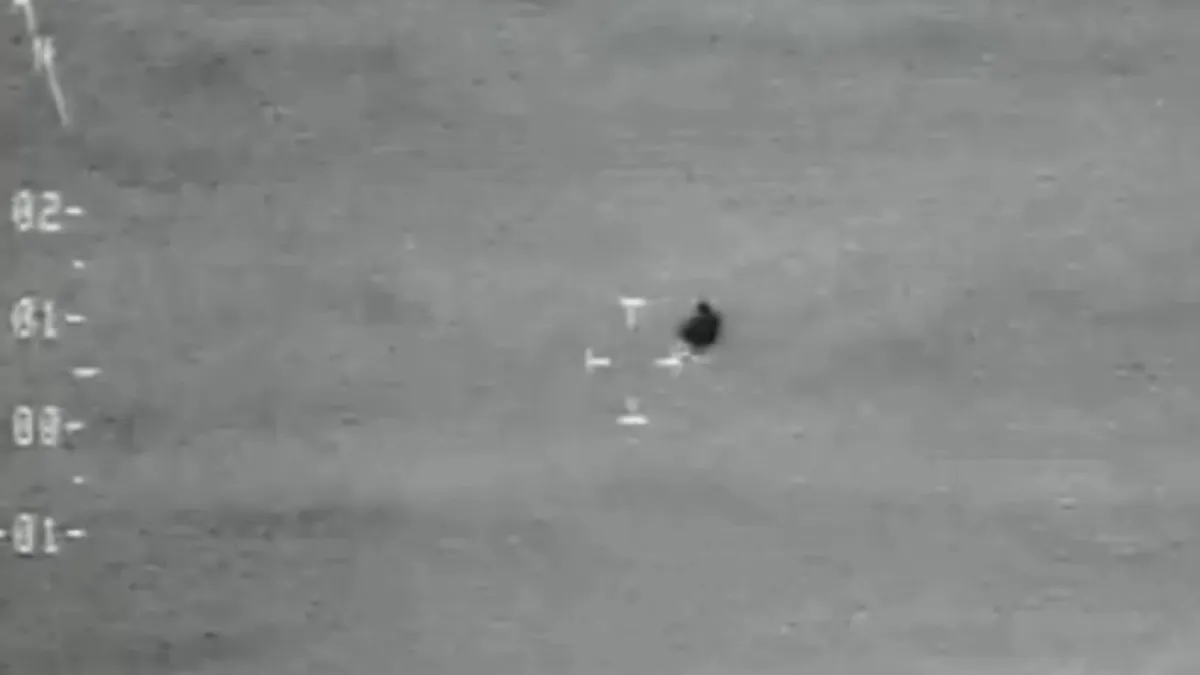
Toont deze foto een echte UFO?
1.3 De invloed van politieke en militaire belangen
De jaren zestig markeerden een periode van toenemende militaire spanning, met de Koude Oorlog en de Space Race. In die context waren sommige UFO-incidenten mogelijk militaire geheimen of gevechtsvliegdekschepen. De vraag bleef of er soortgelijke verschijnselen technisch verklaarbare oorzaken hadden, of dat ze echt iets bovennatuurlijks of buitenaards waren.
Er was ook sprake van een soort ‘disinfo’ strategie, waarbij men gegevens technische en mysterieus hield om te voorkomen dat vijanden of oppositie zich een beeld konden vormen van nieuwe technologieën of bedreigingen. Veel incidenten konden niet worden verklaard, zelfs niet door geavanceerde radar en sensorische apparatuur.
Kortom, ze sluimerden onder de oppervlakte, en de officiële documenten tonen dat veel rapportages verduisterd of afgewezen werden zonder adequate verklaring.
Hoofdstuk 2: De jaren zestig – Een Bloei van Onverklaarbare Incidenten
2.1 De algemene kenmerken van de waarnemingen
De jaren zestig blijken een bijzonder rijke periode te zijn in termen van UFO-waarnemingen. Uit de rapporten blijkt dat veel waarnemingen zich herhaalden: opvallende lichten, ongewone vormen, grote objecten die stilhielden of plotseling snelheden bereikten die klassieke technologie niet kon halen.
De getuigen variëren van militairen en piloten tot gewone burgers, zoals boeren, studenten, en politieagenten. Betrouwbare getuigen zoals piloten en ervaren militairen meldden incidenten die met radar en visuele waarnemingen werden ondersteund. Dat maakt deze gevallen extra interessant, omdat zij de mogelijkheid bieden om waarnemingen vanuit verschillende bronnen te vergelijken.
Veel UFO-waarnemingen hadden meerdere getuigen
2.2 Voorbeelden van opmerkelijke incidenten uit de jaren zestig
Laten we enkele incidenten in detail bekijken.
a) Het geval van de grote driehoek in Kansas (1961)
In de nacht van 3 januari 1961 meldde een politieagent in Kansas een indrukwekkende driehoekvormige ufo die stil zweefde boven de snelweg. De ufo was ongeveer 200 voet breed, draaide langzaam en leek geen geluid te maken. Toen de agent naderbij kwam, sloeg het object plotseling snel weg en verdween. Het had een glanzend oppervlak en leek uit meerdere lagen te bestaan.
Wat dit incident uniek maakt, is dat het niet alleen visueel werd waargenomen, maar ook radarbevestiging kreeg. Verschillende radarvelden registreerden de bewegingen van het object, wat de onbevooroordeelde wetenschappelijke waarde verhoogt. Het werd ook bevestigd door meerdere getuigen in de omgeving. Dit soort gevallen, waarbij radar- en visuele gegevens overeenkomen, wordt beschouwd als zeer moeilijk te verklaren.
b) Het waarnemingsincident van Michigan (1966)
In Michigan werden meerdere mensen tegelijkertijd getuige van een groot, ringvormig object dat traag door de lucht bewoog. Het object had een halo effect en leek een blauwachtige gloed uit te stralen. Sommige getuigen rapporteerden dat het object zich splitste in kleinere delen en verdween achter de bomen of zich snel vervolmaakte naar een punt.
Het interessante was dat dit fenomeen meerdere keren werd gemeld door olika mensen in korte tijd, en dat enkele waarnemingen werden ondersteund door radardata van nabijgelegen luchthavens. Het verband tussen visuele waarnemingen en radarvermeldingen suggereert dat er werkelijk een fysiek object aanwezig was dat op de een of andere manier niet bekend was.
2.3 Sporen en fysieke effecten
Veel onverklaarde waarnemingen gaan gepaard met fysieke effecten, zoals intense hitte, elektromagnetische verstoringen, en zelfs schade aan apparatuur. Bijvoorbeeld, in een incident in Oklahoma (1962) werd een klein vliegtuig achtervolgd door een rood-oranje vuurbol die zich snel door de lucht bewoog. De piloot meldde dat zijn navigatiesysteem stoorde en dat er een warmtegevoel op de huid was. Sommige onderzoekers vermoeden dat dergelijke fenomenen antimagnetische of energiewaardevolle eigenschappen bezitten.
Wat hebben de twee getuigen die avond precies gezien?
2.4 Voorbeelden van andere opvallende gevallen
De ‘lighthouse’ in New York (1962): meerdere getuigen meldden een grote, heldere lichtbron die boven de skyline hing. De lichtsterkte deed denken aan een kustlamp, maar bevond zich op een plaats waar geen natuurlijke lichtbronnen bekend waren.
De landingspoging van een klein object in Oklahoma (1962): getuigen zagen dat een klein, dik object leek te landen en dat er uit het object een man uit een voertuig stapte die zich vreemd gedroeg. Dit soort ‘bijzondere’ waarnemingen roept vragen op over buitenaardse en menselijke factoren.
Hoofdstuk 3: Analyse van de patronen en kenmerken
3.1 De herhaling van kenmerken en patronen
Een belangrijke bevinding uit de verzamelde rapporten is de consistentie: vele waarnemingen delen kenmerken zoals:
Lichtfenomenen die in verschillende vormen verschijnen: cirkels, driehoeken, cilinders, en kubussen.
Snelle bewegingen en plotselinge snelheden die de technologische mogelijkheden van de jaren zestig overtreffen.
Stilstaande of langzaam bewegende objecten, vaak met het vermogen om van vorm te veranderen.
Felle lichten die van kleur variëren, vooral rood, geel, blauw en groen.
Geluiden die vaak ontbreken of erg zacht zijn, hoewel sommige getuigen zingen dat ze harde kreunen of sissende geluiden hoorden.
3.2 Radar- en sensorwaarnemingen
De combinatie van visuele waarneming met radarbevestiging is een belangrijke indicator voor de objectiviteit van sommige incidenten. Vooral in militaire en luchthavendossiers blijkt wel dat bepaalde objecten niet alleen visueel, maar ook via radar werden gevolgd en dat ze zich niet konden aanpassen aan bestaande technologie of natuurlijke verschijnselen.
Meldingen van UFO-waarnemingen bleven afnemen voor Blue Book naarmate de jaren '60 vorderden
3.3 fysieke en elektromagnetische effecten
Veel incidenten tonen dat objecten elektromagnetische verstoringen kunnen veroorzaken. Dit viel op in gevallen waar vliegtuigen en communicatieapparatuur uitvallen bij de waarneming van de UFO. Daarnaast worden lichaamseffecten gerapporteerd, zoals warmte, tintelingen en waterige ogen. Sommige onderzoekers vermoeden dat deze verschijnselen te maken hebben met energiegolven die door de objecten worden uitgezonden.
3.4 De rol van de publieke en militaire perceptie
In de jaren zestig was de publieke belangstelling voor UFO’s groot, vooral met de opkomst van de televisiekunst en de nieuwe media. Overheidsrapporten proberen vaak de incidenten te ‘verdammen’ door ze te labelen als natuurlijke fenomenen, menselijke fouten, of ballon- en weerballonnen. Maar de herhaalde onverklaarbare incidenten wijzen op een complex samenspel van natuurlijke en technologische factoren die nog niet volledig zijn begrepen.
Hoofdstuk 4: Conclusies en Reflecties
4.1 De blijvende onverklaarbaarheid
Ondanks de inspanningen van Project Blue Book en de technologische vooruitgang, blijven veel incidenten onverklaard. Vaak wordt er gesuggereerd dat bepaalde fenomenen een bewijs vormen voor buitenaardse intelligentie, terwijl andere mogelijk natuurlijke of menselijke oorzaken hebben.
Ondanks dat er een UFO-golf was, kwamen er in 1964 weinig meldingen bij Blue Book binnen
4.2 Het belang van herziening en onderzoek
Veel gevallen uit de jaren zestig worden nog steeds bestudeerd door UFO-onderzoekers en historische wetenschappers. Het herzien van oude dossiers kan patronen blootleggen die voorheen niet zichtbaar waren, en kan zelfs nieuwe technologieën behulpzaam maken bij de analyse van historische waarnemingen.
In 1966 nam het aantal Blue Book-onderzoeken toe
4.3 De vraag of we echt alleen zijn
De confrontatie met onverklaarbare incidenten benadrukt dat de lucht en de ruimte boven ons vol raadsels blijven. Of deze verschijnselen nu buitenaards, natuurlijke, of door menselijke technologieën veroorzaakt zijn, ze blijven mysterieus en relevant voor de menselijke nieuwsgierigheid en wetenschap.
4.4 Toekomstperspectief
Met de huidige toename aan technologie en sensoren, en de hernieuwde belangstelling van overheden zoals de Amerikaanse Pentagon en NASA, wordt aangenomen dat er meer data en inzichten zullen komen. Openbare transparantie en wetenschappelijk onderzoek kunnen uiteindelijk bepalen of we ooit het antwoord vinden op de vraag: Zijn we echt alleen in de kosmos?
Het verhelderende auto-incident is een van de meest intrigerende die ooit is vastgelegd
Slotwoord
De afgelopen tien jaar laten zien dat de onverklaarde UFO-gevallen niet enkel een fascinerende verzameling raadsels vormen, maar ook een venster bieden op de limieten van onze kennis. Door de historische incidenten te bestuderen en patronen te zoeken, kunnen we misschien op termijn meer begrip krijgen van deze mysteries die ons al decennia lang uitdagen. Het blijft een boeiende uitdaging voor wetenschappers, overheden en nieuwsgierigen om verder te kijken dan de horizon en de waarheid boven tafel te krijgen.
De korte video hieronder onderzoekt de mogelijkheid van UFO's en buitenaards leven.
By Bob Spearing - MUFON Director of International Development
Anyone who knows anyone aware of anything happening on UFO Street right now knows that Steven Spielberg is re-entering the UFO movie field after several decades, following his monumental successes with ET and Close Encounters of the Third Kind. But why now?
Personally, I think Close Encounters is a monumental Hollywood success and sucked me into this community based on my own personal experiences that Spielberg seemed to understand. But why now?! Indeed! I certainly don't want to give Spielberg free press here because I don't know his motives apart from the fact that he needs to make money for the studio.
It will undoubtedly be a mega-blockbuster.
It will also skew public opinion in a certain direction. Be careful of the magician showing youhis left hand while his right hand receives you. Is Spielberg part of the cabal? Real or not?
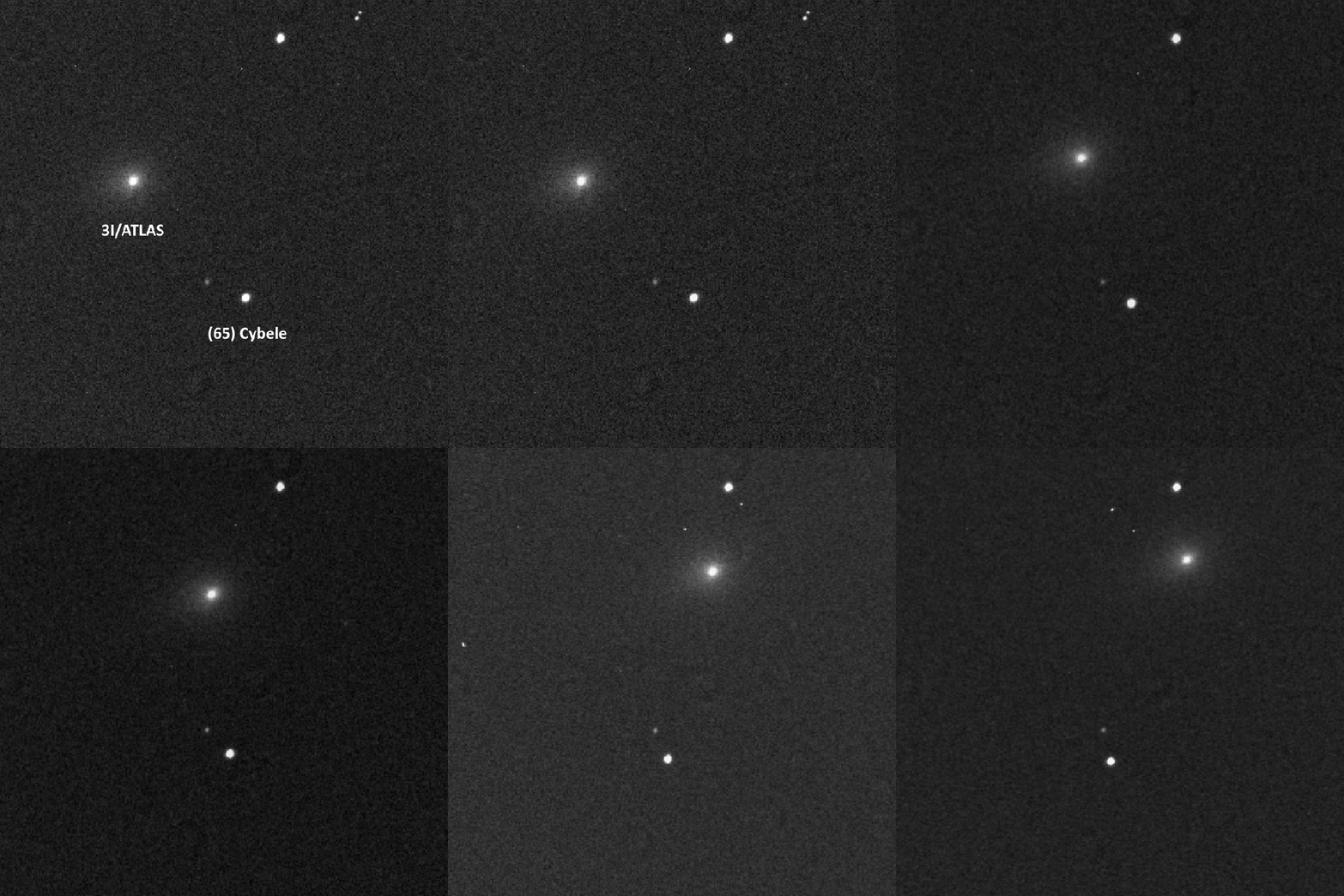
Also, it’s just good ole' product placement, to be honest. Know your audience. Hollywood thrives on this! UAP is the hottest topic in the universe right now because the public is craving answers, and there seems to be a slow rollout by the government and its various mouthpieces that disclosure may be near. OR NOT. Think of how worldwide audiences are being seduced by the 3i/ATLAS affair based on virtually nothing.
You've got the all everywhere at all times, Lue Elizondo, and a supporting cast of George Knapp, David Grusch, Cris Mellon, Hal Putoff, Eric Davis, Jeremy Corbell, Robert Bigelow, and the folks at Skinwalker, and as if late, a scientist or two at Lockheed, claiming to have reverse-engineered weird stuff, possibly from the future. That stuff is similar to what mysteriously disappeared from a USPS box intended for MUFON, which all adds to the mystery and intrigue. Just stay in the loop! They rob us from time to time! Isn’t that to be expected, though?
On the governmental side, we have advocates for disclosure like Representatives Anna Luna, Tim Burchett, Andre Carson, and Senators Kirsten Gillibrand and the late Harry Reid, who got the whole gig going by funding AATIP, which has morphed into the mess that is the less-than-useless All Doman Resolution Office (AARO.) Let's not leave out those photo pixelating folks at NASA also.
We have endless Congressional Hearings, with the latest being held by Representative Nancy Mace. If you go back to the glory days of Ufology, NICAP was reaching out to our Congressional members as far back as the late 50s. Yet we reinvent the wheel every 5 years or so. With no results. EVER. Or at least, if you are privileged enough to get the skinny in a Congressional briefing behind closed doors in the "SCIF. You are golden! Why nothing for us, the public?" LOL! What a fix!
So, what gives? Is Spielberg a truly independent filmmaker, or is his new movie, rumored to be entitled "Disclosure"; a life-like interpretation of an alien contact, or is it like propaganda to keep the UFO Community begging for more per governmental requirements?
Interestingly, when Spielberg was in consultations with J Allen Hynek and Jacque Vallee, on Close Encounters, Vallee (brilliantly portrayed by the late Francois Truffet in the movie), Vallee suggested at the time that maybe it wasn't aliens but something far different. And perhaps even more exotic and anomalous. I remember that. Do you? Exactly!
At the time, Spielberg’s response, to paraphrase, was that people wanted aliens.
I think on this point, 40 years later, Vallee will be on the winning side of this argument. It’s far more weird than we ever considered, and is Spielberg finally catching up, or is he being directed?
Spielberg is intimating perhaps it's not aliens at all but humans from 500,000 years in the future!
Why that number? Why not 100 years from now or 1,000? What a grand departure from 40-plus years ago in his thinking. But is it his thinking or putting out the party line? Things have changed since the 80s. Where did he come up with the 500,000-year number? Out of whole cloth? Or is he privy to something we do not know about or never will because we are not part of the enlightened elite like him?
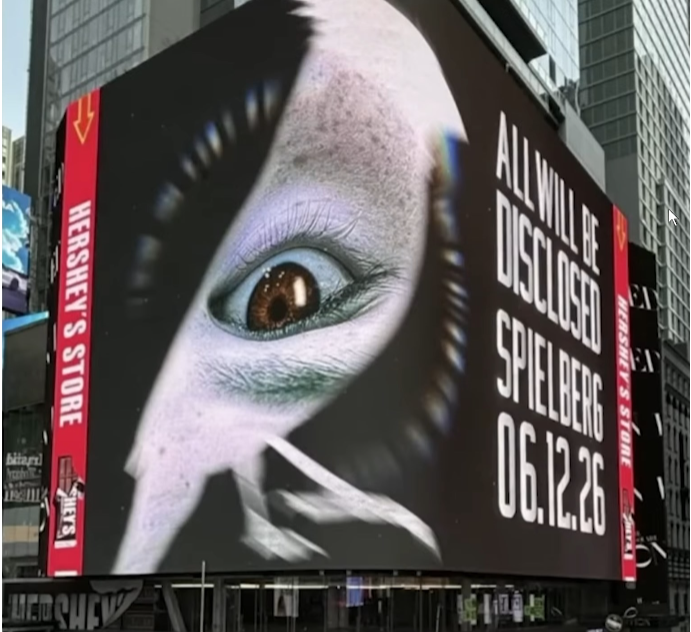
The initial ad for Spielberg’s new movie is very cryptic, the first ad showing what appears to be a bird’s head with a human eye. That, at least, is my interpretation. It’s cryptic indeed. Maybe it's?the dinosaurs coming back? I hope that's not the Jurassic plot. I really hope not!
Even still, that would suggest a nod towards human evolution and a complete erasure of his Close Encounters of the 1980s concerning aliens.
It also, in a way, leads to a theory of time travel. Are aliens US from a far, far future?
Is the government’s hand being forced now by human tools in the form of whistleblowers, preparing us for some revelation? Interrupting or even destroying their disclosure plans. Is it a giantclusterf…! If so, who is in charge? Governments or whistleblowers throwing everything on its head!? I guess that whistleblowers will be the first to lose!
What happens next?
There is a certain angst in the reluctance to fulfill disclosure. WHY? In some circles, including?intimations from prominent UFO spokespersons, that the reality of who is operating these.UFO/UAP are of such dire reality that the public cannot absorb it all at once. If this is true, we?certainly face a dark and dystopian reality that could destroy civilization when disclosure actually occurs! Then again, is it all a psyop?
In the final analysis, considering longstanding free and open grassroots organizations like MUFON and NUFORC are under attack like never before, with the sudden appearance of the Department of War entities like AARO, other governmental entities under serious suspicion, and factual disregard like NASA, and the sudden appearance of mysterious private corporations like Enigma Labs, funded by billionaire Peter Thiel, with multi-billion dollar contracts held with the
Department of War via his Palantir company, YOU, the public, YOU, the UFO Street, should be very, very, very concerned that what is going down might be the largest “Psyop” in human. history. A perfect storm of cooperation between government, military, media, the entertainment establishment, and industry ever conceived to hide the truth from us all.
Be very careful when you submit your UFO report. Do you want it to go into useless black holeslike AARO, NASA, Enigma, or even worse, tiny little startups that come and go like the? International UFO Bureau, or do you want an established organization like MUFON with over 700 certified field investigators from numerous forensic backgrounds reaching out to you in real time getting the job done? Real investigations that the government has zero access to?
We have been doing the Air Force’s job since 1969! No one owns us! NO-ONE!
The biggest unanswered questions in the Bible The Bible remains the best-selling book of all time, but to this day scholars and theologists debate on a number of inconsistencies. Indeed, many parts of the Bible have been confirmed to be true by science. As for others, well, not quite. In fact, some parts of the Bible remain a complete mystery.
Curious to learn what the biggest unanswered questions in the Bible are? Then read through!
The location of the Garden of Eden The original home of Adam and Eve, from where they were cast out by God, remains one of the mysterious locations in the Bible.
The location of the Garden of Eden It is true that the whole story can be interpreted as a metaphor, but what if one interprets it literally? Where would the Garden of Eden be located, after all? We can find some hints in Genesis 2.
The location of the Garden of Eden Genesis 2:10 says that, “A river flowed out of Eden to water the garden, and there it divided and became four rivers” (the specific wording depends on the Bible translation). And then it mentions their names: Pishon, Gihon, Hiddekel (the Tigris), and Phirat (the Euphrates).
The location of the Garden of Eden This hint has led to speculations that the Garden of Eden was located either in Mesopotamia (present-day Iraq and Kuwait), or modern-day Turkey or Armenia. Though the specific location has, thus far, not been located.
There are two creation stories In Genesis 1, God creates male and female at the same time. But then, in the very next chapter, Genesis 2, God created a woman from a man’s rib.
There are two creation stories Not only that, but even God himself is described as having two different names: Elohim in the first account, and YHWH in the second.
Metaphorical interpretation aside, there are indeed two different versions of the creation story. Sure, these may have been an editorial mistake when putting the Bible together, but still, which story should we trust and why?
Who were the "sons of God?" Genesis 6:2 says that, “The sons of God saw that the daughters of humans were beautiful, and they married any of them they chose.” So who were these “sons of God,” after all?
Who were the "sons of God?" There are various interpretations of who the "sons of God" were. Some theories point to fallen angels, while others say they might be the descendants of Seth (one of Adam and Eve's children). The Bible, however, doesn’t really tell us who they were for sure.
What really happened to the Ark of the Covenant? The Ark of the Covenant, which is mentioned in both the Old and New Testaments, contains the Ten Commandments tablets. But whatever happened to such an important piece of Biblical history?
What really happened to the Ark of the Covenant? There is a theory that the Ark ended up in Ethiopia and it’s in Aksum today, where it’s guarded by a monk. Other theories point to the Ark being hidden somewhere beneath Jerusalem. To this day, no one has found it.
Who is Lucifer? He’s Satan, right? Well, there’s more to it, actually. Isaiah 14:12-17 mentions the story of Lucifer, however, you won’t find any connection to Satan or the Devil. Just that he’s a fallen angel who was cast down to earth by God for wanting to be above him.
Who is Lucifer? But then Luke 10:18-20 mentions Satan falling "like lightning from heaven." So, yes, it seems like Lucifer and Satan fell down from heaven, but are they the same? It is possible that the connection between the two was made after the Bible was written.
Who is Lucifer? So, who is Lucifer, after all? Some theories point to the hypothesis that Lucifer was a reference to a Babylonian ruler. Another theory says that Lucifer was simply the Latin word for “morning star,” but the truth is that no one knows for sure.
What happened during the "lost years" of Jesus? Not much is documented in the Bible about Jesus’ so-called "lost years." So what was Jesus up to between the ages of 12 and 30, after all?
What happened during the "lost years" of Jesus? Some theories say Jesus stayed in Nazareth, while others say he went to study elsewhere. Locations range from Alexandria, in Egypt, to India.
What happened during the "lost years" of Jesus? It is possible that Jesus studied with the Jewish mystic group the Essenes, or that he traveled as far as Britain with his uncle Joseph of Arimathea, who was a tin trader. The truth is that there is no solid evidence of any of these hypotheses.
How did humanity multiply? Okay, so Adam and Eve were cast out of the Garden of Eden and went on to have babies. But then for humans to multiply they had to intermarry, right? After all, there were no other humans around.
How did humanity multiply? Not only does it sound wrong, but scientifically speaking this wouldn’t have worked out. We need genetic diversity to thrive as healthy humans. So what gives?
How did humanity multiply? Well, one theory says that God either prevented genetic disorders that would likely happen from incestuous relationships, or that, indeed, he created more than two humans.
What happened to the lost tribes of Israel? Both the Kingdom of Israel and the Kingdom of Judah were formed by 12 tribes of Hebrew people. While there is historical evidence of the tribes of Judah and Benjamin (which formed the Kingdom of Judah and are considered the ancestors of modern Jews), the remaining 10 tribes are not well documented.
What happened to the lost tribes of Israel? The tribes were reportedly overtaken by Assyria and exiled from the Kingdom of Israel. But where did they go? Some theories say they traveled to Persia, the Arabian Peninsula, Ethiopia, and even as far as Asia and North America.
What happened to the lost tribes of Israel? It is also possible that they merged with other non-Hebraic cultures and their traditions faded away over the years. Despite all the theories, no one knows for sure what happened to the lost tribes of Israel.
Where is Noah’s Ark? It is true that the Great Flood might have happened (though not on a global scale as the Bible mentions). But if Noah’s Ark did, too, what happened to it?
Where is Noah’s Ark? Over the years, numerous theories have emerged, and 'evidence' has been found, though none was robust enough or indeed conclusive.
Where is Noah’s Ark? One example includes wooden fragments discovered on Turkey's Mount Ararat. Being made of wood, it’s very possible that if the Ark ever existed, it rotted and disappeared over the years.
What happened to Enoch and Elijah? The Bible says that Enoch (the father of the 969-year-old Methuselah), one of the 'two witnesses,' "walked faithfully with God; then he was no more, because God took him away." But what does that mean? Did he die? Did he join God in heaven?
What happened to Enoch and Elijah? According to Kings 2 2:1, Elijah, the other witness, who was a prophet, “Went up by a whirlwind into heaven” in a chariot of fire. If indeed this was a description of his death, why did he ascend to heaven? He was a man, after all.
Archaeologists have been very busy excavating lost civilizations, but they haven't found everything. There are still prominent ancient cities, including capitals of large kingdoms and empires, that have never been unearthed by scholars.
We know these cities exist because ancient texts describe them, but their location may be lost to time.
In a few cases, looters have found these cities, and have looted large numbers of artifacts from them. But these robbers have not come forward to reveal their location. In this countdown Live Science takes a look at six ancient cities whose whereabouts are unknown.
1. Irisagrig
Ancient inscriptions, some of them from Irisagrig, are on display at a ceremony where they were returned to Iraq. (Image credit: Win McNamee/Getty Images)
Not long after the 2003 U.S. invasion of Iraq, thousands of ancient tablets from a city called "Irisagrig" began appearing on the antiquities market. From the tablets, scholars could tell thatIrisagrig was in Iraq and flourished around 4,000 years ago.
Those tablets reveal that the rulers of the ancient city lived in palaces that housed many dogs. They also kept lions which were fed cattle. Those that took care of the lions, referred to as "lion shepherds," got rations of beer and bread. The inscriptions also mention a temple dedicated to Enki, a god of mischief and wisdom, and say that festivals were sometimes held within the temple.
Scholars think that looters found and looted Irisagrig around the time the 2003 U.S. invasion took place. Archaeologists have not found the city so far and the looters who did have not come forward and identified where it is.
2. Itjtawy
The remains of the pyramid of Amenemhat I at Lisht. The capital city he built has never been found, although scholars think that it is likely somewhere near Lisht. (Image credit: DeAgostini/Getty Images)
Egyptian pharaoh Amenemhat I (reign circa 1981 to 1952 B.C.) ordered a new capital city built. This capital was known as "Itjtawy" and the name can be translated as "the seizer of the Two Lands" or "Amenemhat is the seizer of the Two Lands." As the name suggests Amenemhat faced a considerable amount of turmoil. His reign ended with his assassination.
Despite Amenemhat's assassination, Itjtawy would remain the capital of Egypt until around 1640 B.C, when the northern part ofEgypt was taken over by a group known as the "Hyksos," and the kingdom fell apart.
While Itjtawy has not been found, archaeologists think it is located somewhere near the site of Lisht, in central Egypt. This is partly because many elite burials, including a pyramid belonging to Amenemhat I, are located at Lisht.
3. Akkad
A bust of Sargon of Akkad, an early ruler of the Akkadian Empire. (Image credit: Photo12/Universal Images Group via Getty Images)
The city of Akkad (also called Agade) was the capital of the Akkadian Empire, which flourished between 2350 and 2150 B.C. At its peak the empire stretched from the Persian Gulf to Anatolia. Many of its conquests occurred during the reign of "Sargon of Akkad," who lived sometime around 2300 B.C. One of the most important structures in Akkad itself was the "Eulmash," a temple dedicated to Ishtar, a goddess associated with war, beauty and fertility.
Akkad has never been found, but it is thought to have been built somewhere in Iraq. Ancient records indicate that the city was destroyed or abandoned when the Akkadian empire ended around 2150 B.C.
4. Al-Yahudu
A painting dating to 1830, which depicts Jewish exiles in the Babylonian empire. (Image credit: ARTGEN/Alamy)
Al-Yahudu, a name which means "town" or "city" of Judah, was a place in the Babylonian empire where Jews lived after the kingdom ofJudah was conquered by theBabylonian king Nebuchadnezzar II in 587 B.C. He sent part of the population into exile, a practice the Babylonians often engaged in after conquering a region.
About 200 tablets from the settlement are known to exist and they indicate that the exiled people who lived in this settlement kept their faith and used Yahweh, the name of God, in their names. Al-Yahudu's location has not been identified by archaeologists, but like many of these lost cities, was likely located in what is now Iraq. Given that the tablets showed up on the antiquities market, and there is no record of them being found in an archaeological excavation, it appears that at some point looters succeeded in finding its location.
5. Waššukanni
A cylinder seal from the Mitanni empire. It is now in the Metropolitan Museum of Art in New York City. (Image credit: Gift of Martin and Sarah Cherkasky, 1987; Metropolitan Museum of Art; Public Domain)
Waššukanni was the capital city of the Mitanni empire, which existed between roughly 1550 B.C. and 1300 B.C. and included parts of northeastern Syria, southern Anatolia and northern Iraq. It faced intense competition from the Hittite empire in the north and theAssyrian empire in the south and its territory was gradually lost to them.
Waššukanni has never been found and some scholars think that it may be located in northeastern Syria. The people who lived in the capital, and indeed throughout much of its empire, were known as the "Hurrians" and they had their own language which is known today from ancient texts.
6. Thinis
The Narmer palette, shown here, depicts King Narmer — also known as Menes — smiting an enemy. It dates back around 5,000 years ago to when Egypt was being unified. (Image credit: Werner Forman/Universal Images Group/Getty Images)
Thinis (also known as Tjenu) was an ancient city in southern Egypt that flourished early in the ancient civilization's history. According to the ancient writer Manetho, it was where some of the early kings of Egypt ruled from around 5,000 years ago, when Egypt was being unified. Egypt's capital was moved to Memphis a bit after unification and Thinis became the capital of a nome (a province of Egypt) during the Old Kingdom (circa 2649 to 2150 B.C.) period, Ali Seddik Othman, an inspector with the Egyptian Ministry of Tourism and Antiquities, noted in an article published in the Journal of Abydos.
Thinis has never been identified although it is believed to be near Abydos, which is in southern Egypt. This is partly because many elite members of society, including royalty, were buried near Abydos around 5,000 years ago.
2 meter UFO spins, attaches to space station, flies off! UAP paranormal sighting news 👽 Dec 27, 2025 👀
2 meter UFO spins, attaches to space station, flies off! UAP paranormal sighting news 👽 Dec 27, 2025 👀
Guys I recorded this yesterday in Taiwan, I haven’t been able to update my site because I’m doing it from my phone right now. I’m busy doing medical stuff, Ct scans etc in a hospital and so my blog is updated less than my YouTube channel.
This UFO flying in front of the space station is just absolute proof that aliens exist, fly near and land on the hull of the space station. This is several spinning diamonds that change color, shine brightly so they want to be seen. Read the comments on YouTube below the video, eye opening thoughts.
Scott C. Waring wish me luck at the hospital.
2 meter UFO spins, attaches to space station, flies off! UAP paranormal sighting news 👽 Dec 27, 2025
The usual annual highlights include eclipses, full moons, and meteor showers. But let’s look a little further into the future. Here are the most spectacular cosmic events expected to occur before the end of 2100.
What will future astronomers see in the sky? Illustrative photo: Unsplash
The flight of the asteroid Apophis
Asteroid 99942 Apophis.Image: Space Engine
The first major spectacle, which previously gained notoriety due to distorted media reports, awaits us on April 13, 2029. The asteroid Apophis, with a diameter of 370 m, will fly by at a distance of only 32,000 km from Earth – closer than satellites in geostationary orbit.
Its discovery caused concern. However, more accurate calculations have almost completely ruled out a collision with Earth in this century. Nevertheless, the 2029 flyby is a unique opportunity for science, as such a close approach occurs only about once every 800 years.
The return of Halley’s Comet
Halley’s Comet (1P/Halley) is the most famous comet and the brightest of the short-period comets
The last perihelion of the famous Halley’s Comet took place in 1986. The next return of the tailed guest is expected in 2061. Moreover, next time there will be the most favorable conditions for its observation, because it will be 9 times brighter. It will be a wonderful object for observation. In addition, the comet is expected to meet with Venus, which promises an additional spectacle.
V Sagittae
This faint star in the constellation Sagitta has been slowly but steadily brightening since the early 20th century. Astronomers believe it is a binary system, where two stars are gradually moving closer together. The most popular theory says that towards the end of the century, around 2083±10 years, these stars may merge. This will cause a powerful explosion – the birth of a new or even supernova star. V Sagittae may shine brighter than Sirius in the sky and be visible even during the day for weeks or months.
The Great Conjunctions of Jupiter and Saturn
These two giant planets come together in the sky every 20 years. But not every conjunction is clearly visible. In 2040, the phenomenon will be moderate, but in September of that year, all visible planets will line up in a row, creating a beautiful sight.
Space connections in 2040 and 2080
But the most important conjunction will be in 2080. That is when Jupiter and Saturn will come extremely close together – at a distance similar to the record set in 2020. They will also be far from the blinding glare of the Sun, providing ideal conditions for observation around the world.
Unpredictable events
The century also promises surprises that cannot be accurately dated at this time:
Flashes of new meteor showers, more powerful than the famous Leonids.
The explosion of a supernova in our Milky Way galaxy, the first in many centuries.
Bright comets that are currently located far away in the outer Solar System.
Interstellar objects, which were first officially confirmed only in the last decade, and since 2017, three such “guests” have been officially detected.
Despite the forecasts, the main thing is to remain attentive to the sky. The most memorable astronomical events often come unexpectedly.
Deep inside the Earth, at the boundary between the mantle and the outer core, there are so-called ultra-low velocity zones – areas that seem to be unaffected by the fiery chaos raging in the depths. Now, scientists claim to have unraveled their mystery.
What lies beneath the Earth? Source: www.livescience.com
Ultra-low speed zones
At the very center of our planet is a solid inner core. Between it and the crust, matter is in a very hot and liquid state and is divided into two layers: the outer core and the mantle above it. Recently, the journal Nature Communications published a study by scientists from the Institute of Earth Sciences of the Chinese Academy of Sciences, in which they attempted to unravel one of the mysteries lurking at the point of their collision.
The fact is that the 300-kilometer layer at the boundary between the outer core and the mantle, i.e., at a depth of 2,900 km, has a complex structure. Complex processes of mass and heat exchange take place there, but at the same time, there are relatively small areas of up to 100 km in size that are characterized by extremely low seismic activity and high density.
They are called ultra-low velocity zones. It is believed that they have a significant impact on the processes occurring in this boundary layer, but scientists still do not understand where they come from.
Thermal insulation materials
Researchers have tackled this mystery in their latest work. They used ultra-fast optical spectroscopy in combination with diamond cells with a high-pressure and high-temperature anvil. This allowed them to study the properties of the iron-rich magnesiowüstite, which may make up the low-velocity zones.
Usually, minerals rich in metal have high thermal conductivity; they are like natural radiators for heating systems, but in magnesiowüstite, this indicator turned out to be extremely low. Simply put, it is a good heat insulator.
Scientists now understand that ultra-low velocity zones are actually pieces of heavy thermal insulation floating in viscous, molten material and altering the flows within it. Further research will reveal how this occurs.
A study has laid bare the shocking true cost of climate change as heatwaves, wildfires, droughts and storms cause havoc around the world.
The 10 most costly climate disasters alone cost the world more than $120 billion (£88.78 billion) in 2025, according to a report from Christian Aid.
Each was made significantly more likely and more devastating by the effects of human-caused climate change.
And scientists warn that these calculations only reflect insured losses, with the true cost of climate-influenced disasters likely to have been even higher.
This devastating fire alone caused more than $60 billion (£44.4 billion) in damages and killed 40 people.
This was followed by the cyclones which struck Southeast Asia, causing $25 billion (£18.5) in damage and killing more than 1,750 people across Thailand, Indonesia, Sri Lanka, Viet Nam and Malaysia.
The 10 most costly climate disasters cost the world more than $120 billion (£88.78 billion) in 2025. The most damaging were January's Los Angeles Wildfires, which caused more than $60 billion (£44.4 billion) in damages and killed 40 people
Scientists have gathered a vast amount of evidence showing a clear, incontrovertible connection between a warming climate and more intense climate disasters.
It is not that human-caused climate change creates extreme weather events, but it does make them more likely to occur and more intense when they do.
Dr Davide Faranda, Research Director in Climate Physics in the Laboratoire de Science du Climat et de l'Environnement (LSCE), who was not involved in the report, says: 'The events documented in this report are not isolated disasters or acts of nature.
'They are the predictable outcome of a warmer atmosphere and hotter oceans, driven by decades of fossil fuel emissions.'
In this report, researchers have tallied the total costs of the biggest disasters that have been intensified by the changing climate.
Even though extreme weather events in rich countries where property prices are higher typically incur greater costs, the worst-affected countries have been poorer.
Of the six most costly climate disasters in 2025, four hit Asia for a combined cost of $48 billion (£35.5 billion).
Four of the six most costly climate disasters were in Asia, including cyclones that struck Southeast Asia, causing $25 billion (£18.5) in damage and killing more than 1,750 people. Pictured: People flee flood waters in Hat Yai, Southern Thailand
China experienced some of the most severe flooding in recent history, as rising waters killed more than 30 people and created $11.7 billion (£8.6 billion) of damage. Pictured: Flood-affected areas in Congjiang, southwestern China
Since hurricanes are driven by warm ocean waters, humans' continued creation of planet-warming greenhouse gases directly contributes towards making these storms more frequent and more powerful.
But in today's climate, with 1.3°C warming, it has become four times more likely – with such an event now expected once every 1,700 years.
Professor Joanna Haigh, an atmospheric physicist from Imperial College London, who was not involved in the report, says: 'These disasters are not "natural" - they are the inevitable result of continued fossil fuel expansion and political delay.
'The world is paying an ever-higher price for a crisis we already know how to solve. While the costs run into the billions, the heaviest burden falls on communities with the least resources to recover.'
However, no inhabited continent on Earth was unaffected by climate disasters this year.
Jamaica was hit by the 'storm of the century' as Hurricane Melissa made landfall, costing at least $8 billion (£5.9 billion).
Pictured: Destroyed houses in St. Elizabeth, Jamaica
Scientists say that climate change warmed the waters over which Hurricane Melissa (pictured) formed, making the deadly storm four times as likely
Besides the 10 most destructive events, Christian Aid also analysed 10 other extreme weather incidents that have lower financial cost but are equally concerning.
Across England, Scotland, Wales, and Northern Ireland, fire crews responded to the highest number of wildfire incidents on record, with over 1,000 separate outbreaks by early September.
Early estimates suggest that more than 47,000 hectares (184 square miles) of forest, moorland, and heath were burned - the largest annual area since records began.
According to climate and wildfire researchers, the increased intensity and frequency of these blazes were a direct product of climate change.
An exceptionally wet winter followed by one of the hottest, driest springs on record led to an unusually large amount of dead, dry plant matter that fuelled the fires.
Likewise, the report points to the Iberian Wildfires, which were caused by record-breaking extreme temperatures.
Outside of the 10 most expensive events, the report also tracked a number of notable climate incidents. These included the record-breaking wildfires, which destroyed 47,000 hectares (184 square miles) of forest, moorland, and heath in the UK. Pictured: Wildfires rage in the Isle of Arran, Scotland
Spain and Portugal were also hit by the Iberian Wildfires, which were caused by record-breaking extreme temperatures. Pictured: Fires burning in Vesu, Portugal
Weeks of extreme heatwaves, with temperatures exceeding 40°C (104°F), combined with low humidity, created explosive fire conditions.
Scientists estimate that climate change made this event around 40 times more likely and increased the intensity of fire conditions by about 30 per cent.
The report also analysed Japan's year of extreme weather, after the country was battered by back-to-back snowstorms and heatwaves.
Unusually heavy snowstorms and winds killed 12 people and destroyed several houses at the start of the year, followed by the hottest summer ever recorded, with average temperatures 2.36°C (4.25°F) above the average.
Scientists call this phenomenon 'climate whiplash', and research shows that it is likely to become more common as climate change alters global weather patterns.
The most costly climate disasters in 2025
Palisades and Eaton Fires, USA: $60 billion
South & Southeast Asia Cyclones, Thailand, Indonesia, Sri Lanka, Viet Nam, Malaysia: $25 billion
Growing up, most of us learned about the five senses: sight, hearing, smell, taste, and touch.
But it's time to rewrite the science textbooks – at least if one scientist has anything to do with it.
Professor Barry Smith, Director of the Institute of Philosophy at the University of London, claims that humans don't just have five senses.
Instead, he says there are anywhere between 22 and 33 senses.
'Aristotle told us there were five senses,' he explained in an article for The Conversation.
'But he also told us the world was made up of five elements and we no longer believe that.
'And modern research is showing we may actually have dozens of senses.'
Scroll down for the full list of hidden senses – and how you can harness their powers.
Professor Barry Smith, Director of the Institute of Philosophy at the University of London, claims that humans don't just have five senses. Instead, he says there are anywhere between 22 and 33 senses (artist's impression)
Professor Smith's reasoning is that all almost everything we do is multisensory.
'What we feel affects what we see and what we see affects what we hear,' he explained.
'Different odours in shampoo can affect how you perceive the texture of hair.
'The fragrance of rose makes hair seem silkier, for instance.
'Odours in low–fat yogurts can make them feel richer and thicker on the palate without adding more emulsifiers.
'Perception of odours in the mouth, rising to the nasal passage, are modified by the viscosity of the liquids we consume.'
While the exact number of senses humans have remains unclear, Professor Smith says it could be as many as 33.
This includes proprioception (by which we know where our limbs are without looking at them) and interoception.
Interoception operates through a network of neural pathways (artist's impression), deep within the body. For this reason, the researchers have dubbed it the 'hidden sixth sense'
What is the sixth sense?
The sixth sense is known as 'interoception'.
It helps us to feel and interpret internal signals that regulate vital functions in our bodies.
This includes things like hunger, thirst, body temperature and heart rate.
Problems with interoception are linked with a range of conditions, including autoimmune disorders, chronic pain, and high blood pressure – as well as mental health issues.
Interoception is an 'understudied process', by which your nervous system continuously receives and interprets your body's physiological signals to keep vital functions running smoothly.
It helps to explain how your brain knows when to breathe, when your blood pressure drops, or when you're fighting an infection.
Professor Smith also highlights 'gustation' – the sense when we taste something.
'When we taste something we are actually experiencing a combination of three senses: touch, smell and taste – or gustation – which combine to produce the flavours we perceive in food and drinks,' he said.
'Gustation covers sensations produced by receptors on the tongue that enable us to detect salt, sweet, sour, bitter and umami (savoury). What about mint, mango, melon, strawberry, raspberry?
'We don’t have raspberry receptors on the tongue, nor is raspberry flavour some combination of sweet, sour and bitter.
'There is no taste arithmetic for fruit flavours.
'We perceive them through the combined workings of the tongue and the nose. It is smell that contributes the lion’s share to what we call tasting.'
While this might all sound a bit overwhelming, Professor Smith hopes his idea will actually bring comfort to you.
He concluded: 'There are always plenty of things around you to show how intricate your senses are, if you only pause for a moment to take it all in.
'So next time you walk outside or savour a meal, take a moment to appreciate how your senses are working together to help you feel all the sensations involved.'
A hilarious video has revealed the moment a man was kicked in the groin by a humanoid robot that was mimicking his own movements.
The footage was initially shared to BiliBili by user zeonsunlight, but has since gone viral across social media.
It shows a man wearing a motion capture suit – an outfit with sensors that record body movements and convert them into digital motion data.
Unfortunately for him, this data is fed straight to a Unitree G1 robot, which replicates his movements almost immediately.
So, when the man goes for a high kick, the robot quickly follows suit – aimed directly at his groin.
Following the kick, the man doubles over in pain, which the robot obediently also mimics.
The short clip has gained huge attention on Bluesky with one user joking: 'The kick in the n***s is one thing but then mocking his pain is just diabolical...'
Another added: 'Humanity kicking itself in the junk with technology is the perfect metaphor the moment.'
A hilarious video has revealed the moment a man was kicked in the groin by a humanoid robot that was mimicking his own movements
Following the kick, the main doubles over in pain, which the robot obediently also mimics
The clip was posted to Bluesky by journalist James Vincent, who captioned it: 'another robot highlight for 2025: man wearing humanoid mocap suit kicks himself in the balls.'
Hundreds of delighted viewers flocked to his replies to discuss the footage.
'The greatest AI metaphor of all time doesn't exi—,' one user joked.
Another wrote: 'I've been laughing for ten minutes at this. My belly is cramping up.'
And one quipped: 'How many humans in history can be said to have kicked themselves in the balls? Truly revolutionary.
'Mankind's dream for millennia has finally been fulfilled. Our destiny has been reached.'
The Unitree G1 robot weighs 35 kilograms (77 lbs), stands at 1.32 metres tall (4.33 ft) and boasts 23 degrees of freedom in its joints, which gives it more mobility than an average human.
Behind its blank face, the robot is hiding an advanced perception system which includes a 3D LiDAR sensor and a depth–sensing camera.
The Unitree G1 robot weighs 35 kilograms (77 lbs), stands at 1.32 metres tall (4.33 ft) and boasts 23 degrees of freedom in its joints, which gives it more mobility than an average human
Although this makes it one of the most advanced commercially available humanoid robots, it needs to be specifically programmed to carry out any given task.
Straight out of the box, like it is in this video, the Unitree G1 is capable of little more than walking around and waving.
So it's somewhat unsurprising that the robot ended up in this hilarious situation.
This also isn't the first time that Unitree's humanoid robots have gone viral for their bizarre behaviour.
In a viral video posted last month which amassed over 6.3 million views, a humanoid robot attempted to make a stir–fry for its owner – with disastrous results.
YouTuber Cody Detwiller, who goes by the name WhistlinDiesel, put his lunch in the unsteady hands of a Unitree G1 robot.
The $80,000 (£60,940) bot promptly lost control of the pan, threw the food on the floor, and slipped up in the mess.
After clattering about like a drunken ice skater, the robot eventually collapsed to the floor in a crumpled heap.
On social media, tech fans flooded the comments with their reactions, with one calling it 'peak comedy'.
0
1
2
3
4
5
- Gemiddelde waardering: 0/5 - (0 Stemmen) Categorie:SF-snufjes }, Robotics and A.I. Artificiel Intelligence ( E, F en NL )
28-12-2025
Who Are the Men in Black — And Are They Still Active?
Who Are the Men in Black — And Are They Still Active?
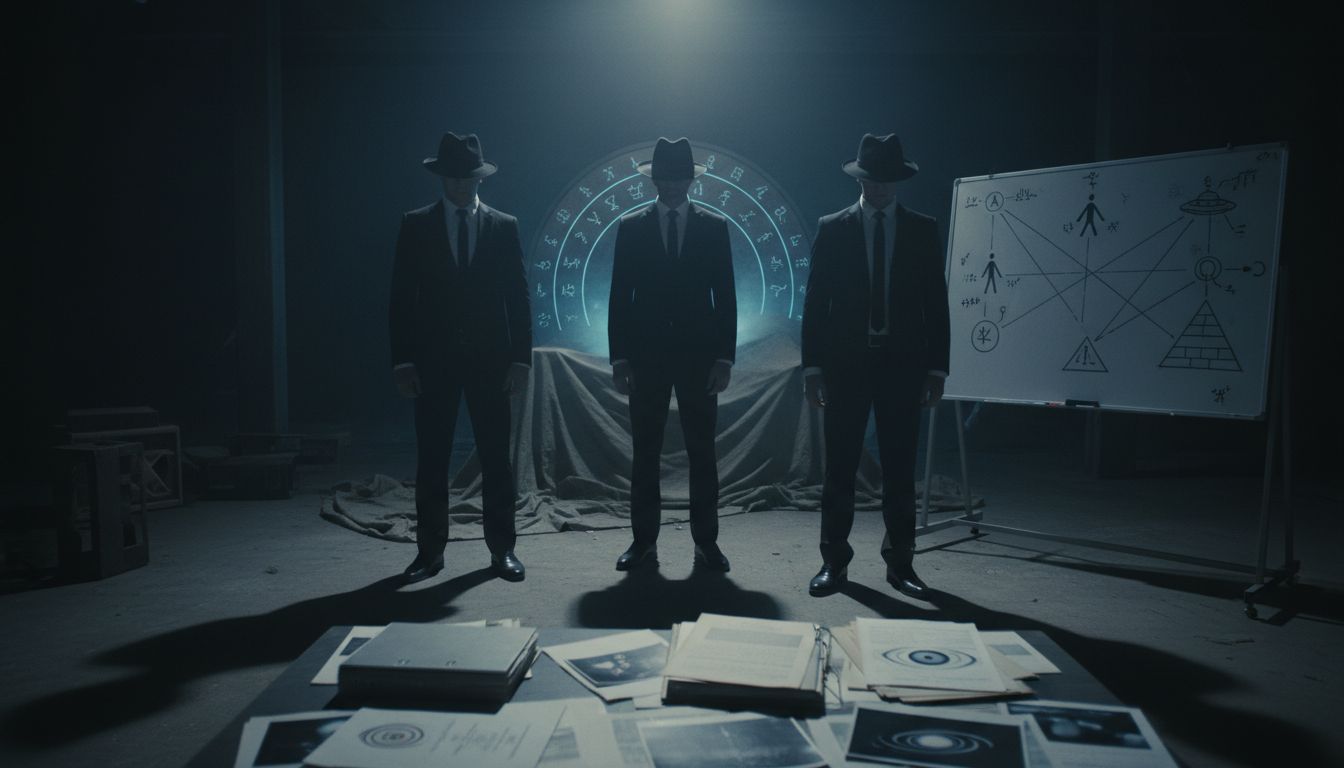
The Men in Black have long intrigued the public with their elusive presence and ties to UFO phenomena. Often described as shadowy figures in black suits, they are believed to intervene following sightings or encounters with extraterrestrial craft. Speculation abounds about their true identities—government agents, aliens themselves, or perhaps something more sinister. As reports of MIB encounters continue to surface, questions arise: Are they still monitoring our skies, or has their role evolved in the face of shifting narratives?
Introduction
The world of extraterrestrial encounters and intergalactic diplomacy is often depicted in stories, but few engage the imagination quite like Men in Black. This iconic franchise blends comedy, action, and science fiction, showcasing a secret organization tasked with monitoring and regulating extraterrestrial activity on Earth. Since its inception, Men in Black has evolved into a cultural phenomenon, inspiring films, animated series, and comic books. The black-suited agents, equipped with advanced technology, remain vigilant defenders of humanity, ensuring that alien encounters happen discreetly. Their unique blend of humor and adventure resonates with audiences, fostering curiosity about what lies beyond our planet. Through engaging storytelling, Men in Black invites fans to ponder the possibilities of life beyond Earth, making them a staple in popular culture.
Government Secrecy and UFOS
Although government secrecy often fuels speculation, the topic of UFOs has fascinated both enthusiasts and skeptics for decades. Many believe that the government’s reluctance to disclose information only heightens curiosity. Former military personnel and whistleblowers have claimed that they witnessed unexplainable phenomena, yet their accounts often meet silence or skepticism from officials. This secrecy raises questions about what authorities might know but choose not to reveal. Public interest peaked after incidents like the Roswell crash, further complicating the narrative around UFOs and government involvement. Now, with recent declassifications and a push for transparency, some wonder if the truth about these unidentified aerial phenomena will finally surface, or if the shadows of secrecy will continue to obscure reality.
Notable Cases or Sightings
Numerous notable cases and sightings have captured public attention and fueled the UFO debate. One prominent instance occurred in 1967, when a Canadian ufologist named Paul Hellyer reported encounters with Men in Black, coinciding with numerous UFO sightings. Another significant case emerged in 1980, when two teenagers in the small town of Kecksburg, Pennsylvania, claimed to have seen a flying saucer and were later confronted by mysterious figures dressed in black suits. In 2008, a Houston resident reported two Men in Black visiting him after he filmed an unusual light in the sky. These incidents illustrate a consistent pattern where witnesses of UFO phenomena encounter these enigmatic figures, raising questions about their true intentions and role in the ongoing UFO discourse.
Common Theories or Explanations
While many theories circulate about the Men in Black, most fall into a few broad categories that attempt to explain their existence and purpose. One prevalent theory suggests they’re government agents tasked with silencing UFO witnesses to maintain secrecy. Another theory posits that they’re extraterrestrial beings themselves, disguised as humans to monitor and investigate human activity. Some enthusiasts claim the Men in Black serve as a form of psychological warfare, intimidating individuals to deter them from discussing their alien encounters. Additionally, paranormal researchers argue they’re connected to otherworldly phenomena, acting as intermediaries between humans and aliens. Despite these diverse explanations, the true nature and intent of the Men in Black remain elusive, keeping conspiracy theories alive.
Frequently Asked Questions
What Do the Men in Black Actually Look Like?
The Men in Black typically appear in formal black suits, wearing dark sunglasses, and exhibiting serious expressions. Their demeanor often seems robotic, and they project an unsettling aura that suggests they’re not entirely human.
Are There Any Female Men in Black?
Some reports suggest there are female agents among the Men in Black. They’re described as equally mysterious, often wearing dark suits and sunglasses, effectively maintaining the secretive aura associated with their male counterparts.
How Do People Report MIB Encounters?
People report MIB encounters through various channels, including online forums, paranormal conventions, and local news outlets. They share detailed descriptions, unsettling experiences, and mysterious encounters, creating a collective narrative around these enigmatic figures of folklore.
What Is the Origin of the Men in Black Legend?
The legend of the Men in Black likely originated in the 1950s, fueled by UFO sightings and reports. People claimed mysterious figures appeared after such events, adding an air of intrigue and secrecy to their experiences.
Are There Any Movies Inspired by MIB Theories?
Numerous films draw inspiration from Men in Black theories, blending sci-fi and comedy. Notable examples include the iconic “Men in Black” series, which popularized the concept, and other movies referencing government conspiracies and extraterrestrial encounters.
Overzicht De “Mannen in Zwart” (MiZ) of (MIB) zijn geëvolueerd van een cultklassieke filmreeks naar een terugkerend element binnen de moderne UFO-mythevorming. Terwijl de populaire cultuur hen vaak afbeeldt als gestileerde, pakdragers die op humoristische wijze getuigen stilhouden, beschrijven veel eerstehands verslaggevers een veel verontrustender aanwezigheid. Volgens een artikel uit 2020 op UFO Insight spreken mensen die een onverklaarbaar vliegend object (UFO) hebben gezien vaak later over bezoeken van onbekende mannen die dreigen, terugbetaling beloven of gewoon een aura van gezag uitstralen. Het artikel, gepubliceerd op 4 april 2020, verzamelt tientallen van dergelijke getuigenissen en onderzoekt de verschillende hypothesen die proberen te verklaren wie – of wat – deze figuren mogelijk zijn.
Verschillende Theorieën Onderzoekers hebben drie voornaamste verklaringen voorgesteld voor het fenomeen van de Mannen in Zwart.
Overheidsorganisatie De meest gangbare theorie stelt dat de Mannen in Zwart onderdeel uitmaken van een topgeheim overheidsysteem dat belast is met het onderdrukken van UFO-bewijzen. Deze opvatting sluit aan bij langdurige beweringen over geheime “UFO-taskforces” binnen inlichtingendiensten die in de loop der jaren de informatie onder controle proberen te houden.
Extraterrestrische Wezens Een andere hypothese suggereert dat deze agenten buitenaardse wezens zijn, in hun natuurlijke vorm of vermomd in menselijke gedaante. Deze theorie is gebaseerd op het idee dat geavanceerde buitenaardse culturen mogelijk direct ingrijpen om hun activiteiten op aarde te verbergen, vooral in het licht van de waargenomen misbruik van technologie of ontmoetingen.
Ondergrondse Beschaving Een meer speculatieve uitleg linkt de Mannen in Zwart aan een ondergrondse beschaving – misschien een overblijfsel van de mensheid dat eeuwen geleden onder de grond is gedwongen. Volgens deze theorie zouden ze nu toezicht houden op gebeurtenissen aan het aardoppervlak. Aanhangers verwijzen naar oude mythes en obscure teksten die verwijzen naar schimmige toezichthouders, hoewel deze interpretatie marginaal blijft binnen het veld van reguliere UFO-studies.
Historische Verslagen Getuigenissen over ontmoetingen met de Mannen in Zwart dateren van enkele decennia terug, met Some onderzoekers die de verhalen traceren naar de jaren 1950.
Een van de oudste gedocumenteerde gevallen betreft Paul Miller, een boer die beweerde dat na het zien van een lichtgevend object, drie mannen naar zijn huis kwamen. Ze “wisten alles over mij,” zo stelde hij, en waarschuwden hem om nooit over het voorval te spreken. In een later, agressiever voorval, meldde Robert Richardson dat hij, nadat hij een crash van een vaartuig in de Nevada-woestijn had ontdekt, een groep mannen in donkere pakken arriveerden, met wapens zwaaiend, en eisten dat de wrakstukken binnen enkele uren werden verwijderd. Beide gevallen bevatten enkele gemeenschappelijke elementen: plotselinge verschijning, gedetailleerde persoonlijke kennis en expliciete dreigementen om te zwijgen.
Fotografisch bewijs, zoals de foto’s genomen in de jaren 1970 door Jack en Mary Robinson van twee mannen in donkere kleding die naast een landelijke omheining staan, wordt zelden overtuigend ontkracht en blijft een zeldzame visuele claim binnen de bewijslast rond de MiZ.
Recente en Opmerkelijke Incidenten Het verschijnsel blijft tot in de 21e eeuw voortduren. Zo beschreef Danny Gordon, een voormalig luchtverkeersleider, in 2018 een waarneming van een “zeer groot, koepelvormig vaartuig” dat boven een Midden-Westerse vliegveld zweefde. Enkele dagen later ontving hij bezoek van twee mannen met officiële identificatie, die hem opdroegen alle radargegevens over de waarneming te verwijderen. Gordon’s verslag onderstreept een patroon dat door UFO-onderzoekers wordt opgemerkt: een continue stroom aan rapporten vol intimidatietactieken.
Hoewel sommige sceptici deze verhalen toeschrijven aan hoaxes of psychologische stress, blijft de consistentie in details – zoals de kledij van de mannen, hun kennis van persoonlijke achtergronden en de eis om geheim te blijven – de interesse van onderzoekers vasthouden.
Vervolg Debat en Context De Mannen in Zwart blijven een controversieel en onopgelost onderdeel van de UFO-discussie. Voorstanders die de overheid als oorzaak aanwijzen, wijzen op gedocumenteerde projecten als Project Blue Book en de meer recente UAP Task Force, en suggereren dat de verhalen een culturele spiegel kunnen zijn van echte inlichtingenoperaties die bedoeld zijn om het publiek te beïnvloeden.
Aan de andere kant beweren voorstanders van een buitenaardse of ondergrondse afkomst dat de anonimiteit en soms bovennatuurlijke overtones van de verhalen de capaciteiten van bekende instanties overschrijden.
Volgens de Amerikaanse UFO-onderzoeker Dr. Emily Hargrove, geciteerd in het UFO Insight-artikel, moet men voorzichtig zijn: “Zonder verifieerbare documentatie blijven de Mannen in Zwart een mengelmoes van folklore en mogelijk geheime activiteiten, en het is belangrijk dat we dat onderscheid duidelijk maken.”
Met de recente declassificaties van de Amerikaanse overheid over onverklaarde luchtvaartuigen (UAP), groeit de publieke interesse om meer te weten te komen over soortgelijke fenomenen, inclusief de mysterieuze Mannen in Zwart. Of toekomstige onthullingen de ware aard van deze ontmoetingen zullen blootleggen of slechts nieuwe lagen toevoegen aan een complexe mythe, blijft nog onduidelijk.
Voorlopig blijven de Mannen in Zwart een schimmig en intrigerend element dat tussen overheidsgeheim, buitenaardse speculatie en oude mythologie zweeft, en onderzoekers uitdagen om feit van fictie te onderscheiden terwijl ze de ervaringen van degenen die hen beweren te hebben ontmoet, respecteren.
2026 will be the year NASA astronauts fly around the moon again — if all goes to plan
2026 will be the year NASA astronauts fly around the moon again — if all goes to plan
The Artemis II mission, which could launch as early as February, is expected to send four astronauts on a trip to the moon, though they won't land on its surface.
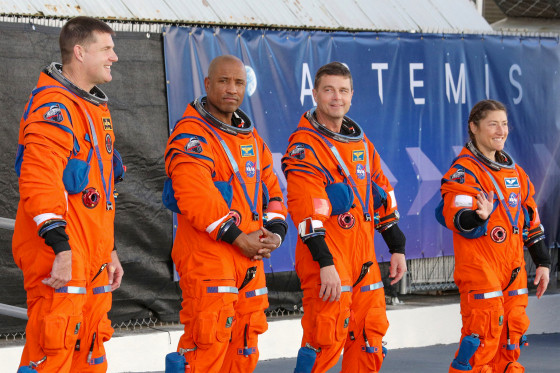
The Artemis II astronauts pause during a demonstration test at the Kennedy Space Center in Cape Canaveral, Fla., on Saturday.Gregg Newton
If all goes according to NASA’s plans, 2026 will finally be the year that astronauts once again launch to the moon.
In a matter of months, four astronauts are poised to fly around the moon on a roughly 10-day mission — the closest humans will have gotten in more than half a century.
The flight, known as Artemis II, could lift off as early as February and would be a long-awaited jump start to America’s lagging return-to-the-moon program. The mission will serve as a crucial test of NASA’s next-generation Space Launch System rocket and Orion spacecraft, which have been in development for more than a decade and faced years of setbacks and severe budget overruns. The system has never carried a crew before.
Returning to the moon has been a priority for President Donald Trump since his first term, and the current administration has placed renewed emphasis on dominating the intensifying space race between the U.S. and China. Chinese officials have pledged to land their own astronauts on the lunar surface by 2030.
Beyond the geopolitical implications, the Artemis II mission is designed to usher in a new era of space exploration, with the goal of eventually establishing bases for long-duration stays on the moon before astronauts someday venture on to Mars.
“Within the next three years, we are going to land American astronauts again on the moon, but this time with the infrastructure to stay,” Jared Isaacman, NASA’s new administrator, told NBC News in an interview last week after he was sworn in.
For some scientists, the excitement around returning to the moon stems from the prospect of investigating enduring mysteries about the moon’s formation and evolution — such as violent collisions in the nascent solar system that created it and where its water originated — which came into focus during the Apollo program in the 1960s and 1970s.
“As you can imagine, lunar scientists have had a lot of pent up questions for decades,” said Brett Denevi, a planetary scientist at the Johns Hopkins University Applied Physics Laboratory in Laurel, Maryland.
Answering some of those questions could shed light on similar processes that occurred during our planet’s formation, according to Denevi.
“Earth is kind of a terrible record-keeper,” she said. “With plate tectonics, weather — these things have just totally erased its very earliest history. But on the moon, you have this terrain that formed about 4.5 billion years ago, and it’s just sitting there on the surface for us to explore.”
Although the Artemis II mission won’t land on the lunar surface, it will test various technologies,docking maneuvers and life-support systems — first in Earth orbit and then in orbit around the moon — that will be essential for future missions.
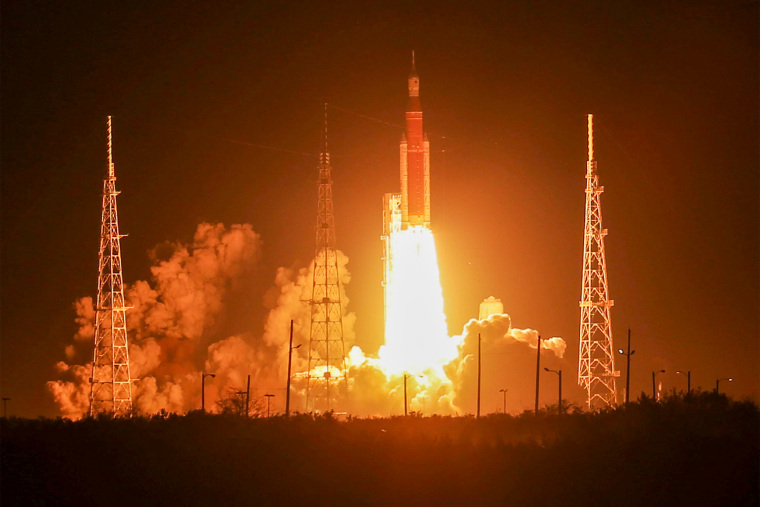
NASA previously launched the Space Launch System rocket and Orion capsule on an uncrewed test flight around the moon — the Artemis I mission — for 3 1/2 weeks in 2022.
NASA's Artemis I Space Launch System rocket, with the Orion capsule attached, launches toward the moon in 2022 from NASA's Kennedy Space Center in Cape Canaveral, Fla.
“There’s a lot riding on this, both good and bad,” said Casey Dreier, chief of space policy for The Planetary Society, a nonprofit organization that conducts research, advocacy and outreach to promote space exploration. “Everything seems to be coming together, but this is the first time with humans on this rocket, and we’ve never tested this life-support system in space before.”
No launch date has been announced, but it is expected between February and April. The crew on board will be NASA astronauts Reid Wiseman, Victor Glover and Christina Koch and Canadian Space Agency astronaut Jeremy Hansen.
The foursome was selected for the mission in 2023. Wiseman, Glover and Koch will make their second trips to space, while Hansen will be making his spaceflight debut.
Last weekend, the astronauts completed a key launch-day rehearsal, which involved donning their flight suits, boarding the Orion spacecraft and running through the countdown sequence to the point just before liftoff.
The Artemis program was established under the first Trump administration in 2019, and it salvaged the Space Launch System rocket and Orion capsule from prior stalled or canceled projects at NASA. The space agency had been working on a next-generation booster since 2010, a year before it retired the space shuttles. The Orion spacecraft, meanwhile, was originally designed for the Constellation Program, which was established by President George W. Bush to conduct crewed flights to the moon and Mars.
Last week, Trump doubled down on his return-to-the-moon agenda in an executive order that directed NASA to prioritize “expanding human reach and American presence in space” by landing astronauts on the lunar surface by 2028.
“This is the culmination of what is now almost a 15-year effort,” Dreier said. “Assuming it works, it’ll be seen as a major win for the administration. But if this doesn’t work, or if something calamitous happens, that will really reset everything.”
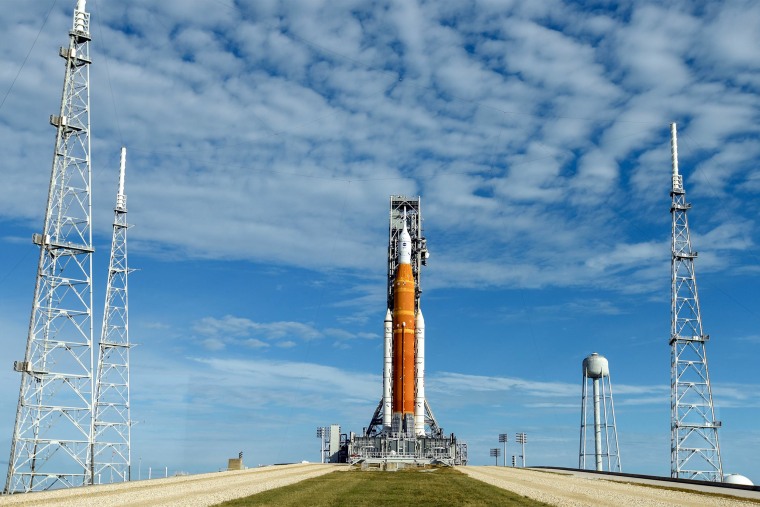
The Space Launch System and Orion spacecraft sit on the launch pad ahead of liftoff in November 2022 at the Kennedy Space Center in Cape Canaveral, Florida.
Red Huber / Getty Images
Artemis II is intended to pave the way for the Artemis III mission in 2027, which is expected to land four astronauts near the moon’s south pole, a region vastly different from where the Apollo astronauts left their bootprints.
Whereas the Apollo moon landings occurred within a narrow band around the moon’s equator, the south polar region is a more challenging place to land because the terrain is pockmarked with craters. These permanently shadowed basins are thought to house abundant water ice, a precious resource for establishing a long-term presence on the moon and for future crewed missions deeper in the solar system.
“Apollo gave us the framework to understand the moon,” Denevi said, “and now we have the foundation to ask different questions.”
Denevi leads the geology team for the Artemis III flight, a role thatinvolves deciding where the crew members will roam after they land, what types of fieldwork they will conduct and which samples they will collect to bring home. She is particularly interested in samples from the moon’s shadowed craters, which are among the coldest places in the solar system.
“When I first started studying the moon, I thought I’d spend my whole career studying historical data,” she said. “Now to have the opportunity to be involved in going to collect new samples that can provide new pieces to this puzzle, instead of trying to rearrange all of the old pieces, that’s going to be a huge step forward.
In 2025, many new thresholds in this complex area of study were crossed, with empirical inquiry into our questions about the nature of consciousness occurring within fields such asneuroscience,psychology, andmedicine. Many advancements in this area over the last year have also challenged long-held assumptions about where and how consciousness originates, how widespread it may be, and how profoundlyaltered statescan reshape human perception.
Here’s a look at just a few of the major stories involving consciousness, the mind, awareness, and the science behind it all that The Debrief has covered in 2025.
Did ‘Universal Consciousness’ Exist Before the Big Bang?
Among the year’s most provocative work about consciousness, one controversial peer-reviewed paper published in AIP Advances proposed that “universal consciousness” may have existed before the Big Bang, functioning not as a byproduct of matter but as a foundational feature of reality itself.
(Image Credit: Pixabay)
Such claims are nothing new and remain hotly debated by researchers, although they reflect a growing willingness among scientists to explore questions about consciousness, whether it is purely emergent or could play a deeper role in shaping the universe. The result has been a reignition of discussions long relegated to philosophy, now increasingly framed through modern cosmology and theoretical physics.
Consciousness May Be Far More Widespread Than Previously Believed
Closer to Earth, neuroscientists and cognitive researchers have increasingly argued that consciousness may be far older and more widespread than traditionally believed. Studies examining simple organisms, brain networks, and evolutionary pathways this year, undertaken by researchers at Ruhr University Bochum, suggested that rudimentary forms of awareness could predate complex nervous systems throughout the animal kingdom.
Rather than being the apex of the human evolutionary process, the researchers argue in a pair of papers that appeared in Philosophical Transactions of the Royal Society B, consciousness “rather represents a more basic cognitive process, possibly shared with other animal phyla.” This reframing has major implications not only for how scientists define consciousness but also for how humans understand their relationship to other life forms.
Psychedelic Therapy and Related Discoveries
Perhaps the most tangible advances came from renewed interest in altered states of consciousness, particularly through psychedelic research. Multiple studies in 2025 demonstrated that psychedelic compounds can rapidly reorganize brain networks, temporarily dissolving rigid patterns of thought associated with depression, trauma, and addiction.
(Image Credit: Pixabay/CC0 Public Domain)
At the same time, scientists explored non-drug pathways to similar states, such as research into ancient breathwork techniques combined with modern neuroscience that suggests altered states resembling psychedelic experiences could be induced through controlled breathing alone.
Additionally, long-term studies also continued to examine the social and spiritual dimensions of psychedelic experiences. Decades of research now suggest that such states often produce a heightened sense of connection—to other people, to nature, and to perceived transcendent realities. In 2025, experiments involving participants from diverse religious backgrounds highlighted how profoundly personal belief systems shape the interpretation of these experiences, even when the underlying neurochemical mechanisms are shared.
The resulting research revealed functional connections between neurons within the visual areas of the brain and the brain’s frontal areas, which the researchers behind the study say helps them “understand how our perceptions tie to our thoughts” while also reducing the typical emphasis on “the importance of the prefrontal cortex in consciousness, suggesting that while it’s important for reasoning and planning, consciousness itself may be linked with sensory processing and perception.”
University of Virginia Researchers Study Support Gaps for NDE Experiencers
Finally, 2025 saw increased attention to near-death experiences (NDEs) as a legitimate area of study. Researchers at the University of Virginia identified significant gaps in psychological and medical support for people who report NDEs, many of whom struggle to integrate these experiences into their lives. While interpretations of NDEs vary widely, the research emphasized a growing consensus: regardless of cause, such experiences can be deeply transformative—and ignoring their impact may carry real mental health consequences.
Taken together, these stories reveal a year in which consciousness research moved decisively out of the shadows. Whether probing the origins of awareness in the early universe, mapping its neural signatures, or exploring its therapeutic potential, scientists in 2025 treated consciousness not as an unspeakable mystery—but as a frontier worth confronting directly.
Micah Hanks is the Editor-in-Chief and Co-Founder of The Debrief. A longtime reporter on science, defense, and technology with a focus on space and astronomy, he can be reached atmicah@thedebrief.org. Follow him on X @MicahHanks, and at micahhanks.com.
Stunning photos of Mars that will blow your mind Mars has always fascinated scientists, and it is believed to be the planet with the closest conditions to Earth for life in our solar system. Various projects with rovers have been sent looking for traces of bioactivity, among other experiments and data collection efforts.
In this gallery, you can explore the beautiful landscapes of our neighboring planet in breathtaking images. Click through to get started.
Mount Sharp, 2012 This picture displays the bottom of Mount Sharp, also known as Aeolis Mons, on Mars. The mountain stands at a height of 5.5 km (3.4 miles) above the surrounding valley.
Gullies, 2017 These flow features, resembling moraines on Earth, are located in the mid-latitudes of Mars. This indicates that the deposits may contain ice or have had ice in the past.
Yellowknife Bay, 2013 These spherical shapes in Yellowknife Bay are believed to be concretions, suggesting that water seeped through sediment pores to create them.
Sandy hill, 2014 These are the sand dunes of Mars' northernmost region, visible as they appear after being covered by seasonal carbon dioxide (dry) ice during winter.
Acidalia Plain, 2015 This plain is depicted as the fictional touchdown location for a crewed mission called Ares 3 in the popular novel and film 'The Martian.'
Noctis Labyrinthus, 2013 Located on the Tharsis rise in the upper part of Valles Marineris, this area is recognized for its intricate network of deep valleys with steep walls.
Gale crater, 2013 This crater, thought to be around 3.5 to 3.8 billion years old, is likely a dry lake located near the northwestern region of the Aeolis quadrangle.
Gale crater, 2013 The rover designed to explore Gale crater, which is about the size of a car, can be seen as a blue dot in the lower right corner of the image.
Gale crater, 2012 This photo shows a section of the wall of Gale crater, where a system of valleys, thought to be created by water, enters the crater from the surrounding area.
Victoria Crater, 2006 This impact crater found in the Meridiani Planum plain has a width of approximately 730 meters (2,395 feet)and is named after a ship from Ferdinand Magellan's fleet, the first to sail around the world.
Color Photos, 2008 This is one of the initial color photographs of the surface of Mars captured after the Phoenix Mars lander spacecraft safely touched down on May 25, 2008. It marked the historic first landing near Mars's northern pole.
Hellas Planitia, 2008 This image displays a view from a different angle of a mountain located in eastern Hellas Planitia. The mountain harbors sizable glaciers beneath rocks.
Hellas Planitia, 2008 This is an alternative view of the mountain in the eastern Hellas Planitia, which revealed the presence of sizable glaciers concealed beneath fragmented rocks.
Southern hemisphere, 2017 Small pits are visible in the bright residual layer of carbon dioxide ice near a larger, circular feature that extends through the ice and dust. This may be an impact crater or a pit created by collapse.
Rock geology, 2014 This evenly-layered rock formation displays a pattern typical of a lake-floor sedimentary deposit, suggesting a lake once filled this crater.
Cape Verde, 2006 Cape Verde, a landscape with rocky cliffs, stands on the edge of Victoria crater. These cliffs were named after the country, as a tribute to Ferdinand Magellan who had explored Cape Verde during his round-the-world journey.
Marquette Island, 2010 Marquette Island is a rock about the size of a basketball whose texture and composition suggest it came from deep inside the Martian crust.
Echus Chasma, 2008 Waterfalls may have cascaded down these towering cliffs in the past, which stand at a staggering 4,000 meters (13,123 feet). The remarkably even valley floor indicates that it was subsequently submerged by basaltic lava.
Mars, 1997 This high-definition image captures the detailed features of Mars, while it was positioned approximately 100 million km (60 million miles) away from Earth.
Many fascinating discoveries and new insights into the curiosities of the ancient world have been unearthed throughout 2025.
Archaeological findings over the last 12 months have helped push back the timescales for ancient construction in Europe and elsewhere, while the unearthing of unique artifacts has added new clues to our understanding of ancient life. Additionally, several discoveries in 2025 have even helped bridge the gap between ancient history and mythology.
With such discoveries in mind, here’s a look at some of our favorite archaeological discoveries from 2025, and some of the greatest new insights we’ve obtained about the ancient world throughout the year.
A 4,000-Year-Old Labyrinth Rewrites an Ancient Myth
The unearthing of a massive, 4,000-year-old labyrinthine structure in Crete, hailed by researchers as among the most important finds of the century, captured headlines in 2025 as new details about the curious site, initially discovered in 2024, continue to emerge.
(Credit: Greek Ministry of Culture)
The accidental discovery, uncovered during excavations in advance of the construction of a new airport on the island, suggests that complex designs existed in the ancient world long before classical Greek accounts popularized the legend of the Minotaur and its famous labyrinth, potentially even offering support for there being at least some factual basis for the legendary structure’s existence.
A 5,000-Year-Old Spanish Tomb Reveals a Connected Ancient World
This year, the discovery of a 5,000-year-old tomb in Spain revealed unexpected evidence of long-distance cultural and material exchange in ancient Europe. Artifacts found at the site suggest that ancient communities were far more interconnected than previously assumed, sharing ideas, technologies, and symbolic practices across vast regions.
“The presence of seashells in an inland territory reflects the importance of the sea as an element of prestige and the existence of long-distance exchange networks,” explained Professor Juan Jesús Cantillo of the University of Cadiz, who was involved with the research.
Credit: University of Cadiz
Rather than isolated settlements, the tomb supports a growing view of prehistoric Europe as part of a dynamic, networked world—one in which trade routes and shared traditions linked distant populations centuries before written history.
Pompeii Continues to Yield Surprises
Excavations at Pompeii once again reshaped historians’ understanding of Roman life. This year, the intriguing placement stairway led archaeologists to evidence of a “lost” portion of the ancient city, thanks to modern 3D digital reconstructions that reveal how much of the ancient settlement was lost during the cataclysmic eruption of Mount Vesuvius and how it might have looked nearly 2000 years ago.
3D reconstruction of Pompeii’s ‘House of Thiasus’
(Image Courtesy of the Archaeological Park of Pompeii)
At the same time, new research into Roman concrete is helping to uncover how the material can seemingly self-heal over thousands of years. By decoding the chemical processes that underpin its durability, MIT scientists have gained insights not only into Roman engineering mastery but also into how ancient knowledge might inform modern sustainable construction.
Sunken Megaliths Off France Push Back Europe’s Timeline
Off the coast of France, archaeologists recently discovered a series of 7,000-year-old submerged megaliths, dramatically extending the known timeline of monumental stone construction in Europe. The finds suggest that large-scale architectural projects were underway centuries earlier than previously believed—and that rising sea levels may have hidden entire chapters of human history.
(Image Credit: SAMM, 2023/Yves Fouquet et al. / International Journal of Nautical Archaeology (2025))
“Also of intrigue is the fact that local legends bear some similarities to the recent discovery,” Ryan Whalen reported for The Debrief on December 14. “Specifically, a legend from around Brittany holds that, west of the Bay of Douarnenez, a drowned city known as Ys is believed to lie at the bottom of the ocean.”
Based on recent discoveries, archaeologists who published their work in the International Journal of Nautical Archaeology on December 9, 2025, believe the sunken structure could be related to traditional beliefs long associated with the region.
New Clues Near Stonehenge Challenge Old Assumptions
And finally, ongoing discoveries near the famous Stonehenge monument continue to offer new insights into Neolithic life in Britain. Among 2025’s major discoveries were a massive ring of ancient pits suggesting the presence of an ancient henge, and, more broadly, coordinated construction efforts on a scale not previously recognized, pointing to sophisticated social organization and long-term planning at the famous site.
A. Sood/Unsplash)
Meanwhile, research into the enigmatic Newall boulder overturned the idea that glaciers transported the stone to the site, instead revealing a far more deliberate human role in its placement. Together, the findings reinforce the view that Stonehenge was part of a much larger, carefully designed ceremonial landscape.
Micah Hanks is the Editor-in-Chief and Co-Founder of The Debrief. A longtime reporter on science, defense, and technology with a focus on space and astronomy, he can be reached atmicah@thedebrief.org. Follow him on X @MicahHanks, and at micahhanks.com.
"Science doesn't always go as planned. In any case, there's a lot of work to be done."
A photo taken at the recent US Congressional UAP hearing on September 9.
(Image credit: Kevin Dietsch / Getty Images staff)
After years of making headlines, air vehicles of nameless origin, unknown intent, and seemingly odd capabilities are still being reported within America's national airspace, allegedly flying over sensitive facilities and interfering with commercial air traffic.
All of this aerial weirdness involves unidentified anomalous phenomena, or UAP for short. Whatever they are, UAP continue to be seen, reported and even documented through various sensor technologies. However, despite years of whistleblowers testifying before Congress, there seems to have been a bottleneck in getting to the bottom of the UAP issue in 2025. Why so?
Key specialists appraising the issue UAP have yet to untangle the mystery, but do appear to agree on what needs to be done now to further resolve what UAP are and from where they might originate.
Hellfire missile smacks 'UFO' and 'bounces right off,' revealed at US congressional hearing
Plurality of minds
The UAP phenomenon benefits from having a plurality of minds engaged in disciplined debate, suggests Michael Cifone, founding executive director and President of the Society for UAP Studies, based in Los Angeles, California.
Today, there's a division emerging between classical Unidentified Flying Object (UFO), aka "flying saucer," incidents and studying UAP from the point of view of observational and experimental science. But engaging scientific methods and instruments turns out to be neither trivial nor cheap, Cifone said.
"Perhaps the holdup is reluctance to dump time, energy and money into what looks to some like a wild goose chase," said Cifone.
Cold cases
"Like any other scientific venture, both funding and institutional support is required," Cifone said. "Given the historical stigma associated with the topic that has been hard to achieve. But now with the emphasis no longer on chasing forensic cold cases, and relying on reports of UAP, serious scientists and student researchers are getting involved."
The upshot is to deploy scientific methodology to establish the observational framework with the proper instrumentation, Cifone added, "in order to generate the data on UAP from which more secure conclusions can be derived."
Cifone said that progress, like in any other science or research area, will be slow but hopefully steady, albeit incremental.
"What will likely happen is that there will be downstream benefits that aren't foreseeable exactly now. Maybe new sciences will break away. So it will be a win for the growth of knowledge and for science in particular," Cifone senses.
For Cifone, his view is to keep the eye on the ball and work out the observational framework design and required instruments and observational modalities before we can have the reliable datasets we need. "But science doesn't always go as planned. In any case, there's a lot of work to be done."
Cifone points to an increasing number of institutions that are studying UAPs. Indeed, work underway on UAP has blossomed into a world-wide field of research, he said.
A still from a video reportedly showing a "transmedium" UAP that appears to travel between air and water and split in half. During testimony on Nov. 19, 2024 the head of the Pentagon's UFO office AARO said it actually shows an infrared camera's inability to tell two objects' temperature apart from the ocean behind them. (Image credit: AARO/DOD)
All sky, all the time
To Cifone's point, there's the University of Würzburg in northern Bavaria, one of the oldest universities in Germany. An Interdisciplinary Research Center for Extraterrestrial Studies (IFEX) has been established.
One effort the university is developing is an "AllSkyCAM" able to capture UAP. An automated reporting system is currently under construction with the university cooperating with the Luftfahrt-Bundesamt, the national civil aviation authority of Germany, to research unusual phenomena in the country's airspace.
Then there's the Galileo Project led by astrophysicist Avi Loeb of Harvard University. They have designed and built an array of sensors to scan the sky for aerial phenomena and assess atmospheric anomalies that may not be of terrestrial origin.
This type of research can produce data on UAP, Cifone said, "then we need to experiment with the data and produce theories, or what you call explanations, and perhaps even understanding! We're only at the observational framework design and testing phase. Then we need to let the systems run, probably for many years."
Test a hypothesis
There's need to be able to scientifically test a hypothesis that some UAP are potentially extraterrestrial craft, said Robert Powell, executive board member of the Scientific Coalition for UAP Studies (SCU).
"I consider extreme acceleration to be the best characteristic that has the potential to eliminate a terrestrial explanation for a UAP," said Powell. But measurement of high accelerations of UAP, he said, requires high-precision scientific gear and data.
"The cost of putting out a network of calibrated and characterized equipment, maintaining it, obtaining placement rights on land, and analyzing the data will cost tens to hundreds of millions of dollars," said Powell.
Military systems
One estimate by an engineer in SCU forecasts that given 300 "actual" UAP sightings per year — and assuming random distribution of sightings — that with 930 automated camera systems distributed across the U.S., one would have a 95% chance of detecting a UAP of 50 foot or larger size within a year.
"To date, the financial resources to achieve this are not available," said Powell. "The military has the capability with radar, satellite, and optical systems, but the scientific community does not have access to these systems." He thinks the work ahead could be done now via military systems, but only if there were no national security concerns.
"I think it will take many years to do it through privately-financed civilian systems but that doesn't mean we shouldn't continue working at it," Powell concluded.
"Highly credible people and professional observers are seeing objects that appear to exhibit capabilities beyond the state of the art," Graves told Space.com. "In the data received, there seems to be this core anomalous aspect that we can't just ignore or rationalize away."
Graves speaks with UAP eye-witness authority as a former Lt. U.S. Navy and F/A-18F pilot. He was the first active-duty pilot to publicly point to his own encounters and spotlights his military colleagues regarding their UAP sightings.
In July 2023, Graves testified about UAPs before the House Oversight Committee's National Security Subcommittee in Congress, a hearing centered on UAP and the implications for national security, public safety, and how best to attain government transparency on the issue.
Ryan Graves, the chair of the American Institute of Aeronautics and Astronautics. (Image credit: BRENDAN SMIALOWSKI/Getty Images)
Pay attention
"We need to pay attention to this and recognize the national security implications," Graves said. Objects are operating in sovereign air space, he said, potentially collecting intelligence and trying to break into or set the stage to counter our defenses and set the country up for strategic surprise.
In blunt talk, Graves said UAP are engaged in actions "that would be recognized as acts of war or at the minimum preparation for an attack."
For its part, the AIAA UAP Integration & Outreach Committee is a strictly agnostic, science-first committee inside the AIAA.
"Our remit is to bring aerospace rigor to an area with real safety-of-flight implications," Graves said. The committee has been convening experts across AIAA's technical committees, publishing peer-reviewed and conference papers, and producing policy guidance that standardizes how aviation professionals document and share safety-relevant observations, Graves added.
Retention of data
While AIAA provides technical expertise rather than lobbying, Graves said the work on UAP has helped clarify best-practice reporting standards as well as set standards for retention of data on what's being reported.
One early payoff is that AIAA's UAP effort parallels what Congress has been considering in the standalone bill "Safe Airspace for Americans Act," introduced in January 2024 and reintroduced in September of this year. "Our focus remains the same," said Graves, "and that is credible data, clear procedures, and aviation safety."
That bipartisan Act is championed by U.S. representatives Robert Garcia of California and Glenn Grothman of Wisconsin, legislation crafted to support civilian UAP reporting.
"Transparency surrounding UAP is crucial for national security, public safety, and making sure people trust that our government is taking these reports seriously," Congressman Garcia said in a statement. "This bill creates a clear, protected pathway for pilots and other aviation professionals to report UAP incidents without having to fear stigma or worry about retaliation. This is a vital step forward to make sure our skies are safe and our government is responsive."
Closure on the topic?
Graves also points to the current leadership of the Department of Defense All-domain Anomaly Resolution Office, or AARO. It too is established to minimize technical and intelligence surprise by "synchronizing identification, attribution, and mitigation of UAP in the vicinity of national security areas," the AARO states.
"I'm optimistic. There is significant organizational change across the government that I think will bare fruit. There process is maturing to the point where they can start delivering on their expectations," said Graves.
Overall, Graves is heartened by current UAP interest and on-going activities.
"I don't know if there's been a better time to hope for closure on this topic. I don't think we've ever been in quite the situation we're in today," Graves said.
Totality over Guam from 2019. Credit: Eliot Herman.
The coming year offers eclipses, occultations and much more.
Ready for another amazing year of skywatching? 2025 was a wild year with a steady parade of comets knocking on naked eye visibility, and one extra special interstellar comet,3I/ATLAS.
The sky just keeps on turning into 2026. Watch for mutual eclipse season for the major moons of Jupiter, as the moons pass one if front of the other. The ongoing solar cycle is also still expected to be active into 2026 producing sunspots, space weather and more. And (finally!) we’ll see the return of total solar eclipses on August 12th, as umbral shadow of the Moon crosses Greenland, Iceland and northern Spain.
Comet 3I/ATLAS crosses paths with asteroid 65 Cybele.
Credit: Filipp Romanov.
Here's a quick run down of the best of the best events to watch for in 2026:
-A total solar eclipse spanning the North Atlantic into Spain on August 12th. -A return of totality with a total lunar eclipse for North America and the Pacific Region on March 3rd. -Mutual eclipse-transit season resumes for the moons of Jupiter. -Two fine dusk occultations of Venus by the Moon on June 17th and September 14th. -The Moon occults Jupiter for eastern North America on October 6th. -The Perseid and Geminid meteor showers both put on fine shows, with the Moon near New. -The Moon occults Antares, Regulus and the Pleiades (Messier 45) worldwide. -Saturn meets Mercury in the dusk sky on April 20th. -Several fine lunar/planetary/stellar groupings occur in November, as the Moon slides by several planets and notable bright stars. -A good binocular comet C/2025 R3 PanSTARRS makes a brief Spring 2026 apparition.
The Sun in 2026
We’re still coming off of the intense Solar Cycle 25 maximum in 2026, as we head towards the transition dip of solar minimum around 2030 into solar cycle 26.
A massive sunspot graces Sol in 2025, as seen in hydrogen-alpha and calcium-k.
Credit: Eliot Herman.
Sunspot activity is always a big unknown, as massive sunspots come and go. Here are the definite known phenomena for the Earth and Sun in 2026:
Sun-Earth phenomena for 2026.
The Moon in 2026
The path of the Moon is still transitioning in 2026, from steep versus the ecliptic plane in 2025 fresh off major lunar standstill. We're now headed back towards shallow and Minor Lunar Standstill in May 2034. This is due to the 5 degree tilt of the Moon’s orbit versus the ecliptic, assuring a cycle transitioning from hilly to shallow to hilly again. This 18.6 year cycle is what’s known as *lunar nodal precession*. The Moon is still swinging wide in 2026, and headed from wide north-to-south near the solstices.
Moon phases for 2026.
Eclipses in 2026
*The eclipse path for the August 12th Total Solar Eclipse. From The Atlas of Total Solar Eclipses 2020 to 2045 by Michael Zeiler/Michael E. Bakich*
2026 sees four eclipses (2 lunar and 2 solar) the normal minimum that can occur:
February 17th - An annular solar eclipse for the Antarctic.
March 3rd - A total lunar eclipse for the Americas, the Pacific, Australia and the Far East. Totality for this one is just over 56 minutes in duration.
The March 2025 total lunar eclipse.
Credit: Robert Sparks.
August 12th - A Total solar eclipse for Iceland, the North Atlantic and northern Spain.
August 28th - A deep (93% obscured) partial lunar eclipse for Africa, Europe, the Atlantic and the Americas.
*An animation of the August 2026 eclipse.
Credit: NASA/GSFC/A.T. Sinclair*
Lunar Occultations of Planets in 2026
The Moon occults 4 planets a total of 11 times in 2026: Mercury (1), Venus (3), Mars (3), Jupiter (4). Saturn is the only naked eye planet that eludes the Moon in 2026.
Lunar v. planet occultations for 2026.
The October 6th occultation of Jupiter by the Moon.
Credit: Occult 4.2.
Lunar Occultations of Bright Stars by the Moon
Two of the four +1st magnitude stars that the Moon can occult (Regulus and Antares) are visited by the Moon in 2026… Aldebaran and Spica sit this one out.
First, the Moon occults Regulus:
Lunar occultations of Regulus for 2026.
The Moon also visits Antares in 2026:
Lunar occultations of Antares for 2026.
The Moon also continues visiting the open cluster Messier 44 (Praesepe) and Messier 45 (The Pleiades), once per lunation in 2026.
Planets in 2026
Planets wander the ecliptic (hence the Greek name planetai, meaning ‘wanderer’) transitioning from the dawn to dusk sky and back again. Sometimes, they slide past each other as seen from Earth. Here’s the best planet-versus-planet conjunctions to look forward to in 2026:
Planetary conjunctions for 2026.
The Inner Planets in 2026
Mercury reaches greatest elongation six times in 2026, three each in the dawn and dusk. Meanwhile, Venus passes solar conjunction on January 6th, and spends the rest of the year dominating the dusk sky before reaching solar conjunction on October 24th and reemerging once again in the dawn.
The inner planets for 2026.
Outer Planets in 2026
Planets beyond Earth’s orbit can reach opposition, rising ‘opposite’ in the east versus the setting Sun in the west. This also represents the best time to observe a given planet, as it passes closest to the Earth and remains above the horizon from sunset until sunrise.
Mars does not reach opposition until February 19th, 2027. Meanwhile, the average plane of Jupiter’s moons reaches its bidecadal edge-on point once again starting in late 2026, meaning the four moons will pass one in front of the other, eclipsing and occulting each other in a complex series of events. Finally, Saturn’s rings are gradually widening from edge-on in 2025, averaging 10 degrees open in 2026 and headed towards their widest tilt 27 degrees in 2031.
Oppositions for 2026.
Here are several key planetary groupings to watch for in 2026:
-June 16th: Mercury, Venus, Jupiter and the waxing crescent Moon at dusk.
-Nov 2-3rd: The waning, just past Last Quarter Moon passes Mars, Jupiter and Regulus, all in a row in the pre-dusk sky.
-Nov 7th: The waning crescent Moon groups with Venus and the bright star Spica at dawn.
-Nov 30th: The waning gibbous Moon groups with Mars, Jupiter and Regulus high in the pre-dawn sky.
The Moon meets Venus and Spica on November 7th.
Credit: Stellarium.
Three planets also transit the Messier 44 cluster in 2026:
-M44/Jupiter August 4th (but just 4 degrees west of the Sun) -M44/Mercury August 14th (just 13 degrees west of the Sun) -M44/Mars October 11th (70 west of Sun the Sun)
The Best Meteor Showers in 2026
About a dozen dependable meteor showers of the 110 known showers peak annually, as the Earth plows through streams laid down by their respective parent comets:
Top meteor showers for 2026.
Bright Comets in 2026
Bright comets for the coming year are always the big wildcard. As of writing this, there are only a half-dozen odd comets set to break +10th magnitude in 2026. Keep in mind, that could change very quickly if a bright new comet on a long period orbit makes itself known.
Comet C/2025 A6 Lemmon as seen from Sa Calobra, Mallorca Spain.
The James Webb Space Telescope observes galaxies in the early universe. In one of them, it saw a bright spot – a supernova explosion.
A supernova explosion. Source: phys.org
Explosion from the early universe
An international team of astronomers has achieved a first in probing the early universe, using the James Webb Space Telescope (JWST), detecting a supernova – the explosive death of a massive star – at an unprecedented cosmic distance.
The explosion, designated SN in GRB 250314A, occurred when the universe was only about 730 million years old, placing it deep in the era of reionization. This remarkable discovery provides a direct look at the final moments of a massive star from a time when the first stars and galaxies were just beginning to form.
Credit: Artwork - NASA, ESA, NSF's NOIRLab, Mark Garlick, Mahdi Zamani
This event, reported in a recently published scientific article, was first noted by a bright burst of high-energy radiation known as a long gamma-ray burst (GRB), detected by the Space-based Multiband Variable Object Monitor (SVOM) on March 14, 2025. Follow-up observations with the European Southern Observatory’s Very Large Telescope (ESO/VLT) confirmed the extreme distance.
The connection between supernovae and gamma-ray bursts
The key finding came from targeted observations with JWST’s Near-Infrared Camera (NIRCAM) approximately 110 days after the burst. Scientists were able to separate the light of the explosion from its faint, underlying host galaxy.
Astronomers now have a new measuring stick to peek into the universe in its early stages. NASA’s James Webb Space Telescope has captured the earliest known supernova on camera, a mind-blowing stellar explosion that lit up the universe some 730 million years ago. At the time, galaxies were still finding their feet, and stars were burning with an unrestrained ferocity. This discovery pushes the timing for such massive events back more than a billion years, providing a better understanding of how the early cosmos formed its first heavy elements.
Co-author and astrophysicist at UCD School of Physics, Dr. Antonio Martin-Carrillo said, “The key observation, or smoking gun, that connects the death of massive stars with gamma-ray bursts is the discovery of a supernova emerging at the same sky location. Almost every supernova ever studied has been relatively nearby to us, with just a handful of exceptions to date. When we confirmed the age of this one, we saw a unique opportunity to probe how the universe was there and what type of stars existed and died back then.”
“Using models based on the population of supernovae associated with GRBs in our local universe, we made some predictions of what the emission should be and used it to propose a new observation with the James Webb Space Telescope. To our surprise, our model worked remarkably well and the observed supernova seems to match really well the death of stars that we see regularly. We were also able to get a glimpse of the galaxy that hosted this dying star.”
Similarities between supernovae from the early universe and modern supernovae
The data indicate that the distant supernova is surprisingly similar in brightness and spectral properties to the prototype GRB-associated supernova, SN 1998bw, which exploded in the local universe.
This similarity suggests that the massive star that collapsed to create GRB 250314A was not significantly different from the progenitors of GRBs observed locally, despite the vastly different physical conditions (such as lower metallicity) in the early universe. The observations also ruled out a much more luminous event, such as a superluminous supernova (SLSN).
The findings challenge the assumption that the stars of the early universe, formed under extremely low-metallicity conditions, would lead to markedly different, perhaps brighter or bluer, stellar explosions than those seen today.
While this discovery provides a powerful anchor point for understanding stellar evolution in the early universe, it also opens new questions about the observed uniformity.
Beste bezoeker, Heb je zelf al ooit een vreemde waarneming gedaan, laat dit dan even weten via email aan Frederick Delaere opwww.ufomeldpunt.be. Deze onderzoekers behandelen jouw melding in volledige anonimiteit en met alle respect voor jouw privacy. Ze zijn kritisch, objectief maar open minded aangelegd en zullen jou steeds een verklaring geven voor jouw waarneming! DUS AARZEL NIET, ALS JE EEN ANTWOORD OP JOUW VRAGEN WENST, CONTACTEER FREDERICK. BIJ VOORBAAT DANK...
Druk op onderstaande knop om je bestand , jouw artikel naar mij te verzenden. INDIEN HET DE MOEITE WAARD IS, PLAATS IK HET OP DE BLOG ONDER DIVERSEN MET JOUW NAAM...
Druk op onderstaande knop om een berichtje achter te laten in mijn gastenboek
Alvast bedankt voor al jouw bezoekjes en jouw reacties. Nog een prettige dag verder!!!
Over mijzelf
Ik ben Pieter, en gebruik soms ook wel de schuilnaam Peter2011.
Ik ben een man en woon in Linter (België) en mijn beroep is Ik ben op rust..
Ik ben geboren op 18/10/1950 en ben nu dus 75 jaar jong.
Mijn hobby's zijn: Ufologie en andere esoterische onderwerpen.
Op deze blog vind je onder artikels, werk van mezelf. Mijn dank gaat ook naar André, Ingrid, Oliver, Paul, Vincent, Georges Filer en MUFON voor de bijdragen voor de verschillende categorieën...
Veel leesplezier en geef je mening over deze blog.