The purpose of this blog is the creation of an open, international, independent and free forum, where every UFO-researcher can publish the results of his/her research. The languagues, used for this blog, are Dutch, English and French.You can find the articles of a collegue by selecting his category. Each author stays resposable for the continue of his articles. As blogmaster I have the right to refuse an addition or an article, when it attacks other collegues or UFO-groupes.
Druk op onderstaande knop om te reageren in mijn forum
Zoeken in blog
Deze blog is opgedragen aan mijn overleden echtgenote Lucienne.
In 2012 verloor ze haar moedige strijd tegen kanker!
In 2011 startte ik deze blog, omdat ik niet mocht stoppen met mijn UFO-onderzoek.
BEDANKT!!!
Een interessant adres?
UFO'S of UAP'S, ASTRONOMIE, RUIMTEVAART, ARCHEOLOGIE, OUDHEIDKUNDE, SF-SNUFJES EN ANDERE ESOTERISCHE WETENSCHAPPEN - DE ALLERLAATSTE NIEUWTJES
UFO's of UAP'S in België en de rest van de wereld Ontdek de Fascinerende Wereld van UFO's en UAP's: Jouw Bron voor Onthullende Informatie!
Ben jij ook gefascineerd door het onbekende? Wil je meer weten over UFO's en UAP's, niet alleen in België, maar over de hele wereld? Dan ben je op de juiste plek!
België: Het Kloppend Hart van UFO-onderzoek
In België is BUFON (Belgisch UFO-Netwerk) dé autoriteit op het gebied van UFO-onderzoek. Voor betrouwbare en objectieve informatie over deze intrigerende fenomenen, bezoek je zeker onze Facebook-pagina en deze blog. Maar dat is nog niet alles! Ontdek ook het Belgisch UFO-meldpunt en Caelestia, twee organisaties die diepgaand onderzoek verrichten, al zijn ze soms kritisch of sceptisch.
Nederland: Een Schat aan Informatie
Voor onze Nederlandse buren is er de schitterende website www.ufowijzer.nl, beheerd door Paul Harmans. Deze site biedt een schat aan informatie en artikelen die je niet wilt missen!
Internationaal: MUFON - De Wereldwijde Autoriteit
Neem ook een kijkje bij MUFON (Mutual UFO Network Inc.), een gerenommeerde Amerikaanse UFO-vereniging met afdelingen in de VS en wereldwijd. MUFON is toegewijd aan de wetenschappelijke en analytische studie van het UFO-fenomeen, en hun maandelijkse tijdschrift, The MUFON UFO-Journal, is een must-read voor elke UFO-enthousiasteling. Bezoek hun website op www.mufon.com voor meer informatie.
Samenwerking en Toekomstvisie
Sinds 1 februari 2020 is Pieter niet alleen ex-president van BUFON, maar ook de voormalige nationale directeur van MUFON in Vlaanderen en Nederland. Dit creëert een sterke samenwerking met de Franse MUFON Reseau MUFON/EUROP, wat ons in staat stelt om nog meer waardevolle inzichten te delen.
Let op: Nepprofielen en Nieuwe Groeperingen
Pas op voor een nieuwe groepering die zich ook BUFON noemt, maar geen enkele connectie heeft met onze gevestigde organisatie. Hoewel zij de naam geregistreerd hebben, kunnen ze het rijke verleden en de expertise van onze groep niet evenaren. We wensen hen veel succes, maar we blijven de autoriteit in UFO-onderzoek!
Blijf Op De Hoogte!
Wil jij de laatste nieuwtjes over UFO's, ruimtevaart, archeologie, en meer? Volg ons dan en duik samen met ons in de fascinerende wereld van het onbekende! Sluit je aan bij de gemeenschap van nieuwsgierige geesten die net als jij verlangen naar antwoorden en avonturen in de sterren!
Heb je vragen of wil je meer weten? Aarzel dan niet om contact met ons op te nemen! Samen ontrafelen we het mysterie van de lucht en daarbuiten.
Distance to Object(s): roughly 100 to 120 ft. above the ground
Shape of Object(s): Disc
Color of Object(s): The object was surrounded by pale green light, and an intense conical beam of emerald-green light was coming from the center of the under-part towards the ground.
Number of Witnesses:
Source: Joel Mesnard, FSR Vol. 19. No. 3
Summary/Description: Legionnaire N.G., was on sentry duty at a Foreign Legion camp at Bouamama during the Algerian War, when he saw an enormous, roundish object descending. It stopped when it was about 35-40 meters above the ground, and began to hover there, motionless and silent. He estimated it to be as much as 350 meters wide. The witness feels that something most unusual happened to him psychologically.
1958: Enormous UFO seen during Algerian War
Map Data
Full Report
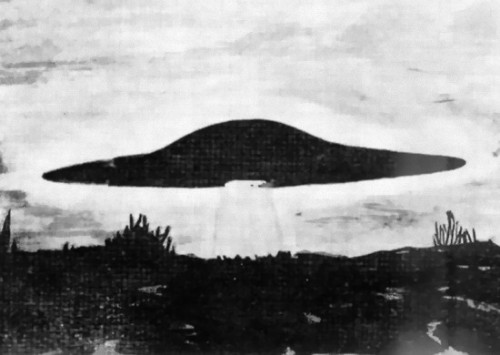
Representation of the craft seen by the soldier.
TRANQUILIZING VISITATION AT BOUAMAMA
An Algerian report of 1958
Joel Mesnard
An extraordinary UFO sighting was reported one night in March, 1958, during the Algerian War, at a Foreign Legion camp at Bouamama in the Sud Constantinois. The sole witness. Legionnaire N.G., was on sentry duty outside the camp. The site where he was consisted of a fortified emplacement dug out of the ground, lightly armored and equipped with a telephone connected to the camp.
The night was cloudless and the moon was shining. All was silent on the desert landscape. No large-scale operations were being carried out in the area at the time so N.G., who had been in the Legion for three years, was not feeling especially anxious. He was sitting on the ground near ihe trench, and had his rifle. If anything unexpected happened he was supposed either to fire his rifle or call the camp by telephone.
Suddenly, at a few minutes after 0.30 hours, something did happen. What it was that happened, we cannot say for sure. The witness remembers seeing a positive, physical phenomenon of enormous size. But he feels that something most unusual happened to him psychologically. And he freely admits that there might well be a difference between what he sincerely remembers and what actually took place.
It began with a whistling noise, the sort of noise you hear if you blow into the neck of a bottle. This sound seemed to him to be coming down from the sky. He immediately looked up, and saw an enormous, roundish object descending. It stopped when it was about 35-40 meters (roughly 100 to 120 ft.) above the ground, and began to hover there, motionless and silent.
He estimated it to be as much as 350 meters wide (1,000 ft.). As seen by him slightly from below, during the arrival and take-off phases, it seemed to be elliptical in shape, quite independently of the perspective effect that makes a disc look elliptical when observed from a point outside the disc’s center-line. Its span might, he thought, have been in the neighborhood of 250 meters. He estimated the distance between himself and the nearest edge of the object at little more than 50 meters (150 ft.).
When I asked Monsieur N.G. to extend his arms towards the ends of the object as he recalled seeing it, he held them out at an angle of about 100 between them. This estimate would fit quite well with the estimates given above of its size and its distance from him.
The object was surrounded by pale green light, and an intense conical beam of emerald-green light was coming from the center of the under-part towards the ground.
Legionnaire N.G. did not fire his rifle, nor did he pick up the telephone. He just remembers staring at the object for 45 to 50 minutes. The pale green and emerald colors were the most beautiful, relaxing and fascinating colors he had ever seen. Legionnaire N.G. had forgotten all about the war. All nervous or psychological tension had gone from his mind. He was just feeling happy.
Then came the noise again, like somebody blowing into a bottle, and the object started rising gently, until it had reached a height of about I(K) or 120 meters. Then it flew offal tremendous speed towards the North-West, climbing as it went.
What the Legionnaire then felt was a sort of sadness at the disappearance of this beautiful sight. After a few minutes this feeling began to fade, yielding place to a return of his ordinary state of consciousness, until his full mental faculties were back. He quickly picked up the telephone and reported what he had seen. To his great amazement however the officer at the camp simply replied in the manner: “Alright. We’ll see about it tomorrow morning.”
Greatly disappointed at the officer’s reaction, N.G. continued his watch until he was relieved by another man in the early hours of the morning. He again reported his experience, and this time more attention was paid to him. Some of his superiors were inclined to believe his story, because N.G., then aged 28, was a well-respected soldier and was considered serious and reliable. The majority however thought it was just a case of psychological trouble caused by the tough conditions of war in the desert.
A careful investigation was carried out at the scene of the sighting. N.G. recalls with a smile that the officers even examined the sand with a magnifying lens. No footprints, no marks, no alien material was found in the area, and no smell either.
Probably more for medical than for “ufological” reasons, the witness was thoroughly questioned by officers. He stuck to his original story, and the affair was considered to be quite amazing. He was sent lo the Military Hospital at Val dc Grace in Paris. There he was kept for a week under dose scrutiny by neurologists and psychiatrists. An electroencephalogram revealed nothing unusual. The conclusion of all the doctors was that N.G. was in a slate of good physical and mental health. He had not been notably affected by the strains caused by wartime service in Algeria. He had no tendency towards drinking, and was considered to be competent for service in the Foreign Legion, which means an especially hard way of life. Indeed, no man with a tendency towards dreaming or science-fiction, or with an over-developed imagination or analytical, critical mind would he selected for service in the Legion.
Monsieur N.G., who is today a civilian, is obviously a man with a strong sense of the realities of everyday life, and seems lo be just the opposite of an over sensitive type or a poet.
What happened that night in Bouamama? It is just as difficult for us to believe in the physical features of the reported sighting as it is for us not to believe in the sincerity of the witness.
Monsieur N.G. obviously is not seeking publicity. He just recounts his experience, in a natural manner, to his own close relatives, and when I met him in May 1970, he looked slightly reluctant for the first few minutes, and then answered my questions without emphasis on any particular feature.
I have been unable so far to find any evidence from military sources regarding his alleged experience. The
Val de Grace Hospital in Paris does not keep documents about patients beyond a period of ten years.
The size of the reported object is so large that, if it actually was where the witness claims to have seen it, it must have been visible from the camp at an angle of about 60 . Yet nobody else reported seeing it. When 1 asked him about the possible reasons for his having been the only witness, N.G. replied that it is in no way astonishing, since most of the men in the camp were asleep in their barracks at the time. There was a legionnaire on sentry duty at the opposite end of the camp, and he could have seen the UFO at an angle of almost 40 ! And yet that sentry reported nothing. Monsieur N.G. does not think that the slope or the irregular pattern of the ground could have been sufficient to render the phenomenon invisible from the camp.
The witness seems to be conscious that something quite extraordinary happened to his mind, but he seems to believe quite positively in the geometrical features of his “sighting.” He says he has had no disease or illness of any kind since the night of the sighting, and no unusual physical or mental conditions. He has never had any other experiences involving flying saucers, cither before, or since, his experience at Bouamama. What happened to him there in 1958 has left him with the belief that “there is something,” and that “something is coming from another world to watch ours.” Regarding his amazingly peaceful state during the sighting, he uses words like: “It was like time running very slowly . . .” and “it was like being in another world.”
Since the experience he had felt a certain degree of interest in flying saucers, and recalls having read about UFOs in newspapers and magazines. In any case, the subject definitely docs not upset him and his experience, however extraordinary it may seem, has not notably changed his life.
The Bouamama case, devoid as it is of physical evidence but so puzzling in many respects, invites comparison with a number of other cases. What she wrote of the witness actually was leaves much to our imagination. It is just one more of those very special UFO sightings which lead us to think that Ufology may somehow be related to some obscure psychic phenomenon.
Astartling discovery in Germany has caused scientists to question historical records regarding the evolution of man. Researchers from the Natural History Museum in Mainz announced Friday that they excavated 9.7 million-year-old teeth fossils from the Rhine river. What makes this finding so remarkable is that these teeth appear to be potentially hominin and considerably older than similar specimens found in Africa — a mysterious possibility that could rewrite what we know about where early human life emerged.
In a preprint published by ResearchGate, a team of researchers led by Natural History Museum deputy director Herbert Lutz write that they found two teeth — an upper left canine and an upper right first molar — that are “exceptionally well preserved and obviously come from the body of unknown sex.”
Archeologists found 9.7 million year-old teeth that might have belonged to a Lucy-like hominid.
It’s believed that these teeth belonged to a great ape that was potentially an early hominin species, one that could have been related to members of the African hominin tribe. The canine tooth, in particular, is indicative that this ancient being is unlike any other specimen found in northern Europe.
“It’s something completely new, something previously unknown to science,” Lutz told ResearchGate. “It’s a complete mystery where this individual came from, and why nobody’s ever found a tooth like this somewhere before.”
The Rhine River in Mainz, Germany.
While Lutz and his team are wary of speculating exactly what this finding means, they are hopeful that this finding can help fill in the holes of the fossil record and a new species could may be added to the family tree. These teeth most closely resemble the teeth of the famous early human Lucy, who existed 3.2 million years ago, and 4.4 million-year-old skeletal remains also found in Ethiopia. If subsequent analysis proves the researcher’s belief that these teeth are indeed 9.7 million years old, that would make this specimen much older — which raises questions about how the heck it got to Germany.
The molar fossil on the left and the canine fossil on the right.
“It’s possible that, with the morphology of this canine tooth being so similar to more recent examples from Africa, the species could be related,” says Lutz. “That would mean that a group of primates was in Europe before they were in Africa.”
The dig site in Eppelsheim, Germany.
Another potential way this ancient European specimen could have had these advanced canines is via the phenomenon of convergence, an evolutionary biology process where organisms that are not closely related still independently evolve to share similar traits, even if they live in different areas and have never interacted. These traits evolve because both groups of organisms had to adapt to similar ecological niches.
Hopefully, answers will begin to emerge as the scientist begin to analyze the specimens. High-resolution x-rays will be used to examine the inner structure of the enamel, which will reveal information about how old the individual was and whether it developed healthily. They will also examine the wear-and-tear on the chewing surface of the teeth, which can indicate what it’s diet was like.
That’s not to say that the researchers aren’t acutely confident they have something big on their hands: They actually discovered the teeth a year ago, and are only now confident enough to publish a paper saying these 9.7 million-year-old chompers are the real deal.
“We want to collaborate with other researchers to process these finds, and hopefully in one or two years, we’ll know a lot more about what we’ve got on our hands,” says Lutz. “It’s definitely a fantastic, exciting story.”
Paleontologists in Germany have discovered 9.7 million-year-old fossilised teeth that a German politician has hailed as potentially “rewriting" human history
The dental remains were found by scientists sifting through gravel and sand in a former bed of the Rhine river near the town of Eppelsheim.
They resemble those belonging to “Lucy”, a 3.2 million-year-old skeleton of an extinct primate related to humans and found in Ethiopia.
However, they do not resemble those of any other species found in Europe or Asia.
Scientists were so confused by the find they held off from publishing their research for the past year, Deutsche Welle reports.
Herbert Lutz, director at the Mainz Natural History Museum and head of the research team, told local media: "They are clearly ape teeth. Their characteristics resemble African finds that are four to five million years younger than the fossils excavated in Eppelsheim.
“This is a tremendous stroke of luck, but also a great mystery."
At a press conference announcing the discovery, the mayor of Mainz suggested the find could force scientists to reassess the history of early humans.
Ancient mystery of how the Egyptians built the Great Pyramid of Giza solved
"I don't want to over-dramatise it, but I would hypothesise that we shall have to start rewriting the history of mankind after today," he said.
Axel von Berg, a local archaeologist, said the new findings would “amaze experts”.
With the first paper on the research having just been published, the “real work” to unlock the mystery is only just beginning, Dr Lutz said.
Although there is abundant fossil evidence that great apes were roaming Europe millions of years ago, there has been no confirmed cases of hominins – species closely related to humans – on the continent.
Archaeological treasures of Ancient Greece
The current scientific consensus proposes that modern humans evolved out of east Africa somewhere between 400,000 and 200,000 years ago, before dispersing around the world as recently as 70,000 years ago.
The teeth will be on display from the end of October at a state exhibition, before heading to Mainz’s Natural History Museum.
The region where the find was made has been an attraction for fossil hunters for almost 200 years.
Welcome to another edition of Let’s Talk Photography!
Imagine this; you’re out shooting and you capture some really beautiful landscape shots or you’ve just taken a bunch of portraits and the sun was perfect, the lighting was in just the right place, the colors and composition were immaculate and you’ve never had sharper photos in all your life. The excitement is so intense that you just can’t wait to get home and get the photos on the computer and start working on them so you can enjoy your new masterpieces. You set aside the entire evening so you can be undisturbed and you wait anxiously while the photos are downloading into your software and then you pull up the first photo and that’s when you see them. To your surprise you stare at first, then you think “did I get them in every shot?” So, you cull through your photos and see them in just about every photo where the sky was in the frame. At this point you simply can’t believe what you are seeing! Then it finally hits home … “I’ve just captured a bunch of UFOs!”
That’s right, UFOs! Unidentified Fuzzy Orbs that appear where the sky is or where any bright part of the photo might be. In this photo, I’ve circled one of them but you should be able to see several all around the sky. At first, you start wiping your screen because maybe it’s a bit of dust that found its way onto your computer monitor. Then you realize every shot has the exact same pattern of dark orbs and you have the revelation that there must be some dust on your camera lens. If that’s the case, you can breathe more easily and give the lens a good cleaning before heading out for your next shoot.
For those of you with a point and shoot or fixed lens camera, that may be where the problem exists. Something got stuck to the front of the lens and it appeared in the shots as very large, faint, but noticeable orbs or smudges. However, those with removeable lens cameras may have to go a couple steps further to find the culprits.
First, you should understand that you can tell almost exactly where the dust is by the size and shape of your UFOs. If they are very large dark or light spots in your image then it’s most likely on the front of the lens. If the dark spot is clearly circular but still large and very soft then it will likely be on the back element of the lens, where the lens attaches to the camera. If the spot is a small, hard, very defined circle, then the dust is inside the camera and stuck to your sensor.
Dust on the lens is the easiest to take care of. Simply remove the lens and give both elements a wipe with a lens cleaning cloth. Dust on the sensor is a different animal all together. The sensor is extremely sensitive and does not like to be touched by anyone or anything. To access the sensor on a DSLR with a mirror, you must lock the mirror in the up, or open, position and you’ll see the sensor directly behind it. On a newer mirrorless camera, the sensor is right there when you remove the lens.
Most of the time, a puff of air will remove the dust and you’ll be good to go. Don’t use a canned or compressed air solution like you would on a computer. You don’t want to blast air onto the sensor. Instead, you can pick up a sensor cleaning kit on the Internet that will include a rubber ball with a small tube and brush on it that will allow you to squeeze a small puff of air and direct it onto the sensor. Never blow on it with your mouth because your breath will carry moisture that can damage the sensor or make the problem worse. Also, when cleaning your sensor like this, hold the camera above you with the sensor and the camera opening pointing down so all the dust that you dislodge will fall out and down. If you put the camera on the table so your looking down into the camera body while cleaning, then you’re just going to be blowing the dust around inside the camera body and it won’t fall out.
You can check to see if any dust remains by holding the camera in front of a light source and tilting the camera from side to side and up and down to see if you see anything on the shiny sensor. In the event a puff of air didn’t do the trick, you can use a cleaning swab and special cleaning fluid to “wipe” the sensor clean. I put “wipe” in quotes because you want to do this with the most delicate touch. Typically, you would wipe the top half of the sensor with one continuous wipe, then wipe the bottom half using the other side of the swab. Not a cotton swab! Do the Internet search for camera sensor cleaning kit and you’ll see what I’m talking about. Never, ever, ever use paper towels, toilet paper, facial tissues, or anything else that can come apart or leave more dust behind. These will all scratch your sensor and your lens if you use them.
Now check to see if you got rid of all the dust. Put your camera in aperture priority mode, set the ISO to the lowest number and turn off auto ISO and auto focus. Set the aperture to the highest number and aim the camera at the clear sky or, if indoors, aim it at a white sheet of paper or even your computer screen with a blank white screen. Zoom your lens, or move close enough so the white fills the entire frame and make sure your camera is completely out of focus. Now, take a picture. Look at the picture in the viewfinder and see if you can see any of those UFOs floating around in the shot. If so, you need to go back in. If not, you’re in great shape!
Until next week, happy shooting!
Is there a topic that you’d like to learn more about? Send feedback, share your photos, or offer topic suggestions to talkphotos@ecklof.com. If you’re looking for a place to connect with local photographers in Chautauqua County, search for the group “Shoot ‘n Share Chautauqua” on Facebook.
Four times in the past 2 years, physicists working with mammoth gravitational-wave detectors have sensed something go bump in the night, sending invisible ripples through spacetime. This week, they announced the detection of a fifth such disturbance—but this time astronomers saw it, too, at every wavelength of light from gamma radiation to radio waves. Just as physicists had predicted, the unprecedented view of the cosmic cataclysm—in which two superdense neutron stars spiraled into each other—brought with it a cornucopia of insights, each of which by itself would count as a major scientific advance.
A new study of China’s one-child policy is roiling demography, sparking calls for the field’s leading journal to withdraw the paper. The controversy has ignited a debate over scholarly values in a discipline that some say prioritizes reducing population growth above all else. Chinese officials have long claimed that the one-child policy—in place from 1980 to 2016—averted some 400 million births, which they say aided global environmental efforts. Scholars have contested that number as flawed. But the new paper argues that the figure may, in fact, have merit.
In just 3 decades, insect populations—everything from parasitic wasps to hoverflies and wild bees—have plummeted by more than 75% in German nature reserves, according to a new study. The reasons for the decline aren’t clear, but the pattern is consistent over a swath of western and northern Germany, and it’s likely having wide-ranging effects on plants and other animals, such as insect-eating birds.
Next month, the lavish Museum of the Bible will open its doors in Washington, D.C. The grandiose new venture is bankrolled by the Greens, the billionaire family that owns the arts and crafts chain Hobby Lobby and that has donated to the museum hundreds of artifacts purchased on the antiquities market. But although the Museum of the Bible is trying to establish itself as a legitimate academic enterprise by hiring respected curators and consultants, scholars worry that it will use its artifacts to further an evangelical view of the Bible as historically accurate and immutable, and they wonder how many items in the museum’s collection may have been looted from archaeological sites.
Might ET be buried under too much ice to phone Earth? That’s what one planetary scientist has concluded may be delaying our contact with alien civilizations. Most extraterrestrial creatures are likely deep inside their home planets, in subsurface oceans crusted over in frozen water ice. The hypothesis could explain the lack of signals from other technologically advanced civilizations, especially if they think that everyone else is trapped in their own icy bubbles.
Dogs may be social butterflies, but wolves are top dog when it comes to working together as a team. That’s because, unlike dogs, wolves haven’t evolved to avoid conflict; instead, members of a pack “sort things out” as they forage together, according to a new study. The work calls into question a long-held assumption that domestication fostered more cooperative individuals.
That may sound like a strange – even bizarre – question to ask. But, stay with me. There’s absolutely no doubt that something very strange happened on the Foster Ranch, Lincoln County, New Mexico in the summer of 1947. There is intriguing witness testimony which supports the idea that people were warned not to talk about what they knew – as in ever. There were, allegedly, death threats made too. Tales even exist of people being murdered to prevent the truth of Roswell from surfacing outside of the secret world of government. But, that was then – seventy years ago. What about now? That’s the important question. It’s a question which gets to the heart of the title of this article.
Whenever elements of the U.S. Government, such as the GAO (the Government Accountability Office) or the Air Force have anything to say about Roswell, Ufologists typically scream “Lies!” “Disinformation!” I saw this, and still remember it, when back in the 1990s the Air Force published its reports on Roswell. One surfaced in 1994 and was soon followed by a massive report in excess of 1,000 pages in length. The Air Force concluded that, most likely, what came down on the Foster Ranch was a huge “Mogul” balloon array, designed to monitor for early Soviet atomic bomb tests. Then, in July 1997 – which was the 50th anniversary of Roswell – the Air Force published another report on Roswell. This one was on the controversial matter of the bodies found at Roswell – which the Air Force suggested were probably crash-test dummies. Ufology was in a state of uproar, pointing figures at what it considered to be a bunch of liars. But, those same ufologists were wrong.
I don’t think that a Mogul balloon came down on the ranch – at all. Nor do I think that the bodies were mere dummies. But, I don’t think the government/Air Force lied. I think they genuinely went looking for answers, but couldn’t find anything solid, and – as a result – came up with what they truly considered to be a viable answer. Or answers. I am of the opinion that when, in the 1990s, the Air Force and the GAO came out with their reports on Roswell, they had less answers than did Ufology.
Within Ufology there is an (almost required) assumption that if what the government states about UFOs doesn’t accord with what Ufology wants to hear, then it must be a lie. Not so. A careful and close read of the combined Roswell reports of the USAF and the GAO makes it very clear that officialdom’s theories were simply that: theories. The Air Force openly admitted there was no definitive proof that dummies or Mogul balloons were the cause of all the fuss. The Air Force admitted that crash-test dummies were not used in the area until the early 1950s. Their theory was that the witnesses to the dummies got the years wrong, confusing the fifties with 1947. The Air Force also admitted that while it found thousands of pages of documents on Mogul – and in numerous military archives – not a single such document confirmed that it was a Mogul balloon that came down in Lincoln County.
In my view, if the USAF was lying, we would have seen a far more robust, well-constructed cover-story that addressed every avenue and plugged every hole. But, the reports do not do that. Instead, they show that the USAF tried to come up with what they thought were probably the answers, but couldn’t prove it. Then, there’s the matter of one of the key military/intelligence figures in Roswell: Sheridan Cavitt. Certainly someone who knew exactly what happened at Roswell, he took the truth to the grave with him. When, in the early 1990s, the Air Force was busily trying to figure out what the hell happened at Roswell, Cavitt was still alive. The Air Force contacted him and plans were made for a face-to-face interview. It happened in May 1994, in Cavitt’s own home.
Department of the Air Force Seal
The Air Force told Cavitt that, in their minds, the Roswell debris was very likely from a vast Mogul array – which might have explained the huge debris field found on the Foster Ranch. Cavitt, though, was having none of it. He firmly told the Air Force that what he saw and handled was a regular, tiny weather-balloon and nothing else. End of story. This caused the Air Force some big problems: they were pretty sure that Mogul was the answer. But, the one still-living man that just about everyone in the know said was on-site back in forty-seven was denying the Mogul scenario. As I see it, had the Air Force been engaged in conspiracy and lies – and knew what happened at Roswell – they would have had Cavitt on-board to help uphold and bolster their theory. After all, Cavitt was there. He saw what it was that came down. And he knew the truth. But, he chose to direct the Air Force to nothing stranger than a weather-balloon. For me, this is evidence that the USAF was genuinely looking for answers, but their primary guy (who they had their hopes on) was skillfully steering them away from what he knew – and doing so with something as simple as a weather-balloon. Cavitt knew the truth. The Air Force didn’t know the truth. And that’s just how Cavitt wanted it. Whether Cavitt was acting alone, or some deeply hidden cabal ordered him to try and keep the Air Force away from the truth, is an issue that still requires an answer.
All of this leads me to believe that neither the GAO nor the USAF knew the truth of Roswell. I’m sure that is still the case, today. But, how could that be? How could there be so many books written on Roswell, but the Air Force can’t find any solid data? Well, if aliens crashed (which I don’t believe) then it’s not impossible that over the years and decades the truth has been buried so deeply that not even elected officials and high-ranking members of the military can get close to the truth.
There is another possible scenario too; a theory which I think is far more likely. My recent book, The Roswell UFO Conspiracy, suggests that Roswell was a dark and disturbing example of “human experimentation,” which was born out of the likes of the controversial Operation Paperclip. It’s entirely possible – as several sources told me – that all of the incriminating data and files were destroyed decades ago, chiefly to protect the guilty parties who crossed the line in big-time fashion.
This latter possibility may provide a viable reason why the government knows less than we do: if the files are all gone – relegated to the furnace – then, today, there is nothing to find. That may explain why such a monumental event has seemingly vanished off the face of the Earth. The result? The military came up with Mogul balloons and crash-test dummies; honest attempts to find the truth of an event that has been completely eradicated – apart from in the depths of old, fading memories of even older people. So, yes, the chances are that we, the UFO research community, really do know more than the government itself knows about Roswell. Of course, the same community doesn’t want to hear that all of the Roswell material is long gone: burned and shredded. They don’t want to hear that because it implies that finding the truth may be completely impossible. Which is very probably the case.
Just because the Air Force published reports concluding that down-to-earth things caused all the monumental fuss, doesn’t mean they lied. It means they failed to solve something which is very possibly now unsolvable. Why? Because there is nothing left to find, that’s why. And there was nothing left to find when all the controversy about balloons and dummies was afoot back in the nineties.
JAXA discovers 50 km cavern beneath the Moon’s surface - Artificially or natural created?
JAXA discovers 50 km cavern beneath the Moon’s surface - Artificially or natural created?
The Japanese space agency JAXA has announced the discovery of a cave hidden beneath the lunar surface.
Illustration of an opening/cavern.
Using a radar sounder system that can examine underground structures, the orbiter initially found an opening 50 meters wide and 50 meters deep.
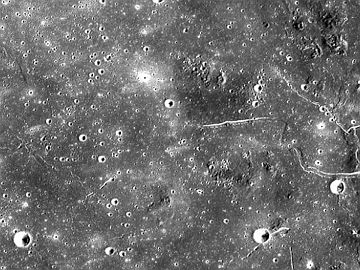
The enormous cavern in the Marius Hills area on the near side of the moon stretching for about 50 kilometers exists beneath the moon’s surface.
Marius Hills on the near side of the Moon.
Image credit: Japan Aerospace Exploration Agency.
It offers a possible protected site for future underground lunar bases and could provide shelter from cosmic radiation and menacing temperatures, while water or ice could be used as fuel, JAXA said.
It is widely believed the moon was rocked by large-scale volcanic activity until about 1 billion years ago whereby the cavern, likely created by volcanic activity, has not collapsed, reports asahi.com
According to The Hollow Moon hypothesis, the Moon is either wholly hollow or otherwise contains a substantial interior space which is supported by countless pieces of evidence from astronomers and NASA scientists who reveal that some 3-5 kilometers down there appear to be dense layers of metal have led that scientific experts, including NASA investigators believe that the Moon is hollow with a shell about 32 kilometers thick.
Image credit: Japan Aerospace Exploration Agency.
Could it be possible, given the huge interest in this enormous cavern to use it as a future underground base, that the cave rather than created by volcanic activity, as the official statement reads, actually is an artificially created entrance that leads to an already existing enormous underground lunar base built by an extraterrestrial race in the past?
The RB-47 radar visual multiple witnesses cases, July 17, 1957:
The RB-47 radar visual multiple witnesses cases, July 17, 1957:
An Air Force Boeing Stratojet reconnaissance jet RB-47, equipped with electronic countermeasures gear and manned by six officers, was followed by an unidentified object for a distance of well over 700 miles, and for a time period of more than one hour, as it flew from Mississippi, through Louisiana and Texas and into Oklahoma. The object was, at various times, seen visually by the cockpit crew as an intensely luminous light, followed by ground-radar and detected on ECM monitoring gear aboard the RB-47. Of special interest in this case are several instances of simultaneous appearances and disappearances on all three of those physically distinct observation channels, and rapidity of maneuvers beyond aircraft possibilities.
On board an RB-47H aircraft equipped with sophisticated electronic countermeasures equipment, including three electronic intelligence (ELINT) stations over the Gulf of Mexico.
The crew consisted of:
Major Lewis D. Chase, pilot, Spokane, WA Capt. James H. McCoid, copilot, Offutt AFB Capt. Thomas H. Hanley, navigator, Vandenberg AFB John J. Provenzano, No. 1 monitor, Wichita, KS Capt. Frank B. McClure, No. 2 monitor, Offutt AFB Capt. Walter A. Tuchschner, No. 3 monitor, Topeka, KS
These six men were on a training and test exercise in an RB-47H electronic countermeasures reconnaissance aircraft. The RB-47, while originally developed as a bomber, was also used extensively as a reconnaissance aircraft. One was shot down by the Soviet Union while on such a mission in 1960.
This particular mission began at Forbes AFB, Topeka, Kansas as an exercise including gunnery exercises over the Texas-Gulf area, navigation exercises over the open Gulf, and Electronic Countermeasures exercises on the return trip across the south-central U.S. The men participating were soon to depart for Germany and duty there. It should be noted that the ECM equipment was not radar. It did not emit a signal and then pick up reflected echoes off of an object. Rather, it detected electromagnetic signals that were actually emitted by an object itself. The purpose of this was to detect and locate enemy radar installations. On this aircraft, the #2 monitor consisted of a direction finder with antenna on the lower rear of the aircraft, and the #1 monitor consisted of a direction finder with antennas on each wingtip of the aircraft. The #3 monitor was not involved in the events of July 17, because its range did not include the frequencies involved.
The first contact with the unknown was before 4:00 AM CST. The first two parts of the mission had been completed, and the aircraft was just leaving the airspace over the Gulf of Mexico near Gulfport, Mississippi, when Frank McClure, on the #2 ECM monitor, detected an airborne signal to the right rear of the aircraft, out over the Gulf of Mexico. The signal was of a type usually confined to ground-based radar installations. It was at 2800 megacycles, a common frequency for S-band search radar. McClure at first thought that his scope must be 180° out of alignment and that he must be picking up a ground-based radar station in Louisiana, which would actually be to the left front of the aircraft. As he watched, the signal moved up the scope, as it would if the scope was 180° out of alignment. However, he was amazed to see that, after it had moved up the scope on the right-hand side of the aircraft, it then crossed the path of the RB-47 and proceeded to move down the scope on the left-hand side. In other words, whatever was emitting the signal flew a ring around the RB-47, which was flying at approximately 500 miles per hour. Even if the scope was 180° out of alignment, the signal source still moved completely around the aircraft, which no ground radar could do. McClure said and did nothing at this time, not mentioning the signal to the other crewmembers. The signal faded as they flew north.
The RB-47 made a scheduled turn to the west over Jackson, Mississippi and the crew was preparing to begin a series of simulated ECM operations against Air Force ground radar units, when suddenly the pilot, Lewis Chase, saw a light coming in from the left, at approximately the same altitude as the RB-47. At first he thought it was another plane, but it was only a single white light, closing fast. He gave the command to prepare for evasive maneuvers, but the light flashed across from left to right so fast that no such action could have been taken. It then blinked out at a point to the right front of the aircraft. Both Chase and Copilot James McCoid observed this. At this point, approximately 4:10 AM CST, they were approximately over Winnsboro, Louisiana.
Chase told the other crewmembers what he had seen, and McClure now told him about his earlier signal reading. At 4:30 AM, McClure set his scope to detect signals near 3000 mcs again, and he detected a strong signal at the same location in relation to the RB-47 that Chase had last seen the light. He and Provenzano checked the alignment of the #2 monitor by tuning in on known ground radar installations and found it to be in perfect working order. At 4:30 AM, Provenzano tuned his own monitor, #1, to 3000 mcs, and found that his equipment detected a signal at the same location. What's more, he and McClure found that the signal was staying in the same position, keeping pace with the RB-47, which was still flying at 500 miles per hour. This meant that it was not a signal from a ground-based radar.
By this time they had reached the Duncanville, Texas area. At 4:39, Chase spotted a huge light to the right front of the RB-47 an about 5,000 feet below the aircraft's 34,500 feet altitude. The weather was perfectly clear. At 4:40, McClure reported two signals, at 40° and 70°. Chase and McCoid reported seeing red lights at those locations. Chase contacted radar Station Utah at Duncanville, Texas and requested permission to abandon his flight plan and pursue the lights, which he received. At 4:48 AM, radar station Utah requested the position of the signals that McClure was receiving, and they immediately confirmed that their radar had detected the objects at the same location.
As the RB-47 attempted to pursue, the object appeared to stop suddenly. Chase could see that they were gaining on it, and they over shot it. At 4:52 it blinked out, and simultaneously vanished from McClure's scope and the ground radar! Chase put the aircraft into a port turn, and the object suddenly blinked on again, simultaneously reappearing on McClure's scope and the ground radar at 4:52! They began to close to within 5 miles of the object, when it suddenly dropped to 15,000 feet and then blinked out again, once again vanishing from the scopes and ground radar. At 4:55, Chase radioed Utah radar station that they had to break of pursuit and continue with their scheduled flight plan due to low fuel. At 4:57 McClure picked up the signal again, and at 4:58 Chase made visual contact again. As they headed into Oklahoma, McClure continued to receive a signal, now from the rear of the aircraft, until it finally faded as they neared Oklahoma City. The Director of Intelligence, 55th Strategic Reconnaissance Wing, stated in his report that he had: "...no doubt the electronic D/F's coincided exactly with visual observations by aircraft commander numerous times, thus indicating positively the object being the signal source."
What can be detected on ECM direction finding devices, can be seen visually, and can be detected on ordinary ground-based radar all at the same time? What can be detected by all the sensors and can also fly rings around a jet travelling at 500 miles per hour?
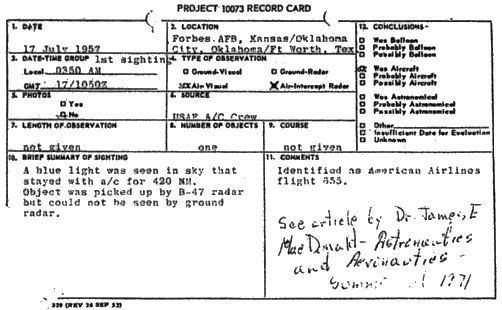
Project Bluebook said that the sightings in Dallas - Fort Worth area were an ordinary jet airliner. They actually simply confused or voluntarily confused the case with a totally different incident implying a quasi-collision between civilian flights 966 and 655 of American Airlines, which flew above Texas at more than 1000 kilometers away from the RB-47. They couldn't explain the abrupt, simultaneous disappearance and reappearance of the object from radar screens, ECM scopes, and visual detection. They also couldn't explain the events that occurred over Mississippi and Louisiana. They couldn't explain how the Utah radar station could not have told an airliner from an unknown.
Above: Blue Book file card for the case.
The Condon Committee toyed with several explanations, but found none to be satisfactory, finally classifying this case as unknown. In fact, Condon's radar case specialist Gordon L. Thayer said that the Blue Book explanation that the case was due to airliners was "literally ridiculous." The self proclaimed UFO debunker Philipp Klass, not discouraged by his previous ridicule explanation of UFOs as plasmoids which was pointed at as typical pseudoscience wishful thinking by Dr. McDonald, considered that the electronic tracks were due to anomalous radar wave propagation and that the visual sighting was first a meteor, then the star Vega and finally the other planes from American Airlines cited by Blue Book; the long demonstrated ridicule of this explanation apparently did not came up to his mind. Ufologist Brad Sparks, a specialist of aeronautics, responded point by point in a paper in Jerome Clark's UFO Encyclopedia and demonstrated how Klass' interpretation was based on the erroneous interpretation of the data and overall nonsensical.
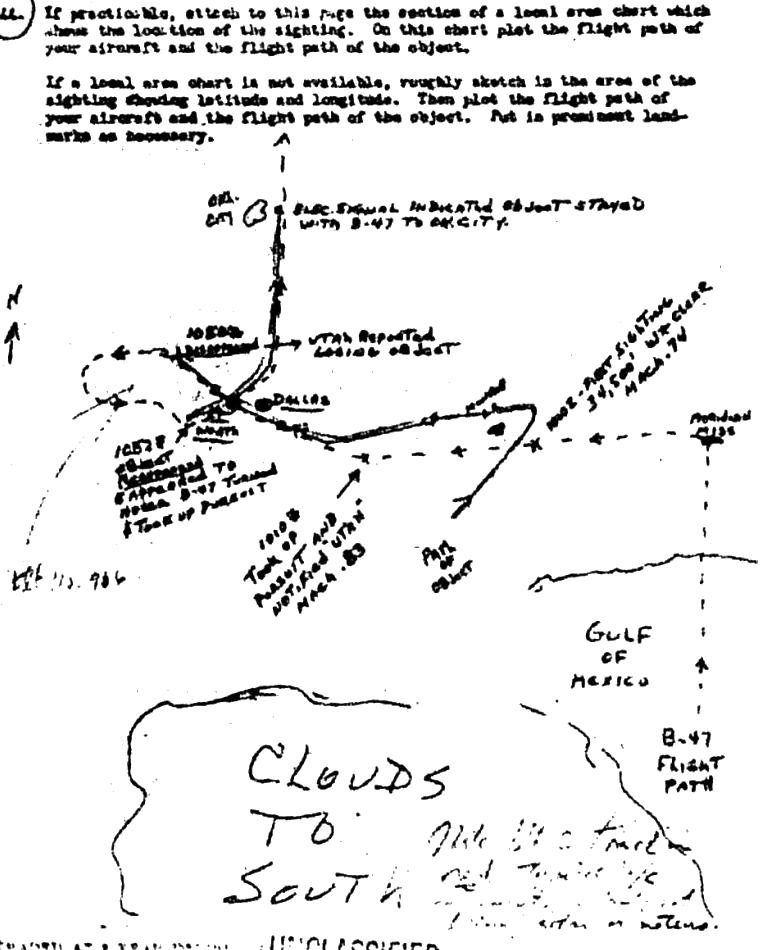
Map by the crew:
This is the flightpath of the RB-47 (dotted line) and of the UFO (plain line), drawn on their formal report by the captain of the crew.
PROFESSOR JAMES MCDONALD:
The following study is excerpted from "Twenty-Two Years of Inadequate UFO Investigations" American Association for the Advancement of Science, 134th Meeting, General Symposium, Unidentified Flying Objects, by James E. McDonald, Professor of Atmospheric Sciences, the University of Arizona, Tucson, Arizona, December 27, 1969.
Case 1. USAF RB-47, Gulf Coast area, September 19-20, 1957.
Brief summary:
An Air Force RB-47, equipped with ECM (Electronic Countermeasures) gear, manned by six officers, was followed over a total distance in excess of 600 miles and for a time period of more than an hour, as it flew from near Gulfport, Miss., through Louisiana and Texas, and into southern Oklahoma. The unidentified object was, at various times, seen visually by the cockpit crew (as an intense white or red light), followed by ground-radar, and detected on ECM monitoring gear aboard the RB-47. Simultaneous appearances and disappearances on all three of those physically distinct "channels" mark this UFO case as especially intriguing from a scientific viewpoint. The incident is described as Case 5 in the Condon Report and is conceded to be unexplained. The full details, however, are not presented in that Report.
1. Summary of the Case:
The case is long and involved and filled with well-attested phenomena that defy easy explanation in terms of present-day science and technology. The RB-47 was flying out of Forbes AFB, Topeka, on a composite mission including gunnery exercises over the Texas-Gulf area, navigation exercises over the open Gulf, and ECM exercises in the return trip across the south-central U.S. This was an RB-47 carrying a six-man crew, of whom three were electronic warfare officers manning ECM (Electronic counter-measures) gear in the aft portion of the aircraft. One of the extremely interesting aspects of this case is that electromagnetic signals of distinctly radar-like character appeared definitely to be emitted by the UFO, yet it exhibited performance characteristics that seem to rule out categorically its having been any conventional or secret aircraft.
I have discussed the incident with all six officers of the crew:
Lewis D. Chase, pilot, Spokane, Wash.
James H. McCoid, copilot, Offutt AFB.
Thomas H. Hanley, navigator, Vandenberg AFB.
John J. Provenzano, No. 1 monitor, Wichita.
Frank B. McClure, No. 2 monitor, Offutt AFB.
Walter A. Tuchscherer, No. 3 monitor, Topeka.
Chase was a Major at the time; I failed to ask for information on 1957 ranks of the others. McClure and Hanley are currently Majors, so might have been Captains or Lieutenants in 1957. All were experienced men at the time. Condon Project investigators only talked with Chase, McCoid, and McClure, I ascertained. In my checking it proved necessary to telephone several of them more than once to pin down key points; nevertheless the total case is so complex that I would assume that there are still salient points not clarified either by the Colorado investigators or by myself. Unfortunately, there appears to be no way, at present to locate the personnel involved in ground- radar observations that are a very important part of the whole case. I shall discuss that point below.
This flight occurred in September, 1957, just prior to the crew's reassignment to a European base. On questioning by Colorado investigators, flight logs were consulted, and based on the recollection that this flight was within a short time of departure from Forces to Germany, (plus the requirement that the date match a flight of the known type and geography) the 9/19/57 date seems to have emerged. The uncertainty as to whether it was early on the 19th or early on the 20th, cited above is a point of confusion I had not noted until preparing the present notes. Hence I am unable to add any clarification, at the moment; in this matter of the date confusion found in Thayer's discussion of the case (1, pp. 136-138). I shall try to check that in the near future. For the present, it does not vitiate case-discussion in any significant way.
The incident is most inadequately described in the Condon Report. The reader is left with the general notion that the important parts occurred near Ft. Worth, an impression strengthened by the fact that both Crow and Thayer discuss meteorological data only for that area. One is also left with no clear impression of the duration, which was actually over an hour. The incident involved an unknown airborne object that stayed with the RB-47 for over 600 miles. In case after case in the Condon Report, close checking reveals that quite significant features of the cases have been glossed over, or omitted, or in some instances seriously misrepresented. I submit that to fail to inform the reader that this particular case spans a total distance-range of some 600 miles and lasted well over an hour is an omission difficult to justify.
From my nine separate interviews with the six crew members, I assembled a picture of the events that makes it even more puzzling than it seems on reading the Condon Report - and even the latter account is puzzling enough.
Just as the aircraft crossed the Mississippi coast near Gulfport, McClure, manning the #2 monitor, detected a signal near their 5 o'clock position (aft of the starboard beam). It looked to him like a legitimate ground-radar signal, but corresponded to a position out in the Gulf. This is the actual beginning of the complete incident; but before proceeding with details it is necessary to make quite clear what kind of equipment we shall be talking about as we follow McClure's successive observations.
Under conditions of war, bombing aircraft entering hostile territory can be assisted in their penetrations if any of a variety of electronic countermeasures (ECM techniques as they are collectively termed) are brought into action against ground-based enemy radar units. The initial step in all ECM operations is, necessarily, that of detecting the enemy radar and quantitatively identifying a number of relevant features of the radar system (carrier frequency, pulse repetition frequency, scan rate, pulse width) and, above all, its bearing relative to the aircraft heading. The latter task is particularly ample in principle, calling only for direction-finding antennas which pick up the enemy signal and display on a monitor scope inside the reconnaissance aircraft a blip or lobe that paints in the relative bearing from which the signal is coming.
The ECM gear used in RB-47's in 1957 is not now classified; the #2 monitor that McClure was on, he and the others pointed out, involved an ALA-6 direction-finder with back-to-back antennas in a housing on the undersurface of the RB-47 near the rear, spun at either 150 or 300 rpm as it scanned in azimuth. Inside the aircraft, its signals were processed in an APR-9 radar receiver and an ALA-5 pulse analyzer. All later references to the #2 monitor imply that system. The #1 monitor employed an APD-4 direction finding system, with a pair of antennas permanently mounted on either wing tip. Provenzano was on the #1 monitor. Tuchscherer was on the #3 monitor, whose specifications I did not ascertain because I could find no indication that it was involved in the observations.
Returning now to the initial features of the UFO episode, McClure at first thought he had 180-degree ambiguity in his scope, i.e., that the signal whose lobe painted at his 5 o'clock position was actually coming in from the 11 o'clock position perhaps from some ground radar in Louisiana. This suspicion, he told me, was temporarily strengthened as he became aware that the lobe was moving upscope. (It is important here and in features of the case cited below to understand how a fixed ground-radar paints on the ECM monitor scope as the reconnaissance aircraft flies toward its general direction: Suppose the ground radar is, at some instant, located at the 1 o'clock position relative to the moving aircraft, i.e., slightly off the starboard bow. As the aircraft flies along, the relative bearing steadily changes, so that the fixed ground unit is "seen" successively at the 2 o'clock, the 3 o'clock, and the 4 o'clock positions, etc. The lobe paints on the monitor scope at these successive relative azimuths, the 12 o'clock position being at the top of the scope, 3 o'clock at the right, etc. Thus any legitimate signal from a fixed ground radar must move downscope, excluding the special cases in which the radar is dead ahead or dead astern. Note carefully that we deal here only with direction finding gear. Range is unknown; we are not here speaking of an airborne radar set, just a radar-frequency direction-finder. In practice, range is obtained by triangulation computations based on successive fixes and known aircraft speed.)
As the lobe continued moving upscope, McClure said the strength of the incoming signal and its pulse characteristics all tended to confirm that this was some ground unit being painted with 180-degree ambiguity for some unknown electronic reason. It was at 2800 megacycles, a common frequency for S-band search radars.
However, after the lobe swung dead ahead, his earlier hypothesis had to be abandoned for it continued swinging over to the 11 o'clock position and continued downscope on the port side. Clearly, no 180-degree ambiguity was capable of accounting for this. Curiously, however, this was so anomalous that McClure did not take it very seriously and did not at that juncture mention it to the cockpit crew nor to his colleagues on the other two monitors. This upscope-downscope "orbit" of the unknown was seen only on the ALA-6, as far as I could establish. Had nothing else occurred, this first and very significant portion of the whole episode would almost certainly have been for gotten by McClure.
The signal faded as the RB-47 headed northward to the scheduled turning point over Jackson, Miss. The mission called for simulated detection and ECM operations against Air Force ground radar units all along this part of the flight plan, but other developments intervened. Shortly after making their turn westward over Jackson, Miss., Chase noted what he thought at first were the landing lights of some other jet coming in from near his 11 o'clock position, at roughly the RB-47's altitude. But no running lights were discernible and it was a single very bright white light, closing fast. He had just alerted the rest of the crew to be ready for sudden evasive maneuvers, when he and McCoid saw the light almost instantaneously change directions and rush across from left to right at an angular velocity that Chase told me he'd never seen matched in his flight experience. The light went from their 11 o'clock to the 2 o'clock position with great rapidity, and then blinked out.
Immediately after that, Chase and McCoid began talking about it on the interphone and McClure, recalling the unusual 2800 megacycle signal that he had seen over Gulfport now mentioned that peculiar incident for the first time to Chase and McCoid. It occurred to him at that point to set his #2 monitor to scan at 2800 mcs. On the first scan, McClure told me, he got a strong 2800 mcs signal from their 2 o'clock position, the bearing on which the luminous unknown object had blinked out moments earlier.
Provenzano told me that right after that they had checked out the #2 monitor on valid ground radar stations to be sure it was not malfunctioning and it appeared to be in perfect order. He then checked on his #1 monitor and also got a signal from the same bearing. There remained, of course, the possibility that just by chance, this signal was from a real radar down on the ground and off in that direction. But as the minutes went by, and the aircraft continued westward at about 500 kts. The relative bearing of the 2800 mcs source did not move downscope on the #2 monitor, but kept up with them.
This quickly led to a situation in which the entire 6-man crew focussed all attention on the matter; the incident is still vivid in the minds of all the men, though their recollection for various details varies with the particular activities they were engaged in. Chase varied speed, to see if the relative bearing would change but nothing altered. After over a hundred miles of this, with the 2800 mcs source keeping pace with the aircraft, they were getting into the radar-coverage area of the Carswell AFB GCI (Ground Controlled Intercept) unit and Chase radioed that unit to ask if they showed any other air traffic near the RB-47. Carswell GCI immediately came back with the information that there was apparently another aircraft about 10 miles from them at their 2 o'clock position. (The RB-47 was unambiguously identifiable by its IFF signal; the "other aircraft" was seen by "skin paint" Only, i.e., by direct radar reflection rather than via an IFF transponder, Col. Chase explained.)
This information, each of the men emphasized to me in one way or another, made them a bit uneasy for the first time. I asked McClure a question that the Colorado investigators either failed to ask or did not summarize in their Report. Was the signal in all respects comparable to that of a typical ground radar? McClure told me that this was what baffled him the most, then and now. All the radar signature characteristics, as read out on his ALA-5 pulse analyzer, were completely normal - it had a pulse repetition frequency and pulse width like a CPS-6B and even simulated a scan rate: But its intensity, McClure pointed out, was so strong that "it would have to had an antenna bigger than a bomber to put out that much signal." And now, the implications of the events over Gulfport took on new meaning. The upscope-downscope sweep of his #2 monitor lobe implied that this source, presuming it to be the same one now also being seen on ground radar at Carswell GCI, had flown a circle around the RB-47 at 30-35,000 ft altitude while the aircraft was doing about 500 kts.
Shortly after Carswell GCI began following the two targets, RB-47 and unknown, still another significant action unfolded. McClure suddenly noted the lobe on the #2 monitor was beginning to go upscope, and almost simultaneously, Chase told me, GCI called out that the second airborne target was starting to move forward. Keep in mind that no visual target was observable here; after blinking out at the 12 o'clock position, following its lightning-like traverse across the nose of the aircraft, no light had been visible. The unknown now proceeded to move steadily around to the 12 o'clock position, followed all the while on the #2 monitor and on the GCI scope down at Carswell near Ft. Worth.
As soon as the unknown reached the 12 o'clock position, Chase and McCoid suddenly saw a bright red glow "bigger than a house", Chase said, and lying dead ahead, precisely the bearing shown on the passive radar direction-finder that McClure was on and precisely the bearing now indicated on the GCI scope. Three independent sensing systems were at this juncture giving seemingly consistent-indications: two pairs of human eyes, a ground radar, and a direction-finding radar receiver in the aircraft.
One of the important points not settled by the Colorado investigations concerned the question of whether the unknown was ever painted on any radar set on the RB-47 itself. Some of the men thought the navigator had seen it on his set, others were unsure. I eventually located Maj. Hanley at Vandenberg and he informed me that all through the incident, which he remembered very well, he tried, unsuccessfully to pick up the unknown on his navigational radar (K-system). I shall not recount all of the details of his efforts and his comments, but only mention the end result of my two telephone interviews with him. The important question was what sort of effective range that set had. Hanley gave the pertinent information that it could just pick up a large tanker of the KC-97 type at about 4 miles range, when used in the "altitude-hold" mode, with antenna tipped up to maximum elevation. But both at the start of its involvement and during the object's swing into the 12 o'clock position, GCI showed it remaining close to 10 miles in range from the RB-47. Thus Hanley's inability to detect it on his K-system navigational radar in altitude hold only implies that whatever was out there had a radar cross-section that was less than about 16 times that of a KC-97 (roughly twice 4 miles, inverse 4th-power law), The unknown gave a GCI return that suggested a cross-section comparable to an ordinary aircraft, Chase told me, which is consistent with Hanley's non-detection of the object. The Condon Report gives the impression the navigator did detect it, but this is not correct.
I have in my files many pages of typed notes on my interviews, and cannot fill in all of the intriguing details here. Suffice it to say that Chase then went to maximum allowable power, hoping to close with the unknown, but it just stayed ahead at about 10 miles as GCI kept telling them; it stayed as a bright red light dead ahead, and it kept painting as a bright lobe on the top of McClure's ALA-6 scope. By this time they were well into Texas still at about 35,000 ft and doing upwards of 500 knots, when Chase saw it begin to veer to the right and head between Dallas and Ft. Worth. Getting FAA clearance to alter his own flight plan and to make sure other jet traffic was out of his way, he followed its turn, and then realized he was beginning to close on it for the first time. Almost immediately GCI told him the unknown had stopped moving on the ground-radarscope. Chase and McCoid watched as they came almost up to it. Chase's recollections on this segment of the events were distinctly clearer than McCoid's. McCoid was, of course, sitting aft of Chase and had the poorer view; also he said he was doing fuel-reserve calculations in view of the excess fuel-use in their efforts to shake the unknown, and had to look up from the lighted cockpit to try to look out intermittently, while Chase in the forward seat was able to keep it in sight more nearly continuously. Chase told me that he'd estimate that it was just ahead of the RB-47 and definitely below them when it instantaneously blinked out, At that same moment McClure announced on the interphone that he'd lost the 2800 mcs signal, and GCI said it had disappeared from their scope. Such simultaneous loss of signal on what we can term three separate channels is most provocative, most puzzling.
Putting the aircraft into a left turn (which Chase noted consumes about 15-20 miles at top speed), they kept looking back to try to see the light again. And, about halfway through the turn (by then the aircraft had reached the vicinity of Mineral Wells, Texas, Chase said), the men in the cockpit suddenly saw the bright red light flash on again, back along their previous flight path but distinctly lower, and simultaneously GCI got a target again and McClure started picking up a 2800 mcs signal at that bearing: (As I heard one after another of these men describe all this, I kept trying to imagine how it was possible that Condon could listen, at the October, 1967, plasma conference at the UFO Project, as Col. Chase recounted all this and shrug his shoulders and walk out.)
Securing permission from Carswell GCI to undertake the decidedly non-standard maneuver of diving on the unknown, Chase put the RB-47 nose down and had reached about 20,000 ft, he recalls, when all of a sudden the light blinked out, GCI lost it on their scope, and McClure reported loss of signal on the #2 monitor: Three-channel consistency once more.
Low on fuel, Chase climbed back up to 25,000 and headed north for Oklahoma. He barely had it on homeward course when McClure got a blip dead astern and Carswell radioed that they had a target once more trailing the RB- 47 at about 10 miles. Rear visibility from the top blisters of the RB-4 now precluded easy visual check, particularly if the unknown was then at lower altitude (Chase estimated that it might have been near 15,000 ft when he lost it in the dive). It followed them to southern Oklahoma and then disappeared.
2. Discussion:
This incident is an especially good example of a UFO case in which observer credibility and reliability do not come into serious question, a case in which more than one (here three) channel of information figures in the over-all observations, and a case in which the reported phenomena appear to defy explanation in terms of either natural or technological phenomena.
In the Condon Report, the important initial incident in which the unknown 2800 MC source appeared to orbit the RB-47 near Gulfport is omitted. In the Condon Report, the reader is given no hint that the object was with the aircraft for over 600 miles and for over an hour. No clear sequence of these events is spelled out, nor is the reader made aware of all of the "three-channel" simultaneous appearances or disappearances that were so emphatically stressed to me by both Chase and McClure in my interviews with them. But even despite those degrees of incompleteness, any reader of the account of this case in the Condon Report must wonder that an incident of this sort could be left as unexplained and yet ultimately treated, along with the other unexplained cases in that Report, as calling for no further scientific attention.
Actually, various hypotheses (radar anomalies, mirage effects) are weighed in one part of the Condon Report where this case is discussed separately (pp. 136-138). But the suggestion made there that perhaps an inversion near 2 km altitude was responsible for the returns at the Carswell GCI unit is wholly untenable. In an Appendix, a very lengthy but non-relevant discussion of ground return from anomalous propagation appears; in fact, it is so unrelated to the actual circumstances of this case as to warrant no comment here. Chase's account emphasized that the GCI radar(s) had his aircraft and the unknown object on-scope for a total flight-distance of the order of several hundred miles, including a near overflight of the ground radar. With such wide variations in angles of incidence of the ground-radar beam on any inversion or duct, however intense, the possibility of anomalous propagation effects yielding a consistent pattern of spurious echo matching the reported movements and the appearances and disappearances of the target is infinitesimal. And the more so in view of the simultaneous appearances and disappearances on the ECM gear and via visible emissions from the unknown. To suggest, as is tentatively done on p. 138 that the "red glow" might have been a "mirage of Oklahoma City", when the pilot's description of the luminous source involves a wide range of viewing angles, including two instances when he was viewing it at quite large depression angles, is wholly unreasonable. Unfortunately, that kind of casual ad hoc hypothesizing with almost no attention to relevant physical considerations runs all through the case-discussions in the treatment of radar and optical cases in the Condon Report, frequently (though not in this instance) being made the basis of "explanations" that are merely absurd. On p. 265 of the Report, the question of whether this incident might be explained in terms of any "plasma effect" is considered but rejected. In the end, this case is conceded to be unexplained.
No evidence that a report on this event reached Project Bluebook was found by the Colorado investigators. That may seem hard to believe for those who are under the impression that the Air Force has been diligently and exhaustively investigating UFO reports over the past 22 years. But to those who have examined more closely the actual levels of investigation, lack of a report on this incident is not so surprising. Other comparable instances could he cited, and still more where the military aircrews elected to spare themselves the bother of interrogation, by not even reporting events about as puzzling as those found in this RB-47 incident.
But what is of greatest present interest is the point that here we have a well-reported, multi-channel, multiple-witness UFO report, coming in fact from within the Air Force itself, investigated by the Condon Report team, conceded to be unexplained, and yet it is, in final analysis, ignored by Dr. Condon. In no section of the Report specifically written by the principal investigator does he even allude to this intriguing case. My question is how such events can be written off as demanding no further scientific study. To me, such cases seem to cry out for the most intensive scientific study - and the more so because they are actually so much more numerous than the scientific community yet realizes. There is a scientific mystery here that is being ignored and shoved under the rug; the strongest and most unjustified shove has come from the Condon Report. "unjustified" because that Report itself contains so many scientifically puzzling unexplained cases (approximately 30 out of 90 cases considered) that it is extremely difficult to understand how its principal investigator could have construed the contents of the Report as supporting a view that UFO studies should be terminated.
About the RB-47:
The B-47 "Stratojet" was the first all-jet operational bomber in the Air Force and was the backbone of the Strategic Air Command bomber fleet in the 1950s. It was a medium range bomber that could be refueled in flight manufactured by Boeing Aircraft Company (primary), Douglas and Lockheed. It had 6 General Electric J-47-GE-25 turbojet engines, a maximum speed of 600 miles per hour, and a range of 4000 miles.
The RB-47E was the photomapping, weather and electronic reconnaissance version of the B-47 and was also one of its best versions; it first flew July 1953. It was designed to check weather along projected bombing routes, photograph enemy installations and monitor defensive radar systems during the period 1954 to 1964. It was used in missions above North Korea, China, and also over the Soviet Union for the most sensitive reconnaissance missions of the Cold War.
References:
Project Blue Book case file #10073, National Archives and Record Administration (NARA, www.nara.gov), Washington D.C., files of 1957.
"Optical and radar analyses of field cases" by Gordon D. Thayer, 1969, in "Final report of the scientific study of unidentified flying objects" aka "The Condon Report", by Edward U. Condon and E.P. Dutton et al., New York, Library of Congress Catalog No. 73-77914, 1969.
"Twenty-Two Years of Inadequate UFO Investigations", by James E. McDonald, American Association for the Advancement of Science, 134th Meeting, General Symposium, Unidentified Flying Objects, by James E. McDonald, Professor of Atmospheric Sciences, the University of Arizona, Tucson, Arizona, December 27, 1969, reprinted in "UFOs, a scientific debate", edited by Carl Sagan and Thornton Page, Cornell University Press, Ithaca, New York, 1972.
"Meteorological Factors in Unidentified Radar Returns", paper Presented at the 14th Radar Meteorology Conference American Meteorological Society November 17-20, James E. McDonald The University of Arizona Tucson, Arizona, 1970.
"The RB-47 UFO Case - A New Explanation", self-published article by Philipp Klass, 1971, reprinted in his book "UFOs Explained", Random House, New York, ISBN 0-394-72106-3, 1974.
"UFO Encounter I Sample Case", case selected by the UFO Subcommittee of the AIAA Astronautics and Aeronautics, July, 1971, pp. 66-70. Dr. James E. McDonald.
"UFOs: A Scientific Debate", edited by Carl Sagan and Thornton Page, "a collection of evidence and opinion from both sides", Norton publisher, ISBN 0-39300-739-1, 1974
"RB-47 radar/visual sighting", article by Gordon D. Thayer, in the book "The encyclopedia of UFOs", edited by Ronald D. Story, Doubleday and co, New York, 1980.
"UFOs: An insider's view of the official quest for evidence", by Roy Craig, University of North Texas Press, Denton, Texas, ISBN 0-929398-94-7, 1995.
"The UFO Book", by Jerome Clark, pp. 505-509, Visible Ink, New York, ISBN 1-57859-029-9, 1998.
"L'affaire du RB-47", by Dominique Weinstein, in "OVNI USA", hors série VSD magazine, pp 32-33, July 2001.
"Les OVNIS et la défense - A quoi doit-on se préparer", book by association Cometa, pp. 40-44, Editions du Rocher, ISBN 2-268-04592-7, France, 1999.
Will we ever discover extraterrestrial life, and, if so, what will it look like? Six experts give their best guess.
Brian Cox
NICKY J SIMS / GETTY IMAGES
1: Brian Cox: purple slime
Cox suggests that life in the universe is likely abundant. Intelligent life, however, is another matter.
In his 2015 book Human Universe (written with Andrew Cohen), Cox writes there is a sense of “chemical inevitability” to life in the universe. But he adds that complex life on Earth only arose after the emergence of eukaryotes – cells containing organelles.
Research suggests eukaryotes developed as a result of one primitive cell – called a prokaryote, like a bacterium – absorbing another, two billion years ago. (Mitochondria and chloroplasts are descendants of independent prokaryotes that entered symbiotic relationships with larger cells.)
The advent of eukaryotes on Earth was a vanishingly unlikely development. Cox calls it an “evolutionary bottleneck” and thinks it so unusual that it might have happened only once in the universe.
“One can easily imagine that the 20 billion Earth-like worlds in the Milky Way could all be covered in prokaryotic slime,” he writes. “A living galaxy, yes, but a galaxy filled with intelligence? … I’m not so sure.”
2: Chandra Wickramasinghe: bacteria
Together with the late Fred Hoyle, mathematician, astronomer and astrobiologist Wickramasinghe developed the astrobiological theory known as panspermia, which holds life on Earth was catalysed arrived as microbes travelling through space on meteors and interstellar dust.
He suggests that microbial life may have landed during the Hadean period, four billion years ago, when lots of smallish meteorites smacked into the planet.
In a paper published in August 2017, he suggests ET might also have been deposited on the moon. Recent evidence indicating the presence of water, he says, “reopens the possibility that microbial life might exist close to the lunar surface”.
3: Paul Davies: indescribable
In a 2016 paper, The “Hard Problem” of Life, written with Sara Imari Walker, astrobiologist Paul Davies begins with a well-known problem. Given that all life on Earth arose from a single common ancestor, we have no way of knowing what aspects of it are law-like – found in all life, across the universe – and which are specific only to our own biosphere.
It follows that life elsewhere need not involve Earth-like biology or chemistry. Indeed, write Davies and Walker, it is possible that it “will not ultimately be reducible to known physical principles”.
The pair suggests that the true essential for life is information – which somehow “calls the shots”.
Those things that we assume to be fundamental – replication and metabolism – might be features only of “Earth-like” biologies. There is a risk that should we ever encounter ET, we might not recognise it because we lack “a general-purpose set of criteria for identifying it”.
4:Chris Hadfield: oddly familiar
The retired commander of the International Space Station thinks the bizarre 500 million year-old soft-bodied fossils found in Canada’s Burgess Shale hold some clues.
“It’s so wildly different to the life we’re used to,” he says. “There was such wild experimentation through the four billion years of life on Earth.”
We might find life on Mars, or Enceladus, or Europa, he notes, and it might look like an organism that died out during a mass extinction down here.
“But I might have that completely wrong,” he adds. “Some of the strange examples they came up with on Star Trek might be a better representation.”
5: Jason Wright: highly skilled builders and engineers
Wright, an astrophysicist at Penn State University in the US, suggests we need to be looking for the things ET builds.
He suggests focusing the search for intelligent ET on exoplanets. Rather than look for traces of biology, though, we should look for technology.
We should search for giant machines, which are likely to be “be detectable by their waste heat in the mid-infrared.”
Such structures, he says, could include enormous energy-collectors (known as Dyson spheres), satellites and defensive shields.
Looking for them, he notes, need not be expensive. The search can “piggyback on work likely to happen in the future, anyway, as natural anomalies are discovered in the course of exoplanetary science.”
6: Neil deGrasse Tyson: not huge, and hopefully paying attention
In his book Death By Black Hole (2005), Tyson says microbial life is possibly humming away throughout the universe.
Intelligent life, on the other hand, is likely to be very scarce. However, the Copernican Principle – they key idea that we and our planet are not special – implies it must be around somewhere.
He says ET must be limited to a maximum size. It could not be as big as the solar system –10 light years across. Even assuming nerve impulses at the speed of light “if it wanted to scratch its head, then this simple act would take 10 hours to accomplish.”
Tyson hopes that some intelligent ETs are sending out messages into the cosmos, rather than, like us, scanning in the hope of hearing an alien transmission. If not, he writes, “everybody would be listening, nobody would be receiving, and we would collectively conclude that there is no other intelligent life in the universe.”
ALTON - A strange aerial object was sighted by a group of friends talking on the back deck of a building on Langdon in Alton.
Altonian Ian Whitmore said he sighted the object after midnight Tuesday morning with a group of a few friends. He said it appeared in the southeastern sky, toward the Clark Bridge. Whitmore said he noticed a light in his periphery, but ignored it for as long as a half hour before realizing it was not similar to any plane, planet, star or other atmospheric phenomenon of which he was familiar.
"I was sitting around chatting with some friends and had noticed the light in the sky from my peripheral view, but ignored it for probably 20-30 minutes, until it finally struck me that the light wasn't budging, so it wasn't a plane like I had assumed," Whitmore said in a Facebook message. "We observed it flash red and blue very intensely for another 20 minutes until we decided to look up what the light is."
Whitmore said the unidentified flying object was like "a cop car in the sky." He said it was formless at times, but appeared to be circular. He said it emitted bright flashes of red and blue lights, like "cartoon stars." Whitmore and his friends, being logical skeptics they said, began researching astronomical and meteorological phenomena to find the source of the object.
"After using several sources that utilized Hubble telescope/NASA data, we concluded that the object was not identified currently as a planet or star," he said. "We watched it flash at that rate for several hours by the time it was all said and done. It flashed more intensely in random spurts, but at every moment, remained much brighter and larger than anything else in the sky."
The object was stationary for that entire time, Whitmore said, which would mean it existed within the confines of Earth's atmosphere, not bound by its rotation through the cosmos. The duration of the object's stationary hovering also discounts a suspicion of Whitmore's friend the object was a drone. Most commercial-use drones would have to have recharged batteries to sustain that amount of flight time. Whitmore also said the object was far away.
"However, it was clear this was something that was quite far away," he said. "My final thoughts were that it was either an unidentified star out there in supernova or something; or perhaps something even stranger. The phenomenon was not visible from the exact location the next night at any point. We looked thoroughly."
Calls to the Mutual UFO Network (MUFON) of Illinois were answered with the assertion the Riverbend area is a hot spot for such activity. He said three reports from Illinois were entered within a few days of Whitmore's sighting.
The night before, a sighting was reported from Hamel, Illinois, which lasted for hours as well. The following is a witness report from the MUFON live sighting map.
On the night of October 15, 2017 at roughly 8:35pm cst my girlfriend and i were driving down Fruit Road in between Edwardsville and Hamel, Illinois in Madison County, 30 minutes outside of St. Louis. we noticed one larger-than-star-sized light in the sky glowing orange and witnessed it remaining motionless in the night sky for roughly 15 minutes before we pulled over on a Frontage Road that parallels Interstate 55. the objects where roughly north/north east of or position when we stopped the car. once parked a second object, appeared in the sky that looked similar but may or may not have been associated with this phenomenon. we began to photograph and film the anomalous floating object in the sky and shortly after recording the original object began to move, at first in an eastward direction and then south east towards our vehicle until it flew directly over head. at this point we witnessed but did not record the previously homogeneous orange glow reveal itself to be a constant orange glow followed by a series of successive lights that flashed in an ordered pattern, appearing to be on the same craft. over the course of the next 3 hours multiple orange glowing objects appeared from the same point on the horizon only follow a similar pattern of hovering then flying in various directions but not necessarily in the same direction as the ones before it. over all 4-5 craft were observed.
Another report from Fenton, Missouri was reported to MUFON on Oct. 15. That report described a different object than either of the Illinois reports.
I was taking our dog for a walk on Sennawood Dr. to Fabick Lane in Fenton, Missouri when at approximately 10:00-10:15pm my dog started barking. I looked up and witnessed a large, dark craft which was long like a cylinder over the treeline with 3-4 emerald to pine green iridescent but non-flashing lights underneath moving from what I believe is the south west to the north east of where I was standing. it appeared to be under a mile away and I witnessed a faint, almost non noticeable beam protruding from the back of the craft but not illuminating the trees, I could see a shadow from the craft on the tree tops but no light hitting them. I did not hear any sound coming from it and my phone shut off and restarted on its own. the object appeared to be moving at about 20-30 mph until it stopped in the distance, then I lost view of it.
A call to NASA regarding the incident was not returned.
Reporter Cory Davenport can be reached via call or text at (618) 419-3046 or via email at cory@riverbender.com.
ALTON - A strange aerial object was sighted by a group of friends talking on the back deck of a building on Langdon in Alton.
Altonian Ian Whitmore said he sighted the object after midnight Tuesday morning with a group of a few friends. He said it appeared in the southeastern sky, toward the Clark Bridge. Whitmore said he noticed a light in his periphery, but ignored it for as long as a half hour before realizing it was not similar to any plane, planet, star or other atmospheric phenomenon of which he was familiar.
"I was sitting around chatting with some friends and had noticed the light in the sky from my peripheral view, but ignored it for probably 20-30 minutes, until it finally struck me that the light wasn't budging, so it wasn't a plane like I had assumed," Whitmore said in a Facebook message. "We observed it flash red and blue very intensely for another 20 minutes until we decided to look up what the light is."
Whitmore said the unidentified flying object was like "a cop car in the sky." He said it was formless at times, but appeared to be circular. He said it emitted bright flashes of red and blue lights, like "cartoon stars." Whitmore and his friends, being logical skeptics they said, began researching astronomical and meteorological phenomena to find the source of the object.
"After using several sources that utilized Hubble telescope/NASA data, we concluded that the object was not identified currently as a planet or star," he said. "We watched it flash at that rate for several hours by the time it was all said and done. It flashed more intensely in random spurts, but at every moment, remained much brighter and larger than anything else in the sky."
The object was stationary for that entire time, Whitmore said, which would mean it existed within the confines of Earth's atmosphere, not bound by its rotation through the cosmos. The duration of the object's stationary hovering also discounts a suspicion of Whitmore's friend the object was a drone. Most commercial-use drones would have to have recharged batteries to sustain that amount of flight time. Whitmore also said the object was far away.
"However, it was clear this was something that was quite far away," he said. "My final thoughts were that it was either an unidentified star out there in supernova or something; or perhaps something even stranger. The phenomenon was not visible from the exact location the next night at any point. We looked thoroughly."
Calls to the Mutual UFO Network (MUFON) of Illinois were answered with the assertion the Riverbend area is a hot spot for such activity. He said three reports from Illinois were entered within a few days of Whitmore's sighting.
The night before, a sighting was reported from Hamel, Illinois, which lasted for hours as well. The following is a witness report from the MUFON live sighting map.
On the night of October 15, 2017 at roughly 8:35pm cst my girlfriend and i were driving down Fruit Road in between Edwardsville and Hamel, Illinois in Madison County, 30 minutes outside of St. Louis. we noticed one larger-than-star-sized light in the sky glowing orange and witnessed it remaining motionless in the night sky for roughly 15 minutes before we pulled over on a Frontage Road that parallels Interstate 55. the objects where roughly north/north east of or position when we stopped the car. once parked a second object, appeared in the sky that looked similar but may or may not have been associated with this phenomenon. we began to photograph and film the anomalous floating object in the sky and shortly after recording the original object began to move, at first in an eastward direction and then south east towards our vehicle until it flew directly over head. at this point we witnessed but did not record the previously homogeneous orange glow reveal itself to be a constant orange glow followed by a series of successive lights that flashed in an ordered pattern, appearing to be on the same craft. over the course of the next 3 hours multiple orange glowing objects appeared from the same point on the horizon only follow a similar pattern of hovering then flying in various directions but not necessarily in the same direction as the ones before it. over all 4-5 craft were observed.
Another report from Fenton, Missouri was reported to MUFON on Oct. 15. That report described a different object than either of the Illinois reports.
I was taking our dog for a walk on Sennawood Dr. to Fabick Lane in Fenton, Missouri when at approximately 10:00-10:15pm my dog started barking. I looked up and witnessed a large, dark craft which was long like a cylinder over the treeline with 3-4 emerald to pine green iridescent but non-flashing lights underneath moving from what I believe is the south west to the north east of where I was standing. it appeared to be under a mile away and I witnessed a faint, almost non noticeable beam protruding from the back of the craft but not illuminating the trees, I could see a shadow from the craft on the tree tops but no light hitting them. I did not hear any sound coming from it and my phone shut off and restarted on its own. the object appeared to be moving at about 20-30 mph until it stopped in the distance, then I lost view of it.
A call to NASA regarding the incident was not returned.
Reporter Cory Davenport can be reached via call or text at (618) 419-3046 or via email at cory@riverbender.com.
Entrance To AREA 51 Underground Found Near Runway?
Entrance To AREA 51 Underground Found Near Runway?
Secret Entrance To AREA 51 Underground Complex?
We received a message from a fan of UFO Seekers, Alex, about new images seen on Google Maps of Area 51. Updated images of the complex is nothing out of the ordinary, but Alex elaborated and said he believes he found a possible underground entrance located right off the main runways at AREA 51!
The area in question may be some kind of retaining wall and might be nothing at all. But we felt they warranted your opinions and comments.
Infamous Black Tower At AREA 51
Here we can see the infamous black tower located at Groom Lake. The images on Google Maps seem to be very clear now. You can see the tower in our Episode named, Traversing Tikaboo Peak To View AREA 51.
Did Something Get Erased At Groom Lake?
Here we can see a glare from a bright object or something has been erased. This area is near the location of the supposed burn pits where AREA 51 employees would burn all trash generated by the top secret facility.
What Do You Think? Underground Entrance?
What do you think the supposed underground entrance is? Is it an entrance to an underground complex hiding UFO technology. UFOs, or aliens?
Bizarre Pacific Ocean Red Lights Suggest Underwater Alien Presence
Bizarre Pacific Ocean Red Lights Suggest Underwater Alien Presence
What was supposed to be a routine flight over the North Pacific Ocean turned into something really unexpected. Heading from Hong Kong to Nome, Alaska, Dutch pilot J.P.C. van Hejst and his co-pilot saw a powerful flash of light on the horizon that was leading into the ocean.
Their plane was flying near the Russian peninsula of Kamchatka when this strange light looking like a lightning bolt appeared up in the distance, scaring them both. The unexplained light was directed vertically over a circular portion of water up ahead, intersecting with their flightpath. They received no reports of thunderstorms on their route, so they knew the light had to come from elsewhere. So what was the cause of this mysterious phenomenon?
The pilots first thought of a fishing boat fleet trying to catch squids at night using bright LED lights in order to attract them, although they’ve crossed this route before and saw nothing more except water.
When they reached the place where the lightning occurred, the two pilots witnessed the most unique and unfamiliar event. Bright red lights were glowing from within the ocean and were spread over a big, round surface. Captain van Hejst couldn’t believe his eyes.
Last night over the Pacific Ocean, somewhere South of the Russian peninsula Kamchatka I experienced the creepiest thing so far in my flying career, van Hejst said. The bright lights had different colors but a dominant red was visible more than the rest.
The pilots couldn’t explain the cause, they only witnessed it and took as many photos as they could.
Strange lights have been spotted near the Russian peninsula of Kamchatka (image by Dutch pilot JPC van Heijst). The sighting was made by pilots flying from Hong Kong to Alaska. The glow came about 20 minutes after a vertical lightning bolt was seen
The closer we got, the more intense the glow became, illuminating the clouds and sky below us in a scary orange glow, in a part of the world where there was supposed to be nothing but water.
Pilot van Hejst and his colleague felt really unsafe when they flew over the bizarre glowing red dot because they could not understand what was happening and there were no other aircrafts nearby to check or confirm the sighting. They were flying in the middle of nowhere, and no possible explanation came to their minds.
The only cause of this red glow that we could think of, was the explosion of a huge volcano just underneath the surface of the ocean, about 30 minutes before we overflew that exact position.
The strange lights (shown at the pink dot) were spotted south of the Russian peninsula Kamchatka during a flight from Hong Kong to Anchorage, Alaska (flight path in blue)
His supposition proved to be wrong however, as he was expecting to encounter an ash-plume as a result of the eruption, but nothing like that ever happened. They eventually landed safe in Nome, Alaska and filed a full report to the Air Traffic Control who promised a full investigation of the strange bright area the two pilots depicted.
As the authorities failed to give any conclusive explanations whatsoever, theories involving the strange red lights have surfaced, and they range from an unknown marine species to an underwater alien base harbored near the Kamchatka Peninsula, with the red lights being caused either by more submersible objects (USOs), or by an underwater structure.
‘The closer we got, the more intense the glow became, illuminating the clouds and sky below us in a scary orange glow, in a part of the world where there was supposed to be nothing but water,’ said van Heijst
Considering this wasn’t the only case of unusual sightings which occurred on the same Hong Kong – Nome, Alaska route, and that more witnesses spoke about underwater alien-like encounters, also submersible crafts not far from this place, backed up by some NASA photos showing similarities, we tend to believe that this recent event had more to do with extraterrestrials rather than natural phenomenon.
Van Heijst ruled out squid-fishing-boats as the origin. He says the cause may have been an underwater volcano. An ongoing investigation is taking place to find out what happened
Unfortunately, we cannot efficiently explore this underwater world, most of it remaining in darkness and full of mysteries, which is why plenty of room is left for speculating about underwater beings living undisturbed underneath the vast surface of water – probably the best hideout in the world.
Around the Pacific Ocean is a region known as the Ring of Fire, where a large number of earthquakes and volcanic eruptions occur that may have been the origin of glow. The horseshoe shape is 25,000 miles (40,000 km) and, with 452 volcanoes, is home to more than 75 per cent of the planet's active and dormant volcanoes
One reflection in the International Space Station window caused by a light? Believable. Two reflections? Possible. Three reflections? Those are UFOs. That’s the conclusion arrived at by many looking at a video taken this week from the ISS live camera which shows what appears to be three unidentified objects hovering outside the station.
UFO spotted during recent spacewalk.
The UFOs were spotted by a YouTubeuser named Streetcap1, who has posted a number of similar videos of anomalies seen through the window of the ISS. The video was taken on October 21 and shows two large flat lights and one small round one slowly approaching the station. It doesn’t appear that any residents of the ISS noticed the objects because no one zoomed the camera (or can be seen waving).
These sightings make October a banner month for UFO visitsto the ISS. A glowing orb was seen in the video feed on October 2nd and another appeared in a video of two astronauts on a spacewalk on October 7th. In October 2nd video, the camera cuts away and goes to blue shortly after the appearance of the UFO, a common phenomenon that many believe is NASA’s way of saying “Nothing to see here … move along.”
If you believe aliens operate on a different calendar than we do, you can throw in a sighting on September 15th of a moving white glowing ball and add it to a long list of sightings in about a 30 day period.
Why all of this UFO activity around the ISS in October? Is work there being monitored? Are aliens getting an early start on intergalactic Halloween trick-or-treating? If it’s reflections, why doesn’t NASA do something about them? If it’s space junk, wouldn’t this sudden increase in frequency be cause for concern? As always, more questions from us than answers from NASA.
UFO fever started after World War II, when Kenneth Arnold claimed to spot nine high-speed flying objects near Mount Rainier Washington in 1947. This fever hasn’t seemed to calm down, even though academic interest in UFOs has pretty much been shut down since then.
UFO sightings have been on the rise since the 1980s.
No, we haven’t suddenly become a sightseeing hotspot for intergalactic aliens. More likely, it has something to do with new technology that may be mistaken for UFOs or spread conspiracy theories about aliens. Next time you see some conspiracy theorist post a video about the latest UFO sighting, keep these three things in mind.
These flying objects can easily be mistaken from the distance as alien spacecrafts touching down into our atmosphere. Back in the day, UFO sightings often turned out to be objects like weather balloons, satellites, meteorites, planets, airplanes, and weather anomalies.
But now, enter the drone. These flying mechanical objects zipping through the air may even be deliberately created to look like UFOs, causing unsuspecting viewers to mistake them for out-of-the-world machines. In 2014, some drone enthusiasts even organized a night to strap LED lights to drones and fly them to prank the public and get them to think they’re UFOs.
2. If there are no pics, did it really happen?
Back then, if you claimed to see a UFO, unless you had an expensive camera, there was really no way of verifying whether you saw one or not. But now that people are equipped with smartphone cameras, pictures of UFO sightings can quickly go viral on Facebook, Instagram, Twitter, Reddit, YouTube, or anywhere else on the internet. What’s more, people can edit their photos digitally to make the UFO look more like an alien spacecraft — leading to more “UFO sightings.”
3. The internet.
With the internet, it’s easier to figure out how to report sightings. Just type “report UFO sighting” and the NUFORC’s website will pop up. Even if you don’t officially report it, as said before, it’s easy for photos and videos of your “UFO sighting” to go viral. There are conspiracy blogs and websites all over the internet about UFOs and aliens.
What’s more, countries like the U.S., Canada, Mexico, Australia, and Scandinavian nations report more UFOs. It doesn’t necessarily mean aliens are visiting those countries more — it probably just means people have more access to the internet. The same goes for countries that report less UFO sightings — likely meaning less widespread internet access.
Sam Monfort compared Internet access and UFO sightings per country.
The U.S. is especially obsessed with reporting UFOs, as Americans report UFO sightings 300 times greater than any other nation. And when we’re feeling patriotic, we report even more UFOs. UFO sightings in the U.S. spike on, you guessed it, July 4. It’s probably just fireworks and strange lights, although conspiracy theorists will likely disagree.
400 Mysterious Ancient Stone Structures Discovered in Saudi Arabia
400 Mysterious Ancient Stone Structures Discovered in Saudi Arabia
By Owen Jarus, Live Science Contributor
Mysterious stone structures that archaeologists call "gates," due to their loose resemblance to old-fashioned field gates, have been discovered in Saudi Arabia.
Credit: Google Earth
Almost 400 mysterious stone structures dating back thousands of years have been discovered in Saudi Arabia, with a few of these wall-like formations draping across old lava domes, archaeologists report.
Many of the stone walls, which archaeologists call "gates" because they resemble field gates from above, were found in clusters in a region in west-central Saudi Arabia called Harrat Khaybar.
The smallest gates are 43 feet (13 metres) in length while the longest are
Long and mysterious
Discovered mainly through satellite images, a few of the gates are actually located on the side of a volcanic dome that once spewed basaltic lava, researchers found.
The gates "are stone-built, the walls roughly made and low," David Kennedy, a professor at the University of Western Australia, wrote in a paper set to be published in the November issue of the journal Arabian Archaeology and Epigraphy. The gates "appear to be the oldest man-made structures in the landscape," Kennedy noted, adding that "no obvious explanation of their purpose can be discerned."
The smallest of the gates extends about 43 feet (13 meters), while the longest is 1,699 feet (518 m) long, or longer than an NFL football field. Many have multiple stone walls that, in some instances, form a rectangular design; some of the others, called "I" type gates, have only one stone wall with heaps of stone at each end.
"Gates are found almost exclusively in bleak, inhospitable lava fields with scant water or vegetation, places seemingly amongst the most unwelcoming to our species," Kennedy wrote. Thousands of years ago, he noted, the landscape was more hospitable to human life. Other types of stone structures — such as "kites," which were used to hunt animals, and "wheels," named for their shape — have also been discovered in these lava fields.
The kites, wheels and other types of stone structures were typically found to be built on top of these gate-like walls, suggesting that the gates predate these stone structures, Kennedy said. The remains of lava flows are also sometimes found on top of the gates, indicating that the gates are also older than some of the flows, Kennedy said.
Older than dirt
Picture of two more gates taken by Vic Camp in the "Harret Khaybar" region in the 1980s. The remains of a lava flow can be seen very close to them. The lava flow may be partially covering a third gate. Camp notes that the lava flows tend to cover the gates and other stone structures something which suggests that the gates are older than the lava flows.
This picture of the lava dome that has gates on it was taken in the 1980s by Vic Camp. The taller lava dome behind it is called "Jabal Abyad" a name which means "white mountain" in Arabic. The lava domes are no longer active although in the past basalt lava poured from them.
Need for fieldwork
Most of the gates were discovered through satellite surveys, and no archaeological fieldwork has been conducted on them. However, in the 1980s, before the gates were discovered, volcanologists Vic Camp and John Roobolmapped an area of the Harrat Khaybar that included a lava dome festooned with gates and other stone structures. This lava dome is located near a taller lava dome, called Jabal Abyad,which means "white mountain" in Arabic.
The lava domes are no longer active, Camp said, adding that in the past, basaltic lava covered some of the stone structures, including the gates.
"We see several areas where the younger lavas are devoid of such [stone] structures, although surrounded by several [stone structures]," Camp told Live Science. One of the stone structures is partially covered in hardened lava, photographs show. Camp estimates that some of the gates around the lava dome were built around 7,000 years ago.
Archaeological fieldwork is necessary to determine what the gates are and when, exactly, they date to, Kennedy said.
Travis Hearn, a research assistant with the Aerial Photographic Archive for Archaeology in the Middle East, contributed to the journal article; and Kennedy also worked with members of the Desert Team, a group of Saudi Arabian citizens who were the first to map some of the stone structures and visit some of the sites.
Urgency
The study of gates has taken on some urgency as modern day development is threatening or has already destroyed some of them. This gate still existed in February, 2012, but was destroyed by the end of 2015. In addition to the satellite survey archaeological fieldwork needs to be done to determine exactly how old the gates are and what purpose they may have had.
Anders Sandberg and Stuart Armstrong of the University of Oxford’s Future of Humanity Institute, working with Milan Ćirković of the University of Novi Sad in Serbia and Montenegro, recently offered a new way to link the Fermi Paradox—the odd fact that we’ve never heard from an alien civilization—with matters of computation. While I’m in no position to judge the technical merits of their new proposal, it’s good fun to think about, so I’d like to summarize it here. Before I do that, though, let me first explain a bit more about what the Fermi Paradox is and what computing has to do with it.
The Fermi Paradox is the contradiction between the very reasonable surmise that there must be other forms of technologically advanced life out there somewhere in our great galaxy and the complete lack of any evidence for it. Space is awfully big, so it might seem just too hard to detect some distant alien civilization. But if the evolution of life and intelligence isn’t immensely improbable, lots of technologically advanced civilizations should have developed elsewhere in our Milky Way galaxy long ago. And although the galaxy is vast, the time that’s elapsed since its creation is even vaster, so those alien civilizations should have had plenty of time to reach our corner of space already. In the words supposedly uttered by Enrico Fermi when he came to this realization one day in 1950 while lunching with colleagues at Los Alamos National Laboratory: Where is everybody?
The Fermi Paradox is misnamed, because Fermi was not the first person to consider this issue; nor did he formally analyze the question and explore answers. Others have done that since, but the paradox is far from resolved. There are plenty of intriguing theories, though. And some of them hinge on computation.
Perhaps the most outlandish one in this family is that the universe that we think we know is really just some sort of computer simulation. If the cosmic tweens who are running this simulation wanted us to encounter intelligent life elsewhere, they’d arrange that. If they wanted human beings to be the only highly intelligent species there is, they’d leave us to strut and fret all alone in their simulated universe. Or maybe they had to buy the paid version of the game to get civilizations evolving on multiple planets and they are running the free, one-intelligent-race version.
In 1999, Anders described another possible solution to the Fermi Paradox involving computers. He noted that technologically advanced civilizations may not go gallivanting around the galaxy and instead might prefer to spend their time building giant computing machines of planetary scale, something others had earlier dubbed “Jupiter brains.” The late Robert Bradbury took this idea even further, proposing that advanced civilizations would construct what he called “Matrioshka brains”—essentially giant supercomputers that surround stars in a series of shells and use the energy of the central star to perform calculations, perhaps for the purpose of keeping the digitally preserved souls of their builders up and running in some post-singularity paradise. Or maybe they’re doing something else with all those gigaflops. In any event, distant Matrioshka brains would be hard to detect.
In 2006, Bradbury and Ćirković proposed yet another explanation that assumes advanced civilizations just want to compute. Like datacenters today, those of advanced spacefaring civilizations would need to dump the waste heat of their computations. The late AI pioneer Marvin Minsky suggested in 1971 that advanced civilizations would likely use space itself as a heat sink for their computing. Bradbury and Ćirković refined Minsky’s idea, pointing out that the best place to do this practically would be at the edge of the galaxy. So maybe that’s where the little green men are hiding out.
This brings us to the latest theory, that of Sandberg, Armstrong, and Ćirković, which is described in a paper titled “That is not dead which can eternal lie: the aestivation hypothesis for resolving Fermi’s paradox.” That title is more than a little cryptic, so let me try to unpack things here for those who don’t want to read their paper.
First, those of you who are rusty at Latin need to know that “aestivation” is kind of like hibernation, but it’s something done by certain animals (crabs for example) to survive the heat of summer, not the cold of winter. You also need to understand that the amount of energy required for computation can only be reduced so far. When you erase a bit, the loss of information is translated into some increase in entropy, which typically manifests as heat. Yes, you can make your computing apparatus more efficient, but only so much—at some point you run up against a fundamental barrier called the Landauer limit. The key point in this context is that the Landauer limit is a function of the temperature at which the bit erasure happens.
Advocates of quantum computing and reversible computing will point out that it’s possible to breach that barrier. But Anders argues that it’s unlikely that calculations done on reversible quantum computers will entirely eliminate heat-generating operations, if only for things like error correction. Thus even if the limit turns out to be smaller than what Landauer calculated, there will always be some limit.
So if you are the master of some technologically advanced civilization keen to do huge amounts of computation with your alien technology, you’ll surely conclude that it would be best to carry out those calculations at low temperatures. And if you tried to create those low temperatures with some futuristic refrigerator, you’d just be using energy to run it. What you really want to do instead is to take advantage of the coldness of space.
In that sense, the new proposal is a little like the one that Bradbury and Ćirković offered in 2006 when they suggested that the cold edge of the galaxy would be the place to go. The new explanation takes this concept to a whole new dimension: time. You see, space is only so cold—limited to 2.7 kelvins by the cosmic background radiation. Or rather, it can get only that cold now. Wait several billion years, though, and the universe will have expanded enough to reduce the temperature of the cosmic background radiation considerably. So if you’re seeking serious cold for doing calculations, best to wait—to “aestivate”—until conditions are better.
The notion of going to sleep for many billions of years certainly seems odd, but that may be because our puny biological selves have a hard time thinking about the passage of time being so malleable. Perhaps we’ll one day figure out how to freeze-dry ourselves or upload our noggins into those computers that we’ll be so keen to keep running. If that’s possible, then maybe an advanced civilization can choose what clock speed it wants to run at. Or maybe the strategy will be to turn off everybody’s clock and just run a low-power wake-up timer set for the year 1,000,000,000,000.
You might think that if waiting 1,000 billion years is good, waiting 2,000 billion years would be better. Anders and his colleagues say no: The universe doesn’t just get colder and colder forever. Eventually some exotic physics comes into play that limits the ultimate cold to 2.6 x 10⁻³⁰ kelvins. And that should happen in 1,400 billion years, give or take. So any advanced civilization pursuing this aestivation strategy would know when it’s time to end the big sleep.
Could this be the answer to “Where is everybody”? Could they all just be snoozing? It seems preposterous, but Anders and his co-workers take pains to explore the possibility in great detail. They consider, for example, competition from other civilizations. They write: “If a civilization merely aestivates it may find its grip on its domain supplanted by latecomers. Leaving autonomous systems to monitor the domain and [prevent] activities that decrease its value would be the rational choice.” Let me translate: An advanced civilization that put itself to sleep would leave some sort of automated mechanism in place to detect and squash any young upstart civilization that threatened to elbow into its territory. So maybe that’s something to think about before we start launching interstellar probes.
Personally, I prefer what seems a simpler explanation to all this: that the evolution of technologically advanced life is just so improbable that humans represent the sole occurrence in our galaxy. Maybe one day, we’ll spread ourselves through its spiral arms testing that surmise. Or perhaps we’ll just put our energies into figuring out how to build one of those grand cosmic computers to surround the sun and then command it to hibernate—or rather, aestivate—maybe by closing its grand cosmic lid.
Dubai police have announced they will soon have officers buzzing around the skies on Star Wars-style electric hoverbikes capable of speeds of up to 70 kilometres per hour.
The police hoverbike can fly at up to 40mph
Alexander Atamanov via Facebook
The Hoversurf Scorpion was unveiled at the Gitex Technology Week conference, Gulf News reported.
The Russian-made craft can fly at a height of five metres and carry a police officer over congested traffic in emergency situations, First Sergeant Ali Ahmad Mohammad told Gulf News.
GIF: A pilot flies the Hoversurf Scorpion
"The bike can also fly without a passenger and can go up to six kilometres," he said.
"It can fly for 25 minutes and can carry up to 300kg of weight at a speed of 70kph."
Hoversurf CEO Alexander Atamanov posted on Facebook to say the company and Dubai police had signed a memorandum of understanding to mass produce the craft in the Dubai area.
Police also unveiled a smart electric motorbike that has multiple cameras to spot reckless drivers, and small driverless robotic vehicles equipped with biometric soft
PHOTO BY (INSET): Claude CoutantPhoto Credit: COURTESY: Anthony Bragalia (UFOExplorations.com)
WANAQUE, N.J. – A once-anonymous photographer who 50 years ago snapped a shot of what observers called a UFO over the Wanaque Reservoir has been identified.
“Claude Coutant was the name of the individual who took at least five photos of the Wanaque Reservoir craft in late December 1966, including the ‘beam’ shot,” Anthony Bragalia reports onUFOExplorations.com .
Bragalia said he got previously-unreleased images taken by Coutant , along with his identity, from a woman who once worked for the Star-Ledger – who said she got it from a woman who’d been engaged to the 46-year-old factory worker.
Coutant, who worked for a rubber mill in Butler, died in 1986, Bragalia wrote.
Other sightings had been reported in the months leading up to the photo, the story says .
“The strangest part is that there was no noise attached to this object. None whatsoever. It was absolutely silent,” then-Wanaque Reservoir Police Chief John Casazza was quoted as saying at the time.
“It was a bright white light. It was funnel-shaped. It seemed to come out of some object, like a funnel,” Casazza reportedly said. “In other words, it spread out as if it were focused through a telescope. It was narrow at one end in the sky and spread out into a very wide beam at it approached our upper gate house at the Dam.”
The photo shows a beam stopping before hitting the water and a cube-like area beneath the surface.
Beste bezoeker, Heb je zelf al ooit een vreemde waarneming gedaan, laat dit dan even weten via email aan Frederick Delaere opwww.ufomeldpunt.be. Deze onderzoekers behandelen jouw melding in volledige anonimiteit en met alle respect voor jouw privacy. Ze zijn kritisch, objectief maar open minded aangelegd en zullen jou steeds een verklaring geven voor jouw waarneming! DUS AARZEL NIET, ALS JE EEN ANTWOORD OP JOUW VRAGEN WENST, CONTACTEER FREDERICK. BIJ VOORBAAT DANK...
Druk op onderstaande knop om je bestand , jouw artikel naar mij te verzenden. INDIEN HET DE MOEITE WAARD IS, PLAATS IK HET OP DE BLOG ONDER DIVERSEN MET JOUW NAAM...
Druk op onderstaande knop om een berichtje achter te laten in mijn gastenboek
Alvast bedankt voor al jouw bezoekjes en jouw reacties. Nog een prettige dag verder!!!
Over mijzelf
Ik ben Pieter, en gebruik soms ook wel de schuilnaam Peter2011.
Ik ben een man en woon in Linter (België) en mijn beroep is Ik ben op rust..
Ik ben geboren op 18/10/1950 en ben nu dus 75 jaar jong.
Mijn hobby's zijn: Ufologie en andere esoterische onderwerpen.
Op deze blog vind je onder artikels, werk van mezelf. Mijn dank gaat ook naar André, Ingrid, Oliver, Paul, Vincent, Georges Filer en MUFON voor de bijdragen voor de verschillende categorieën...
Veel leesplezier en geef je mening over deze blog.