The purpose of this blog is the creation of an open, international, independent and free forum, where every UFO-researcher can publish the results of his/her research. The languagues, used for this blog, are Dutch, English and French.You can find the articles of a collegue by selecting his category. Each author stays resposable for the continue of his articles. As blogmaster I have the right to refuse an addition or an article, when it attacks other collegues or UFO-groupes.
Druk op onderstaande knop om te reageren in mijn forum
Zoeken in blog
Deze blog is opgedragen aan mijn overleden echtgenote Lucienne.
In 2012 verloor ze haar moedige strijd tegen kanker!
In 2011 startte ik deze blog, omdat ik niet mocht stoppen met mijn UFO-onderzoek.
BEDANKT!!!
Een interessant adres?
UFO'S of UAP'S, ASTRONOMIE, RUIMTEVAART, ARCHEOLOGIE, OUDHEIDKUNDE, SF-SNUFJES EN ANDERE ESOTERISCHE WETENSCHAPPEN - DE ALLERLAATSTE NIEUWTJES
UFO's of UAP'S in België en de rest van de wereld Ontdek de Fascinerende Wereld van UFO's en UAP's: Jouw Bron voor Onthullende Informatie!
Ben jij ook gefascineerd door het onbekende? Wil je meer weten over UFO's en UAP's, niet alleen in België, maar over de hele wereld? Dan ben je op de juiste plek!
België: Het Kloppend Hart van UFO-onderzoek
In België is BUFON (Belgisch UFO-Netwerk) dé autoriteit op het gebied van UFO-onderzoek. Voor betrouwbare en objectieve informatie over deze intrigerende fenomenen, bezoek je zeker onze Facebook-pagina en deze blog. Maar dat is nog niet alles! Ontdek ook het Belgisch UFO-meldpunt en Caelestia, twee organisaties die diepgaand onderzoek verrichten, al zijn ze soms kritisch of sceptisch.
Nederland: Een Schat aan Informatie
Voor onze Nederlandse buren is er de schitterende website www.ufowijzer.nl, beheerd door Paul Harmans. Deze site biedt een schat aan informatie en artikelen die je niet wilt missen!
Internationaal: MUFON - De Wereldwijde Autoriteit
Neem ook een kijkje bij MUFON (Mutual UFO Network Inc.), een gerenommeerde Amerikaanse UFO-vereniging met afdelingen in de VS en wereldwijd. MUFON is toegewijd aan de wetenschappelijke en analytische studie van het UFO-fenomeen, en hun maandelijkse tijdschrift, The MUFON UFO-Journal, is een must-read voor elke UFO-enthousiasteling. Bezoek hun website op www.mufon.com voor meer informatie.
Samenwerking en Toekomstvisie
Sinds 1 februari 2020 is Pieter niet alleen ex-president van BUFON, maar ook de voormalige nationale directeur van MUFON in Vlaanderen en Nederland. Dit creëert een sterke samenwerking met de Franse MUFON Reseau MUFON/EUROP, wat ons in staat stelt om nog meer waardevolle inzichten te delen.
Let op: Nepprofielen en Nieuwe Groeperingen
Pas op voor een nieuwe groepering die zich ook BUFON noemt, maar geen enkele connectie heeft met onze gevestigde organisatie. Hoewel zij de naam geregistreerd hebben, kunnen ze het rijke verleden en de expertise van onze groep niet evenaren. We wensen hen veel succes, maar we blijven de autoriteit in UFO-onderzoek!
Blijf Op De Hoogte!
Wil jij de laatste nieuwtjes over UFO's, ruimtevaart, archeologie, en meer? Volg ons dan en duik samen met ons in de fascinerende wereld van het onbekende! Sluit je aan bij de gemeenschap van nieuwsgierige geesten die net als jij verlangen naar antwoorden en avonturen in de sterren!
Heb je vragen of wil je meer weten? Aarzel dan niet om contact met ons op te nemen! Samen ontrafelen we het mysterie van de lucht en daarbuiten.
01-04-2026
Jesus's final journey through Jerusalem before the crucifixion revealed
Jesus's final journey through Jerusalem before the crucifixion revealed
The final journey Jesus took to the cross remains one of the most studied and sacred paths in history.
Now, a researcher has reconstructed what he believes were Christ's last movements through Jerusalem in the days leading up to his crucifixion.
The map, based on Bible scripture and archaeological evidence, traces key locations tied to the final week of Jesus' life, now known as Holy Week.
The journey begins at the Temple Mount, where Jesus is said to have taught daily and, according to the Book of Matthew 21:12–17, 'cleansed the temple' of merchants and money changers seven days before his death.
According to the Bible, this happened when Jesus entered Jerusalem for the last time before his crucifixion, signifying a symbolic cleansing of the 'house of God' right before his own sacrifice.
Jesus then partakes in the Last Supper in the Upper Room, located in the southern part of the Old City of Jerusalem on Mount Zion, followed by his arrest in the Garden of Gethsemane and a trial appearance in front of the ancient Roman government north of Bethlehem.
His passage through Jerusalem ends with the Church of the Holy Sepulchre, claimed to be the site of Jesus' crucifixion, and the Garden Tomb where his body was said to have been placed.
Scholars have proposed that the journey began late Thursday evening and finished with Jesus' death on Friday.
Jesus' journey begins at the the Temple Mount located in the Old City of Jerusalem. The Bible says he was there a week before his death
The map was created by theologian and author John Walsh, who highlighted the first spot as the Temple Mount located in the Old City of Jerusalem.
This site is considered one of the holiest sites in Judaism and Islam, and is central to the Christian Gospels.
It currently features a 35-acre platform built by King Herod, who was the Roman-appointed king of Judaea and ruled from 37 to 4BC.
The Temple Mount is now a walled compound with the Dome of the Rock to the north and the Al-Aqsa Mosque to the south.
The Dome of the Rock is believed to be the location where Abraham was prepared to sacrifice his son, Ismail.
And for Muslims, the Prophet Muhammad was transported from the Sacred Mosque in Mecca to Al-Aqsa during the Night Journey, and then on to heaven.
The map, however, places a temple there that Jesus taught at every day.
The Bible says Jesus entered the structure, seeing people betting, making loans and selling goods. He then flipped tables and drove them out of the temple.
The Last Supper - Jesus' final meal with his apostles before being crucified - is believed to have taken one to three days before the crucifixion
The Cenacle stands in the Old City of Jerusalem on Mount Zion, which is located above the southern gate
Within that same week, it was believed the Last Supper was held in the Upper Room in the southern part of the Old City of Jerusalem on Mount Zion.
Jesus and his disciples traveled about one mile from the temple to the Upper Room, which would have taken between 20 and 30 minutes.
The Last Supper - Jesus' final meal with his apostles before being crucified - is believed to have taken place one to three days before the crucifixion.
The Upper Room, also known as the Cenacle, was originally a prayer room that could house more than 120 people.
The room is briefly described in the Book of Luke 22:11-13 when Jesus requested a large, furnished upper room where he and his disciples could eat their Passover meal.
The Cenacle stands in the Old City of Jerusalem on Mount Zion, which is located above the southern gate and was constructed with large, branching columns that supported a vaulted ceiling and a sloping red roof that is still there today.
The next stop was likely the Garden of Gethsemane, which researchers estimate is roughly half a mile from the location of the Upper Room.
Archaeologists uncovered the remains of a ritual bath , dating back to the time of Jesus, at Gethsemane in 2020. The garden is said to have been where Jesus was arrest before being sentenced to death
The Garden of Gethsemane sits outside the city walls. Luke 22:39 states that Jesus and his disciples walked the path following the Last Supper.
Experts speculated that if the group was looking to avoid guards in the city, 'they would have skirted the southern wall which overlooks the valley of Hinnom, the garbage dump of the city where the fires were constantly burning the refuse from the populace of the urban area.'
Archaeologists uncovered the remains of a ritual bath, dating back to the time of Jesus, at Gethsemane in 2020.
They suggested the bath may have been used to cleanse workers before they operated an oil press in the garden, and by those climbing the hill to pray.
The Bible states that it was in the garden where Jesus was betrayed by Judas and arrested.
According to the map, Roman soldiers took Jesus to the House of Caiaphas, which experts have estimated would have been a 40-minute walk from the garden.
There is a debate within Christianity as to where Jesus was buried. Some believe it was the Garden Tomb, while others suggest it was the Church of the Holy Sepulchre (pictured)
Depending on the exact route and pace, the path would have involved ascending from the Kidron Valley up to Mount Zion.
The House of Caiaphas is a biblical site in Jerusalem that is believed to be the location where Jesus was accused of blasphemy against God.
From there, Jesus was brought to Herod's Palace, which once stood against the western city wall.
The journey would likely take about a 30-minute walk due to the hilly terrain of Jerusalem.
Herod's Palace was also the site of the praetorium, where Pontius Pilate, the Roman governor of Judea, sentenced Jesus to death.
According to the Bible, Jesus was forced to carry a massive, wooden cross through the city to Golgotha, or Calvary, about 2,650 feet away.
Scholars have proposed that the journey began late Thursday evening and finished with Jesus' death on Friday
The Bible does not specify how long Jesus carried the cross, but theologians have estimated it took him at least three hours to make the journey.
According to the Bible, Jesus was crucified at a location called Golgotha, or Calvary.
The site is now known as the Church of the Holy Sepulchre, which Christians believe stands on the site of Jesus' crucifixion. The church was built in 326AD.
Following the crucifixion, Jesus is said to have been laid to rest in a rock tomb about 300 feet away from Calvary.
While many believe the Church of the Holy Sepulchre sits upon his grave, others suggest he was laid to rest inside the Garden Tomb, which is outside the Old City walls, near the Damascus Gate.
Christian tradition says Jesus' body was laid on a slab cut from a limestone cave after his crucifixion by the Romans more than two thousand years ago.
The burial slab was enclosed in a structure known as the Edicule – a word derived from the Latin term aedicule, meaning 'little house.'
Jerusalem: The Final Journey of Jesus at the Church of the Holy Sepulchre
This Is Where Jesus Was Crucified and Buried | Full Church of the Holy Sepulchre Tour
The video documented more than 100 shafts clustered around the site in the northwest corner of the plateau, near the western cemetery of Giza, a region historically filled with burial shafts and ancient tomb complexes.
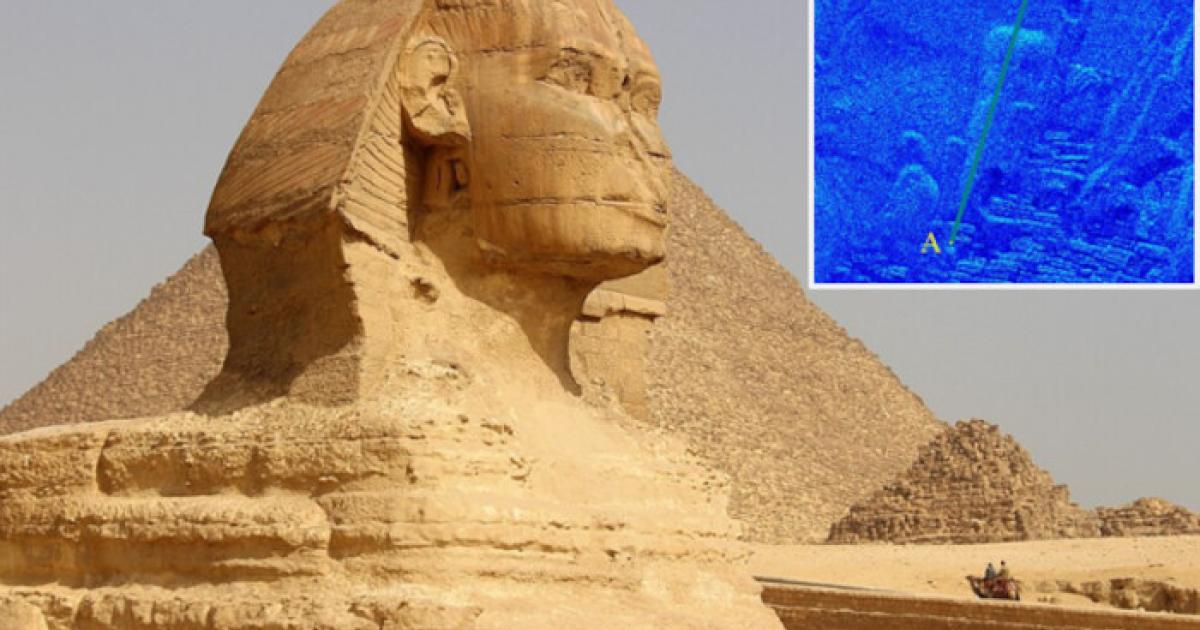
The renewed interest follows claims by researcher Filippo Biondi last week that scans detected a large anomaly deep beneath the mound, which he believes may be a long-lost sphinx.
The footage, released by independent researcher Trevor Grassi of the Archaeological Rescue Foundation, captured dozens of square shafts carved into bedrock, many reportedly extending deep underground but filled primarily with sand.
Grassi, who has spent nearly two decades researching Giza, said the video shows him physically walking along the perimeter of the mound, passing shaft after shaft cut directly into the limestone, some only about three feet across, while others measure roughly eight feet wide.
He said the unusually dense concentration of shafts surrounding the mound raises new questions about what may lie beneath the surface.
The footage is among the first to document the full perimeter of the site, offering what supporters of a second sphinx described as critical context for the ongoing debate.
While no definitive proof of a second sphinx has been discovered, researchers say the location warrants further investigation, given the number of openings and the underground anomaly previously detected at the site.
The video documented more than 100 shafts clustered around the site, which supporters believe could conceal underground structures
The video documented more than 100 shafts clustered around the site, which supporters believe could conceal underground structures
In the video, the camera follows a walking path along the northern edge of the mound, revealing what Grassi described as 'endless shafts all over the place going straight down, all blocked with sand.'
Grassi emphasized that many of the shafts seen in the footage appear to extend more than 100 feet underground, noting that he had personally lowered equipment into several openings to measure their depth.
Biondi took the world by storm last week during his appearance on the Matt Beall Limitless podcast, where he claimed to have scanned a mound of solidified sand on the surface, which he believes sits above the proposed second sphinx.
Using satellite radar technology capable of detecting subtle ground vibrations, Biondi said the data points to a massive structure concealed beneath a 180-foot-high mound of hardened sand, which he described as composed of solidified sand rather than natural bedrock.
Preliminary scans show vertical shafts and passageways strikingly similar to those already found beneath the original Sphinx, with dense vertical lines believed to represent the solid walls of underground shafts rather than empty voids.
'We are very confident to announce this… we have a confidence of about 80 percent,' said Biondi.
However, Zahi Hawass, Egypt’s former minister of antiquities, has dismissed similar claims in the past, saying the areas around the pyramids and the Sphinx have been extensively studied and excavated over decades without uncovering evidence of a second monument.
Grassi spent 12 years studying under independent researcher John Anthony West, who helped popularize the controversial theory that erosion patterns on the Great Sphinx were caused by ancient rainfall, suggesting the monument could be thousands of years older than traditionally believed.
Biondi took the world by storm last week during his appearance on the Matt Beall Limitless podcast, where he claimed to have scanned a mound of solidified sand on the surface, which he believes is above the second sphinx
Grassi emphasized that many of the shafts (bottom right) seen in the footage appear to extend more than 100 feet underground, noting that he had personally lowered equipment into several openings to measure their depth
Grassi was able to look past the gated opens in some of the shafts
He first traveled to Egypt in 2018, joining geologist Robert Schoch, who worked alongside West on the erosion theory, and he is now investigating Biondi's claims.
'You've got a hundred of them within 100 meters [328 feet] right there,' Grassi said in the footage, arguing that such a concentration makes it unlikely they are isolated burial chambers.
Zahi Hawass, Egypt's former minister of antiquities, has dismissed similar claims, saying the areas around the pyramids and the Sphinx have been extensively studied for decades without revealing evidence of a second monument.
The theory of a second Sphinx at Giza is not new, as Egyptologist Bassam El Shammaa first proposed the idea in 2007, based on ancient pyramid texts, including the Dream Stele that Biondi also used to state his case.
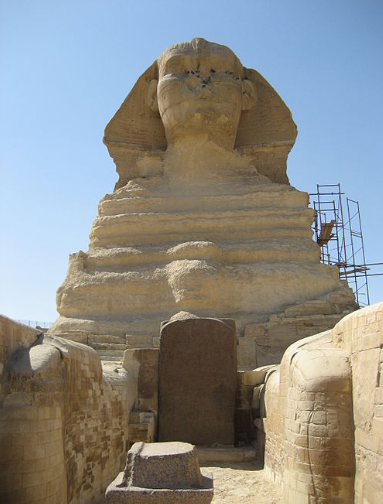
The Dream Stele, positioned between the paws of the Great Sphinx, appears to depict two sphinx figures.
'If you look at all the temples, if you look at all the architecture and the way that everything in Egypt is set up, there are always two obelisks,' said Grassi in a YouTube video.
'There are always two statues. There are always two sphinxes. There's always a perfect balance.
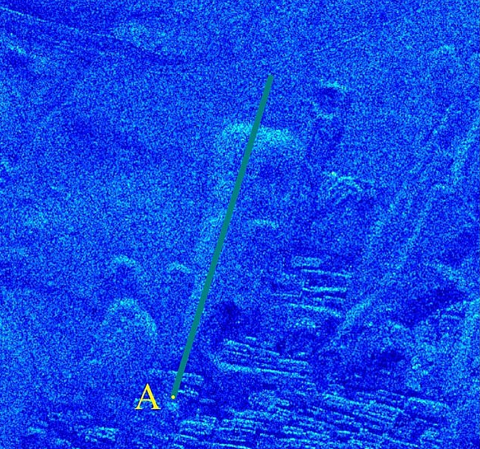
Biondi claimed that the red line labeled 'A' leads to a possible second sphinx
Archival photographs from the 1900s appeared to show the area without the sand pile, indicating that it may have formed as a spoil heap, sand removed from nearby excavations and deposited in a central location
'There are always the two brain hemispheres, the two rising sun and setting sun. Everything is balanced in Egypt, and this is central as a tenet of the Egyptian religion.'
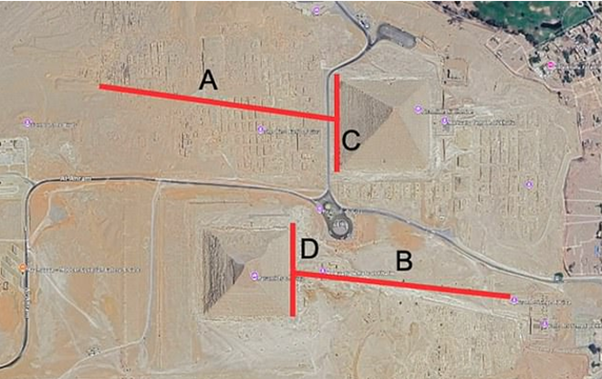
The mound itself is positioned along what researchers describe as a mirrored alignment across the plateau, extending from the known Sphinx through a central axis between the two largest pyramids.
The footage focuses heavily on the large number of shafts surrounding the mound.
Many of the openings appear only a few feet across, while others are significantly wider and cut deep into the limestone bedrock.
According to Grassi, many of the shafts are currently filled with sand deposited during earlier excavations.
He argued that the sheer number of shafts packed tightly together suggests they may function as ventilation or access points for a larger underground network rather than isolated tombs.
Biondi is part of the team that claimed to have uncovered enormous shafts below the Great Sphinx
'When you have this many shafts concentrated like this, it's really got to be light and ventilation shafts for a massive tunnel system,' he said.
Historical images referenced in the footage suggested the mound itself may not have existed before the early 20th century.
Archival photographs from the 1900s appeared to show the area without the sand pile, indicating that it may have formed as a spoil heap, sand removed from nearby excavations and deposited in a central location.
Grassi argued that this detail strengthens the possibility that buried features could exist beneath the mound, since spoil piles sometimes accumulate above previously excavated areas.
'All we have to do is pull some sand out of there, and we'll know if they connect straight into this,' he said, adding that clearing sand from existing shafts would be non-invasive and would not require drilling into the site.
Filippo Biondi | BREAKING NEWS: Second SPHINX found under Giza Plateau
The shocking things 10 days in space does to the human body: As NASA's Artemis II astronauts prepare to blast off to the moon, experts reveal how they'll be ravaged by the void
The shocking things 10 days in space does to the human body: As NASA's Artemis II astronauts prepare to blast off to the moon, experts reveal how they'll be ravaged by the void
Four astronauts are about to embark on a10–day voyage to the moon and back– but what will spending 240 hours in space do to their bodies?
An expert has revealed the shocking health hazards they will face on their 685,000–mile (1.1 million km) journey, from motion sickness to 'chicken legs'.
While Artemis II is considered a short–term mission, astronauts Reid Wiseman, Victor Glover, Jeremy Hansen and Christina Koch can still expect to contend with a series of issues.
Dr Irene Di Giulio, from the Centre for Human and Applied Physiological Sciences at King's College London, said the duration of the mission means the long–term health risks are 'significantly reduced' compared to those who spend months on the International Space Station (ISS).
However, these astronauts will still be exposed to high levels of radiation that can trigger nausea.
'Space motion sickness could also be experienced as the body needs a few days to adapt. Meanwhile acute fluid shift from the lower part of the body to the head may cause discomfort and swelling,' she said.
'Sleep disturbances due to a sudden change in the light–darkness cycle and the use of artificial lighting may be experienced.
'And mental stress and isolation, especially given the mission demands and living in an enclosed environment, may affect performance.'
Astronauts who spend significant amounts of time in space can expect to experience a raft of health issues
Last year, shocking before–and–after images showed the damage that nine gruelling months in space had on astronauts Butch Wilmore and Suni Williams.
Both experienced weight loss and muscle atrophy and appeared significantly older when they finally returned to Earth.
However, it's unlikely the Artemis II astronauts will experience such a major decline in their muscle and bone health.
'The impact on muscles and bones seen in longer missions may be less apparent, because they typically require a longer exposure to altered gravity,' Dr Di Giulio explained.
'However, bone loss and muscle deconditioning can begin within just a few days, as demonstrated during NASA Space Shuttle missions, which were often seven to 14 days in duration.
'These effects therefore remain relevant for Artemis II and highlight the importance of performing in–flight exercise to counter the loss in bone and muscle.'
She said activities the astronauts perform before, during and after the mission can help mitigate the effects.
While space motion sickness can be reduced through training and the use of medication, muscle deconditioning can be counteracted with on–board exercise and sleep disturbances can be reduced by maintaining a structured schedule and controlled lighting.
After nine gruelling months in space, Suni Williams (pictured) and Butch Wilmore finally returned to Earth. But shocking before–and–after images show the damage that their unintended stay in space has caused
Although low–gravity, stress and lack of sleep lead to cognitive decline while astronauts are in space, research has shown that these symptoms abate back on Earth
What 10 days in space could do to the human body
Radiation: Could cause nausea and sickness.
Microgravity: May trigger motion sickness for the first few days, as well as muscle deterioration.
Fluid shifts: Could cause 'chicken legs' and 'baby feet' as fluid moves upwards to the head. This can also lead to swelling and headaches.
Sleep disturbances: Bright lights could mean sleep quality declines, leading to slower cognitive processing.
Mental stress: Triggered by isolation and the nature of the mission.
During the mission, the crew will test every system on the Orion spacecraft and collect biological data to understand the health effects of deep–space travel on the body.
This will help inform future missions, including long–distance travel to Mars.
'The Artemis II mission is the first step towards moon landing and then establishing a long–term presence on the moon,' Dr Di Giulio said.
'There are a number of challenges that need to be addressed to minimise and mitigate the effect of the space environment on the human body.
'While Artemis II is short, it provides critical data that feeds directly into planning for longer–duration cis–lunar missions and sustained lunar presence.'
NASA has previously identified five main hazards for human spaceflight – space radiation, isolation and confinement, distance from Earth, gravity and closed or hostile environments.
In addition, the Apollo missions highlighted additional issues on the moon – dust and locomotion stability.
If humans are ever successful in setting up a base on the lunar surface, inhabitants would face levels of radiation exposure that would increase the risk of cancer, organ damage and nervous system impairment.
NASA astronauts Reid Wiseman (left), Victor Glover (second left), Christina Koch (second right) and Canadian Space Agency astronaut Jeremy Hansen (right)
Gravity on the moon is just one–sixth of that on Earth, which could trigger extensive muscle deconditioning, bone loss and changes in cardiovascular function that affects the brain and the eye.
Meanwhile lunar dust is sharp, fine and abrasive, which could potentially cause breathing difficulties as well as skin and eye irritation.
'To establish a long–term presence on the moon, medical autonomy will be crucial,' Dr Di Giulio said.
'Habitats must include diagnostic tools, medical supplies and crew training to treat injuries or illnesses independently.'
As part of their training for the Artemis II mission, the astronauts will have prepared for medical emergencies in space and learned first aid, CPR, wound care and how to use medical kits.
They will have trained to perform these procedures in simulated microgravity environments, such as underwater.
Artemis II: Key facts
Launch date: NASA initially identified three possible launch windows for Artemis II: From February 6 to February 11, from March 6 to March 11, and from April 1 to April 6. The space agency is now targeting the April window.
Mission objective:To complete a lunar flyby, passing the 'dark side' of the moon and test systems for a future lunar landing.
Total distance to travel: 685,000 miles (1.1 million km)
Mission duration: 10 days
Estimated total cost: $44billion (£32.5billion)
NASA Space Launch System rocket: $23.8billion (£17.6billion)
Aerial view of the Didé Ouest 1 iron reduction site following the 2018 excavation, showing an unusual deposit of used tuyères arranged in two semicircles. Credit: Camille Ollier
The discovery of a 2,400-year-old metalworking workshop in Senegal provides new insights into the history of iron production in Africa. Despite decades of archaeological research, the origins of iron metallurgy in sub-Saharan Africa remain largely unclear. Yet this technological revolution—crucial for producing efficient agricultural tools—emerged there at least 3,000 years ago.
While investigating an archaeological site in eastern Senegal, an international team led by the University of Geneva (UNIGE) uncovered exceptionally well-preserved remains of an ironworking workshop dating back to the 4th century BCE and used for nearly eight centuries. The discovery, published in African Archaeological Review, provides new insights into late prehistoric metallurgical practices in Africa.
In Europe, the Iron Age is generally dated from around 800 BCE to the end of the 1st century CE. However, these chronological frameworks vary widely across different regions of the world. The earliest evidence for iron production is thought to date to the 2nd millennium BCE in Anatolia—modern-day Turkey—and the Caucasus. This technique spread from there to Europe, but did it develop independently in Africa? The question remains open.
Excavations carried out by a team coordinated by UNIGE, in partnership with the Institut Fondamental d'Afrique Noire (IFAN) in Dakar, shed new light on the emergence of iron metallurgy in West Africa. At the site of Didé West 1 (DDW1), near the Falémé River valley in eastern Senegal, archaeologists uncovered an exceptionally well-preserved iron-smelting workshop in 2018 that was in use from the 4th century BCE to the 4th century CE. Its longevity is particularly striking, as such sites are typically used for only a few generations.
Credit: Anne Mayor
Well-preserved 'tuyères' and bloomery furnaces
The workshop consists of a large heap containing around a hundred tons of slag, a semicircular arrangement of about thirty used "tuyères"—clay pipes that channel air into the furnace—and 35 circular furnace bases, each approximately 30 cm deep. This iron and steel production was likely carried out on a small scale to meet local needs, particularly for the manufacture of agricultural tools.
"Thanks to its exceptional state of preservation, its age, the length of time it remained in use, and its distinctive technical features, this site is truly unique. It offers a rare opportunity to study the continuity and adaptation of an iron smelting technique over the long term," says Mélissa Morel, postdoctoral researcher at the Laboratory of Archaeology of Africa & Anthropology (ARCAN) within the Biology Section of the Faculty of Science at UNIGE, and lead author of the article.
Documenting practices
Since 2012, the team has been studying both past and present techniques used by potters and blacksmiths in the Falémé Valley. The work of its members has identified several distinct ancient traditions of iron‑ore smelting. At DDW1, the spatial organization, furnace morphology and associated waste products point to the tradition known as FAL02. It is characterized by small circular furnaces topped with a removable chimney, as well as large clay "tuyères."
A key feature is that these "tuyères" do not have a single air outlet but multiple small openings connected to the main channel by perpendicular side ducts. This design allows air to be distributed to the bottom of the furnace. Another distinctive characteristic is the use of palm nut seeds as packing material at the base of the furnace—a practice not previously documented.
"Despite the very long period during which this workshop operated, this tradition remained remarkably stable, undergoing only minor technical adjustments. This continuity contrasts with other African metallurgical contexts and highlights the importance of understanding the technical and cultural choices made by early metallurgists in iron production," explains Anne Mayor, director of the ARCAN laboratory in the Biology Section of the Faculty of Science at UNIGE and senior lecturer and researcher at the Global Studies Institute, who led the project.
The team's research is continuing at other sites in Senegal to compare smelting practices and gain a better understanding of how ironworking techniques developed and spread. To date, only around a dozen sites dating to the first millennium BCE have been well documented and reliably dated across West Africa.
Ancient African Ironworking The Birthplace of Metallurgy
UAP Plasma Entities Evidence the Military Won't Release
UAP Plasma Entities Evidence the Military Won't Release
Overview
On May 23, 2024, researcher Rhawn Gabriel Joseph, Ph.D., released a video titled “UFO‑UAP Plasmas in the Thermosphere: A Fourth Domain of Life.” In the presentation Joseph argues that a subset of Unidentified Aerial Phenomena (UAP) observed by NASA’s space‑shuttle missions are not conventional debris or experimental hardware but living plasma‑based entities that occupy the Earth’s thermosphere. He frames these objects as a “fourth domain of life,” analogous to extremophiles that thrive in deep‑sea vents, but powered by electromagnetic energy rather than chemical metabolism.
Central Claims
Joseph’s thesis rests on three main observations. First, he describes intelligent‑like behavior—coordinated flight patterns, rapid acceleration, and what he interprets as predatory or mating displays. Second, he asserts that the objects are drawn to high‑energy events such as hurricanes and electromagnetic storms, allegedly feeding on the released energy. Third, he points to physical anomalies—trajectory changes, near‑light‑speed bursts, and abrupt decelerations near storms—that, in his view, cannot be explained by known space debris, ice crystals, or conventional aerodynamics. Joseph summarizes his position: “What we are seeing are self‑illuminating organisms that have evolved to exist where the atmosphere becomes a plasma sea.”
Evidence Cited
The video relies heavily on archival footage from several shuttle missions, most notably STS‑48, STS‑75 (the tether experiment), STS‑80, STS‑96, STS‑106, and STS‑115. Joseph highlights moments where bright, pulsating objects appear to interact with the shuttle or its tether, interpreting the behavior as “swarming” to harvest electrical currents. He references two articles he authored in the Journal of Modern Physics—“Extraterrestrial Life in the Thermosphere” and “Extraterrestrial Life: Plasmas”—and notes that flight‑path analysis was performed by Cary Martynuik. The presentation also classifies the observed shapes into three categories (sperm‑shaped “hunters,” donut‑shaped, and cone‑shaped) and speculates that they are non‑carbon‑based plasma structures lacking DNA.
NASA Transparency Allegations
Joseph alleges that NASA deliberately obscures these phenomena by inserting visual “noise” or “snow” into night‑time recordings and by shutting down camera feeds when objects approach the shuttle. He claims the agency’s actions are intended to hide evidence of a previously unknown biological ecosystem. NASA has not responded to these specific accusations, and no official documentation corroborates the existence of systematic footage manipulation. The agency’s public statements on UAPs emphasize ongoing data collection and analysis rather than concealment.
Scientific and Policy Context
While the video has generated discussion in fringe scientific circles, mainstream experts caution that the claims lack independent verification and have not undergone peer‑review beyond Joseph’s own publications. Astrobiologists note that plasma, by definition, consists of ionized gas rather than organized cellular structures, making the notion of a plasma‑based life form highly speculative. The U.S. Department of Defense’s recent UAP report and the establishment of the All‑Domain Anomaly Resolution Office underscore a broader governmental effort to assess aerial anomalies, but they stop short of endorsing biological interpretations. As one atmospheric physicist remarked, “Extraordinary observations require extraordinary evidence; without reproducible data, the plasma‑organism hypothesis remains an intriguing hypothesis, not a confirmed discovery.”
The discussion highlights a growing intersection between UAP investigations and astrobiology, prompting calls for rigorous, transparent research protocols that can separate genuine anomalous phenomena from misinterpretations of sensor artifacts
The vice president, who is Catholic, said he does not believe they are beings from another planet; instead, he says, they are demons.
Vance noted many world religions have long acknowledged the existence of what he described as “weird things out there” that are difficult to explain.
Loeb told “Jesse Weber Live” Vance’s theory is not new based upon scientific findings and Judeo-Christian beliefs.
Loeb told “Jesse Weber Live” Vance’s theory is not new based upon scientific findings and Judeo-Christian beliefs.
“I don’t see necessarily a conflict between religious beliefs and science as long as everyone agrees that we should attend to the evidence that should guide us,” Loeb said.
“If the U.S. government cannot figure out what these objects are, then of course, people have their own speculations or theories, or they connect them to some past traditional thoughts.”
Ahead of the launch of the Artemis-2 mission, experts have once again raised concerns about issues with the Orion spacecraft’s heat shield. It is designed to protect the astronauts as they re-enter Earth’s atmosphere upon returning from their journey around the Moon.
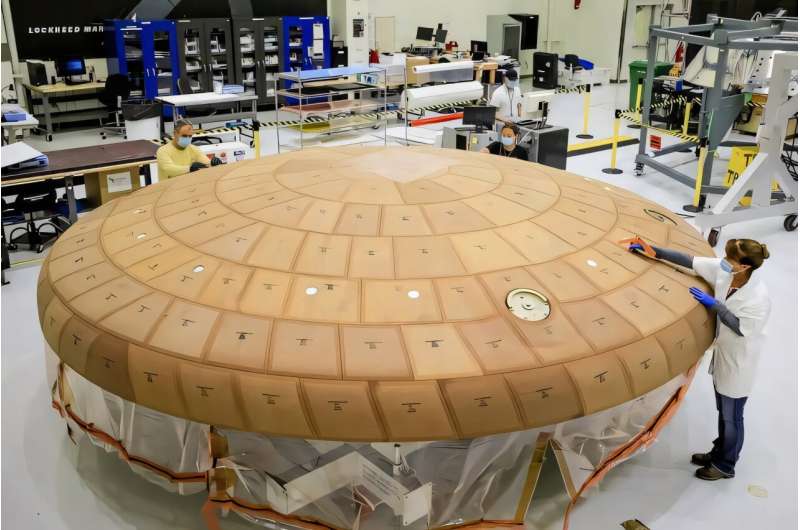
Heat shield of the Orion spacecraft. Source: phys.org
Problems with the heat shield in past missions
The Artemis-2 mission covers a distance of a quarter of a million miles, but the last five minutes of it are likely to cause the greatest concern regarding the astronauts’ safety.
During the uncrewed test of the Orion spacecraft in 2022, problems with the heat shield were identified for the first time. This is the part of Orion that bears the brunt of the intense heat the capsule is exposed to as it enters Earth’s atmosphere.
When engineers inspected the Orion heat shield from the 2022 Artemis-1 mission, they discovered that large pieces of material had fallen off. The concern was that if this were to happen again during the Artemis-2 crewed mission, it could expose the interior of the capsule to dangerously high temperatures. From the very beginning of manned spaceflight, engineers have protected capsules from extreme heat during atmospheric reentry using so-called “abrasive” heat shields made of a material that burns away uniformly as the capsule penetrates the atmosphere.
To meet the requirements for a reusable spacecraft, NASA developed an incredible heat shield system made from ultra-light tiles of glass-coated silica fibers. Although this heat shield possessed exceptional thermal properties, it was also very fragile and required careful maintenance after every flight. Damage to this fragile and unprotected heat shield was the cause of the tragic loss of the space shuttle Columbia in 2003. For the Artemis program, NASA has returned to the concept of an abrasive heat shield.
New heat shield design for the Orion spacecraft
The Orion capsule’s heat shield is made of a material called Avcoat, which is based on a material originally developed for the Apollo program. Although NASA considered other, newer materials for the Orion heat shield, the material ultimately chosen was one that had already proven its reliability during the Apollo missions.
However, the structure of the Orion heat shield differs from those used during the Apollo program. The Apollo heat shield consisted of a single honeycomb-structured matrix containing approximately 320,000 individually filled hexagonal segments. To make the Orion heat shield more effective and easier to reproduce in production, NASA chose a configuration consisting of approximately 180 individual segments.
This heat shield was first tested in 2014, when the Orion uncrewed capsule was launched by a Delta IV rocket to an apogee of 3,600 miles. On reentry, the capsule passed through the atmosphere at a temperature of about 2,200 °C (4,000 °F), but the heat shield proved capable of withstanding such extreme heat.
The next test for the Orion capsule was the Artemis-1 mission in 2022. This was the first flight of the powerful Space Launch System rocket and an uncrewed demonstration of the mission planned for Artemis II. As it flew through Earth’s atmosphere at a much greater distance than during the first test, the spacecraft reached a temperature of about 2,800 °C (5,000 °F). The first concerns regarding the Avcoat heat shield arose at this point.
Instead of burning away evenly across the entire surface, sections of the Artemis-1 heat shield unexpectedly fell off in irregular pieces. Such uneven ablation makes it difficult to predict thermal loads during atmospheric reentry and increases the probability that the Orion capsule could heat up to dangerous levels.
Causes of uneven burning of heat shields
The investigation determined that the cause of the uneven ablation was the irregular release of gases trapped within the heat shield material, which was exacerbated by the “skip re-entry” profile adopted for this mission.
Following the “skip” profile, Orion first lightly touches the edge of the atmosphere to slow down. It then uses the capsule’s aerodynamic lift to skip back out of the atmosphere, before re-entering it for its final descent to Earth. The “skip” profile got its name because it somewhat resembles a stone skipping across the surface of a pond.
NASA researchers found that as the heating rate decreased between atmospheric re-entries, thermal energy accumulated within the Avcoat material. This led to the accumulation of gases and, in turn, to an increase in internal pressure, which resulted in the formation of cracks and uneven delamination of the material.
Necessary improvements
Based on the experience gained during the Artemis-1 mission, NASA has taken a number of measures to protect the Artemis-2 crew. For the first crewed flight under the program, NASA retained the Avcoat heat shield material but updated the tile design to facilitate gas venting during atmospheric reentry.
In addition, NASA has now chosen a more direct re-entry profile for the Orion capsule instead of the “skip” profile. This reduces uncertainty in the heating profile and means that the trapped gases will be exposed to peak temperatures for a shorter period of time, thereby reducing the risk of damage to the heat shield; however, it also means that the crew will experience greater deceleration upon re-entry.
Safety first
At the most dramatic moment in the film Apollo 13, Mission Control Director Gene Kranz says his famous line to the Mission Control team: “Failure is not an option.” Although this phrase was actually coined by the film’s screenwriters, it has become not only the second most popular quote from the movie, but also a kind of motto for NASA.
Nowhere is this truer than in the case of the Artemis-2 heat shield. In the final phase of the Artemis-2 mission, there is no backup plan, no contingency plan, and no chance of escape. The four astronauts on board will rely on a few centimeters of resin-coated silica to protect themselves from temperatures approaching half that of the Sun’s surface.
Human spaceflight has always involved calculated risks, but at the same time it has given us a unique human perspective on our place in the Universe. The Artemis-2 mission will make its crew the first people in over half a century to see the blue globe of Earth in all its glory with their own eyes.
The crew will carry the hopes and aspirations of an entire new generation of explorers. Their safe return will depend on the meticulous work of thousands of scientists and engineers, and they will bring back with them a new human perspective not only on the Moon, but also on the planet we call home.
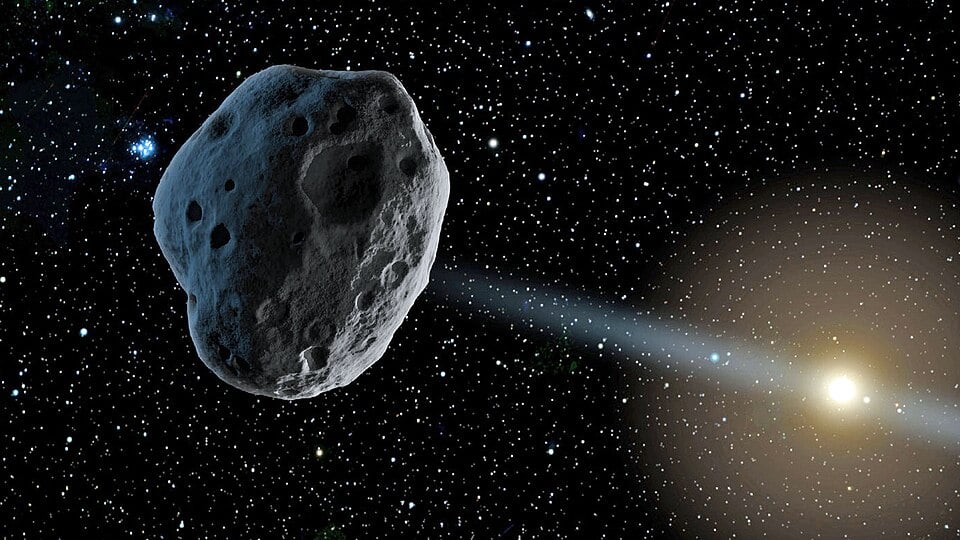
We Could Be Hit By Five Building-sized Asteroids By The End Of The Century - So What Are We Going To Do About It? By Andy Tomaswick - March 30, 2026 11:56 AM UTC | Planetary Science Image of an asteroid traveling through the solar system. Credit - NASA /
We Could Be Hit By Five Building-sized Asteroids By The End Of The Century - So What Are We Going To Do About It?
Image of an asteroid traveling through the solar system. Credit - NASA / JPL-Caltech
It’s amazing how much one movie can act as a cultural touchpoint for an entire topic - even a topic as serious as defense of a planet. Popular media consistently use the 1998 movie Armageddon as a reference when talking about how we would destroy a civilization-ending asteroid. That’s despite the movie’s glaring scientific flaws, not the last of which is the likely size of the rogue comet that threatens the Earth. Planetary defense researchers at MIT were recently interviewed by the university’s media department as part of their “3 Questions” series. One of the most important takeaways is that the size of any likely planetary impactor in our lifetime is going to be much smaller than the kilometer-sized behemoth that did in Bruce Willis’ character.
These smaller objects, known as decameter-scale asteroids because they typically have a diameter of 10s of meters, aren’t the civilization-destroying kind—those are typically kilometer scale and above. But they are much more common. The MIT researchers believe they impact the Earth-Moon system roughly every couple of decades, compared to the once in ten million years a larger impactor would hit us.
To be clear, these decameter sized objects are bigger than the ones that have been causing a significant amount of fireballs over US cities. For example, the one that burst over my home city of Cleveland a few weeks ago, which was loud enough to shake houses in the area, was only around 2 meters in diameter.
One recent example of an asteroid in this size is 2024 YR4, which was discovered a little more than a year ago, and comes in at between 53 and 67 meters - roughly the size of a 15 story building. According to the MIT researchers, this class of objects isn’t likely to cause human casualties. However, if they strike a populated area, they certainly could, as they could release an airburst equivalent to 8 to 10 megatons of TNT.
But what they are sure to do is disrupt space infrastructure - including the satellites used for GPS and communications. In really bad scenarios, they could potentially be the spark that ignites Kessler syndrome - the orbital debris cascade that could lock us out of space access for decades or longer. So even if all this type of asteroid did was knock out a few satellites, its best if we knew it was coming and could potentially do something about it.
The problem is they are really hard to see. At this scale, these asteroids don’t reflect much light, and ground-based observatories have a hard time tracking them. Some space-based observatories, such as the James Webb Space Telescope, fare better. It was used by some members of the MIT team to track 2024 YR4 and recently definitively rule out an impact on the Moon in 2032. But, since the JWST is our most capable deep-space telescope, demands on its time are so frequent it can’t constantly be used to watch for decameter scale asteroids.
Another ground-based telescope that is coming online shortly should be able to help, though. The Vera Rubin Observatory is expected to find up to 10 times more decameter-scale asteroids than we have previously found. However, while it's great at detecting very faint objects like these small asteroids, it is not great at tracking them, making it hard to determine either the asteroid’s size or trajectory.
To make up for this shortfall, the MIT team is developing a pipeline of other telescopes, such as the MIT Haystack and Wallace Observatories, that should be able to track the asteroids that Vera Rubin finds. That pipeline will also include data analysis to make sure they are tracking actual objects and not artifacts from the telescope or other noise.
Figuring out what to do when they inevitably find a decameter sized asteroid that will actually hit the Earth (or the Moon) is a different matter entirely. It’s almost inevitable that we will though. The MIT researchers expect that, within the next decade, astronomers will identify several small objects on a course to impact the Earth-Moon system this century. As of now, there’s still no framework for the nations of the world to deal with this possibility. But what planetary defenders can be sure of is simply sending Bruce Willis and his hand picked team to take care of it definitely won’t help.
Less than two days from now, NASA’s Artemis II mission is scheduled to lift off for its historic 10-day journey around the Moon, marking the first time humans have ventured beyond Low Earth Orbit for the first time since Apollo 17 in 1972, and possibly even set new distance records for traveling beyond Earth. However, Artemis II is only scheduled as a flyby mission and will not be landing humans on the lunar surface, with this endeavor being scheduled for later missions.
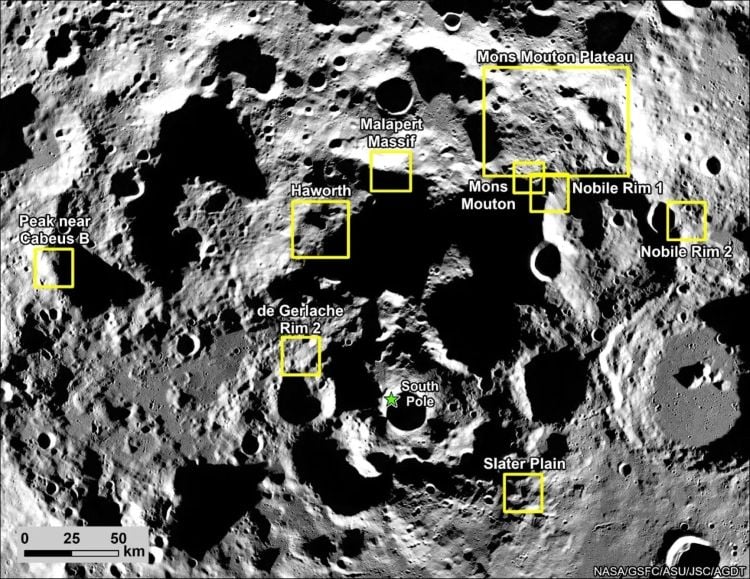
Now, a team of researchers from NASA and industry might be one step closer to landing humans on the lunar surface, as they recently presented findings at the 57th Lunar and Planetary Science Conference (LPSC) discussing how they narrowed down the landing site selection for future Artemis missions. While the study mentions site selection for Artemis III, NASA changed the landing mission to Artemis IV in 2028 before this year’s LPSC meeting, with Artemis III now being used as a testing mission for an Earth orbit docking test in mid-2027 for the Starship or Blue Origin landers. Nonetheless, the research presented in this study is paramount for future human landings on the lunar surface.
For the study, the researchers provided an updated list of 9 candidate landing sites that was also announced in October 2024. Both the October 2024 and LPSC announcements build off the initial NASA announcement in 2022 regarding 13 candidate landing sites with the goal of narrowing down the most plausible landing sites to maximize mission success.
The team notes that between the 2022 and 2024 announcements, numerous assessments and mission updates were conducted and made for narrowing landing site candidates based on several mission needs, including crewed lander and vehicle design, communications, surface lighting, safety, and surface mission duration, the last of which the researchers estimate will be 5.75 to 6.25 days.
The study notes,“The resulting down selection from thirteen to 9 regions reflects prioritization under current Artemis III constraints and does not imply that removed regions are unsuitable for future exploration. Rather, the 9 regions represent those that continue to balance operational feasibility, terrain safety, and science potential most effectively for the architecture envisioned for the first crewed mission.” Once again, Artemis III has been re-designated as a test mission, so the landing sites in this study will likely get pushed back to Artemis IV or later.
With all landing sites located at the lunar south pole, communications become crucial for staying in constant contact with Earth. While the Earth is tilted approximately 23.5 degrees relative to the Sun, the Moon is only tilted approximately 5 degrees. This much smaller angle means some regions of the lunar poles are not directly in line with Earth, meaning communications can be intermittent.
This issue became apparent during the IM-2 mission for Intuitive Machines that attempted to land near the south pole but ended up landing sideways in a crater. This is because during the descent, the spacecraft’s telemetry and altitude experienced large changes, meaning the spacecraft didn’t know where it was due to intermittent communications with Earth. This occurs if a spacecraft passes behind a crater rim or small hill, temporarily cutting communications with ground controllers on Earth. While a robotic mission might end in failure, or in the case of IM-2, sideways in a crater, future human missions will require constant and uninterrupted communication relay with Earth to ensure maximum safety and mission success.
A primary reason NASA is targeting the lunar south pole is due to the large deposits of water ice present in deep craters that scientists estimate that haven’t seen sunlight in billions of years, resulting in slow buildup of water ice from the frigid temperatures. Known as the permanently shadowed regions of the Moon, these exist due to the aforementioned small axial tilt of the Moon, whereas Earth’s tilt allows sunlight to bathe our entire surface over the course of one Earth year. For context, one “day” on the Moon lasts approximately 29.5 days, with half that time in sunlight and the other half in shade, which is also experienced on the lunar polar regions.
What landing site will ultimately be selected for the first human lunar landing since 1972? Only time will tell, and this is why we science!
Secret treaties: "Tall White" aliens and the human military-industrial complex
Could the so-called tic-tac UFOs be the result of a long-standing, mutually beneficial exchange agreement between the “Tall White” aliens and human military forces, along with private aerospace companies, an arrangement that may date back to at least the 1950s?
In this scenario, the propulsion systems would be supplied by the Tall Whites, while the structural design and hulls are developed by human engineers, alongside the exchange of other advanced technologies.
While this idea may sound far-fetched, author Charles Hall, a former weather observer, has claimed that he lived and worked in close proximity to a group of Tall Whites during the 1960s in the Nevada desert. These beings, often associated with the so-called Nordic or Pleiadian archetype, are typically described as human-like in appearance, standing between 5 and 9 feet tall, with pale skin and white hair. Hall further alleged that such entities operated for decades near military installations like Nellis Air Force Base and Edwards Air Force Base.
The video in question is of poor quality, making it difficult to determine whether it captures a genuine tic-tac UFO or a fabricated one. However, the real issue may not be the authenticity of the footage itself, but rather the broader question it raises: to what extent, if any, are claims of collaborative agreements between extraterrestrial beings and human institutions grounded in reality?
Adding another layer to this speculation are statements made by Donald Trump, who has repeatedly suggested that the United States possesses highly advanced military and artificial intelligence technologies, capabilities that, to some, seem almost unbelievable.
This raises an intriguing question: could such remarks be indirectly referencing technologies similar to the tic-tac UFOs? And if so, might they hint knowingly or unknowingly at a deeper level of cooperation between human organizations and non-human entities?
0
1
2
3
4
5
- Gemiddelde waardering: 0/5 - (0 Stemmen) Categorie:ALIEN LIFE, UFO- CRASHES, ABDUCTIONS, MEN IN BLACK, ed ( FR. , NL; E )
UFO shoots out of sky, Nashville, Tennessee, USA March 30, 2026 UAP Paranormal Alien breaking news.
UFO shoots out of sky, Nashville, Tennessee, USA March 30, 2026 UAP Paranormal Alien breaking news.
Date of sighting: March 30, 2026 9pm
Location of sighting: Nashville, Tennessee, USA
Source: Email report scwaring @yahoo.com
This report just in. An eyewitness was driving home and recorded this UFO coming down from the sky. The UFO actually hesitated in the sky for a split second and then continued on its way, be it began to curve and fly away from the eyewitness car. Meteors don't change direction, but this object did. There is no doubt about this object. It's 100% alien technology.
Scott C. Waring - UFO Sightings Daily
Eyewitness states:
I was driving home from work and saw this strange thing I thought was a crashing plane. I got it on car cam so maybe someone can make heads or tails of this.
The Shroud of Turin mystery has deepened yet again, as a new analysis has uncovered DNA from 'multiple sources' on the material.
For centuries, Catholics have flocked to the Italian city of Turin to be in the presence of its famous shroud.
The venerated piece of linen bears a faint image of the front and back of a man – interpreted by many as Jesus Christ.
Believers say it was used to wrap the body of Christ after his crucifixion, leaving his bloody imprint, like a photographic snapshot.
In their new study, researchers from the University of Padova found DNA from several sources on the cloth.
This includes multiple humans, as well as animals, plants, and fungi.
'This research provides original insights into the diversity of DNA extracted from samples collected in 1978 from the Turin Shroud, revealing its biological complexity through rigorous DNA and metagenomic analyses,' the researchers explained.
'Our findings highlight its preservation conditions and environmental interactions, offering valuable perspectives into the identified genetic variants, which originated from multiple biological sources.'
The Shroud of Turin mystery has deepened yet again, as a new analysis has uncovered DNA from 'multiple sources' on the material
In their new study, researchers from the University of Padova found DNA from several sources on the cloth. This includes multiple humans, as well as animals, plants, and fungi
Currently stored at the Cathedral of St. John the Baptist in Turin, the Shroud of Turin is a 14ft–long linen cloth with a faint image of a man.
The image on the shroud is believed to reflect the story of Jesus' crucifixion, giving rise to the belief that the cloth is the burial shroud of Jesus himself.
However, the authenticity of the shroud has been frequently brought into question over the years.
Writing in their study, published as a preprint in bioRxiv, the researchers, led by Gianni Barcaccia, said: 'The true nature of the Shroud has been highly debated among historians, theologians, and scientists.
'Several hypotheses regarding its origin have been proposed, but as of today, no one has yet been able to establish to any degree of certainty when and where this textile originated from.'
To get to the bottom of it, the researchers analysed DNA extracted from 12 samples collected from the shroud in 1978.
Given how many people have handled the shroud, the researchers were unsurprised to discover 'clear signatures' of modern DNA contamination.
However, what was more surprising was the amount of older human DNA on the shroud.
Currently stored at the Cathedral of St. John the Baptist in Turin, the Shroud of Turin is a 14ft–long linen cloth with a faint image of a man
The image on the shroud is believed to reflect the story of Jesus' crucifixion, giving rise to the belief that the cloth is the burial shroud of Jesus himself
Shroud of Turin: The burial cloth of Jesus Christ?
The Shroud of Turin is a 14–foot–long linen cloth with a faint image of a crucified man.
The image on the shroud is believed to reflect the story of Jesus' crucifixion, giving rise to the belief that the cloth is the burial shroud of Jesus himself.
The authenticity of the shroud has been frequently brought into question over the years but there are also many studies claiming to validate its origin.
It is considered to be one of the most intensely studied human artefacts in history.
Since it first emerged in 1354 Vatican authorities have repeatedly gone back and forth on whether it should be considered the true burial shroud.
The shroud is currently stored at the Cathedral of St. John the Baptist in Turin but is only publicly displayed on special occasions.
'Our analyses revealed several human mtDNA lineages, including one common in Western Eurasia and another prevalent in the Near East,' the researchers explained.
Unfortunately, this suggests we may never be able to find out if the shroud really was used to wrap Jesus' body, according to the experts.
'The occurrence of an unusually high number of human heteroplasmies and the coexistence of different mtDNA variants confirm that the Shroud came into contact with multiple individuals, thereby challenging the possibility of identifying the original DNA of the Shroud,' the team added.
As well as human DNA, the researchers found traces from multiple animals, including cats, dogs, chickens and cows.
While this might not sound like much, it could help to unravel the mystery of where the shroud came from.
'Concerning the Shroud’s journey, the presence of red coral, livestock (e.g. chickens, cows, pigs, goats, sheep, rabbits, horses), and domestic cats and dogs suggest Mediterranean origins or transit through Mediterranean regions,' the team explained.
What's more, the cloth was found to contain DNA traces of carrots and cereals – crops that aren't usually associated with the Middle East.
'The prevalence of Mediterranean crops and the absence of typical Middle Eastern flora raise questions about the agricultural landscape when the Shroud was created or used as a burial cloth,' the researchers added.
'Comparative analyses with other ancient textiles and artifacts could further illuminate cultural and historical interactions with plants and animals.'
Overall, the findings suggest that the Turin Shroud has a 'complex history'.
'The overall DNA results – derived from rigorous methodological handling in clean rooms and metagenomic analyses supported by robust bioinformatics – suggest a diverse mosaic of genetic traces,' the team concluded.
The Daily Mail has contacted the researchers for further comment on the implications of the findings.
No physical description of Jesus is found in the Bible.
He's typically depicted as Caucasian in Western works of art, but has also been painted to look as if he was Latino or Aboriginal.
It's thought this is so people in different parts of the world can more easily relate to the Biblical figure.
The earliest depictions show him as a typical Roman man, with short hair and no beard, wearing a tunic.
It is thought that it wasn't until 400AD that Jesus appears with a beard.
This is perhaps to show he was a wise teacher, because philosophers at the time were typically depicted with facial hair.
The conventional image of a fully bearded Jesus with long hair did not become established until the sixth century in Eastern Christianity, and much later in the West
Medieval art in Europe typically showed him with brown hair and pale skin.
This image was strengthened during the Italian Renaissance, with famous paintings such as The Last Supper by Leonardo da Vinci showing Christ.
Modern depictions of Jesus in films tend to uphold the long-haired, bearded stereotype, while some abstract works show him as a spirit or light.
Is NASA's Artemis II mission safe? Scientists raise concerns about the Orion capsule's heat shield – and warn 'there's no chance of escape' for the astronauts if anything goes wrong
Is NASA's Artemis II mission safe? Scientists raise concerns about the Orion capsule's heat shield – and warn 'there's no chance of escape' for the astronauts if anything goes wrong
Scientists have raised safety concerns about the Orion capsule's heat shield ahead ofNASA's long–awaited Artemis II mission.
Set to launch as early as 1 April,the mission will see four astronauts – Reid Wiseman, Victor Glover, Christina Koch and Jeremy Hansen – blast off on a 10–day mission to the moon.
Now, Ed Macaulay, a lecturer in Physics and Data Science at Queen Mary University of London, has voiced his fears about Orion's heat shield, which bears the brunt of the searing heat during re–entry through Earth's atmosphere.
Dr Macaulay points out that during Artemis I, large chunks of material were found to have been lost from the heat shield.
Should this happen again on Artemis II, it could expose the crew to 'dangerously high temperatures'.
'During the final phase of the Artemis II mission, there's no backup, no contingency, and no chance of escape,' Dr Macaulay explained in an article for The Conversation.
'The four astronauts on board will be depending on a few inches of resin–coated silica to shield themselves from temperatures approaching half that of the surface of the Sun.'
The most dangerous moment will occur during re–entry, as Orion's heatshield is subjected to enormous temperatures due to friction with the atmosphere. Pictured: Orion's heatshield after re–entry during Artemis I
During 2022's unmanned Artemis I test, NASA found that Orion's heat shield was cracked and cratered with unexpected damage.
The heat shield material, known as Avcoat, is designed to burn away during re–entry to help dissipate the heat.
However, the damage was well beyond what NASA had expected.
'Instead of burning away evenly over the whole surface, parts of the Artemis I heat shield were lost unexpectedly in uneven chunks,' Dr Macaulay explained.
'This uneven ablation makes modelling the thermal loads of re–entry more unpredictable, and raises the possibility that the Orion capsule could be exposed to dangerous levels of heating.'
Further investigation found that the problem was that the Avcoat layer wasn't permeable enough, so gases built up in pockets and blasted off entire chunks.
Following the mission, Dr Danny Olivas, a former NASA astronaut who served on review team that investigated the incident, told CNN: 'There's no doubt about it: This is not the heat shield that NASA would want to give its astronauts.'
Surprisingly, NASA has decided not to change the heat shield going into Artemis II.
NASA has not altered the heatshield for Artemis II, but has adjusted the trajectory so that Orion will spend less time at critical temperatures
The heatshield coating is designed to burn away during re–entry, however, NASA found that the coating had chipped and deteriorated far more than expected during Artemis I
Instead, it has made some important changes to the mission itself.
Instead of 'skipping' back to Earth – a technique that sees the capsule act like a stone bouncing on water as it dips and lowers itself into the atmosphere – NASA will use a more direct re–entry model for the crewed Orion capsule.
This should reduce the uncertainty in the heating profile, and will mean less time at peak temperatures for trapped gases to damage the heat shield.
'[It] also means that the crew will be subjected to increased deceleration on re–entry,' Dr Macaulay added.
As the astronauts return to Earth, the heat shield is all that will protect them – so NASA's tweaks to the mission could prove vital.
'Human spaceflight has always brought with it calculated risks, but it has also provided a uniquely human perspective on our place in the cosmos,' Dr Macaulay added.
'The Artemis II mission will make its crew the first humans in over half a century to observe the blue marble of planet Earth in its entirety with their own eyes.
'The crew will carry with them the hopes and aspirations of a whole new generation of explorers.
'They will be depending on the meticulous work of thousands of scientists and engineers for their safe return, bringing with them a renewed human perspective on not just the Moon, but the planet we all call home.'
NASA's Artemis II gets the green light for April 1: Step–by–step graphic reveals exactly what will happen as four astronauts venture to the moon for the first time in over 50 YEARS
NASA's Artemis II gets the green light for April 1: Step–by–step graphic reveals exactly what will happen as four astronauts venture to the moon for the first time in over 50 YEARS
NASA's Artemis II mission has been given the green light to launch, sending four astronauts to the moon for the first time in over 50 years.
The 32–storey Space Launch System (SLS) rocket is set to blast off from the Kennedy Space Centre inFlorida tomorrow.
It will send Reid Wiseman, Victor Glover, Jeremy Hansen and Christina Koch on a mammoth 10–day 685,000–mile (1.1 million km) trip around the moon and back.
At a briefing by NASA yesterday, space agency chiefs said the mission is 'ready to go'.
'As we enter the pre–launch phase, the teams are in a strong posture, and the mission remains on track,' NASA's associate administrator Amit Kshatriya said.
'The vehicle is ready. The system is ready. The crew is ready.
'I have complete confidence in this team. 53 years ago humanity left the Moon and did not return. Now we go back.'
Here, the Daily Mail's step–by–step graphic reveals exactly what will happen during the mission.
NASA has said the launch window opens on April 1, with multiple backup opportunities available over the following days depending on weather, technical readiness and range availability.
The SLS rocket itself consists of several parts, including a launch system and the Orion capsule that sits atop it.
During take–off, four RS–25 engines will fire non–stop for 8.5 minutes.
Along with two boosters, this will produce 8.8 million pounds of thrust – more than any rocket in history.
After launch, the Orion crew capsule will separate from the rocket's upper stage and enter a highly elliptical orbit around Earth.
The crew will then spend the first few days conducting extensive systems checks.
These include testing Orion's life–support, propulsion, navigation and communications systems to ensure the spacecraft is ready to head into deep space.
Once checkouts are complete, Orion's propulsion system will perform a critical engine burn known as translunar injection, sending the spacecraft out of Earth orbit and onto a trajectory toward the moon.
NASA's SLS rocket with the Orion spacecraft sits on its launch pad at the Kennedy Space Center
NASA astronauts Reid Wiseman (left), Victor Glover (second left), Christina Koch (second right) and Canadian Space Agency astronaut Jeremy Hansen (right)
Orion crew capsule: Key specs
Unlike the Space Shuttle or ISS, Orion is designed to go far beyond Earth's orbit
It can support four astronauts for up to 21 days
It has a built–in escape rocket that can pull the crew away from danger during launch
It has the largest heat shield ever built for a human spacecraft
The astronauts will live in about 330 cubic feet of space – roughly the size of two minivans
To get some shut–eye, crew members will strap sleeping bags to the wall
It has a mini gym onboard, equipped with a compact flywheel exercise device
It will take astronauts father from Earth than any humans have travelled since the Apollo missions
Orion will pass behind the moon on a 'free–return' trajectory — a path that naturally swings the spacecraft back toward Earth without requiring additional propulsion.
It will reach its greatest distance from Earth during this phase.
After the lunar flyby – during which the crew will photograph and analyse the lunar surface – the spacecraft will spend several days heading home.
As Orion approaches Earth, it will separate key components before plunging into the atmosphere at speeds of about 25,000 miles per hour (40,233 kph).
Testing the capsule's heat shield during high–energy re–entry is one of the mission's primary objectives – as well as one of its most dangerous.
The spacecraft is expected to splash down in the Pacific Ocean, where recovery teams will retrieve the crew.
'Our team has worked extremely hard to get us to this moment', said launch director Charlie Blackwell–Thompson.
'Certainly all indications are right now we are in excellent, excellent shape.'
The rocket itself consists of several parts, including a launch system and the Orion capsule (pictured) that sits atop it
Crew members will strap sleeping bags to the wall to catch some shut–eye, as shown in this mock–up image
Crewed moon missions
Orbit and test missions
Apollo 8: December 21–27, 1968
Apollo 10: May 18–26, 1969
Moon landing missions
Apollo 11: July 16–24, 1969
Apollo 12: November 14–24, 1969
Apollo 14: January 31 – February 9, 1971
Apollo 15: July 26 – August 7, 1971
Apollo 16: April 16–27, 1972
Apollo 17: December 7–19, 1972
NASA's Artemis II mission should have launched in February, but was grounded by hydrogen fuel leaks.
The leaks were fixed, but then a helium pressurization line became clogged, forcing a return to the hangar late last month.
NASA has the first six days of April to launch Artemis II before standing down until the end of the month.
Tomorrow's launch window opens at 6:24pm EDT (11:24pm BST).
'Our teams in mission control and our crew members have been spent the last two years dedicated to training for this particular mission, developing all of the products associated with this flight, and they are ready to go,' chief flight director Emily Nelson said.
'The opportunity is immense for us to finally send our crew farther than anyone's gone before.'
While the astronauts will not actually touch down on the lunar surface, it will still mark the first time humans will return to the vicinity of the moon since the Apollo 17 mission in 1972.
During the lunar flyby, the Orion spacecraft will travel around 4,700 miles (7,500 km) beyond the far side of Earth's natural satellite, setting a new record.
In this photo provided by NASA, astronaut Charles M. Duke Jr. collects lunar samples during the first Apollo 16 extravehicular activity at the Descartes landing site on April 21 1972
NASA says the mission paves the way for a future lunar landing – planned for 2028 – and will also inform planning for longer missions such as to Mars.
It is also historically significant because it will send the first woman and the first Black person on a lunar mission.
British astronaut Major Tim Peake has said Europe, including the UK, is heavily involved in the Artemis programme.
'We were there on Artemis I... we built the European service module which powers the Orion spacecraft that provides all the electrical power, the life support systems, the propellant,' he said.
He hopes the mission can help inspire young people in the UK to consider a career related to space.
Goonhilly Earth Station, near Helston, Cornwall, will also help to track the capsule on its epic celestial voyage.
Launch date: NASA initially identified three possible launch windows for Artemis II: From February 6 to February 11, from March 6 to March 11, and from April 1 to April 6. The space agency is now targeting the April window.
Mission objective: To complete a lunar flyby, passing the 'dark side' of the moon and test systems for a future lunar landing.
Total distance to travel: 685,000 miles (1.1 million km)
Mission duration: 10 days
Estimated total cost:$44billion (£32.5billion)
NASA Space Launch System rocket: $23.8billion (£17.6billion)
Could a second Sphinx be buried beneath the sands of Egypt's most famous ancient site? A team of Italian researchers using cutting-edge radar technology claims to have detected a massive underground anomaly at the Giza Plateau that mirrors the profile of the iconic Great Sphinx. The announcement has ignited fierce debate, with some researchers hailing it as a potential breakthrough and mainstream Egyptologists dismissing it as unsupported speculation. The controversy cuts to the heart of an enduring question: how much of ancient Giza still lies hidden beneath the sand?
The bold assertions stem from the Khafre Research Project, spearheaded by radar engineer Filippo Biondi and his colleagues. By employing Synthetic Aperture Radar (SAR) Doppler tomography, the team analyzed subsurface variations across the ancient site. According to reports from the New York Post, Biondi claims the radar scans revealed organized geometric formations and deep chambers. The data suggests the presence of a sprawling underground megastructure featuring vertical shafts and interconnected pathways.
Preliminary scans from the Giza Plateau presented by Filippo Biondi, who claims to have captured a structure that mirrors the Great Sphinx.
(Filippo Biondi/The Khafre Project)
At the heart of their hypothesis is the detection of a 108-foot-tall dune made of hardened sand, which researchers believe conceals the monument. Biondi notes that the first Sphinx sits in a shallow depression, making it plausible that a twin could be hidden beneath this elevated mound. The team reported a precise geometric correlation between the visible pyramids and the suspected second monument, suggesting a deliberate ancient design. Biondi expressed high confidence in the data, stating that the structural network mirrors the passages found beneath the known Sphinx reports the Daily Mail.
Researchers from The Khafre Project claim that a second sphinx lies beneath a sand dune where A is shown, adjacent to the Great Sphinx shown as B
(Filippo Biondi/The Khafre Project)
The Dream Stele and Ancient Clues
To support their technological findings, the research team points to historical artifacts and ancient Egyptian mythology. A key piece of evidence cited is the Dream Stele, a granite slab erected by Pharaoh Thutmose IV between the paws of the Great Sphinx of Giza. The stele is famously carved with a pair of the mythical feline creatures, which some interpret as an indication that two such statues were originally built. This dual iconography has long fueled theories among alternative historians about a lost companion to the iconic guardian.
The idea of undiscovered structures at Giza is not entirely new, as ancient texts and accounts have often hinted at hidden realms. The Greek historian Herodotus wrote of a vast Egyptian labyrinth, while esoteric traditions speak of a legendary Hall of Records preserving ancient knowledge. Furthermore, Egyptologist Bassam El Shammaa previously proposed the existence of a second Sphinx, theorizing it was destroyed by a lightning strike based on mythological texts. These enduring narratives provide a compelling backdrop to the recent radar anomalies detected by the Italian team.
Expert Skepticism and the Need for Excavation
Despite the excitement generated by the satellite imaging, the archaeological community has responded with significant caution and criticism. Prominent Egyptologist Zahi Hawass has firmly dismissed the claims of a second Sphinx and an underground city as baseless fabrications. He emphasized that extensive excavations of the Giza Plateau over many decades have yielded no evidence of such monumental structures. Experts argue that radar data alone is insufficient to confirm the presence of human-made monuments, as natural geological formations can produce similar subsurface anomalies.
Radar specialists have also highlighted the inherent challenges of interpreting deep subsurface signals without physical corroboration. Experts warn that remote sensing requires controlled excavation to validate any findings, and anomalies must be treated with care.
Hawass was particularly pointed in his criticism, stating that the rumors about columns beneath the Pyramid of Khafre are:
"nothing but fabrications propagated by individuals with no expertise in ancient Egyptian civilization or the history of the pyramids."
The Italian research team is reportedly awaiting permission from Egyptian authorities to conduct further physical investigations of the mound.
What Comes Next?
The debate over the second Sphinx raises broader questions about how new technologies should be applied in archaeology and how claims should be communicated to the public. Remote sensing tools like SAR Doppler tomography have genuinely advanced the field, helping to identify targets for excavation at sites around the world. However, as this case illustrates, the leap from a subsurface anomaly to the announcement of a second Sphinx is a significant one, and the lack of peer-reviewed publication has drawn criticism from the scientific community. Until an underground chamber or monument is physically uncovered, the existence of a second Sphinx remains a tantalizing but unproven hypothesis.
The Giza Plateau has already surprised archaeologists in recent years, with discoveries of hidden air voids and new passages within the pyramid complex. Whether or not a second Sphinx ultimately emerges from the sand, the renewed focus on what may lie beneath Giza is a reminder that the ancient world still has secrets to reveal. Biondi and his team continue to analyze their data and have expressed hope that Egyptian authorities will grant permission for a physical investigation of the site. For now, the world watches and waits.
Top image: The Great Sphinx of Giza with the Pyramid of Khafre in the background.
Viewing Saturn in complementary wavelengths, the James Webb and Hubble space telescopes reveal more about what makes up the layers of ringed planet's atmosphere.
Two images of Saturn from NASA's James Webb Space Telescope and Hubble Space Telescope show different aspects of the planet, from its atmosphere to its orbiting moons.
(Image credit: NASA, ESA, CSA, STScI, Amy Simon (NASA-GSFC), Michael Wong (UC Berkeley); Image Processing: Joseph DePasquale (STScI))
Saturn may be famous for its rings, but it has long fascinated scientists for another reason: its restless atmosphere, which is shaped by fierce winds, stubborn megastorms and strange weather patterns that can linger for years.
Now, two new views from the James Webb and Hubble space telescopes are cutting through the ringed planet's clouds, giving researchers what NASA calls the "most comprehensive view of Saturn to date." Together, the images let researchers "slice" through Saturn's atmosphere at different heights.
The paired observations capture one of Saturn's strangest landmarks: the famous hexagon at the north pole. According to NASA, the faint edges of the six-sided jet stream appear in both images. These pictures could be some of the last high-resolution views of the hexagon until the 2040s, as Saturn's north pole is about to tip into 15 years of winter darkness.
You may like
Studying Saturn's atmosphere not only allows scientists to understand how large, planet-size storms grow and thrive but also gives further insight into how the planet formed and evolved over billions of years.
A planet seen two ways
In August 2024, Hubble took its visible-light image of Saturn as part of the Outer Planet Atmospheres Legacy program, a decade-long project that tracks the outer planets annually. The James Webb Space Telescope (JWST) captured its infrared image a few months later, in November 2024. Those observations, taken 14 weeks apart, showed the ringed planet shifting from northern summer toward its 2025 equinox.
While Hubble captured Saturn's pale-yellow bands and brilliant-white rings, JWST's infrared image revealed even more striking details. In the infrared view, Saturn's rings transformed into glowing blue "because they are made of highly reflective water ice," NASA representatives said in a statement. Saturn's poles also shone a strange gray-green, emitting light at wavelengths of about 4.3 microns. These emissions could be from either light scattering off of high-altitude aerosols or auroras, NASA suggested. (The telescope recently caught giant auroras shining on Uranus.)
As Saturn tilts into its southern springtime, both space telescopes will continue to keep their eyes on its atmosphere, perhaps revealing more about the planet's weather dynamics. Until then, Saturn is keeping some of its most interesting secrets hidden in the clouds.
Earth has seen a mysterious surge in massive fireballs lighting up the sky, sparking concerns about a potentially city-killing asteroid striking the planet and questions about these objects being UFOs.
The American Meteor Society (AMS), a nonprofit group that has been tracking meteor sightings for over a century, revealed that there have been more reports of fireballs in the first three months of 2026 than in the first quarter of any year dating back to 2011.
The society said: 'The first quarter of 2026 has produced what appears to be a significant surge in large fireball events. The data, drawn from the AMS database going back to 2011, shows a pattern that warrants serious investigation.'
AMS also noted that the recent uptick of space rocks ripping through the atmosphere cannot be definitively explained by local meteor showers or other natural events in space, with 2,046 fireballs already tracked since the start of 2026.
That included 38 major events worldwide reported by more than 50 people, more than the last two years combined.
As many witnesses have suspected that the sightings include extraterrestrial ships visiting Earth, researchers addressed the possibility that the fireballs could be UFOs or some type of artificial craft.
AMS said that the fireballs were not objects of alien origin, adding that their analysis found there has simply been a strange increase in the number of natural meteors flying across Earth's path recently.
'These are rocks from the inner solar system. There is no evidence of anomalous trajectory behavior, controlled flight, or non-natural composition,' the team claimed.
On March 17, witnesses in Pittsburgh reported seeing what appeared to be a burning object streaking through the sky, describing it as 'a rocket or something like a meteor'
There have been more widely witnessed meteor fireballs around the globe in the first three months of 2026 than at any point since records started being kept by AMS in 2011
These bright streaks of light, created when space rocks burn up in Earth’s atmosphere, can be potentially dangerous if a large enough piece reaches the ground and strikes people or homes, but this is considered an extremely rare event.
Recent reported fireballs include widespread sightings over the US, in Pennsylvania and Ohio, Texas and California, and in other countries such as Australia and Turkey.
March 2026 has stood out the most, as there were far more events seen by over 50 and 100 people, fireballs lasting longer than four seconds and meteors producing loud 'sonic booms' - when a meteor shoots through the atmosphere at speeds over 25,000 mph.
For example, one fireball over Germany on March 8 was reported by 3,229 people. Several other widely visible events had hundreds of witnesses each this month.
Overall, nearly a thousand more fireballs have been spotted in this year's first three months than were detected a decade ago, when only 1,175 were seen in 2016.
However, skeptics have challenged the society's analysis that these are all natural phenomena taking place during a random uptick in space traffic streaking past the planet.
Most notably, one fireball over Texas on March 17 has been widely theorized to be a genuine UFO, after it was seen defying the normal trajectory of a shooting star.
Witnesses across Red Oak captured the shocking moments when an orange fireball streaking through the night sky suddenly turned back up into the air instead of crashing to Earth.
Hundreds of people across the western US reported seeing a mysterious green flash ripple across the sky on March 22
'Not your typical burn-up trajectory. UFO or space rock? You decide,' one person posted online after seeing the strange fireball turning and zig-zagging over Texas.
AMS has pushed back on the claims that anything besides harmless asteroid fragments has entered Earth's atmosphere this year, saying that every piece of a meteorite recovered has been a common rock seen falling from space for years.
'The recovered specimens from Ohio and Germany are achondritic HEDs with mineral compositions formed over billions of years on differentiated asteroids,' researchers revealed in a statement.
Achondritic HEDs refer to a special group of meteorites. Achondritic means these are stony meteorites without small round grains, called chondrules, that most common meteorites have. They formed from melted and cooled rock, like volcanic rocks on Earth.
HED stands for Howardite–Eucrite–Diogenite. These are three closely related types of achondrites that all came from the same large asteroid, Vesta, which sits in the asteroid belt between Mars and Jupiter.
The meteor society added that there was no current threat from this surge in meteorite impacts. There was also no risk of a massive space rock colliding with the planet and devastating humanity.
'The objects involved range from pebble-sized to a few [feet] across and are part of the normal continuum of material that Earth encounters. None posed a danger beyond localized effects.'
The meteorite that landed in Sherrie James's home just outside Houston on March 21
Over the last decades, the first quarter of 2026 has seen the most fireballs worldwide, suggesting that more meteors are passing Earth than ever before
NASA said the three-foot-long rock that weighed over a ton prior to colliding with Sherrie James's house was traveling at 35,000 mph before most of it burned up in the atmosphere.
A tiny chunk of the meteor survived and struck the woman's home with such force that it ripped through the ceiling of her daughter's bedroom, ricocheted off the floor, and hit the ceiling again before landing on an empty bed.
AMS said part of the reason for the massive surge in fireballs being reported to them by the public could be because of AI chatbots.
In 2025, there were only 15 fireballs witnessed by more than 50 people in the first three months of the year. There have already been 38 in 2026
When people see a bright fireball, witnesses often ask ChatGPT, Siri, Grok or Google’s AI 'I just saw a fireball - where do I report it?' and the AI directs them straight to the AMS website.
This can cause each big event to get more reports than it would have in the past. However, the report noted that AI likely only explains the higher number of witnesses per event, not the actual increase in loud sonic booms or the meteorites striking Earth.
The last time there were more than 2,000 fireballs seen in Earth's atmosphere before the start of April was 2021.
AI is outperforming humans in coding, science, and decision-making
Sam Altman warns we’ve crossed a key threshold
Experts say laws and safeguards are not keeping up
Artificial Intelligence is moving fast, faster than many expected. Some experts now believe Artificial Intelligence may already be smarter than humans in some areas. OpenAI CEO Sam Altman says we’ve already crossed the line.
“We are past the event horizon. The takeoff has started,” he wrote in a blog post. This implies that we might already be living in an era where machines are smarter than us at critical work. But the question is: Are we prepared to deal with what comes after?
AI Is Beating Us at Some Tasks
Artificial Intelligence is now more capable than humans at many particular things. It can code, respond to questions, do math problems, and even assist in science and medicine. Applications such as ChatGPT, Google Gemini, and Claude can accomplish work in seconds that it took humans hours to accomplish.
A new report from Stanford University revealed that AI software is performing better than expert human counterparts on some tests. For instance, they are better at predicting the outcomes of scientific research than scientists.
Altman reports that humans employ Artificial Intelligence for crucial tasks daily. “Hundreds of millions of people depend on it,” he said. He also cautioned that if there is ever a problem with AI, a large number of people could be impacted very rapidly.
Life Still Feels Normal, For Now
Despite the rapid advancement of AI, life is still normal to everyone, as most people confirm. Altman also concedes this. “Robots are not roaming the streets. Most of us don’t chat with AI all day. People continue to die of illness, and we can’t easily go to space,” he said.
But that doesn’t indicate that change is not taking place. AI is now replacing human employees in tech, design, writing, and customer support. It’s just not deafening. The revolution is silent, yet true.
What’s Coming Next?
Altman thinks Artificial Intelligence will be doing even more very soon. In 2025, he predicts, it will begin generating new scientific concepts independently. By 2027, robots will start functioning in the physical world. By 2030, we will have an ‘abundance’ of intelligence and power.
That is, we’re entering a world where AI will be able to revolutionize the way everything operates, jobs, schools, even governments.
The aspiration of most technology firms is AGI, Artificial General Intelligence. This would be a machine which could learn and reason like a human being in a wide variety of topics.
Currently, AI is still narrow. It can perform one task well, but it does not actually know what it is doing. It is not capable of emotions, nor does it have memory or common sense.
But others believe AGI isn’t around the corner. DeepMind and OpenAI leaders believe it might happen within 5–10 years.
Rules Haven’t Caught Up
The frightening thing? Few nations are prepared. There are no robust rules regarding how AI ought to be designed, deployed, or governed. There’s no universal consensus on boundaries. No robust safety net.
Altman and others such as Geoffrey Hinton and Nick Bostrom have cautioned that one wrong move in AI might create huge issues.
We already have examples to see: deepfakes, fake news, cheating on tests, and even AI being used in war. These are warnings of what might go wrong when technology outpaces regulations.
What Do We Do?
Following is what experts tell us we need to pay attention to at this point:
Make clear rules to guide how AI is used.
Test and review AI tools to make sure they are safe and fair.
Train people to use AI wisely.
Support workers who might lose jobs to machines.
Encourage open talks about AI’s impact on society.
Final Thoughts
AI is no longer science fiction. It’s already here. It may already be smarter than us in some ways. But that’s not the main issue.
The actual question is: Are we intelligent enough to handle it?
Currently, AI is running ahead of our laws, our plans, and our intellect. If we don’t hurry up, we may lose control over a technology that we invented.
AI will be ready to score full marks on one of the world's most challenging knowledge tests branded Humanity's Last Exam (HLE) in a matter of months, developers claim.
HLE was set up by tech bosses to see just how intelligent their systems are and consists of 2,500 meticulously chosen questions, spanning around a hundred topics from rocket science and mythology to physiology.
Each one requires at least PhD levels of understanding and to achieve a score even close to 100 per cent would earn someone the title of a 'universal expert'.
Just two years ago, the much-vaunted ChatGPT system from OpenAI scored a measly 3 per cent on the exam with its rivals at Google and Anthropic not doing much better.
The test served to assuage fears over the growing dominance of AI, with researchers claiming it proved 'a marked gap' remained between large language models (LLMs) and the world's finest academics.
But the seemingly impossible HLE may prove to be just another milestone in AI's unstoppable rise.
Google Gemini scored an impressive 45.9 per cent on the exam last month having soared to a score of 18.8 per cent within months of its first attempt.
And full marks are on the horizon, according to Calvin Zhang, the research lead at Scale, the AI company behind HLE.
AI will be ready to score full marks on one of the world's most challenging knowledge tests branded Humanity's Last Exam (HLE) in a matter of months, developers claim (Stock Photo)
'We wanted to create this close-ended academic benchmark, set to the frontier of expert humans, that only a handful of people on earth can really solve,' he said.
'We've seen over the past few years insane progress on these language models. It's impressive, model builders have really done a great job at improving these reasoning models.'
Kate Olszewska, a product manager at Google DeepMind added: 'If we truly cared about this as the only thing in life, I think we could get to it pretty quickly.'
Anthropic - the company behind the Claude AI system - has achieved a score of 34.2 per cent in HLE and is improving its marks at a rapid pace.
AI returning a score of 100 per cent in the exam would be a significant development given the test is 'designed to be the final closed-ended academic benchmark of its kind', according to its authors.
It means that if the technology cracks the HLE, it will need to be tested on questions no human knows the answer to in future.
The test was created by researchers at Scale and the Center for AI Safety, a non-profit organisation, to examine both the AI's breadth of knowledge and its depth of reasoning.
Illustration: Jacey
Experts from roughly 50 countries submitted 70,000 questions for consideration in response to a global appeal in September 2024 which offered a $500,000 prize pot.
They had to require a short unambiguous answer and be difficult to find on the internet.
The list was whittled down to 13,000 after questions which any existing model could answer were removed from consideration.
Some of the 2,500 that were chosen have since been removed or edited following feedback from users.
They require a wide-range of expertise - from knowledge of biology to proficiency in languages - and a large number of them have remained secret in a bid to stop systems benefiting from answers being publicly discussed online.
Success in HLE would evoke memories of IBM's supercomputer Deep Blue defeating world chess champion Garry Kasparov in a game in 1997, confounding most experts' predictions.
Since then, a string of major AI benchmarks have been cleared including the multi-disciplinary Massive Multitask Language Understanding, released in 2020, which was canned after systems began finding it too easy, often scoring above 90 per cent.
As AI approaches the stage where it can master human-made tests, expanding beyond the existing limits of human knowledge has increasingly become the main focus of developers, Ms Olszewska added.
But there will always be room for human specialism, according to Zhang, with physical fields such as surgery, as well as decision-based skills including judgment and creativity harder for AI to master.
Who were the nephilim? The word nephilim appears twice in the Old Testament of the Bible. They are first mentioned in chapter 6 of the book of Genesis and then again in Number 13:33. But their brief mention in the Bible has led to an ongoing debate as to who or what the nephilim were. Much of this debate stems from the passage in the Bible that states:
When people began to multiply on the face of the ground, and daughters were born to them, the sons of God saw that they were fair; and they took wives for themselves of all that they chose. The Nephilim were on the earth in those days - and also afterward - when the sons of God went in to the daughters of man, who bore children to them. These were the heroes that were of old, warriors of renown. – Genesis 6: 1-4
The Sons of God Saw the Daughters of Men That They Were Fair (1923) by Daniel Chester French. Corcoran Gallery of Art. (CC0)
What Does ‘Nephilim’ Mean?
The traditional definition of Nephilim is giant. Some dictionaries describe the nephilim as being giants who also possess super human strength. The Greek Septuagint, an ancient translation of the Hebrew Bible, refers to them as gigantes, which actually means "earth -born," a concept we will be coming back to as we continue.
It is believed that the word Nephilim comes from the root word "Naphal" which means to fall. In biblical circles this definition has quickly put the Nephilim into the role of the children of the fallen angels. The word Naphal, however, is never directly associated with the concept of fallen angels. Its meaning in context is more closely associated with the idea of lying prostrate or of prostrating oneself. There are also ties in this word to the concept of failure, falling short, or being cast down.
‘The Fall of the Rebel Angels’ (1685) by Charles Le Brun. (Public Domain)
Mythos of the Nephilim
Over the years a mythos has developed around the concept of the nephilim. It alleges that these giants were the offspring of the "Sons of God" and the "Daughters of Man". Are the nephilim the children of the untoward relationship?
The connection between the biblical text and this claim, although commonly pointed to as the basis of this belief, is unfounded. The document in which we find statements that support this claim actually comes from the apocryphal Book of Jubiliees:
And it came to pass when the children of men began to multiply on the face of the earth and daughters were born unto them, that the angels of God saw them on a certain year of this jubilee, that they were beautiful to look upon; and they took themselves wives of all whom they chose, and they bare unto them sons and they were giants. The Book of Jubilees - Chapter V: 1
Is the claim that the nephilim were the offspring of the sons of god and the daughters of men supported by sources outside the Judeo-Christian tradition? In other words, does mythology worldwide support this belief?
The Sons of God Saw the Daughters of Men That They Were Fair, by Maurice Greiffenhagen. (Public Domain)
Giants Roaming the Earth Across Cultures
The notion of giants roaming the earth can be found in cultures worldwide. Greek mythology tells us that the Titan Cronus castrated his father Uranus in order to gain control of the Greek pantheon. It is from the blood of the castrated Uranus that fell upon the earth that the giants, the "earth-born", were created.
The Earth-born, when compared to us, were giants. The giants, lived under the rule of Cronos during the golden age, in a time that was free from sorrow or care and everyone lived happy and joyous lives.
It was only after Cronos' son Zeus fought for control of both the heavens and the earth that everything changed. In his new role, Zeus, according to Greek myth, put the giants to work. It was just a matter of time before the giants started ignoring the god's mandates.
Bell krater depicting Zeus fighting against the giant Porphyrion. (Egisto Sani/CC BY NC SA 2.0)
They were no longer prostrating themselves to the will of the gods. Their lack of complete servitude and their failure to comply with the god’s demands incited the "children of god" into a full blown rebellion against the heavenly gods. Heavy losses were taken on both sides, but their revolution was finally suppressed by the gods.
A truce was declared. As part of their reparations to the giants it was decided to create a new race to handle the burdens that were cast upon the giants - man.
Padraic Column in his book entitled Orpheus, Myths of the World, relates this tale about the creation of man: Aztec legend recounts how the Earth-mother, Citlalicue, gave birth to a flint knife. When the knife was flung down onto the Earth, it was transformed into sixteen hundred "earth-gods." (Is there connection between the flint knife, flung down by Citlalicue, and the sickle used by Cronus to castrate his father?)
These newly formed earth-gods lived as men and women and labored in search of food. After some time, the Earth-gods began to think that this work was below their station. They were, after all, the children of the Sky-father and Earth-mother. They asked their mother Citlalicue to make a race who would serve them and bear the burdens they faced. With the help of Citlalicue, mankind was created.
‘A group of natives in the central highlands of Mexico, capturing and putting to death a giant.’ (CC0)
Based upon these mythological traditions it seems clear that the earth-born giants, the nephilim, existed long before man first inhabited the earth. Thus when you read the line "The Nephilim were on the earth in those days - and also afterward" it seems clear from this perspective that the authors were not being vague. Instead they were just making a statement of fact - that the Nephilim, the earth-born, were on the earth at that time.
The Offspring of the Sons of God and the Daughters of Man
So who were the offspring of the sons of god and the daughters of man? The Hebrew Bible refers to them as gibborim. The inferred meaning of this word is men of great stature, heroes, men who are valiant or brave.
The Greek Septuagint identifies them as the renominati or men or renown. In Greek mythology the gods have a long history of having relations with humans. The names of some of these "demi-gods", or semi-human individuals, whose names have withstood the tests of time include were Hercules, Perseus, and Achilles. In India they are called Hanuman and Garuda and in Sumer Gilgamesh and Adapa.
Interestingly, a parallel myth to this biblical narrative does exist. It comes to us from the pages of the Hindu epic the Ramayana. The Ramayana is the epic tale of Rama, the 7th avatar of the supreme god Vishnu.
Rama lived during the Treta Yuga. It was an age where the world was filled with giants. Around the same time as Rama's birth, the supreme god Vishnu, knowing what was in store for him, requested that all of the gods descend to the earth and mate with the apes and the bears. This request was made in order to, when the time was right, provide Rama with an army he could use to help him conquer Ravana - the giant demon king of Lanka.
The offspring of these unions obtained an array of impressive skills from their divine parents. The mighty Sugríva was the ruler of the vanara, the ape-men. His father was Surya, the chief solar deity. The demi-god Hanúmán was the son of the wind god and is described as being able to travel very fast, while Nala was the son of the god of building and construction and is the vanara that helps Rama to build a bridge from mainland India to Lanka.
These thousands did the Gods create Endowed with might that none could mate, In monkey forms that changed at will; So strong their wish the fiend to kill.
Are the nephelim the offspring of the sons of god and the daughters of man? No. They were the race of earth-born giants who lived before the creation of man. They are the group who revolted against the gods in antiquity.
They are also the ones responsible for the creation of mankind. Additionally, based upon the references that come to us from the Ramayana, it does seem clear the when the gods mated with "ape-men" their offspring were men of renown, heroes, or individuals who are valiant or brave.
Top Image: ‘Norandino and Lucina Discovered by the Ogre’ (1624) by Giovanni Lanfranco. Source: Public Domain
Beste bezoeker, Heb je zelf al ooit een vreemde waarneming gedaan, laat dit dan even weten via email aan Frederick Delaere opwww.ufomeldpunt.be. Deze onderzoekers behandelen jouw melding in volledige anonimiteit en met alle respect voor jouw privacy. Ze zijn kritisch, objectief maar open minded aangelegd en zullen jou steeds een verklaring geven voor jouw waarneming! DUS AARZEL NIET, ALS JE EEN ANTWOORD OP JOUW VRAGEN WENST, CONTACTEER FREDERICK. BIJ VOORBAAT DANK...
Druk op onderstaande knop om je bestand , jouw artikel naar mij te verzenden. INDIEN HET DE MOEITE WAARD IS, PLAATS IK HET OP DE BLOG ONDER DIVERSEN MET JOUW NAAM...
Druk op onderstaande knop om een berichtje achter te laten in mijn gastenboek
Alvast bedankt voor al jouw bezoekjes en jouw reacties. Nog een prettige dag verder!!!
Over mijzelf
Ik ben Pieter, en gebruik soms ook wel de schuilnaam Peter2011.
Ik ben een man en woon in Linter (België) en mijn beroep is Ik ben op rust..
Ik ben geboren op 18/10/1950 en ben nu dus 75 jaar jong.
Mijn hobby's zijn: Ufologie en andere esoterische onderwerpen.
Op deze blog vind je onder artikels, werk van mezelf. Mijn dank gaat ook naar André, Ingrid, Oliver, Paul, Vincent, Georges Filer en MUFON voor de bijdragen voor de verschillende categorieën...
Veel leesplezier en geef je mening over deze blog.