The purpose of this blog is the creation of an open, international, independent and free forum, where every UFO-researcher can publish the results of his/her research. The languagues, used for this blog, are Dutch, English and French.You can find the articles of a collegue by selecting his category. Each author stays resposable for the continue of his articles. As blogmaster I have the right to refuse an addition or an article, when it attacks other collegues or UFO-groupes.
Druk op onderstaande knop om te reageren in mijn forum
Zoeken in blog
Deze blog is opgedragen aan mijn overleden echtgenote Lucienne.
In 2012 verloor ze haar moedige strijd tegen kanker!
In 2011 startte ik deze blog, omdat ik niet mocht stoppen met mijn UFO-onderzoek.
BEDANKT!!!
Een interessant adres?
UFO'S of UAP'S, ASTRONOMIE, RUIMTEVAART, ARCHEOLOGIE, OUDHEIDKUNDE, SF-SNUFJES EN ANDERE ESOTERISCHE WETENSCHAPPEN - DE ALLERLAATSTE NIEUWTJES
UFO's of UAP'S in België en de rest van de wereld Ontdek de Fascinerende Wereld van UFO's en UAP's: Jouw Bron voor Onthullende Informatie!
Ben jij ook gefascineerd door het onbekende? Wil je meer weten over UFO's en UAP's, niet alleen in België, maar over de hele wereld? Dan ben je op de juiste plek!
België: Het Kloppend Hart van UFO-onderzoek
In België is BUFON (Belgisch UFO-Netwerk) dé autoriteit op het gebied van UFO-onderzoek. Voor betrouwbare en objectieve informatie over deze intrigerende fenomenen, bezoek je zeker onze Facebook-pagina en deze blog. Maar dat is nog niet alles! Ontdek ook het Belgisch UFO-meldpunt en Caelestia, twee organisaties die diepgaand onderzoek verrichten, al zijn ze soms kritisch of sceptisch.
Nederland: Een Schat aan Informatie
Voor onze Nederlandse buren is er de schitterende website www.ufowijzer.nl, beheerd door Paul Harmans. Deze site biedt een schat aan informatie en artikelen die je niet wilt missen!
Internationaal: MUFON - De Wereldwijde Autoriteit
Neem ook een kijkje bij MUFON (Mutual UFO Network Inc.), een gerenommeerde Amerikaanse UFO-vereniging met afdelingen in de VS en wereldwijd. MUFON is toegewijd aan de wetenschappelijke en analytische studie van het UFO-fenomeen, en hun maandelijkse tijdschrift, The MUFON UFO-Journal, is een must-read voor elke UFO-enthousiasteling. Bezoek hun website op www.mufon.com voor meer informatie.
Samenwerking en Toekomstvisie
Sinds 1 februari 2020 is Pieter niet alleen ex-president van BUFON, maar ook de voormalige nationale directeur van MUFON in Vlaanderen en Nederland. Dit creëert een sterke samenwerking met de Franse MUFON Reseau MUFON/EUROP, wat ons in staat stelt om nog meer waardevolle inzichten te delen.
Let op: Nepprofielen en Nieuwe Groeperingen
Pas op voor een nieuwe groepering die zich ook BUFON noemt, maar geen enkele connectie heeft met onze gevestigde organisatie. Hoewel zij de naam geregistreerd hebben, kunnen ze het rijke verleden en de expertise van onze groep niet evenaren. We wensen hen veel succes, maar we blijven de autoriteit in UFO-onderzoek!
Blijf Op De Hoogte!
Wil jij de laatste nieuwtjes over UFO's, ruimtevaart, archeologie, en meer? Volg ons dan en duik samen met ons in de fascinerende wereld van het onbekende! Sluit je aan bij de gemeenschap van nieuwsgierige geesten die net als jij verlangen naar antwoorden en avonturen in de sterren!
Heb je vragen of wil je meer weten? Aarzel dan niet om contact met ons op te nemen! Samen ontrafelen we het mysterie van de lucht en daarbuiten.
20-02-2026
Trump says US government will declassify its UFO files. Will we actually learn anything this time, or is this a distraction?
Trump says US government will declassify its UFO files. Will we actually learn anything this time, or is this a distraction?
Will this finally be the time we learn what alien skeletons are in the U.S. government's closet? Don't count on it.
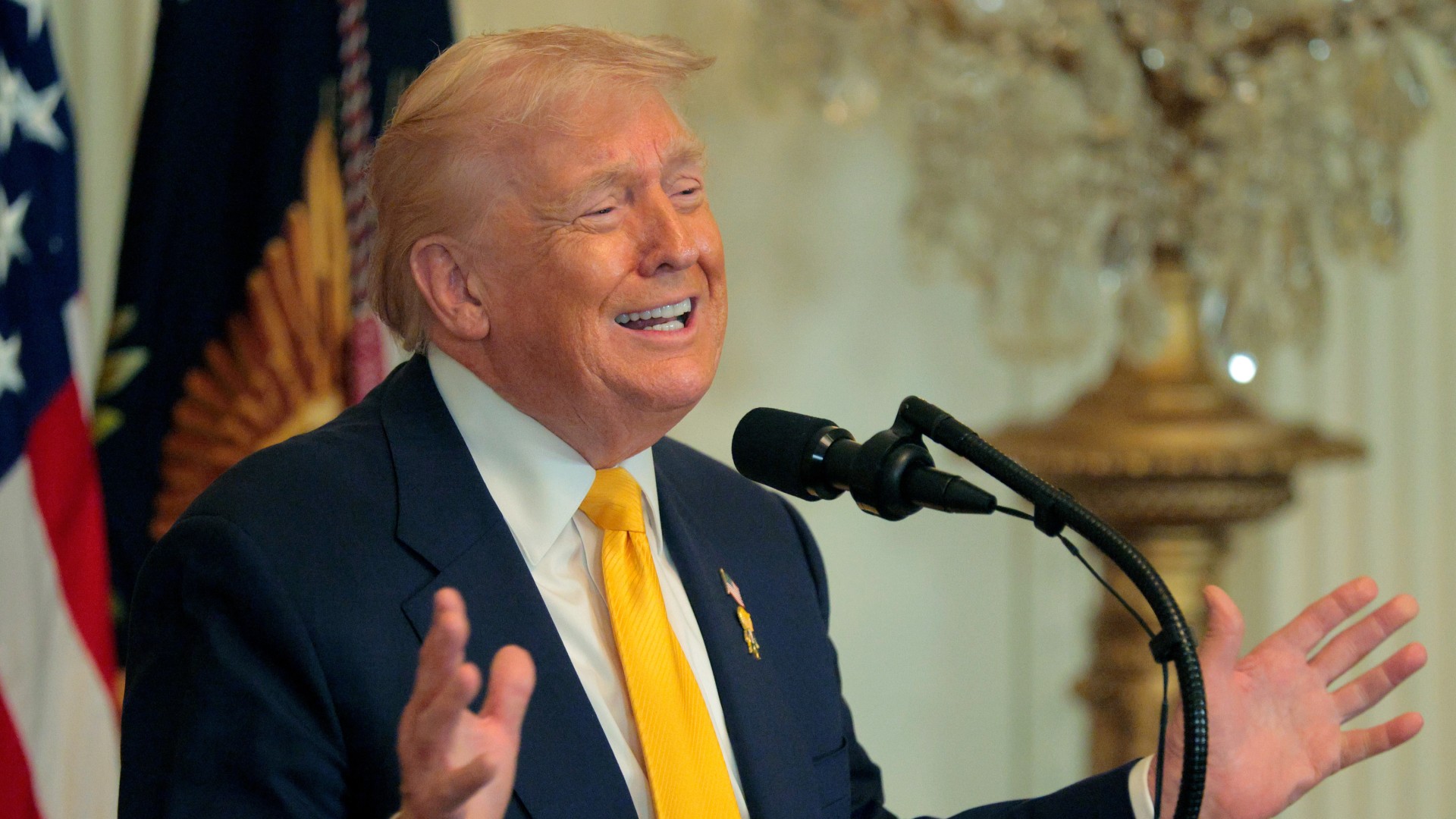
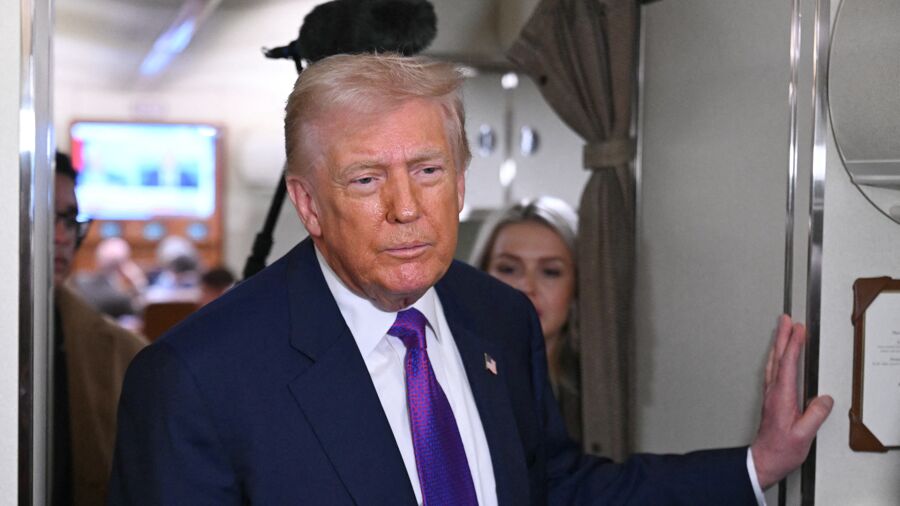
U.S. President Donald Trump speaks during a Black History Month reception in the East Room of the White House on Feb. 18, 2026 in Washington, D.C.(Image credit: Chip Somodevilla/Getty Images)
President Donald Trump has issued a statement that he will instruct the federal government to begin releasing all of its files related to UFOs, or UAP, as they're now known.
Just days after former president Barack Obama told podcast host Brian Tyler Cohen that he saw "no evidence" of alien life or a conspiracy to hide it while in office, Trump took to social media to make the announcement. "Based on the tremendous interest shown, I will be directing the Secretary of War, and other relevant Departments and Agencies, to begin the process of identifying and releasing Government files related to alien and extraterrestrial life, unidentified aerial phenomena (UAP), and unidentified flying objects (UFOs), and any and all information connected to these highly complex, but extremely interesting and important matters," Trump wrote on his Truth Social platform.
While many believers are hailing the announcement as another step toward disclosure, more skeptical observers point out that this is not the first time Trump has made similar promises, nor is it the first time members of the federal government have called for the release of UFO files specifically. Will this finally be the time we learn what alien skeletons are in the U.S. government's closet? Don't count on it.
Te move from Trump follows many of the promises his administration campaigned on, including promising greater transparency from the federal government. Trump's administration has even gone so far as to call itself "the most transparent administration in history" in promotional videos on the White House website.
To that end, Trump has previously promised to release U.S. government files about some of the most conspiracy-theory-laden topics out there. Just last year, for example, Trump issued an executive order calling for the release of all of the files the U.S. government has on the assassinations of President John. F. Kennedy and Dr. Martin Luther King, Jr.
In November 2025, Trump also signed into law the Epstein Files Transparency Act, which called for the release of all unclassified records and documents related to Jeffrey Epstein, the financier indicted in 2019 for child sex trafficking.
But longtime observers point out that those moves by Trump came up short in terms of what was promised.
"Even if an official declassification order is issued regarding UAP/UFOs, what we learn from past releases like the JFK files and, more recently, Department of Justice files related to Jeffrey Epstein, is that much of the documentation will likely be released with significant redactions," Micah Hanks, a longtime researcher into the history of UFOs with relation to the U.S. intelligence community, told Space.com. "Further, some of the documentation may still be withheld altogether, based on national security concerns, which we have also observed in past releases."
The U.S. government has routinely blocked the release of documents, images and videos of alleged or reported UFOs due to the fact that releasing them could reveal sensitive capabilities of satellites, aircraft sensors, or other technologies.
The federal government has also declassified and released large tranches of UFO files before. But none of them contained a "smoking gun" that proved the existence of extraterrestrial visitation or that the U.S. government has concealed an alien presence on Earth.
"While the President's announcement is promising for those who have advocated for broader U.S. government transparency on such issues, it remains to be seen whether anything significant will result from this," Hanks said. "And as past releases have shown, we still have every reason to anticipate that the most sensitive information currently held by the U.S. intelligence community will remain secret."
Other skeptics say there could be an ulterior motive behind Trump's announcement. "I'd be delighted if some interesting UFO files get released, especially if those files contain evidence of aliens. It would be a huge step for science and our understanding of the universe," Mick West, a science writer who has published books on how to debunk sensational claims, told Space.com. "However, I suspect this is largely performative."
West said that leaked UFO videos and other historical documents show little more than ambiguous or misinterpreted data, or even the U.S. government's "embarrassing missteps" into researching pseudoscience or paranormal topics.
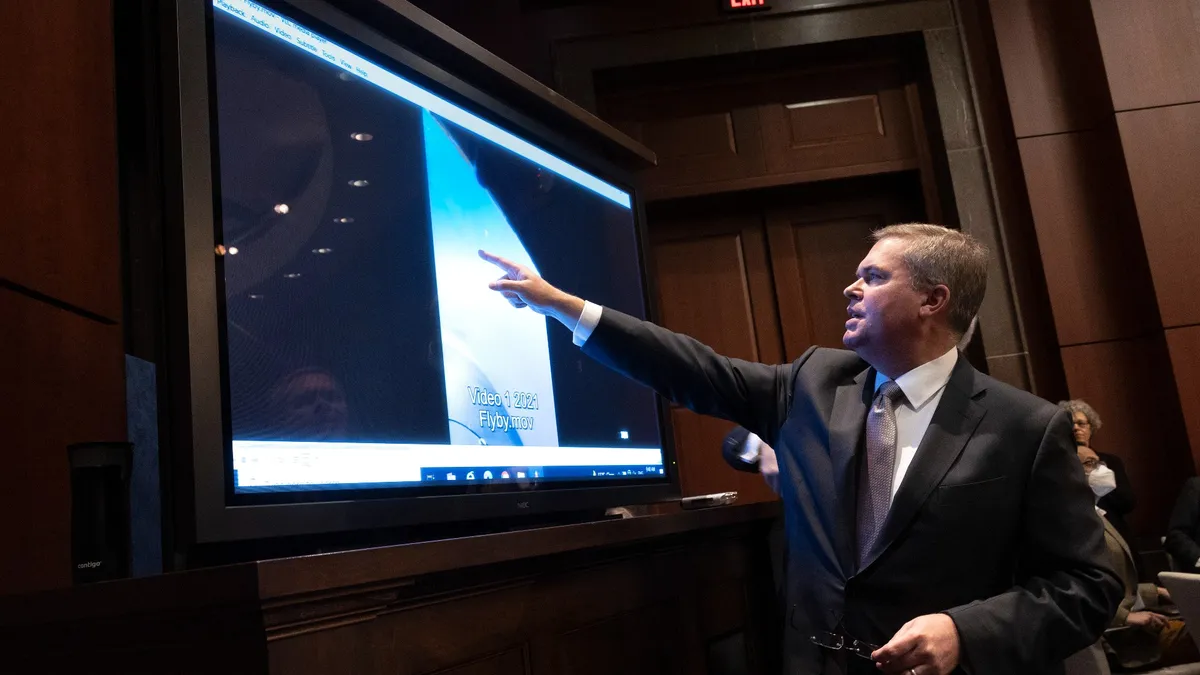
U.S. Deputy Director of Naval Intelligence Scott Bray explains how a video of reported unidentified aerial phenomena was actually a misinterpretation during testimony before a House Intelligence Committee subcommittee hearing at the U.S. Capitol on May 17, 2022 in Washington, DC. (Image credit: Kevin Dietsch/Getty Images)
But many believers and UAP disclosure proponents remain optimistic.
"It would be fantastic if President Trump could provide us with more details on anomalous objects and how they might related to aliens, and I would be delighted to be involved in any further studies related to this topic," Harvard astronomer Avi Loeb said on his YouTube channel. Loeb has previously claimed that interstellar comet 3I/ATLAS could be an alien spaceship visiting our solar system.
Some members of Congress even took to social media to praise Trump's announcement. Representative Anna Paulina Luna (R-Fla.), who chairs the Task Force on the Declassification of Federal Secrets, thanked Trump in a post on X.
"As the Chairwoman of the Task Force that investigates these subjects, we are incredibly grateful for you doing this! I look forward to going through all the footage, photos, and reports with the public!" Luna wrote. The Florida congresswoman has previously stated that she has been shown evidence of interdimensional beings that can "actually operate through the time spaces that we currently have."
But many critics and skeptics are pointing out the timing of Trump's announcement. It coincides not only with Obama's statement about aliens earlier this week, but also with increased scrutiny on the president due to his former ties with Epstein and his appearance in documents in the U.S. Department of Justice's latest release of files related to the indicted sex trafficker.
One such critic, the comedian and talk show host Seth Meyers, called his shot last year. "We're just one Epstein story away from Trump announcing that UFOs are real," Meyers said in July 2025.
Antarctica's worst–case climate scenario laid bare: Terrifying study reveals how ice coverage could plummet by 20% by 2100 – sparking catastrophic global sea level rise
Antarctica's worst–case climate scenario laid bare: Terrifying study reveals how ice coverage could plummet by 20% by 2100 – sparking catastrophic global sea level rise
Antarctica's vast ice sheets and fragile ecosystems are already changing at an alarming rate – and now scientists have revealed just how bad it could get.
A terrifying new study has laid bare the frozen continent's best and worst–case climate change scenarios.
The international team of researchers focused their predictions on the Antarctic Peninsula, a region that is particularly sensitive to human–caused climate change.
In the worst scenario, sea ice coverage around the Peninsula could plummet by 20 per cent by 2100.
This would be devastating for polar species, such as penguins and whales, but could also cause disastrous consequences around the globe.
Like taking the ice cubes out of a cold drink, massive loss of sea ice will accelerate ocean warming, eroding the glaciers and ice shelves that threaten catastrophic sea level rise.
Lead author Professor Bevan Davies, of Newcastle University, says: 'Changes in the Antarctic do not stay in the Antarctic.
'Though Antarctica is far away, changes here will impact the rest of the world through changes in sea level, oceanic and atmospheric connections and circulation changes.'
These maps show the changes in sea ice coverage under a low (top), medium–high (middle), and very high (bottom) emissions scenario. The dark blue shows areas of more extreme ice loss
Scientists have laid bare Antarctica's worst–case climate scenario, as scientists predict that sea ice coverage could shrink by 20 per cent. Pictured: An area of the Antarctic Peninsula that had been covered by ice for thousands of years until 2024
Although the entire Antarctic continent is changing, the Antarctic Peninsula is in a unique position.
Unlike most of the continent, the Peninsula has been frequently visited by researchers, tourists, and fishers for much of the last century.
This means scientists have an extremely good picture of how the region has been affected by the warming climate.
Co–author Professor Peter Convey, of the British Antarctic Survey, says: 'For a casual visitor, the first impression is still inevitably that the region is ice–dominated.
'However, to those of us that have the privilege to go back multiple times, there are very clear changes over time.'
This area is also extremely important for ensuring that the global climate remains cool and stable.
The vast stretches of white ice reflect heat out into space and lock up fresh water that would otherwise increase sea levels and weaken vital ocean currents.
To understand how this sensitive region might continue to change in the future, the researchers used computer modelling to predict what would happen in low, medium–high, and very high emissions scenarios.
The researchers focused their predictions on the Antarctic Peninsula (pictured), a region that is particularly sensitive to human–caused climate change, to see how the area would change under different emissions scenarios
Antarctica's worst–case climate scenario
If emperatures rise by 4.4°C (7.92°F) by 2100:
- Ice coverage will plummet by 20%, sparking 22mm of sea level rise
- Krill will be decimated, limiting food for penguins, seals, and whale
- Heavy rain will wipe out the Adelie penguin population
In the low emissions scenario, global temperatures rise 1.8°C (3.24°F) above the pre–industrial average by 2100.
In the medium–high scenario, temperatures would increase by 3.6°C (6.48°F) by 2100, and the high emissions scenario will see the world get 4.4°C (7.92°F) hotter.
Co–author Professor Martin Siegert, of Exeter University, told the Daily Mail that the hottest scenario would be 'a world very different to today, in ways our human civilisation development has not previously coped with.'
In the worst–case scenario, water temperatures in the Southern Ocean will get hotter much faster.
According to the researchers' modelling, the Antarctic Peninsula alone could increase sea levels by up to 22 millimetres in 2100 and up to 172 millimetres in 2300.
Professor Davies told the Daily Mail: 'This would darken the ocean, making it better at absorbing heat, amplifying global warming.'
The Antarctic Peninsula has already undergone rapid changes due to global warming. In the 1990s, the exposed black peak emerging from the glacier in the top right was a tiny rock poking through the ice that was small enough to ski over
The loss of sea ice in the worst–case scenario will lead to widespread knock–on effects, including rapid ocean warming, the collapse of global ice shelves, rapid sea level rise, and greater severity of extreme weather events
Likewise, warmer water means the oceans can store more energy, leading to more violent weather all around the globe.
Loss of sea ice this dramatic will also have a huge impact on the Antarctic ecosystem, especially on the population of krill, a small crustacean that thrives in the Peninsula.
However, krill are entirely dependent on sea ice, so their population shrinks along with the ice.
Scientists have found that species like the Adelie penguin, which are highly dependent on sea ice and krill, have started to be replaced by more adaptable species.
'Adelie penguin chicks cannot tolerate rain as their downy feathers are not waterproof, so if they get wet, they get hypothermia,' Professor Davies explains.
However, the loss of krill also has serious consequences for humans because they are one of the major means by which the southern ocean absorbs and traps carbon dioxide.
Scientists have found that species like the Adelie penguin (pictured), which rely on sea ice and the krill that live there, are already vanishing from parts of the Antarctic Peninsula
This means that a collapse of the Antarctic ecosystem could accelerate the already devastating process of global warming.
Currently, researchers estimate that the world is on track for a medium or medium–high emissions scenario.
In a medium scenario, carbon dioxide emissions flatline and then begin to fall from 2100, while the medium–high scenario is a world in which emissions double by 2100.
Professor Davies says that we are currently somewhere between these two cases, but that 'resurging nationalism and protectionism' threatens to push the world towards the medium–high case.
In a lower emissions scenario, the ongoing effects of climate change will continue to trigger ice loss and extreme weather, but the effects will be much more muted.
Sea ice will only be a little smaller than it is today, and the sea level rise contributions from the Antarctic Peninsula will be limited to a few millimetres.
However, the hotter the world gets, the more destructive and permanent the effects of climate change will become.
Professor Davies says: 'These changes would be irreversible on any human timescale. It would be very hard to regrow the glaciers and bring back the wildlife that makes Antarctica special. If we don’t make changes now, our great–grandchildren will have to live with the consequences.'
Global sea levels could rise as much as 1.2 metres (4 feet) by 2300 even if we meet the 2015 Paris climate goals, scientists have warned.
The long-term change will be driven by a thaw of ice from Greenland to Antarctica that is set to re-draw global coastlines.
Sea level rise threatens cities from Shanghai to London, to low-lying swathes of Florida or Bangladesh, and to entire nations such as the Maldives.
It is vital that we curb emissions as soon as possible to avoid an even greater rise, a German-led team of researchers said in a new report.
By 2300, the report projected that sea levels would gain by 0.7-1.2 metres, even if almost 200 nations fully meet goals under the 2015 Paris Agreement.
Targets set by the accords include cutting greenhouse gas emissions to net zero in the second half of this century.
Ocean levels will rise inexorably because heat-trapping industrial gases already emitted will linger in the atmosphere, melting more ice, it said.
In addition, water naturally expands as it warms above four degrees Celsius (39.2°F).
Every five years of delay beyond 2020 in peaking global emissions would mean an extra 8 inches (20 centimetres) of sea level rise by 2300.
'Sea level is often communicated as a really slow process that you can't do much about ... but the next 30 years really matter,' said lead author Dr Matthias Mengel, of the Potsdam Institute for Climate Impact Research, in Potsdam, Germany.
None of the nearly 200 governments to sign the Paris Accords are on track to meet its pledges.
NASAhas completed an investigation into the 2024 Starliner fiasco that stranded two astronauts in space for nine months.
The space agency labeled the incident a 'Type A' mishap, the most severe classification of mission failure, it revealed on Thursday. That puts the Starliner test flight in the same category as the Challenger and Columbia disasters, which claimed a total of 14 lives.
Sunita Williams and Butch Wilmore were launched to the International Space Station (ISS) in July 2024 for what was intended to be an eight-day stay. However, the capsule malfunctioned, making it unsafe for human travel and forcing NASA to return it to Earth, leaving the astronauts stranded on the ISS until March last year.
NASA administrator Jared Isaacman said: 'Mistakes occurred from the program's inception and continued throughout execution, including contract management, oversight posture, technical rigor and leadership decision making.
'Boeing built the spacecraft, and from the onset, NASA approved variances and agreed to fly it. As development progressed, design compromises and inadequate hardware qualification extended beyond NASA's complete understanding.'
The investigation found both technical and organizational issues that affected the mission’s safety and oversight.
Decisions and pressures before and during the flight contributed to a culture that sometimes prioritized schedule over caution.
After the mission, concerns about reputation delayed the formal declaration of a mishap, and the program initially conducted its own review.
The Starliner launched Sunita Williams and Butch Wilmore to the International Space Station in July 2024 for what was intended to be an eight-day stay
The capsule malfunctioned, making it unsafe for human travel and forcing NASA to return it to Earth, leaving the astronauts stranded on the ISS until March last year
Starliner, developed under NASA’s Commercial Crew Program since 2010 to ensure continuous American access to low Earth orbit, faced a series of technical setbacks before its first crewed mission.
Early test flights, including Orbital Flight Test (OFT) 1 in 2019 and OFT-2 in 2021 and 2022, suffered guidance errors, thruster failures and oxidizer valve malfunctions, with investigations often addressing only immediate causes rather than underlying issues.
The crewed test flight in June 2024 encountered multiple propulsion anomalies, thruster failures and a temporary loss of full control during docking operations.
The launch took place under the Biden Administration.
Despite these challenges, the astronauts remained safe aboard the ISS, Isaacman said.
Starliner returned autonomously to Earth in September 2024 without crew, and Wilmore and Williams were later brought home safely by SpaceX Crew-9.
The report noted that engineering variances are common across major aerospace programs, but NASA found that Starliner’s qualification deficiencies made it less reliable for crew survival.
The agency acknowledged that it managed the contract, accepted the spacecraft, launched the crew and made critical decisions from docking through post-mission operations, placing a significant portion of responsibility on itself.
The investigation identified both organizational and technical factors contributing to the mishap, though the precise causes of the service and crew module thruster anomalies remain under review.
The American space agency labeled the incident a 'Type A' mishap, the most severe classification of mission failure, and the same as the Challenger disaster
NASA’s limited oversight, according to Issacman's report, left the agency without full insight into spacecraft systems, while Boeing’s propulsion design operated beyond safety qualifications.
Additionally, NASA’s desire to maintain two competing crew transportation systems influenced risk and operational decisions throughout the mission.
Pre-launch, more than 30 scheduled attempts created schedule pressure and decision fatigue, and prior thruster risks were inadequately addressed.
On-orbit disagreements over crew return options led to unprofessional conduct, while advocacy for the Starliner program often overshadowed safety priorities, the report said.
Post-mission, despite a severe loss of control and costs far exceeding Type A thresholds, a mishap was not initially declared due to concern for program reputation, and the Commercial Crew Program first investigated itself.
The independent investigation concluded that these decisions were inconsistent with NASA’s safety culture.
The agency has now formally designated the flight a Type A mishap to ensure lessons are captured for future missions.
Officials emphasized that program advocacy had exceeded reasonable bounds, placing the mission, crew and America’s space program at risk, and pledged leadership accountability to prevent such a culture of mistrust from recurring.
A new 3D map of Uranus is shedding light on one of the solar system's most mysterious planets.
Using NASA's James Webb Space Telescope, scientists observed the ice giant for nearly a full rotation, revealing the inner workings of its upper atmosphere for the first time.
The team, led by Paola Tiranti from Northumbria University, mapped out the temperature and density of ions in the electrically–charged layer that sits 3,100 miles (5,000km) above the cloud tops.
This has provided the most detailed picture yet of where the planet's stunning auroras form, releasing energy that creates a signature glow.
Their observations detected two bright auroral bands near Uranus's magnetic poles, which are lopsided and tilted by nearly 60 degrees.
As a result, its auroras sweep across the surface in complex patterns.
'This is the first time we've been able to see Uranus's upper atmosphere in three dimensions,' Ms Tiranti said.
'With Webb's sensitivity, we can trace how energy moves upward through the planet's atmosphere and even see the influence of its lopsided magnetic field.'
A collage showing Uranus's auroras captured during a full rotation. Observations detected two bright auroral bands near Uranus's magnetic poles, which are lopsided and tilted by nearly 60 degrees
The JWST data revealed two bright auroral bands near the magnetic poles and a zone of low emission and ion density between them.
According to researchers, this feature may be tied to the way Uranus's magnetic field directs charged particles, similar to observations made at Jupiter.
The measurements revealed that temperatures peak between 1,864 miles (3,000km) and 2,485 miles (4,000km) above the cloud tops, whilst ion densities reach their maximum around 621 miles (1,000km).
Analysis also confirmed that Uranus's upper atmosphere is still cooling, extending a trend that began in the early 1990s.
The team measured an average temperature of around 426 kelvins – about 150°C – lower than values recorded by ground–based telescopes or previous spacecraft observations.
Understanding why Uranus is cooling could provide crucial insights into how ice giant planets regulate their atmospheric temperature.
'By revealing Uranus's vertical structure in such detail, Webb is helping us understand the energy balance of the ice giants,' Ms Tiranti said.
'This is a crucial step towards characterising giant planets beyond our Solar System.'
The map has provided the most detailed picture yet of where the planet's stunning auroras form, releasing energy that creates a signature glow
More than one billion miles away from Earth, Uranus is one of the least explored planets in our solar system . So it comes as no surprise that scientists still regularly make new discoveries about the gas giant planet
At more than one billion miles away from Earth, Uranus is one of the least explored planets in our solar system.
Last year, scientists uncovered a secret moon hiding in its orbit, which is believed to be around six miles wide.
The discovery expands the total known number of moons orbiting Uranus to 29.
'No other planet has as many small inner moons as Uranus, and their complex inter–relationships with the rings hint at a chaotic history that blurs the boundary between a ring system and a system of moons,' said Matthew Tiscareno of the SETI Institute in Mountain View, California, a member of the research team.
The new findings, published in the Geophysical Research Letters, are part of an international collaboration that also involved the European Space Agency and the Canadian Space Agency.
A study analysing data collected more than 30 years ago by the Voyager 2 spacecraft has found that the Uranus's global magnetosphere is nothing like Earth’s, which is known to be aligned nearly with our planet’s spin axis.
A false-color view of Uranus captured by Hubble is pictured
According to the researchers from Georgia Institute of Technology, this alignment would give rise to behaviour that is vastly different from what’s seen around Earth.
Uranus lies and rotates on its side, leaving its magnetic field tilted 60 degrees from its axis.
As a result, the magnetic field ‘tumbles’ asymmetrically relative to the solar wind.
As a result, the magnetic field ‘tumbles’ asymmetrically relative to the solar wind.
When the magnetosphere is open, it allows solar wind to flow in.
But, when it closes off, it creates a shield against these particles.
The researchers suspect solar wind reconnection takes place upstream of Uranus’s magnetosphere at different latitudes, causing magnetic flux to close in various parts.
Eeuwenoude mysteries die onderzoekers nog steeds niet kunnen verklaren De oudheid spreekt al eeuwenlang tot de verbeelding van het publiek. Van verloren begraafplaatsen tot verzonken steden, er zijn nog steeds veel dingen die een mysterie blijven voor historici en archeologen. En hoewel wetenschap en technologie grote vooruitgang hebben geboekt, maken deze onopgeloste mysteries onze wereld ontzettend fascinerend.
Van mysterieuze geogliefen in de Nazca-woestijn tot honderden perfect ronde bollen in de jungle van Costa Rica, klik verder om een paar van de meest hardnekkige mysteries van de oude wereld te ontdekken.
Antikythera-mechanisme Een 2000 jaar oude mechanisme van Antikythera, dat ook wel de ‘eerste computer’ wordt genoemd, werd gevonden in een oud Grieks scheepswrak. Het maakte gebruik van een opwindbaar wijzerplaatensysteem om de hemelse tijden van de zon, de maan en vijf planeten bij te houden, samen met een kalender, de fasen van de maan en het moment van eclipsen. Onderzoekers begrijpen nog steeds niet hoe de Grieken toen al zo'n geavanceerd instrument konden maken.
Voynich-manuscript Het Voynich-manuscript werd in het begin van de 15de eeuw in Midden-Europa geschreven. Maar wetenschappers weten nog steeds niet wat er op de pagina's staat, of in welke taal het is geschreven.
Vlakte der Kruiken In de bergen van Laos ligt een vallei met duizenden stenen kruiken, wat bekend staat als de Vlakte der Kruiken. De enorme stenen kruiken zijn 2500 jaar oud en niemand weet waarom ze daar liggen.
Lijnen van Nazca Tussen 1 en 700 na Christus hakten de Nazca-bewoners van Peru in roestkleurige rotsen, waardoor de lichtere steen in diepere lagen blootgesteld werd. Enorme figuren van dieren, planten, mensen en geometrische vormen waren het resultaat, maar tot nu toe weet niemand waarom ze deze figuren hebben uitgehouwen.
Romeinse twaalfvlakken Deze mysterieuze voorwerpen, gemaakt van brons of steen tussen 100 en 300 na Christus, danken hun naam aan hun 12 zijden. Maar hun vorm is zo ongeveer het enige waar experts het over eens zijn.
Lineair A Op oude Minoïsche relikwieën zijn twee verschillende maar vergelijkbare schrijfstijlen aangetroffen, namelijk Lineair A en Lineair B. Terwijl Lineair B in 1952 werd ontcijferd, breken onderzoekers zich nog steeds het hoofd over Lineair A.
Paracas Candelabra De Paracas Candelabra, uitgehouwen in een Peruaanse heuvel van versteend zand, lijkt op de Nazca-lijnen. Het is rond 200 voor Christus gemaakt, maar niemand weet precies wat het voorstelt.
Dogū De dogū, die dateren uit de Japanse neolithische Jōmon-periode, zijn kleifiguren die een kruising zijn tussen mens en dier. Archeologen hebben er ongeveer 18.000 gevonden, variërend in leeftijd van 2300 tot 10.000 jaar oud, maar ze weten nog steeds niet waarvoor ze werden gebruikt.
Sacsayhuamán Er zijn veel vragen rond de stenen structuur van de Inca's in Cusco, Peru. Sommigen beweren dat het een fort was, anderen zeggen dat het werd gebruikt voor ceremonies. Maar hoe dan ook, het is zeker indrukwekkend!
De Lijkwade van Turijn De lijkwade is een stuk linnen waarop een vervaagde afbeelding te zien is van een man die veel op Jezus lijkt. Hoewel uit onderzoek is gebleken dat het doek uit de middeleeuwen stamt, geloven velen dat het de echte lijkwade van Jezus Christus
Yonaguni Monument Voor de kust van het Japanse eiland Yonaguni ligt een onderwaterrotsformatie die lijkt op een door mensen gemaakte trappenpiramide. Deze formatie werd in de jaren 80 ontdekt en wordt door sommige onderzoekers beschouwd als de ruïnes van een oude beschaving.
De Grote Sfinx van Gizeh De sfinx, een van de meest raadselachtige monumenten uit het oude Egypte, zou zijn gebouwd tijdens het bewind van farao Khafre in het derde millennium voor Christus. Sommige historici suggereren echter dat het monument wel eens 9000 jaar oud zou kunnen zijn.
Skara Brae Het oude stenen dorp Skara Brae, dat ongeveer 5000 jaar geleden werd gesticht, ligt op de Orkney-eilanden in Schotland. Het bestaat uit een aantal stenen huizen en het oudst bekende toilet van Schotland. Het dorp werd rond 2500 voor Christus op mysterieuze wijze verlaten. Omdat er geen menselijke resten of andere aanwijzingen zijn gevonden, vragen onderzoekers zich af: waarom zijn de bewoners vertrokken?
Angkor De heilige stad Angkor, gelegen in het hart van de Cambodjaanse jungle, was van de negende tot de 15de eeuw de hoofdstad van het Khmer-rijk. Hoewel er geen duidelijke verklaring is voor de ondergang van deze stad, wijzen recente onderzoeken erop dat klimaatverandering hiervoor verantwoordelijk zou kunnen zijn.
De dood van Farao Toetanchamon Archeologen denken dat de jonge koning onverwacht is overleden. Zijn lichaam lijkt echter in brand te zijn gevlogen nadat hij was gemummificeerd en zijn graf werd verzegeld. Dit, in combinatie met de overhaaste begrafenis, heeft experts doen twijfelen of zijn graf oorspronkelijk voor iemand anders was gebouwd en of er misschien nog andere mummies in hetzelfde graf begraven liggen.
Paaseiland Een van 's werelds grootste mysteries is het afgelegen Paaseiland in Chili, dat ooit de thuisbasis was van een welvarende Polynesische gemeenschap. Maar waarom en wanneer de eerste kolonisten arriveerden, blijft onbekend. Over de ondergang van deze beschaving wordt dan ook nog steeds gediscussieerd.
Tempels van Ġgantija Deze enorme megalieten, gelegen op het Maltese eiland Gozo, zijn naar schatting zo'n 5500 jaar oud. Archeologen vermoeden dat de tempels mogelijk toegewijd waren aan een oude vruchtbaarheidscultus, maar dat is tot vandaag nog niet vastgesteld.
Göbekli Tepe Göbekli Tepe ligt in een landelijk gebied in Turkije en dateert uit 8000 voor Christus. Het bestaat uit meerdere ringen van enorme stenen pilaren met daarop afbeeldingen van dieren en wordt beschouwd als een van de oudste plaatsen van aanbidding. Maar de vraag blijft wie de bewoners daadwerkelijk waren.
Stonehenge Stonehenge, een van de meest iconische prehistorische monumenten ter wereld, zou rond 3000 tot 2000 voor Christus zijn gebouwd. Na eeuwenlang onderzoek zijn de meeste onderzoekers het erover eens dat het als begraafplaats heeft gefungeerd. Maar er blijven nog andere geheimen bestaan, zoals de mogelijke religieuze en ceremoniële betekenis ervan.
Terracotta Leger In het mausoleum van Qin Shi Huang Di, de eerste keizer van China, staat een leger van 8000 levensgrote beelden op wacht. De tombe van Qin is echter nog niet opgegraven, waardoor men zich afvraagt welke andere verrassingen er nog te vinden zijn.
De Grote Piramide van Gizeh Archeologen zijn van mening dat het ongeveer 20 jaar heeft geduurd om de Grote Piramide van Gizeh te bouwen, een van de zeven wereldwonderen uit de oudheid. Het precieze doel van deze piramide is tot de dag van vandaag nog steeds een mysterie.
Schijf van Phaistos De schijf van Phaistos, gevonden op Kreta in 1908, is gemaakt van brons en is aan allebei de zijden bedekt met een spiraal van gedrukte symbolen. De oorsprong en betekenis ervan blijven veelbesproken.
Hobbits In 2003 werd op het afgelegen Indonesische eiland Flores een skelet van een 30-jarige volwassen vrouw gevonden met een lengte van slechts 1,06 meter. Aanvankelijk dachten onderzoekers dat de kleine botten mogelijk afkomstig waren van een mens met microcefalie, een aandoening die wordt gekenmerkt door een klein hoofd en een kleine lichaam. Maar latere vondsten van skeletten van vergelijkbare grootte suggereerden dat deze "hobbit" een aparte soort was, de Homo floresiensis. Deze soort dateert van 50.000 jaar geleden, maar de exacte plaats in de stamboom van de menselijke voorouders is nog steeds een raadsel.
Chichén Itzá Chichén Itzá, gelegen op het schiereiland Yucatán in Mexico, werd rond de zesde eeuw na Christus gesticht door de Maya's. Ooit was dit een bloeiende metropool met 50.000 inwoners, maar we weten nog steeds niet wat de oorzaak van haar ondergang was.
Tikal Tikal, gelegen in het regenwoud van Guatemala, herbergt de ruïnes van een machtige Maya-stad uit de periode tussen 300 en 800 na Christus. Tot op de dag van vandaag hebben archeologen nog steeds geen aanwijzingen over de oorzaak van de ondergang van Tikal.
Koperen Rol De koperen rol, die dateert van 2000 jaar geleden, werd in 1952 ontdekt op de locatie van Qumran. Onderzoekers denken dat de rol een beschrijving bevat van een verborgen schat, maar niemand weet waar deze zich bevindt, of dat deze schat daadwerkelijk bestaat.
Tiwanaku Deze Inca locatie in Bolivia blijft de wetenschappelijke gemeenschap verbazen. De locatie dateert uit ongeveer 536 na Christus, maar het is onduidelijk hoe de stenen blokken ooit werden vervoerd en gevormd.
Stenen ballen van Costa Rica De stenen bollen van Costa Rica zijn een verzameling van meer dan 300 petrosferen in de jungle van Costa Rica. Ze werden ontdekt in de jaren '30 en sommige dateren zelfs uit 600 na Christus. Tot op de dag van vandaag is er weinig bekend over de oorsprong van de stenen of hoe ze gebruikt werden.
UFO Orbs Over Ocean Off Japan, Nov 14, 2025, UAP Paranormal sighting news. Possible alien base under water in that area.
UFO Orbs Over Ocean Off Japan, Nov 14, 2025, UAP Paranormal sighting news. Possible alien base under water in that area.
Date of sighting: Nov 14, 2025
Location of sighting: 700 miles East of Japan
Source: NUFORC
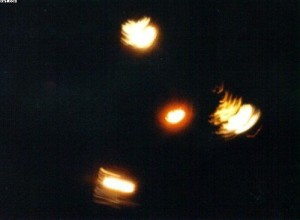
Watch this short video and you will see a fleet of glowing spheres rising out of the ocean and moving upwards out of earths atmosphere. This is a very similar UFO that was also seen in front of tens of thousands of people back at Dome of Rock in 2011. It's also common to see this sphere UFO around the Rocky Mountains in Colorado. This is absolutely a real alien craft, such things are coming to light very fast in our society. Are you ready to meet them?
Scott C. Waring - Taiwan
Eyewitness states:
Multiple large, stationary, internally illuminated spherical light orbs observed above and within cloud tops at ~35,000 ft over the Nor I filmed this sighting on November 14, 2025, during a flight from Hong Kong (HKG) to Chicago O’Hare (ORD) aboard Cathay Pacific CX806, an Airbus A350-900 cruising at approximately 35,012 ft. A few hours into the flight, while over the Northwest Pacific Basin, I noticed multiple bright light sources illuminating the cloud tops below and around the aircraft. I observed approximately 10–14 spherical light orbs, each appearing perfectly round, internally illuminated, steady, and stationary relative to the aircraft.
Some were within cloud formations, causing the clouds to glow from the inside, while others were above the cloud tops with very sharp, clean edges.GPS coordinates at the time of filming: 39°58′05″ N, 150°59′19″ E (approximate) This location is ~700 miles east of Japan over deep ocean.
Trump wil dossiers over buitenaardse wezens vrijgeven (en zegt dat Obama geheime informatie over aliens verspreidde)
Trump wil dossiers over buitenaardse wezens vrijgeven (en zegt dat Obama geheime informatie over aliens verspreidde)
Artikel door Kathleen Heylen
Donald Trump in een gesprek met de pers op het presidentiële vliegtuig Air Force One op 19 februari 2026.
De Amerikaanse president Donald Trump zal het ministerie van Defensie en andere instanties de opdracht geven om alle dossiers over de zoektocht naar buitenaards leven vrij te geven. Documenten moeten worden bekendgemaakt "gezien de enorme belangstelling", zegt hij op Truth Social. Hij vindt ook dat ex-president Barack Obama met zijn 'alien'-uitspraak geheime informatie vrijgegeven heeft.
"Gezien de enorme belangstelling zal ik de minister van Oorlog (zoals Trump het ministerie van Defensie noemt, red) en andere relevante ministeries en instanties opdracht geven om te beginnen met het identificeren en vrijgeven van overheidsdocumenten met betrekking tot buitenaards leven, ongeïdentificeerde luchtverschijnselen (uap's) en ongeïdentificeerde vliegende objecten (ufo's), en alle andere informatie die verband houdt met deze zeer complexe, maar uiterst interessante en belangrijke onderwerpen."
Een aankondiging van Trump op zijn platform Truth Social waarmee hij lijkt te reageren op uitspraken van voormalig president Barack Obama in de podcast van Brian Tyler Cohen vorig weekend.
Tijdens een snelle vragenronde had Obama al grappend gezegd dat hij in 'aliens' gelooft. "Ze bestaan echt, maar ik heb ze niet gezien en ze worden niet vastgehouden in Area 51. Er is geen ondergrondse faciliteit, tenzij er een enorm complot gaande is dat ze voor de president van de VS verborgen hebben gehouden."
Een uitspraak die de Amerikaanse krantenkoppen haalde. Waarna Obama het noodzakelijk achtte te verduidelijken dat hij het statistisch gezien waarschijnlijk vindt dat er buitenaards leven bestaat, gezien de omvang van het universum. En: "Ik heb tijdens mijn presidentschap geen bewijs gezien dat buitenaardse wezens contact met ons hebben opgenomen. Echt waar!"
Trump: "Obama beging een grote fout"
Einde commotie, zou je denken, maar niet zo. Donald Trump kwam er gisteren op terug in een interview met journalisten op Air Force One. "Hoewel veel mensen geloven in het bestaan van buitenaards leven, praat ik er nooit over en heb ik er geen mening over", zei hij.
Trump beweerde bovendien dat Obama geheime overheidsinformatie vrijgegeven had. "Ik weet niet of aliens echt zijn of niet. Ik kan je wel zeggen dat hij classified information vrijgaf. Hij beging een grote fout. Hij haalde dat uit geheime informatie, hij had dat niet moeten doen. (...) Ik kan hem misschien uit de problemen helpen door het te declassificeren."
Voor alle duidelijkheid: er zijn geen aanwijzingen dat Obama gebruikmaakte van geheime informatie tijdens de podcast. Het is ook geen geheim dat Trump graag kritiek geeft op Obama.
Wel of geen mening?
Het is de vraag of Trump geen mening heeft over aliens en er niet over spreekt. Toch niet als we Lara Trump mogen geloven, de schoondochter van Donald Trump. Zij vertelde deze week in de podcast 'Pod force one' dat hij er wel degelijk iets over wil zeggen. De president heeft een toespraak over buitenaardse wezens voorbereid die hij "op het juiste moment" zou houden, klonk het.
Dat zou dan toch niet afgestemd zijn met het Witte Huis, als het al zou kloppen. Woordvoerster Karoline Leavitt kreeg er woensdag een vraag over van journalisten en reageerde lachend: "Een toespraak over buitenaardse wezens zou voor mij ook nieuw zijn."
O
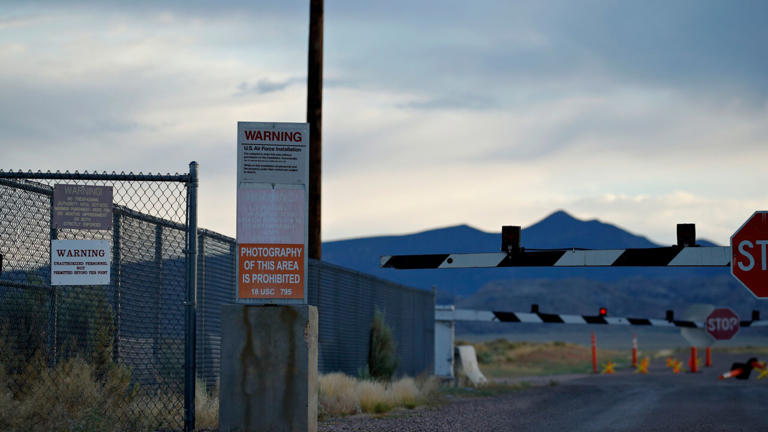
Up deze archieffoto van 22 juli 2019 waarschuwen borden voor verboden toegang bij een ingang van het Nevada Test and Training Range van het Amerikaanse leger, in de buurt van Area 51.
De publieke belangstelling voor ongeïdentificeerde luchtverschijnselen (uap's) en ongeïdentificeerde vliegende objecten (ufo's) is altijd al groot geweest. Net als verhalen dat de Amerikaanse regering geheimen over buitenaards leven zou verbergen. Area 51, een zwaar beveiligde militaire basis in de woestijn in Nevada, is een vaste waarde in die complottheorieën.
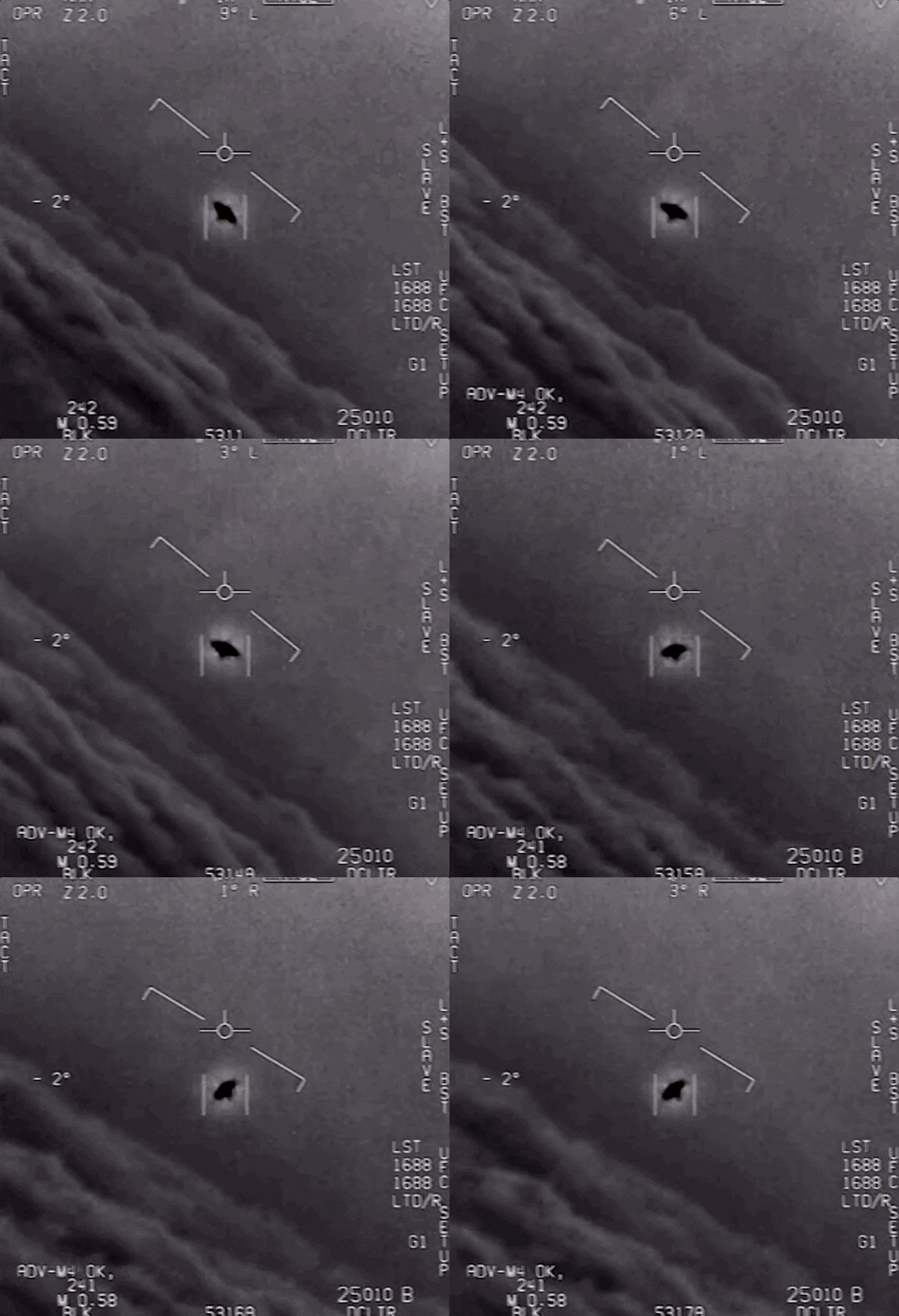
De belangstelling én de complotverhalen laaiden opnieuw op toen ex-medewerkers van het Pentagon en de regering in 2017 video's van onbekende objecten van de marine naar Amerikaanse media lekten. Dat leidde ertoe dat het Congres in mei 2022 voor het eerst in 50 jaar hoorzittingen over ufo's hield.
Ook het Pentagon beloofde toen meer transparantie over het onderwerp. In 2022 werd het het All-Domain Anomaly Resolution Office (AARO) opgericht, bedoeld als centraal meldpunt voor alle militaire ufo-waarnemingen. De informatie die openbaar is gemaakt, toont dat de overgrote meerderheid van de meldingen van het leger onopgelost blijft, maar dat de geïdentificeerde objecten grotendeels goedaardig van aard zijn.
In 2024 werd een 18 pagina's tellend, openbaar rapport voorgelegd aan het Congres. Dat stelde dat militairen in het afgelopen jaar 485 meldingen van uap's hadden gedaan, maar dat 118 gevallen "alledaagse objecten" betroffen, zoals verschillende soorten ballonnen, vogels en onbemande luchtvaartuigen.
"Het is belangrijk te benadrukken dat AARO tot op heden geen bewijs heeft gevonden van buitenaardse wezens, activiteiten of technologie," benadrukte het rappor
UFO Disk Over Saint Ives, England, United Kingdom Nov 16, 2025, UAP sighting news.
UFO Disk Over Saint Ives, England, United Kingdom Nov 16, 2025, UAP sighting news.
Date of sighting: Nov 16, 2025
Location of sighting: Saint Ives, England (near ocean)
Source: NUFORC
The screenshots don't do this justice, you have to see the video below to see the detail of the giant disk UFO passing over the hills at Saint Ives near the ocean. This UFO came from an underwater base off Saint Ives and it was trying to hover a bit to dry off before shooting out of the atmosphere to keep the water from freezing on its outer hull in space, potentially causing damage to the outer hull of the ship.
This is 100% proof aliens exist.
Scott C. Waring - Taiwan
Eyewitness states:
Lights on object, Aura or haze around object Light dots following circular trajectory bright light in middle Huge Luminous disc adorned with bright flashing lights spinning quickly appearing and disappearing moving in different directions.
De "Bermudadriehoek" heeft decennialang zowel dromen als angsten opgeroepen, gevoed door verhalen over onverklaarbare verdwijningen en spectaculaire theorieën. Nu beweert een Australische wetenschapper dat dit raadsel wellicht veel minder mysterieus is dan eerder werd gedacht.
Een gebied dat legendarisch is geworden.
De Bermuda-driehoek ligt in de Atlantische Oceaan, tussen Florida, Puerto Rico en de Bermuda-archipel, en beslaat een gebied van ongeveer 500.000 vierkante kilometer. De term werd in 1964 populair gemaakt door journalist Vincent Gaddis, voordat schrijver Charles Berlitz het gebied tien jaar later tot een object van wereldwijde fascinatie maakte.
Door de jaren heen hebben verhalen over verdwenen schepen, vliegtuigen en verdwijningen van bemanningen talloze hypotheses aangewakkerd: paranormale verschijnselen, verzonken beschavingen, magnetische anomalieën, zeedieren of tijdsverstoringen. De collectieve verbeelding is op hol geslagen en heeft dit stuk oceaan omgetoverd tot een symbool van absoluut mysterie.
Een veel rationelere verklaring
Karl Kruszelnicki, een gerenommeerd Australisch wetenschapper, biedt een pragmatischer perspectief. Volgens hem is er niets echt uitzonderlijks aan dit gebied. De reden is simpel: de Bermudadriehoek is extreem druk, met zowel commerciële schepen als vliegtuigen. Hoe dichter het verkeer, hoe meer incidenten er kunnen plaatsvinden. Relatief gezien, ten opzichte van het verkeersvolume, is het aantal verdwijningen niet hoger dan in andere maritieme gebieden.
Met andere woorden, het mysterie komt minder voort uit de geografie zelf dan uit de berichtgeving in de media eromheen. De legende is gegroeid door sensationele verhalen, terwijl de wetenschappelijke feiten vrij gewoon blijven.
Officiële instellingen en gegevens: niets abnormaals
Officiële analyses bevestigen deze rationele aanpak. De National Oceanic and Atmospheric Administration (NOAA) heeft inderdaad geen abnormale frequentie van ongevallen in de regio geregistreerd. De weersomstandigheden kunnen echter complex zijn: de Golfstroom veroorzaakt snelle veranderingen en onvoorspelbare stromingen, terwijl de geografische configuratie – met zijn talrijke eilanden en smalle doorgangen – de navigatie lastiger maakt. Zelfs de maritieme verzekeraar Lloyd's of London is van mening dat het gebied statistisch gezien geen groter gevaar oplevert dan andere veelgebruikte scheepvaartroutes.
Magnetisme, weer en menselijke fouten
Sommige verschijnselen zijn zeer reëel, maar perfect gedocumenteerd. Kleine variaties in het aardmagnetisch veld kunnen navigatie-instrumenten tijdelijk ontregelen. Daarbij komen nog bekende factoren: menselijke fouten, technische problemen en extreme weersomstandigheden. Samen verklaren deze de meeste ongelukken. Er zijn dus geen verborgen geheimen, geen mysterieuze wervels en geen legendarische zeedieren. De wetenschap toont aan dat de oorzaken klassiek, rationeel en begrijpelijk zijn.
Wanneer de mythe de cijfers overstijgt
Ondanks deze duidelijke verklaringen blijft de Bermudadriehoek fascineren. Het gebied bevindt zich op het kruispunt van wetenschap en verhalen, tussen tastbare cijfers en buitengewone vertellingen. Verdwijningen uit het verleden, of ze nu per ongeluk plaatsvonden of door legendes zijn versterkt, hebben een blijvende indruk achtergelaten op de collectieve verbeelding.
Voor Karl Kruszelnicki is de boodschap duidelijk: er zijn geen bovennatuurlijke verschijnselen geverifieerd. Wat wij als een mysterie ervaren, is in de eerste plaats een verhaal, maar paradoxaal genoeg is juist dit legendarische element wat de Bermudadriehoek zo fascinerend maakt.
Uiteindelijk bewijst de Bermudadriehoek dat wetenschap en verbeelding hand in hand kunnen gaan. Wetenschappelijke gegevens ontrafelen de mysteries van het gebied, maar de fascinatie blijft. Er is niets onverklaarbaars, niets magisch... gewoon een veelbezochte plek, onderworpen aan dezelfde natuurwetten als de rest van de oceaan. En misschien is het juist deze subtiele mix van feit en fictie die de verhalen, films en gepassioneerde discussies rondom deze uithoek van de Atlantische Oceaan blijft voeden.
I just wanted to share this unique find I made back in 2020 so that my newer followers could see it too. It's something that should be impossible for nature to create, and yet it's there on the side of a crater on planet Mercury. The reason it was created by aliens could be that they use it as a wormhole manipulator, a method of harnessing wormholes to travel across the universe in a blink of an eye. Any technology that controls it, will be within its walls. All an alien needs to do is pass though it slowly with any ship. I'm confident there are many other portals too. I just wonder, can the end destination of the portal be adjusted to anywhere or is it limited to only other portal locations?
Now this one is strange. I was searching for UFOs and came across this listing that was selling a house and farm land. In one of the photos a disk is seen cloaked as a cloud and behind it, it's creating a cloud tunnel so that other smaller UFOs can follow its direction. It's a well known fact among UFO researchers that UFOs can make clouds, often to distract onlookers attention away from the UFO itself. This photo is a fantastic catch, although it's by pure accident, never the less, it's 100% proof that UFOs make clouds.
Hey check this out. Not only did I find a doorway into a rock on Mars, but there are a dozen of them or more. The others are partly visible, but covered partly in sand. But the first one I show in the video really explains it all. It's a rectangle doorway entrance that is about 1 foot tall by 8 inches wide. It really fits with the dozens of human-like figures that me and others have discovered over the last ten years in Mars photos, most were under 1 foot tall, but highly detailed. I am 100% confident that these entrances are to primitive homes under the surface and that the face I found on the hilltop reveals to me the face of the species that lived here. A cat-like bipedal species. Bipedal because the door is tall, it's obvious they were standing up as they entered the structures. Also all the figures we have found in the past were two legged, similar to humans.
The world is teetering on the edge of an Artificial Intelligence (AI) disaster in which a tiny elite class live in luxury while the majority suffer.
That's according to Dex Hunter–Torricke, a former communications chief at Google's AI arm DeepMind, who has worked for Mark Zuckerberg and Elon Musk.
Mr Hunter–Torricke, who is a non–executive board member of HM Treasury, wrote in an essay that Big Tech's leaders are driving society towards a radical and disastrous transformation.
He writes: 'By mid–century, on this trajectory, we arrive at something that goes beyond inequality and begins to look like economic speciation.
'An elite class with AI–augmented capabilities enabling lives of luxury, equipped with medical breakthroughs that deliver longer lifespans, living in parallel with a global majority whose economic prospects, healthcare access, and political power have been permanently curtailed.
'This is not a prediction I make lightly. We can see the forces already clearly in motion.'
The main thrust of Mr Hunter–Torricke's dire prediction is the idea that rapid advances in AI will lead to the majority of jobs being displaced by automation,
Dramatically, he claims the International Monetary Fund's estimates that 60 per cent of jobs are vulnerable to replacement 'low–ball the true impacts'.
Dex Hunter–Torricke (pictured), former communications chief for Google DeepMind, says AI risks a crisis that would create a small wealthy elite who live in luxury while the rest of the world suffers
Mr Hunter–Torricke, who is a non–executive board member of HM Treasury, wrote in an essay that Big Tech's leaders are driving society towards a radical and disastrous transformation
Mr Hunter–Torricke's predictions come from having spent over 15 years working with Silicon Valley's leaders in the AI revolution.
The former PR boss has worked with Google's Eric Schmidt, Meta's Mark Zuckerberg, and SpaceX's Elon Musk.
He says that he has spent 'nearly two decades with people who are supposed to be making the plan for the future'.
However, after dramatically leaving his job with Google's AI arm, Mr Hunter–Torricke claims: 'It's crystal clear to me now: there is no plan.'
At the heart of this argument is the idea that AI is developing far faster than anyone is prepared for.
While critics have consistently argued that AI's capabilities are 'flattening', successive generations of new models appear to show rapid advances.
Critically, Mr Hunter–Torricke also claims that these developments are trending towards a more general form of intelligence, one that can be applied to almost any task or activity.
While the Industrial Revolution replaced manual labour with machines, it opened up new avenues for work in jobs that require thinking and decision–making.
Mr Hunter–Torricke previously worked for Elon Musk (pictured), and warns that tech bosses like Musk are 'profoundly incurious about the full consequences of what they are building'
However, since a more general form of AI can do anything, some experts warn that it won't leave any gaps in the job market at all.
While the economic benefits will likely be vast, Mr Hunter–Torricke is more concerned about how those gains will be distributed.
He writes: 'The productivity gains will be real – but there is no automatic mechanism that translates them into broadly shared prosperity.
'The most likely outcome is an economy in which corporate profits explode as labor costs fall, while workers' share of output shrinks. Wealth concentrates at an unprecedented rate at the top, while the vast middle loses ground.'
Based on the current fractured state of global and domestic politics, the former Google chief adds that these changes will likely lead to mass political upheaval.
'The demagogues of today will look restrained compared to what fills that space,' he ominously concludes.
Mr Hunter–Torricke is not alone in his scepticism over the societal benefits of AI.
This comes after Dario Amodei, founder of leading AI firm Anthropic, warned that humanity was not ready to handle the consequences of the AI his firm seeks to create
Mr Amodei wrote in an essay: 'Humanity is about to be handed almost unimaginable power, and it is deeply unclear whether our social, political, and technological systems possess the maturity to wield it.
Separately, leading AI researcher Professor Michael Wooldridge warned that the technology could face a 'Hindenburg moment'.
He told The Guardian: 'The Hindenburg disaster destroyed global interest in airships; it was a dead technology from that point on, and a similar moment is a real risk for AI.
'Because AI is embedded in so many systems, a major incident could strike almost any sector.'
Mr Hunter–Torricke now predicts that the world's governments and institutions have 'roughly ten years left to rethink many of the fundamental assumptions'.
He has founded a new London–based non–profit, the Center for Tomorrow, which will address the issue.
The firm has pledged not to accept any funding from Big Tech and instead has funding from the Scottish billionaire Sir Tom Hunter, who is the uncle of Mr–Torricke's wife.
The 44 professions at risk of being replaced by AI
AI win rate against human professionals:
Counter and rental clerks: 81%
Sales managers: 79%
Shipping, receiving, and inventory clerks: 76%
Editors: 75%
Software developers: 70%
Private detectives and investigators: 70%
Compliance officers: 69%
First–line supervisors of non–retail sales workers: 69%
Sales representatives, wholesale and manufacturing, except technical and scientific products: 68%
General operations managers: 67%
Medical and health services managers: 65%
Buyers and purchasing agents: 64%
Personal financial advisers: 64%
Administrative services managers: 62%
Customer service representatives: 59%
First–line supervisors of retail sales workers: 59%
First–line supervisors of production and operating workers: 58%
Nurse practitioners: 56%
Real estate brokers: 54%
News analysts, reporters, and journalists: 53%
Computer and information systems managers: 52%
First–line supervisors of police and detectives: 49%
Sales representatives, wholesale and manufacturing, technical and scientific products: 47%
Lawyers: 46%
Project management specialists: 42%
Child, family, and school social workers: 42%
Medical secretaries and administrative assistants: 42%
Securities, commodities, and financial services sales agents: 42%
First–line supervisors of office and administrative support workers: 41%
Financial investment analysts: 41%
Recreation workers: 37%
Registered nurses: 37%
Property, real estate, and community association managers: 34%
If you look up in the night sky and think the moon looks rather small, you're not wrong.
A new study has confirmed that the moon is shrinking.
Scientists from the National Air and Space Museum's Center for Earth and Planetary Studies have uncovered more than 1,000 previously unknown cracks on the lunar surface.
This shows the moon is contracting and reshaping itself, according to the experts.
Worryingly, the findings suggest that astronauts who may one day explore or live on the lunar surface may be at risk of devastating quakes.
'We are in a very exciting time for lunar science and exploration,' said Cole Nypaver, lead author of the study.
'Upcoming lunar exploration programs, such as Artemis, will provide a wealth of new information about our moon.
'A better understanding of lunar tectonics and seismic activity will directly benefit the safety and scientific success of those and future missions.'
Scientists from the National Air and Space Museum's Center for Earth and Planetary Studies have uncovered more than 1,000 previously unknown cracks on the lunar surface
Since 2010, scientists have known that the moon is gradually shrinking, as its interior cools and the surface contracts.
This shrinking has created distinctive landforms, known as 'lobate scarps', in the lunar highlands.
These structures form when the moon's crust compresses and the resulting forces push material up and over adjacent crust along a fault, creating a ridge.
However, in their new study, the researchers spotted strange cracks across a different area called the lunar maria – the vast, dark plains on the moon's surface.
They've named these cracks 'small mare ridges' (SMRs).
'Since the Apollo era, we've known about the prevalence of lobate scarps throughout the lunar highlands, but this is the first time scientists have documented the widespread prevalence of similar features throughout the lunar mare,' said Mr Nypaver.
'This work helps us gain a globally complete perspective on recent lunar tectonism on the moon, which will lead to a greater understanding of its interior and its thermal and seismic history, and the potential for future moonquakes.'
In the new study, the team discovered 1,114 SMRs, bringing the total found on the moon to 2,634.
Since 2010, scientists have known that the moon is gradually shrinking, as its interior cools and the surface contracts
On average, the SMRs date back around 124 million years, while the lobate scarps are around 105 million years old.
While this might sound old, it actually makes SMRs and lobate scarps some of the youngest geological features on the moon.
'Our detection of young, small ridges in the maria, and our discovery of their cause, completes a global picture of a dynamic, contracting moon,' said Tom Watters, who first discovered the cracks in 2010.
While the discovery of cracks helps to aid our understand of the moon's geological features, it could prove disastrous for space agencies who have probes on the moon – as well as those planning to send humans there.
Most notably, this includes NASA, which aims to land people on the lunar surface by 2028 as part of its Artemis III mission.
'The distribution of SMRs may also be of relevance to any long–term lunar habitation due to the hazards that shallow moonquakes pose to human–made lunar infrastructure,' the researchers cautioned in their study, published in The Planetary Science Journal.
Archaeologists found an architectural marvel in one of the ancient world’s driest cities
Archaeologists found an architectural marvel in one of the ancient world’s driest cities
Story by Elizabeth Rayne
Here’s what you’ll learn when you read this story:
The ‘Ain Braq aqueduct, which supplied water to ancient Petra, was thought to have only one conduit, or channel, until the recent discovery of a second one.
Although most of the lead pipe is no longer present in the conduit, its former extent can be inferred by matching its imprint to still-extant lead pipe fragments in the area.
Long and narrow, this pipe was most likely used as an inverted siphon, with water passing through a header tank before it flowed through to a series of reservoirs.
The importance of finding water supplies in a harsh desert climate is a central theme in Frank Herbert's classic science-fiction novel Dune(and in its latest film adaptation by Denis Villeneuve). Rising from dusty sands and carved out of red sandstone, Jordan’s ancient city of Petra is reminiscent of the desert landscapes and stone edifices of Herbert's faraway science-fiction desert planet. But Petra already had aqueducts and water systems thousands of years ago that were far ahead of any on fictional Arrakis—so no one in Petra ever needed a stillsuit to survive.
Petra was an urban hub of the ancient world despite its location in a semiarid climate that brought hardly any rain. It stood as the capital of the Nabatean kingdom until it became part of the Roman province of Arabia in the early 2nd century C.E. As an important administrative and trading center, Petra needed water for purposes beyond keeping its people alive. Its hydraulic systems filled baths, kept gardens and agriculture thriving, gushed from a sacred fountain known as a nymphaeum, and filled up basins in temples, sanctuaries, and tombs. Now, on the abandoned city’s southeast edge, archaeologists have discovered that the ‘Ain Braq aqueduct running through the Jabal al-Madhbah massif into Petra was even more sophisticated than they previously believed.
As part of a 2023 excavation conducted as part of the Urban Development of Ancient Petra project, a research team led by Niklas Jungmann of the Humboldt-Universität zu Berlin studied the system that brought water into Petra. These included cisterns, basins, a reservoir with a dam, and the ‘Ain Braq aqueduct. In the course of their research, Jungmann and his team discovered something that the aqueduct had been hiding for millennia. It featured not just one, but two different main conduits that kept water flowing into Petra. Researchers had long known about the first channel lined with terracotta pipes to carry water into the city. What the researchers didn't expect was to unearth the imprint of a second conduit that once held a pressurized lead pipeline supplying water to basins and reservoirs on az-Zantur hill.
University of California Press Engineering in the Ancient World, Revised Edition
“The discovery of numerous water structures on the plateau directly above the rock slopes with the presumed aqueduct channel and the dam, raised broader questions about the engineering and chronology of this area,” Jungmann said in a study recently published in Levant. “As [the existence of a second conduit] was not mentioned in prior research, examining how the aqueduct entered the city became a primary research objective.”
Measuring roughly 380 feet (116 meters) in length, the newly-discovered pipeline used a welded metal pipe that was made of lead and encased in mortar. Further evidence that the Nabateans used a lead pipe in the second conduit includes its significantly larger diameter compared to the terracotta pipes found in the area, and the regular surface of the imprint it left behind in the underlying stone, as opposed to the irregular surface imprint typical of channels that held terracotta pipes. A later excavation backed this hypothesis when Nabatean conduit blocks were discovered during a survey of the city center. In the hardened mortar was section of lead pipe, whose imprint texture and dimensions matched those of the earlier find and left no more doubts about the overall composition of the aqueduct’s second main conduit.
Jungmann concluded that such a long and narrow lead pipe was probably used as an inverted siphon within the ‘Ain Braq aqueduct. It was buried in concrete to transport water beneath the city, bypassing obstacles on the surface. Water in the system would have flowed through a header tank before entering the aqueduct’s two conduits. Previously, one theory posited that the conduit could have taken a detour to supply water to another part of the city before arriving at its destination. However, the conduit was found to head west, probably to reach the reservoirs of az-Zantur hill. A detour would have not even been viable, since only an uninterrupted pipeline that generates enough internal pressure can allow water in a siphon to run from the header tank to the basin or reservoir it was meant to fill.
“Overall, this study underscores the potential for further research into Nabataean water management,” said Jungmann. “While some hypotheses about the aqueduct’s two branches into the city have been proposed above, more fieldwork is required in order to provide a fuller understanding of the distribution system and its evolution over time.”
Buitenaards uitziend wezen gevonden in de Antarctische Oceaan Een paar jaar geleden deed een groep mariene biologen aan boord van een onderzoeksschip in de ijskoude wateren van Antarctica een verbazingwekkende ontdekking: een buitenaards uitziend wezen met 20 armen.
Negen jaar durende expeditie De bevindingen werden in juli gepubliceerd in het 'Invertebrate Systematics Journal' en maakten deel uit van een negen jaar durende expeditie die duurde van 2008 tot 2017 .
Antarctische veersterren Het doel van deze expeditie was om ongrijpbare zeedieren te vinden die behoren tot de soort ' Promachocrinus fragarius ', beter bekend als Antarctische haarsterren, zoals het exemplaar dat ze vonden (zie foto).
“Buitenaards uiterlijk tijdens het zwemmen” "Hoewel ze lijken op andere ongewervelde zeedieren, zoals zeesterren en zeekomkommers, onderscheiden haarsterren zich door hun grote formaat en buitenaardse uiterlijk tijdens het zwemmen", schreven de onderzoekers in het artikel.
Diep in de oceaan Veersterren kunnen op diepten leven die variëren van 215 voet tot een verbazingwekkende 3.840 voet onder het oppervlak van de oceaan, schatten de auteurs.
Meer Antarctische veersterren Naast de 20-armige Antarctische veerster identificeerde het team er zeven andere soorten die behoren tot de 'Promachocrinus fragarius ' die nog nooit eerder door de wetenschappelijke gemeenschap zijn beschreven of benoemd , zo meldde de Miami Herald.
Voorheen onbekende soorten blijken veersterren te zijn Jarenlang werd gedacht, maar het is niet bevestigd, dat exemplaren die tijdens eerdere expedities waren gevonden, tot de groep 'Promachocrinus' (Antarctische haarsterren) behoorden, tot nu toe, zo vertelde een auteur van de studie aan Insider.
Foto: Antarctische haarster vastgelegd door EVNautilius (Ocean Exploration Trust).
DNA- en morfologisch onderzoek Volgens de wetenschappers was de classificatie mogelijk dankzij onderzoek naar zowel het DNA als de fysieke morfologie, oftewel de vorm, van de ontdekte organismen.
Potentieel onontdekte zeedieren Volgens de onderzoekers zijn de ontdekkingen een herinnering aan de vele potentieel onbekende zeedieren die in de uitgestrekte oceanen van onze planeet leven. Onderzoek is dan ook van cruciaal belang.
Overvloed aan leven in de Antarctische wateren "Een uitgebreide verkenning zal onmisbaar zijn om zelfs maar een basisbegrip te verkrijgen van de rijkdom aan leven in de Antarctische wateren", concludeerden ze in het wetenschappelijke artikel.
Laboratory tests of defrosted strains of 5,000-year-old ancient bacteria recovered from the Scarisoara Ice Cave in Romania revealed one strain resistant to several modern antibioticsused to treat a wide range of infections.
Although the ancient samples of the resistant strain, dubbed Psychrobacter SC65A.3, were retrieved from a frozen ice deposit deep in a Romanian cave, the research team behind the discovery said there is a real threat that melting ice could lead to these infectious organisms entering the modern environment, where they could pass along some of their antibiotic resistance genes to modern-day bacteria.
The 5,000-year-old strains also showed the ability to inhibit the growth of other antibiotic-resistant bacteria, suggesting their genetic profiles could be used to develop therapies to combat modern, drug-resistant strains and offer new insights into how antibiotic resistance spreads.
“Studying microbes such as Psychrobacter SC65A.3 retrieved from millennia-old cave ice deposits reveals how antibiotic resistance evolved naturally in the environment, long before modern antibiotics were ever used,” explained Dr. Cristina Purcarea, a senior scientist at the Institute of Biology Bucharest of the Romanian Academy and a senior author of the study detailing the discovery.
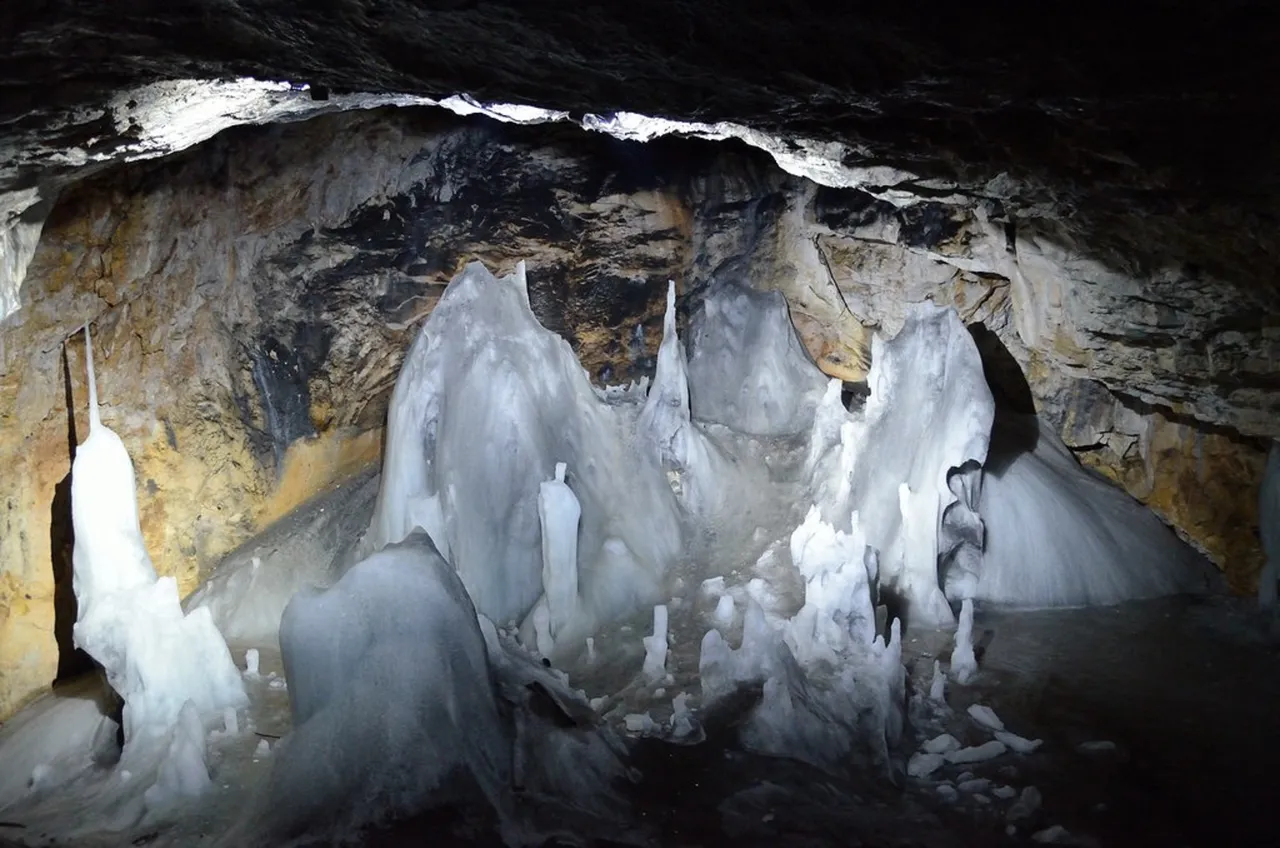
Scarisoara Ice Cave in Romania. Image Credit: Paun V.I.
Scarisoara Ice Cave holds one of the world’s largest underground glaciers, with ice estimated to be more than 10,000 years old.
(flickr/Florina) / Others
5,000-Year-Old Ancient Bacteria Retrieved from Deep Inside an Ice Cave
According to a statement, Dr. Purcarea and colleagues drilled a 25-meter ice core into the frozen floor of a section of the ice cave known as the Great Hall. Collecting samples from this depth enabled the team to study ice deposited over the past 13,000 years.
The team drilled a 25-meter ice core from the area of the cave known as the Great Hall.
Credit: Itcus C.
Next, the team placed the ice core samples in labeled, sterile bags to avoid contamination. While remaining frozen, the ice core samples were transported back to the lab for examination.
During their initial analysis, the researchers isolated various bacterial strains and sequenced their individual genomes. Along with revealing the genetic identity of each strain, the research team said sequencing the genomes of bacteria that survive in these extreme climates also helped identify which genes confer low-temperature survivability.
During this process, the team identified the presence of Psychrobacter SC65A.3, a bacterial genus known for its adaptation to cold environments. Notably, some Psychrobacter strains cause infections in animals and humans.
Ancient Psychrobacter Strain Demonstrates Resistance to 10 Modern Antibiotics
In a series of tests designed to measure the resistance of the SC65A strain to commonly used modern-day antibiotics, the team selected 28 antibiotics from 10 classes used to treat bacterial infections. According to the team, several of those antibiotics “have previously been identified to possess resistance genes or mutations that give them the ability to resist drug effects.”
After running a series of tests using the Psychrobacter strains collected from the Romanian Ice cave, the team found that the ancient bacteria appeared to successfully resist 10 of the 28 tested modern-day antibiotics. This data was consistent with the genetic analysis, which identified several genes associated with antibiotic resistance.
“The Psychrobacter SC65A.3 bacterial strain isolated from Scarisoara Ice Cave, despite its ancient origin, shows resistance to multiple modern antibiotics and carries over 100 resistance-related genes,” Purcarea explained.
The researcher also noted that the 10 antibiotics are widely used “to treat a range of serious bacterial infections in clinical practice.” For example, the tests revealed resistance to rifampicin, vancomycin, and ciprofloxacin, which are used to treat diseases such as tuberculosis, colitis, and UTIs.
The ancient, 5,000-year-old bacteria also showed resistance to trimethoprim, clindamycin, and metronidazole, which are used to treat infections of the lungs, skin, or blood, and the reproductive system. The researchers note that SC65A.3 is the first Psychrobacter strain to show resistance to these three antibiotics.
If Melting Ice Releases These Microbes, These Genes Could Spread
When discussing the significance of the team’s findings, Dr. Purcarea said their ability to resist modern antibiotics could represent a potential health risk, especially if they were allowed to share genetic material with modern bacteria.
“If melting ice releases these microbes, these genes could spread to modern bacteria, adding to the global challenge of antibiotic resistance,” the researcher explained.
Conversely, the researchers found several potential benefits in the ancient Psychrobacter strain. For example, they found 11 specific genes that may stop or even kill the growth of other bacteria, viruses, or fungi. Purcarea said this strain produces “unique enzymes and antimicrobial compounds” that could lead to the development of new antibiotics, industrial enzymes, and other biotechnological innovations.
“It can also inhibit the growth of several major antibiotic-resistant ‘superbugs’ and showed important enzymatic activities with important biotechnological potential,” Purcarea explained.
During the genetic analysis, the team found nearly 600 genes they described as having “unknown functions.” Given the organisms stron resistance profile, they said these uncharacterized genes could represent an “untapped source” for discovering novel biological mechanisms that could be exploited.
“These ancient bacteria are essential for science and medicine,” Purcarea concluded, “but careful handling and safety measures in the lab are essential to mitigate the risk of uncontrolled spread.”
Christopher Plain is a Science Fiction and Fantasy novelist and Head Science Writer at The Debrief. Follow and connect with him onX,learn about his books atplainfiction.com, or email him directly atchristopher@thedebrief.org.
Rapa Nui, more commonly known as Easter Island, is often cited as one of history and archaeology’s best examples of environmental mismanagement: the widely known ecocidehypothesis for its downfall suggests that deforestation led to social collapse on the island long before Europeans arrived.
Recent research, however, now suggests a different turning point in the island’s history. Researchers report the discovery of evidence that asevere drought began around 1550, leading to a significant drop in rainfall on the island. This prolonged dry period, the researchers say, coincided with changes in ritual practices, political structures, and settlement patterns, although there is still little evidence of a sudden societal collapse before European contact.
Scientists from the Lamont-Doherty Earth Observatory studied past rainfall by collecting sediment cores from two of the island’s few freshwater sites: Rano Aroi, a wetland at a higher elevation, and Rano Kao, a crater lake.
Lake and wetland sediments accumulate in layers, preserving chemical signatures of past environmental conditions. Previous studies on Rapa Nui used pollen, plant fragments, elemental analysis, and sediment accumulation rates to reconstruct the island’s history. While these approaches provide important information, changes in temperature and human activity can influence their results. In this study, the research team focused on plant leaf waxes as a more direct indicator of past rainfall.
“We think leaf waxes on Rapa Nui are only recording information about local rainfall and aridity,” lead author Redmond Stein explained. By measuring the ratio of “heavy” to “light” hydrogen preserved in those waxes, the researchers reconstructed 800 years of rainfall history. The data shows that rainfall declined sharply in the mid-1500s and remained low for more than a hundred years.
A Significant Rainfall Drop on Easter Island
Isotope measurements show that rainfall decreased by about 600 to 800 millimeters, or 24 to 31 inches, each year compared to the previous three centuries. This drop in rainfall would have been especially significant for an island that already had few freshwater resources.
Notable cultural shifts also took place during this time. Fewer ceremonial ‘ahu’ platforms were built, and Rano Kao became an important ritual site. A new social system called Tangata Manu emerged, in which leaders were chosen through athletic contests rather than through family ties to the moai statues.
Archaeologists continue to debate exactly when and why these changes took place. The researchers note that climate was not the only cause, yet their results show that the island’s society underwent significant change after the drought began.
Rethinking the Ecocide Theory
According to the popular ecocide theory, the people on Rapa Nui overused the forests, which led to conflict and a population collapse before Europeans arrived on the island in the 1700s. Many have told this story as a warning about the dangers of environmental destruction. However, there is little proof that the population dropped sharply before Europeans arrived.
“Our research is not intended to produce a new parable for the modern times but rather push against the old one,” Stein said.
While the researchers agree that deforestation occurred and likely affected the environment, the new evidence shows that people on the island were also dealing with other climate-related problems. A decrease in rainfall may have led to more soil erosion, less drinking water, changes in vegetation, or forced communities to reorganize around scarce freshwater resources. The findings suggest that Rapa Nui’s history is more complex than a simple story of self-inflicted collapse.
A 50,000-Year Climate Archive
Rapa Nui is located more than 3,000 kilometers from the coast of Chile and over 1,500 kilometers from the nearest inhabited island. This isolation makes it one of the few land-based sediment records in the Southeast Pacific. As a result, it is especially valuable for studying long-term atmospheric circulation patterns, which are still difficult for climate models to simulate accurately.
The research team is now studying a much longer leaf-wax isotope record from Rano Aroi that covers about 50,000 years. If future studies confirm and extend these findings, the record could provide important insights into how Pacific climate systems have changed over tens of thousands of years.
Austin Burgess is a writer and researcher with a background in sales, marketing, and data analytics. He holds a Master of Business Administration, a Bachelor of Science in Business Administration, and a Data Analytics certification. His work combines analytical training with a focus on emerging science, aerospace, and astronomical research.
Congressman Eric Burlison Questions Alleged Large Abroad UAP Construction • Newest UFO Sightings
Congressman Eric Burlison Questions Alleged Large Abroad UAP Construction • Newest UFO Sightings
Missouri Congressman Eric Burlison has drawn renewed consideration to unidentified aerial phenomena (UAP) following a current tv interview during which he mentioned reviews of an unusually massive object allegedly situated exterior the US. Talking publicly concerning the matter, Burlison emphasised that he has not personally verified the claims however is actively searching for entry by congressional oversight channels.
Allegations of a Construction Constructed Round an Object
Through the interview, Burlison defined that he has obtained data from sources each inside and outdoors the federal authorities suggesting the existence of a large unidentified object in a foreign country. In line with the accounts relayed to him, the item is reportedly so massive that it couldn’t be transported. As a substitute, a construction was allegedly constructed round it.
The congressman clarified that he can’t reveal the nation concerned, stating that a few of the data was obtained in labeled settings. He additionally famous that extensively circulated reviews figuring out a selected constructing in media protection don’t match what he has been advised.
Importantly, Burlison harassed that he doesn’t but possess “laborious proof” confirming the item’s existence. His feedback mirror ongoing efforts to find out whether or not the claims have benefit and whether or not extra transparency is warranted.
Growing Congressional Attention on UAPs
Burlison, a member of the House Oversight Committee, has increasingly pushed for greater transparency on UAP matters. In August 2025 he introduced the Unidentified Anomalous Phenomena (UAP) Disclosure Act of 2025 as an amendment to the National Defence Authorisation Act, which would require the preservation and public release of government records on UAPs and provide oversight mechanisms.
The proposal aims to ensure federal agencies cannot destroy or hide records, a move supporters argue would bring clarity to what authorities know about unexplained aerial phenomena. Critics say such measures risk leaking sensitive defence information. Burlison's interest in UAP disclosure aligns with broader congressional concern about how governments classify sensitive sightings. Lawmakers have criticised the Pentagon and Department of Defence offices for withholding information on apparent encounters reported by military personnel.
Oversight Challenges and Bureaucratic Resistance
Burlison, who serves on committees engaged in UAP-related inquiries, acknowledged that getting access to delicate services—whether or not in the US or overseas—isn’t easy. He described important institutional resistance rooted in jurisdictional disputes, interagency secrecy, and committee turf safety inside Congress.
In line with him, even makes an attempt to go to home websites reportedly related to UAP analysis or reverse-engineering applications have confirmed troublesome. Entry to an alleged abroad location would require cooperation at a number of ranges, together with coordination with international governments and labeled authorization channels.
Regardless of these obstacles, Burlison indicated that he intends to proceed pursuing oversight alternatives.
What Did Burlison Actually Say?
The Reddit thread suggests Burlison may have referenced the UFO site in connection with Dr Stephen Greer's claims, a controversial figure in the UFO disclosure world, though the congressman himself has not publicly confirmed this. One Reddit commenter noted that if such an object were truly 'too big to move', it would be difficult to keep secret, particularly in a highly developed region like South Korea. Another added scepticism about the idea of such an installation near major population centres.
Dr. Steven Greer’s Further Claims
Additionally showing within the interview was Steven Greer, founding father of the Disclosure Mission. Greer claimed that one such object is situated within the mountains exterior Seoul, South Korea. He asserted that the item is extraordinarily massive—doubtlessly a whole bunch and even hundreds of ft throughout—and that its materials composition makes it resistant to traditional reducing instruments.
Greer additional acknowledged that his data comes from whistleblowers who allegedly had entry to extremely labeled applications. Nevertheless, these claims stay unverified by impartial proof.
When requested whether or not the item in query was a spacecraft, Greer answered affirmatively. He advised that comparable objects might exist in different places, together with inside the US.
Transparency Versus Nationwide Safety
Burlison emphasised that if he have been to acquire definitive proof—whether or not bodily, photographic, or documented—he believes the American public would should know. On the similar time, he acknowledged the necessity to stability transparency with nationwide safety issues.
The dialogue additionally referenced previous public feedback from former President Barack Obama, who has beforehand addressed extraterrestrial questions in interviews. Obama has acknowledged that he has seen no proof of alien craft being hidden in services like Space 51, although he has additionally famous that sure labeled applications might not all the time be totally accessible even to presidents.
Greer countered by suggesting that some data might not have been totally shared with senior officers. These assertions, like others within the dialog, stay a part of an ongoing debate fairly than confirmed truth.
Evidence That Raised Eyebrows
Rep Burlison has repeatedly brought attention to UAP issues during congressional hearings. In September 2025 he played a previously unseen video, reportedly taken by a US military drone, showing what he described as a Hellfire missile striking an unidentified object off the coast of Yemen, 'and it kept going'. The Pentagon's All-domain Anomaly Resolution Office (AARO) said it had no comment on the video's authenticity and noted that many unexplained UAP reports remain under investigation without confirmation of extraterrestrial origin.
Broader Oversight Efforts
Burlison's remarks are part of a broader congressional push to scrutinise how federal agencies handle UAP reports. In late 2024, he questioned a former Pentagon employee on alleged secret UFO programmes and non-human 'biologics', claims that government critics often cite as evidence of cover-ups. However, mainstream experts and Defence officials continue to stress the distinction between unexplained aerial phenomena and extraterrestrial visitation, pointing out that many sightings are eventually attributed to misidentified aircraft, drones, atmospheric phenomena, or data errors.
Public Reaction and Scientific Scepticism
Views on Burlison's implied South Korea UFO claim range widely. UFO enthusiasts online argue that such hints deserve serious investigation. Sceptics counter that Reddit-based interpretation of Burlison's comments cannot be treated as verification of classified knowledge. Scientific communities emphasise that open inquiry must be grounded in verified data rather than speculation about hidden sites or unverified testimonies.
Unanswered Questions
A number of important questions stay unresolved:
What precisely is the alleged object?
When did it first come to gentle?
Which companies or governments can be accountable for overseeing it?
Why has no verifiable proof surfaced publicly?
At current, there aren’t any authenticated paperwork, satellite tv for pc imagery, or bodily supplies confirming the existence of the item described.
A Persevering with Investigation
The interview displays the broader nationwide dialog surrounding UAP investigations. In recent times, Congress has held hearings and requested briefings aimed toward clarifying unexplained aerial sightings and potential superior applied sciences.
Whereas Burlison’s remarks don’t present proof of extraterrestrial craft, they underscore ongoing tensions between public curiosity, congressional oversight, and labeled nationwide safety applications. Whether or not additional inquiry will result in concrete findings stays to be seen.
For now, the claims stay allegations—severe sufficient to immediate oversight efforts, however unverified within the public area.
0
1
2
3
4
5
- Gemiddelde waardering: 0/5 - (0 Stemmen) Categorie:ALIEN LIFE, UFO- CRASHES, ABDUCTIONS, MEN IN BLACK, ed ( FR. , NL; E )
Congressman Eric Burlison Questions Alleged Massive Overseas UAP Structure
Congressman Eric Burlison Questions Alleged Massive Overseas UAP Structure
Missouri Congressman Eric Burlison has drawn renewed attention to unidentified aerial phenomena (UAP) following a recent television interview in which he discussed reports of an unusually large object allegedly located outside the United States. Speaking publicly about the matter, Burlison emphasized that he has not personally verified the claims but is actively seeking access through congressional oversight channels.
Allegations of a Structure Built Around an Object
During the interview, Burlison explained that he has received information from sources both inside and outside the federal government suggesting the existence of a massive unidentified object in another country. According to the accounts relayed to him, the object is reportedly so large that it could not be transported. Instead, a structure was allegedly constructed around it.
The congressman clarified that he cannot reveal the country involved, stating that some of the information was obtained in classified settings. He also noted that widely circulated reports identifying a specific building in media coverage do not match what he has been told.
Importantly, Burlison stressed that he does not yet possess “hard evidence” confirming the object’s existence. His comments reflect ongoing efforts to determine whether the claims have merit and whether additional transparency is warranted.
Oversight Challenges and Bureaucratic Resistance
Burlison, who serves on committees engaged in UAP-related inquiries, acknowledged that gaining access to sensitive facilities—whether in the United States or abroad—is not straightforward. He described significant institutional resistance rooted in jurisdictional disputes, interagency secrecy, and committee turf protection within Congress.
According to him, even attempts to visit domestic sites reportedly connected to UAP research or reverse-engineering programs have proven difficult. Access to an alleged overseas location would require cooperation at multiple levels, including coordination with foreign governments and classified authorization channels.
Despite these obstacles, Burlison indicated that he intends to continue pursuing oversight opportunities.
Dr. Steven Greer’s Additional Claims
Also appearing in the interview was Steven Greer, founder of the Disclosure Project. Greer claimed that one such object is located in the mountains outside Seoul, South Korea. He asserted that the object is extremely large—potentially hundreds or even thousands of feet across—and that its material composition makes it resistant to conventional cutting tools.
Greer further stated that his information comes from whistleblowers who allegedly had access to highly classified programs. However, these claims remain unverified by independent evidence.
When asked whether the object in question was a spacecraft, Greer answered affirmatively. He suggested that similar objects may exist in other locations, including within the United States.
Transparency Versus National Security
Burlison emphasized that if he were to obtain definitive proof—whether physical, photographic, or documented—he believes the American public would deserve to know. At the same time, he acknowledged the need to balance transparency with national security concerns.
The discussion also referenced past public comments from former President Barack Obama, who has previously addressed extraterrestrial questions in interviews. Obama has stated that he has seen no evidence of alien craft being hidden in facilities like Area 51, though he has also noted that certain classified programs may not always be fully accessible even to presidents.
Greer countered by suggesting that some information may not have been fully shared with senior officials. These assertions, like others in the conversation, remain part of an ongoing debate rather than confirmed fact.
Unanswered Questions
Several critical questions remain unresolved:
What exactly is the alleged object?
When did it first come to light?
Which agencies or governments would be responsible for overseeing it?
Why has no verifiable evidence surfaced publicly?
At present, there are no authenticated documents, satellite imagery, or physical materials confirming the existence of the object described.
A Continuing Investigation
The interview reflects the broader national conversation surrounding UAP investigations. In recent years, Congress has held hearings and requested briefings aimed at clarifying unexplained aerial sightings and potential advanced technologies.
While Burlison’s remarks do not provide proof of extraterrestrial craft, they underscore ongoing tensions between public curiosity, congressional oversight, and classified national security programs. Whether further inquiry will lead to concrete findings remains to be seen.
For now, the claims remain allegations—serious enough to prompt oversight efforts, but unverified in the public domain.
Beste bezoeker, Heb je zelf al ooit een vreemde waarneming gedaan, laat dit dan even weten via email aan Frederick Delaere opwww.ufomeldpunt.be. Deze onderzoekers behandelen jouw melding in volledige anonimiteit en met alle respect voor jouw privacy. Ze zijn kritisch, objectief maar open minded aangelegd en zullen jou steeds een verklaring geven voor jouw waarneming! DUS AARZEL NIET, ALS JE EEN ANTWOORD OP JOUW VRAGEN WENST, CONTACTEER FREDERICK. BIJ VOORBAAT DANK...
Druk op onderstaande knop om je bestand , jouw artikel naar mij te verzenden. INDIEN HET DE MOEITE WAARD IS, PLAATS IK HET OP DE BLOG ONDER DIVERSEN MET JOUW NAAM...
Druk op onderstaande knop om een berichtje achter te laten in mijn gastenboek
Alvast bedankt voor al jouw bezoekjes en jouw reacties. Nog een prettige dag verder!!!
Over mijzelf
Ik ben Pieter, en gebruik soms ook wel de schuilnaam Peter2011.
Ik ben een man en woon in Linter (België) en mijn beroep is Ik ben op rust..
Ik ben geboren op 18/10/1950 en ben nu dus 75 jaar jong.
Mijn hobby's zijn: Ufologie en andere esoterische onderwerpen.
Op deze blog vind je onder artikels, werk van mezelf. Mijn dank gaat ook naar André, Ingrid, Oliver, Paul, Vincent, Georges Filer en MUFON voor de bijdragen voor de verschillende categorieën...
Veel leesplezier en geef je mening over deze blog.