The purpose of this blog is the creation of an open, international, independent and free forum, where every UFO-researcher can publish the results of his/her research. The languagues, used for this blog, are Dutch, English and French.You can find the articles of a collegue by selecting his category. Each author stays resposable for the continue of his articles. As blogmaster I have the right to refuse an addition or an article, when it attacks other collegues or UFO-groupes.
Druk op onderstaande knop om te reageren in mijn forum
Zoeken in blog
Deze blog is opgedragen aan mijn overleden echtgenote Lucienne.
In 2012 verloor ze haar moedige strijd tegen kanker!
In 2011 startte ik deze blog, omdat ik niet mocht stoppen met mijn UFO-onderzoek.
BEDANKT!!!
Een interessant adres?
UFO'S of UAP'S, ASTRONOMIE, RUIMTEVAART, ARCHEOLOGIE, OUDHEIDKUNDE, SF-SNUFJES EN ANDERE ESOTERISCHE WETENSCHAPPEN - DE ALLERLAATSTE NIEUWTJES
UFO's of UAP'S in België en de rest van de wereld Ontdek de Fascinerende Wereld van UFO's en UAP's: Jouw Bron voor Onthullende Informatie!
Ben jij ook gefascineerd door het onbekende? Wil je meer weten over UFO's en UAP's, niet alleen in België, maar over de hele wereld? Dan ben je op de juiste plek!
België: Het Kloppend Hart van UFO-onderzoek
In België is BUFON (Belgisch UFO-Netwerk) dé autoriteit op het gebied van UFO-onderzoek. Voor betrouwbare en objectieve informatie over deze intrigerende fenomenen, bezoek je zeker onze Facebook-pagina en deze blog. Maar dat is nog niet alles! Ontdek ook het Belgisch UFO-meldpunt en Caelestia, twee organisaties die diepgaand onderzoek verrichten, al zijn ze soms kritisch of sceptisch.
Nederland: Een Schat aan Informatie
Voor onze Nederlandse buren is er de schitterende website www.ufowijzer.nl, beheerd door Paul Harmans. Deze site biedt een schat aan informatie en artikelen die je niet wilt missen!
Internationaal: MUFON - De Wereldwijde Autoriteit
Neem ook een kijkje bij MUFON (Mutual UFO Network Inc.), een gerenommeerde Amerikaanse UFO-vereniging met afdelingen in de VS en wereldwijd. MUFON is toegewijd aan de wetenschappelijke en analytische studie van het UFO-fenomeen, en hun maandelijkse tijdschrift, The MUFON UFO-Journal, is een must-read voor elke UFO-enthousiasteling. Bezoek hun website op www.mufon.com voor meer informatie.
Samenwerking en Toekomstvisie
Sinds 1 februari 2020 is Pieter niet alleen ex-president van BUFON, maar ook de voormalige nationale directeur van MUFON in Vlaanderen en Nederland. Dit creëert een sterke samenwerking met de Franse MUFON Reseau MUFON/EUROP, wat ons in staat stelt om nog meer waardevolle inzichten te delen.
Let op: Nepprofielen en Nieuwe Groeperingen
Pas op voor een nieuwe groepering die zich ook BUFON noemt, maar geen enkele connectie heeft met onze gevestigde organisatie. Hoewel zij de naam geregistreerd hebben, kunnen ze het rijke verleden en de expertise van onze groep niet evenaren. We wensen hen veel succes, maar we blijven de autoriteit in UFO-onderzoek!
Blijf Op De Hoogte!
Wil jij de laatste nieuwtjes over UFO's, ruimtevaart, archeologie, en meer? Volg ons dan en duik samen met ons in de fascinerende wereld van het onbekende! Sluit je aan bij de gemeenschap van nieuwsgierige geesten die net als jij verlangen naar antwoorden en avonturen in de sterren!
Heb je vragen of wil je meer weten? Aarzel dan niet om contact met ons op te nemen! Samen ontrafelen we het mysterie van de lucht en daarbuiten.
02-04-2026
Former US Congressman Claims Man in Uniform Revealed Secret Alien-Human Hybrid Program to Create Galaxy-Communicating Race
Former US Congressman Claims Man in Uniform Revealed Secret Alien-Human Hybrid Program to Create Galaxy-Communicating Race
Former U.S. Congressman Matt Gaetz claims a man in a U.S. Army uniformonce visited his office and described a secret program in which aliens were bred with kidnapped humans to create a galaxy-communicating hybrid race.
in an interview with Benny Johnson, Matt Gaetz said that a man in a U.S. Army uniform once came to his office in Crestview, Florida, and gave a strange briefing in a non-classified setting with his staff present. This man claimed there was a very secret military program where living aliens were forced to breed with kidnapped humans from war zones and migrant caravans to create a hybrid race that could communicate across galaxies.
The whistleblower said there were about six to twelve locations in the United States where this was happening and asked for multiple members of Congress to visit all sites at the same time so the evidence could not be moved, which Gaetz says was physically impossible, so it never happened. Gaetz clearly says he never checked or verified any of this and that there were questions about whether the whistleblower was mentally stable; his own lawyer suggested it might just be a military person who “lost his mind” and made a PowerPoint.
Former U.S. Congressman Matt Gaetz with Benny Johnson
He then connects this to David Grusch’s testimony in Congress about “non-human biologics,” saying Grusch told the House Oversight Committee that in some recovered crashed craft, the CIA and a special crash-recovery program found not only materials but also biological matter that could not be linked to humans.
David Grusch said that when he worked in U.S. intelligence, he was told about a long-running secret program that recovered crashed UFOs and tried to reverse engineer their technology. He explained that this program went on for many decades and that he learned about it in his official duties, even though he was personally blocked from full access to it. He said he and trusted colleagues with special clearances interviewed around 40 people, including senior officials, and checked their claims using documents, reports, and cross-checking with other sources. After this, he became convinced that the program was real and that the U.S. government had multiple craft of non-human origin.
When he spoke about “non-human biologics,” he said that with some of these crash recoveries, there were biological remains connected to the craft. In his congressional testimony, he stated that “biologics came with some of these recoveries,” and when a member of Congress asked him if these were human or non-human, he answered that they were non-human. He said this was not just his guess, but the assessment of people who had direct knowledge of the secret program and were still working inside it. At the same time, he admitted he had not personally seen alien bodies himself, and that his statements were based on what these insiders told him.
Grusch also said there had been “various retrievals” and suggested there were different kinds of biological remains, which hinted at more than one type of entity. He said there seemed to be a variety of beings, but no one fully understood their biology, and he described this as a major challenge for scientists who studied the material. He mentioned that some people used the word “extraterrestrial,” but he preferred broader terms like “non-human intelligence” because the origin might be more complex, possibly involving other dimensions or realities.
Gaetz said he had personally not visited any secret bases or UFO crash sites, and that the hybrid-breeding story had been one of the strangest briefings he had ever received.
Gaetz explained that in classified briefings, he had seen radar sequences showing several craft moving in formation, merging into a single object, then splitting back into many craft again, repeatedly. He said this kind of behavior had not been possible with any technology the United States or its adversaries then had. When he later watched a public video of a drone strike where an object broke into pieces and then reformed, he was not surprised because it looked similar to what he had seen on classified radar, except that what he had seen involved multiple objects flying in a clear, controlled formation before merging and separating again.
He said that if the classified footage he had seen had been declassified, the main public question would have been how such technology existed, and if the U.S. had not had it and had not thought any other country had it, then where it came from. He described it as “space age” technology that had not looked like anything on Earth. Gaetz said he had had higher-than-normal access as a member of the Armed Services Committee for eight years, on the emerging threats subcommittee, with special clearances above a standard congressional briefing, including visibility into DARPA and advanced military projects.
He said he had seen things in classified settings that had not been explained by the technology the U.S. had then known it possessed, and he had felt well informed about existing weapons and systems, so these anomalies had stood out. He mentioned that scientists connected to UFO work had kept “disappearing” and joked that on LinkedIn, it might have been more dangerous to be known as a UFO scientist than even as a general in the Iranian Revolutionary Guard.
On whether the U.S. had been using alien technology, Gaetz said he had believed the American military had benefited from acquiring unknown technology and reverse engineering it, but he had not claimed to know for sure that it had been alien or from outer space. He talked about reports that the U.S. had handed unusual technology to defense contractor Lockheed Martin to try to copy things like plasma propulsion and stealth capabilities.
For him, this had fit with how deeply defense contractors and the military had been connected, and he had thought such advanced projects might have existed as much in the contractor world as inside the official military. He ended by saying he had only known that this technology had not seemed to come from within the normal U.S. defense system, even if he had not been able to prove it had been from aliens.
There is a bizarre story of a Florida man named Eddie Page, born Tommy Coleman Jr., who claimed he was a human–alien hybrid whose father was from the Pleiadian star system. He grew up with strange experiences and, after joining the US Marines in 1972, was sent on a secret mission to Vietnam, where an attack happened, he blacked out, and later woke up in a rice field more than 500 miles away, with 11 days missing from his memory. He was detained and examined for months by doctors, and he said his military medical file showed abnormal organs, unusual blood, and a note saying “Not of Human Origin.” (Click here to read the full story)
Years later, after his first wife and newborn child mysteriously disappeared from the hospital, he used regressive hypnosis and “remembered” that he had been killed in the ambush but rescued by Pleiadian aliens, healed in a liquid on their craft, and told telepathically by a small being, “No son of mine will be killed.” He said he was part of a joint US government–Pleiadian hybrid program, that he was one of 32 cloned hybrids (21 female, 11 male) with only 8 still alive, and that secret agents watched him afterwards. He also claimed to have medical records proving his non‑human origin and promoted his story through websites and his book “Project Aquarius.”
Dr. Karla Turner also said that the so‑called alien “hybrid program” was only one part of a much darker agenda, and that abductions involved far more than just making mixed alien‑human babies. From her research and her own family’s experiences, she said abductees reported implants, surgeries, pain experiments, cloning, mind control, and even interest in the human soul, which went way beyond simple breeding.
She argued that aliens controlled human perception, memories, emotions, and even spiritual experiences, often hiding what really happened behind fake, “beautiful” scenes or screen memories. She said this manipulation allowed them to trick people into believing comforting stories, like a loving hybrid program, while hiding cruel medical procedures, sexual abuse, and psychological programming.
Turner believed some aliens lied and used propaganda, mixing truth with lies to gain trust, and she warned that many promises and predictions from these beings never came true. She said abductees’ memories could not be taken at face value, because they usually described what the aliens wanted them to remember, not the real events, and she stressed that the agenda seemed physical, psychological, and spiritual altogether, not just about creating hybrids.
She also said human military forces sometimes took part in abductions and harassment, which made her think there was cooperation between aliens and parts of the military. Overall, she saw the hybrid‑baby story as too small to explain everything she documented and thought it might even be a cover to hide a deeper program that targeted bodies, minds, beliefs, and souls.
RELATED VIDEOS
Alien Hybrids & the Secret Programs Behind Them | Ancient Aliens | History
Ancient Aliens: Dark Secrets of Alien-Human Genetics | History
The interstellar comet 3I/ATLAS may be more than just thestrangest space object astronomers have ever observed within our solar system—it could also be one of the oldest.
The new findings were made possible by data collected by NASA’s James Webb Space Telescope, as revealed in a new preprint paper, which suggests the mysterious space invader could be up to 12 billion years old, making it as old as the Milky Way Galaxy.
Objects from interstellar space like 3I/ATLAS are relatively rare, and only two others like it—1I/Oumuamua and 2I/Borisov—have been confirmed, although it is very likely that others preceded these space visitors before the technologies that allow us to detect them in the present day.
However, these objects are important because they offer astronomers a unique opportunity to glimpse the chemistry of worlds far distant from our solar system.
“Interstellar objects provide the only directly observable samples of icy planetesimals formed around other stars, and can therefore provide insight into the diversity of physical and chemical conditions occurring during exoplanet formation,” write the authors of a new paper that appeared at the arXiv preprint server.
Their study, which draws from data collected by the James Webb Space Telescope, offers isotopic measurements of 3I/ATLAS, which they say “reveal an elemental composition unlike any Solar System body.”
As previously reported by The Debrief, among the unique discoveries the team behind the new paper found was an unusually high abundance of enriched deuterium, a discovery that has attracted attention in recent days due to its association with nuclear fusion fuel here on Earth, where its presence is far more abundant than in other parts of the cosmos.
However, while the presence of deuterium—also known as “heavy hydrogen”—has prompted the inevitable speculations involving possible alien technosignatures, the team behind the research interprets this discovery a bit differently.
“Such extreme isotopic signatures indicate formation at temperatures [of about 30 Kelvin] in a relatively metal-poor environment, early in the history of the Galaxy,” the team writes in their paper. “When interpreted with respect to models for Galactic chemical evolution, the carbon isotopic composition implies that 3I/ATLAS accreted roughly 10–12 billion years ago, following an early period of intense star formation.”
In other words, based on the isotopic signatures detected during Webb’s observations of 3I/ATLAS, it seems very likely that the strange interstellar visitor is extremely old, hailing from a vastly ancient period in the cosmos.
“3I/ATLAS thus represents a preserved fragment of an ancient planetary system, and provides direct evidence for active ice chemistry and volatile-rich planetesimal formation in the young Milky Way,” the team reports.
Thus, as astronomers continue to observe 3I/ATLAS and its many peculiarities, its unique chemical composition and other unusual qualities have been revealed as only one part of what makes it so intriguing—the comet is also probably one of the oldest objects astronomers have ever observed in relatively near-proximity to Earth, since it entered our solar system last summer.
Altogether, spectroscopic detections of 3I/ATLAS provide a look at the unique chemistry of distant worlds, and with its suspected extreme age, astronomers are now also able to glimpse a window to much earlier events in our universe as the mysterious interstellar visitor continues its journey through our planetary neighborhood, and on towards whatever new cosmic adventures await it.
Micah Hanks is the Editor-in-Chief and Co-Founder of The Debrief. A longtime reporter on science, defense, and technology with a focus on space and astronomy, he can be reached atmicah@thedebrief.org. Follow him on X @MicahHanks, and at micahhanks.com.
NASA Shares Interstellar Comet 3I/ATLAS Images
Interstellar Comet 3I/ATLAS Captured From Every Angle By NASA
UFO Slingshots From Moon- Earth is 3 sec, 3-28-2026, UAP Paranormal Sighting Breaking news.
UFO Slingshots From Moon- Earth is 3 sec, 3-28-2026, UAP Paranormal Sighting Breaking news.
Date of sighting: March 28, 2026
Location of sighting: Redmond, Washington, USA
Source: email report to scwaring @yahoo.com
This was in my email this morning and it's just amazing evidence that aliens use the same science we learn in school. You see, this UFO slingshot itself around the moon to get to earth in just seconds. But thats not all. Many glowing objects have been recorded daily worldwide of craft coming to Earth at remarkable speeds. This means they are coming back to Earth...because they know...the truth is about to be revealed to all humanity within a few months. The time is now.
Scott C. Waring - UFO Sightings Daily
UFO Slingshots From Moon- Earth is 3 sec, 3-28-2026, UAP Paranormal Alien Sighting Breaking news.
Lawmakers have set a strict deadline for federal agencies to hand over secret UFO videos as officials warn the unidentified objects could threaten US forces.
Republican Rep Anna Paulina Luna penned a letter to the US Secretary of War requesting 46 specific Unidentified Anomalous Phenomena (UAP) videos, telling Pete Hegseth to deliver them no later than April 14, 2026.
The requested footage includes dozens of military-recorded encounters showing spherical, cigar-shaped and Tic Tac-like objects spotted over war zones, oceans and sensitive airspace around the world.
Some clips reportedly captured UAP formations near Iran and Syria, incidents near US bases and airports and even a 2023 shootdown over Lake Huron.
Lawmakers said the footage could reveal patterns of activity near sensitive military sites and help determine whether the objects pose a national security risk.
'The lack of disclosure regarding the very real threat posed by UAPs in and around US restricted airspace is concerning,' Luna said in a statement.
'The Task Force has found responses from AARO, when questioned about UAP sightings and provided data, [to be] less than adequate.
'The presence of UAPs in and around the sensitive airspaces of US military installations poses a threat to the security of the armed forces and their readiness.'
One of the videos requested was 'Spherical UAP over AFG in and out of clouds' captured in 2020. The footage was leaked by Investigative journalists Jeremy Corbell and George Knapp last year
She chairs a House Federal Secrets Task Force focused on investigating UAPs, declassifying federal records and protecting whistleblowers.
The threats extend beyond mysterious sightings, pointing to the danger unidentified objects pose when they appear near restricted airspace, military bases and active training zones.
Officials fear the craft could be conducting surveillance, testing US defenses or interfering with aircraft operations, raising concerns about both pilot safety and national security readiness.
Luna released the letter on Wednesday, saying: 'The continued lack of transparency surrounding these anomalies and the potential national security threat they pose is troubling.'
She added that the Task Force held a hearing on September 9, 2025, to discuss those concerns.
'Whistleblowers informed the Task Force that AARO possesses additional video records of potential UAP sightings,' she wrote.
'To continue its investigation, the Task Force requests certain video files related to UAP sightings.'
Anna Paulina Luna chairs a House Federal Secrets Task Force focused on investigating UAP, declassifying federal records and protecting whistleblowers
Some clips reportedly captured UAP formations near Iran and Syria, incidents near US bases and airports and even a 2023 shootdown over Lake Huron (stock)
Several clips were captured by fighter jets, surveillance aircraft and drones operating in regions such as the Persian Gulf, Afghanistan and the East China Sea.
In multiple cases, more than one object was tracked moving at high speeds at the same time, raising concerns about possible coordinated activity near sensitive military operations.
One of the requests: 'Spherical UAP over AFG in and out of clouds, 11/23/20,' is a video reportedly showing a massive disc weaving in and out of cloud cover.
Investigative journalists Jeremy Corbell and George Knapp, who leaked parts of the clip, said the footage was recorded by government personnel over the Afghanistan-Pakistan border in November 2020.
The object was spotted during a reconnaissance mission by a high-altitude Air Force platform.
Luna's deadline comes after President Donald Trump ordered the release of government files relating to UAPs and extraterrestrials on February 19.
Speaking at an event for the Department of War’s 'Arsenal of Freedom' tour in February, Hegseth said he intends to find out if aliens really exist, and the American people will learn the truth at the same time.
Although he admitted he never envisioned being the person put in charge of potentially revealing alien life to the world, Hegseth declared that the Department of War would fully comply with the president's orders.
'I did not have that on my bingo card at all,' Hegseth said.
'We've got our people working on it right now. I don't want to oversell how much time it will take, right? We're digging in. We're going to be in full compliance with that executive order, eager to provide that for the president.'
Hegseth didn't have an estimate of how long it would take for the Pentagon and US intelligence agencies to release every piece of information on unidentified aerial phenomena (UAP), which have been widely reported throughout the US since the 1940s.
Asked if he believes aliens exist, Hegseth replied: 'We'll see. I get to do the review and find out along with all of you.'
NASA’s chief has revealed a shocking new outlook on extraterrestrial life, saying Mars could hold proof that we are not alone.
Jared Isaacman sat down with conservative political commentator Benny Johnson, where he said: 'If we can get to Mars and bring samples back, I put it at a better 90 percent chance that we could prove there was some microbial life on Mars.'
Isaacman, NASA’s newly appointed administrator, argued that with roughly two trillion galaxies in the universe, each packed with countless stars and planets, it seems unlikely that Earth is the only world to host life.
'I would say there could be life everywhere. It doesn't mean it looks like us. It doesn't mean it has the tentacles you have in movies,' he added.
NASA reports an 80 percent chance of favorable weather, as the crew prepares for the mission that will see them launch inside the Orion capsule atop the Space Launch System (SLS) rocket.
'8.8 million pounds of thrust are gonna send four astronauts farther into space than we’ve ever sent humans before, faster than humans have ever traveled around the moon, back safely to Earth, and set up for subsequent missions to follow,' Isaacman said. 'We are going back to the moon.'
The mission will see NASA's Reid Wiseman, Victor Glover and Christina Koch, and Canadian Space Agency astronaut Jeremy Hansen conduct a 10-day lunar flyby.
Jared Isaacman sat down with conservative political commentator Benny Johnson , where he said there is a 90 percent chance there was life on Mars
Isaacman explained that the mission will begin in low Earth orbit before moving into a higher orbit, where engineers will spend the first 24 hours confirming the spacecraft is operating correctly.
Astronauts will remain close enough to return quickly during this phase.
Once the vehicle performs a translunar injection burn, it will head past the moon, use its gravity to swing back toward Earth, and splash down in the Pacific Ocean off the US West Coast about 10 days later.
'Hopefully, we have learned enough about that vehicle to set us up for Artemis III in 2027,' said Isaacman.
'Again, that’s where we are going to test the Orion spacecraft with the landers into Earth orbit. And then in 2028, before President Trump’s term, Artemis IV is going to put American boots back on the surface of the moon.'
While Isaacman believes life could exist outside of Earth, he has continually stated that he has not seen any classified files or historic documentation to support that aliens have visited our planet.
In response to Trump's order to release all government files relating to UFOs and extraterrestrial life on February 19, NASA press secretary Bethany Stevens said: 'We continue to make all NASA data publicly available and welcome public participation using our data.
'As the NASA Administrator has said, there are certainly things he's come across in the job that he can't explain… but they relate more to unnecessarily costly programs than they do to extraterrestrial life.'
Isaacman, however, noted that the previous life on Mars would likely be microbial life
In 2025, acting NASA Administrator Sean Duffy announced the discovery of microbial life on the Martian surface.
He said a sample collected by the Perseverance rover has been declared the 'clearest sign of life' on the Red Planet.
NASA's Associate Administrator Nicky Fox said: 'This is the kind of signature that we would see that was made by something biological.'
Specifically, researchers have been looking at unusual spots and seed-like shapes in ancient Martian rocks that might point to the existence of tiny life forms in the distant past.
These features, nicknamed 'poppy seeds' and 'leopard spots,' were spotted in mud-like rocks in Neretva Vallis, part of the Jezero crater, where a river existed billions of years ago.
Scientist Joel Hurowitz revealed how these tiny signatures found in the crater pointed to the existence of life on Mars long before most organisms emerged on Earth.
Although the findings have been discussed for months, Hurowitz noted that scientists needed to gather more data from Neretva Vallis and confirm the results with other researchers before releasing the conclusion that this could be Martian life.
'We are here to say this is exciting, and we want to share that news. This could be very real,' Duffy continued.
This is the moment the BBC's science editor was left in tears during NASA's Artemis II lift-off.
The spacecraft, which will take four astronauts to the moon for the first time in over 50 years, took off from the Kennedy Space Centre yesterday evening.
Its mammoth 285,000-mile (1.1 million km) round trip will transport crew to the dark side of the moon before slingshotting back to Earth.
The BBC's Science Editor, Rebecca Morelle joined hundreds of other spectators in Florida to witness the historic launch.
As Artemis II's booster ignitions activated, sending large plumes of smoke billowing across the launch pad, the excitable reporter can be heard saying 'oh my goodness' and repeatedly clapping.
The rocket then blasts off into the sky to thunderous cheers from crowds gathered at the Kennedy Space Centre.
'Oh my goodness that is spectacular,' a visibly emotional Ms Morelle said.
'It's not just want you see and you hear as the rocket lifts off. You can feel the force of it through your body. This is the most powerful rocket that NASA has ever built.'
The BBC's Science Editor, Rebecca Morelle (pictured) joined hundreds of other spectators in Florida to witness the historic launch
Artemis II officially launched yesterday evening on its mammoth round trip to the dark side of the moon before returning to Earth
The roaring engines of the massive spacecraft then interrupt Ms Morelle as it commences its journey towards the stars.
She struggles to be heard over the thunderous noise as she looks over her shoulder at the rocket in wonder.
Artemis II will take American astronauts Reid Wiseman, Victor Glover and Christina Koch, and Canadian astronaut Jeremy Hansen farther into space than any human has ever gone before.
They will break the previous record set by Apollo 13 in 1970.
Four minutes into the historic journey, Artemis II crossed the boundary into space with no issues and a clear view of their target destination.
Mr Wiseman, the mission commander, said: 'We have a beautiful moonrise. We're headed right at it!'
NASA Administrator Jared Isaacman reported that Artemis II suffered a temporary communications problem after launch and was dealing with a 'controller issue' with the toilet on board the Orion capsule.
However, these have now been fixed and the space agency has declared the spacecraft ready for its trip to the moon.
From left to right: Canadian astronaut Jeremy Hansen, NASA astronauts Victor Glover, Reid Wiseman and Christina Koch
Just after 6pm in the US, Mr Wiseman declared 'Full send,' as he and his crewmates sat atop NASA’s towering rocket, confirming they were ready for launch.
Orion crew capsule: Key specs
Unlike the Space Shuttle or ISS, Orion is designed to go far beyond Earth's orbit
It can support four astronauts for up to 21 days
It has a built¿in escape rocket that can pull the crew away from danger during launch
It has the largest heat shield ever built for a human spacecraft
The astronauts will live in about 330 cubic feet of space ¿ roughly the size of two minivans
To get some shut¿eye, crew members will strap sleeping bags to the wall
It has a mini gym onboard, equipped with a compact flywheel exercise device
It will take astronauts father from Earth than any humans have travelled since the Apollo missions
From mission control, launch director Charlie Blackwell-Thompson delivered an emotional message to the crew, telling them they carried 'the heart of this Artemis team, the daring spirit of the American people and our partners across the globe, and the hopes and dreams of this generation.'
'Good luck. Godspeed, Artemis II. Let’s go,' she said, following the final launch checks.
The crew will spend the first one to two days conducting extensive systems checks.
These include testing Orion's life-support, propulsion, navigation and communications systems to ensure the spacecraft is ready to head into deep space.
Once checkouts are complete, Orion’s propulsion system will perform a critical engine burn known as translunar injection, sending the spacecraft out of Earth orbit and onto a trajectory toward the moon.
It will take three to four days for the Artemis II crew to reach the moon, with the Orion spacecraft projected to enter what NASA calls the moon’s sphere of influence on day five.
This is the point at which lunar gravity overtakes Earth’s pull and begins guiding the spacecraft toward its destination.
Day six is likely to be historic for NASA and the rest of humanity, as Artemis II conducts its lunar flyby and travels to the dark side of the moon.
The spacecraft will not only reach a point farther from Earth than any previous crewed mission, but NASA confirmed that the astronauts will be able to see a lunar eclipse - when the moon blocks out the sun.
After looping around the moon, the Orion craft will begin its return journey, leaving the moon’s gravitational influence and heading back toward Earth.
It will take another four days to return, which the astronauts will fill by conducting key safety demonstrations, including testing procedures designed to shield the crew from dangerous solar radiation from solar flares. The crew will also practice manually steering the spacecraft.
As Orion approaches Earth, it will separate key components before plunging into the atmosphere at speeds of about 25,000 miles per hour (40,233 kph). Testing the capsule’s heat shield during high-energy re-entry is one of the mission’s primary objectives.
The spacecraft is expected to splash down in the Pacific Ocean, where recovery teams will retrieve the crew.
Parachutes will deploy to slow the spacecraft before it splashes down, bringing the landmark mission to an end.
Artemis III, NASA's next space mission, is set to launch in 2027 and will see two astronauts land on the surface of the moon and stay there for about a week. This will be the first time man has set foot on the moon since Apollo 17 in December 1972.
Artemis II: Key facts
Launch date: NASA initially identified three possible launch windows for Artemis II: From February 6 to February 11, from March 6 to March 11, and from April 1 to April 6. The space agency is now targeting the April window.
Mission objective:To complete a lunar flyby, passing the 'dark side' of the moon and test systems for a future lunar landing.
Total distance to travel: 685,000 miles (1.1 million km)
Mission duration: 10 days
Estimated total cost:$44billion (£32.5billion)
NASA Space Launch System rocket: $23.8billion (£17.6billion)
Chilling two final words of Challenger pilot before disaster killed all astronauts on board
Chilling two final words of Challenger pilot before disaster killed all astronauts on board
When the pilot confirmed his insturction to mission control with the words, “go throttle up”. It sounded like another routine mission was unfolding -until it didn't.
The failed launch was one of the biggest disasters of its kind in history
(Image: The LIFE Images Collection via Getty Images)
On the morning of January 28, 1986, millions of people across the globe sat glued to their TVs, excited to watch the Space Shuttle Challenger prepared for lift-off.
At first, everything went according to plan. Challenger shot into the sky, with Commander Francis Scobee calmly confirming his instructions from mission control with the words, “go throttle up”. It sounded like another routine mission was unfolding. Until it didn't. Just three seconds later, came the final transmission frominside the cockpit.
Pilot Michael Smith uttered only two words, but they showed him to be a man who realised something was very, very wrong. - “uh oh”. Moments later, the shuttle was engulfed in fire and tore apart in the sky just 73 seconds after launch, killing all seven astronauts on board.
The launch looked pretty ordinary at first, but things quickly turned south.
(Image: MPI/Getty Images)
From the ground, it looked like an enormous explosion, a violent fireball that appeared to instantly destroy the spacecraft. For decades, that was the version many people believed: that the crew were killed immediately.
But years later, deeply unsettling details emerged that painted a far more disturbing picture.
Challenger did not explode in the traditional sense. A failure in a booster designed to seal fuel leaks caused scorching gases to escape, weakening the external fuel tank. As the shuttle climbed, the structure failed, triggering a massive fireball that ripped the vehicle apart.
Crucially, the crew compartment did not disintegrate straight away.
None of the craft's crew survived
(Image: AFP)
Instead, it is believed to have broken free pretty much intact, continuing to rise for around 25 seconds before beginning its long fall into the Atlantic Ocean.
Investigators later revealed that several of the astronauts’ personal air packs had been switched on, a process that could only be done manually.
That discovery raised the horrifying possibility that at least some of the crew were alive and conscious after the initial breakup, fully aware that they were falling helplessly back to Earth.
NASA maintained that a sudden loss of cabin pressure may have caused the astronauts to lose consciousness quickly. But experts noted that the physical evidence inside the crew module did not fully support that explanation, leaving the exact final moments unclear.
What is certain is that the impact with the ocean was unsurvivable.
The crew compartment slammed into the sea at immense speed, bringing the nightmare to a brutal end.
The remains of the astronauts were later recovered from the ocean floor, though details of their final moments were never publicly disclosed.
RELATED
NASA Tried to HIDE What Happened to the Challenger Crew — The Truth Is DISTURBING
NASA Insider Just Revealed What Happened To Bodies Of the Challenger Disaster Crew…
What Happened To The Bodies Of The Challenger Crew?
In Beaver Falls, Ni was detected in both the primary mudstone and within cross-cutting Ca-sulfate veins. Credit: Nature Communications (2026). DOI: 10.1038/s41467-026-70081-3
In 2024, NASA's Perseverance rover found surprising levels of Nickel in the Martian bedrock of an ancient river channel, called Neretva Vallis, which flowed into the Jezero crater. A new study,published in Nature Communications, has taken a closer look at the data collected from the region and researchers are seeing what could be remnants of ancient Martian life.
Nickel as a biosignature
Although nickel is not typically thought of as a major component of human life, it is important in many microbial metabolism functions. For example, nickel is a requirement for the Wood-Ljungdahl (W-L) pathway—an ancient, energy-efficient anaerobic process utilized by bacteria and archaea to fix carbon dioxide. The reverse of this process also requires nickel and has been observed in some species of sulfate-reducing bacteria, for the decomposition of organic matter.
"In particular, Ni is an essential component of enzymes used by methanogenic archaea and many bacterial species. Ni is vital to the metabolism of methanogenic organisms, such that a decrease in the Ni content of Earth's oceans in the Archean is hypothesized to have caused a collapse in atmospheric methane preceding the Great Oxidation Event," explain the study authors.
Furthermore, most of a planet's nickel is expected to be in its core. So, higher concentrations on or near the surface are typically unexpected, unless deposited there through other means. Researchers can use information from surrounding rocks to determine more about the origin, such as whether the nickel likely came from volcanic, meteoritic, or other sources.
Magnitude and distribution of Ni discovered by SuperCam in Jezero Crater, Mars. Credit: Nature Communications (2026). DOI: 10.1038/s41467-026-70081-3
Unexpected nickel concentrations in Neretva Vallis
Samples picked up by Perseverance showed nickel concentrations of up to 1.1 wt.% in Neretva Vallis, representing the highest-ever nickel concentrations detected in Martian bedrock. Nickel was detected at 0.12 wt.% or higher in 32 out of the 126 distinct rock targets analyzed by Perseverance's remote Laser Induced Breakdown Spectroscopy (LIBS) technique. The team notes that many of these samples were near iron-rich rocks, which they say indicates the presence of nickel in an iron-bearing phase. Scans also identified nickel rich regions in veins of magnesium sulfate.
"There are few processes capable of enriching Ni to the extreme levels seen in Neretva Vallis and any such explanation must also be consistent with the bulk geochemistry and geologic context of Neretva Vallis sedimentary rocks. In particular, the observation that Ni is found concentrated in dispersed Fe-sulfides and diagenetic sulfates within Mg poor mudstones must be considered," the study authors write.
Although the team is still uncertain of the exact origins of these nickel-rich regions, they say that the geochemistry and textures resemble ancient Earth rocks where life first emerged. They say that sedimentary Fe-sulfides on Earth, similar to those found in certain regions of Neretva Vallis, are believed to form by microbial sulfate reduction in the presence of Fe-bearing minerals.
The researchers say that the thermochemical reduction of sulfate at high temperatures is another possible explanation, but there is no evidence for the metamorphism or burial to the depths required for thermochemical sulfate reduction, and that the hydrated sulfate minerals and clays there indicate low-temperature processes. The authors note that previous findings of organic matter and iron-sulfides spurred the designation of a "potential biosignature" for the same reason.
They explain, "The results of our investigation of sedimentary rocks derived from Noachian (~4.1-3.7 Gya) materials in the Jezero watershed invite comparisons with an early Earth environment and a terrestrial biosphere that developed around the same time as these rocks. While the observations presented in this work do not necessarily imply that the distribution of Ni is related to a biological process, the presence of strong enrichments suggests it was bioavailable.
"As an element essential to the earliest known forms of life on Earth, and a particularly scarce trace metal, the elevated concentrations of Ni in the Beaver Falls workspace—co-located with organic matter—offers an intriguing hint of past organic driven redox processes on Mars."
Non-biological possibilities
The instruments available on Perseverance cannot perform the detailed isotopic or trace metal analyses needed to confirm origins or biological links, so the origins of nickel in Neretva Vallis remain uncertain. However, the study authors do present some non-biological possibilities as well.
The team says that the nickel may have been delivered by a meteorite, then dissolved and redistributed by water flowing through the region at the time. They say another possibility is that nickel accumulated from intense chemical weathering of an ultramafic protolith—a type of igneous or sedimentary rock, primarily composed of iron and magnesium-rich minerals, but also nickel.
The researchers plan on further analysis when the collected rock samples are brought back to Earth. They say this could clarify the source and significance of nickel enrichment, potentially revealing more about Mars' history and its potential for ancient life.
Written for you by our author Krystal Kasal, edited by Gaby Clark, and fact-checked and reviewed by Robert Egan—this article is the result of careful human work. We rely on readers like you to keep independent science journalism alive. If this reporting matters to you, please consider a donation (especially monthly). You'll get an ad-free account as a thank-you.
Publication details
H. T. Manelski et al, Strong nickel enrichment co-located with redox-organic interactions in Neretva Vallis, Mars, Nature Communications (2026). DOI: 10.1038/s41467-026-70081-3
‘Full-send,’ said Wiseman, clearing the way for the launch.
Launch director Charlie Blackwell-Thompson replied: ‘You take with you the heart of this Artemis team, the daring spirit of the American people and our partners across the globe, and the hopes and dreams of this generation.
‘Good luck. Godspeed, Artemis II. Let’s go.’
The craft soared from the Kennedy Space Center in Cape Canaveral, Florida (Picture: Reuters)
Artemis II is made up of the Space Launch System rocket with the Orion crew capsule perched on top (Picture: Reuters)
(L-R) Mission specialist Jeremy Hansen, pilot Victor Glover, mission specialist Christina Koch and commander Reid Wiseman earlier today (Picture: Getty Images)
The goal of the 620,000-mile-long round-trip is to test life-support and other systems – the toilet included – inside the Orion.
If all goes to plan, the next mission in the 21st-century equivalent of the Apollo programme could send humans to the lunar south pole by 2028.
Artemis II just launched – what now?
Artemis II was slated for earlier this year but was delayed due to hiccups during dress rehearsals.
Yet these were a good thing, Libby Jackson, who worked in Mission Control for a module on the International Space Station, tells Metro.
‘Until you have got all the way down to zero, it might not happen,’ she says of the 10-second countdown to launch.
‘You don’t believe it until you get into those final seconds.’
The head of space at the Science Museum in London adds that, as nail-biting as the countdown was, it’s just the start of the 10-day mission.
‘It’s 10 minutes up into space. That all has to go to plan, right? You want the crew to be safe. You want the rocket to work well.’
One of the things that has gone right so far is the unfolding of Orion’s solar arrays. Jackson says: ‘If you don’t deploy the solar panels, you have no mission, because you need the power.’
Don’t get too attached to the 2,600,000kg orange rocket, though. The core stage, crammed with engines, is already somewhere in the Atlantic.
At nearly 1,381 miles above the surface, the upper stage of the rocket fired to shove the Orion into an elliptical orbit around Earth so it won’t fall back.
This will set the record for the farthest that people have travelled from Earth while still swinging around the planet.
But that record will only last about 13 hours, when the second stage will fire once again on the rocket’s second lap around the planet tomorrow.
The Orion is where the four spacefarers will spend the next 10 days (Picture: PA)
This will push the crew into what Nasa calls ‘high-Earth orbit’, or about 43,730 miles above your head, before the second stage is discarded.
From then on, it’ll just be four people floating inside the Orion.
On April 6, the spacecraft will swoop around the moon’s far side, also called the dark side, so astronauts can observe parts of the lunar surface never seen by humans before.
Just a day later, the team will return to Earth by using the moon’s gravity to fling itself, a process called ‘free return’, which will take four days.
The Orion will smash into the Earth’s rough atmosphere at about 25,000mph, withstanding temperatures of 2,760°C, and splash down just off the coast of San Diego on April 10.
The crew’s destination is our nearest celestial neighbour (Picture: AP)
‘If everyone has done their homework, they will go into space, go to the moon and just come back,’ Jackson says.
‘But everything has been well prepared and well checked out and well tested. No one launches a mission expecting it to fail.’
Why are we bothering to go to the moon?
Compared to discussions about migrating to Mars or discovering life on faraway worlds, visiting our closest neighbour might sound mundane.
But there’s a great deal we don’t know about this big grey rock – including how it even formed, which could help us understand how we came to be.
Dr Megan Argo, a reader in astrophysics at the University of Lancashire, tells Metro: ‘The moon has fascinated humans for thousands of years, appearing constant yet ever-changing in our skies and helping track time and seasons.
‘Every culture has developed its own stories and traditions around it.’
‘This means its rocks and potential water deposits act as an archive, offering insights into planetary formation that we simply can’t access on Earth,’ Dr Argo says.
By getting up close to the moon, space officials can think of ways to get people even further into the cosmos.
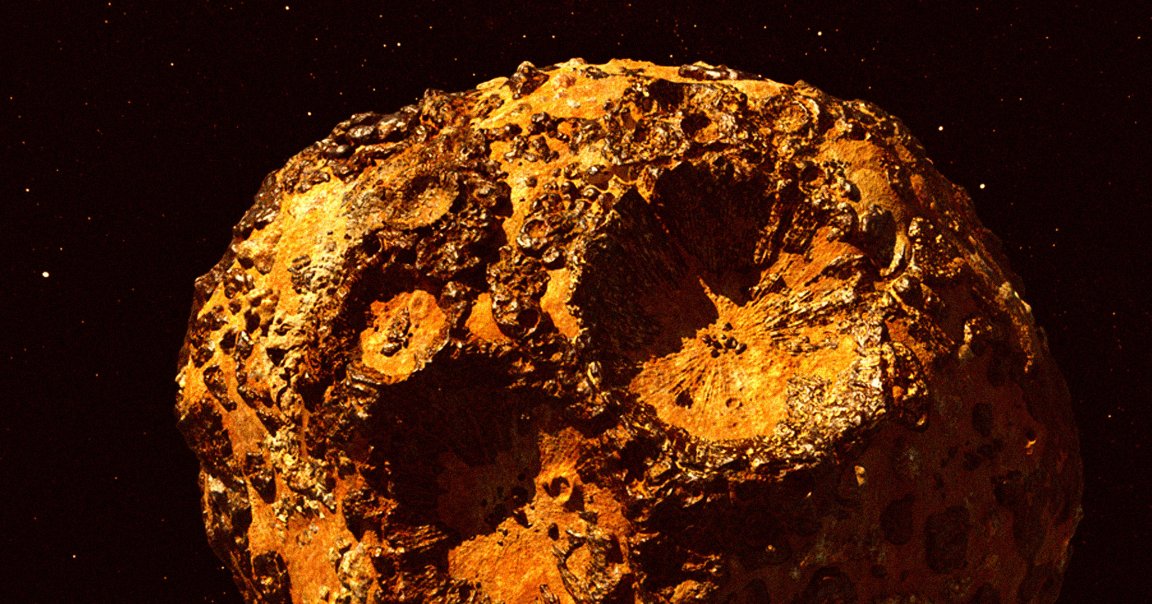
Scientists have long been intrigued by an enormous potato-shaped asteroid, dubbed 16 Psyche, that they suspect to be teeming with metal — and therefore potentially worth a ludicrous amount of money to future asteroid mining operations.
The 173-mile object, which orbits the Sun in the asteroid belt between Mars and Jupiter, features two enormous crater-like depressions, which researchers say could be closely related to its still largely unknown origin story.
In a new paper published in the journal JGR Planets, an international team of researchers tried to get to the bottom of one of the key questions regarding 16 Psyche that remains unanswered. Is it a core of a planetesimal, a billions-of-years-old building block of a planet, in which case it would have a “large metallic core buried under rocks,” or is it a “homogeneous mixture of iron and rock?”
Put differently, could 16 Psyche be the ancient exposed remains of a planetary core whose crust and mantle were blown off, or is it a separate primordial lump of far less dense and potentially riddled-with-holes rock that either started out metal-rich or became blended with metal after colliding with other asteroids?
While the latest paper doesn’t necessarily exclude any of these possibilities — its simulations support both hypotheses — the goal was to know what to look out for once NASA’s mission to the space rock, which launched in October 2023, arrives roughly three and a half years from now.
Once there, the spacecraft could finally allow us to solve the mystery surrounding 16 Psyche’s history once and for all. As Universe Today points out, 16 Psyche’s size makes it far more approachable than the thousands of miles we’d have to drill into the Earth. (So far, we’ve only made it around 0.2 percent of the way to our own planet’s center.)
For their paper, the researchers took into consideration 16 Psyche’s unusual dented shape, previous findings that concluded it may be teeming with metal material, and its porosity.
“Large impact basins or craters excavate deep into the asteroid, which gives clues about what its interior is made of,” said first author and University of Arizona doctoral candidate Namya Baijal in a statement. “By simulating the formation of one of its largest craters, we were able to make testable predictions for Psyche’s overall composition when the spacecraft arrives.”
“One of our main findings was that the porosity — the amount of empty space inside the asteroid — plays a significant role in how these craters form,” she added. “Porosity is often ignored because it’s difficult to include in models, but our simulations show it can strongly affect the impact process and shape of craters left behind.”
A more porous asteroid would theoretically feature deeper and steeper-sided craters on its surface. The researchers are hoping that close-up observations by NASA’s Psyche mission could allow them to determine its porosity and therefore infer if its interior is metal clad in rock, or a more homogenous mix of both.
To explain their line of thinking, the researchers used the unusual metaphor of an abandoned pizza parlor.
“The cooks have long left, but you can look at what’s left behind — the ovens, scraps of dough, the toppings — and make inferences about how the pizzas were made,” said coauthor and University of Arizona’s Lunar and Planetary Laboratory professor Erik Asphaug in a statement. “We can’t get to the cores of Earth or Mars or Venus, but maybe we can get to the core of an early asteroid.”
The team came up with two possible interior structures.
“One is a layered structure with a metallic core and a thin, rocky mantle, which likely formed if a violent collision stripped away the outer layers,” Baijal explained. “The other is a uniform mixture of metal and silicate, created by a more catastrophic impact that mixed everything together, like some metal-rich meteorites found on Earth.”
By simulating a series of asteroid belt collisions with objects of varying sizes, they tried to reproduce the known dimensions of 16 Psyche’s craters.
“We found that an impactor about three miles across would create a crater of the right dimensions,” Baijal said. “The crater’s formation is consistent with both scenarios of Psyche’s makeup.”
In short, while we’re only inching closer to answering the question of whether 16 Psyche is the ancient remains of a planetary core, we’ll be ready when NASA’s mission gets there.
“When the spacecraft arrives at Psyche in a few years, the geochemists, geologists and modelers on the team will all be looking at the same object and trying to interpret what we see,” said Asphaug.
Beste bezoeker, Heb je zelf al ooit een vreemde waarneming gedaan, laat dit dan even weten via email aan Frederick Delaere opwww.ufomeldpunt.be. Deze onderzoekers behandelen jouw melding in volledige anonimiteit en met alle respect voor jouw privacy. Ze zijn kritisch, objectief maar open minded aangelegd en zullen jou steeds een verklaring geven voor jouw waarneming! DUS AARZEL NIET, ALS JE EEN ANTWOORD OP JOUW VRAGEN WENST, CONTACTEER FREDERICK. BIJ VOORBAAT DANK...
Druk op onderstaande knop om je bestand , jouw artikel naar mij te verzenden. INDIEN HET DE MOEITE WAARD IS, PLAATS IK HET OP DE BLOG ONDER DIVERSEN MET JOUW NAAM...
Druk op onderstaande knop om een berichtje achter te laten in mijn gastenboek
Alvast bedankt voor al jouw bezoekjes en jouw reacties. Nog een prettige dag verder!!!
Over mijzelf
Ik ben Pieter, en gebruik soms ook wel de schuilnaam Peter2011.
Ik ben een man en woon in Linter (België) en mijn beroep is Ik ben op rust..
Ik ben geboren op 18/10/1950 en ben nu dus 75 jaar jong.
Mijn hobby's zijn: Ufologie en andere esoterische onderwerpen.
Op deze blog vind je onder artikels, werk van mezelf. Mijn dank gaat ook naar André, Ingrid, Oliver, Paul, Vincent, Georges Filer en MUFON voor de bijdragen voor de verschillende categorieën...
Veel leesplezier en geef je mening over deze blog.